
Episode 770 ·
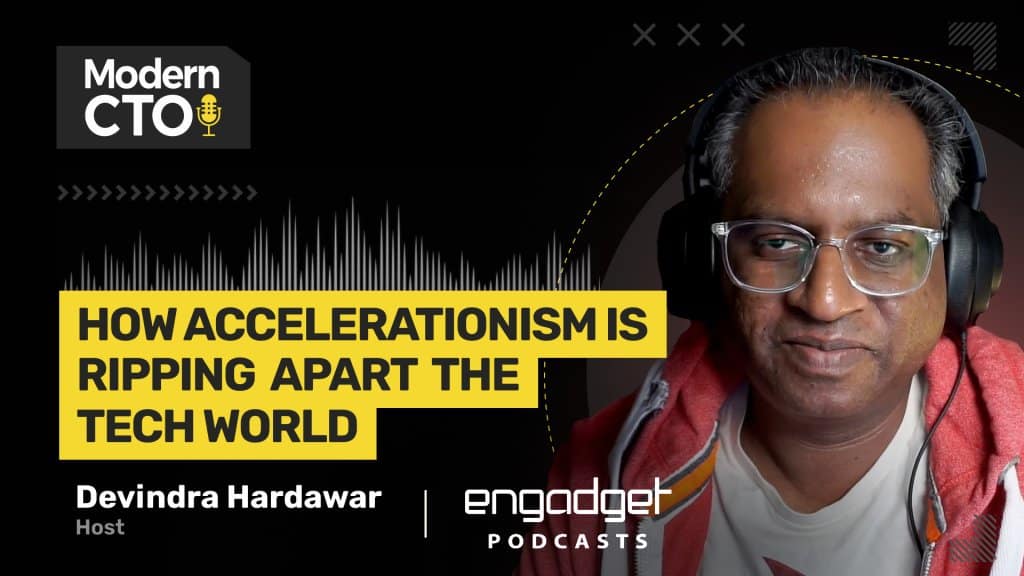
How Accelerationism is Ripping Apart The Tech World with Devindra Hardawar, Host of The Engadget Podcast
Today we’re talking to Devindra Hardawar, Host of The Engadget Podcast. Devindra dives deep into the transformative forces of radical innovation within the tech industry, exploring both its monumental promises and the ethical quandaries it presents. From the heart of Silicon Valley to the broader societal impacts, we critically examine how technology's rapid evolution is reshaping our world.
All of this right here, right now, on the Modern CTO Podcast!
To learn more about Engadget, check out their website here.
To listen to The Engadget Podcast, check out their website here or wherever you get your podcasts.
Have feedback about the show? Let us know here.
Produced by ProSeries Media.
For booking inquiries, email [email protected]
About Devindra Hardawar
I'm a technology journalist aiming to explain the latest products and trends for audiences of all types -- from neophytes to experts. Currently, I'm focused on reviews, analysis, and New York City's burgeoning tech scene. Aside from writing about tech, I've also spent eight years working in desktop computing support, which helped me realize the importance of breaking complex tech topics down for everyone.
To quote Tron: "I fight for the users."
I'm also a part-time film critic and co-host on one of the longest running movie podcasts online, the /Filmcast. When I'm not diving into the latest gadgets, I'm probably at the movies or bingewatching something on Netflix.
About Engadget
Technology isn't just about gadgets. It's the car with no driver, printing human organs and leisurely flights into space. It's the future and we're here to tell you all about it.
Our web, mobile, and Flipboard presence reaches over 20 million unique readers per month. We are the Official Online News Source for CES, the world's largest trade show for consumer electronics held each year in Las Vegas in January, as well as the proud home of the 2014 Best of CES Awards.
Transcript
(Intro Narrator at 00:00:00) Today, we're talking to Devindra Hardawar, host of the Engadget podcast, about how effective accelerationism is changing the world of tech and more. You're listening to Joel Beasley, Modern CTO.
(Joel Beasley at 00:00:19) I am very excited. So there was a lot of ground to cover. I read through the prep and the notes and all of that, but there was one thing I had never heard of before. And so I did some research on it, and it blew my mind. Mind blown.
(Devindra Hardawar at 00:00:33) Uh-huh.
(Joel Beasley at 00:00:34) And that's accelerationism. How do you say this word?
(Devindra Hardawar at 00:00:37) It's effective accelerationism, which is, if you see on Twitter, people have e/acc on their accounts, which is becoming more of a thing among the tech crowd, especially the Elon Musk followers. It's a thing that a lot of people think where, you know, the changes we're doing now will make humanity better, will be good for humanity. Pumping everything into technology will be good for humanity hundreds, thousands of years into the future or something. Technology is the solution to all of humanity's problems, and I find it's a crock of crap, but that's just me.
(Joel Beasley at 00:01:14) The interesting thing to me is, you know how you go about life sometimes and there's these patterns that you see, but you haven't necessarily identified them and verbalized them, but the moment someone slaps a word on it, you go, "Oh, I know that's true."
(Devindra Hardawar at 00:01:28) Yeah. You know these people. You know people who think like this. Yeah.
(Joel Beasley at 00:01:31) Yeah. But the thing that I thought was beautiful is that it happens in the far left wing, and it happens in the far right wing. And it's like they're both—they wouldn't agree with each other, but they're working towards the same outcome. Right?
(Devindra Hardawar at 00:01:45) Well, see, I mean, I don't—I mean, one, if we're gonna bring up that whole idea, I think at the very least the far left is trying to maybe militantly, you know, make the world a fairer place, and that's not what the far right is doing. So...
(Joel Beasley at 00:02:00) And so, this acceleration—can you say the word again for me? I don't know why I'm having—
(Devindra Hardawar at 00:02:04) Effective accelerationism. I mean, it's e/acc. E/acc is what people say often. It's the pro-technology stance that Sam Altman and a lot of those people are really backing. And I don't know. People listening to a podcast like this one may align with that. I imagine a lot of CTOs at companies may think along these lines too.
(Joel Beasley at 00:02:26) So maybe it was just the Wikipedia definition of what I had read. But what it seemed like was these e/acc people—we can call them that, I guess—these e/acc people, they exist across the political spectrum, but their common thing that they have is technology. Is that accurate or no?
(Devindra Hardawar at 00:02:43) I mean, as much as the technology world, there's a spectrum of politics there. I think I've covered Silicon Valley, and I've been interested in tech forever my entire life. But since I've been covering Silicon Valley and startups and stuff, and that started in 2009, 2010, what I've noticed is a weird, weird strain of libertarianism among tech leaders, and that's really, I think, the motivating force behind certainly billionaires, certainly people like Elon Musk and his whole cadre of people, people like Sam Altman. Libertarianism is the guiding philosophy of Silicon Valley because it sounds great. Right? It sounds great to them because they're rich. Right? They have made it. They have made certain things possible. Therefore, they should have more say about how the world works, and they don't want to pay taxes. That's also a big thing.
(Joel Beasley at 00:03:37) Yeah. This is interesting. And so you've been—are you in Silicon Valley, or are you in Georgia?
(Devindra Hardawar at 00:03:44) I'm outside of Atlanta. I used to be in New York, and one of the things that kept me in New York was every time I went to San Francisco and have conversations with people, it would always be really weird. It would always be weird how everyone kind of thought the same when it came to the rise of startups, especially around 2010 before Instagram was purchased, you know, before Instagram even existed. There was always a hype cycle that the tech industry would kind of jump on and pump up. And when I would go back home to New York, people think in many different ways, even people within the tech world there. And I think I realized is that San Francisco, and this is not a knock against Silicon Valley, but it is kind of a one-industry town, a one-industry universe. So everyone kind of talks the same and speaks the same, and I go back to New York where there's a lot of stuff happening. Yeah. There's more than just tech. And you hear different perspectives, and I think that's pretty important. So that's kind of what kept me in New York too, even while covering tech.
(Joel Beasley at 00:04:43) And so you've been covering tech for a while. This has been an entire career. Can you just walk me through the 30-second credentialed overview?
(Devindra Hardawar at 00:04:50) Thirty-second credentialed overview is I always left technology—I remember the moment when I was five years old and I first laid hands on a Nintendo Entertainment System, and I think I just cried with joy. I wanted this to be a part of my life forever. I grew up on technology in the mid-'90s. My family, we had a PC. We had dial-up internet. I was living on the internet for ages. I grew up watching stuff like TechTV and ZDTV, and this is probably beyond younger viewers, but Leo Laporte, who now runs the TWiT podcast network, was a presence there. So I grew up watching him and his colleagues, and the wildest thing of my career now is I can be on a podcast with Leo Laporte. You know? I can have conversations with these people I grew up admiring. So that was my lens into the tech world, and I was fascinated by it. In high school, I worked at OfficeMax, which was a thing that existed. I sold electronics there, and I gave people tech advice. And in college, I worked in IT throughout college and even after college. So clearly, my thing was about being really into technology, but also deconstructing it and communicating it to people. So that is my—that's been my mission with tech journalism, basically. And post-IT, post-college, I moved to New York and just worked my damnedest to freelance about technology writing and, you know, eventually land a full-time spot somewhere.
(Joel Beasley at 00:06:12) Oh, nice. And how did you meet the TWiT guys?
(Devindra Hardawar at 00:06:15) I met the TWiT guy—I mean, I think at some point, I was just invited to be on TWiT because they reach out to tech journalists. So they often reach out for their daily news shows. And I think at some point in the early 2010s, you know, they reached out to me to do something on the podcast. But I've also been a movie blogger and a movie podcaster since 2008. So we've been doing that forever, and I've been in the podcasting world forever too. So, you know, we're all kind of talking to each other too.
(Joel Beasley at 00:06:43) Oh, nice. Yeah. A movie podcast? Tell me about this.
(Devindra Hardawar at 00:06:46) Yes. We started a movie podcast—me and my co-host, David Chen. We started in 2008. We moved over to slashfilm.com, which is a movie news website. They kind of basically picked us up to do their official podcast, the /Filmcast, and we have now—we've kind of rebooted. We're now just The Filmcast podcast at thefilmcast.com. But essentially, we've been doing movie reviews since 2008. Every week, every single week with no major breaks in between. We've been running strong since then.
(Joel Beasley at 00:07:17) Do you do all genres?
(Devindra Hardawar at 00:07:19) We do all genres. Yep.
(Joel Beasley at 00:07:21) That's awesome. I'm a big movie guy.
(Devindra Hardawar at 00:07:23) Oh, okay. Okay. We can talk movies.
(Joel Beasley at 00:07:26) These are tech leaders trying to grow in their career and figure out what's going on. You know—
(Devindra Hardawar at 00:07:29) You know one thing tech leaders need to do is freaking go engage in art. Read a book, watch a movie, do something that makes you think because the most boring conversations I have in the tech world are just engineers who have just been sitting, coding all day and don't have knowledge of the world or art or anything outside of their sphere of tech. So good God, the tech world needs liberal arts culture. I went to a liberal arts college, so having that well-rounded education was certainly helpful. Yeah.
(Joel Beasley at 00:08:02) So what are you seeing right now? What's—what's the hot thing everyone's—I know your stories, they move pretty fast, don't they? The Engadget stories.
(Devindra Hardawar at 00:08:09) I'm always going from review to review. That's kind of just the way things are at Engadget. Sometimes things slow down. But right now, I mean, what's hot? What's hot are the AI PCs that companies tend to be hyping up right now. Intel and AMD both have new chips with AI processors in them, NPUs. And there is a lot of talk about how those things will make computing better and more interesting, so that's the story I'm following. We're gearing up for Microsoft's new Surface device announcement in a couple of weeks, and they're likely going to have NPUs. So I'm really interested in seeing how Windows is going to take advantage of that. That's also been a thing on the Mac side for a while too. So, you know, Apple has had NPUs in the iPhones and the mobile chips forever. So they've also been doing this work. AI is certainly the big hotness, but I think the whole idea of an AI PC and seeing how developers can soup up certain functions within their programs just using an NPU, that's gonna be really interesting. That's just a different way to think of our computers. Foldable tech is still a thing we're following. I'm really interested in seeing how Apple is thinking of that idea because so far, I have not been really sold on foldable smartphones and stuff. They are really cool parlor tricks. They're not really cool things that effectively change the way these things work in our lives and make our lives better. What else am I following? I mean, I'm following what is happening with electric cars and EVs and how they're kind of working their way into our culture. Since I moved to Atlanta, I've had more room to do car coverage, and that's been fascinating. Although I've also learned that EVs aren't the savior for everything. We need whole-scale transportation—you know, public transportation—thinking going on in this country too. There's a lot of stuff. But I think EVs, the AI stuff—those are at least what we're following and what I'm paying attention to. So the news is never really slowing down. We're also following, you know, the increasing regulation against tech across the country and certainly across the world too. And I think that's an important thing because I've also covered the rise, the unchecked rise of startups and technology giants, throughout the 2010s. And, you know, we probably could have stepped up a little more as Facebook dominated the social space and as their business practices directly, you know, hurt news organizations and things like that and hurt our—honestly, our cultural dialogue too. So, yeah, there's a lot just to be looking at when it comes to tech now. There's a severe tech backlash, but a lot of that seems warranted, unfortunately.
(Joel Beasley at 00:10:41) And then, Josh, if you're there, can you find that girl that their PR firm reached out yesterday? She was talking a lot to your point of the unchecked rise of the technology companies. And so when you see this increase in regulation, have you looked at the source of where this is coming from? Like, who's standing up and saying we need to—oh, Techno-Capitalism, The Rise of the New Robber Barons and the Fight for the Common Good. Have you heard of this girl before? What's her name, Josh?
(Devindra Hardawar at 00:11:07) I have not heard of this author, but this is a common idea right now, and we're seeing it because tech has taken over the world. I do remember the days when Apple was on the ropes and they felt like they were almost gonna go out of business. Right? Now Apple's one of the biggest companies in the world. So, yeah, the role of tech has gone far from being just a bunch of nerds who were kind of working in the Wild West, and now the nerds have taken over the world. So, yeah, that's essentially it. I think the source of this is mainly a lot of public pushback, a lot of media pushback, and researchers and academia. People have been speaking up against the tech world for a long time, but it's been tough. It's been tough to get very oppositional coverage. There's all sorts of reasons for it. But I think one example is I appreciated Kara Swisher, you know, the reporter, and a lot of her work. It is really weird to see her going around doing a press tour for her book now, being interviewed by a lot of these tech bigwigs, by Sam Altman and people—essentially people that she's supposed to be covering, you know, vigorously. And I don't know.
(Joel Beasley at 00:12:19) That's the problem with Washington. You know, I like the idea of breaking it up geographically. Because what happens is any group of people, even if they're representing two different sides, if they're all cohabitating together socially, then there's gonna be these weird things that emerge between them that are not in the greater good of the people they're representing. In any sense—
(Devindra Hardawar at 00:12:39) There's good and bad to it. Right? There's good and bad to being close to somebody who's ideologically opposed to you, to sit down and have a meal with them. I think that is a key thing. But, yeah, it's especially—where we are right now with Sam Altman trying to raise trillions of dollars to power his—wow. Trillions to power his, the vision of OpenAI or whatever else he has working on. I think we have to be a lot more confrontational with these folks and not super friendly with them because it is scary. It is scary what they're doing with the money that they're building, the stuff he's doing with the Worldcoin eye-scanning thing. I don't know about this. That's the eye-scanning orb that's been—that they've been trying to pitch around the world, and they've been paying people to essentially—they've been paying people to scan their irises because they're building this database of retina biometric scanning. I believe it's called Worldcoin.
(Joel Beasley at 00:13:30) Oh my goodness. Yeah. Why are they doing this?
(Devindra Hardawar at 00:13:35) There's a lot of reasons to it, but I think it's about—the idea I've read is that he wants to create a database or a way to authenticate identities online because as AI becomes more of a thing, it's gonna be easy to, you know, make up people, to deepfake somebody's identity, to pretend you're somebody else. So that's the pitch, but they're also—we don't know. We don't know what he's gonna be doing with this. But it's also backed with a ton of money, and they're doing things like going all over the world and paying, you know, people in poor communities just a couple bucks to scan their irises.
(Joel Beasley at 00:14:12) They're just trying to get a huge database of irises.
(Devindra Hardawar at 00:14:14) They're getting a huge database, and they don't know where it's going to lead. And that sort of feels like the OpenAI thing, which ostensibly was, hey, we're going to build this AI company that's going to build towards generative AI and build towards AGI, the dream of perfect AI. They want to do that so that Google and other companies don't do it first. But then it just turned out, once OpenAI was built up enough, Sam Altman had no problem spinning off a division of that company to be a thing that was licensing, getting money from Microsoft to basically bring all the AI stuff to Microsoft. And Microsoft is very much steering the ship for a lot of OpenAI.
(Joel Beasley at 00:14:55) Why don't we just all get RFID tagged? Just chip us up.
(Devindra Hardawar at 00:14:59) That's what they'd love. That's what they'd love.
(Joel Beasley at 00:15:02) Have you gotten your hands on the Apple Vision Pro?
(Devindra Hardawar at 00:15:05) I have. I had it for a couple weeks. I reviewed it. It's over at engadget.com. I did have a video review and a written review. It's a fascinating project. It's a fascinating device that feels too early and a really unique thing for Apple to put out there, but I'm intrigued by it. It's just not something anybody really should be buying at this point. Really?
(Joel Beasley at 00:15:23) I have not put my hands on it. Did you get to keep it?
(Devindra Hardawar at 00:15:25) I returned the one that we had for review because I had to just buy it. Apple was not nice to us and didn't give us a review unit.
(Joel Beasley at 00:15:32) Engadget? Apple didn't give you? You guys are a household name.
(Devindra Hardawar at 00:15:36) I mean, we're a name. I don't know about household name.
(Joel Beasley at 00:15:38) I don't know that many, and I know you guys. So—
(Devindra Hardawar at 00:15:41) I've had conversations with Apple afterwards, and we've gotten a test unit to hold on to. So I have something to keep testing with at this point. Yeah, didn't help out for the whole review unit thing.
(Joel Beasley at 00:15:50) I mean, most people, when you go about in life and you talk to people that are in tech, they know what Engadget is, right?
(Devindra Hardawar at 00:15:55) I hope so. But listen, I've been in media long enough to know that most people don't pay attention to media. It's mainly the PR people and some executives, but most people don't pay attention to our coverage unless our review has annoyed somebody at the company. Yeah, when you piss somebody off, then they pay attention.
(Joel Beasley at 00:16:15) Yes, yes. So you think Apple—so you would not recommend me buying an Apple Vision Pro?
(Devindra Hardawar at 00:16:19) I mean, it depends on what you're using it for, but it is a test product out here mainly for developers and for Apple fanatics who have way too much money. So if you count yourself in one of those buckets, maybe it would be useful for you. But it is a buggy thing. There's a lot of hardware and software that they're still trying to get right, but it does have some of the best screens I've ever seen on a device. It is really fascinating to see where Apple is going for this idea of spatial computing. But yeah, this product is going to eventually get cheaper, but this whole process will take years for Apple. This is a very, very early product, and it's also a rare thing to see from a company like Apple, which usually plays it pretty safe when introducing new products. So I just find it fascinating. I'm endlessly fascinated by this thing.
(Joel Beasley at 00:17:04) I think there will be a lot of use in the B2B type world. When Microsoft's one came out, I saw, what was it, Trimble? They're one of the largest companies when it comes to everything, building skyscrapers and all this. And they were using it to visualize the piping in the system, so they'd give it to their construction workers to do reviews.
(Intro Narrator at 00:17:25) And I was like, that's actually—
(Joel Beasley at 00:17:26) A really good use case because it's a temporary use. You put it on for a specific task. It gives you some unique ability that you don't have as well in another fashion, and it looked really effective.
(Devindra Hardawar at 00:17:36) Yeah. I mean, that's what Microsoft did with HoloLens for years. Magic Leap, as much as it failed, was trying to—they're all trying to target businesses because for normal people, this tech was just not there. The actual viewing window for a HoloLens was really, really narrow. It was like looking through a very, very tiny window slit, even though you could see the whole world beyond the goggles too. What Apple is doing is trying to be like, hey, can we bring full-on computing for everybody to goggles like this? And that's why I think it's a far more ambitious goal. I think it's pretty—I respect what they're doing with it. It's just it takes a lot of money. It takes a lot of hardware to get those—it's basically expensive to build something with displays like that, with the amount of computing power that has, with the power to recognize your finger gestures and eye tracking and all that stuff. It costs a lot of money. So Apple's sort of building a road to the future, but it's sort of like the first Macintosh, which a lot of people forget was obscenely expensive even at the time compared to other computer products. So this is the first thing, and it may lead to more things if Apple can actually make it cheaper. It is kind of fascinating, though.
(Joel Beasley at 00:18:48) How many hours did you wear it?
(Devindra Hardawar at 00:18:51) I don't know. I think at least 24 to 48 hours worth. I basically had to review it within a week, so I had it on as much as I could to do testing, writing. It has a really cool feature where if you're near a Mac, you can explode the Mac's screen into a virtual Vision Pro window, and that's a super cool way to work. So I did a lot of writing like that too. I wore it as much as I could, and it is—it's a little painful. It's a little heavy. It's not a thing you want to wear for super long, but that is kind of Apple's idea eventually. They want it to be a thing where maybe during your workday, you have it on for a couple hours to take your meetings, do some research with a huge virtual display in front of you. There are really interesting ideas here, but even the first iPhone, Apple had no real clue about a lot of aspects of the iPhone early on. There was no App Store. There was no built-in 3G. A lot of the things that make the iPhone the iPhone were not there in the first model. So it took the company time to kind of get there.
(Joel Beasley at 00:19:52) And you're a glasses wearer full-time, correct?
(Devindra Hardawar at 00:19:56) I am.
(Joel Beasley at 00:19:57) Yeah. So you're used to having something on your face.
(Devindra Hardawar at 00:19:59) I am. But I wear specifically plastic frames. I've tried metal glasses frames before, but they start to dig into my nose a little bit. I don't mind glasses. I don't want LASIK. I don't want to wear contacts. I love wearing glasses just fine. But the Vision Pro, because it is a huge bulky thing with giant screens on it and tons of hardware, it is heavy. It's big. Even with the dual strap band that kind of goes over your head to kind of balance out the weight, I don't think anybody will want to wear a device like that for too long, and that is the biggest problem. But Apple needs to release this thing to eventually release something like the XReal glasses, which look like sunglasses, but can have their own built-in display.
(Joel Beasley at 00:20:37) Yeah. Until it gets to the point—for me and my personal preference, there's probably three ways. One, just to test it out just to see what it is for a few minutes. But to get me into long-term work, there would have to be something in there that I couldn't do another way or that had such an amplifying benefit of using that that I would go ahead and put it on. I'm not at the—
(Devindra Hardawar at 00:21:00) The Windows thing is kind of like that. If Apple sold a $1,000 headset that just—you sat down at your Mac and exploded your view into as many virtual windows as you want, I think people, Mac heads especially, would totally go for that because it is a fascinating way to work. I could be sitting out in my backyard with a little MacBook Air but have essentially a 200-inch window floating in front of me on my deck. That stuff is amazing.
(Joel Beasley at 00:21:27) Yeah. Yeah. Me, personally, I don't know. I haven't tried it yet. I will try it. But if it got to the point where it was like your glasses are today, and you put them on, I would probably be really comfortable with that because I don't mind—why—
(Devindra Hardawar at 00:21:39) I'm taking glasses. People don't—I think a lot of regular folks just don't want to wear glasses. That's the entire LASIK industry—is people who just don't want to wear glasses anymore, no matter how light or easy they are. I do wonder if Apple's building the building blocks to get to a world where a lot of these interfaces could be in holographic technology. You know? So if you had a little module on your desk that could spit out a virtual window to you where you didn't even need glasses to see it, that could be interesting. I could see how it's building towards that future, but that is 10, 15 years down the line.
(Joel Beasley at 00:22:14) Yeah, yeah. Have you seen the transparent LEDs?
(Devindra Hardawar at 00:22:16) I did. I didn't see them in person, but we did cover them, some of the ones that launched recently. And they look really cool, but it's also the use case is really bad because somebody on the other side sees your screen. It is a cool thing. It looks cool, but functionally, it seems like the light bleed is really bad on those backlights. There's just a lot of functional problems. It's sort of like folding phones. Why are you doing this? So you can say you have a folding phone, or are you actually making my life better?
(Joel Beasley at 00:22:47) Hey, Apple Car. That was this big rumor that existed forever. You released an episode on it, I think, about—on March 1st. Yeah. RIP Apple Car. What do we know about the Apple Car? Is it dead? Was it a thing? Tell me about it.
(Devindra Hardawar at 00:23:02) I mean, I can only tell you what Mark Gurman over at Bloomberg has reported on. He is a longtime Apple rumor hound. We even had him on the show a couple months ago, I think. But basically, he's reported that Apple has been working on something called Project Titan for about a decade now. The idea was to create a next-generation car that had no steering wheel, that was fully self-driving. This was when the kind of buzzword of self-driving started bubbling up in Silicon Valley too. So there's a lot of Apple hubris here to think we can do this thing we've never done before, enter a totally new field, and do it better than everybody else. And according to Gurman's reporting, it sounds like there were divisions in the company between, like, should we just make a car? Let's make an Apple EV to prove we can do it and kind of get our basic ideas out there. And it also sounds like a lot of designers, and potentially spearheaded by Jony Ive at the time, were like, no, no, no, the Apple way is to do it completely different and to break conventions and whatnot. And it seems like that just ended up being a boondoggle. Tens of billions of dollars wasted trying to develop that because, essentially, self-driving, which is a really cool technology in theory, but so far, no company has really perfected it. Google has also spent billions on it with Waymo. A lot of companies have invested a lot of time in this, and the technology just isn't quite there yet. As much as Tesla has been pushing self-driving and full self-driving in their cars, it's a crock of crap. It's not real. It's kind of wild that even people who buy Teslas now—there is still a $6,000 accessory. You could buy the full self-driving addition to your car, but it doesn't actually enable anything. All you get is a basic, more assisted driving right now, which Teslas have. Self-driving just takes a lot of computing power, a lot of algorithm work that we have not perfected. So that's been the big problem. So it's basically been impossible for Apple to even produce a prototype or something that could actually be on public streets. Whereas you look at the Vision Pro, which I think is a wild swing, and I think according to a lot of theories is something that also kicked off probably a decade ago too. But it's more of an idea of, okay, what's the next step of computing? Should we wait until we have the perfect glasses, or should we ship something that we have now that people can start working on and thinking about? And I think the thinking there was, let's just get this thing out here. Let's get this thing out here so developers can start wrapping their heads around the idea of spatial computing. And the Apple Car just never quite got there. And also Apple has CarPlay, which is the software that they're pushing to a lot of car manufacturers. I think for a lot of people, CarPlay is enough. You know? CarPlay mirrors your phone really well, gives you access to the computer apps. It's great. I would not buy a car without CarPlay, and that is something Apple is investing more in now. I do think it's kind of sad that this whole idea of the Apple Car died. My theory was that it just ended up being kind of redundant because I think Tesla essentially did everything Apple would do in the car industry when it comes to a straight-up EV—doing something transformative, selling it in a different way, bringing in all sorts of new features that existing models didn't have. Tesla did the Apple car, basically. And according to Gurman's reporting, it seems like Apple is trying to build something sort of like the VW minibus. You know, the thing that can carry six people that had no steering wheel.
(Joel Beasley at 00:26:27) No, they need to go teleportation. If you're going to—I mean, if you're going to try to look at Tesla and the EV market and say, we need to do something that's significantly different than those to make an impact, you're going to have to go teleportation.
(Devindra Hardawar at 00:26:39) I mean, yeah, defy the laws of physics. That's super—yeah, we could just do that. I feel like Apple is the sort of company that would sort—and it sort of be like, well, maybe. I know. We do have a lot of money in the bank. But, no, the idea of easy transportation—I love the idea of self-driving because human drivers are notoriously unreliable and, you know, the cause of so many accidents. But there is a lot of thinking now in the transportation field that just delivering cars with more sensor-enabled safety features is doing a lot and also working on how we work on safety issues around roads, like making sure roads are—people aren't going too fast, making sure there are adequate signposts to warn people of speed changes ahead or something. A lot of that is the design of how we've designed roads in this country too. So there's a lot of work we have to do. Self-driving won't solve everything, but I do dream of the day when, eventually, I can have an EV that will fully drive itself. Right now, I have a pretty good car that can do basic driving on its own, and that even that alone is a bit of a lifesaver.
(Joel Beasley at 00:27:46) So I want to understand your official position on self-driving. Do you believe that there are no self-driving cars out there today?
(Devindra Hardawar at 00:27:53) No. I mean, no. There are self-driving cars out there, but you can't ship it to everything. You know? Like, Waymo has, I believe, taxis out there in certain cities.
(Joel Beasley at 00:28:02) Phoenix.
(Devindra Hardawar at 00:28:03) Yeah, we also see how these things were deployed in San Francisco and elsewhere without full approval from city officials and have done things like wreak havoc with traffic and get in the way of ambulances. And that's not what you want to see. You don't want to have this testing be done in public. And it does remind us of what a lot of tech companies have done just in public spaces since the freaking electric scooter companies dropped, like Lime and a whole bunch of others. They're like, "Oh yeah, cool. This is a cool thing. People will use these things, rent them," except they didn't care at all about infrastructure. So you go to Austin, you go to a lot of other cities where these things are deployed, and it's just like trash littering the streets of people just dumping these things because they don't need to care about where they park it or whatever. And cities didn't have time to work on anything to kind of support them either, because they did not work together with the city.
(Devindra Hardawar at 00:28:54) So when I was in New York, I think one thing I really appreciated was a lot of our city government was like, "No, we are not. No. You are not bringing this thing into the city if you don't actually have an infrastructure idea or places to charge them or something." In New York, even Uber and Lyft, there was a whole fight about getting those things into the cities. Uber and Lyft drivers are people with taxi medallions and people in the taxi industry. Normal people cannot go drive for Uber and Lyft in New York. And I think, I don't know, I'd argue New York was better for it, because my experiences with normal drivers elsewhere was not great.
(Joel Beasley at 00:29:31) I want to touch on this e/acc thing again. You think it's a little bit dumb. Can you explain just briefly again what it is and why it's dumb?
(Devindra Hardawar at 00:29:41) Oh, I think it's a lot of bit dumb.
(Joel Beasley at 00:29:43) A lot of bit dumb.
(Devindra Hardawar at 00:29:44) Not just a little bit. But no, it is. I think what I've realized is a lot of people, especially as they get rich and as they become embedded in the world of Silicon Valley, they do think that tech can fix everything. And that leads to things where people are like, "Yeah, we're just going to pump all this money into AI because eventually AGI, artificial general intelligence, which is sort of the idea of the perfect artificial intelligence, will solve so many of our problems, and it'll help fix climate change and all these things." And the reason I call bullshit on that is because even right now, we are burning tons of fossil fuels even to run the hardware necessary for a lot of these AI services. So a lot of it is basically, it feels like an excuse to invest in tech but not really invest in people.
(Devindra Hardawar at 00:30:31) You know, I've talked with people who are all about bringing tech everywhere, but when I bring up things like, "Hey, we also have a hunger issue to solve in this country. We have health care needs to take care of." The tech isn't necessarily helping with that stuff, and people just aren't really looking at that. So it's a whole thing. I don't want to go on a huge rant here, but I do think anybody who's leaning on the idea of effective altruism or effective accelerationism—and effective altruism is another way of thinking of that—I can't take them seriously philosophically. That is not a really useful worldview, I'd say.
(Joel Beasley at 00:31:07) So we really need people that are competent with incentive alignment to be structuring systems that hit the right goals, because it seems a lot of the people have a mindset right now, just at humanity as a whole, that invest in the technology, you need less people, you make a ton of profit. But if everybody goes that path, then what are we as people? You know? AGI. Right? Do you think that that's a big risk for us?
(Devindra Hardawar at 00:31:41) I don't think it's a risk now. It's another one of those things where I also grew up reading a lot of technological thinkers, people like Michio Kaku, who I've loved. I've loved his earlier books. And who's the guy? The guy who's writing about the singularity. Ray Kurzweil. That was him for a while too. I definitely read all those books and was so fascinated by it. But looking at it now, that doesn't seem like the ultimate issue. You know? We don't know. We don't know if we'll even ever achieve something like AGI. But we do know right now is that as we're building towards AI, we have to look more closely at how these things are affecting people and how they're actually affecting users, and especially users who don't always get as much focus from the technology world. So those are things I'm more worried about. I'm more worried about AI being used as an excuse to sort of take jobs away from people right now.
(Devindra Hardawar at 00:32:39) Also worried about what things are being trained on and the sort of training data that is going into a lot of these generative AI solutions. If they are pulling information from the internet, a lot of them are also pulling racist and sexist and bigoted material, and we see that reflected in some of the AI chatbots that have come out. You know, what was the one from Microsoft? I forget the name.
(Joel Beasley at 00:33:00) Gemini? Where it shows?
(Devindra Hardawar at 00:33:01) Gemini, that's Google's. But Microsoft released one. Oh, Tay. Tay was their thing. And it did not take long before it just started becoming a little racist bot. Basically, a little racist bot that was not great. We don't control the gender of AI, you know. So a lot of these companies, when I talk to Microsoft and I say, "This thing is just giving me garbage or it's not giving me accurate information," their response is, "We're still learning. We're still learning how this all works out." And to me, that weird black box of AI is not the way computers should work. You know? If I hit a button, I should know exactly what's going to happen with my computer. And right now, we're kind of losing a lot of that control.
(Joel Beasley at 00:33:41) It's kind of like a virus where we don't know how it works, and we're just going to say, "Oh, let's just release it into the population."
(Devindra Hardawar at 00:33:46) Well, I don't know if virus is the correct idea, but it is the thing people are doing because I think of it sort of like crypto, you know, where the crypto people were really into it for a while. As a journalist, I was never fully convinced of it. But people kept promoting it because it made some people money. You know? It was a new speculative thing that you could make some money on. And because it made some people money, people thought it was a legitimate thing. And I was never fully sold on it, and most things fell apart. Bored Apes, a lot of the NFT stuff has completely fallen apart. The one thing that has come back is Bitcoin. Right? And that's only because the federal government gave recognition for that in some financial tool, so that feels like the thing that brought Bitcoin back at least.
(Joel Beasley at 00:34:41) Yeah. No, I'm a fan of the concept of blockchain-based currency.
(Devindra Hardawar at 00:34:46) Mmhmm.
(Joel Beasley at 00:34:47) I noticed that in the United States—
(Devindra Hardawar at 00:34:50) Let me ask, why are you a fan of that?
(Joel Beasley at 00:34:53) I'm a fan of it because I believe that it's the currency of the future. When we're an interplanetary species, I think we'll use some type of currency like that that's not directly controlled by a very specific government. Now there's pros and cons to that, and whether it's right or wrong is all separate. But I just, yes, why I think, yeah, why I'm a fan of it and why I believe it's the future is because it's a currency that's very difficult, if not impossible, to manipulate.
(Devindra Hardawar at 00:35:24) I mean, difficult to manipulate, sure. But the idea of getting tons of people to invest money in a thing, and decentralization isn't the full thing right now too, right? Because a lot of crypto are being, you're managing them on centralized systems. Right? People are going to different services to manage their wallets and everything. Right? And then when issues happen there—
(Joel Beasley at 00:35:40) The protocol. That affects everywhere. That affects everything.
(Devindra Hardawar at 00:35:49) Yeah.
(Joel Beasley at 00:35:50) Just like you storing your money in a bank. Yeah. But the protocol itself is decentralized.
(Devindra Hardawar at 00:35:54) Federally protected. If your crypto exchange fails, you're done. You're cooked.
(Joel Beasley at 00:36:00) Yeah. And they're protected by the government. But governments come and go historically.
(Devindra Hardawar at 00:36:06) I mean, I would rather, I would certainly rather bet on the long-term survivability of current governments over crypto. Because if the governments fall, your crypto is no good either. You're going to be trading in Mad Max currency of water and gas and whatever goods you have in your house. But you've got bigger problems if the government's fall.
(Joel Beasley at 00:36:27) 100% agree with you. Now to this point, I think a lot of the people in first world countries or specifically the United States see it as an investment and a way to make money. But a lot of other people in the world see it as a way to store their currency without government manipulation. So let's take third world type countries, you know, where they're basically running around, you know, and it's very—their citizens are very manipulated by the government. It's very, very diff—just a lot worse. Right? And they have their government currency. They can, they see this as freedom from the tyrannical government. So sure, while first world countries are seeing it like an investment, like a buy and it's worth more, the other countries see it as infrastructure, like Brazil is super bullish with Bitcoin. But other countries see it as a way to have freedom from the central banking system because their stuff's being manipulated by the larger players in the economy. And so when I see this, I was more and more surprised. Once I saw the ETF thing happened, I thought there's a really low possibility of this thing getting shut down as a whole.
(Joel Beasley at 00:37:45) Until the ETF thing happened, I was like, "Yeah, it could get shut down. They could probably get smart and figure out how to do this." But now I'm like, "Man, people are really into it." And there's a lot of money in politics and BlackRock's involved and all the ETFs now that are coming out with it. They're all putting money into it. And so, yeah, I do think it's the future, and you're exactly right. Now here's my Ledger Nano S. So if you have custody on a central system, you don't own that crypto. You own a right to it on that central system. If that central system is compromised, so are you. Your stuff's just gone. Now there's new companies coming out, like Unchained, which are offering really nice interfaces for custody, but they have it set up in a way that if they go down, your stuff doesn't get lost. And there's lots of cool tools and things out there. But yes. Yeah, I'm a fan.
(Devindra Hardawar at 00:38:43) Yeah. Yeah. It's, I feel like there are a lot of open questions here. I mean, Bitcoin came about as it essentially feels like a response to the 2008 banking crisis. You know? It feels like that's what it was directly a response to, and there are certainly cool ideas here. And the idea of the blockchain and something that is completely decentralized and tracking the information, totally great. I don't know if it's a thing to build an entire new financial system on. What do you think about El Salvador after going all in on Bitcoin, you know, recently?
(Joel Beasley at 00:39:14) I don't know. I just think that they see it, they're going to see it as freedom from the central banking system. Like, the idea that you and I—I mean, I'm assuming you have most of your wealth in USD. Correct?
(Devindra Hardawar at 00:39:25) Mmhmm.
(Joel Beasley at 00:39:25) And so do I. The idea that our government can just sign a bill like they did last week for nearly $500 billion of spending, of which you and I didn't have really any say—
(Devindra Hardawar at 00:39:38) Mmhmm.
(Joel Beasley at 00:39:38) As individuals, it was our elected representatives that we don't know that are making these decisions on our behalf. I don't like that in general. I don't like them being able, I don't like that happening. I like being a part of my financial decisions and things of that nature. I don't—and so let's take it as nonpolitical as possible. I don't like people spending the dollars and being able to print more money and then water down our labor and our value that we've stored in our savings. And are the crypto system, the blockchain-based currencies—I won't pick a specific one, I'll just say blockchain-based currencies in general—are they a solution to that? And the answer is yes, they are. The ones that are finite and fixed in total emissions.
(Devindra Hardawar at 00:40:27) I mean, from what I've read, and the reason why we haven't done a lot of crypto reporting too is because of the speculative nature of so much of this stuff is what's dangerous. People have lost a lot more money with crypto than they have with central banking methods at this point.
(Joel Beasley at 00:40:43) I don't know.
(Devindra Hardawar at 00:40:44) I don't know. I mean, I feel like that's at least a number you should be paying attention to if you're going all in on this stuff. But I do feel like that, to me, is kind of a big deal. But yeah, politically, if you don't want your actual money to be diluted, I guess, by government spending, I don't know if that's necessarily true. I don't know if that's the way I frame it. But yeah, forget the—
(Joel Beasley at 00:41:06) I mean, for, to take out government spending, they can just print. They can just print. Sure. They control the M2 money supply. So like—
(Devindra Hardawar at 00:41:16) Right.
(Joel Beasley at 00:41:16) They could just put more money into the economy. I mean, that's literally their function. It's one of the things that they're doing. I like the fact that there's a finite fixed supply. That's the concept I like. Whether that's gold, forget cryptocurrency, whether it's a gold standard or whatever it may be, I like that there's a fixed supply. I don't like that other people can make decisions that are going to be changing the currency drastically.
(Devindra Hardawar at 00:41:40) What is the downside of that to you? Like, what is the downside of printing more money and basically deflating the value to you?
(Joel Beasley at 00:41:49) Well, more money means my money's worth less.
(Devindra Hardawar at 00:41:53) I know. Yeah. I don't know if that's necessarily true. I'm also not an economist, so I'm not an expert on this.
(Joel Beasley at 00:41:59) Right. If there's more of the supply, it costs less.
(Devindra Hardawar at 00:42:05) Mmhmm. Mmhmm. Has that been true for crypto as more things are mined and, you know—
(Joel Beasley at 00:42:13) Yeah. Yeah. So if you look at the total number of Bitcoins that will be distributed as a whole, there's these halvenings every couple years, and so there's less and less Bitcoin. So there's, yeah, there's a lot to it.
(Joel Beasley at 00:42:28) As far as the distribution now, each coin is going to have its own distribution and emission mechanisms and rules. That's why I'm not picking a particular coin. And just so you know, as far as all in, I think money speaks. I've got less than 1% of my net worth into cryptocurrencies.
(Devendra Hardawar at 00:42:49) Mhmm.
(Joel Beasley at 00:42:50) I still think that they're gonna be the future long term. If you look at a hundred year scale, I think we're gonna come out of a specific country having the control of the monetary system, and we will go to more of a public utility mathematical function that can't be as messed with. I think that's the direction we're headed.
(Devendra Hardawar at 00:43:12) Gotcha. Gotcha.
(Joel Beasley at 00:43:12) Yeah. But I could be wrong. I mean, I could be wrong.
(Devendra Hardawar at 00:43:15) I mean, I feel like if you're all in, you should you'd have more money in it. Right? You'd have more of your total money in it, but I don't know. I think you're hedging your bets a little bit, which everybody is.
(Devendra Hardawar at 00:43:25) I'm wrong a lot about all these things. Yeah.
(Joel Beasley at 00:43:26) Yeah. I'm wrong a lot, but I still see and honestly, I tell my wife all the time. I've been pro this since Bitcoin was $200 a coin.
(Devendra Hardawar at 00:43:33) Mhmm.
(Joel Beasley at 00:43:34) And I'm like, you know, yeah, I think this is the future. I think this is what's going on. And there's been big ups and there's big downs, but I'm not focused on that. I'm focused on the principles of the underlying infrastructure and the purpose of it and what that means to other people in the world as they come online and become more technologically advanced. Because you start booting up new cities in Western Africa. Right? They start to get electricity. They start to get compute. They're gonna come online. You think a lot of them don't even have IDs and documentation.
(Joel Beasley at 00:44:10) They're not opening bank accounts. They're just gonna start using these cryptocurrencies that are available because there's banking infrastructure that they can use. And the same thing is true for artificial intelligent agents. I believe that there's gonna be a huge—I believe in the next five years, the number of AI agents are going to outnumber the human population.
(Devendra Hardawar at 00:44:27) Are you using any of the AI solutions right now?
(Joel Beasley at 00:44:32) Yes. Which ones? Specifically, we believe at the company, we save about $100,000 a year in personnel by using GPT-4.
(Devendra Hardawar at 00:44:40) But how are you using it?
(Joel Beasley at 00:44:42) We are using it very specifically for episode research, transcriptions. We manage our show and about 20 other shows for Fortune 500 companies.
(Devendra Hardawar at 00:44:53) Mhmm.
(Joel Beasley at 00:44:53) So we're more than just Modern CTO. We don't talk about it a lot, but yeah. So everything from prep, outreach, a lot of the writing task has replaced at least a person and a half from our staff. And then on top of that, on non-text generative stuff, the audio editing features and the identification of clips from the episode. So we don't have to have someone sit there and watch the whole episode and highlight the best parts. There's tools out there like Clap.app that will figure out what are the best clips based off of a number of things.
(Devendra Hardawar at 00:45:29) That's cool. That's cool. I mean, I totally like AI as a tool, which like any other, we use computers as tools to enhance what we already do and what we already know. I think that's a big thing. That's going to be the thing. But I look at Microsoft's investment to Copilot and OpenAI at this point as being a thing that they still don't really have a clue with. You know? They're saying Copilot is a really useful thing in Windows or in Office or whatever. But, man, it just feels like desperation right now.
(Joel Beasley at 00:45:58) It got weird when they started taking the Copilot name and tool and start trying to apply it to every—they're trying to make it clear.
(Devendra Hardawar at 00:46:04) They all have agents now. They all have the GPT agents. So that's their branding for it. And the idea of Copilot is, hey, this AI is not doing all the work for you. It is your assistant. Right? It is your copilot in this task, and I understand that whole thing. But, hey, I've been subscribing to Copilot Pro, which is their new thing, which has the latest GPT models, and it's faster, you know, has better image processing and stuff than the others. And it's just fine, but it does not feel like something Microsoft will be banking their entire future on, even though that seems like where it's going. So this is such a nascent field. You know? We are still waiting to see how people are gonna be using this.
(Devendra Hardawar at 00:46:40) I love using AI for transcription. That is one of those rote tasks that takes tons of man-hours. It takes a ton of time, and it's hard to do it well. And I've used Mac Whisper, which uses the Whisper GPT function to do some of that, and it works really well. So that sort of thing is totally, totally great. It's just I do wonder how normal users are gonna start adopting these things moving forward.
(Joel Beasley at 00:47:05) Yeah. Yeah. And so you're using it mainly for transcriptions?
(Devendra Hardawar at 00:47:09) Transcription, maybe a few tasks. If I need to do a quick, hey, can you just get me a table of specs comparing this computer to this computer so I can glance at it? I do that if I am in a rush. But I also have found 30 to 40% of the time, some of those numbers are wrong, and that fucks me up. You know? If those numbers go in a review and I print that, that's a problem. So you can't fully trust the AI. You know? The AI can do a lot, but you also have to be aware of, you know, it's like an employee that's faking it until they make it.
(Devendra Hardawar at 00:47:42) Some people can really feign skill and competence, and you have to keep a close eye on people that occasionally try to lie and kinda get past. And AI is kind of in that thing where you get this veneer of confidence and veneer of it actually doing good work, but the work it's doing is based on the stuff it's chewing up, right, the stuff it's processing. And even right now with the latest GPT-4 models, I'm still getting incorrect data for things like computer specs and pricing and just things that I ask questions about.
(Joel Beasley at 00:48:16) Well, it's not always trained. Right? Yeah. Yeah. Just to put a little bow on the AI agents part of the conversation, when those are gonna start working together, so you're gonna have agents that specialize in different things, and then you're gonna have delegation agents that are going to delegate tasks to specific agents.
(Devendra Hardawar at 00:48:32) Mhmm.
(Joel Beasley at 00:48:33) I believe that the financial system that they're going to adopt will be some form of blockchain ledger. I don't know which currency it is. I'm not gonna call it or anything like that. It probably definitely won't be Bitcoin, but they're gonna use some way to—because it's power, it's energy. It's I'm having you process this task, and that's taking compute and energy. And so the agents need to compensate each other for these delegated tasks. And they're not gonna go get a bank account and KYC into some sort of central bank system. They're gonna use some open technology that's available that doesn't require anything other than them just accessing the technology.
(Devendra Hardawar at 00:49:14) Mhmm. Mhmm.
(Joel Beasley at 00:49:16) So I think there's something there. I think because of that nature of it, you can just go get your account immediately and just start doing business. I think that will win long term unless if the governments step in with their guns and just say no. The Biden administration just proposed a 30% tax on energy for mining, which would effectively be a ban on most cryptocurrencies in the United States for as far as mining them.
(Devendra Hardawar at 00:49:43) Mhmm. Mhmm. I mean, they are using a ton of energy is the thing. We are facing a climate crisis right now, and I think one thing that's pissed me off recently over the last decade is we are heading straight long into the signpost for climate change. If we go past two degrees Celsius of the normal heat, there's just no coming back. We're just careening right towards that. And the thing—instead of coming up with better ways to be efficient with our technology use and be more efficient with our carbon use footprints at this point, we have created energy-chewing robots to create invisible money, and it's just kinda hilarious. It's exactly the opposite of what we need right now, um, but here we have it. And this is the thing blowing up because it's making people money. It's amazing.
(Joel Beasley at 00:50:38) Well, in all fairness, the banks also use a ton of energy just to operate their data centers and infrastructure.
(Devendra Hardawar at 00:50:43) Yeah, but it's not in the very creation of the—this is a whole new other layer of it too. So that's just hilarious. It is the computing work. It is relentless computing work being thrown at this potential problem, and we still don't know the full value of this stuff. So yeah.
(Devendra Hardawar at 00:51:00) That's why it's been a little annoying. Yeah. Yeah. Okay. I have to run soon to do another show. But is there anything else you want to ask?
(Joel Beasley at 00:51:09) No. Thank you for doing this. I'm surprised. I was super excited because I knew Engadget, and then I had heard your show, and I was like, man, this would be great. And then maybe we could have you on every couple months and just—
(Devendra Hardawar at 00:51:22) Sure. I'd love to check in with you guys. I mean, I hope I'm still at Engadget. I don't know what the landscape is gonna be.
(Joel Beasley at 00:51:28) If you're not at Engadget, I don't care. I go for people.
(Devendra Hardawar at 00:51:30) Alright. Thank you so much, guys. Another podcast I gotta run to.
(Joel Beasley at 00:51:35) Thank you so much for listening. And if you found this episode useful, please share it with a friend or colleague who you think would get value from it. And if you have topics that you'd like to hear discussed on the podcast, either add me on LinkedIn or send me an email [email protected]. Every time I get an email or LinkedIn message, it absolutely makes my day and inspires me to keep going.