
Episode 758 ·
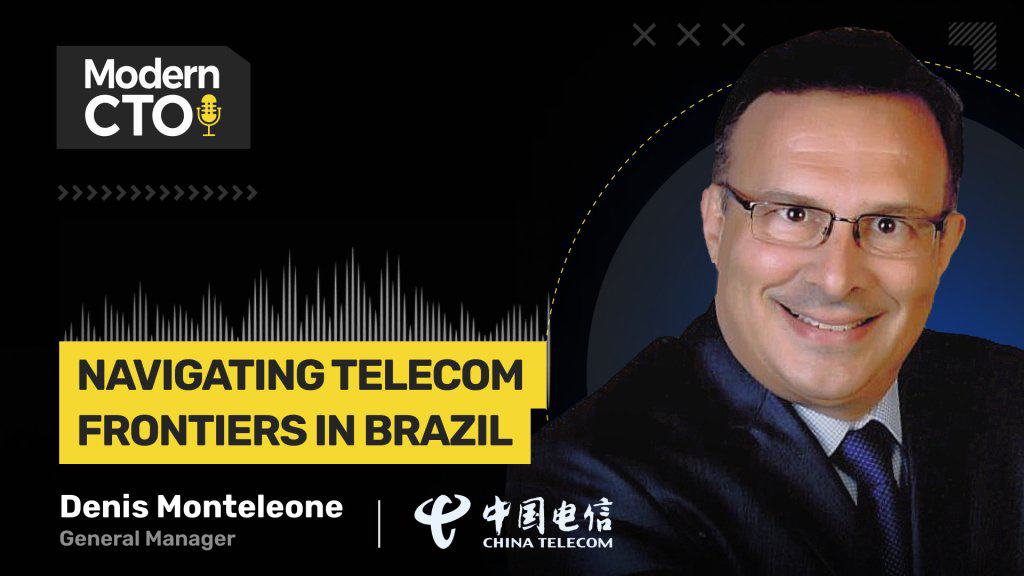
Navigating Telecom Frontiers in Brazil with Denis Monteleone, General Manager at China Telecom Brasil
Today we’re talking to Denis Monteleone, the General Manager of China Telecom Brasil. In this episode, Denis offers pivotal leadership advice, emphasizing the role of empathy and innovation in shaping Brazil's telecom future with China Telecom. He underscores the transformative potential of 5G and IoT technologies under visionary leadership.
All of this right here, right now, on the Modern CTO Podcast!
To learn more about China Telecom Brasil, visit their website here.
Have feedback about the show? Let us know here.
Produced by ProSeries Media.
For booking inquiries, email [email protected]
About Denis Monteleone
Denis has over twenty-five years of experience in the high technology industry, including more than twenty years in management, sales, channel management, marketing, and international customer relations. As a result of this professional life, Denis has created a very good knowledge and business relationship with the Brazilian and Latin America Market in the different industry sectors. He also created a great business partnership with IT companies such as IBM, Microsoft, A WS, Tots, Google, and Oracle.
Working in different positions and companies, such as; Channel Sales Manager at Edgio, Sales Director at Verizon, S&V Consultoria, Sitel, British Telecom, Novell and AT&T, Denis had the opportunity to contribute to designed and implemented Business Plan to restructure sales area, channels and partners and most important is to create a healthy environment to develop and motivate individuals to work as a team to reach the company goals.
Denis began his career working at Itautec Informatica (Brazilian Computer Company) managing technical support team and later in the international marketing and sales areas, offering Bank Automation Systems and computer solutions, including software, hardware and services in Brazil and Latin America. In addition, Denis has a technological background in engineering, marketing specialization and MBA in International Business would contribute further value to your organization activities.
About China Telecom do Brasil
China Telecom do Brasil is the largest subsidiary of China Telecom Americas and a leading provider of Internet and cloud computing services in Brazil. Prioritizing customer satisfaction, China Telecom do Brasil enables businesses to thrive in today's digital landscape by delivering reliable, scalable, and secure solutions that connect networks within Brazil and internationally. China Telecom do Brasil is one of the largest Chinese Internet providers in Brazil with network POPs and backbone connecting the State of Sao Paulo, State of Rio De Janeiro, State of Parana and State of Rio Grande do Sul to the China Telecom global network.
Transcript
(Intro Narrator at 00:00:00) Today, we're talking to Dennis, the General Manager of China Telecom Brazil, about Brazil's telecom growth in 2024 and how Dennis guides his team to success. You're listening to Joel Beasley, Modern CTO.
(Joel Beasley at 00:00:20) So Dennis, I saw that you were over at Verizon, and now you're over at China Telecom. I know some great people over at Verizon, and I was hoping you could share a little bit about your experience there and then your transition to China Telecom.
(Dennis at 00:00:34) Well, I began at Verizon in 2014 as the Sales Director for Cloud Computing and Data Center. It was a great experience. Verizon is the kind of company that chooses high potential guys to work with them. I met a lot of intelligent, smart people over there. Verizon is one step ahead in the Americas, especially offering different products, especially for mobile services. Data Center was sold in 2017 to Equinix, and then I migrated to another area. And then we had a great experience selling CDN services, cloud computing, WAF security under CDN. Got a lot of customers in Latin America. I was in charge of Latin America Channel Management. It was a very good experience there. Since then, the unit of Verizon Media was sold to the equity company called Apollo. And after that, they decided to close the Yahoo company in Brazil. And then after that, I started at China Telecom. And China Telecom, it is a great opportunity for me because the company began in Brazil. Even if they started the operations in 2014 too, at the same time, they were focused on different things. But I think my boss, he's located in the U.S., said all the time, "Dennis, I chose you because you have experience in ICT and global customer relationships." I have been working for the IT or technology industry in cloud computing for about thirty years in management positions in sales and marketing. I've been director for Verizon, AT&T Latin America, Novell, British Telecom, and now I've arrived at China Telecom.
(Joel Beasley at 00:02:44) How do you maintain a positive attitude as a leader when one of your team members really screws up big time and costs you a lot of money?
(Dennis at 00:02:52) I don't know why. I go to bed every time and say, "Jesus Christ, what are you going to do?" And take a very good sleep and wake up and smile. I think that's a positive attitude. Even if you're facing challenges, difficult situations, it's the best way to face your challenges in your life. Because professionally, it's happening all the time. It's a part of your life. However, there are other things that can damage your heart or your feelings more than your job. The positive attitude is really great to have. For me, an important behavior about leadership is taking a personal interest in the long-term development of their employees, using tact and social skills to encourage employees to give their best. I try to extract the maximum I can, not forcing people, but trying to inspire and motivate them. That's hard because you need to understand everyone. I'm not talking about being a nice guy, but an understanding guy, because everyone has a limit. It's about tying individual motivations and interests to furthering organization-wide goals. That's important.
(Joel Beasley at 00:04:32) And how do you do that?
(Dennis at 00:04:34) How do I do that? Sometimes empathy. Sometimes I try to understand, but all the time I can see the company goals and company rules, and sometimes, you know, you need to adjust it sometimes. I always think in my life, when you build a house, you have some tools that work and help you to make the infrastructure of the house underground and above ground. However, when you go to the roof or finish it, you're going to use other tools. And then some talents will adapt. Other talents or people do not adapt. And then how can you manage it? You try to figure out, "Okay, the guy, hey, you need to do that." Sometimes they can, and the company has their challenges. We have those challenges. We need to achieve our goals too. But however, encourage people and try to give information on how they can improve their job. Not only the personal, because I don't believe that everyone has all the answers. I believe in teamwork, listening to people, getting good ideas, implementing suggestions. But the point is, our major challenge is time. We don't have much time to implement some challenges. It needs to be adaptive and flexible all the time.
(Joel Beasley at 00:06:05) What are the goals that you're currently working on for the new year for your team?
(Dennis at 00:06:10) Yeah, that's a very good question. When we talk about China Telecom Brazil for 2024, we have a big challenge. Why is that? Because since 2014, 2015, China Telecom Brazil has focused on providing IP services to ISPs. Different than the U.S., Brazil does not have much coverage or fiber coverage in order to bring internet for homes or cable TV to homes. And then these small companies saw those shadows, network shadows, and started building small companies. In Brazil, we have almost more than 15,000 ISP companies. We say family companies with ten, fifteen employees around Brazil. And then that was our focus, to support their operations. It was good, but from now on, we need to change it. Why is that? Because China Telecom has a lot of products, services, and capabilities outside of Brazil that we need to implement in Brazil. Some of them are already implemented. How do you change the team? Well, we need—that's what I mentioned to you—some tools you're going to use in the beginning won't be able to be used in the future. You buy other tools. You hire some people with different talents in order to build that other side of the company. In other ones, you're going to adapt, train, and give some support in order to adapt for the new situation. Right now, we are focused on three different segments. We do not forget the ISP. We continue with ISP. However, we're going to focus on higher ISPs. It means the enterprise ISPs with more than 20,000 subscribers. We have about 220 accounts or prospects or customers with that format. The second market we're going to face in 2024 is CNE. CNE is Chinese enterprise companies. Brazil and China have a trade of $140 billion. Comparing to the U.S., it's—forget about it. Nothing is comparable with the U.S. For Brazil, China is the first trading partner. That's $145 billion last year. This year is expected to have $170 billion of trading, and China continues to invest in Brazil, buying companies, establishing branches, building manufacturers. They're opening new businesses. And then in Brazil, we have more than 200 Chinese enterprise companies located in Brazil in different segments: financial, logistics, energy, utilities, computing, agriculture, car manufacturers, among other industries. These companies need local financial and tax understanding because Brazil is a challenge for tax. And also they need ICT support to be established. China Telecom Brazil wants to be an ICT or IT provider, IT facilitator, to support their operations and welcome them. We have been doing that since two, three years ago. And now we have a Mandarin speaker for presales, sales, and post-sales to support their operations, because in the beginning, they don't hire Brazilians. They have Chinese people speaking Mandarin, only Mandarin, very low English. And then we are there to help the people grow in Brazil. That's the second one. The third market we're talking about is Brazilian enterprises. We have more than 500 companies that have a great opportunity for us to support connectivity between Brazil and China. We are connected in the United States, in Europe, Africa, and all countries in Asia, offering telecom services. And also, for Brazilian enterprises, we're going to offer IoT services and joint solutions that were developed by China Telecom in Asia and implemented in Asia. And that segment, IoT for agriculture and logistics, will be very important to market to us because, you may not know, but we have more cows and bulls than people in Brazil. We have 240 million cows and bulls. You know, once it was seen on the internet, why the U.S. is picking on Brazil about pollution, pollution, pollution. We don't have as many cars as compared to other countries. However, we have 240 million bulls and cows. That's a lot of gas, guys. A lot of gas. And then there's the opportunity. Brazil is the first producer in soy, corn, oranges, and about 80% is for exportation. And then we support Brazilian companies in agriculture and transportation. And the fourth market that we are facing in 2024 is Brazilian telecom companies. We have about 40 companies in Brazil. They need connectivity in Asia and other countries. And then first, we're going to support that connectivity. The second one, we can bring some solutions from Asia to Brazil in order to compose services with our telecom customers and offer them to the end users in Brazil. That's our vision from 2024 on.
(Joel Beasley at 00:12:32) When you say that there are Brazilian companies that need connectivity in Asia and other countries, what do you mean?
(Dennis at 00:12:41) Yeah. I want to say connectivity is telecom connectivity. Because if, for example, you go to China, you have a big firewall over there. If you choose, for example, China Telecom, you pass through our firewall in China. It's much easier. And then we have the entire connectivity. When I say connectivity, it's telecommunications, end-to-end MPLS services, internet services, IP services. Why is that? Because we just renewed our CTG networking. CTG networking is the new generation to support artificial intelligence. They have new standards and it's very secure. It's brand-new networking with more capability, flexibility to increase bandwidth, and new equipment too. We call that the next generation to support artificial intelligence and videos on demand.
(Joel Beasley at 00:13:48) That's interesting. I haven't thought much about countries having firewalls, and I was hoping you could just explain to me a little bit more about what the countries do with the firewalls, how they work. If it's too deep, we can go to a different part of the conversation, but I'm just kind of curious.
(Dennis at 00:14:07) It depends. If we talk about a firewall in terms of security, we have F5 and other companies to provide firewalls to the local companies. We do not offer firewall in those terms, WAF or different, very deep DDoS solutions to the customers, because in my vision, we're in the beginning to explore that market. But we have partnerships in order to provide it. But if you talk about a firewall, some government restrictions or things like that, no. We have monitoring. ANATEL is the regulatory area from the government. They are very smart people, very savvy. They have high knowledge about the internet, and they provide flexibility, but they are monitoring all the time. They're catching some invasions, you know, and they're looking for these bad guys on the internet. And we collaborate on that because we manage it. We just sell the connectivity. We are not the ISP provider, the internet provider, to the end.
(Joel Beasley at 00:15:35) What advice would you give someone starting their career in technology based on your experience?
(Dennis at 00:15:43) I saw one last week. I was seeing an interview with a CTO in a global company. They are located in Brazil. They said Brazil has about 170,000 open IT opportunities. And Brazil does not have enough professionals to cover that. In three, four years, all of the IT job openings will be about 725,000 employments. My son works in IT. And then my advice to him is keep studying, keep improving. Go into security, go into artificial intelligence, and learn Mandarin. Learn Mandarin because everyone is going to make business in Mandarin. Even if English is the basic language, as a Brazilian has some challenges to learn English, the Chinese have some challenges to learn English too. But we have a great opportunity. We do not have many graduate people in IT. I advise everyone who is good in math or has some curiosity, go forward, go study. It's very interesting, and you can make money and get a job as soon as you want because there are a lot of open jobs in Brazil.
(Joel Beasley at 00:17:18) So we talked a little bit about the growth in 2024 for China Telecom Brazil. We talked a little bit about your past. And one of the things I was hoping to understand is, like, the current market trends. Like, what's the real big thing happening right now between you and your peers?
(Dennis at 00:17:41) Let me give you an overview of the Brazilian momentum. We're growing in the 5G business. That's in high demand because we have IoT needs, especially for farms. We have edge computing. Brazil, if you look, 90% of Brazilians—we have more than 250 million smartphones. Some people use two smartphones, one for the company, one for personal. And then the demand for data is very high. Social media has grown a lot. If you're seeking on the internet, Brazilians are on the top of Latin America. They are using Facebook and social media. And that is high demand. When I say high demand for cloud computing or data center, imagine in Brazil we have 80 to 82% of data center occupation. That's a huge opportunity. That's what China Telecom was looking for, saying, "Wow, that's a huge opportunity to cover that market." We have energy, we have infrastructure, optical fiber infrastructure, and good locations to provide. We have land to provide that infrastructure. And that will be welcome. Data center is going to cloud computing for hyperscalers. And I was in a meeting two months ago—I won't mention the company's name—it's one of the largest cloud companies. And they said to us, "Hey guys, if you want to build a data center in Brazil, hyperscale, I want to have 50 kilowatts for each rack, 80 kilowatts for each rack, because you're going to serve Brazil's demand." And that's a huge opportunity. And in terms of ICT services, IoT is great, it's good, and China Telecom is able to provide it. Cloud computing is another market that's growing faster. I think it keeps about more than 60% of data center infrastructure needs. That's the major. Artificial intelligence—a lot of people are using artificial intelligence, even if it is not good enough, but they are using it. Also, collaboration, communications, and then internet and edge computing, as I mentioned before. Data analytics—several American companies, including Sushi and others, are here offering data analytics for those companies locally. And mobility—mobility is growing, and the network is growing, especially in the northern part of Brazil. But we can tell that Brazil has existed in the south and southwest, and the south is very well developed, but you have a green field in the northern part. Even if they had been supported by telecom companies, there's a lot of things to exploit over there because there's less competition. There are a lot of people too, a lot of customers. In conclusion, Brazil is an emerging market. It is offering unique opportunities to explore ICT services. ICT, government, manufacturing services, agriculture, and retail—those industries are most impacted by the deployment of 5G in Brazil.
(Joel Beasley at 00:21:47) That's exciting. Sounds like Brazil is really growing right now.
(Dennis at 00:21:51) Yeah, it is growing. Even if you have some challenges, okay, you're still growing. Not growing as much as we want to, but it's still growing, especially in terms of the technology.
(Joel Beasley at 00:22:04) Well, it sounds like it's a super exciting time. I hope that you keep me updated on things as they grow there. And, dude, Dennis, we made a podcast. How do you feel?
(Dennis at 00:22:14) Good. Comfortable. You make me very comfortable. Sorry for my English. Sometimes I—
(Joel Beasley at 00:22:20) I can't even speak one language well. Thank you so much for listening. And if you found this episode useful, please share it with a friend or colleague who you think would get value from it. And if you have topics that you'd like to hear discussed on the podcast, either add me on LinkedIn or send me an email [email protected].
(Joel Beasley at 00:22:42) Every time I get an email or LinkedIn message, it absolutely makes my day and inspires me to keep going.