
Episode 185 ·
Building a Strong Foundation for Growth and Success with David Singleton, CTO at Stripe
Today we are talking to David Singleton, CTO at Stripe. And we discuss the operating principles that have led to their success and growth, why Stripe views itself as an infrastructure company, and valuable tips for running a hybrid remote culture.
All of this, right here, right now, on the Modern CTO Podcast
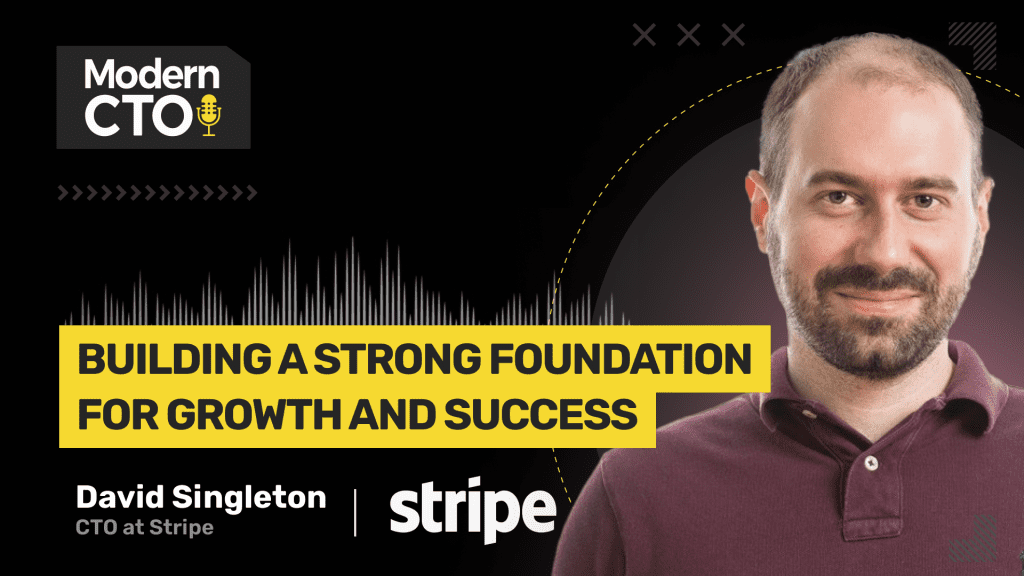
About David Singleton:
He joined Stripe from Google, where he was VP of Engineering, leading the Android Wear and Google Fit teams, which included product development and coordinating more than 15 different hardware partnerships. Over the course of his 11-year career at Google, David led teams that built some of the company’s most ambitious products, including its first apps with voice search; publisher products for Google Adsense; Google Offers; and Google Mobile Search Apps. He was also one of the first engineers at Google London and oversaw much of the growth of the London engineering office from inception to the large scale it has today.
Prior to Google, David spent three years as a senior engineer at Symbian, the pioneering mobile phone operating system. At Symbian, he developed software for Nokia and Samsung smartphones and worked on both the Bluetooth stack and PC Connect software.
David has a bachelor’s degree in Computer Science from St. John’s College at the University of Cambridge. In his spare time, he enjoys cooking, skiing, and tinkering with neural networks. He lives in San Francisco with his wife and two kids.
About Stripe:
Stripe is a technology company that builds economic infrastructure for the internet. Businesses of every size—from new startups to public companies like Salesforce and Facebook—use the company’s software to accept online payments and run technically sophisticated financial operations in more than 100 countries. Stripe helps new companies get started and grow their revenues, and established businesses accelerate into new markets and launch new business models. Over the long term, Stripe aims to increase the GDP of the internet.
Transcript
(Joel Beasley at 00:00:00) Hello, my friends. Today we are talking to Dave Singleton, the CTO at Stripe, and we discuss the operating principles that have led to their success and growth, why Stripe views themselves as an infrastructure company, and valuable tips for running a hybrid remote culture. All of this right here, right now on the Modern CTO Podcast. Here we go. This is the Modern CTO Podcast.
(David Singleton at 00:00:34) David. Hey, Joel. It's great to meet you.
(Joel Beasley at 00:00:37) Dude, great to meet you. You have got to be one of the most interesting people. And we're meeting just now for the first time, but I've been reading your blog for the past several hours and it's unbelievable.
(David Singleton at 00:00:49) Wow. It's a bit of a random assortment of stuff. I like to think that I have a wide range of interests.
(Joel Beasley at 00:00:59) Yeah. I mean, you had everything from you built a self-driving RC car.
(David Singleton at 00:01:06) That's right.
(Joel Beasley at 00:01:07) Tell me about that.
(David Singleton at 00:01:08) That was really fun. So you probably remember this was a long time ago. This was before self-driving cars were a thing. I mean, they were a thing inside research labs or whatever. And there was a Stanford machine learning course which I happened to take on the weekend over the course of several weeks.
(David Singleton at 00:01:28) And at the very end of that course, they showed a video of one of the world's first, I guess, neural network-driven self-driving cars, which was out of CMU in the nineties, I guess, or maybe even earlier. And they basically said, hey, we've taught you all the techniques to build one of these things in this course. So I got pretty excited about that. And not actually at the time owning a real car to turn into a self-driving car, I bought literally the cheapest radio-controlled car you could get and stuck a mobile phone on the back and built a system where it would stream the video frames to the computer.
(David Singleton at 00:02:07) And then I wired up the radio controller to a little Arduino board, and I could drive it with the arrow keys in my computer. And then that gave labels to train the algorithm, and then I trained it, and then the car would drive itself. And this was pretty miraculous, I thought. I mean, I was pretty shocked that it was possible myself. And the thing that's really cool is that you could rebuild the track on the fly and it would follow the corners wherever they were.
(David Singleton at 00:02:37) So that post was actually fun because it got picked up on Hacker News and got a bunch of attention. I got invited to a couple of conferences to talk about it as the fun side topic, which was cool. So yeah, I was building self-driving cars before they were cool, but only radio-controlled ones.
(Joel Beasley at 00:02:54) That's amazing. Have you always been interested in the hardware and the software side of things?
(David Singleton at 00:02:59) Yeah, I pretty much have. I've always been interested in building stuff. And I think, you know, when I was a little kid, I was really into Lego and getting the complicated Lego and making it into new things. And then when I got into software, I got very excited about how creative and limitless building stuff with software was.
(David Singleton at 00:03:21) So I've always had a passion for putting together software systems with things that you could really feel and touch in the real world.
(Joel Beasley at 00:03:29) But how do you become such an amazing person? This, I'm like, this topic of this episode is now. So you do cooking, you have such a wide array of interests. And so do you just go with the flow and then you just choose to document stuff sometimes? Do you have a recurring event in your calendar where you make one of these blog posts every month that you just find something creative to do for? Like, how do you do that?
(David Singleton at 00:03:54) Yeah, I mostly go with the flow. So I'll typically have, I don't know, five or ten ideas that are kicking around in my head that I want to spend some time building. And to be clear, none of them usually with a particular purpose in mind, but just because it's an idea that seems pretty interesting from my perspective. They'll kind of niggle away at me.
(David Singleton at 00:04:14) So I usually start working on them when I get frustrated with myself that I haven't already done so. And I like to build stuff. I like to write such that it shares the experience with other people so that they could have the same enjoyment that I had in doing the thing. And actually, it's been really fun. Since I joined Stripe, I think I've been more intentional about my writing.
(David Singleton at 00:04:36) We have a really vibrant, I think, writing culture at Stripe. And so I think I'd be more diligent about taking side projects I've worked on and writing them up so that others could learn from them since I've been immersed in this culture, which has been great. But it is definitely something I've done for a while.
(Joel Beasley at 00:04:53) And to your point, with docs and stuff, with writing culture in your docs, I've used the Stripe documentation as examples for the standard since the day I found Stripe. I was looking for alternatives to authorize.net, and this is way back in the day. And I came across this basic couple-page site, and the docs are so easy to read and it made my life so much easier. And then going forward, I just—every company I talked with, because I had a—for about ten years I had an app consultancy, so I just built applications for people for hire. And I would always just point to the Stripe docs. Like, this is the standard. This is how good the docs have to be.
(David Singleton at 00:05:37) Cool. Well, thank you for saying so. I mean, like any product that you work on, when we look at our docs, we still see so many ways that we would like to improve them. We keep them moving along, I think, quite quickly. I think the critical thing that we do at Stripe that is different than how some other companies treat documentation is we really view our documentation experience as part of the product.
(David Singleton at 00:06:00) So in fact, this is a lot of what brought me to Stripe in the first place. So I happened to build a little side project along the lines of what we're talking about before, which was an international group SMS app. And it was actually quite expensive to run. I was just using my own credit card for it, and so it became pretty critical to integrate payments. And I actually put it off for quite a while. Just like, oh, that's gonna be really hard. But I knew about Stripe. Stripe was relatively early at the time. I knew about Stripe, and one weekend I sat down to integrate payments.
(David Singleton at 00:06:36) And it was a really, really quick experience. It took me just a couple of hours, and then people started paying for the group SMSes that they were sending. It was pretty miraculous. Money started flowing in very quickly. And the reason that that experience was so productive was, number one, we do work really hard to make sure that the API is accessible and intuitive and easy to get started with. But really, back then, I saw all of these touches in the docs that continue to be important to us today.
(David Singleton at 00:07:05) So for instance, if you're reading the Stripe documentation and you're signed into your Stripe account, the examples that you see have your API keys in them so that you can copy-paste them and use them right away. If you're looking at our API reference, we'll give you sample requests and responses. And the data in the responses, if relevant, actually comes from your own account, and that makes it so much easier to understand what this thing is about. So if I've provisioned a bunch of products in my account and then I'm looking at the product list API response and it's my stuff, it makes so much more sense. And so we do exactly the same product development loop in our documentation where we'll show it to users, we'll observe them using it, what are the pain points, we'll get their feedback, and really, really listen to it.
(David Singleton at 00:07:47) Just the same product development loop that we use in all the rest of the product. And I think that's not a consistent practice across the industry. I think increasingly folks recognize that it might be something worth investing in. But sometimes software teams—I've certainly worked in software teams before that were set up like this—think of the product, and then there's this separate group that will take care of writing it up and putting docs somewhere else.
(David Singleton at 00:08:12) And you really have to think about them as part of the same journey, especially when you're building an API-based or infrastructure product.
(Joel Beasley at 00:08:19) So how did you meet the people at Stripe?
(David Singleton at 00:08:22) Well, like I said, I built this side project that used Stripe. So I was intrigued and started really following what was going on here. Sometime in early 2017, I actually just happened to drop an email to Patrick, who's our CEO, to actually ask for some advice, and that blossomed into a conversation. And I got to really understand what was going on at Stripe. And in particular, that was a phase of our growth where we were really starting to think hard about how to distribute engineering around the world and not just in San Francisco.
(David Singleton at 00:09:01) And that's something that I spent a lot of time doing before and certainly have a passion for. I think realizing that a lot of the things that I really enjoyed myself in the product were not accidental but very deliberate, and that there was a real culture here that creates those kind of experiences, got me pretty excited. And then the idea that maybe I had something to give was what eventually brought me to Stripe. And it was a wonderful experience because it really did start just as a series of conversations, and then it turned into a case where I was like, that is where I have to be. And I am really having a blast here and really enjoying it.
(Joel Beasley at 00:09:40) Yeah. Well, it's an awesome company as far as the brand and the sentiment. I've never met anybody who doesn't like Stripe. Everyone's like pro—we're pro-Stripe world here.
(David Singleton at 00:09:49) Well, thanks for saying so.
(Joel Beasley at 00:09:52) So I was reading about how you guys look at yourself as an infrastructure company. Can you explain a little bit more about that?
(David Singleton at 00:10:02) Sure. I mean, we built economic infrastructure for the internet, but really at its heart, what that means is we're building tools for businesses to be able to do things that otherwise they might not be able to do or otherwise would require tremendous amount of investment on their side. So I really think of what we're doing as it's infrastructure, but really we're looking to provide engineering leverage to all the businesses that build on Stripe. This obviously got started with our payments API that I already talked about. But today, we have a real set of composable economic infrastructure that solves a wide range of problems that our users run into.
(David Singleton at 00:10:45) And the way that we got there is by doing a little bit of what I talked about before. So we really, really focus on understanding our users well, which means we're always asking for feedback. So we had the original payments API, and the early Stripe team did a tremendous amount of work with the early users to really make sure that we were providing something that added value right away, that was a really intuitive experience to integrate. And that was done through sitting with users, watching them going through the process of integrating.
(David Singleton at 00:11:17) Anytime that we saw friction or them feel like they made a mistake, that's not their mistake. That's our mistake. We need to design the system so that it's super intuitive to use. And so we've had this culture from very early on of paying a tremendous amount of attention not only to what do users think of the product, but what are the problems that they really have and that they're really seeking to solve. So that's a question that we'll hear people ask each other at Stripe a lot, which is, what are you really trying to do? To users, what are you really trying to do? And then when we see patterns across those business problems that they're running into, that's our invitation to build the next layer of our economic infrastructure. So maybe a good example of this is Stripe Connect. Connect is our product for platforms and marketplaces.
(David Singleton at 00:12:13) And the ideas behind Connect came from working very early on with a wide variety of early-stage companies that were using the payments API but were actually trying to build these multi-sided marketplace products. And there's a tremendous amount of heavy lifting you have to do to build a product like that. You have to do identity verification. You have to know that the people in the businesses are who they say they are. There's a lot of just plumbing to do to make sure that funds can flow in the right ways and so on and so forth. What we could see was that many of these Stripe users, these businesses building on the API, were having to solve those same problems over and over again.
(David Singleton at 00:12:37) And when we see that happening and we realize that's not the core business, that's not the reason that they started the company in the first place, that's a really great opportunity for us to build the next layer in our infrastructure. And that was the genesis of Stripe Connect. And Connect, of course, has gone on to be a tremendous engine in our growth because we work with platforms and they bring many other businesses onto their platforms for the particular problem that they solve for. Then those businesses have a relationship with Stripe potentially as well, and we can offer them more and more services. So we can kind of run that loop over and over again. And that theme of how we figure out what infrastructure to build goes through every capability, I think, that we've built and every product that we have.
(David Singleton at 00:13:21) So if you think about Radar, which is our solution for payments fraud, again, that comes from exactly the same loop of what are the problems you're running into, what is the work that you're doing to solve for these. So Radar for Fraud Teams enables you, number one, not to have to build tools to enable a fraud operations team and to enable a fraud operations team that could be much smaller than it otherwise would be so you can actually take that energy and put it into the thing that you really set up the company for in the first place. And so that's very much how I think about the business. It's how do we enable the companies that build with Stripe and on Stripe to have a lot of engineering leverage for themselves.
(Joel Beasley at 00:14:03) Yeah. And it's used for everything from complicated things to very simple things. For example, my wife uses Stripe for—she refinishes cabinets, and that's how she gets her payments through that. You know, we use it for the podcast and the advertisers, and it's just this amazingly simple system. It was so cool that she could just—you know, she got furloughed during COVID from her job, and she's like, what am I gonna do for money?
(Joel Beasley at 00:14:32) And I was like, well, your hobby is refinishing furniture. Why don't you go do that? And so she got a Stripe account, ran some Facebook ads, got some people, and started a little business. Now she's doing a cabinet every week. And it was just—it was the fact there was no friction. She just did it.
(David Singleton at 00:14:52) That is an awesome story, and I mean, I'm delighted to hear that we've been able to help her. That story is very consistent across so many Stripe users. And I think the principle behind that is, I've just talked a lot about how we're building infrastructure that, you know, as I was speaking, you're probably thinking about large companies. And we do serve a lot of really large companies and multinationals and public companies. But the principles that we have and how we serve them—another principle we have is we really want to make sure that everything works really well in a self-service mode and is universally available.
(David Singleton at 00:15:28) So we really see a lot of what we do is arming upstarts. We're literally seeking to help some companies get started that otherwise wouldn't get started and helping companies grow in ways that they otherwise wouldn't be able to. So COVID's been a really interesting experience for us. I mean, obviously, I have a tremendous amount of empathy for a lot of businesses out there that are going through a very difficult period of trying to respond to the demand drying up in many cases. But it's been a very energizing time in some ways at Stripe because we have been doing a lot to help businesses like your wife's actually come online for the first time.
(David Singleton at 00:16:04) And the self-service nature of our tools makes that really quick to do and makes it possible for it to happen at all. So for instance, there's a company called Rue Chevout, which is France's largest B2B farmers market, and they're now using Stripe post-COVID to sell goods directly to consumers online. There's a Mexican supermarket chain called Mercado Hidalgo who are using Stripe to support online orders. Some of these users will have had a relationship with Stripe already or maybe come to us through our sales team, but the vast majority actually just come in self-serve, find that they can experience the documentation as a product that we talked about, and get an integration up and running. And it's really exciting to be able to power that kind of innovation and enable those kind of businesses.
(Joel Beasley at 00:16:58) We're kind of dancing around principles. You mentioned a little bit of ownership earlier where, you know, you don't say it's the customer's fault. We take it upon ourselves. It's our problem.
(David Singleton at 00:17:07) Mm-hmm.
(Joel Beasley at 00:17:07) Does Stripe have some solid values or principles?
(David Singleton at 00:17:12) Yeah. So we have a set of operating principles, and I think that they're very deep in our culture. So I know a lot of companies have principles, but at Stripe, we really do talk about them a lot and live by them. For instance, we have an emoji for each operating principle, and you'll often see people on Slack when they see someone doing something that corresponds to one of the principles, like kind of saying, "Well done. That's like that principle in action." And I'd like to talk about a few of them.
(David Singleton at 00:17:39) I think that the most consistently cited operating principle and the one that drives so much of our work is that we put users first. So I think I've talked about that quite a bit already, but it really does mean seeking to have very deep conversations with our users and understand what they really need from us and to use that to drive our own thinking and prioritization. And when you see that in action at Stripe, it's quite striking. So I'm responsible for engineering and design. And in design, we have a user experience research group. But, I mean, truly, at Stripe, almost every product manager, engineering manager, and many of our engineers are themselves doing user research. Right? So we seek to empower everyone to talk deeply with users and understand what are the actual problems so that we build the right solutions. And that works inside the company as well. So we build a lot of stuff for our users outside of the metaphorical four walls, but also we build infrastructure to power all the products that we're building for them.
(David Singleton at 00:18:45) And the mentality that we take when we're developing and thinking about infrastructure inside of Stripe is, who are the users? There are other Stripe engineers, so it's even easier to talk to them and really deeply understand what they need. And how do we make sure that we don't just provide a solution and say, "Hey, you know, good luck with that"? We really seek to understand what do you need today and where are you going, and then we evolve our infrastructure like that.
(David Singleton at 00:19:08) So that's why that operating principle really applies. Another operating principle we have is to be meticulous about the foundations. So if you think about it, economic infrastructure is a very serious business. I'm sure your wife's business depends on being able to have people pay her for the cabinets. And very, very many Stripe users absolutely depend on us for their ability to serve their customers and also to pay their employees.
(David Singleton at 00:19:39) So we take it very seriously, and it's important that we are very clear thinking about what are the foundations, where are the places that we have to apply significant rigor and to really develop them that way. We think about that again both for our infrastructure and for how we design the company because we want to make sure that we're building systems that are durable and will mean that we can continue to serve our users very well for a long time. But alongside that, we have another operating principle, which is to move with urgency and focus. So we really believe that one of the primary ways that we serve our users is by evolving our products as quickly as we can to serve the needs that they have that are new or emerging, especially as we've started to take Stripe all around the world and especially as events like COVID come along. It really is an important differentiator for us and also an important just thing that we want to do in the world that we can respond quickly to their needs.
(David Singleton at 00:20:37) And so that's why it's important that we can move with urgency and focus. And when I think about how that applies to how we structure engineering, we put a lot of investment into developer productivity. So we think a lot about how Stripe can be a place where you can be more productive than at a tiny little startup because you don't have to kind of pull everything in yourself and stand it up yourself to make it work, but also more productive than at a really, really large company where there might be good infrastructure, but it's probably designed for relevant generic needs. So we build opinionated infrastructure for our engineers and really pay a lot of attention to the software development loop.
(David Singleton at 00:21:15) So, you know, how can we accelerate the time between writing a change and seeing the results of the test that you run locally? How can we accelerate the time between finishing a change and having it deployed to production? So we do continuously deploy our API to production, which in the financial space is not necessarily the normal way things are done. We typically deploy our API about 20 times each business day. And we can only do that through a huge amount of automated testing and automated deployment systems so that we provide safety as we roll that stuff out.
(David Singleton at 00:21:49) And that's why that operating principle kind of applies to what we do. But we have others, and we really think very hard about what the right principles are. And we sort of amplify them by how we work together, like I was saying in the beginning.
(Joel Beasley at 00:22:05) Yeah. That's really cool. You guys have a strong culture over there. I'm really curious. This is a little bit off topic. But what it's like—you, when you originally met them, you sent an email off to the CEO asking for some advice. Is that like career advice or technical problems advice? Or—
(David Singleton at 00:22:24) It's a good question. I think it was actually both, because I think I was asking for some advice that was probably framed as technical advice around a potential business thing that I might have wanted to start.
(Joel Beasley at 00:22:38) That's pretty cool. I can only imagine the ideas you've got bouncing around up in that head after reading through your blog. You also have some kids, right?
(David Singleton at 00:22:48) That's right. I have two kids. They are six and about to turn four.
(Joel Beasley at 00:22:53) I've got two. I've got a little girl. She's about three years old and then a boy who's about one.
(David Singleton at 00:22:58) Awesome. I have girl, boy in the same order.
(Joel Beasley at 00:23:02) Oh, it's—she's doing that thing right now where he walks up to her and she just screams just because he touched her or he touched one of her items?
(David Singleton at 00:23:11) I think the bad news is that never goes away.
(Joel Beasley at 00:23:17) No. But you can do creative things to distract them, like take your 3D printer and build them tic-tac-toe. That's amazing, by the way.
(David Singleton at 00:23:25) That was fun. That was not my idea. That was my daughter's idea. She wanted to give one of her friends a kind of homemade birthday present. And she just came to me one morning and said, "Daddy, please can we use the laser cutter to make this present?" And I was kind of like, "Awesome. Yes. Excuse to do my passion projects," which is, you know, coming from helping my daughter. So it's fun when they come up with the ideas.
(Joel Beasley at 00:23:50) So what is that printer? It was like a Glow or something like that?
(David Singleton at 00:23:53) Glowforge. Yeah.
(Joel Beasley at 00:23:55) And what, like, how does it work? What type of 3D printer is it?
(David Singleton at 00:23:59) It's so it's a laser cutter. It's not a 3D printer. So it is, I think, maybe one of the first consumer laser cutters. And it was originally kind of like a crowdfunding campaign. They used Stripe. I bought it before I joined Stripe. But I've had a lot of fun building stuff with it. And in particular, little software projects that actually generates designs. So for instance, I built a sundial template cutter, which you can use to build a sundial for your own garden if you like. Yeah.
(Joel Beasley at 00:24:33) You had a lot of open source stuff there too. You can find out the details of it. No, I just think it's fascinating. So this concept—I don't know much about 3D printing world. So this laser cutter, you put things in and it cuts it with the laser. I assume you used a slab of wood? You used—what did you do to make that?
(David Singleton at 00:24:54) So, yeah, you can buy laser-safe materials because when you use the laser, the gas vents off, so you want to be careful with what kind of plastics you're cutting and so forth. But you get flat pieces of material, wood, plastic, et cetera, leather, and you put it in. You use a piece of software to kind of configure where it's going to cut and where it's going to engrave, and then it does its thing.
(Joel Beasley at 00:25:16) That's so cool. So did you find an existing print for this tic-tac-toe?
(David Singleton at 00:25:21) No. We designed that ourselves. We—I got her to draw it on paper, and then I wrote a little Python program to generate the SVG that was the template to cut it, which is fun.
(Joel Beasley at 00:25:39) That is so—you used a Python program to generate the SVG?
(David Singleton at 00:25:44) I did. Yeah. You could use that—in Python program, but it's actually a lot faster and—well, it's a lot faster for me personally to write code to do stuff than use my horrible art skills.
(Joel Beasley at 00:25:55) Dude, you have good art skills. I saw that post about you drawing something every day for the month of February, I think.
(David Singleton at 00:26:01) I did that. Yeah. That was fun.
(Joel Beasley at 00:26:03) Yeah. I was like, I got some of my basic art skills from just whiteboarding. And then, you know, I was whiteboarding early on, and then I said I actually took a couple free courses online to learn how to draw better because I wanted to draw my whiteboards better. But, yeah, you've got a pretty cool sense between your—you could tell a lot from someone by their photography and what they choose to draw.
(David Singleton at 00:26:28) I'm really intrigued to know what you can tell by me. By the way, drawing is a really interesting topic because one of the things I talk about a lot with folks that I manage or mentor is kind of having a growth mindset. So really believing that people can improve and change. And when I was at school, I was terrible at art. I mean, it was the one subject where I would fail, literally. And I kind of had it in my head for years that I couldn't do art, and it—I actually got back into art through computers because I used Photoshop to kind of make conceptual art album covers. This is like, I don't know, '99 or something and realized, oh, wow, there's more to art than drawing and there's more to art than what I did at school. I've actually over the years kind of gotten into drawing and, I mean, thank you for saying that. I still think I'm a kind of mediocre artist, but I certainly do not deserve to fail my art classes. And it just goes to show that any skill that you want to get better at, you probably can by just believing that you can and putting in the effort.
(Joel Beasley at 00:27:36) Yeah. That resiliency to go at it, have it not turn out the way you want, and then decide that, okay, you didn't get the results you wanted, but I'm going to do it again. And then I'm going to find a way to track improvement to help build confidence. And then I know if I just leverage compounding nature of time, this will improve over time.
(David Singleton at 00:27:58) Totally.
(Joel Beasley at 00:28:00) Because most people just give up. I was actually thinking a lot about this. I didn't get into the personal development space or look into any of that stuff until my mom passed away a few years ago. And before then, I was just kind of going through life, and then you get into the personal development space and you realize these concepts about growth and ownership. And then what happens is you go from being a passive participant of life to an active participant of life. And it's just—it's a way more rewarding way to live. So that's why I was so intrigued when I saw your blog and I saw the things that you were actively doing. And my thoughts were, I'm doing things like this, but I'm not documenting them. I mean, I document them when I take photos of them, but I don't reflect on them in a written sense. And so that's actually—I was looking at that. I said, is this something that I want to integrate into my goals next year? Because I'm pretty strict about picking three or four goals and then let that happen for the whole year.
(David Singleton at 00:29:05) That is cool. I'm sorry to hear about your mom, by the way. That is—I think—a really important and valuable skill just to decide you're going to do something consistently and then work at it until you see where it goes. And I think about that a lot in how we build the right development culture at Stripe as well. So it's very important to me that we are building an organization where there's a really strong learning environment. It's both what I personally find keeps me very excited and engaged about working in a larger team, and it's also very consistently what we see and hear when we talk to Stripes and also people who are thinking about joining Stripe—that it's something that really helps people feel like it's the place to be because you are developing yourself as well as having a huge impact for our users. And our very inquisitive culture and our culture of writing and reflecting on work we've done, I think, is very powerful to that end, as you're just saying, Joel. And I think there's a real inclination at Stripe to study what we do and how we have done it and how to make it better at every stage. So another one of our operating principles, well, maybe two that are kind of related. One of them is to acknowledge that we haven't won yet.
(David Singleton at 00:30:31) So, you know, while we've built a bunch of stuff that is definitely having a good impact for users, there's a tremendous amount more to do. And so it's important that we stay humble and stay curious, and that's one of the ways that I think what that operating principle—and another one is edit the company. So, I mean, Stripe is growing relatively quickly. I think that there can be a failure mode or slight dysfunction in companies that do grow very quickly, which is, you know, the ways you worked, the culture and so forth are a certain way when you're small, and it probably changed a lot over the early days.
(David Singleton at 00:31:09) But if you grow quickly, it suddenly kind of inflates that and makes it just the way things are, and it's very difficult to change them. We believe very deeply that while we don't think that we're doing things completely terribly, there's so many ways that we could be working more effectively, both with ourselves and for our users. So really preserving the humility and acknowledging that we should work hard to change the way we work to make it better is, I think, quite a valuable part of the culture here, and also helps feed into the personal learning environment. So I've really enjoyed both working in that environment and then also working hard to amplify it. Examples of how we do that are we're very deliberate about development, by which I mean people learning new skills or doing things that they want to do that they haven't done before that have a lot of impact for our users, and also mentorship.
(David Singleton at 00:32:02) So creating connections within Stripe between folks who have a certain skill set or have experienced a certain set of things with the folks that want to learn from that experience. And it really does, I think, create a very palpable feeling that everyone is on a path where they're bettering themselves as well as having a big impact for our users.
(Joel Beasley at 00:32:28) Do you have any ideas, and this is again, it's pretty far out there, so not to put you on the spot, but do you have any ideas of how we could take these operating principles, like, how do we get—I get to talk to great leaders like you, right? And we talk about these operating principles, and then how do we get those to elementary or middle school kids? Like, how do we get those concepts earlier into our culture and society?
(David Singleton at 00:32:59) So it's a really great question. It's actually—I mean, it's been very fun for me seeing my daughter, who's six. So she's in kindergarten and about to go into first grade at school, and seeing the experience of school—and she goes to school in San Francisco—but the experience of school that she's having compared to what I had as a kid is very different. There is a huge amount of affirmation to the kids that they can learn. This growth mindset thing I mentioned, that's something I've thought about for years.
(David Singleton at 00:33:34) I was actually pretty blown away that in the first couple of weeks of school, my daughter came home and told me what the growth mindset was. Maybe her school is unique in that regard, but that's something I think all school kids should know. And the state of public school—she is not, she's at a private school—but the public school on my block, where we have neighbors, friends, and I've gone in and helped with a few of their events, do exactly the same thing, like, same materials that my daughter's school uses. So,
(Joel Beasley at 00:34:08) That's awesome.
(David Singleton at 00:34:09) I do think it is a very important thing to emphasize when folks are setting up on the learning journey that everyone has.
(Joel Beasley at 00:34:17) I love it, because, you know, I'm not there yet. I just have what happened to me thirty-two years ago, and that seems pretty—I mean, there just wasn't any conversation about it. I mean, it was just, here's the basics that we know in math. Here's the basics that we know in science. Good luck.
(Joel Beasley at 00:34:35) Right. You know?
(David Singleton at 00:34:37) And the art teacher who said, oh, that picture is terrible, so you're never gonna be an artist.
(Joel Beasley at 00:34:43) I left art and then went into the drama club thing because it was more interesting. To be honest with you, I had to do a monologue. I was really, really shy. And so I figured, okay, if I go over there and they forced me to do a monologue or something, that would help me on my growth.
(Joel Beasley at 00:35:08) And it
(David Singleton at 00:35:09) That's cool.
(Joel Beasley at 00:35:09) I guess.
(David Singleton at 00:35:10) I actually had a very similar experience. I had a particular teacher, one of my languages teachers, and she noticed, I guess, that I was a bit shy about, mostly about speaking in a foreign language, to be clear. I don't know that I was particularly shy in English, but she made me go to the speech and drama club. Made is a strong word, but strongly encouraged. And that actually has been a very formative experience for me because the ability to speak with very little preparation was something we practiced there.
(David Singleton at 00:35:42) The ability to act and have a bit of confidence in yourself, I find quite important in both, as a manager, how I work with people in one-on-one setting, but also being confident enough to get up and talk to a big team and answer questions that might be pretty tough questions off the cuff. And again, just like we were talking about with art or science or math, whatever, it is something where practice really helps, and it certainly has helped me do what I do today.
(Joel Beasley at 00:36:17) Yeah. I noticed when—I did, like, 50 talks last year in person, and then since the COVID stuff, I haven't been doing talks. And I remember, you know, looking three years back, I had done virtually no talks in person, like, one or two. And looking at once you get into that routine of going on the stage and going to the different city and then speaking, you get so incredibly comfortable with getting to talk to complete large audiences of strangers. And I think the thing that's helped me most or the thing that built my confidence from being so shy and quiet is I put myself through, or I found myself in difficult situations in life, and those were opportunities to get to know who I am.
(Joel Beasley at 00:37:03) And so I just became really confident in who I am as an individual and knowing myself and knowing that sometimes I'm up and sometimes I'm down, or sometimes I go through these patterns where I'm more interested in these certain topics. And, you know, there were times getting to know myself where I tried to fight that. I'd be like, no, I'm just gonna be this one thing. I'm just gonna go a mile deeper.
(Joel Beasley at 00:37:23) And then there's times where I realized, you know, there's this balance that I have to achieve within myself. And so when I step back and look at life from this continuous journey of getting to know myself and understand myself, that allows me to interact with other people in a more fluid sense.
(David Singleton at 00:37:39) Yeah. That's really awesome. People often ask me what my management style is. And I was probably first asked this, like, fifteen years ago, and I tried to answer the question literally. I was like, well, I do this and this and this.
(David Singleton at 00:37:53) And that was all true. But if people ask me that today, the answer I give is adaptive. I mean, I know that doesn't sound very interesting, but it's true. I really, over time, just as you described, spent time introspecting on what is the right way to engage and mirror my own energy and my own passions in all the different ways. So, yeah, great observation.
(Joel Beasley at 00:38:17) You said introspection has provided you a lot of benefit in your experience?
(David Singleton at 00:38:21) It certainly has, and it was not something that came naturally. I think—so I grew up in Ireland. It wasn't a particularly introspective culture. I did a lot of the stuff we're talking about, you know, speech and drama stuff, which never really invites you to look into yourself. It's more kind of looking at words.
(David Singleton at 00:38:42) But through the first maybe five years of being a manager in particular, I realized I'm encouraging folks that I work with to introspect. I should do more of that myself, and it's been very valuable.
(Joel Beasley at 00:38:53) Yeah. You know, I find that too. I find that sometimes I'll hear myself talking, and I'm saying, am I talking to this person or am I talking to myself? Because the advice that's applicable to them is the same thing that maybe I should be working on. It's not all the time, but sometimes that sleepy process that's in the back of your mind that's running autonomously will kick up and say, hey, this is a hook. This is one of those moments where you need to actually implement that advice in your own life. Right.
(David Singleton at 00:39:21) I love—
(Joel Beasley at 00:39:22) I love it. I love talking about life. I love getting weird. Are there any questions—like, you get to do a lot of interviews and talks. Are there any questions that you wish people asked?
(David Singleton at 00:39:33) Well, right now I get asked a lot—so you mentioned you haven't done a lot of talks since COVID, and our regular schedule has changed up from that as well. But I've spent quite a lot of time talking with other CTOs recently, and I guess we've spent a lot of time talking about how all of our various different companies are responding to COVID. And at Stripe, you know, all the stuff that I just talked about about really paying attention to how we're working has really worked very strongly for us. So we invested last year a tremendous amount in setting up a remote hub.
(David Singleton at 00:40:13) So we had been building offices as hubs for Stripe product development around the world for another, I don't know, six to nine months before that. So today, our engineering offices, if we're not all working from home in the current COVID environment, are at San Francisco, Seattle, Dublin, Singapore as hubs around the world, and then we've got some smaller offices across the US and internationally. Remote engineering has been a big part of the culture at Stripe since the early days. And I think we first came to that because there were just people that were particularly talented that we wanted to bring to Stripe, and they were not in the Bay Area. And so some very early engineering hires were remotes, and we did a lot in the culture to make that work well.
(David Singleton at 00:41:01) So for instance, the document-based culture I talked about earlier, to some extent came about to help folks who are not physically in the room be able to follow along and be part of a discussion. So we also, when Stripes have a discussion maybe in the corridor or in a one-on-one setting, we'll tend to exercise what we call email transparency. So we'll actually send a note about that to the team mailing list so that folks who are not physically co-present can follow along. So there was a lot in our culture already. Exactly a year ago, so it was May last year, we decided to start treating our remote population just like we do a hub office that we're trying to stand up, because there's a lot of work that we did to get those off the ground.
(David Singleton at 00:41:46) So in particular, we would appoint a site lead. We would make sure that folks in the leadership team were traveling there a lot to help share information and make sure that there was good connectivity with the team and the rest of the company. We would also do events with the local community, which obviously was both to let folks know Stripe is here and we can help you use Stripe, but also for hiring purposes as well. And in retrospect, it seems kind of obvious, but it didn't occur to us, to me, until a year ago that we should think of remote just as another hub. And so we did that a year ago, and we appointed a site lead, and we've been really leaning into making remote even more successful.
(David Singleton at 00:42:27) And it's been, I think, very successful for us. So over the past year, we have three times as many remote Stripes as we had a year ago. It's like 22% of our engineers that are remote, which means that other than San Francisco, it is our biggest office if you think of it that way. And those same things I talked about turned out to be super valuable for this population of Stripes.
(David Singleton at 00:42:56) Having a site lead you can actually go talk to people and understand what's working well and what's not working so well, connect the patterns, see the themes, build the systems that help, has been tremendously valuable. And some things that have come out of that include, we now have really good guidelines for what AV equipment you should use. We have a bunch of norms now around team Slack channels. So most team Slack channels might have a social channel alongside the main work channel, where folks can connect as human beings and stay in touch with how each other are doing.
(David Singleton at 00:43:34) We also have, we've kind of learned from our remotes that not every meeting needs to be a meeting. You know, you can work in a document at the same time and make a tremendous amount of progress when you're collaborating and you're maybe talking in a Slack channel or actually working on a document together. So that's been really valuable for us in really making remote work great at Stripe. It's been extremely valuable for us as we pivoted the whole company for working from home in the current COVID environment. So really a tremendous number of the tools and systems that we had set up because of having the remote hub have been extremely valuable there.
(David Singleton at 00:44:24) And this culture of talking to people and seeing what's working well and not working so well has been pretty remarkable. So we've been doing weekly pulse surveys since everyone went remote at Stripe. And the data that we hear back from folks is actually quite different to what I might have expected before we kicked this all off. So we survey on things like how would you rate your connectedness to your team, and how would you rate your productivity in your current environment. And right away, so early March when we all went to working from home, the initial results were quite surprising.
(David Singleton at 00:45:04) So the initial results for connectedness to the team were actually the majority of people felt either about as connected as they did before or more connected. And that has just been monotonically improving over time. So it's not the case that the significant majority of folks at Stripe feel more connected to their teams in this environment where folks are working from home than they did before. I think that's pretty remarkable, and it's not what I expected. But there's also a sizable group of folks that we work hard to really enable and support, and we listen very carefully to their feedback, that feel less connected.
(David Singleton at 00:45:39) And there's a lot of work to do still to have the right setup to make this work better. When it comes to productivity, again, right on the very first week that we were doing this, and frankly, I think a year ago, this would have been extremely challenging for Stripe. But because we had gone through the process of really standing up a first-class citizen remote hub and then taking those patterns and applying it to the rest of the org, we find that right out of the gate, the majority of people were either more or about the same level of productivity, self-reported, as before. And again, we've seen that monotonically increase over time. So it's been a great experience over the past year in enabling our remotes and growing our remote population, and then it has stood us in remarkably good stead for what's going on right now.
(Joel Beasley at 00:46:28) For this remote hub thing, did you talk with other CTOs? Are other CTOs doing that? Have you shared this with them?
(David Singleton at 00:46:36) Yeah. So, again, we really believe in learning from others' experience. So before we do anything major like this at Stripe, we'll tend to go out and try to talk to as many other companies as we possibly can who may have seen similar things to us before and try to learn from their experience. Before we did this, as I mentioned, we did already have a bunch of, relatively large number of remote Stripes. So it wasn't the case of, like, we were making a decision of are we gonna do this at all or not, but we did want to figure out what we could do to make it as effective as possible.
(David Singleton at 00:47:11) So we talked to people who work at fully remote companies, companies like Automattic who build WordPress, GitLab, which is fully remote, and also some earlier stage companies like Coda, that's fully remote.
(Joel Beasley at 00:47:25) Oh, I know Coda. Are you kidding? You just tickled my brain so fast. I'm sorry to interrupt. I was like, Coda? I used to love them.
(David Singleton at 00:47:34) Yeah. Well, they are a fully remote company, and I think it's pretty valuable for their product because their product is all about helping people collaborate in those ways. So the point is there are a lot of folks who thought hard about this, and we tried to both learn from their experience and figure out what would transfer well to Stripe. We also talked to companies that were not doing this to understand why they were not doing it and make sure that we didn't feel like we were going to hit any rocks in the road. But we ultimately, of course, decided that we were going to do this.
(David Singleton at 00:48:03) I think some of the most important lessons that we've learned are, and I think this could be of particular interest to folks thinking about what they're going to do as the COVID restrictions start to relax. We were in a mixed model. Right? So a lot of CTOs I talked to would say, hey, it's great if the whole company's remote, and it's great if the whole company is kind of office centric, but in between is harder, and it is for sure.
(David Singleton at 00:48:29) But we are obviously working hard to make that work. One of the things that we've noticed is it really is the case that one is the loneliest number. So if you're a single remote engineer or designer or whatever your job is working with a team that is primarily based in offices—they may not even all be in the same office but in offices—then the burden tends to fall on that person to be the momentum to shift the way the team works, even with a tremendous amount of organizational support. So we just don't do that. We make sure that teams that have remote members are at least half remote, as much as we possibly can.
(David Singleton at 00:49:11) And we've also stood up a large number, in fact, of entirely remote teams, so that the way that they work is tuned to the way everyone will most benefit from. We've also really found that investing in tools and communication norms is important. So, I mean, one example of tools: one of the things that I heard from someone in another company was, well, we were really worried about having lots of remotes because we still depend on all getting together in a room when there's a crisis, so instant response. And we were still doing some of that at Stripe before we started our remote hub. But we really put a lot of investment into tooling for incident management.
(David Singleton at 00:49:59) So today, if something happens that we need to respond to as an emergency, people at Stripe can press one button and it stands up a virtual war room. So a set of Slack channels with tools to help with collaboration. And, I mean, I don't really know what the counterfactual is. Maybe we would have built that anyway, but we definitely built it because of hearing some of these insights, and we use it as our primary mechanism for doing these things because of hearing some of those insights, and that's been valuable. And communication norms—I mentioned already having a doc that you're collaborating in.
(David Singleton at 00:50:36) One of the things that has been, I think, pretty valuable is, comes from treating the remote population as a hub, is having leadership Q&As with the team where we're just trying to create really transparent two-way communication. That is something that we started doing over Zoom. So if I would visit an office other than my home office, we typically get everyone together in a room and have a little bit of spiel of what's going on right now, but then answer questions. It turns out you can do that just as effectively over Zoom. You can have a 100-person Zoom meeting.
(David Singleton at 00:51:14) You can shepherd questions in a Slack channel so that everyone's not interrupting each other and kind of agree who's going to go next to ask their question and have a really high bandwidth large conversation. And so we started doing some of those things for our remotes. And now that the whole company is working remote, we've started doing that at a company-wide level. So our company Q&A, which John and Patrick, our cofounders, run each week, is now really a big rallying point and sort of focal point of the week. I love it. It's probably my favorite meeting of the week. And, again, we learned some of those techniques through making the remote bridge super effective.
(Joel Beasley at 00:51:54) I want to respect your time here because I know that you've got a hard stop at the top of the hour. So is there anything else that you want to get out or that we didn't cover that you want to talk about before—
(David Singleton at 00:52:04) I mean, just thinking and reflecting on what we're talking about around remotes. I think what's top of mind for me is: so what's next for our remote hub? It is actually the one-year anniversary of doing this this week, and we're going to publish some lessons learned pretty soon. But we're working really hard to now scale it even further. So we're increasing the number of countries that we are able to hire remote engineers and other functions in.
(David Singleton at 00:52:37) And we're going to be investing a lot in that. And the thing that I want to share here is the heart of this is pretty cool. So we decided to take engineering and product development international because it was so important for us to be close to our users. I talked about our users-first operating principle. And what we have seen is that we have genuinely built products that we may not otherwise have built because we've had folks that are deeply connected to what's necessary to make a business successful in this economic infrastructure space in every country.
(David Singleton at 00:53:14) So for example, the way that we built FPX, which is a bank payment system in Malaysia, as a really deeply capable set of features probably would not have happened if we hadn't had engineers in Singapore. And the way that we have implemented stuff for folks in Mexico probably wouldn't have happened if we hadn't had engineers on the ground talking to those businesses and understanding the real pain that they had in Mexico City. And I think that was consistent with our original thesis. The thing that's been really interesting from my perspective is as we've had remote engineers across the US and Canada and in other places, it's not just a country-by-country cultural thing that matters. When we've hired in some of the existing tech hubs around the country, we tend to end up hiring folks that are great who have come from either the startup community or very large established companies.
(David Singleton at 00:54:18) It turns out there are way more engineers working in companies of all shapes and sizes all across the US, all across many countries around the world. And those companies can also benefit from Stripe's products and do benefit from Stripe's products. And actually hiring folks from cities outside of what we might have previously thought of as the beaten track has been really valuable in bringing insights about how those kinds of companies, those kinds of communities need to work and interact. And this genuinely made our products and the way we think about our products better. So I'm extremely bullish on being able to hire folks with a really diverse set of experiences because we no longer have location as the number one selection criteria, and it's like a self-selection billboard.
(David Singleton at 00:55:09) And I think that's been quite remarkable from my perspective.
(Joel Beasley at 00:55:14) No, it completely makes sense to have people available in the communities that you're serving so that you're really closely bound with them. David, we did it.
(David Singleton at 00:55:23) Joel, thank you. This was a lot of fun, and I learned some stuff from you. So thank you very much.
(Joel Beasley at 00:55:30) Yeah, I love good conversation. And then maybe at the beginning of next year, the next time I'm out in San Francisco after all the travel stuff, stop by and say hello next time I'm out there.
(David Singleton at 00:55:42) Awesome. Thank you. I really enjoyed it, and I hope you have a great day.
(Joel Beasley at 00:55:45) You too. Talk soon, David.
(David Singleton at 00:55:46) Thanks. Bye.