
Episode 800 ·
What’s Going on with the Tech Layoffs? Part 2 with David McCall, VP of Innovation at QTS Data Centers
Today we’re talking to David McCall, VP of Innovation at QTS Data Centers. We discuss the current state of the tech layoffs, where we misjudged the trajectory of AI, and what the future of the layoffs looks like.
All of this right here, right now, on the Modern CTO Podcast!
To learn more about QTS Data Centers, check out their website here: https://www.qtsdatacenters.com/
Produced by ProSeries Media: https://proseriesmedia.com/
For booking inquiries, email [email protected]
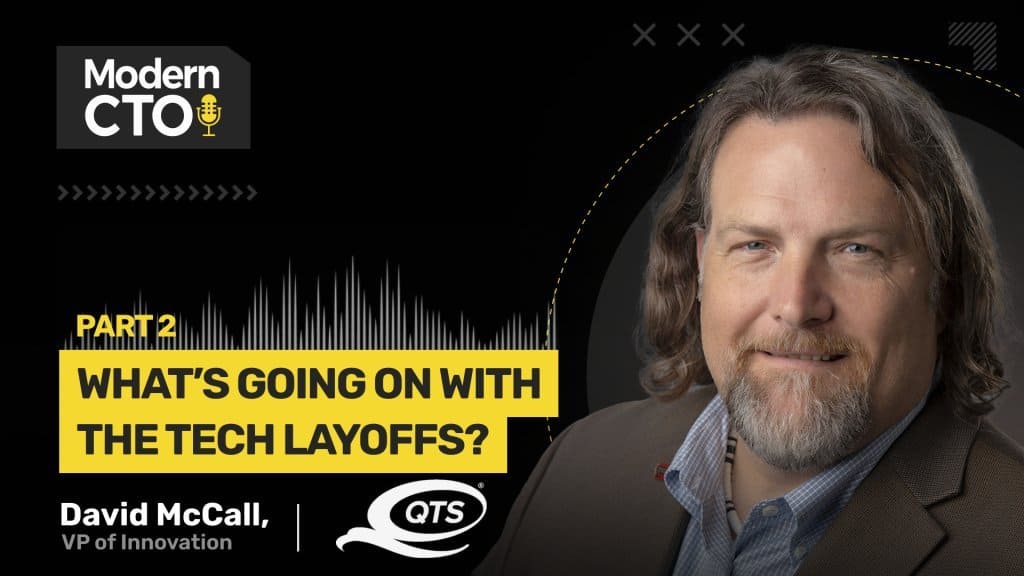
About David McCall
In his role as VP of Innovation for QTS Data Centers, David McCall is responsible for building teams, setting strategic goals and serving as an evangelist for one of largest and fastest growing data center service providers in the United States. He has more than 14 years of solutions engineering experience in the data center, telecommunications and internet technology industries.
About QTS Data Centers
QTS Realty Trust, LLC. is a leading provider of data center solutions across a diverse footprint spanning more than 9 million square feet of owned mega scale data center space throughout North America. Through its software-defined technology platform, QTS is able to deliver secure, compliant infrastructure solutions, robust connectivity and premium customer service to more than 1,100 leading hyperscale technology companies, enterprises, and government entities.
Transcript
(Intro Narrator at 00:00:00) Today, we're finishing our conversation with Dave McCall, VP of Innovation at QTS Data Centers, with a discussion about the current state of the tech layoffs. You're listening to Joel Beasley, Modern CTO.
(Joel Beasley at 00:00:18) Tech layoffs. I want to talk about tech layoffs. Because the last time we spoke, I think it was a year ago, or I know we talk a lot, but one of the times, I think it was in '23 and we were about to peak. The layoffs were rising.
(Dave McCall at 00:00:39) Right.
(Joel Beasley at 00:00:39) They were becoming more and more and more. And I pulled an updated graph, and they have since plateaued.
(Dave McCall at 00:00:46) Are you kidding me? I thought it was rise of the robots. I thought AI was taking every tech job. I remember our conversation plus the people we've interviewed, and it was all going to be wiped out, and there was nothing to be replaced. You're telling me it's plateaued? And we didn't set any of these questions up in advance.
(Joel Beasley at 00:01:02) No. It's the same exact thing that happened with the mail. You know, they said, oh, the UPS is going to die. No one's going to ship anything anymore because we can email. And that's what happened. You know?
(Dave McCall at 00:01:14) I think it's too soon to tell. So how am I responding to that? I think it's too soon to tell what the long-term implication of all of these things is. I think that probably my Spidey sense tells me that there was a rush towards something two, three, four years before those layoffs, a thing that was projected, whatever. And I'm not trying to be cagey, whatever that was, because these big organizations, they get moving. They get a sense something lands and there's a race. We need to be the first or we need to have this. Or even if it's just independent, a hundred people, five hundred people, five thousand people, ten percent of the workforce, whatever, leaves the big thing because they've got enough seed money to go do small and intermediate things. As you know, being an entrepreneur of a small or multiple small organizations, it's hard. It's hard to define what you want to do. It's hard to find the people, the right competent people. It's hard to define a mission and purpose that stays the same in an ever-changing marketplace and then to rally all those people. It's hard for you to keep your own self clean, much less manage all of these people and your kids and whatever. So it's hard. Ultimately, it's not going to be very impactful.
(Dave McCall at 00:02:37) But all these systems, ML, machine learning, and artificial intelligence applications, all these things are going to eliminate the coders. They're going to eliminate all of this stuff. And what we've seen is that's not true. What's happened is they've moved to different roles. Or, well, I shouldn't say it's not true. In my world, it's not true. They've either moved up the stack into a more complicated role that has more money and more job growth and more opportunity because the tools just aren't applicable or they're not adaptable yet. Or we just need more people. We create so much more opportunity that now, for example, we're talking about AI impact on my business, in my data centers. My million-square-foot campus down in Atlanta is now four buildings. When we bought that building, people thought, you've lost your mind. You will never fill this building. You'll never accomplish this stuff. Why do you have a substation that big on your property? It will never, it was the old Sears and Roebuck catalog shipping, East of the Mississippi came out of there. I've now built three more buildings on that campus, not quite that size, but equal to that power capacity because we just do it much more efficiently now.
(Dave McCall at 00:03:54) And so my security staff has not shrunk. It's much bigger. Is it four times bigger? No. Because I employ all these modern tools. My operations, my trades staff is much bigger. Is it four times bigger? No. Because I use AI to help me open and close valves in real time, not to a design spec. But now I'm spectacularly more efficient because it's going to, in real time. It's kind of like fly-by-wire on a plane. It's constant adjustment. Like, this is the stuff. Instead of kind of getting close to the, you know, close to the left or close to the right, operating within this broad range, you're safe, but you're not as efficient as you could be. Whereas if I can dial it in, I am much more fine-tuned. But I still have four facilities that require sophisticated competent people that we're constantly training. We have our own data center academy so we can train people. Many of them have zero experience with data centers at all or even electrical or anything. And we train them up how to be technicians to go in there. They just have to have an aptitude and an attitude, and we train them up and turn them loose. And now they've got a career. Or they find out, man, I know this about data centers, but I really want to be in marketing. And they, five years in, they move over into that thing. They still know our industry, and they still know what it's like to be in it. Kind of like you become a grunt in the infantry and the army and you get onboarded and you're effective, but four years in, you realize, you know what, I'd rather be a medic or I'd rather do this other thing, but I know how to salute and do army stuff or whatever it is. And so as it relates to tech layoffs, I don't know if there's going to be another round or another wave, but I think we all just went through whatever the preparation was. And now we have all of these other things and people are trying to also build shops that take advantage of the modern tools, and they need people. So it's this, I just think, like so many people have said that spend a lot of time looking at trends. Hold on. Let's see what the impact of this thing is. Let's not get too excited.
(Joel Beasley at 00:05:57) Oh, we're going to get excited. Okay.
(Dave McCall at 00:06:01) But, I mean, in terms of the world's going to end tomorrow, you know, maybe it will because of these things. But it just hasn't in our history, and I think we just, I don't think we take a naive approach. But anyway.
(Joel Beasley at 00:06:20) So I think that when people are discussing, because I hear this conversation happen a lot. Right? And one of the things that I picked up on is when you walk into such a conversation, you have all these assumptions as you start speaking that haven't necessarily been aired yet. We didn't do the Amazon thing and write out a five-page document and then read it all and then have a discussion about it. And so you've got people saying, okay, you're going to lose all these jobs. It's like, all right. Well, maybe. You know, obviously, some jobs are going to turn over. You're going to be replaced by maybe a human with AI versus AI. That's like the favorite quote of all executives. Right? Because you cannot say you're going to be replaced by AI because that's going to turn everyone into chaos. It's like the sky is falling. Right? They're going to try to stop the progress, and it's going to create all sorts of issues. Right? A lot of people I see when they approach this part of the conversation, they assume that demand is going to stay the same for the same things currently. That nothing new is going to happen. And I think in that case, they're pretty right. Like, if you assume that there's the same number of people, that that rate of growth of people is staying the same, and we're going to have a lot more people, and the jobs are going to stay the same, and then those jobs are going to get automated away, I'd say, yeah, that sounds fairly logical. Right? Now we're just arguing about the rate at which they get automated away. But that assumes all of these fixed things that aren't actually fixed. For example, our birth rates are plummeting. So we're going to need drastically better systems and tools and efficiencies that specifically are designed to work with less people because of the fact that there's going to be less people.
(Dave McCall at 00:08:13) Have you heard this narrative that big corporate farms are putting small farmers out of business? Have you ever heard that before?
(Joel Beasley at 00:08:22) Oh, 100%. I live in, just to give you an idea of where I live, I'm the only one within miles that doesn't have a ten-plus-acre crop of some sort or livestock.
(Dave McCall at 00:08:34) Yeah. So I did a thing on data gravity years ago, probably 2019. So maybe something's changed since then, but I heard that narrative a bunch of times. I was also learning about the technology that people like John Deere and others were bringing to farms to automate. I mean, you talk about two things, two polar opposite things. An opportunity to really make something efficient. While there is a steering wheel in these combines, you don't need to be in there. They just LIDAR that field and program the combine. I'm sure it's even more sophisticated now five years later and turn it loose, it'll do all the other thing. You know how they train the robots that inspect, like, broccoli plants or whatever? Do you know how they train those things?
(Joel Beasley at 00:09:19) How?
(Dave McCall at 00:09:19) Because if you imagine, there's millions of types of insects or whatever, certainly dozens and dozens in any particular geographic area. There's dozens of plants that could be in that field. What they do is they just train on what broccoli looks like. Don't train on any of the other things. And what they say is use the camera, and if it doesn't look like broccoli, it's not broccoli. So get rid of it or make a change or dig it up if it's a weed or whatever. That's it. Just make it broccoli. But so you've got all these sophisticated tools, these really cool, badass tools. They've got drones that could do things. They've got ways to protect the plants much better without these nasty, over and over and over. They have no connectivity kind of back to where we started. Or the connectivity they get to upload that information and get it over to a router to then get it down to get it to a land base over somewhere, it's hard. I was like, oh, that's got to be. So I did all this research at the time. It's like, what's the number one reason? Is it access to infrastructure, power, connectivity? First of all, there are way more small farms by acreage, not just number, than there are big corporate farms, at least at that time. I didn't know that. I was shocked. It's like an eighty-twenty difference. It's like, that can't be. So at least all the search engines, they've either been feeding me this information, or that's what it was in 2019 when I looked. And I talked to some farmers or friends of mine who had family that were farmers in South Dakota and other places and livestock people. And then the other thing that I learned was when you talk to these people, do you know what the number one risk to them with their small farms was? Nobody wants to be a farmer. Yep. They're not driven out of business. Their kids don't want to be a farmer. They don't want to live in your little town.
(Joel Beasley at 00:11:02) They go to the city.
(Dave McCall at 00:11:03) Or somewhere. Yeah. Like Tulsa, Oklahoma. They might be from, you know, Little Rock. And Tulsa says, if you come and be a Salesforce programmer here, we're going to pay you LA money or whatever. I'm just making this up. But we're going to pay you remote work money to come live here, raise your family here, and do these things with this kind of great fiber and all this other stuff or whatever. Why would I want to be a farmer? Now there are people who would love to be a farmer or whatever. But the biggest risk wasn't corporate farms putting them out or technology disrupting them or whatever. So they're desperate for AI. They're desperate for technology. They're desperate for these things because their families don't want to be, or these other things. And I'm sure there are examples where that's not true or whatever. But over and over and over, it rings true. And so tying some of these things together where we've got the connectivity, the mesh, the AI, people that need jobs to make a livable wage, I just want to help people get to where, well, what do you want to do? Because there's plenty of work. How do you want to spend your time?
(Joel Beasley at 00:12:09) The question that I have been struggling with since achieving success. How do you want to spend your time?
(Dave McCall at 00:12:17) And how do you define success? So you've defined it a certain way, which, by the way, you just reminded me of something. You made me chuckle. I don't know if it was the last conversation or two conversations ago. I commented, I don't know, it wasn't a shirt like that, but I commented on your shirt. I was like, that's a really good-looking t-shirt. I was waiting for you to tell me some sexy name. Do you remember what you told me?
(Joel Beasley at 00:12:35) It's Target, probably. It's Target. Yeah.
(Dave McCall at 00:12:37) $8. Target.
(Joel Beasley at 00:12:38) Yep.
(Dave McCall at 00:12:38) I went to Target and got some of those t-shirts, one of my favorites. I wear it, I don't wear it to work, but I wear it around the house all the time. I started laughing. But anyway, what's going to happen is there's whole businesses where people want hand-picked boutique tomatoes. You can't use a machine because they're so tender. The ripeness needed and the cost to get a machine in there to look at it with its four-key cameras and determine it's the right one and then somehow vacuum this off. And I'm sure there's a way to build ultimately something like that, but it's not easy. I love disc golf. I'm watching these people build these big disc golf machines trying to simulate the human throw, and they get to something, but it's so many hours. It's a labor of love. This is not easy. There's so many problems out there. There's so many things. Could we, on some future version, have solved so many things that we're now impacting this stuff? And by the way, well, who wants to be a boutique tomato picker? $32 an hour? You can go pick some boutique tomatoes? Heck, yeah. Yeah. Where is that? You know, I want to know. Because over here, I'm making $12 an hour going to school. Yeah. And it's just a few months of the year that you go do that and you move on to these other things. Like, I am not saying there isn't a risk if we as human beings in society don't pay attention to how we're applying the technology in any way. Let's pay attention to it so it doesn't ruin our lives. Our brains are wired for availability and variety. And you can apply that to your sexual life. You can apply that to your money. You can apply it to your hobbies. You can apply it to all these other things. And when technology interferes with that because that's how we are to survive, how we've lived for forever, and it's not restricted, either self-restriction or your community of people who love you restriction or a legislature that restricts other leaders or whatever in a government of transparency, it always leads to personal or corporate destruction. Always, it is our condition. We've seen it throughout all of history.
(Dave McCall at 00:14:52) And so the layoffs, it won't be the last time. And right now, the pendulum has swung because there's so much opportunity in so many places, but only if you're connected. And if you're connected, you're connected to a data center or you're not connected some way. So let's make sure they're deployed in a responsible way, in an ethical way, and the people that are using the data centers are using that data in an ethical and responsible way, and that we have access to it without restriction by whoever wants access so it leads to human flourishing, and we can combat, how you combat misinformation is by other information, by letting truth reign in the marketplace. And, you know, not to slam at home too hard, but I think that our organization, certainly my role in the organization, is to help internally encourage us to do that, our regular employees or whatever.
(Dave McCall at 00:15:45) Our CEO for sure carries out that mantra and then communicates it externally. But because I'm an optimist, I'm not naive. It's weird because while I'm an optimist in so many things, I'm skeptical. When somebody brings me an idea that I'm holding and they challenge my idea, I'm skeptical.
(Dave McCall at 00:16:03) Let me see your card trick. I'm like Joe Pesci from, you know, they're gonna tell you this is the thing, but the card's this thin, you know, My Cousin Vinny, right? He lays it all out. I think it's the same way.
(Dave McCall at 00:16:17) I think it's Reagan said "trust but verify," or whoever it was that said that. I think it's the same thing. You go with good intentions trying to serve each other, but with a healthy level of skepticism, not cynicism, but skepticism. Is this really the design that's gonna work? Is this really optimal?
(Dave McCall at 00:16:35) Or is this a step on the way? Is it the final way? How do we do it? That's what I think we should be about.
(Joel Beasley at 00:16:42) Thank you so much for listening. And if you found this episode useful, please share it with a friend or colleague who you think would get value from it. And if you have topics that you'd like to hear discussed on the podcast, either add me on LinkedIn or send me an email, [email protected]. Every time I get an email or LinkedIn message, it absolutely makes my day and inspires me to keep going.