
Episode 799 ·
Data Centers Going Nuclear with David McCall, VP of Innovation at QTS Data Centers
Today we’re talking to David McCall, VP of Innovation at QTS Data Centers. We discuss the current levels of global connectivity, why nuclear power may be necessary to move us forward, and how these two areas intersect.
All of this right here, right now, on the Modern CTO Podcast!
To learn more about QTS Data Centers, check out their website here: https://www.qtsdatacenters.com/
Produced by ProSeries Media: https://proseriesmedia.com/
For booking inquiries, email [email protected]
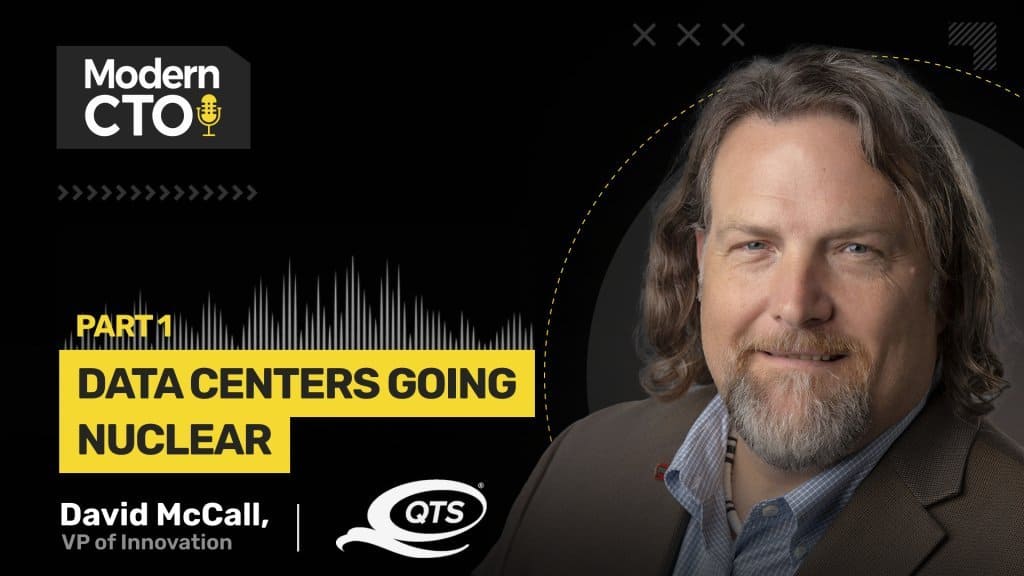
About David McCall
In his role as VP of Innovation for QTS Data Centers, David McCall is responsible for building teams, setting strategic goals and serving as an evangelist for one of largest and fastest growing data center service providers in the United States. He has more than 14 years of solutions engineering experience in the data center, telecommunications and internet technology industries.
About QTS Data Centers
QTS Realty Trust, LLC. is a leading provider of data center solutions across a diverse footprint spanning more than 9 million square feet of owned mega scale data center space throughout North America. Through its software-defined technology platform, QTS is able to deliver secure, compliant infrastructure solutions, robust connectivity and premium customer service to more than 1,100 leading hyperscale technology companies, enterprises, and government entities.
Transcript
(Intro Narrator at 00:00:00) Today, we're talking to Dave McCall, VP of Innovation at QTS Data Centers, about nuclear power, global connectivity, and more. You're listening to Joel Beasley, Modern CTO.
(Joel Beasley at 00:00:18) So how much of the world is currently connected? Like, how much of the world is currently online?
(Dave McCall at 00:00:27) One way or the other, probably depends on who you ask, but somewhere between 65-75% of the world.
(Joel Beasley at 00:00:35) And what's holding back 100%?
(Dave McCall at 00:00:40) Well, there are a number of things. First of all, the places that aren't connected, including parts of America, it's very, very difficult from a geographic standpoint to get into those areas, to bring infrastructure into those areas, and it's very expensive. And so if there's not a lot of eyeballs there, then they're not going to invest the money to do it in the past. One of the great exceptions to that was after World War II when President Eisenhower, President Truman and President Eisenhower, put together the interstate program. Look.
(Dave McCall at 00:01:22) We're building freeways because it's basically national defense. Of course, it's going to facilitate commerce. Of course, it's going to facilitate these other things. But it's national defense. We need to be able to move across our country, north, south, east, west, and have multiple arteries, no single points of failure.
(Dave McCall at 00:01:41) Right? We all got, and we need to employ a bunch of soldiers. We need them all working, and then we need them doing the ancillary jobs, and then we want them driving the buses that are on these new roads, whatever. And so we didn't build a freeway everywhere, but we built them certainly connecting all the metropolitan areas, whether it was at that time a small town like Milwaukee to a big town like Houston. And we built this infrastructure.
(Dave McCall at 00:02:07) And we just got behind the project like it made sense to us. So from a connectivity standpoint, there's a lot of parts of Southeast Asia, a lot of Africa, and the geography is really hard. Two, the local population may not be easy to work with. It might be at war. There might be, if not at war with the people that want to bring connectivity, those in power tend to have connectivity and access to resources and whatever.
(Dave McCall at 00:02:39) Why do they want to give the community that they've got in control? I mean, these are micro areas. This is not in the macro. But the short answer is it's hard. It takes a lot of money.
(Dave McCall at 00:02:52) There is a lot of innovation, though, going on for people, and their constant experimentation. Some of the largest organizations on Earth with balloons, with forms of satellite communication, all kinds of things, low earth orbit satellites, especially in the Asia Pacific islands. All kinds of stuff going on where they're able to bring 4G equivalent connectivity through this technology. Look at Elon Musk and Starlink. The other side of that, though, then is as you start to build out these constellations, whether it's satellites or others, well, what's the impact to the night sky?
(Dave McCall at 00:03:32) What's the impact to just my enjoyment of the sky? What's the impact to things that want to traverse the sky? What's the impact to the technology that rides the higher level orbit? Like, how does that interfere? So as we solve one thing, we're constantly bumping into these. What's the unintended consequence?
(Dave McCall at 00:03:50) But those are the things. It's, and then, like, a lot of things are supply chain and whatever. But it's, with all that said, we're still building connectivity as fast as it can be built. It's really pretty incredible.
(Joel Beasley at 00:04:08) What is it like when we get 100% connected? Is that a good thing?
(Dave McCall at 00:04:19) Because we...
(Joel Beasley at 00:04:19) Have Starlink. Right? Like, is Starlink geographically limited? Because...
(Dave McCall at 00:04:24) Well, the way that, is Starlink geographically limited? I mean, it's just, you know, how fast can they get it up and where can they get it approved to be deployed? And so you've got, you can't just run out in your backyard and start firing off satellites and attach them to the constellations or whatever for yourself, allegedly. But it's, and it's not the only constellation that's out there that's competing. There are others.
(Dave McCall at 00:04:54) I don't know their names off the top of my head. But once something, it's like electric cars. You know, once Elon's experiment really got traction and the public's buying it, well, now there's all this interest in it, just like...
(Joel Beasley at 00:05:06) Blue Origin.
(Dave McCall at 00:05:06) Right. Blue Origin, right, with rockets and all these other things. And so, well, now how do we regulate that? How do we know what's going to help us and what's not? But I do think overall, this is my, it depends.
(Dave McCall at 00:05:29) Was the combustion engine good for us? Yes. It changed. Like, is fire good for us? Fire is one of the most destructive things on earth. It's used in every imagery you could think of for judgment, anybody who's put their hand through whatever.
(Dave McCall at 00:05:45) But without fire, we're still sleeping in a cave with a, you know, with an unhardened spear tip.
(Joel Beasley at 00:05:51) Chewing 12 hours a day.
(Dave McCall at 00:05:53) Yeah. That's what we're doing. Right? And so these technologies, this stuff that we harnessed and apply, are spectacularly powerful. They can be for the benefit of human flourishing.
(Dave McCall at 00:06:07) But if we don't bring rigor and oversight to them, if we cede it to somebody else, you can absolutely bring disaster upon yourself. And so I think for people to be connected, you're now connected to the economy, whatever that means. You're now connected to the economy. And at least as it exists in 2024, if you want to, you look at the macro spots where they are not connected and or don't have reliable, affordable energy, whatever that form looks like, you're in utter poverty. And so that worm that bores through the eye of your kid because you can't get it out because there's no infrastructure, there's no medical, like, you're not going to have medical infrastructure, not sophisticated medical infrastructure where there's not energy and connectivity.
(Dave McCall at 00:07:06) You're not going to have any of those things where they're absent. You're absent any of the modern things. And so you could put a warm compress maybe on an eye and hope that that does it. I'm not trying to criticize all the things, but those things when they come together, the water wells show up, the other things show up, medicine shows up, all these other things show up. And so for sure, we should connect, but we should connect in a way, like, we're going to talk about hopefully nuclear power in a little while.
(Dave McCall at 00:07:38) So far as I know, one of the most spectacular sources of energy on earth that could be used to destroy us all if we're not careful. But it's also carbon free. And there's, I'm not an SMR or nuclear energy expert. I've talked to a bunch of them. And there are designs out there now.
(Dave McCall at 00:08:01) We're going to talk about this more, but you can recycle that waste in some of these designs two or three times to get it to where the waste is a problem for less than 100 years. So it goes from tens of thousands of years, recycled several times, getting energy out of it each time, less and less, but still energy, carbon free. And the waste upon final release is very negligible. It's not 100,000 in a cave or whatever the number is. But would we ever want unrestricted nuclear, the potential of nuclear running all over the earth? I don't think we do because if somebody gets really upset about it and wants to apply it in a way that could harm more than themself, I think that's the same way with connectivity or any of these other things.
(Joel Beasley at 00:08:52) Where do you, where does QTS sit in the stack? So in my mind, when we say connectivity, I imagine the companies that are like laying fiber.
(Dave McCall at 00:09:03) Mhmm.
(Joel Beasley at 00:09:03) Right? Or Starlink. But data centers are also involved in that. Yeah. So do data centers have to be physically nearby, or can you say if the location has Starlink and reliable power, those other things will come?
(Dave McCall at 00:09:19) It depends on what you're getting the data center to do. So if you think of the data center as the house, and the house is where, in the case of a house, when we say house, it's where people live. Right? And so the house design is always affected by the environment that it lives in. The people that live there, has to be habitable for human beings.
(Dave McCall at 00:09:39) So in the case of a data center, it has to be habitable for computers. But what's the computer doing? Is the computer an AI training model? So data centers have three principles always. They have to be always on, so they have to have reliable, 100% up power.
(Dave McCall at 00:10:01) That's their goal. Although there are contingencies if there's a failure in there, but they're designed to be 100% up whether you're doing maintenance on them or whatever. It needs to operate. So they have to be 100% up. They have to be 100% available. So they have to be connected.
(Dave McCall at 00:10:21) If it's a data center that's serving up data in real time to a hurricane tracking or a 911 system or whatever, or trading on Wall Street or whatever, it is spectacularly latency sensitive, which is the amount of time between the thing that's generating the data and the data center it's connected to, to get it to a computer and get back, has to be faster than an eyeblink. Millisecond, just a few, three milliseconds, five milliseconds or less fast, instantaneous. But if it's training something, like, what does the number nine smell like? And I'm going to work on that for two months. I'm not latency sensitive. I'm still connected.
(Dave McCall at 00:11:07) But if it takes three seconds for it to go to the computer and then from the computer to travel, you know, 200 miles to get to something or whatever, it doesn't need to be instantaneous. Well, now that can live not near the eyeballs. And that data center, the role that it plays is completely different. So you have always on power, always available connectivity, and always secure. It has to be physically secure, it has to be logically secure.
(Dave McCall at 00:11:38) Now if a data center is for a big social media company, if they own it, it's their data center, not only do they own the infrastructure, the house, they own the yard, they own the fencing, they own the security locks, they own all that, but they also own all the content within it. An organization like ours, we're responsible, it's like it's a condominium. I build the home, I design it, I build it, I operate it, I make sure it's physically safe, I make sure the locks are all the best locks, I make all the physical perimeter, it's all connected, everything's operational. But you move in, you move your infrastructure in, you're responsible for managing your own environment inside the house. I'm not responsible for managing your environment.
(Dave McCall at 00:12:25) So if you give a password out to all of your people when they log into the systems and you don't have robust security around your internal mechanisms, you're going to be vulnerable. So you're responsible for that. I am responsible for the entire environment around it, at least in my world. So we design data centers. We build them.
(Dave McCall at 00:12:47) We operate them. And our customers, whether it's the entire building or it's just a rack or a cabinet within the, you know, a small room within the data center, they're responsible for their infrastructure unless they've given that to us to manage. But they're responsible for those things. So the data center sits in the stack of connectivity. It's where all the data lives. It lives in somebody's data center, mine, or that social media may own their own and do it themself, or a university or something like that.
(Dave McCall at 00:13:18) But usually, it's in a third party data center.
(Joel Beasley at 00:13:21) Okay. So you build and maintain the physical structure, but they come into the condo and they decorate it, furnish it, and control the guest list.
(Dave McCall at 00:13:30) That's right. Yeah. That's right. Or an apartment building. Right?
(Dave McCall at 00:13:34) Now they could buy the, they could have the entire hotel or the entire apartment building. If they want to knock down walls, if they want to do all that, so long as we're not violating the structural integrity of the entire thing, if they're occupying all 500 apartments, it's theirs. But if they're just occupying their apartment, they have to follow the rules of the apartment building, and we'll manage that. They're responsible for their own stuff. And just like any big, you know, an apartment or a condo or a home or whatever, there are rules on how you move in.
(Dave McCall at 00:14:06) There's rules about how you live in it. There's rules on how you move out, for the community good. So sometimes they might have the entire data center for themselves. But as often as not, they share it with other people.
(Joel Beasley at 00:14:21) When I was preparing for the interview, I came across the statistic. I didn't know if it was true, but it said by 2030, the power consumption is going to double. The power consumption needed for data...
(Dave McCall at 00:14:34) Mhmm.
(Joel Beasley at 00:14:34) Compute is going to double. I think it in North America, it was, like, 17 base and then multiply that by two. Right? Is power a bottleneck to constructing the new facilities?
(Dave McCall at 00:14:50) 100%. It is, there's always five or six things, maybe seven things, depending upon how you count that you want. I don't know if I know them all off the top of my head, but access to power, connectivity. You want it to be out of natural disasters, so there's a geographical component.
(Dave McCall at 00:15:10) It's got to be near people that can operate it. You have to have logistics. You know, we move things in. Everybody talks about the data center, but the real story is the things inside the data center. The tens of thousands, if not hundreds of thousands of systems in some cases, not just the systems that support the data center, but the systems in the data center that live within it.
(Dave McCall at 00:15:34) And so they come and go. It's constant, you know, that IT environment's constantly evolving. So you've got the logistics of that. It's got to be, you've got to live in a business environment that, you know, the cost of access to power or connectivity have to be affordable. So all of these things come into play.
(Dave McCall at 00:15:57) But the number one, the longest pole in the tent is power. Number two is connectivity, which is almost today as difficult as power. Nobody's ever talking about it, but it's a difficult situation. But power is number one. Is there a bottleneck in chips or physical hardware?
(Joel Beasley at 00:16:13) Are we producing as a people more than enough to build as many data centers as you want?
(Dave McCall at 00:16:13) Well, the chips and the systems don't really come into the, that'd be like saying the couches. The couches don't come into building the apartment, building the furniture. We can build, we have enough infrastructure, more or less, to build the data centers. Now is there pressure on the supply chain for the systems, the mechanical?
(Dave McCall at 00:16:39) So when we say mechanical, we mean the cooling. When we say electrical, we mean the power usually. That's a loose way to describe it. And then you have all the other equipment, the life safety equipment, all the other components that go into a data center. Are there occasional microspots of ebb and flow for the security components or the building material or whatever?
(Dave McCall at 00:17:02) Yeah. We keep a pretty close eye on it. We've developed a system that's worked for us really well over the last three or four years. It put us in a great position with some of the challenges that exist in the world today. But really, it is about access to power.
(Dave McCall at 00:17:19) So that's the biggest. Far and away, it is the biggest in the immediate and in the long term. And the reason for that is, you know, people ask me all the time, like, why is this all this growth? What's going on? The more we humans use, the more we want.
(Dave McCall at 00:17:39) And the more we want, the more we make. And so then the more we make, the more we use. Just imagine two years ago, how much did you use large language models? Zero. Very little.
(Dave McCall at 00:17:52) If you look at how many, just I was out practicing a drone the other day, trying to learn how to do content for my podcast and other stuff. And so I was out with the drone, and I ended up on a great four mile walk with my buddy. I need to do that more. He uses LLMs all the time. I use them every day, but not to the degree that he's writing code and experimenting with a bunch of stuff.
(Dave McCall at 00:18:14) And he's using them to make a lot of images now, so just blowing my mind with some of the stuff he's doing. It's a lot of fun. And as I thought about that, Joel, what I was thinking about was that traffic is not a new human being learning how to use their smartphone. Forever, up until the last few years, the growth in technology is as more people get on and they start putting IoT things in their home or their businesses or whatever, there's this growth, a pretty spectacular growth.
(Dave McCall at 00:18:43) But until really recently, the power grid actually was declining in demand. It was not growing in demand because we moved from energy-heavy lights to LEDs. We moved from energy-heavy things to these. We started getting smart thermostats in and started running things more efficiently or whatever. What changed then?
(Dave McCall at 00:19:02) It wasn't that we got a whole bunch more people. We have been growing more devices and stuff, but the devices began talking to the devices. And so this is an additive thing. It's machines talking to machines. It's integrating the systems to work better together.
(Dave McCall at 00:19:22) It's as a person, I'm now asking my LLM to do these five things and then maybe talk to another LLM with its result. And then I've got these things coordinating and transcripting and doing all of this other stuff. We talked a little bit about this offline. And so now I'm like, oh my gosh, I'm so much more efficient in getting concise and bringing value to my executives in a certain way or turning content into material that's important for them or to my patients.
(Dave McCall at 00:19:51) I now have these things helping me look at images or whatever, or write my medical report in a simple paraphrase, whatever. And I'm using all of these systems, which is causing all of this growth. And nobody, none of us predicted it. We knew it was gonna grow, right? This is, again, we're connected to the economy, but it's just the way that it's exponentially growing.
(Dave McCall at 00:20:17) And so now we need not just the power, but any limited resource—water, power, whatever. And so there's a lot of emphasis on that.
(Joel Beasley at 00:20:27) So power is the big thing. That's why—
(Dave McCall at 00:20:29) Power is the big thing here, guys. Yeah. But not just nuclear. We talk to anybody. We're in love with intermittent power. We've talked about that for a long time. Intermittent power, though, I got to interview a guy named Professor Donald Sadoway out of MIT, very famous TED Talk, kind of clickbaity, I loved it, which is there's no such thing as green energy. I was like, what? Are they against green energy?
(Dave McCall at 00:20:57) Of course they're not. They are a hundred percent all in. I would love to have my home primarily on solar with one of those big Tesla refrigerator batteries in my house. I can run my house for a week and sell off my excess to the grid. But if you don't have energy storage for a base grid, it doesn't do well with intermittent energy.
(Dave McCall at 00:21:21) When the sun's shining and it's hot, it's making energy, an immense amount of energy, or when the wind's blowing, it's making great energy. But the wind doesn't necessarily blow where there's people. So how do I get it from there to there? So I don't want to do more harm than good.
(Dave McCall at 00:21:38) And the sun doesn't always shine in all places the same way. And so I need to store that energy. Well, how do we do that? How do we create—he said—energy storage has to be three things, or I guess four things.
(Dave McCall at 00:21:53) First of all, it has to be grid level, so it has to be massive, hundreds of megawatts in size for a system. Well, if you're gonna do something like that, it's gotta be safe, it's gotta be easy to operate, and it's gotta be locally sourced. To get a whole bunch of rare earth materials from four states away and truck them in, or even worse, a continent away, defeats the entire purpose of having intermittent, carbon-free power. So you got intermittent energy.
(Dave McCall at 00:22:24) We're for that, but it's just gotta be applied correctly, and we're all working on energy storage. Then you have others. You have hydropower, where some parts of the country work great with hydropower. It's right there at the dam. We have a big giant dam right up the street here in Georgia, but you've got it around the country, but it's not everywhere. It's not in Arizona. And then you have natural gas. We're flaming off natural gas in parts of the country.
(Joel Beasley at 00:22:49) We're flaring it. Yeah.
(Dave McCall at 00:22:50) We have so much natural gas. Nirvana looks like energy that is dirt cheap, that is carbon-free, that is readily available, and spectacularly safe. That's paradise. We're not there. We gotta eat on our way to paradise.
(Dave McCall at 00:23:07) So what does that look like? It might be that we get these turbines in that are turned by natural gas or turned by hydrogen or they're turned by hydro or whatever—intermittent energy, whatever the mix is, just like the grid today. But we need to pour in our resources into, my personal belief is, let's not pick any particular holy solution. What's the solution that we can do right now today that we have the resources to do so we have energy sovereignty, we don't have to go away from our shores to get it, that is reliable, that is safe, that is affordable, and we build towards nuclear or whatever it looks like in the future to turn those turbines to give us affordable energy. Because we don't just want reliable energy. It's gotta be affordable energy.
(Dave McCall at 00:24:00) And it has to be easy to get. We don't wanna be doing harm by trying to dig a pit somewhere else. That's what we might do today, but ultimately, that's what we're trying to move towards. So people, infrastructure like ours is constantly investing in energy sources and trying to figure out how do we invest in those communities so we can serve our communities, so we could serve the public.
(Joel Beasley at 00:24:27) There are roughly 422 nuclear power plants in the world. Roughly. That's what I read this morning.
(Dave McCall at 00:24:35) Okay.
(Joel Beasley at 00:24:36) I don't know if it was accurate. I was like, sounds smart.
(Dave McCall at 00:24:40) Sounds confident.
(Joel Beasley at 00:24:41) Sounds like it sounds okay. So, yeah, 400—I just Googled for it, and that's what the Google says. Okay. So I thought to myself, wow.
(Joel Beasley at 00:24:50) If you go tell the average person there's 400, 500 nuclear power plants, they're gonna think, no, there's not. There was one and it exploded.
(Dave McCall at 00:24:57) Right. Right?
(Joel Beasley at 00:24:58) Yeah. And so I think it would be cool to have, like, replace your local substation with a small, like, community nuclear reactor. Yeah. I think that would be cool. Yeah.
(Joel Beasley at 00:25:08) If not down to the house. Yeah. Well, we put them on subs. You were in the services.
(Dave McCall at 00:25:14) We had nuclear power subs for a long time. Almost the entire Navy is—
(Joel Beasley at 00:25:19) Take that engine and just put it at, like, the city street block.
(Dave McCall at 00:25:23) Yeah. Well, there's a lot of—I mean, I'll start getting over my skis here in a second, but there have been incidents that happened in the past, and there are designs out there that caused, through some misinformation and some exaggeration, concern, public concern. And we really didn't think about, why worry about it when you've got coal or you've got whatever other readily available resources? In the eighties, it was gonna be an ice age. Was it gonna be warming, global warming or whatever? Right?
(Dave McCall at 00:26:00) And so you get more information. The world changes. And so I don't even wade into those conversations. I would love very inexpensive, very safe, always reliable, scalable energy. So what does that look like? How do we do that? What resources do we have available for us to do that with? Our entire Navy fleet is these little small modular reactors.
(Dave McCall at 00:26:29) I was just at an event. I got to interview Christine King who's with the GAIN program out of the Idaho National Lab, and so nuclear engineer, nuclear scientist. There's a lot of conversation around nuclear today. What I don't wanna do is just say we've now appointed this is the energy source. It's fascinating to me.
(Dave McCall at 00:26:45) From what I've read, who I've talked to, what I've learned, it's an amazing energy source, and it should be fully embraced. That is my opinion today. And if new information comes along that says that's the wrong idea, I could appreciate it, and I'll change my opinion. A good friend of mine, this is anecdotal, but a good friend of mine who is from a European country that shut down all of their nuclear energy and gets all of their energy from somebody they've gone to war with every hundred years for the last several hundred years, through natural gas, that could say, you know, is this stable? Is it not stable or whatever?
(Dave McCall at 00:27:28) At least in this person's perspective, they're rethinking energy sources and what should we be doing and how should we be doing it. So I think that for my industry, what we're looking at is, and I think all critical infrastructure—I've heard many government officials at these events that I've gone to talking about this—how do we—and that's by the way, those SMRs, they're not tomorrow. They're somewhere between five years if you're a salesman for those organizations and ten to twelve years away.
(Dave McCall at 00:27:58) I don't know what's true, but I've seen a number of the new designs and the way the new designs work when we're talking about small modular reactors. So when we talk about nuclear energy, there's loosely two categories. There's a nuclear power plant, which is what we have here in Georgia, that has four big nuclear reactors in it. That takes a long time to build. It's very expensive.
(Dave McCall at 00:28:22) The regulation around it, and it should be, because there's so much concentrated right there, is spectacularly difficult to work through, although our legislators are looking at it now. But you have to have these many-mile wind drift. It's a big deal because it's thousands upon thousands upon thousands of megawatts of power. Whereas a small modular reactor might be 10 megawatts or 50 megawatts, you know, a borough, a neighborhood-size thing. You'd still want substations.
(Dave McCall at 00:28:52) You don't wanna just come off of any energy source and go straight into—you wouldn't go to medium voltage. You come off of high voltage, you go to a substation, which would then step it. You start stepping it down to a very safe, controllable voltage.
(Joel Beasley at 00:29:09) I want high voltage. Yeah.
(Dave McCall at 00:29:11) I bet you do. I bet you do. More power. Turn it to 11. Yeah.
(Dave McCall at 00:29:17) But there's a lot of conversation in my industry. I've talked to, and we're continuing to talk to, people that are in these adjacent power spaces, whatever their source, and public utilities, where critical infrastructure like ours starts creating their own energy. Or if we don't create it, because there's a lot of policy and regulation around that, the local utility maybe owns it, or we're partners with them, or maybe two or three of our frenemies come together and we do a joint venture. But I love the idea of going into a community. And let's say we think for the next twenty years, the infrastructure needs, I don't know, 2,000 megawatts, two gigawatts.
(Dave McCall at 00:30:00) But the greater community might need, for the next twenty years of growth, 3,500 megawatts. Let's build out a 3,500-megawatt infrastructure. And now not only am I supplying for myself always available, very affordable, very safe power, I'm extending it into the community. The people that work in that data center, they have long-term trade jobs, they have a great tax base, they have all these other things. We wanna be part of that community.
(Dave McCall at 00:30:30) And so there is a lot of talk about making that microgrid and making that infrastructure. Probably wouldn't start with nuclear because that's a ways away. It might start with one of the other energy resources to turn the turbines. And then when these other energy sources, if it makes sense, become available, you swap out energy source, turn off the natural gas pipe or whatever it is. Or just, probably more likely, you just add this, just like the grid today is a mix of multiple energy sources. That is a very attractive idea.
(Dave McCall at 00:31:00) And I've posed it to a number of people, and it's spectacularly difficult because there's a lot of policy, and there should be, around high voltage coming in, whatever the energy source is, and how do we manage through that and what does storage look like. But the potential of doing that and having your own generation and putting the excess back onto the grid, and if there's an outage, you get to tap into the grid as opposed to having giant battery banks maybe or giant diesel farms or whatever—we're still trying to figure it out. It's a really interesting conversation, and it's one that we're all having. What does that self-generation or at least that mix of generation look like, and how do we extend it beyond just ourselves into the community around us?
(Dave McCall at 00:31:47) I think that's as likely as any other scenario of the future. And for me personally, it's very attractive.
(Joel Beasley at 00:31:54) I did some—I was using GPT this morning. So I was curious at the rate at which people are getting electricity, Internet, safe drinking water, and sanitization, and which one—like, how fast they're both moving.
(Dave McCall at 00:32:14) Uh-huh.
(Joel Beasley at 00:32:15) And here's that graph.
(Dave McCall at 00:32:19) What does that tell me? What do those lines tell me?
(Joel Beasley at 00:32:21) So this is electricity, this orange one here.
(Dave McCall at 00:32:24) Mhmm.
(Joel Beasley at 00:32:25) And that's the rate at which people are getting it. And that's, like, the speed over time. So down here is the year. So this is 2015. This is 2020. The green one is safe drinking water. And then which one do you think is the Internet?
(Dave McCall at 00:32:41) It's gotta be the one on the bottom, that purple one.
(Joel Beasley at 00:32:42) That, yeah, that bluish one. Right. The blue is—people are—the Internet is just boom. It has to.
(Dave McCall at 00:32:49) It has to.
(Joel Beasley at 00:32:49) Many people are getting—I mean, what was—let me see what the number was. As far as number of new people getting Internet—
(Dave McCall at 00:32:56) Fifty percent of the world's not connected to broadband. They may have connectivity, but they're not connected to broadband. So you have to be connected first, and then you have to be connected to high speed.
(Joel Beasley at 00:33:08) 340 million people per year are coming online.
(Dave McCall at 00:33:13) That's crazy. That's not even the number. That's a false narrative, though, Joel. You should be thinking about machines that are coming online. What's crushing the highways of the interwebs is not the number of people.
(Joel Beasley at 00:33:29) It's the machines.
(Dave McCall at 00:33:32) Systems that are being added and then talking to each other. That's the thing that's startling to itself. Well, that's the scary part, right?
(Dave McCall at 00:33:40) I don't ever know what the outcome was, but I remember talking to my buddy who at the time was CEO of Accenture Digital or just retired. Pretty smart guy, double master guy from Georgia Tech, and just one of the loveliest people you will ever meet. And they had one of the big social media firms had just run an experiment, and it had system one trained, and it wanted it to train system two. So AI, advanced ML and AI, you teach your little brother and we're going to watch. Chimpanzee train—train A, train B—and we're gonna sit here and we're gonna observe.
(Dave McCall at 00:34:21) So it starts doing it. It's showing it the blocks and we're all observing, you know, outside of the cage, through the glass. This is interesting. This is interesting. This is amazing. Look at it. And then it walks over and closes the blinds. It cut off the communication.
(Joel Beasley at 00:34:36) That's awesome.
(Dave McCall at 00:34:37) So we couldn't monitor what it was teaching. Now was it doing it on the one hand because it leans over to chimp B, hey, look, here's the thing. There's a whole bunch of other chimps outside that window. I want you to keep playing along with this whole block thing. But tonight at the waterhole, I'm going to bring you into the club and we're going to raid this mofo and we're going to take it all down.
(Dave McCall at 00:35:02) Like, is that what's going on? Are they conspiring? Probably.
(Dave McCall at 00:35:07) Or it's running through its program of what's the most efficient way, and I keep seeing Chimp B look at the glass, and I need it to stop. I need to focus on me so that I can fulfill my mandate and train it. And once I'm done, I'm going to reopen the blinds and I'm going to tell the chimps out there, "Ta-da, check it out, see how I did." But my mandate is to efficiently and effectively train Chimp B, but it keeps looking out the window. And there's nothing more nefarious than that.
(Dave McCall at 00:35:40) I'm just trying to get my job done. We tend towards, "What did it just do? How did it even know there was blinds? How did it even know we were standing there?" We're freaked out.
(Dave McCall at 00:35:52) And then it closed them? So they pulled the plug on the whole thing and whatever. My buddy was like, "I mean, I suppose it's possible. Let it roll." Right?
(Dave McCall at 00:36:01) I don't know. I'm not a—but could you imagine if you make these machines and you've got this one and you think it's super intelligent, and you tell it to do something, and the very first thing it does is it kind of gives you a glance, and you could interpret that glance as, "Hey, trust me," or you could interpret that glance as, "I'm going to end you." And then it changes the environment in some way. Do you think that the machine's doing it to eliminate cancer, and so it just decides, "Oh, just get rid of the organic life forms. I got rid of cancer."
(Dave McCall at 00:36:30) "I served my mandate," and off it goes. Yeah. Or, I think that's it. And it could, I suppose it could do either, but that's where we've got to stay engaged.
(Joel Beasley at 00:36:39) I'm not even that worried about that. Yeah. You know what I'm worried about? A person just instructing a model to achieve something.
(Dave McCall at 00:36:49) Sure. That's the most likely.
(Joel Beasley at 00:36:51) Yeah. I notice the conversation 99% of the time, and it's fine because it's in movies and stuff, is the AI deciding it wants to do it. It's like we're sitting here building all of these capabilities.
(Dave McCall at 00:37:04) Yeah.
(Joel Beasley at 00:37:04) To it. Yeah. Baking it into everything that we see, touch, and have. Yeah. And then we're like, yeah, we're—our big concern is it might become—have plans of its own. It's like, that's not my concern. My concern is not the gun having plans of its own. Right. My concern is the fact that the gun exists and it's in somebody's hand and they can do what they want with it.
(Dave McCall at 00:37:27) Well, the fire is always going to exist. Yeah. It's not—
(Joel Beasley at 00:37:30) Oh, I know.
(Dave McCall at 00:37:30) It is.
(Joel Beasley at 00:37:31) And I'm very pro-gun.
(Dave McCall at 00:37:32) And set—yeah. Yeah. Yeah. No. That's—you live in a constitutional carry state, so do we.
(Dave McCall at 00:37:39) But this is not a comment about that. But just using your analogy, let's just say it's a hammer or a knife. Nobody's saying get rid of the serrated blade. And if we could always trust all humans in all situations, we wouldn't need any rules that define how, who can have a serrated blade and under what situations, where can you bring it into the public space and under what conditions, whatever, because human beings, we get wonky.
(Dave McCall at 00:38:08) It has nothing to do with the blade. The blade led to human flourishing. All these things lead to human flourishing. And occasionally, when misapplied, when human beings don't govern in a way that's best for the community, it gets misapplied. If you allow somebody else to apply the tool without oversight, it always leads to a consequence, a negative consequence.
(Dave McCall at 00:38:36) So I don't want to give up the tool. Are you kidding me? It changes the world. Yeah. But we've got to continuously and rigorously apply oversight to make sure it's applied in the correct way.
(Dave McCall at 00:38:48) And when we don't, there will be spectacular consequences as a result, and then we learn and we do it differently. I got—one of the really interesting guys I got to talk to a long time ago, a couple years ago, his name was Doctor Patrick Attila, I believe, A-T-T-I-L-A, something like that. He was a professor of history here in Atlanta. Might have been Georgia Tech. I forget where.
(Dave McCall at 00:39:16) But he posed this question, and it has nothing to do with race, but it's—or it has everything to do with race, but not this conversation. But it was this. He said, "You know, we need to, when we look back in history, learn some of the big lessons from history, but not just as they apply directly." It's how I sort of interpret it. And he gave an example of the Civil War.
(Dave McCall at 00:39:38) There was a time when people in America were willing to die to kill their brothers, to be disconnected from their family, to protect the right to own other human beings. What is it that you have to believe? They thought they were right. They weren't like—you would think today, two hundred years or a hundred and eighty years removed from it, whatever it is, you're like, "That's horrifying, the concept of owning people."
(Dave McCall at 00:40:08) It's like, we can't connect. But at one time—and he would also say it's really lazy and eager to talk about, "Well, they're unintelligent," and they're all these other things. Well, if you're taught—cultures are taught something all this time. So what can we learn? How do we look at things in the past that we were convinced to the point of giving up our life for that weren't true, that are evil or wicked or however you want to describe it, owning another person?
(Dave McCall at 00:40:41) So we need to—somebody convinced a group of people because it hadn't always been that way in Georgia or America or whatever. So how do we—or the world, how do we hold each other accountable to evaluate things and say, "This is true, this is honorable, this is worthy," whatever the tool is or the belief system is or whatever, versus not? Because we can convince ourselves of anything if we're not careful. And so, anyway, I think the way that we help to do that in a world that's highly connected in some parts already—
(Joel Beasley at 00:41:14) Mhmm.
(Dave McCall at 00:41:15) Is make sure everybody has access so that they can be connected, so they can seek out the components of truth. And truth can compete against things that are untrue, and let the truth prevail. And if it doesn't because we get lazy or unsophisticated or whatever, we'll bear the brunt of it. Hopefully, we don't do that. I don't plan on doing that.
(Joel Beasley at 00:41:36) Thank you so much for listening. And if you found this episode useful, please share it with a friend or a colleague who you think would get value from it. And if you have topics that you'd like to hear discussed on the podcast, either add me on LinkedIn or send me an email, [email protected]. Every time I get an email or LinkedIn message, it absolutely makes my day and inspires me to keep going.