
Episode 628 ·
Navigating Tech Layoffs, WALL-E-esque Societies, and Godzilla-level Events Part 2 with David McCall, VP of Innovation at QTS Data Centers
Today we’re talking to David McCall, VP of Innovation at QTS Data Centers. We discuss the tsunami of tech layoffs over the past year; the possibility that our society turns into the Disney movie WALL-E; and how to be truly prepared for a Godzilla-level event in your life.
All of this right here, right now, on the Modern CTO Podcast!
Check out the QTS Experience Podcast on YouTube!
Produced by ProSeries Media
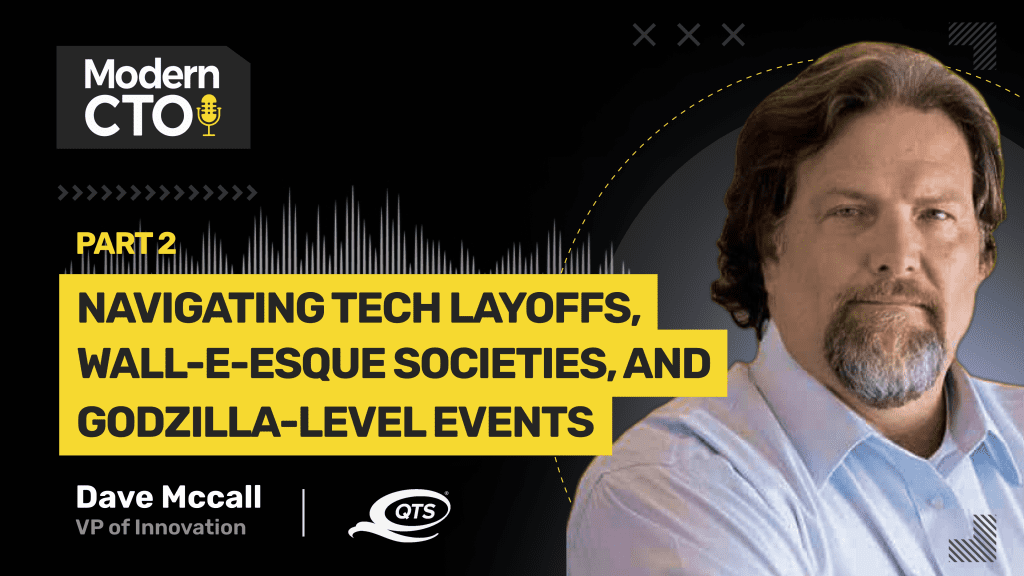
About David McCall:
In his role as VP of Innovation for QTS Data Centers, David McCall is responsible for building teams, setting strategic goals and serving as an evangelist for one of largest and fastest growing data center service providers in the United States. He has more than 14 years of solutions engineering experience in the data center, telecommunications and internet technology industries.
About QTS Data Centers:
QTS Realty Trust, LLC. is a leading provider of data center solutions across a diverse footprint spanning more than 9 million square feet of owned mega-scale data center space throughout North America. Through its software-defined technology platform, QTS is able to deliver secure, compliant infrastructure solutions, robust connectivity and premium customer service to more than 1,100 leading hyperscale technology companies, enterprises, and government entities.
Transcript
(Intro Narrator at 00:00:00) Today, we're bringing you part two of our conversation with Dave McCall on the tech layoffs and spiritual impacts of technology. You're listening to Joel Beasley, Modern CTO.
(Joel Beasley at 00:00:16) Let's talk about the layoffs, the layoff tsunami. I think that's a direct quote from you.
(Dave McCall at 00:00:23) Yeah. So many of those companies are customers of ours, and, you know, talk to any of the technologists in that space. One of the things, the thing that's been most consistent for, you know, where I started to go with that thought, was they all have a different theory of why it's happening. I know you've talked to some yourself.
(Dave McCall at 00:00:49) The thing that's most consistent with me is there doesn't seem to be a rhyme or reason on the who. Or, wait a minute, that product over there was making you money. It was in the green. It was popular within your community and within your, seemed to fit the narrative of your corporate goals. Why tank that?
(Dave McCall at 00:01:16) Or that's two or three of the, not just the brightest people you have in that organization. They know where everything is, and they're, all things considered, not very expensive. The cost of production. I'm not talking about a senior-most person. A medium person that has a lot of experience, a lot of tenure, very difficult to replace, a lot of skill in that.
(Dave McCall at 00:01:41) They'll probably go to a competitor or some other group that's gonna have a consequence for you in the long run. I don't know. Why do you think?
(Joel Beasley at 00:01:51) Well, Josh, who did we have that conversation with?
(Intro Narrator at 00:01:54) It's mostly Brian Singer.
(Joel Beasley at 00:01:56) Brian Singer. Did you hear that one? Is that the one you're talking about, or no?
(Dave McCall at 00:02:00) Yeah, I remember. I listened to your podcast regularly. That was a few months ago, I want to say. Yeah, I don't remember.
(Joel Beasley at 00:02:07) We debated. He had this theory about why all these people were getting let go, and we sort of shared and brainstormed two or three different reasons. One, because of the tax money and the free money pipelines stopping.
(Dave McCall at 00:02:22) Right.
(Joel Beasley at 00:02:24) I can't remember all three, but there were about three different reasons. But he said the same kind of thing that you just said. He goes, one of the things that didn't make sense is who got let go when they got let go. And I don't know what to do. I know this: if I have someone on from any of those places, they won't tell me.
(Dave McCall at 00:02:43) Yeah, well, they won't tell me either. We've, my company's benefited. We've got some genius people now. We were able to go out on the marketplace and just upgrade. We didn't replace anybody. We just, it's all additive. You know, data centers right now are having a moment. The thing about OpenAI tools or whatever is you need digital infrastructure for it. There's just, you know, the two things for any modern civilization, to your point about a kid in some other part of the world: they need electricity, they need connectivity. I don't make electricity, but we are part of the heart of the digital infrastructure, whether it's on the telecom side or the data center side. You know, somebody says a cloud. Well, I'm the sky for the cloud. They live in somebody's data center somewhere, their own, some combination of data centers.
(Dave McCall at 00:03:37) And so as we've added people that have been a result of these consequences, we have just been able to add some of the smartest, genius, really creative thinking people. So we're experiencing not a renaissance, but a just a great burst of talent. So we love that. What we're scratching our head about is we're not really sure why. I am reminded now what you said about the tax, that Brian brought it up. I never researched that, but man, that resonates with me. It has the ring of truth that, for sure, if that's the way that, Brian and I have no reason to doubt him, this is the way that he laid it out. I can see that, and it kind of makes sense.
(Dave McCall at 00:04:28) There's so many, you know, with so many of these organizations, we're rushing into, you know, indulging, I don't want to say indulging, but just exploring all these creative ideas and all of these teams and all of these work streams. I could see if they had these incentives how they could afford to do that. Where it doesn't make sense to me is incentive or not, these, at the core of your business or in your businesses, these people would, I would think, would be the last to go. They're not the most expensive. They're not at the top of the food chain. They're exponentially qualified to solve the problems that are core to your business, and they're not there anymore. It surprised them. I don't know the rhyme or reason of it, but we're going to take advantage of it.
(Joel Beasley at 00:05:19) Yeah. And I can't remember his point. I brought up the tax thing because I saw the money go away. Yeah, because it was a direct stoppage of money for your employee retention, and so that's dollars. He had a couple other perspectives on why it might be, but the one thing that was unsure is why they cut who they cut, right. And one of the only ideas I have there is the second reason, other than the tax free money going away, is all the big businesses want the Fed to stop raising rates. And the Fed is saying we're not going to stop raising rates until the economy is impacted. So I think that they were quick cuts with not a lot of thought behind them. There's like, look, we need to shed 10,000 jobs. We need to keep that news cycle going. You notice that they didn't all do it the same week. It was like they all announced in this order to create this feeling in society that there's just this massive amount of layoffs continuously happening. I think, look, here's why I think it.
(Dave McCall at 00:06:20) Right.
(Joel Beasley at 00:06:21) It's what I would do. If we were sitting up there and we were having these types of problems and they kept raising our interest rates, which is killing our profits through the debt that we have. All those companies have tons of debt. Right?
(Dave McCall at 00:06:31) Right.
(Joel Beasley at 00:06:32) Even though they have cash, they still have debt, but that debt's becoming more expensive, making it not make as much sense. They should have used their cash, right? So I'd, a quick thing is, hey guys, let's all get together and let's just start dropping, you know, chunks of employees here and there that aren't on our most profitable core product lines, you know, that are our bread and butter of what we're known for, for shareholders, so it doesn't freak shareholders out. Let's just cut a bunch. Let's just cut a whole bunch, and then we'll just cut one after the other. And I know it's a little bit nefarious, but it's also really not that far from reality because that's exactly what did happen. They just, every month or every other week, another person announced these cuts.
(Dave McCall at 00:07:11) I think that's an area I'm an expert in, but it seems to me the idea of people getting together either in some coordinated fashion, or maybe they were fast followers of, oh, that's a genius idea, they didn't do it very well. Because so many of the, if that's in fact what they planned, because so many of the engineers and design people in the infrastructure of their worlds. At the end of the day, these are genius, creative organizations. I admire pretty much all of them at the core of what they build and how they build it. It's just remarkable to me.
(Dave McCall at 00:07:52) It was more like, you know, it's the every third raindrop that hit somebody took that person out. It just is random, almost like, what was the Marvel movie where half of the population was wiped out and the other half didn't? There wasn't a rhyme or reason to them, to the people that were close to it. I haven't heard any of them across all of the major hyperscales that you could imagine, and I live in this world, having any thought like that. And if it did, if they, you know, evidently, the Fed didn't get the message because the Silicon Valley Bank failed, the second largest failure in history, Credit Suisse later. But SVB in particular, the consequence to so many people I know in that world was pretty spectacular. And I'm talking about, you know, executive leadership. They're still part of their organizations. That's not a, I don't think they're trying to tiptoe around it either. I just don't think they have that perspective.
(Dave McCall at 00:08:54) I'm not sure what it is. Whatever the confluence of things, your premise is as likely as any that I've heard, but it is, it's head scratching for sure. I don't know. I don't know what the answer is, but I am absolutely going to take advantage of the talent that's become available.
(Joel Beasley at 00:09:10) Yes. And that's the thing that matters most is what you do to what happens. And I want to be clear that I'm not all tinfoil hat on this one specific thing. I believe that the greatest driver could have been the reduction in free money. I mean, that's a huge driver because literally it was money to retain employees. So you were incentivized to bring these people on. But I believe, as a human, the way we make decisions, I think there's a lot of parts to it. Rarely is it one very ultra specific thing that you claim, like, this is the reason. You know, usually it's a little bit of, well, friends raising rates wouldn't hurt to lose people. We don't have this extra money. This is also happening. This is happening. That product's also maybe not doing so well and, or maybe, you know, whatever the reason is. I do believe that there are reasons. I do believe that there is some, you know, whether it's as simple as the person who led that department didn't have a good enough justification on their report, and so that whole department got cut just because they weren't good enough at communication. I mean, that is a completely realistic plausible reason why an important part would get cut is because you know how it works at the highest levels of leadership. It's very social.
(Dave McCall at 00:10:29) Sure. If I saw a pattern like that, I would agree. I would be quicker to agree. I just didn't see it. It just seems so randomized. Products that seem to be doing well that are still there, but the smartest, not most expensive, capable people in them removed. Other people that are much more expensive, in some cases, retained. Other products that aren't as successful, retained, where other, like, it's just, I don't know. It was, it's, now granted, I haven't, because I'm not part of that, personally, I haven't studied it very closely. I don't know if we're done with that, or maybe they just grew quicker, faster, more. I don't know what the answer is.
(Dave McCall at 00:11:11) But it is, it certainly, if you've been out on the West Coast in particular, it has been a lumpy six months for sure between the layoffs and the banking infrastructure out there. The weather that they've had makes me grateful to live in Atlanta, Georgia. I'll tell you that.
(Joel Beasley at 00:11:31) It's impacted our sales. One of our happy salespeople was doing far worse, and we were trying to figure out, you know, like, sales automation's working. Open rate's good. Deliverability. All of our normal KPIs are good. And then we realized, oh, she's only got California. And California's been put through the wringer. There's been a lot of turnover and lots of departments, and we chalked it up to that's most likely a territory reason why her meetings and everything are down.
(Dave McCall at 00:12:00) Yeah. It's, I think we're still figuring this thing out. I think we're figuring out, you know, there's this wild crazy growth and then there's consumption and absorption. And unfortunately, the idea of controlling costs through layoffs, which is, I've been exposed to this idea of conscious capitalism and learned that's really sort of a thing that's become normative in the early eighties and on, and that wasn't a normative management style before that. Presuming that's true, I think it's wildly unfortunate that organizations grow like that. We're pretty entrepreneurial in our organization, try to be very careful and guarded as we grow, to the best of our ability to manage that. But it is, it's just the randomness. As I see it and as I talk to my community that's connected to it, it's the wild randomness. And I don't know that any of us have come up with an idea that we all kind of nod our head and say, yeah, that makes sense. I could see a path like that. We haven't yet figured out the jigsaw puzzle.
(Joel Beasley at 00:13:09) So I've got a little thought experiment for you. Let's imagine a future, fourth industrial revolution eats up 80% of the jobs in an incredibly short period of time, more condensed than any of the other previous revolutions, so much so that there's not an opportunity to replace them all. What should this 80% of the laid off workforce do? What will happen to them?
(Dave McCall at 00:13:34) I think, what will happen to them? Well, for sure, if there isn't a, well, here's what's happened in history. Whatever the disruption has been, whether you're a weaver or a, pick a tool, they rebel. If there is not a path that leads to hope, there is rebellion. Good or bad, there is a rebellion and a revolution. That is human history, and I am certain that would be the case. But let's just presume that there is something better. I don't know. You know, as I think about the thought experiment, what I know in my own personal life is if I don't have something I'm striving for, I tend to not be the best version of me. Something that I'm striving for intellectually, something that I'm striving for morally, something in my community. And I think that's true. I mean, one of the things that COVID seemed to illustrate is that human beings are social creatures, and we're designed for community. There are outliers. I'm not talking about the outliers. But in general, we are designed to be in community and connected to people. And I believe in the West, we do the best in the world when we have a high value on life, we have a high value on, not outcome, but opportunity. I'm not a big equality of outcome person. I think that leads to all sorts of bad behavior and conversation for another day, but certainly opportunity, equality of opportunity. And so for that 80% that's disrupted, one of the things I don't think is that it's the government's job to provide a, what is that movie? WALL-E was the, I think it was a Disney movie, we're all sitting around in lounge chairs. I'm doing my best to do my WALL-E. Normally, I'm in a suit. This is my WALL-E suit. Normally, I'm not this thick. But it is, whatever, in order for our society to thrive, that 80% is going to have to have an opportunity, whether it's personal endeavor because my immediate circumstances are met, whatever they look like. But I'm going to have to be able to find a way to strive for the things that just bring value and meaning to me and to my community, whatever that looks like.
(Dave McCall at 00:15:50) And I don't know exactly. What I don't want to see is the government trying to come in and mandate some mechanism by which we find meaning or we're just doing mundane whatever. But I'm not one, look, if somebody came along and said, hey, look, we're going to create an opportunity for me and my family where I don't have to show up to work tomorrow if I don't want to. What would I do? In other words, I'm not trying to get a paycheck. I've got my health care taken care of. I've got my income taken care of, and I'm free in this society to do what I want.
(Dave McCall at 00:16:28) I probably do exactly what I'm doing. My name would be on the podcast, so my topics would probably be wider and different and maybe more controversial in my podcast. I follow the corporate rules because I'm a good corporate citizen. But I know that the best version of me is if I'm out there striving, and I would just let my curiosity reign. And I think as long as we as human beings do that, we'll adapt to whatever it is.
(Dave McCall at 00:16:53) If we don't do that, I think there will be rebellion and chaos in an order of magnitude that we have yet to experience because we just don't thrive without a higher purpose and a commitment to community. I think it's demonstrable. It's scientifically demonstrable. We know it through just personal experiences. So I don't have an answer for the what we would do, but I know what we should do.
(Joel Beasley at 00:17:23) And what's the what we should do in like two sentences?
(Dave McCall at 00:17:26) Yeah. Well, in two sentences, we should pursue things that bring us value, bring value to ourselves and to our community.
(Joel Beasley at 00:17:33) Yeah. A hundred percent.
(Dave McCall at 00:17:35) How do you answer that thought experiment? I call it a break. In Tennessee. So what would you do?
(Joel Beasley at 00:17:42) What would I do?
(Dave McCall at 00:17:44) Well, I'm sorry. Doing right now. Like, you created—you know, I know a little bit of your story because we are friends, and I admire you very much. And you said for you and your family, look, these are the things that are not only I have an aptitude for, but I have an attitude for.
(Dave McCall at 00:17:59) These conversations, for example. I love this community of thinkers, and I'm constantly improving myself and my business. Want to create a life for my family, but also to satisfy my curiosity and hopefully build value for my guests and for myself. Like, some version of that you've made for yourself and you're pursuing that. And so if the government came in tomorrow and said, hey, if you were at some corporate job, we've replaced that. Some machine's going to do that for us. You don't need to do that anymore. But we've got some universal basic income over here. We've got some other mechanism by which you're satisfied enough so you don't rebel. What would you do?
(Dave McCall at 00:18:39) You would do something similar to what you're doing now. So long before that government came in and intervened like that or technology, you have decided, I'm going to pursue this for myself because this is the best version of me.
(Joel Beasley at 00:18:52) If I could—I'm running with your thought experiment now. So let's just say that this happened. I believe currently with the limited experience that I have in life, I believe that what would happen is that most people would not. I think most people don't have the self-discipline, the drive, and the desire.
(Joel Beasley at 00:19:14) I think most people do the least amount if possible just to get by. They wake up and they drag themselves to a job they hate. Look at job statistics of how people enjoy their jobs. Right. This isn't my personal opinion. This is just what I've seen out there in data. And so what I think would happen is if you did that to 80% of the jobs, what you're going to get is basically a blast from the past. There's going to be gangs and violence and issues and sub-economies that pop up and drug usage and depression, and there's going to be all sorts of bad stuff. So to answer your question, if it was at a point where society was stable enough, where the police weren't so overrun that they could be out policing versus having to be at home to protect their families—right, if society was stable enough, I'd still be pursuing what I'd do.
(Joel Beasley at 00:20:00) Sure. If it wasn't, I'd be taking care of my family, growing food and doing things like that and figuring out how to make it. But here is the thing that gives me confidence, Dave.
(Dave McCall at 00:20:09) Mhmm.
(Joel Beasley at 00:20:09) No matter what happens, I don't give up.
(Dave McCall at 00:20:13) Right.
(Joel Beasley at 00:20:13) Like, that's it. Like, I go out fighting. Like, I don't give up. I don't care how bad it gets. I told people when I raised money for my business five years ago, one of the reasons why they told me after that they decided to invest in me is because I was standing up in front of them, all like 50 limited partners, and I said something along the lines of—they were grilling me, like, what happens if it doesn't work? What's the contingency plan? Or this and—I told them, I said, look, guys. I go, if this didn't—the only way something ceases to exist is if you decide you're going to let it die as an entrepreneur. I said, I will be working night shifts at Walmart scrubbing toilets and still trying to get this thing to work. Right.
(Dave McCall at 00:20:56) Like, there—
(Joel Beasley at 00:20:56) There is nothing that will stop me from trying to get this thing to work. Like, I will do that. You could find me. If I still don't get it to work, I'll be 80 years old still scrubbing those toilets trying to figure out how to get it to work. Like, I won't stop until we get there.
(Joel Beasley at 00:21:09) And for them, they liked that aspect of it, but it's the truth. It wasn't something I said to raise capital. In fact, I had never raised capital myself before that, and it was my first time ever doing it, and I haven't since. I've only ever done it once.
(Dave McCall at 00:21:21) Right.
(Joel Beasley at 00:21:22) So in a venture capital official way. So, yeah, I won't give up. I'll just keep going. I'll find a way to do what I love. And regardless if I have a lot or if I have a little, I'll figure it out.
(Joel Beasley at 00:21:37) I'm blessed in the sense that for some reason, I have that in my DNA. Yeah.
(Dave McCall at 00:21:43) Yeah. Well, it's a—you know, America in general or certainly in its foundation, we are pioneer stock. You know, the people that came, the people that survived, however they got here, they're pioneer stock, and they survived and they fought against every odd and it was, you know, when you go back in history and you read like real history of all the different groups and how they got here and how they survived. It was—we're a tough, hardy people unlike pretty much any place else on earth, not just because of our constitution, but this interconnected, many times spectacularly messy group of people. So what would happen if 80% of them found themselves without purpose?
(Joel Beasley at 00:22:32) I think it's been watered down a lot too.
(Dave McCall at 00:22:34) Oh, well, for sure. Yeah. Absolutely. There's no doubt about it. Right?
(Dave McCall at 00:22:39) There's a saying, I'm sure you've heard it before, that said hard times create hard men. Yeah. You know this. Yeah. Yeah. Yeah. Hard men make good times. Good times make weak men, and it's a cycle. And so but if there is a technological revolution where all of a sudden, beyond our ability to absorb the change, you know, whatever the percentage is, 80%, 40%, some consequential, unabsorbable group of people were set afloat with no purpose. Yeah.
(Dave McCall at 00:23:13) It would—there would be many of the things. Some of them would do what you did and what I would like to think I would do, which is, I'm not giving up. I've got a purpose greater than myself. I believe my steps have been ordained. I'm going to go out. I'm going to do the things that I feel like I have the aptitude and the attitude to do, and it'll work or it won't. I'm not trying to be naive or Pollyanna. That's what I've done. You know, I have a career path that kind of bounces all over the place, taking advantage of opportunities in front of me my whole life. The thing that I'm not going to do is worry about the things that I can't control.
(Dave McCall at 00:23:45) If I—at least I tell myself that I somehow have this emotional stability, but I have to face that regularly. I don't have control over these things. I've got control over these things. And if the population doesn't have a hope and maybe someday whether it's in the States or someplace else, we get that spot, we will rebel. There will be a rebellion.
(Dave McCall at 00:24:06) Whatever the outcome of that is, hard to say, but there will be a rebellion. And I'm sure people think about that and do these models all the time, and who knows whether they think that fits a narrative that they care about or don't care about. I don't know. But it is for those of us that around technology and we see all these amazing sparkly things, I think it does us good to also pay attention, to have a level of skepticism, maybe not cynicism, but skepticism. So what's the unintended consequence to my children, to my grandchildren, to the world around me if we allow—if in our world, we do not mandate certain uses of these tools and experiences.
(Dave McCall at 00:24:51) There could be consequences that we can't imagine that would just absolutely destroy our society. I think it's a very real conversation that we should have. We have it on occasion here, but it is—I don't know. I don't spend a lot of time in those thought experiments.
(Joel Beasley at 00:25:08) I don't spend a ton of time there mostly because I have spent time there in the past, and I found it to be not too fruitful. First of all, I don't like making decisions based off of fear. Right. It's like a general core principle. I—if I find myself making decisions off of fear, I try to correct that as quickly as possible.
(Dave McCall at 00:25:27) Right. Yeah. Now when you say fear, do you mean fear? Like, if you open the door and there's a lion there. Yeah.
(Dave McCall at 00:25:32) You should have fear, and you should make immediate decisions as opposed to anxiety because I'm postulating what could happen. I'm postulating all these other things, which is different than being wise. Like, if you're a settler on the Oklahoma Prairie a hundred and fifty years ago, freaking tornadoes come across the prairie, and there's not going to be any 24-hour weather system to tell you to prepare. So you should build as if tornadoes come, but don't wake up every day in fear of tornadoes. You've got a mechanism.
(Dave McCall at 00:26:03) You've got ninety days of food and water. You've got—like, you prepare for the very likely things that are likely to happen with a level of wisdom, which is not the same as being afraid to go out and farm your plot of land because a storm may pop up.
(Joel Beasley at 00:26:22) Exactly the case. Yes. I deal with what's in front of me, but I also make decisions the best I can, like, long term. You learn this a lot if you run a business or if you run a budget for your own family or if you want to run a budget for a department. You learn how to live with margin.
(Joel Beasley at 00:26:41) You learn how to—you know, what your risk tolerance is. I happen to know that I have a higher risk tolerance than the average person.
(Dave McCall at 00:26:48) Right.
(Joel Beasley at 00:26:48) I found this out really quickly during the pandemic. Yeah. I was like, oh, I'm definitely on the other end of the spectrum. I apparently—and it makes sense if you look at, you know, historically, what I like, being an entrepreneur is a high-risk situation. So Yeah.
(Joel Beasley at 00:27:03) But for me, learning to deal—specifically, we went out to this farm, and we were talking about becoming like completely independent as quickly as possible in homesteading. And Right. You know, we were finding ourselves being a little bit like, things are falling apart. We and we're like, we don't like the sky is falling feeling.
(Joel Beasley at 00:27:19) I was like, let's take a step back, and let's just pay attention. And then our theory is the following. If things get to the point where it's bad enough to where we're actually having to farm for food and do all these things, well, then work's not like a thing anymore.
(Dave McCall at 00:27:36) Right.
(Joel Beasley at 00:27:37) Like and then at that point, I'll have eight hours a day. And if I have the same amount of time that I put into my work right now to put into making the house livable without basic things or whatnot, then we'll be completely fine. And so those are some of your thoughts.
(Dave McCall at 00:27:52) You'd be able to survive. So, Joel, your—part of your story that I love besides our conversations offline, I just think you're such a remarkable human being, but it is a—it's such a cool story on how through the series of circumstances you began leveraging the things that you're good at and your curiosity as a programmer and developing that into a business, the circumstances with your mom, some of your own personal health circumstances, just as you're transparent about this in your conversations. Not a lot of people react the way that you did and do where they maintain their curiosity, but they also bring this level of wisdom and say, okay. So how do I—I can't change this about myself. I'm curious.
(Dave McCall at 00:28:35) I want to explore, and I want to interact with this community and these communities that are really interesting to me both professionally and personally. At the same time, I want to create some—back to your comment about control, some world where I and my family can thrive in and make short-term provision. I have a neighbor. You know, I like to shoot. I have a lot of weapons.
(Dave McCall at 00:28:57) I have a lot of ammo. Somebody that I know said to me not long ago, well, you know, if the zombie apocalypse ever happens, you know, I'll be over at your doorstep, and we can, you know, we could stop them at the doorstep. I'm like, who are we going to shoot? Like, I don't—you know, if the world's falling apart in my faith tradition, like, I'm greeting people, and I'm trusting that, you know, the things that we—we try to be wise. I—we wouldn't consider ourselves hoarders, but I think there's a—I don't know what the fine line is.
(Dave McCall at 00:29:24) Maybe it's in our individual hearts between being wise fiscally, socially, or whatever, and creating boundaries for yourself so you can have a—because I think boundaries help human beings. I don't think they hurt human beings. They help us to navigate. And not everybody's boundaries are the same. Some are narrower.
(Dave McCall at 00:29:41) Some are wider. But there's—there's a difference between being wise and being prepared and being a hoarder and being greedy
(Joel Beasley at 00:29:50) Mhmm.
(Dave McCall at 00:29:51) And at least in this personal level that I'm describing. And so I don't have a mindset of me against them if the apocalypse happens, if whatever that looks like. We'll just live our life as authentically and genuinely as we can. But I do think human beings—and this was our tradition, really, for the longest time through the late seventies into the early eighties, and it began to change. How do we—had a rainy day savings is what some people called it or whatever.
(Dave McCall at 00:30:20) You have some—you know, you weren't in debt in every way. You had things around—nobody was called a prepper or anything like that. You lived within your means. You could be a Chicago bus driver and put your kid through state school. Like, you could—there was a—and I know this is a much more complicated conversation.
(Dave McCall at 00:30:37) We don't have time for it. I know we're coming up on the end of our time. But I just think that it is—I admire that at, from my perspective, at a pretty young age, as you and your bride and your family have moved through these experiences, you've said to yourselves, what's our risk tolerance professionally and personally? How do we build communities? Because nobody's going to be able to—if this really is that dire circumstance, you're not going to be able to protect your family by yourself.
(Dave McCall at 00:31:01) You're going to have to have a community of like-minded people where you guys rally together. And that's our heritage as Americans. I mean, that is for sure our inheritance. We started off as a very impoverished people that have grown to where we've grown because of the resources that we have and the opportunities that we've had, but building it as a community of people. We are our best as people, as a nation, when we're inclusive within broad boundaries, but boundaries nonetheless, and look out and take care of each other.
(Dave McCall at 00:31:36) We're at our worst when there are either no boundaries that destroys us or it is just for a super small select group of people. So I don't know that I answered anything in there, but it is—that's my perspective anyway.
(Joel Beasley at 00:31:52) Yeah. Risk tolerance-wise, to your point of coming to the door type deal—
(Dave McCall at 00:31:56) Yeah.
(Joel Beasley at 00:31:57) What we have analyzed in our risk profile is the following. We ranked the most likely situations. I think the most likely situation of an actual meaningful issue would be something gets disrupted horribly in the supply chain to where it's limiting their delivery of food to places, because then that's when people get crazy.
(Joel Beasley at 00:32:19) Some sort of power grid failure or EMP type situation. I think if we're gonna get attacked kinetically, I think it would be that way versus a nuke being dropped. That's my gut. And so with those two things, when we play out the scenario, like, well, what do you think would happen? Well, I see it in, like, the street level. We live in a really small town outside of Nashville. So it's very clear there's one road essentially in and out of town. It's like the main road. So I imagine, I'd be like, yeah, we as a community of this small town would likely come together, block the road off or whatever, and work with resources and share and build community within our space of the people who geographically reside here. I think that's the most likely thing to happen. And so that's how we saw it, and we said, okay, well, what can we do to be reasonably prepared for today and right now? And so, you know, we join all the groups too about the homesteading, and we have timelines, and we think about it a lot. But not, we don't think about it in a manic, stressed out. It's more of a hobby we pick up and drop from time to time.
(Dave McCall at 00:33:35) You know?
(Joel Beasley at 00:33:35) Oh, you wanna build a greenhouse this weekend? Yeah. We could do that. Or you wanna dig a well next month or something? Like, what of the 20 different things that we could wanna do should we do? And I think it's an important part of, at least, American culture, if not men. I think it's a manly thing to want to be prepared for and to protect and to provide for your family and to, you know, move towards that at a reasonable pace and not frantically all at once spending your life savings trying to build a forever shelter under your property or whatever. I think that's just a part of the experience. Also, sort of wrap up, I get a lot of peace by just putting God first.
(Dave McCall at 00:34:18) Yeah.
(Joel Beasley at 00:34:19) Like, obviously, we're gonna get punched in the face at some point. It's happened before. It'll happen again. I don't know when. But what I do know is that I'll respond to it, and I'll try to be the best version of myself when responding to it. As you said, I am typically the best version of myself when I'm responding to some form of challenge.
(Dave McCall at 00:34:43) Yeah. I love that idea. I mean, if you go out there and you feel, not from a perspective of greed, but look, I like to be independent. That's my mindset. That's who I am as a person. And so my property has the ability to support a well. I have a well put in. Why not? Then I can irrigate how I want. I can do how I want. But I also now have plenty to give my neighbor should there be a circumstance that I need to share with my neighbor. I like to have a plot of land so I can have the healthiest, freshest, direct to table, environmentally friendly, all these things. I think where we get tripped up is either one of two things. We either say, there won't be a consequence that will happen to me. Godzilla won't show up. Godzilla always shows up. There will be some point, some way, somewhere. I don't think you live your life in fear, to your point earlier, but there is, who knows what the disruptions are. Again, I don't think you run around foolishly and in a greedy, selfish way. By selfish, I don't mean just share with anybody. I just mean, be purposeful. It's the long term investments over time that allow you to live today while growing value for yourself and the people who inherit things from you. But the second part of it is, so that's do nothing, is to just be so insular and so isolated. Both of those things, I think, are the opposite of the purpose of God. I think we are created—my personal philosophy is I'm created to live out the life that's the opportunities in front of me. And as I get plenty, I don't think God has a problem with us paying ourselves and rewarding ourselves. But when it's always for ourselves, then we take a good thing and we turn it into a bad thing. You're able to leverage your talent, whatever your talents are, to employ people or to create whatever around you. You leverage it first for yourself and your family and then the community around you. And if we can spend time doing that, we are, I think, the best, most beautiful version of ourselves in our community. And that will withstand Godzilla, AI taking over the world, mass layoffs, whatever it is. We've been through circumstances before. And as long as we have that attitude and that kind of a community, I don't think there's anything stopping us.
(Joel Beasley at 00:37:10) If you wanna have a lot of fun, we go out to eat maybe twice a month.
(Dave McCall at 00:37:15) And I know what you're gonna say. You're about to tell me about the Golden Corral dessert bar? The chocolate fountain? Can we have—
(Joel Beasley at 00:37:23) We're gonna put that on the menu now.
(Dave McCall at 00:37:26) You wanna talk about a petri dish of experience.
(Joel Beasley at 00:37:29) Yeah. Yeah. We picked it up from somebody. Can't remember who. But when we go out to eat, because it's a rare thing, we don't go out to eat all the time, but like, maybe twice a month, we'll tip a hundred percent. And I'll tell you what, I've gotten more hugs from that. Mind blowing. But it's selfish too. Like, I like the—I here's one of the things I picked up. I think it was the guy who sold Snapchat. There was some big Silicon Valley guy who sold some big tech we all know. I can't remember what it was. I read something in his book, and he said that every interaction he has with the service industry, he gives them a hundred dollars. And he built out the math, and he's giving away nothing, basically. Right. Like, it is such a—he can give a hundred dollars to every single barista, lunch meal tip, to every single person, whether it's buying a two dollar cup of coffee.
(Dave McCall at 00:38:27) Right.
(Joel Beasley at 00:38:27) And I think the amount comes in crazy small, like $36,000 a year or something like that, compared to having, you know, $500 million. And so, you know, that's just something he picked up, and he does now. And I was like, well, how can I do that on my level? Because I can't do it on his level. And so I started doing it, and it's probably been about a year. And I'll tell you what, man. It gives you the best feeling in the world.
(Dave McCall at 00:38:55) If you open your mind to do something like that, it may not be money. You may not have the money to do it, but you've got time. You've got a resource. You've got something. There's something that you have. If nothing else, you've got the power of your words. Now I'm not saying use your words if you've also got cash. My wife was a bartender through college, and I remember one time I tipped really cheap. I was irritated of the service or whatever. My wife's half Japanese, half Irish. That was not a good day for me because she knows how hard, whether it's bartending and all the crap you gotta deal with as a young woman through school dealing with that, or just as a server. She was in the service industry for a number of years. Honestly, she paid for half of our wedding. I mean, we were just poor army guy trying to figure this out. So she really drilled that value. And then I began experiencing, if I am able to be generous, and I tried to be generous. I've been at restaurants, and not to toot my own horn, but just go over and I see a party over there, and there have been circumstances in my life where I could afford it at that time. And I pick up the tab for that table because they don't even know. I just ask the person to come over. Now not everybody has the economic opportunity to do that every time. And there were times in my life, I now have kids in college, and I don't know that that's—my wife's gonna hear this. She'll be like, what are we doing? We're not picking up the tab for the table. But it is fun to do stuff like that. But I have also found, Joel, the opportunity to just tell people, man, I really appreciate what you're doing, and I really appreciate the way you treated me today. We were at Hard Rock in New York last week, or I was in New York City and went to Hard Rock, and this poor woman was having to deal with like 300 Italian tourist teenagers. Just driving her crazy, trying to get them, not because they're Italian, they're just teenagers, but they're kind of, you know, out and running around. When they all left, I went up to her after they had served us our meal and said, man, I just really appreciate not only how you treated them firmly, but with respect, but how you treated us and how you treated me and my daughter. She teared up because people just don't pause. It wasn't just, if I had given her a tip, she'd appreciate it, which we did. We gave her a very good tip. But just to tell her, this is how you created value for me, and I won't forget my experience to the city because of you and how you interacted with us and how you interacted with them. I just think that if we try to, but genuinely, I don't mean in a false way, but if, just like that tech giant sold something or how you're doing it now, if you just adopt a mindset, and you won't have it every day because some days we're not a good version of ourselves, but if that's how we try to live out loud more often than not, you'll change somebody's life a little bit that day. And I think those are gifts from God for us to do and to live that out. And, selfishly, I love it. I love that they react like that. I don't know how that's not a—I'm wired like that. I'm wired to both express and to receive that interaction.
(Joel Beasley at 00:42:00) The phrase that I heard that changed the tipping thing for me was, they said, tip to your ability, not to the service you received. And that's when I'd get the hugs too. Like, when I get really bad service and I'll leave them a huge tip, I've had people walk up to me after, like, why did you do that? Like, I was crazy busy. I forgot your stuff. They left—they forgot to bring my wife's meal because I don't know why, but it just happened. And she thought that they were waiting till she finished feeding the baby, and that they were being nice and keeping it heated up, and they were gonna bring it to her when she was done feeding. And they just completely forgot. And she was like, why did you do that? And I was like, I don't know. But have a good day. And I wasn't eloquent with it. But you mentioned something else real quick that I wanna touch on about caring about people. You know, you can do what you can do with the finances you have and on the scale that you want and that you're able to do it. And don't stretch yourself to do something you shouldn't be doing. Be prudent with your finances. But this one time, the first time I ever met a billionaire, I was at some event, and I was, you know, introduced to him. And he looked at me, and the way that interaction went, he made me feel like the only person in the entire world. He focused so intently on me and held the conversation so well and showed so much interest in me. I was going to ask him a bunch of things, and he was just curious about me. And he was—and I left. It was a two minute exchange, the entire experience. And I turned to my wife. I'm like—
(Dave McCall at 00:43:42) That just happened.
(Joel Beasley at 00:43:43) That is who I wanna be. Like, I don't need a billion dollars to be that person. Like, I can interact with people, and I can make them feel like that, and I can pay attention to them, and I can care. And it doesn't cost me anything other than, you know, my time. And so that was very, very freeing.
(Dave McCall at 00:44:01) Yeah. Look. If you have a humanist mindset where you believe this life is all there is, there's still tremendous value, in my opinion, about helping—like, then humanity is the highest order of importance for you. And so to be able to pour into other, in my opinion, in my sort of Pollyanna idea, to be able to pour into another human beings is one of the greatest blessings you can. Now I don't think you do that, to your point earlier, don't put yourself in a financial hole to go do or whatever because, you know, I see too many people that don't have the time, pull back and try to do a little bit for many and dive into doing some for a few. Like, really, you go out to dinner twice a week or twice a month, and you are then—that creates not only the opportunity for you to eat healthy, because most of the time, you're not out eating crummy food. But it allows you in those few interactions to really go deep, to be at a hundred percent instead of having 20 meals out and doing a, you know, a little bit more. But for those of us that have a perspective that there's more than just this life, we're encouraged over and over and over. Look. It doesn't earn you salvation. It doesn't earn you these things. But if you wanna—if there really is a creator, what is the better thing to show up to some building and give a hundred dollars or to turn to that creator's other children and help them? In other words, if somebody came to you and is really cool to you but is crappy to your children, as opposed to is kind of maybe not indifferent to you, but is formal with you, but treats Atlas, goes out of their way to help Atlas, goes out the way out of the way to help your other children, is time self-sacrificing in their own needs, stands up, and lets them sit down for your wife or whatever? Goes out of their way out of genuineness of their heart, not every time, but as often as it occurs to them. What is more important to you? And that's why one of my favorite scriptures says something to the effect of, if you show up with an offering and you know you have trouble between you and some other person, set it down. I'm not looking for your money or your time or whatever. Pause what you're doing and go to the best of your ability and restore that person even if it's not your fault. Go restore. And so you can live that out whether you have a faith-based perspective or you have a humanist perspective. If we live like that, like the who's my neighbor, I wanna try to use every excuse to adopt people into that definition of neighbor and try to do everything I can to remove barriers on what my neighbor might look like and I pour into them, I think we win today, ultimately. And I think that in the end that part of the way we're measured as human beings and our value on earth is how we treat each other. There's an artist named Charlie Mackesy who tells about his faith journey. He's one of the most interesting guys. He's kinda become famous since COVID. He wrote this really cool book that I have up here on the shelf, but I heard him. He's the first person I ever heard use the f-word from the pulpit. I don't think he's trying to say that that's a good thing, but he's just a really cool artist. But he started his faith journey as an—he was an atheist, went through a bunch of circumstances. He ended up in Africa in a, basically, a mud hut as an artist doing some experiment, and the family there was destitute in a way that we don't understand. And they had a joy in life and a joy in living and a joy in their circumstances. Obviously, they would want running water, and they would want better things. But they had a love relationship with their community and with their—with God and with their faith and all these other things. And he couldn't understand.
(Dave McCall at 00:47:43) You have no material things. Why do you live like this? And so I'm not gonna go through all this story because we don't have time. You can find it on YouTube. Fascinating guy, Charlie Macassie.
(Dave McCall at 00:47:53) And he's kind of shy, actually. But it really got him thinking, like, I'm measuring worth by all these material things, and these human beings are living an authentic level of humanity, which is not to say you gotta be a pauper, you gotta be in Africa. But if you have a heart and a mindset of a particular perspective, man, it just—it's a paradigm shift. I think my personal experience with you, I would say that you're that kind of person, not just because you said these words today. We've had plenty of conversations in the past.
(Dave McCall at 00:48:25) But I'm attracted to people like that, and I fail all the time to be that kind of human being, but I want to be that kind of human being. I'm attracted to being that kind of human being. And if I'm gonna in selfishness or self-grandiizing, I want to do it while I'm helping other people instead of just indulging in me, because I'm pretty good at indulging in me. And whatever—we've talked about tech layoffs, we've talked about chatty, but we talked about all these other things. Technology is gonna come and go. Circumstances are gonna come and go, and we have no control over any of those things. What we do have control of is how we treat the people to the left of us, to the right of us. And I think the most beautiful thing is those servers, for example, that you're interacting with, even when it's crappy service, we shock the world when we treat them in a way, not just when they can't pay us back, but when they don't want to pay us back. And that philosophy of I'm not even interested.
(Dave McCall at 00:49:19) And when you pour into them in love, maybe most of them is not gonna make a difference. But for a few of them, you're gonna shock them in a way that's gonna change the trajectory of their life. And I think those are gifts the universe gives us to do that on occasion. And I don't know if that has to do with data centers or technology, but I do think it's a great way to be a human being.
(Joel Beasley at 00:49:42) So I'll share a last story with you because it happened recently. So one of my best friends, he's an atheist, and he came over to visit a couple weeks ago. And he drove over. You know, we went out to dinner. It was a good time, and we were just talking about different perspectives.
(Joel Beasley at 00:49:59) And he was asking me all sorts of questions because he didn't know that I have faith based. And so when he found that out a month or two ago, he's been curious and asking me. He's like, you're one of the brightest people I know. Like, why do you do that? And I was like, well, irrational? Like, yeah. And I was like, well, I don't know, because—well, I've openly explored everything before I came to where I am today.
(Joel Beasley at 00:50:22) And so I've got the mind to be able to talk about it with other people. And basically, the takeaway that you were hinting at that I just wanted people who are listening to emphasize is this common misconception I see where the conversation went a lot towards, well, there's these atrocities and Catholicism and the things, the abuses of people and children. Like, there's all these bad things around it. And then there's all this the physics and the science and the myth, and then this has been disproven, this has been—and I just said, he's like, so, like, why?
(Joel Beasley at 00:50:57) And I was like, well, first of all, within the community, there's a large amount of debate about each specific thing that you've mentioned, and there's many different ways of thinking about it, right? But I'll tell you about the way I think about it. And the way I think about it is this. The Christian men that I spend my time with in the community that I'm in, and you would be in that. You're like my digital extended community, you and Brad Sosa and a couple other people. I'm around these other men because of two core reasons. The first reason is that we acknowledge we don't get it right all the time. And the second reason is that we're all of the mindset that we're trying to get it right as much as possible.
(Joel Beasley at 00:51:39) Yeah. And that's as simple as it is. It doesn't get more complicated than that to me. It's that—that is what is happening if I were a Martian looking down at the humans on Earth, and I was like, oh, okay. These humans are hanging out. They know they're not perfect. They're trying to do the best that they can. And there is something to be said about the person who wakes up indifferent to the person who wakes up and has this heart for attempting to be the best version of themselves, and they screw up. But the next day, they don't have all this incredible guilt, and they're not shaming themselves. The next day, they're just like, look. It's a new day.
(Joel Beasley at 00:52:15) It's a new start. I'm gonna try to be a better version of myself today. And that is rare in my experience, and I have found it the most abundant within communities that love God.
(Dave McCall at 00:52:26) Yeah. I know some amazing moral humanists. Most of my friends tend to be agnostic to atheist or many of them. I don't know if it's most—I haven't counted—but a significant portion, and I love them dearly. And many of them are very moral people.
(Dave McCall at 00:52:40) Even some of them have a degree of enviable peace. There are real challenges for people about the problem of evil. If there—you know, the argument usually goes, if there is a God, he can't be good, or if he is good, he can't be omnipotent. And those are great. There's all kinds of YouTube things that we can go into those things. You know, I didn't check my brain when I came to faith in Christ because I have—like getting married. I remember, I'm never gonna get married. How do I know if it's the right person? How do I know if my—like, all these objections. And then a year later, somebody bumps into me. I'm about to get married, and they're like, did you save enough money?
(Dave McCall at 00:53:24) Do you know that's the person for you forever? Which, by the way, in February, it was thirty-six years for me. You know? Do you know all these other things? You're a young man. You're 21. And I was like, I have figured out none of that. But she smells fantastic, and I didn't get all that. She looks amazing, and she's—now I'm terrified of her. She's one-third my size, and she's from the land of the rising sun.
(Dave McCall at 00:53:46) So I gotta be in my p's and q's. We don't have a lot in common. Somehow, here we are thirty-six years later, and I still love her dearly. But all that aside about having to work through the things that I don't have—blind faith. You're not a blind faith person. I'm not wishing for something in spite of evidence to the otherwise. I think logically, intellectually, all these other things have led me or have been steps on this path for me. At the end of the day, I've become convinced of the eyewitness testimony that Jesus Christ is who he says he is. And this is not a podcast about faith, but it just informs this for me. I can't change me. Christ didn't come to make bad people good.
(Dave McCall at 00:54:28) He came to make dead people alive. And for me, as I try to submit myself regularly, I don't think he came to condemn the world. I think he came to save human beings. And in my personal journey, as I am a spectacular hypocrite and get it wrong way more than—by some miracle, I sometimes get it right.
(Dave McCall at 00:54:51) I just let God change me day by day. It's this tension between it's already done, and I'm not there yet. And each day that I can, I resubmit myself. And what's cool is, man, my boundaries don't choke me. They're kind of like—here's—it's like in the military. You get the uniform code of military justice and the Geneva Convention. You go prosecute your mission in between those boundaries, and it lets me navigate. For me, your story may be different, but for me, it gives me a framework to navigate the world around me. And so as I do that, as I go about doing that, I just try to live that out. And when I regularly mess it up, I repent and try to get restored.
(Dave McCall at 00:55:37) But you can have many of those ideas without, you know—my—I have lots of beautiful people that do not have this perspective of faith, and I don't know why they don't fall in love the way that I did with—I believe the person who created me. Even if that's your perspective as a technologist, if you live a life out loud of giving and serving in whatever way that you've been gifted, it just is—for me, it's such a fulfilling way to live and a better way to live. And who knows what the circumstances are for you? It's no guarantee of avoiding illness or challenges or tragedy, but it is, I think, the best expression of being a human being. And I'm unashamed to say it and encourage people to live like it.
(Joel Beasley at 00:56:27) I ran science experiment for probably a decade where I tried multiple ways of living and religion and perspectives and ideologies. And I've paid attention to which one created the most joy, and I said, well, this is a soul thing, and my soul says this one creates the most joy. So this is where I am. And that's—I like to say God found me and brought me to church.
(Dave McCall at 00:56:51) Yeah. That's usually the way it works.
(Joel Beasley at 00:56:53) Yeah. Because I—look. People can—you can change my thoughts and influence me on many things, and I'm open to debate details of stories and whatnot. But there's one thing that no one will ever be able to talk me out of, and it's the fact that good and evil are real things, and they're active things. And the more I spend time focused on the good and trying to live that out, and I believe that—we're all connected as human beings. I believe it's much like—here's where we're gonna get a little nerdy and sciency.
(Dave McCall at 00:57:24) That's alright.
(Joel Beasley at 00:57:24) Dave, if I went back to the sixteen hundreds and I said, Dave, there's this light that's all around us. You can't see it, and there's no detection devices at all
(Dave McCall at 00:57:33) Right.
(Joel Beasley at 00:57:34) that can detect this thing, but it's all around us. You'd say, you're crazy. It doesn't exist. You know, untrue, whatever. Well, what's infrared light?
(Joel Beasley at 00:57:41) And once we get the ability—historically, we can't see things. We don't know they're around us, microwaves. Like, then we advance our science. We get the ability to detect these things, and all of a sudden, now they're real, right?
(Dave McCall at 00:57:53) Yep.
(Joel Beasley at 00:57:53) And so I think it would be unintelligent as a scientific person, person that likes science, at least a fan, if not a practitioner as much as I'd like to be, but to think that we've discovered everything.
(Dave McCall at 00:58:07) Yeah.
(Joel Beasley at 00:58:07) And I believe that one day we'll discover some force, some way that we are all connected in a detectable way. And I think that that's true. And I think that we can talk to God, and I don't think that God's a genie or a wishing machine or anything like that. But I do believe that we can talk to God, and sometimes I get more clear responses. Sometimes I don't get anything.
(Joel Beasley at 00:58:33) I don't really know. I guess what I'm trying to say is, like, the joy I get from the entire experience is greater than any argument against it. And so—
(Dave McCall at 00:58:43) Yeah.
(Joel Beasley at 00:58:43) —that I believe it's the truth.
(Dave McCall at 00:58:43) I mean, I have spent a lot of time to—and it's sometimes it's an inconvenient truth. You know, it'd be way more convenient not to because it's not culturally popular in many circles today. But, you know, I just think that you resolve things until you line up the evidence for something or against something. What are the things that comes up?
(Dave McCall at 00:59:09) And don't be afraid to embrace truth. I listen to and have been in many conversations and followed many people who disagree with the outcome that I've come to. They're smart. They're capable. I've enjoyed Dawkins, Hitchens, Sam Harris.
(Dave McCall at 00:59:26) There are a variety of people that are humanist or atheistic minded that are smart people. There's so many areas—Sam Harris and neuroscience—that are intriguing to me and interesting to me and really get me to think. And not everybody who claims my faith tradition is somebody that I admire or would aspire to. Think you work these things out as a human being, and that's what I've done. So I haven't checked my brain. I engage it regularly.
(Dave McCall at 00:59:53) But I'm so comfortable with my thoughts on this and many other topics that I can hold this idea firmly, not a death grip, firmly, and allow other ideas to contend with it and see if they win, whether, you know, whether it's a mortal argument or intellectual argument. I think that serves us well, and it's—Avi Loeb, who is not a religious person, was just on my podcast. He is a former chair of astronomy at Harvard. And in 2017, this object came into the solar system, and he was one of the few people that said, I don't think this is natural. I think this is unnatural.
(Dave McCall at 01:00:27) I think it's alien in origin, and here's why. And he went through the scientific reasons on how we measure meteors and comets and asteroids and all these other things. He said, it doesn't follow any of those rules. And so following this standard, this needs to—you know, this is how I'm gonna label it. And he got a lot of criticism. It's pretty funny. He's been on Lex Fridman and Joe Rogan and a number. Really popular guy. I loved having him on my show. But what's really cool about Avi is even though he is—he's Israeli, but I don't think he's religious in particular. He's like, look.
(Dave McCall at 01:01:01) I love pursuing curiosity. In my world, science and religion and—I would not call myself religious. I would call myself a Christ follower, but I wouldn't call myself religious, conversation for another time. But he's like, the level of curiosity is—we're trying to explore. We should have an open mind of curiosity, resolving things, some that we can experiment with on the workbench, establish laws, and move from hypothesis to theorem to law, and we can do that.
(Dave McCall at 01:01:27) And other things are things that we have to hypothesize. For example, how can we call something good if we don't have evil, and where do they come from, and all these other things. And we don't have all these answers, but we should have a level of curiosity and intellectual honesty and not criticize each other as we try to work it out, which is not to say we don't criticize the idea, because maybe it doesn't survive scrutiny or we all look at the same set of information and we may not come to the same conclusion. But we shouldn't destroy each other over it. We should work through it.
(Dave McCall at 01:02:01) And if we agree to disagree, we agree to disagree. And but we're wildly kind and loving neighbors as we do that. And I completely agree with that philosophy. And I, you know, I don't know that it's a sign of our time because this has ebbed and flowed all of human history, but I do believe the best version of us and the best version of our society is when we have that attitude. Whatever our faith tradition is, when we have that attitude of serving each other and we err on the side of helpfulness and kindness, not niceness. Nice can be polite, but not helpful.
(Dave McCall at 01:02:44) But we're actually kind. You know, you and I have talked about this before. But when we live that out, I don't know. It gives me hope for tomorrow, whatever the technology changes are around us.
(Joel Beasley at 01:02:54) Have you ever looked up the root of the word nice? Did we talk about that before?
(Dave McCall at 01:02:58) I don't know if we have.
(Joel Beasley at 01:02:59) It's like the village idiot.
(Dave McCall at 01:03:01) Yeah.
(Joel Beasley at 01:03:02) Yeah. Yeah. I didn't make it up. I just was curious what nice meant one day, and I went and looked it up. And I saw the, you know, what do they call it, like, etymology or something like that.
(Joel Beasley at 01:03:13) Yeah. But basically, the root of it. And it came from that, so it was like dumb and aloof. I was like, well, that's weird how that's made its way into modern day language. Obviously, we're not calling people dumb and aloof and village idiots today, but you got it there, Josh. Let's see. Yeah. Middle English word, ignorant, to mean ignorant.
(Dave McCall at 01:03:33) Yeah. You know how we say that in the South? Bless your heart. Yeah. Bless your heart.
(Dave McCall at 01:03:40) It is, you know, kind is you're willing to risk social standing and the way that somebody thinks about you, but they may not be aware of a truth. And so you tell them a truth in love even if it's inconvenient to say and may cost you, but you love them and they need to hear the truth, whatever that is.
(Joel Beasley at 01:04:07) Salad in your teeth. That's kind. That's being good and loving.
(Dave McCall at 01:04:11) That's exactly right. Yeah. As opposed to just being nice and letting them wander on down the road. Right?
(Joel Beasley at 01:04:19) That is the worst. I am the guy. I am the guy that tells you when you have food in your teeth or your face.
(Dave McCall at 01:04:23) Yeah. Well, there's a difference between honesty and brutal honesty. Like, pull me aside and say, bro, you got a piece of toilet paper hanging out. Your suit coat is tucked into your pants. You just came out of the restroom.
(Joel Beasley at 01:04:35) Yeah.
(Dave McCall at 01:04:35) Or just untuck it for me. Don't grab the mic in front of the room and say, hey, you idiot. You know, this is what's going on. Now you're just being cruel.
(Joel Beasley at 01:04:43) Yeah.
(Dave McCall at 01:04:44) But look, we get it wrong. We're getting it wrong all the time as we try to live this out because we are human beings. We're inherently flawed like that. But I think if that's our—what you're talking about before when you said, look, I've adopted this lifestyle, and I have this mission as I interact with the world to interact with these groups of people, servers, in this way. And I hope to get joy out of it. Many times, I'll get the reaction I'm looking for. Sometimes I don't. But it's not just about them. It's also about me. And I try to keep the mindset of that. It's not my salvation. That's not saving me or anything like that. But it is a way I get to affect the world around me in a way that I think is beautiful and brings value even if they don't always appreciate it. And that makes me feel good, you know, to live with that kind of love. And I know that it impacts other people around me, and maybe some fraction of them are gonna pick it up and do it themselves. So if I'm gonna err, I try to err like that.
(Joel Beasley at 01:05:48) Spread the love.
(Dave McCall at 01:05:50) Yeah. Yeah. No, spread the kind.
(Joel Beasley at 01:05:53) What else do we need to do to wrap up? Oh, can you just tell me real quick in, like, a thirty-second sound bite? Because I know you. We didn't really go into it. Who are you, what do you do, and what is QTS Data Centers?
(Dave McCall at 01:06:05) Yep. So appreciate it. So let's back up. So a data center is where all this data that we're talking about on Earth lives. And whether it's an Amazon, Apple, Meta, whoever, they have their own building, or it's an operator like QTS. We operate what we would call mega data centers or hyperscale data centers. So data centers of a few hundred thousand to millions of square feet around the globe that house this digital infrastructure of the world. The idea is the whole world. Every song probably you listen to or DNA storage or whatever, they live in a data center somewhere. So we build that digital infrastructure.
(Dave McCall at 01:06:46) Within that organization, I'm one of the original employees there. I've been there for a long time, and I've had all kinds of operational roles, business-facing roles. Today, I'm an evangelist for the company. How ironic is that? We're talking about this. But I am truly a—I love being part of the digital infrastructure world because I think it is where some of the most important conversations are happening. The ethic. How—what do we do with data? How do we manage it? How do we protect it? How do we make sure we're doing the right thing? How do we manage the resources? It takes a lot of power and water and other resources to manage these facilities, and so we need to be doing it in a sustainable way. And so, anyway, about four years ago, almost five years now, my CTO came and said, hey, look. I got a bunch of engineers that can lead all these different engineer things. I would love for you to come and be an evangelist for us. And I said, absolutely not. You've lost your mind. I'm terrified of doing that. I'll never do it. And he didn't give me a choice. He made me do it. And then about a year later, head of marketing and our chief revenue officer said, hey, look. I wanna take you from the CTO group and just put you in this position and really kind of magnify it. I love it now. I couldn't imagine doing anything else. I have a podcast that I do called the QTS Experience. I do a lot of public speaking. But one of the really cool things that we do is we take all this information, and on the back end, we turn it into actionable data for us. What are the trends in the industry? What are trends in the world? How do we distill that down and turn it into information for our sales teams or turn it into value for our customers or for our employees? And so to be part of—I think that's the new world, is how does evangelism not just outward-facing, but inward-facing to maintain culture, to educate, to help us to be adroit and agile in responding to marketplace forces. I get to be at the heart of all of that. And so that's what I do for the organization today. I've had a bunch of different hats, as I said, so we'll see what it looks like tomorrow. But look, if you wanna be in a business that—I don't know if it's recession-proof, but it's part of the future economy—somehow be connected to that data or digital infrastructure, whether it's legal or evangelism or operations or a developer or whatever. It is one of the best places on Earth to be. I'm so grateful that I'm part of it.
(Joel Beasley at 01:09:26) Dave, we did it, man. We made a podcast. How do you feel?
(Dave McCall at 01:09:29) I feel fantastic. Thanks for letting me hang out with you today.
(Joel Beasley at 01:09:33) Thank you so much for listening. And if you found this episode useful, please share it with a friend or a colleague who you think would get value from it. And if you have topics that you'd like to hear discussed on the podcast, either add me on LinkedIn or send me an email [email protected]. Every time I get an email or LinkedIn message, it absolutely makes my day and inspires me to keep going.