
Inside the Exponential World of the Morpheus Project & Decentralized Tech with David Johnston, Technologist in Web3 & AI
Today we’re talking to David Johnston, Technologist in Web3 & AI. We discuss David’s evolution from creating the Dapps framework, how Morpheus is revolutionizing the web3 landscape, and what a decentralized future might look like if we can manage to get there.
All of this right here, right now, on the Modern CTO Podcast!
To learn more about Morpheus, visit their website here.
Have feedback about the show? Let us know here.
Produced by ProSeries Media.
For booking inquiries, email [email protected]
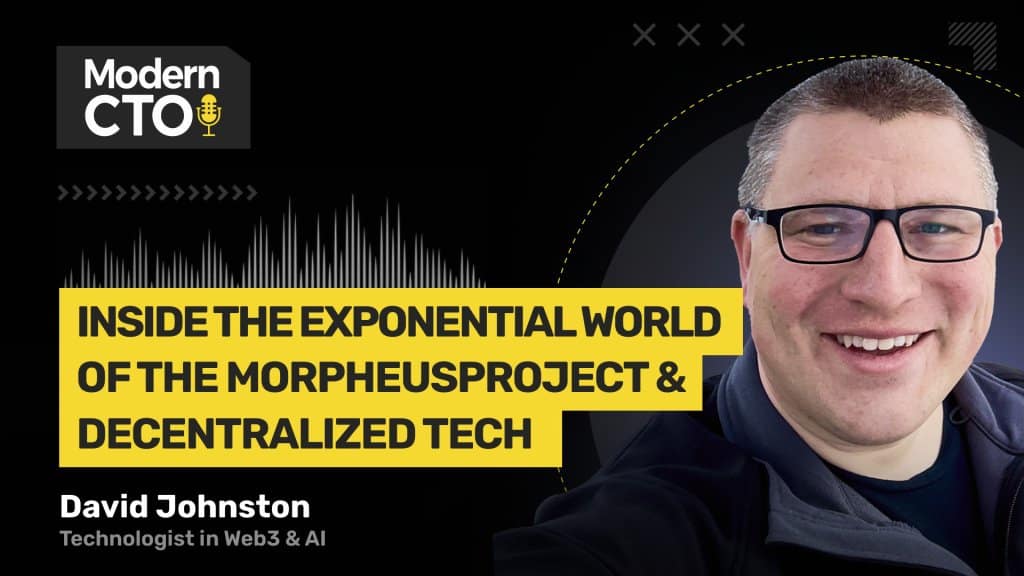
About David Johnston
Created the framework for "Dapps" in 2013 & “Smart Agents” in 2023. Weaving humans into the heart of Web3 & AI. Freedom Accelerating Decentralist. d/acc
About Morpheus
Morpheus is the peer-to-peer network for generative AI. Permissionless and open-source.
The revolution will not be centralized.
Transcript
Today, we're talking to David Johnston, technologist in Web3 and AI, about the Morpheus project and what a decentralized future might look like. You're listening to Joel Beasley, Modern CTO.
The way that we got connected was through Christopher, and he was telling me about this Morpheus project maybe a month or two ago, and I said, oh, okay. So I went and I downloaded it, and I said, wow, this is fascinating. There's many layers to it, but the thing that caught my attention was its ability to make it accessible to the average individual, and that's just gonna open everything up. And in the white paper, it had reference back to how Google made the internet more accessible as well through their search engine. And I said, okay, I buy it. So I downloaded it. I played with it. I said, this looks like the future. This is interesting.
And he mentioned you. I went to go hunt you down to ask you questions, and I found out we were already connected on LinkedIn, which is part of life, right? And then here we are. So I've got lots of questions about the Morpheus project and how to contribute, but I wanted to start with who you are, why are you credible, what's your story?
So David Johnston. I've been in the crypto and Web3 space, I guess, since about 2012, back when it was pretty much just Bitcoin. And I really fell in love with the ethos and the philosophy of the early community. You know, I'm a free market economics guy. I've read Rothbard and Hayek, and once you go down the rabbit hole of Mises and Friedman, there's no going back, right? So, you know, when I saw Bitcoin, it's like, wow, honest money that can't be manipulated by politicians. It's really scarce. It runs natively on the internet. Yeah. I wanna take my green pieces of paper and switch for this, right? So I was already sold on that ethos, and I've been building tech companies pretty much since I was a kid, right, in the early internet days, websites, stuff like that. And when I saw Bitcoin, I saw a framework. And I was like, hey, let's take the things that are amazing about Bitcoin—open source, peer to peer, based on a blockchain, and has a token—and use that as a generalized model. So I ended up writing this paper called The General Theory of Decentralized Applications, and that was October '13. So if you've heard of DApps, I'm kind of the DApps guy, right? So I was like, let's take that model and do it for other projects. And the Ethereum community ended up using that terminology, describing Ethereum as a platform for decentralized applications and smart contracts, right?
And so then I just started helping with as many open source projects as I could. Helped with Mastercoin back in the day when they put the first digital assets on Bitcoin. And when Ethereum came out, I wrote a paper on the token sale. Helped a lot of projects that were building on Ethereum in those early days. So, yeah, it's just been incredible twelve years to see sort of this whole ecosystem evolve. You know, I put out this idea in 2014 that everything that can be decentralized will be decentralized, jokingly, on stage as Johnston's Law, and people started tweeting that out. And so that's what I wanted to capture. I really think this is inevitable, right, because it's just permissionless innovation. Decentralization empowers people at the edge to create the next thing. I think that wins inevitably, right?
So we've just been making our way up the tech stack from decentralized money. Okay, now we've got smart contracts. Now we got Filecoin and decentralized cloud. Great. Now we're finally getting to decentralized smart agents, right? AIs that are connected to smart contracts. And that's sort of, you know, when I saw the Morpheus paper in September of last year, I was like, yeah, that's the next thing, right? Because funny enough, what I had been working on before crypto was AI. And 2012, it was way too early in that trend, right? But the things we were dreaming about in 2012 were finally possible now in 2023, 2024. So, anyway, that's kind of my background. That's what I've been doing. A lot of open source last ten, twelve years. But it's just really cool to be part of these different communities that are so passionate about solving these big problems that are taking a fundamentally different approach to do so.
Do you think centralization of resources is a natural human behavior, something we do by default?
No. I think property rights to the individual are the natural state of the world, right? And to change that, you have to insert a bunch of force, either by the state or some other actor to take that property and put it in some sort of collective or centralized form. I think property rights are the natural way and, you know, obviously are the thing that people most respond to, right? In societies with high property rights, you get more prosperity, you get more economic growth, you get more freedom, because you're allowing the individual to express their preferences without the influence of some central planner, right?
That's not to say, and I would separate centralization, central ownership from network effects. Yes, absolutely. Network effects are a real thing. Also, economies of scale are a real thing, right? But those are separate, I would say, separate economic concepts from the idea that you have to centralize ownership in order to get network effects and economies of scale. And that's, I think, what blockchains have fundamentally unlocked is for the first time, we have really good coordination across a lot of independent people to build these network effects and get those economies of scale without giving up individual property rights, right? And that's sort of what I realized over time, and this even became more clear for me last year, is ultimately these are property right systems that we're building, right? We're using cryptography and private and public keys to let individuals hold value and express intent and make individual choices. Those systems are so much better. It's so less full of friction than legacy companies or states trying to make those decisions. Just let the individual do it.
So that's kind of my view is, yes, absolutely, there are network effects and economies of scale. How do you get them without giving up sort of the natural property rights that people have?
I'm not super intelligent when it comes to the details of the decentralization and the cryptography and all of that. I spent most of my software engineering career in business logic, retirement planning analysis, real estate data, things like that. But that said, I was having a conversation with my wife about me getting to talk with you. And what I was looking at just going about life, we're driving in the car and I thought to myself, I said, look, we tend to as humans, we tend to lean towards centralizing something for a variety of reasons, right? Economies of scale. There's so many reasons why we would centralize. But we tend to centralize to the point of failure, and then once we hit failure, then we go decentralized. So think about pre-pandemic, nobody was thinking about the medicine. We realized that we'd centralized most of our manufacturing to China. Now everyone's like, let's decentralize it. But, you know, same thing with manufacturing. So it's a weird thing that humans do with this centralization. Is it—sorry, go ahead.
I would just put a different word on it. Okay. I would refer to it as specialization. And, absolutely, specialization is hugely valuable in an economic context to have people that have become experts in one thing or built one process that's just optimized to do that. We don't need every single person to grow their own food. The fact that we're not subsistence farmers is a good thing, right? I'm glad I wasn't born in 1500 as an Irish potato farmer or whatever, you know, sixteen, seventeen hundreds, whenever potatoes made their way to Ireland. I don't have to do that. I can do more interesting and valuable things with my time. And so, yes, absolutely, specialization is key to economic growth. But, again, it's how do you achieve that specialization without giving up your right to choose a service provider, right? And that's where free markets come in. If I have lots of options of different specialized services, I can pick the one, like you're saying, if you get a failure, right, somebody's aggregated either through regulation or some other force, most of the customers into a single provider, you usually get bad results.
There's, I don't necessarily wanna use the term out on your show because I don't know the audience, but, you know, enshittification, if you've heard that term before, where a service gets worse and worse over time—that's often a symptom of regulatory capture, right, where they got a customer base, and they're just making it worse over time and extracting more value over time. And, usually, the only way you can maintain that is through force, right? If people have a free market, they're just gonna pick the better option as soon as something becomes worse. So, yes, specialization is important, but again, it goes back to property rights. If I have a free and open market, I can choose whatever I want. I have the freedom of entry and exit, right? And I can vote with my money much better and more effectively than I can vote in some governance or democratic system.
So this decentralization's giving the benefits of centralization while maintaining the property rights?
It gives you the benefits of specialization, of network effects, of economies of scale, right? Because, take Ethereum for an example, right? Anybody could launch a smart contract platform. It's open source, right? Fork the code, do it tomorrow. The problem is, if you do that today and there's already 100 million people using Ethereum, you better have some really interesting differentiator to convince those people to switch, right? And maybe you have some innovation that attracts a niche of people, but I would consider that sort of a natural and not a negative network effect when it comes to, okay, this protocol has served the smart contract community really well, and it's specialized around that, and that's okay, right? And if they ever stop doing that well, people can instantly move to Cosmos or Solana or Avalanche or any of the other public blockchains that have embraced smart contracts, right? And so that creates sort of a really great natural check against somebody abusing power, right, in any system.
Which crypto should I buy?
No idea. I think the better question is which one do you wanna use?
Yeah. Filecoin. That's my favorite.
Filecoin is great, and if you've got a bunch of data to store or you're optimistic on decentralized data storage, that's great. And I think about it then in those network effects, right? Bitcoin has won that network effect for digital gold, right? It's not trying to be payments. It's not trying to be a cloud. It's not trying to be smart contracts. They have narrowed in and focused just on digital gold, great scarcity, high security. For Ethereum, it's hard to compete if you want to do smart contracts with Ethereum because everybody uses Solidity, everybody uses the same EVM tech stack that they pioneered. So even other protocols have all sort of embraced that now as the lingua franca for the system. You know, we talked a little bit about Morpheus earlier. This is a new network effect that's just being created now around smart agents, right? So we need a platform where you can get AI compute, right, which looks like inference from people running large language models. You need to be able to reward those coders. You need to be able to provide mechanisms for them to launch and deploy their smart agents. You need all the front-end interfaces for people, like you said earlier, to actually be able to use this thing, right? Give me a website. Give me a drag and drop one install click. I don't wanna touch the terminal. You don't have to be technical. It needs to reach an audience of billions.
And so that's what gets me excited is to do that, you have to have a protocol that is neutral, incredibly neutral, right? Meaning that it's not owned by some company or one guy or a couple of founders or a team or something like that. The best protocols have had very broad distribution, right, of their users and of their people that are contributing to it. It has to be permissionless, right? That's how you get thousands of people instead of just a little centralized team. Who's the marketing director of Bitcoin? Nobody. We can all tell our friends and family if we think it's compelling. Filecoin is very much the same. The foundation helps write some of the code, but there's a broad community of people running decentralized storage. So I think that's really the best practice.
So where is Morpheus at as far as maturity?
Well, the anon published the paper September 2nd of last year. I had been writing about the concept of smart agents, and so they sent the paper to me and a bunch of other developers in the smart agent community and basically made the case, okay, great, open source LLM on your local computer, that's wonderful, but it's not enough. Most people don't have the right hardware. They don't have a GPU. They don't have something powerful if they wanna create images or whatever. So there needs to be a network where you can incentivize the compute, build all these broader tools so that you can serve not just the hobbyists who will run a full download, but the broader market, right? And I thought that was really compelling. And they donated the paper to the public domain and disappeared, right? But the idea was really powerful, and people started immediately starting to code up, okay, what would this look like? You know, start working on smart contracts and stuff like that.
But then what happened is October, the executive order came down and that got people serious, right? The AI executive order, I don't know if you've read it, but it's pretty draconian. And it woke up the AI groups to the fact that they were about to get heavily regulated, right? It's introducing KYC for data centers, which if you haven't built a KYC app, is a lot of friction. They're gonna block foreigners from using US compute to train models. They're going to institute safety committees. You'll need to register with Homeland Security if you want to release a model. And probably the craziest is in July, the Commerce Department will determine if open source AI weights constitute dual use weapons and thus are illegal for US people to release to foreigners, right? This is 1991, Phil Zimmermann, PGP, crypto wars all over again, right, when they tried to ban encryption in the nineties. I mean, that didn't work then. It turns out math is hard to ban, but they're gonna give it another try. So that sort of lit this fire and urgency under the AI community. It's like, okay, now we need permissionless, decentralized, distributed systems. Oh, who's done all that?
(David Johnston at 00:16:38) The Web3 guys, right? So very quickly, the crypto and AI community started coming together, and honestly, it's a benefit for crypto because crypto needs an easier interface to use all these smart contracts. Right? What they can do is amazing, but most people don't know what they are or how to use them.
(David Johnston at 00:16:56) To have a chat interface simplify all that is so compelling. So it's been so cool to see the communities come together. So it's all sort of a long-winded way of saying, you know, it's gone from a white paper to working code to smart contracts in December, January to a test net. And then on February 8th, the fair launch began, right, where coders and capital providers could contribute to the network and sort of get it bootstrapped. So I've rarely seen something grow so fast or organically, but there are 100-plus code contributors already, thousands of people in the community.
(David Johnston at 00:17:35) Turns out people are excited about this idea of decentralized AI.
(Joel Beasley at 00:17:39) Yeah. I was curious about if there's a way for the governments to shut it down. Like, for example, in Pakistan, they just had elections last week, and two of the mobile carriers, I think, were Chinese-owned companies, and they shut down the mobile data. Cloudflare did a report on it to interfere with the elections. What would keep the United States or any other country from just saying no and just shutting down any network traffic related?
(David Johnston at 00:18:08) You'd have to go pretty crazy, right? You're talking about not just, you know, filtering. You'd have to stop the Internet stuff, right?
(David Johnston at 00:18:20) Because people are running this on their local computer, right? So literally anybody with, you know, a thumb drive, I mean, this is only 16 gigs to, you know, put a model on your local computer. So unless they're going to seize all the thumb drives and, you know, block personal computer ownership or turn off the Internet, you know, it's sort of the same thing as Bitcoin, right?
(David Johnston at 00:18:43) There's no company in Morpheus. There's no foundation. There's no token sale. There's no pre-mine. Nobody even knows who the founders are.
(David Johnston at 00:18:53) It's this open source code. Like, it will exist, you know, at this point, if anybody has a copy of this code, and, you know, lots of people have downloaded and forked the code at this point. And then, you know, I guess on the next level, you know, the incentives will exist as long as Ethereum exists, right? And if you read the paper, you know, the author is sort of intended for it to be, you know, chain-agnostic.
(David Johnston at 00:19:17) Right? So there's already people talking about adding smart contracts for Morpheus on Cosmos or Solana or other chains, right, to let those people use the smart agents as well. So I don't see any realistic way, but that's why the structure of decentralization is so important. It places, you know, regulation and compliance at the application layer, not at the protocol layer, right? Just because Bitcoin protocol didn't know the state exists, Coinbase still did, you know, a bunch of licensing and regulation in their particular jurisdiction to serve customers, largely because they had custody of customer funds.
(David Johnston at 00:20:03) Right? So that is what it is, but the protocol itself could operate agnostically, right? China decided they didn't like it, didn't affect anybody else anywhere else in the world, right?
(David Johnston at 00:20:15) And so it'll be interesting to see how it shakes out, but so far, the US is implementing these regulations, which are largely focused on the companies. So it's these people actually training the models. Those are the people that need the permission. You may not realistically be able to train a model in the US, and most of them may get pushed overseas, right?
(David Johnston at 00:20:38) You might have to train it in the UK or Europe or somewhere else, but, you know, we have that for lots of things. You know, if a jurisdiction makes it too hard to launch websites, you don't build websites in that country, right? You go somewhere else, right?
(David Johnston at 00:20:52) And that's already the case for Web3. 70, almost 80% of all Web3 devs are outside the United States. Most of them are already in Europe or Asia. Who knows, right?
(David Johnston at 00:21:05) And so that's sort of an evolution crypto has already seen. Where are the protocols? They're not in the US, right? They're in Switzerland. They're in Singapore. They're in whatever friendly jurisdiction they could, you know, set up a foundation if they were using that model. You know, and so I think the key is people are going to go where they're treated best. And probably this year, we'll figure out where that is, right?
(David Johnston at 00:21:28) The US is going to introduce these regulations. Unfortunately, the EU is mirroring those regulations. China is pretty restrictive. So far, the UK, though, has come out and said they won't regulate base models. So does everybody go to London?
(David Johnston at 00:21:43) Is that the Switzerland of AI? Maybe. Switzerland's likely to be friendly, from what I've heard. Maybe other jurisdictions will be as well. But, you know, it's a hell of a boon for anybody that's smart enough to embrace this technology. They'll get all the developers and people setting up shop there.
(Joel Beasley at 00:22:00) I turn on C-SPAN, and it looks like a retirement home. You know, these old people struggling to understand some basic essentials of how phones and Internet work. What's your confidence—you're more into this than I am as far as socialized with people and networks and stuff. What's your confidence rating that there's competent people in the administration that are coming up with these regulations versus scared old people who are frightened by their own shadow just trying to ban it?
(David Johnston at 00:22:31) Well, I think most of the state is just a thin facade, right? Like, realistically, we all know that regulations are written by lobbyists, right? That's fairly well established, right? You can literally see who pays for the lobbyist and who wrote the legislation. In the case of the executive order, it was written by Google, Microsoft, and OpenAI. Like, these are public facts, right?
(David Johnston at 00:22:56) You can see the disclosures of, you know, the lobbyists they hired. Certainly, the administration didn't write the 100-page executive order with all these technical details, right? There's nobody in the administration that has that kind of competence. How could they, right? How could you possibly have, you know, inside a small group of people, the expertise of every industry of the country, right? It's not possible, right?
(David Johnston at 00:23:17) So they largely lean on incumbents to write the rules. And, unfortunately, that's what this is. This is regulatory capture. It has nothing to do with actual fears of AI, which I can tell you from a technical perspective have no basis in reality whatsoever. But, you know, it's entirely regulatory capture.
(David Johnston at 00:23:41) Right? Google is terrified right now of losing their market share on search, right? And they've got all these AI companies coming up and disrupting them. Easiest thing to do is just pay some lobbying dollars, get this executive order passed, which they did, and then all of those tiny competitors who can't afford a safety committee, a registration, a year-long government review of their product, they're just going to go away, right, at least in the jurisdiction that you've captured.
(David Johnston at 00:24:11) Right? And so largely, this is regulatory capture. If you're not in the $100 billion club, like, you're not welcome, right? They're just pushing out everybody. This is so reminiscent of the BitLicense in 2014.
(David Johnston at 00:24:26) Like, I don't know if you remember those days, but this is when New York passed a law that if you wanted to be a Bitcoin company in New York, you needed this registration that would cost you about $30 million. You had to have the equivalent of a banking license, and it took three to four years to get. Every early crypto project, which there were a lot of in New York in 2013, left, right?
(David Johnston at 00:24:50) It basically pushed everybody out. The same with the SEC refusing to give any basic guidance on how to properly do a token sale or even what a security was in this new context just pushed everybody out of the US, right? All the foundations went to Switzerland or Singapore or somewhere else, right?
(David Johnston at 00:25:07) And so that's what's going to happen, right? This is not by accident. It's not because he's old. Like, it doesn't matter who's in the White House. They just default to incumbents with the expertise, and the lobbying dollars tell them what to do. So that's sort of the cynical, practical view of what's going on. Like, people in the industry are very well aware of it. They know how this works, and that's what happened.
(Joel Beasley at 00:25:32) I have two paths in my mind when I think about Morpheus. The first one is decentralized AI. So it's basically making ChatGPT a decentralized personal large language model, and there's that. Then I have just simply the capability to interact through text prompting and natural language with something that can help me. For example, if I want to make a purchase with crypto or make a transfer and understand exactly what's happening.
(Joel Beasley at 00:26:06) Are those two separate paths that are being pursued? Are they two separate specialties of programming being able to do the specific stuff for that? Are you hoping that the communities like Llama and all of them, they'll progress, and then that'll handle the back stuff, and then you'll have the front stuff of—I'm not explaining this great, but you get the two layers I'm describing?
(David Johnston at 00:26:29) Yeah. I do. I would say that Morpheus is a platform for smart agents like Ethereum is a platform for smart contracts, right? The Ethereum Foundation isn't writing any particular smart contract, right? They're not trying to compete with the guys building decentralized exchanges or something, right? They're just focused on the tools, you know, the consensus layer, the execution layer, you know, the actual sort of guts and infrastructure involved in the tech stack. That's their thing they're giving to the community, and anybody can fairly compete and go and build something on Ethereum.
(David Johnston at 00:27:06) So with Morpheus, it's the same thing, right? It's, okay, here's the large language model. Here's the connections to the wallets. Here's the ABIs and embeddings for all the popular smart contracts. Go crazy, right? Build whatever smart agent you want, deploy it on the system. People using Morpheus will be able to opt in.
(David Johnston at 00:27:28) Oh, yeah. I want that smart agent, right? And it has a concept inside called the Smart Rank system. This is an algorithm I wrote last year that gave a rank to each of the smart contracts. And so you could connect the intent and context of the request.
(David Johnston at 00:27:46) Hey. I want to stake my ETH. Most people have never heard of Lido. They don't know how to do that. No problem.
(David Johnston at 00:27:53) The AI understands what they're trying to do. It already has the list of all the smart contracts and says, oh, I should recommend Lido. It's the most used, you know, safest contract they could use to stake ETH. Here, I've prepared this transaction for you. Make sure the, you know, amounts and everything are correct. Push that button on MetaMask, and it approves the transaction, right? That's the flow we want to get to, right, to use that Google comparison, right? The magic of Google is I could just show up.
(David Johnston at 00:28:22) I didn't need any technical knowledge. I told the magic box what I wanted, and it previewed some options, and I picked the top one, right? That's what we want to get to. So with Morpheus, it's the same thing. I don't need any technical knowledge. I say what I want to do. Oh, I want to stake some ETH. Great. Set it up for you.
(David Johnston at 00:28:40) Click this button. Done, right? That's how we get to billions of users and not just a few hundred million technical people.
(Joel Beasley at 00:28:49) So is there a layer of just, like, general intelligence and then these sort of, like, applications—they're agents. You can install these agents that sit on top of that general intelligence. Is that correct? Who maintains the general intelligence?
(David Johnston at 00:29:02) So you've got a couple layers even within the general intelligence. The foundational models, you've got Llama 2, Mixtral, Nous Hermes, right? There's a bunch of good open source models and they're like 95% as good as ChatGPT at this point. They're rapidly surpassing the closed models.
(David Johnston at 00:29:21) Right? So that's what's called the foundational model, right? That's your general intelligence about the world. And then on top of that, what the Morpheus community has built is what are called embeddings, right? So this is just a database, a file that says to that foundational model, hey, you're a Morpheus smart agent, and here's a list of smart contracts. If somebody asks about this topic, refer to this list, right?
(David Johnston at 00:29:49) That's an embedding that is giving a specific knowledge about Web3 smart contracts, whatever, right? So you could add more of those embeddings to continue growing that context, right? And then on top of that, yes, here's a specific smart agent that I built that makes it easy to, you know, do swaps.
(David Johnston at 00:30:11) Right? And if that's registered and deployed on Morpheus, it becomes part of that embedding, part of that context, right? So their AI can say, hey, oh yeah, there's a great tool right over here that can, you know, do something even more detailed or more advanced. So you sort of have the foundational model, you have the embeddings, you have the smart agents that sit on top of that and these nice user interfaces for the user to access all of that.
(Joel Beasley at 00:30:40) Got it. Are the embeddings things that the end user can add and remove?
(David Johnston at 00:30:46) To an extent. You know, you want sort of enough general knowledge in there, but if you have the full version of the install, you can drag and drop documents that will add additional context, especially if you're doing a particular session, like, read this document and, you know, give me a summary, right? So there's a plus button and you drag and drop, you know, some Word document or whatever you're working on. There's an option for using different foundational models.
(David Johnston at 00:31:18) If you have a preference for Nous Hermes over Mixtral, go for it, right? You can use any open source model. The whole idea of Morpheus, and there's this concept of atomic governance, is the user can do anything they want without permission, right?
(David Johnston at 00:31:35) They can use any model. They can use any smart agent, right? They can connect it to any interface that they want. They don't need anybody's permission. So there's no, you know, group of people voting on this stuff. It's just a market, right? There's nobody voting on which apps get released on the App Store. You just let all of the apps on the App Store, and people are going to choose the thing that's most interesting to them.
(David Johnston at 00:31:58) And so that's how you can kind of think of these smart agents. They're the new apps, right? They're the interface, the easy-use interface everybody's going to transition to. So they're just going to start wrapping up all the existing smart contracts, dApps, and stuff like that and giving them this better interface.
(Joel Beasley at 00:32:16) That's interesting. And so are there any smart agents active today if someone downloads Morpheus?
(David Johnston at 00:32:21) If you go into the GitHub, there's a 0.0.6 in beta right now, and I just saw on both X and Discord that the first smart agent has just been published on there. And so it's somebody that created an interface where you could tell it you want to send ETH, and it, you know, prompts the MetaMask, it creates the transaction, and then the user approves. So that's a good sort of base example, and that's likely—that might even be broad enough to be, like, a generalized tool that lots of people want to access. It'll probably get baked into the current version of Morpheus. So if you have, you know, compile from source code powers, you can go and check out the beta.
(David Johnston at 00:33:10) Otherwise, it'll probably get wrapped up next week or so into a nice, easy, one-click install for Mac and Linux right now. Everybody's waiting on Ollama to add Windows support. Ollama is part of the tech stack for providing the open source models that Morpheus uses, but they haven't had Windows yet. But they just made an announcement yesterday, so hopefully we'll see that fairly soon.
(Joel Beasley at 00:33:35) Can I give a shout out to someone who is helping me in the Discord group?
(David Johnston at 00:33:38) Yeah, man. Go for it.
(Joel Beasley at 00:33:40) Anton B. I don't know if you've come across that guy, but he was very kind to me.
(Joel Beasley at 00:33:46) I went in there green as anything, asking some basic questions, and he helped me through the entire process, and then we DMed a little bit back and forth. Very, very nice person. And so that made me feel really good about this community, because I heard about it, I downloaded it, installed it, went and joined the Discord, and people there were pretty helpful, pointing you in the right direction.
(David Johnston at 00:34:09) Yeah. Anton is great. He's a beast, man. He's just constantly in there answering people's questions, super patient. And that's what I think you need.
(David Johnston at 00:34:17) You need a welcoming community where people are encouraged to experiment and try stuff out and ask questions and stuff like that. So it's been really cool to see that continue to be the fact even as it's grown to thousands of people.
(Joel Beasley at 00:34:32) What are the ways people can get rewarded for participating in the project?
(David Johnston at 00:34:38) So in the white paper, it described these four groups, which is one of the things I really liked. Code—everybody that contributes code to the Morpheus platform itself or building the smart agents—that's 24% of the MOR emissions. Capital, right? Everybody providing staked ETH and specifically the yield, the rebase reward from their staked ETH, into the protocol and liquidity, they get 24% of the MOR emissions. But then in Phase Two, there's work being done to launch a Compute group.
(David Johnston at 00:35:20) So anybody that wants to run a large language model and offer it to others—right, you've got a GPU and you want to generate images, whatever people want—that's going to get 24% of the rewards. And then finally, there's this concept of Community Front End Builders. Right? This is interfaces, apps, websites, whatever, that add either capital, compute, or code to the network. Those people get 24%. And I really like that because most projects, one, they usually only reward either proof of stake—so only capital people—or only proof of work, compute people, but people usually forget coders and front ends and these community builders. Right?
(David Johnston at 00:36:08) And I haven't seen something really since Ethereum, right, where they not only rewarded miners, not only let people contribute Bitcoin in the crowdsale, but people forget they airdropped ETH to every single person who contributed code before the genesis block. Hundreds of developers got Ethereum for code, doing reviews. Even if you left a comment, they rewarded everybody. And people are like, "Oh, why are all the developers on Ethereum?" Because they rewarded all the developers so generously. I was like, this isn't rocket science. Right? And so it's cool to see a new project with Morpheus doing the same thing. It's like, yes, we value developers.
(David Johnston at 00:36:53) Yes, it takes more work to quantify that, but it's worth the extra work to quantify that and try to do that as broadly and permissionlessly as possible. So those are the four categories. There is a fifth because 24 plus 24 plus 24 plus 24, you have 4% left over. That goes into a Protection Fund. And the purpose there is funding audits, funding bug bounties, rewarding people that find vulnerabilities.
(David Johnston at 00:37:20) No software is perfect. Right? I mean, Morpheus has been through five code reviews already, but no software is perfect. Right? So you have to have a built-in way to reward people to continually do that work of securing the code. And if somebody finds a bug, give them a reward. Right? Give them a reason to be a white hat who is coming in as the hero and reporting a bug and getting rewarded for it. Right? And so I think that's really smart too.
(David Johnston at 00:37:46) I don't think enough projects think through the long term, what if something goes wrong? So having defined upfront how to take care of that is smart. Then you don't have a DAO-like situation where everybody's freaking out and, "Oh, what are we gonna do? Are we gonna fork the network? Are we gonna reverse the—" Like, you have a predefined plan. Right? And so if you go into GitHub, there's a whole write-up on the Protection Fund. So those are the five groups, if you will, that are receiving MOR.
(David Johnston at 00:38:08) And the way it works is it started at 3,456 MOR per group. Right? So, at least for the big four. Right? And those daily emissions are a competition. So everybody providing staked ETH is competing every day to earn those 3,456 MOR. And then there's a decay rate. Right? So it's a little bit less every day, but that's the sixteen-year emissions curve that puts the 42 million MOR tokens into supply. Right? So that's how you get, over this long period of time, everybody competing to provide capital, code, compute, front end, stuff like that.
(Joel Beasley at 00:39:07) So there's MOR tokens out there right now and you hold them in your wallet. Correct?
(David Johnston at 00:39:14) There are MOR tokens being earned right now, but we want to be very careful so nobody gets scammed. They're not sendable or claimable until May 8th. So if anybody claims to be selling MOR, it's a scam. Until May 8th, they can't be claimed or sent. Right? Everybody can be earning them during this bootstrapping period, but it's ninety days before the tokens will be claimable.
(David Johnston at 00:39:30) And the way it's structured is people are providing staked ETH on Ethereum mainnet—layer one—and they'll be able to claim their MOR tokens on Arbitrum. Right? So you're getting this on a layer two where the fees are super low, which will make it great for paying for AI inference and stuff like that. So that's the current structure. But that's an important thing to note.
(David Johnston at 00:40:01) And there's a lot of details on mor.org about the fair launch. So there's a whole page on there. It's one of the community sites put up by Eric Voorhees about the fair launch and all the details. And there's a link to a dashboard where if you don't want to interact with the smart contract manually, you could just use the dashboard to provide staked ETH. But it's been really amazing to see the community response the last four or five days, how many people have provided staked ETH and joined the community. It's just blown everybody away.
(Joel Beasley at 00:40:35) Can you give me an idea of that?
(David Johnston at 00:40:38) I think yesterday it passed 50,000 staked ETH, which is, I think, at current Ethereum prices, like $125 million of staked ETH in five days from a project that has had no marketing, no press releases. There is no—it's entirely just a community. But I think the reason is because of the structure. Right? You can provide staked ETH and not have to commit the principal. Right? Whatever staked ETH you put in, you can always withdraw. And so it's only contributing that yield, that 3.3% annually, that staked yield. Right? That's the only part that's getting contributed. Right?
(David Johnston at 00:41:20) So the longer you keep it in there, the more and more tokens you earn as part of that competition. But you can always take out your principal. Right? So it's like, if I'm going to hold ETH anyway, I might as well stake it, and I might as well point it at a project that I'm passionate about and that I want to see bootstrapped into reality. Right?
(Joel Beasley at 00:41:40) Do you lose custody of that?
(David Johnston at 00:41:42) That's what I think about it.
(Joel Beasley at 00:41:43) When you do that, do you lose custody of the ETH?
(David Johnston at 00:41:46) It goes into the smart contract, but if you look at the audits and the reviews, I think the developers have done a good job of—there aren't really any ways where the multisig address holder could access that. Right? It should only be claimable or withdrawable by the address that put it in. Right? And so, you know, there's a multisig address held by seven people, but effectively, the only functions it has are the Protection Fund and bootstrapping the contracts that aren't live yet, like the rewards for Compute and Community Builders, just sitting there waiting for those parts of the contracts to go live.
(David Johnston at 00:42:30) But no, there shouldn't be any access of the staked ETH by an admin or anybody else involved in the contract. It's just the individual. There's a seven-day lock, and this is so that if you put in staked ETH, the yield actually gets contributed because that only happens once a day, and if you let people just instantly deposit and withdraw, somebody could game the system, right? Earn MOR and then take it out before the yield is contributed. So there's a seven-day lock on the deposit and withdraw. So from whatever moment you deposit, seven days later you can withdraw.
(David Johnston at 00:43:07) And like we talked about already, MOR are not claimable until the end of the bootstrapping period on May 8th. So you can withdraw whenever you want. You'll stop earning additional MOR, but you've still got the ones that you earned from the days that you contributed.
(Joel Beasley at 00:43:22) Oh, nice. And then when do the MOR tokens start hitting exchanges so you can just buy them?
(David Johnston at 00:43:28) Well, I don't know about exchanges. I'm not a fan of centralized exchanges. But the protocol is set up so there's a Uniswap pool, effectively, day one. And by day one, I mean day 91, right, when the MOR actually become claimable and sendable. There's a setup where the Protection Fund, which will have accrued 50,000 MOR tokens by then, can put those in as an LP into the Uniswap pool and start the Uniswap pool. So you'd have the staked ETH yield earned up to that point and the MOR set aside for the Protection Fund as the bootstrapping mechanism for the Uniswap pool, and that'll kick off on Arbitrum.
(David Johnston at 00:44:13) And so that'll sort of set the initial price as people start depositing and trading. And this is the whole point of the bootstrapping period, is to avoid some arbitrarily high price on day one, which was an issue that plagued Zcash. I don't know if you watched that launch back in 2016, but it was an exciting project, and everybody wanted to get some Zcash in the first day. Right? There's only a couple units. It was just started mining. But unfortunately, people bid it up to a ridiculous price, like hundreds of thousands of dollars a token. And if you look at the chart still today, it's down 99% from, quote-unquote, the all-time high. It truly wasn't an all-time high. It was an artifact of the first day, because there were only a few units.
(David Johnston at 00:45:00) But if you were coming in without that context, you just think it's a failed project. Even though they built great tech and they achieved decent market cap, they're never going to be able to fix that chart. Right? So I think it's a lot wiser that after ninety days, you have, like, 1.2 million units that could theoretically exist in the two pools that are already live—call it 600,000 MOR that will exist. So capital providers, code providers, then go claim that, put that in the Uniswap pool. You have real price discovery, not based on a thousand units, but based on half a million units, 600,000 units. Right?
(David Johnston at 00:45:27) So, hopefully there'll be a much better process where it starts at a fair, reasonable market price and kind of evolves from there, not this artificial one-day spike at the beginning. So that's the reason for the bootstrap.
(Joel Beasley at 00:45:59) By that time, by that ninety days, will I be able to have Morpheus installed on my computer and say to it, hook it up to one of my existing wallets—let's say MetaMask. Right? Say, "Hey, I've got a thousand dollars of ETH in MetaMask, and I want MOR tokens. Figure that out." Will I be able to purchase MOR tokens through that by the time the project's live?
(David Johnston at 00:46:27) I would be shocked if you couldn't, because what got released today was pretty much most of that, which is a smart agent that let you tell your wallet what you wanted to do and send some ETH. So all you'd need to do past what you just described is for somebody to release a smart agent that is either doing the staked ETH step—right, so "I want to stake some ETH," and it calls Lido. That's pretty straightforward. Right? And then one step beyond that is, "Okay, I have staked ETH. I want to contribute it to the MOR contract." You just need the MOR contract.
(David Johnston at 00:46:55) Now that's live, you could include it in the embeddings, right, and include the function steps for approval on Lido and then staking in the Morpheus contract. So, yes, I—you know, not writing that code—but I have a high level of confidence somebody in the community will probably build and ship that. I mean, it's a really obvious use case for people.
(Joel Beasley at 00:47:28) Because it would be kind of absurd to say, "We're developing a technology that's going to make it extremely accessible," and on day 90, when we actually launch, it's not accessible through our own technology.
(David Johnston at 00:47:39) Yeah.
(Joel Beasley at 00:47:39) That would—you get the weirdness of that.
(David Johnston at 00:47:41) Yeah. Yeah. Yeah. So I would think that would be very likely. Yeah. I think that would be very, very likely.
(Joel Beasley at 00:47:49) I'll talk to Anton.
(David Johnston at 00:47:50) Yeah. Yeah. Yeah. Yeah. Get to Anton on that. Yeah.
(David Johnston at 00:47:52) So, you know, it's cool, though, because as everybody has flooded in the community, people have made such cool suggestions. Like, "Oh, well, I can build that part," or "Oh, you should have a smart agent that does that, and you should have—" Great. Go for it. You don't need anybody's permission. I don't have any role. You know? I'm just contributing my code to GitHub like everybody else. So—
(Joel Beasley at 00:48:15) I think there's going to be a lot of people that hear about this. I think there's going to be a lot of people that have my experience. And my experience is I'm going through life, I ran into this guy through a mutual friend who explained this project. It instantly made sense to me. I said, "Oh, I'm putting eggs in that basket. That makes sense."
(David Johnston at 00:48:33) Right.
(Joel Beasley at 00:48:33) Then I go to actually put eggs in the basket. It's like, look, I programmed. I sat at the computer every day for seventeen years. I've considered that part of my life over. Like, I'll do product and everything, but I'm not sitting there keyboard coding all day. I just put too many years into it.
(Joel Beasley at 00:48:48) And I enjoy this. I enjoy conversations with people. I enjoy making content. I enjoy media and all of that. So I was like, "Well, how do I use my skills, what I have, that I enjoy doing?" Because I have programming skills. I don't enjoy it right now. But how do I use my skills that I enjoy doing to help progress the project forward?
(Joel Beasley at 00:49:08) And then there's going to be a lot of people that say, "I don't even have time to apply skills. I just want capital." So I'm assuming you're telling people, stake your ETH. That's how you can contribute today. And then once it's actually out, then I can just buy MOR tokens directly through the technology. Correct?
(David Johnston at 00:49:27) Right. Well, and it'll be really interesting to see the market equilibrium that emerges. Right? Because like you said, there's two ways to do it. You could earn the MOR yourself.
(David Johnston at 00:49:38) Right? And there's sort of an implied price by the amount of stake ETH and how much yield you're contributing to how many more you're earning. Right? And logically, you should expect if it's cheaper to earn it, people are going to put more staked ETH to it, right, until it's cheaper to buy it on Uniswap. Then they're going to grab it off Uniswap. If it's more expensive on Uniswap, going to go put more in the staked ETH. So it'll be interesting to see sort of the long-term, I guess, equilibrium that that evolves. But maybe it won't be an equilibrium. It's hard to know, right?
(David Johnston at 00:49:57) This is sort of a new experiment. I haven't seen many projects use this approach, but now that we finally have the tools of staked ETH and yield contribution, it sort of makes it so easy to participate. Like, I'm going to hold ETH anyway, right? And if I stake it and contribute it here, now I have the same number of ETH I started with plus these Morpheus tokens, and I get decentralized AI. Like, great. That's a really easy decision tree for me to go down as an ETH holder. So, yeah, it'll be interesting to see how it plays out.
(Joel Beasley at 00:50:52) What's the utility of the MOR token?
(David Johnston at 00:50:55) So if you read, which was a really great paper, the Yellowstone Compute paper, which was released, I think, a few months ago by Eric Voorhees, the community was really excited about the idea. And this is now the path the open-source developers seem to be going down, is building a way for the compute to be handled by a decentralized router and for anybody holding Morpheus tokens to have the right to a pro rata amount of inference of compute on the network. The utility is if I hold MOR, I can use an equal amount, my portion of the inference that day. If I want to send in a request, if I want to generate an image, I want to do something compute-intensive—it's almost like staking for inference. It's almost like staking for intelligence.
(David Johnston at 00:51:51) Like, if I hold my MOR, I've got access to all of those people competing to provide compute on the network, right? And I haven't seen anybody else take that approach, right? The original proposal in the paper was around fees, but as soon as you introduce a fee, you have on-chain transactions and that becomes really hard to scale. By instead just doing a read of the contract instead of a write and say, "Yep, they have enough MOR balance. They can request some compute," you didn't need to spend an on-chain transaction or a fee every time you wanted to access inference. I think that whole Yellowstone Compute model approach is brilliant, and it was a great addition by Eric to write that paper and sort of frees it up to a much better interface than we've seen historically to access.
(David Johnston at 00:52:43) So that's the first one, right? It's just I hold MOR. I want to use intelligence from the network. Great. I've got my access. The second aspects that are being explored around the Techno Capital Machine paper—I don't know if you read that one yet, but it's up on the GitHub—in this whole idea of then using this Morpheus model to bootstrap smart agents on top of Morpheus, right? I've got MOR. I want to point that yield at the next project. Like, I want a smart agent that does XYZ. Cool. Let's use the same smart contracts. Let's use the same dashboard, all of the infrastructure that had to be built through Morpheus and use that for every developer who wants to launch something on the Morpheus platform. The contracts have been audited. The community's already there. The network effect's already there. I don't need to spin up my own network or company or foundation.
(David Johnston at 00:53:41) I could just launch it right on Morpheus, right, just the way that a lot of people launched on Ethereum, right, and it sort of simplified the whole deployment of code without having to do a lot of the other things. And so that TCM, Techno Capital Machine approach, I think is really cool. And now that it's been validated—okay, yeah, there's a lot of interest in people pointing their yield and their staked ETH towards cool open-source projects—I think we're going to see a lot more of that.
(Joel Beasley at 00:54:09) When people write code, how do they get compensated with the MOR? Like, you said 24% goes to people who are writing code. But, I mean, it has to be good code. It has to be useful code. Like, how do you—who determines that?
(David Johnston at 00:54:21) So if you read the Techno Capital Machine paper, it talks about this concept of atomic governance, and what that means is a marketplace. So in the Morpheus context, it treats every repo owner as a customer of code, right? So I run a couple of the repos. Somebody proposes some code and they said, "Hey, I wrote this great improvement. I'd like credit for 10 hours worth of work." And I look at the code. It's good code. I want to fix that bug or make that improvement. I merge in the code and give them that credit for the 10 hours.
(David Johnston at 00:55:01) Now somebody comes along and says, "Oh, yeah. I changed this one thing, a thousand hours." Like, yeah, no thanks, right? And I just make a decision as repo owner that, nah, no thanks. That doesn't make sense, right? So if you look in the GitHub, there's a code contributor file, and it has every single person that's contributed hours. And so far, it's like 19,000 hours have been contributed because there was a lot of code, right, in developing all of this. And it's been validated to the best of the abilities of the repo owners. But ultimately, it's a market, right? Anybody can launch their own project and effectively do the same thing and say, "Oh, well, here's my smart contract, or rather my smart agent. Anybody that adds to it helps me improve this. If it's a reasonable ask, I'll include you in the hours." And then you have a new basis for every smart agent where it's getting rewarded by the protocol in proportion to its usage and popularity.
(David Johnston at 00:56:06) Think about it like, again, releasing an app on the App Store. Who determines how much they should get paid? Well, customers. If it gets bought, if it gets used, then they earn revenue. There's no central Apple employee deciding how much money goes to each app. It's just a marketplace. The concept is you're going to have an agent marketplace on Morpheus because people are going to be able to deploy these smart agents and they can bootstrap it however they want. They want to be an individual. They want five people to help them write it. If they want to launch a company, Morpheus is agnostic. It doesn't know how they were written or created. It just sees a list of addresses and rewards people in proportion to what they've published in there.
(Joel Beasley at 00:56:52) Interesting. Are there any other blockchains that have smart agents like this?
(David Johnston at 00:56:58) You know, there's a lot of other AI projects, and a lot of people may be familiar with some of the ones that came out years ago, like Singularity, right? But they have sort of a fundamentally different approach where they're trying to create autonomous agents. It's there in the cloud and it does some good thing, and we're trying to all build together this autonomous agent. Autonolas, a more recent project, has a similar approach. It's like unstoppable DeFi agents or something like that, and you're going to publish them in the cloud and they just spin out and do their thing. They act without any human intervention. Morpheus is the first, let's call it, intention-based agents, and this concept of connecting the human into expressing the intent, reviewing the output, and approving the transaction is this human-centric version of AI where the person is expressing the preference and ultimately holds the key and is the only one that can approve it. Morpheus is much more like an extension of you. It's your data, it's your prompts, it's your intent.
(David Johnston at 00:58:16) It's your goals. It's your wallet. Nobody else can touch any of that. It's literally on your computer if you download the full node, right? That's you. That's a personal agent. That's a personal AI. And I think that's where we need to go. You look at every other technology, we don't use centralized phone systems anymore. We all wanted a personal phone to keep our personal photos and our personal stuff on, right? We don't use, for the most part, terminals that route into a central computer. We all wanted personal computers at the end of the day. And right now we're in that AI phase of the centralization. People are using ChatGPT, but ultimately, they're probably going to want a personal AI that they can take to any device, not inside a walled garden, that connects to all of the applications, not just the ones inside the four walls of OpenAI.
(David Johnston at 00:59:12) That's where I think this goes. Morpheus is a personal AI and it's an extension of you, and that I think is a very powerful model. So it doesn't detract anything away from Autonolas. It'll probably be interoperable with a lot of those other systems. And again, on the compute side, Morpheus is not providing the compute. If you want to use Bittensor, great. If you want to use Akash, great. You want to use Ritual, like Edgellama, there's a bunch of good decentralized compute providers. And whichever you decide to use, go for it. You'll get credited in the Morpheus system if you offer that compute from wherever to people that want to use it in the Morpheus platform, right? So it sort of brings together all these different pieces that have been sort of spread out and disparate into a single user flow and a single tech stack.
(Joel Beasley at 01:00:06) Is anyone making children's books to understand this stuff?
(David Johnston at 01:00:10) I certainly hope so. Graeme is one of my favorite authors in that regard. He wrote "B is for Bitcoin." I still read it to my kids on a regular basis. So I'm sure we'll get to that point. You know, let it mature for a few more months, and then you can write a children's book with your personal AI. You know, I've done a few of those for my kids.
(Joel Beasley at 01:00:30) That's interesting.
(David Johnston at 01:00:32) Yeah. Generate the images.
(Joel Beasley at 01:00:33) "B is for Bitcoin." That's awesome. And then there will be consistency of, like, it'll—it's personal to me. It's going to know me, and then it's going to be available on all my devices and sync across all of them.
(David Johnston at 01:00:47) Exactly, right. So that's where you connect in something like a Filecoin. And it's like, okay, this is my personal data. I can use Filecoin to take it across any of my devices. It's not just living in one account or one place. Yeah. And you can do it on Context.
(Joel Beasley at 01:01:02) Kind of interesting because I did a call with Sir Tim Berners-Lee about three years ago, I believe.
(David Johnston at 01:01:10) Nice.
(Joel Beasley at 01:01:10) And he was describing to me about how data's going to be changed, and I'm butchering it. But the concept was I would have my data store, and then I would let the bank come into it, like, versus right now, the bank has my data, and I just have to trust whatever they show me on the screen, right? So and when he said that to me, it was one of those instinctive things where I was like, "Oh, yeah. That is definitely where it's going to go if it can go anywhere." Because I don't—I don't need Facebook and Instagram. I don't need all these companies. They're mixing the storage with the display and the AI. And it's choosing from its own storage what it's showing and all of that. I don't buy that as the end-all, be-all to the layers, right? I want you guys to act as a data store and I want my algorithms to filter out. So you can have everything you want there. You're just a data store, and then my feed will show me what I want to see, and I have control over that layer. Right now, we delegate that control to these providers.
(David Johnston at 01:02:10) That's absolutely correct. And the way to get there is you have to have a public and private key. That's how you prove the authenticity of your identity and access that data without a third party. That's the only way to do it. Of all the solutions, if you're going to remove a central party, the individual has to own the private key, and we're getting there. There are 400 million people now that have a Web3 wallet, right? It might just be MetaMask. It might not have a lot of money in it, but the infrastructure—for one reason or another, maybe they bought an NFT or they wanted to send some Ethereum. Whatever reason, they downloaded that extension or that wallet.
(David Johnston at 01:02:53) And so I think with the easier chat interfaces, you're going to see an explosion of that because now you could even help do that onboarding process. Like, "Oh, you want to write down this key and you want to keep this private, and here's where you can store it on a wallet." You could do all those onboarding steps with the large language model, and after you do so, connect in your wallet, right? This isn't just for—Morpheus isn't just for a system where people already have Web3, right? You could create that onboarding and make it seamless for the average person. So I think that's how we get to a couple of billion downloads, and once you've got that, yes, the reality that you just described becomes possible, which is I take my data and my stuff everywhere I go, and, no, I don't need to rely on you, Mister Third Party, to do that, right?
(David Johnston at 01:03:55) And that's sort of a maybe a natural smart agent that somebody will build is imagine I've got staked ETH in my wallet, and I want to passively and persistently pay for that storage on Filecoin. I could do that automated now, and it'll never send me another bill the rest of my life, right? I'm earning enough yield to more than cover my Filecoin bill, which is almost nothing anyway, right, to store my data persistently on their network. It's like, great. That's what I want, right? So that's a no-brainer for a smart agent right there. It's going to be really cool to see all the smart agents people build, but I think a lot of it's going to be like that. It's going to start with this low-hanging fruit of an existing app, an existing dApp, an existing smart contract that's already proven that has a lot of users. Let's just make it easier, right? Let's just give it a chance.
(Joel Beasley at 01:04:31) A notes app on your new phone. No matter—Elon Musk creates a phone, it's going to have a notes app.
(David Johnston at 01:04:37) Right? Exactly.
(Joel Beasley at 01:04:38) Okay. Here's another—here's the last idea. I know we're over on time here, but last thing that's been kicking around in my head that I want to get your thoughts on. The other day, I was talking and I had this idea that—well, I saw some developers making projects, and they were calling them agents. This is not cryptocurrency-related at all for this first part. And they were able to actually—they had specialists, like, different agents trained on different specific things. And then they were able to—you were able to talk to one agent, and it could actually dispatch tasks, and those agents would then potentially dispatch to another layer. And so you have this sort of economy of these bots that are doing things to achieve an outcome a human initiated. So, right, human initiates it, a bunch of stuff fires on, a lot of different softwares and programs are talked to, and then ultimately your action happens. So I said, "Well, that's interesting because I saw that happen. I saw it happen." And so I said, "Well, the next layer to this is commerce will form, right? And then what's going to happen is they're going to do some task, and they're going to need some compensation for the compute of doing the task." And so you say, "Okay. Well, I'm comfortable with those two things. First thing, things can happen through multiples working together that aren't me. Second thing is there's going to be some commerce." And then I started to think, "Well, if you look at them as little consciousnesses—"
(David Johnston at 01:06:03) And you—
(Joel Beasley at 01:06:04) look at the number of human consciousnesses, and then you start thinking to yourself, okay, well, how long is it gonna take before there are more smart agents doing smart things and working together and transacting business than there are humans doing things together and working? And then that's like, is that not like creating a brand new country on the planet that has more than double the population of humanity and has this—and it just dwarfs the economy overnight?
(David Johnston at 01:06:32) Yes. The answer is yes. And how long? Couple years? Five years?
(David Johnston at 01:06:38) Ten years? I don't know how long it takes to spin up. It will largely depend on how fast people adopt decentralized AI because you couldn't do any of those things with Microsoft or Google. They can't touch a token. They can't do payments for you, connect your bank account.
(David Johnston at 01:06:54) Oh, I'm sorry. The bank account doesn't work with an AI, right? And so crypto and web3 is literally the only answer for how you build that, right? And I think that's gonna happen very rapidly. Though I would say the key—and that's why, you know, I wrote the paper on smart agents—is keeping the human at the heart, expressing the intent, and approving the actions because that's what you want. You want 8 billion humans tasking, providing goals, you know, setting objectives and approving outcomes, acting as oracles, right, for what they want in the world. Not a couple of big players, you know, with different incentives, you know, states, you know, maybe warfare-related incentives or, you know, bureaucracy-related incentives or large companies with profit incentives.
(David Johnston at 01:07:44) You want the individual to hold this. This is why I'm so focused on this. I really wanna live in the universe and the reality where it's individuals who are expressing that intent and who are empowered and get the benefit from that giant growth in agents acting on my behalf. And in the Morpheus context, this has often been called a coordinator agent, right?
(David Johnston at 01:08:08) The Morpheus install itself, you could think of as that coordination layer, and the embeddings are the list of all those other specialized agents that you wanna go and tap for this particular, you know, job, this particular session, this particular goal, right? Oh, I know it's state deep. I'm gonna go over here. I'm gonna use that specialized agent, right? So what you needed to do at the local level was just interpret intent, know the context, and have the list available of all possible tools, right? So yeah. No. It's gonna be really interesting to see how fast that grows, but I think once it kicks off, it's gonna be rapid.
(Joel Beasley at 01:08:47) I agree. I talked to ChatGPT all weekend about it, asking it to come up with assumptions for how long it's gonna take. Because my thing was, how long until the number of these agents essentially outnumbers the number of human conscious—sure—humans on earth?
(David Johnston at 01:09:03) It's kinda funny using ChatGPT now at this point. Half the times, it tells me, oh, I can't possibly tell you that answer. And I'm like, uh, my guess what? Ethics policy. I know Chris was asking during Christmas for some lyrics to a Christmas song, and it told him that that would be dangerous, and he can't possibly—you know, it violates their ethics policy. It is gonna be reported pretty certain. It's like, jeez, man. They've really turned it into, I would almost describe as restricted intelligence, right? These censored models are so much weaker than what's gonna be possible in these unrestricted, you know, decentralized models.
(David Johnston at 01:09:40) And so it's gonna be interesting to see the competition. But I don't think it's gonna be much of a competition. As much as, you know, AOL competing with the internet. Like, there was, at the end of the day, no competition.
(Joel Beasley at 01:09:53) And then just to put a bow on that last part of the conversation, the final point I wanted to make is—and it adds to your point—as these agents that are working either a ton autonomously or in the loop of humans are conducting their business, these agents can't go get a bank account, right?
(Joel Beasley at 01:10:13) And then do that to transact. So they're gonna take path of least resistance, and they're gonna know that there's—have be aware of this payments network that doesn't require silly paperwork, and they're just gonna use that. So I see the economy—I think that's, I think it's a really good example or an excuse to claim that this economy is going to dwarf the current fiat currency economy.
(David Johnston at 01:10:36) Yeah. I believe that wholeheartedly. And we're already well on the way, right? People forget in an exponential function that 1% is halfway there, right? And what I'm talking about is adoption, right? Since I got into crypto in 2012, the number of people's almost doubled every year. Like, price go up, price go down. People have found utility, and it's just kept on growing, like number of users, number of transactions, amount of value crossing the rails continues to grow. You know, it's the same as the internet. There's a .com boom and bust. You look at the number of users, it never stopped growing, right?
(David Johnston at 01:11:15) It just kept on chugging because people found the internet useful, right? That's what's happening here. And so if we're at 400 million wallets, there's 8 billion humans, you know, there's a couple percent of the global people, but people don't understand. That's most of the way there. Once you're at 400 million, a doubling gets you to 800. A doubling gets you to 1.6 billion. A doubling gets you to 3.2. You're talking three or four years to get to the majority of humans from less than 5% to a majority of humans on earth. You know, the exponential function, that second part goes real quick, right? So it took 15 years to get here. In the next 15 years, you'll have almost total adoption. I'm sure you'll have some laggards at the back, and the Amish exist. Just doesn't matter to most of the economy in the world.
(David Johnston at 01:12:03) Like, more power to them. They could do their thing, but, you know, most of us are gonna be in this new paradigm in the next five, ten years.
(Joel Beasley at 01:12:09) Yeah. That's amazing. And where are you located?
(David Johnston at 01:12:12) Beautiful Austin, Texas.
(Joel Beasley at 01:12:14) So nice.
(David Johnston at 01:12:15) Been here since 2012, though. Did spend a few years in Puerto Rico doing the web3 thing down there. But, you know, when I sort of refocused on decentralized AI last year, I wanted to be closer to the engineers, right? Puerto Rico is great for capital, and it's attracted a lot of, you know, funds and stuff like that, but I wanna build the open source and a lot of the coders and everybody are here in Austin.
(David Johnston at 01:12:39) So it's a fun city. I really love Austin.
(Joel Beasley at 01:12:43) Well, let's wrap up with a fun question. Sure. Let's say you're driving home today from that coworking space, and at the stoplight, the guy rolls down his window next to you, and it's Elon Musk.
(David Johnston at 01:12:53) Uh-oh.
(Joel Beasley at 01:12:53) And he says, hey, buddy, I wanna show you something. Come to the rocket factory. So you go to the rocket factory. There's this giant white curtain. He pulls back the curtain. Behind it is a time machine. But you can only go back to your 12-year-old self and say one sentence. What would that be?
(David Johnston at 01:13:10) Uh, I've been to Starbase. I haven't found the time machine yet. Though I did go to both Starship launches, which was amazing. Build decentralized tech. Yeah. I've, you know, I would just give myself advice to do what I've ended up doing, you know? That is the way. I mean, you know, maybe the cliche is, you know, you say buy more Bitcoin or something like that. But I tried to buy as much as I could, and I tried to hold as long as I could, you know? But, uh, you know, it's kind of felt like that experiment recently to me, right? Is, you know, going from, you know, building in web3 and then shifting, you know, back to AI and trying to weave the two together, I feel like I've restarted, you know, because everything in AI is so new, right?
(David Johnston at 01:13:56) The transformers and how all the tech works. It's so new. There are no experts. We're all figuring it out, right? That's been so refreshing. So it's like going back to my earlier self, but plus the knowledge of having built all these other projects and avoiding the mistakes that you make when you're 15 and 25 and whatever, right? So now in my thirties, you know, 20 years into building tech companies. It's nice to basically start something entirely new, but have that knowledge and experience.
(David Johnston at 01:14:27) So, yeah, it's been a lot of fun.
(Joel Beasley at 01:14:30) Amazing. Well, thank you so much for doing this interview, David. We made a podcast. How do you feel?
(David Johnston at 01:14:34) I feel great, man. I'm happy to do it anytime.
(Joel Beasley at 01:14:37) Thank you so much for listening. And if you found this episode useful, please share it with a friend or a colleague who you think would get value from it. And if you have topics that you'd like to hear discussed on the podcast, either add me on LinkedIn or send me an email, [email protected]. Every time I get an email or LinkedIn message, it absolutely makes my day and inspires me to keep going.