
Episode 793 ·
The Evolution of Decentralized Tech & The Morpheus Project with David Johnston, Technologist in Web3 & AI
Today we’re talking to David Johnston, Technologist in Web3 & AI. We discuss the latest developments from within the Morpheus Project, why people are staking their Ethereum, and what decentralized tech can actually do for the world.
All of this right here, right now, on the Modern CTO Podcast!
To learn more about the Morpheus Project, check out their website: https://mor.org/
Produced by ProSeries Media: https://proseriesmedia.com/
For booking inquiries, email [email protected]
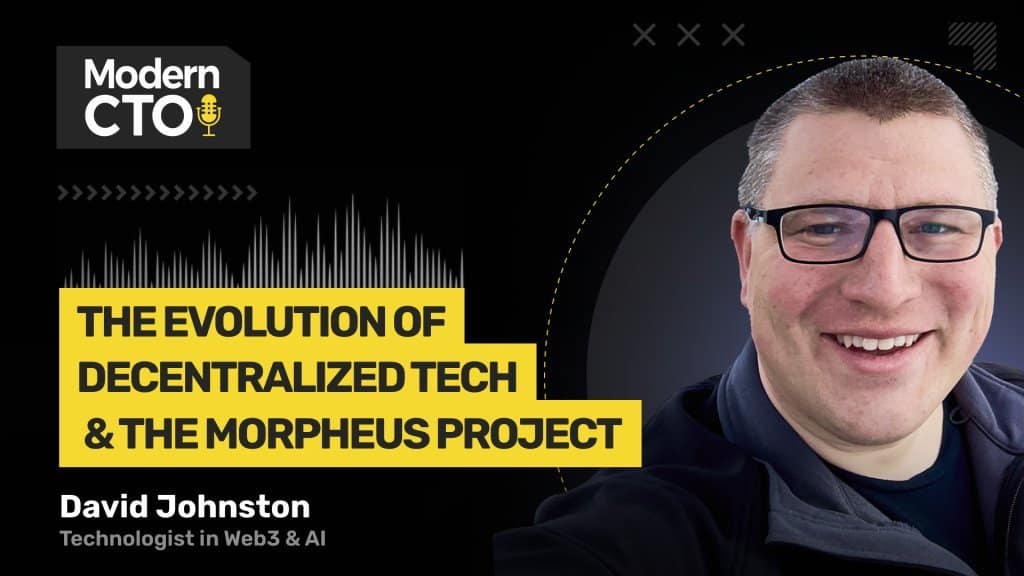
About David Johnston
My 11 Year Journey in Bitcoin / Blockchain:
In 2012, I became passionate about the potential of Bitcoin and how it can be a hedge for inflation and progress for censorship resistance.
In 2013, I spoke at the very first Bitcoin Summit in San Jose, CA and met many of the like minded entrepreneurs who would later start Coinbase, Shapeshift, Binance, Bitcoin.com to make the world more open and free.
That same year, I co-founded BitAngels with friends - world's largest Angel network to invest in the blockchain industry.
In 2014, I wrote the first white paper for The General Theory of Decentralized Application. As one of the first investors in Mastercoin (Now Omni Protocol which is used by the first stable coin Tether's USDT), I became the chairman of the board to facilitate the first ever ICO.
In 2015, I co-founded Dapps Fund - the first all token fund. LP's contributed Bitcoins, they were reinvested into Mastercoin, Ethereum, Maidsafe, Factom and many more projects. The tokens were distributed at the end of 2 year back to the LPs at the end of 2016.
It was fun to be one of the first few people to analyze Vitalik's whitepaper:
https://medium.com/@DJohnstonEC/informational-report-on-ethereum-d847c66be95d
Since late 2016 after the Dapps Fund, I've hired staff and have been running my own family office under the name Yeoman's Capital and invest exclusively in open-source, permission-less technologies. www.Yeomans.capital
By 2020 I expanded my work into Bitcoin mining and in partnership with James Haft began assembling the DLT assets and plan for what would become DLT ASA.
About The Morpheus Project
The Morpheus project is a groundbreaking initiative aimed at leveraging the power of decentralization and AI to transform how individuals interact with digital assets and smart contracts on the Web3 platform. Focused on enhancing user autonomy, Morpheus integrates personal AI agents to manage digital transactions securely and efficiently, fostering a more inclusive and democratized digital ecosystem. By prioritizing open-source development and community-driven innovation, Morpheus sets new standards in creating equitable, sustainable economic models within the blockchain space, ensuring that technology serves the broader community's needs and aspirations.
Transcript
(Intro Narrator at 00:00:00) Today, we're catching up with David Johnston, technologist in Web3 and AI, about how the Morpheus project is evolving and bringing decentralized tech into the future. You're listening to Joel Beasley, Modern CTO.
(Joel Beasley at 00:00:20) We talked, well, I think two months ago on the podcast, and Morpheus had just started to launch. What's been going on the past couple months with Morpheus?
(David Johnston at 00:00:30) Oh, man. It's been wild. You know, Consensus was incredible. Right? We had another Decentralized AI Day. Just to see the whole community come together in person to get to hang out with you and so many of the people building in the ecosystem was really just incredible. It was event after event. You know, Akash had their big Accelerate Day, which was really cool. So started by speaking there, and then we had the Decentralized AI Day, and then spoke at Consensus proper with Eric Voorhees about this concept of how do we create truly decentralized and truly open source AI and draw that distinction between the centralized players.
(David Johnston at 00:01:12) But yeah, it's been incredible. I think over 130,000 staked deals, so it continues to grow. It was like 100,000 before the token went live, and now it is significantly higher. So yeah, the community seems just to have a ton of energy. People are preparing to adopt the whole Fair Launch ethos. And so the idea of MOR20 and having a standard platform for those smart contracts and dashboards and audits. You know, for example, NounSpace has announced their launch, which is coming up just here at the end of the week on the fourteenth. And they're using all these Morpheus smart contracts and sort of building on the same set of concepts. So that's really cool to see. And yeah, so it's been hard to even keep track of everything that's going on. But, you know, it's been really exciting.
(Joel Beasley at 00:02:06) And so why are people staking their ETH?
(David Johnston at 00:02:10) Well, you know, just to go back to how the capital mechanism works in Morpheus, when you deposit staked ETH in the contract, every day, that little bit of yield, that little bit of rebase reward that you get from the Ethereum staking gets contributed to the protocol. So it's a really novel concept that you can still hold all your principal. You've got all your ETH. You can, you know, after seven days withdraw it whenever you want. But just contributing the yield solves for the custody problem. Right? So now nobody's holding your tokens. Only you can deposit and withdraw them. Right? And all you're doing is authorizing the protocol to get the yield. Right? And I wasn't even staking my ETH anyway. Like, I might as well stake it and support this cool open source project. And I guess a lot of other people had that same conclusion. So right now, it's equivalent to more than a million dollars a month of Ethereum yield coming from those deposits into the protocol.
(David Johnston at 00:03:12) And what it does is every week, the protocol buys more tokens out of the Uniswap pool with that yield. Right? Half of that yield gets spent to buy more tokens. The other half is then paired with it and adds liquidity. Half MOR and half ETH into the Uniswap pool. So that whole idea of protocol-owned liquidity is just making MOR ever more scarce, and it's making the tokens more and more liquid over time. So I think I looked this morning, and there were $6 million already of ETH and MOR locked in the Uniswap pool. Right? Which is a good bit considering the project literally just launched and people are just discovering it. So, you know, that whole Fair Launch mechanism just solves so many problems. Right? If you have protocol-owned liquidity, it's not going into some centralized treasury. Right? You don't need a bureaucracy or committees or a bunch of people to vote on what happens with that money. The protocol just fairly rewards people for code contributions, compute contributions, capital contributions, or people building smart agents on top. All of those people can access liquidity whenever they want. Right? It's just created this sort of beautiful frictionless system. Right? And you think about it like the reimagining of ICOs minus the central parties, minus the custodians, minus the treasuries, just all set up in smart contracts. So, yeah, that's been sort of really popular to people say, oh, now that we have staking, we could do something like this instead and just simplify this whole thing. If I just want to launch a project, I don't need the Swiss foundation. I don't need, you know, all of these other pieces. Right? It can just be code.
(Joel Beasley at 00:04:58) So there's three groups of people in my life, and I've been talking with them about this project. The first group of people are the people that know how to have self-custody. They understand this. They are highly familiar with multisig situations, and they're deeply in it. Right? They're the OGs. They're the people that are really into it. And those people, they get it. Then there's the group of people who are, when I, they're exchange people. Right? They've got a Coinbase, so they might have a MetaMask wallet with something in it. And there's the stake button. And when I bring it up to them, they're like, oh, yeah, there's a stake button. How do I click that stake button and just do the Morpheus thing that you're talking about? But they can't because it's far more complicated than just clicking that button in the exchange. And then there's the third group of people that are just like, I don't know what this is. So let's focus on that. I think right now, the Morpheus project is serving very well that first group of people. The people that understand it. They understand chains and Arbitrum or whatever, the different mainnets and all that. They understand how to do all this stuff. But that second group of people, when are they gonna get access to it? When is, when is my brother who's a doctor who's got, I don't know, maybe $10 in his Coinbase wallet, when can he click the stake button there and buy it? Or another friend who's like, I know I'm on the Kraken exchange. When can I buy some of it? When is that second group of people going to be able to access the Morpheus ecosystem?
(David Johnston at 00:06:39) That's a really great question. And Morpheus' core audience is definitely developers. Right? It's people that want to build smart agents, deploy them on the platform, people that want to build projects and use the Fair Launch mechanism. And like you said, for them, they've got a MetaMask wallet. You know, you don't have to have a cold storage, super crazy hardware setup. You just need some amount of self-custody. And there's 300 or 400 million people now that have a MetaMask or Exodus or some sort of self-custody wallet. Right? Because the technical challenge of an exchange is if you were to send funds from that exchange and you don't control that private key, you're hoping that that exchange adds that token in the future or that your private key is connected to that transaction you did. There's just a technical barrier there. Right? The minimum bar is you've got to have some basic self-custody wallet, like a MetaMask in your browser, so that when you get rewarded the tokens and go to claim them for Morpheus, that you have the private key to claim them. Right? Because if it hasn't been listed on Kraken or Coinbase or Binance or some exchange yet, there's no way, you know, they're not recognizing that token yet. Right? This is like when, for example, there are hard forks of Bitcoin. Maybe you'll get those hard fork tokens. Maybe you won't. Depends whether the exchange adds that new coin. Right? And that's because in the exchange context, you're not holding the private key. They're holding the private key. So I would say for those people, they have to at least take a little bit of a step to have a MetaMask or some basic self-custody wallet, which are pretty easy at this point. Right? You can put it on your browser. They can send from their Coinbase into MetaMask, and then they can contribute into Morpheus. But I would say that second group is important and represents sort of a step towards mass market. And that's why Morpheus has a nice GUI. You could download it, you know, basically drag and drop the application directly into your computer. We're not expecting people to be coders. Right? And so you want to access that group. For the third group that you talked about, you know, they're more likely to use Morpheus in a Venice context.
(Joel Beasley at 00:09:02) So
(David Johnston at 00:09:02) if you've seen venice.ai, it's an easy website. There's no login required. You show up. You can make images. You can ask it for text. Right? You can do all those functions without having to know anything about crypto or smart contracts or anything else. So I think in the future, 99% of people will be using Morpheus in some front end. Right? In some website or application that people are building. But the community is definitely working to make it easier and easier for that second group to be able to access Morpheus. And I would point to things like the MOR20 standard. Right? It started as contracts, and now the developers have just put into the testnet dashboards. So you could show up at a website. You don't have to do any code. You just fill out the form. Here's the name of my project. Here's how I want to do my tokens. You push a button, and it pops out a smart contract. So that's an example of extending the scope of people who aren't just hardcore coders, but are entrepreneurs or project builders that want to do something in a web context and be able to do it quickly and, you know, never have to touch a terminal. So it's getting there, but the community is definitely interested in building those pieces. And that's sort of one thing that's unique about Morpheus is it's not just a protocol layer, but it's rewarding groups all the way up the tech stack, all the way to the front end.
(Joel Beasley at 00:10:32) So you talked on two things there. You talked, let's back up to my brother who's a doctor who's got a Coinbase account or whatever. There's a little button that says stake, and he can stake, and there's other, there's options in there to stake. When will Morpheus show up as an option?
(David Johnston at 00:10:51) It's a good question. You know, Coinbase is challenging because they're regulated basically as a bank. Right? And so there's all these limitations on what they can do for people as far as offering DeFi or yielding or staking. And so, you know, the brother who's a doctor probably has to leave the Coinbase context, you know, send his funds into a self-hosted wallet like MetaMask. Right? Be able to turn them into the staked ETH and then put it into the Morpheus smart contract. The only way to change that equation is if somebody set up a website that basically handheld people through those steps. Right? But the trouble again is avoiding that person running the website becoming the custodian. Because as soon as they are, they're like Coinbase again. They're regulated. They need a bunch of licenses and stuff like that. But it would be interesting to see a website where even if it didn't sort of take custody of the coins, it was more like a guide. Right? Step one, here's step two, here's step three. Right? To go through that process.
(Joel Beasley at 00:12:06) So I do, do you have a Coinbase account? Have you used Coinbase?
(David Johnston at 00:12:11) I have used Coinbase in the past. Yes.
(Joel Beasley at 00:12:13) But have you used it in the past six months or so? No. Okay. There's a button where I can stake. I can click on my ETH. I have a small amount of money in the Coinbase exchange. And I can click on my ETH, and I can click the button that says stake, and then I can choose what project to stake it to. And there's so many projects to stake it. Sure. Why can't Morpheus show up in there? Or is this too sensitive? Am I talking in an area where I shouldn't and we should cut it all out? Or is there a reason why it's, am I not seeing something?
(David Johnston at 00:12:48) No. It's a perfectly good question. I would say if you want to get to the point where Coinbase and Kraken and these guys, those folks are welcome to integrate Morpheus. Right? Morpheus is all open source. Yeah. Absolutely. But I guess I've been talking about from the context of what the Morpheus community can do, like building the platform and creating front ends, and then what third parties can do. You know, Coinbase is a great example of a third party. Right? It would be awesome to see Coinbase supporting Fair Launches. And just on this subject, you know, one of the most common requests for MOR20 has been to add Base. Right? Which is a second layer built by Coinbase. Right? And so, Base just got added to the Morpheus contracts. So people are gonna be able to launch a project using Base instead of just Arbitrum. Right? Because Morpheus is chain agnostic. It'd be incredible to see Coinbase doing that type of integration as presumably they would use the Base version. Right? And let people support those projects. So, you know, shout out to Brian and all the cool builders, you know, creating Base and pushing forward. Because now more than ever, there are a bunch of self-custody tools in Coinbase where you can go beyond just holding it in the exchange. Coinbase has a
(Joel Beasley at 00:14:13) wallet app too. Yeah. Yeah. Yeah. Yeah. Yeah.
(David Johnston at 00:14:15) That's self-custody. Right? And so if they were to integrate, you know, MOR is just an ERC-20, right, so it should be very easy for them to integrate, that would be really cool to see.
(Joel Beasley at 00:14:26) Oh, awesome. I am personally excited for Morpheus to be at the point where I can direct staked ETH at it, and then I can say I want a dashboard to, like, what projects I could push it at. So I'll be like, oh, I pointed it at Morpheus, and I'm pointing it at an ecosystem, and maybe the default bucket is the Morpheus project itself. But I could also just choose to delegate that money to the NounSpace project, like, another. Is that even in the vision of what Morpheus is? Because that's how I imagine it.
(David Johnston at 00:14:58) Absolutely. I mean, Morpheus, you can think of as sort of, you know, curated this large network effect of people that want to do exactly that, right, which is direct the yield from their staked ETH. So I think it's a natural extension that will see people release dashboards and websites that make that process easy, right, and just show me, you know, the different projects I can direct it to. So I think that would be awesome. I don't know if the folks at mor.org are planning a dashboard like that. There's a couple of other people in that ecosystem that have been talking about it. But I think that's probably the next logical step because with MOR20, you know, the contracts are moving into like a factory and contracts produced by that factory contract, sort of like they do with Uniswap or other protocols. Right? So when somebody pushes that button and launches their project on Morpheus, you know, you're gonna know that it's using the same secure code and, you know, it's a Fair Launch style project. Right? And then it's very easy to say, oh, yeah, that's the next one I want to support. So, yeah, I think that would be, that'd be awesome. I wouldn't be surprised to see that in the near future.
(Joel Beasley at 00:16:10) I have very little crypto experience, so I think that's a pretty good, actually useful contribution to conversations because I hear it and I'm like, oh, okay. So I'm going to direct my — I'm going to point my servers at this IP. And then I'm going to have some sort of dashboard to then, like, configure it. So I'm going to point my staked ETH at this project, and then there's going to be some dashboard. I'm going to say, I want 20% of my yield to go to this project.
(Joel Beasley at 00:16:35) I want 30% of my yield to go to this project. And in that way, I have this dashboard. It's basically like a yield management platform where I'm investing the yield without ever risking my principal.
(David Johnston at 00:16:49) Yeah. No. That's exactly what folks have been talking about, and I think that's sort of a natural extension of the fourth bucket. Right? Today, we have code and capital.
(David Johnston at 00:17:01) Next is compute, right, which just went into testnet a few days ago. But the last one is the builders. Right? It's the people launching the projects and the smart agents, and people are going to be able to stake their MOR tokens towards those projects. Right?
(David Johnston at 00:17:17) And so the natural extension would be, well, I want to do the same thing with my ETH. Right? I'll put in all my ETH, and then I want to parse it out towards different projects I want to support. So, yeah, I think that's sort of a logical extension of the fourth proof, right, that has to get built out. And I think that's probably one of the next things the open source devs want to work on.
(Joel Beasley at 00:17:38) Let's get to the bottom of your profile picture. So we got this picture of you on Twitter, and when I went to the conference and I got to, you know, see you before, I said to Christopher, I was like, hey. So what happened to David's beard? And it's, like, long hair. Like, why did he get rid of that?
(Joel Beasley at 00:17:59) And he's like, oh, you're talking about his main picture. Tell me about why you choose to have this picture as your profile picture on Twitter.
(David Johnston at 00:18:07) You know, I had my real image for a long time, and then I noticed everybody was having fun with these avatars. I was like, I should pick something more lighthearted and fun. One of the things I did when I first started using modern stable diffusion and other stuff like that is I created a whole graphic novel, right, to walk people through how to use open source. It's called Freeman's Journey. I put up a website.
(David Johnston at 00:18:37) It was just kind of like a fun weekend project. It was like, oh, now I can generate an entire story. I can make a bunch of cool images. When I typed in Sovereign Freeman, right, that's the image that stable diffusion gave me. I was like, oh, that looks pretty cool.
(David Johnston at 00:18:53) I'm going to use that as my avatar, right, just to change things up and make it more fun. Moving into focusing on AI is like, well, my avatar should be generated by AI. Obviously, that's the next step. That's Sovereign Freeman. It's from the graphic novel.
(David Johnston at 00:19:14) I thought it was fun. I've already changed things up and made it much more — it gave me more of a cypherpunk kind of outlook, and reflected my interest in building, engineering, code, and stuff like that because I felt, you know, the normal pictures were a little too corporate. I'm much more on the technical side, so I tried to rebuild my profile as I refocused on AI to be more technical focused. And, yeah. So it was just something fun to do.
(Joel Beasley at 00:19:51) When I first came into the Morpheus project, when I was first made aware of it, my initial reaction and interest in it was the idea that there's going to be these mega corporations that control most of AI, that they're going to have their, what I like to call, nonsense on top of the model. So, like, you got your model, then you got your nonsense that you've taught your model. And then that they're sharing all of that with the government. Right? So if you're asking GPT how to make bombs, it's like sending a text to your local PD.
(Joel Beasley at 00:20:24) So I don't like any of that, but the idea was that we would hit escape velocity in decentralization before the models could get, like, so regulated and shut down. The cat seems to be, like, out of the bag. Right? Genie out of the bottle. Have we hit that escape velocity?
(Joel Beasley at 00:20:41) I mean, there's tools, like, in the Morpheus network, like Hyperbolic. They're already doing decentralized AI model running. I think Venice is using Hyperbolic. Like, are we at the point yet where we're safe and we've, like, we have this decentralized AI technology and it's not going to get shut down, or are we still trying to reach escape velocity?
(David Johnston at 00:21:01) I think we got to escape velocity when Llama 3 got released. So Llama 3, and it's just a few weeks ago. Llama 3 is equivalent to the same quality and accuracy as like a ChatGPT-4. Right? And so the open source models caught up with the proprietary models.
(David Johnston at 00:21:25) Right? And the models will improve from there. But, like, this is a really accurate, really high quality basis. If they ban all models after this, we've already got something. It's not a toy.
(David Johnston at 00:21:37) It's not inferior. It's the gold standard, sort of state of the art today for, you know, a large language model. So the moment that happened, that happened right before Venice went live. And they were super happy because, like, they just got this huge free upgrade to all of their models because they only use the open source models. Right?
(David Johnston at 00:21:57) And when Llama 3 came out, it was like, great. Now we are literally, you know, within striking distance of the quality you get from the closed proprietary models. And so that was a huge moment. To your point, the compute networks are already there. Akash is live, you know, Hyperbolic, you know, all these groups.
(David Johnston at 00:22:17) But keep in mind, they're all on the supply side. Right? They're creating the inference. They're creating the compute and the models that people want to use. Morpheus' addition is it's creating the demand side.
(David Johnston at 00:22:31) Right? The smart agents are using that inference. They're using that compute that's provided by Hyperbolic and others. Right? And the routing network, and the decentralized router that Morpheus has pioneered is matching people that want, you know, an image or text and people that can provide it with those models and incentivizing the compute to provide it.
(David Johnston at 00:22:54) Right? So it's the second half of the market. We need both sides. Right? Otherwise, this will get pushed into, like, the protocol layer and, you know, oh, it's, you know, just for those that are highly technical.
(David Johnston at 00:23:05) If we want to bust into billions of people using this, it has to have a front end. It has to have the applications. It has to be, you know, on the web and in an app. Right? And the only way you get that is if you pair the supply side and the demand side.
(David Johnston at 00:23:19) Right? So these are really complementary. People often ask me, like, why is Morpheus better than Akash? I was like, they're not competing. Like, they're two different sides of the same market.
(David Johnston at 00:23:27) You need both. If you love Akash, you should love Morpheus because it's creating demand for what they're supplying. Right? You know, we speak at their events. They speak at our events.
(David Johnston at 00:23:40) They've been — all the decentralized AI. These are very complementary pieces. I think we are at that escape velocity, but I'll feel a lot better, you know, when the router goes from testnet to mainnet. And I'll feel a lot better when people can stake towards any project they want, and there's rocket fuel under all the smart agent builders that want to release in this context. Because those are the last two proofs that need to go live.
(David Johnston at 00:24:06) Like, capital's proven. Great. People want to do it. They got rewarded for coding. Excellent.
(David Johnston at 00:24:12) But now rewarding compute, and the actual smart agent builders, those are the last pieces. So it's going to be an interesting few months because it looks like they are going to implement a bunch of restrictions, whether at the federal level. Those are due in July. Or now California has this bill where they're going to license models. Yeah.
(David Johnston at 00:24:31) It's like, yeah. You couldn't possibly release an AI without approval from California. So, like, we'll see what happens. Right? If the federal rules get struck down, but California institutes this crazy bill, it's just going to push everybody out of California.
(Joel Beasley at 00:24:47) Well, I think they're doing a good job of that already.
(David Johnston at 00:24:49) Pretty good job of that. But it's like the last thing they had going was like this center of AI, and if they kick everybody out that isn't Google or Microsoft, like, you know, I guess they can come to Austin. But if the federal rules are super draconian, it'll push people into London and Zurich and other international locations. So we'll see.
(David Johnston at 00:25:08) It's a couple more months. Like, for me personally, I'm working as hard as I can. I'm pushing as hard as I can to see as much of this open source get out there because we don't know what's going to happen in July. We don't know what's going to happen with these other rules. And the further and more mature this gets, the sort of more absurd it shows the regulations are.
(David Johnston at 00:25:28) Right? And sort of unenforceable in their nature. So we'll see. Interesting.
(Joel Beasley at 00:25:34) Alright. I'm learning a lot today, man. So I feel good on the side of humanity. I saw this — I had this fear that we wouldn't reach escape velocity. We've got Llama 3. We've got lots of decentralization happening in different ways.
(Joel Beasley at 00:25:47) From Hyperbolic and Akash to, you know, what Morpheus is doing and Venice on the demand side. I think Venice and Morpheus would both be considered demand side. Right?
(David Johnston at 00:26:05) Yep.
(Joel Beasley at 00:26:05) And so I feel like I can take a breath a little bit. Right? Because humanity, the average Joe, will now have access to Llama 3 without oversight of the government on top of it. Unless they shut down, like, the decentralized networks, which are pretty hard to do. Right?
(David Johnston at 00:26:25) Unless they're going to shut off Ethereum or the Internet, it would be hard to shut off the protocols. Now, something like Venice is an easier target because it's a website. Right? They could move to decentralized website infrastructure. Eric said they will if they need to.
(David Johnston at 00:26:45) And he's hoping it won't go there, but it might go there. The government might say, oh, well, you can't show this information to US citizens. Right? And then so they may have to censor what they can show in the US. Which is very American.
(Joel Beasley at 00:26:58) It's like, what is that? Totally.
(David Johnston at 00:27:00) Yeah. Totally. You know? It reminds me of all the freedom I have every time I go to a website that says no citizens from North Korea, Iran, or the United States. Like, you know, just reminds me of the freedom, you know, I've got.
(Joel Beasley at 00:27:14) In other news, China prevents their citizens from seeing stuff, and they're horrible for it. It's like, yeah. Yeah. It's like, what? Exactly the same thing.
(David Johnston at 00:27:23) Yeah. Yeah. Yeah.
(Joel Beasley at 00:27:23) Alright. How long have you known Eric for?
(David Johnston at 00:27:28) I guess, about — in 2013 at the first Bitcoin Foundation conference in San Jose. That was May 2013. So yeah, I guess, wow, it's been eleven years. He was an early pioneer, having built Satoshi Dice and then ShapeShift, helping with a bunch of other open source projects. A lot of my friends like Willie went up to Denver and worked with him on different projects.
(David Johnston at 00:27:58) But he really fought the good fight. As he would say, he's a two-time SEC award winner for his efforts to create transparent, honest financial rails. I think after the last experience, he was enjoying being in this role where everything had been decentralized, right? He famously took ShapeShift from a company to a DAO. Right?
(David Johnston at 00:28:25) And, you know, was able to step away, and the community runs the infrastructure. The community runs, you know, the sites and everything. It's continued operating very well. Right? I see all these new announcements of what ShapeShift is doing.
(David Johnston at 00:28:37) It sort of proved out that you could hand things over to a community and they could run stuff, right, and take a product to the next level. I think when I saw him in September of last year, I had mentioned the Morpheus white paper, which I had received a week before. He was like, yeah, they're going to come for intelligence next. It was already clear some of the proposals for laws and restrictions on AI. We've had a lot of experience from crypto on how to navigate those things.
(David Johnston at 00:29:08) These AI people haven't had all that scar tissue the last decade, decade and a half. It's like, yeah, we need to give them decentralized compute and all these tools and show them, you know, if these rules come out, like, how to keep building and innovating despite those rules. Right? And we had no idea October, like one month later, the executive order would be released. Right?
(David Johnston at 00:29:32) And it's like, oh, yeah. We've got to get serious about this. Oh, yeah. The Morpheus proposal? Yeah.
(David Johnston at 00:29:36) That looks like a good starting point. Let's build. And so, you know, it's been really cool to work, you know, directly with Eric on this type of open source project. And he's just got such great instincts for how to communicate, how to articulate an idea, how to pull in the right talent and other open source contributors. There have been 255 people already that have contributed code to Morpheus.
(David Johnston at 00:30:07) So there's this global ecosystem, like half of them are anonymous. Like, the original paper authors were anon. But I don't care. The code works, and whether they live in Europe or Asia or South America, it doesn't matter. Right?
(David Johnston at 00:30:22) Anybody can contribute from anywhere. Yeah. It seems like a logical extension of the trajectory he was already on from company to DAO to fully decentralized project at Morpheus.
(Joel Beasley at 00:30:36) Yeah. It's interesting to see how the communities blend and work together. So from a high level, what it's looked like to me — so correct me if I'm wrong. What it's looked like to me is, okay. So the currency people come out with, like, the blockchains and decentralized finance and all of that.
(Joel Beasley at 00:30:54) And in order to make sure that that doesn't get shut down, because there's high incentive to shut that down, the decentralized compute area started to emerge. And then now, the people who were in AI, they never had to really worry about decentralized compute. But now that's starting to get regulated. So now they need this, like, economy of decentralized compute. So now the AI people are like, where can I run this stuff that, like, is not going to get shut down?
(Joel Beasley at 00:31:19) And the blockchain, DeFi people are like, we figured that out. Like, check out how we do decentralization. And so I think it's kind of beautiful how, you know, the AI people, they don't have to care or believe in cryptocurrency at all. But the idea that these blockchain runners have figured out the decentralized compute in such a way that it's useful to them now, that's pretty interesting to me how that all kind of works together.
(David Johnston at 00:31:41) Well, and even for people that, you know, aren't affected by the rules and don't care about decentralization, it's just cheaper. Right? Akash is 3x cheaper right now as compared to using AWS or some other provider. And it's a lot cheaper than, you know, paying for the API at OpenAI. Right?
(David Johnston at 00:32:03) And so just on a pure cost basis, it's like, why would I pay 5x to run this model when I could use this open source one, which is just as accurate and just as fast, and it cost me five times less? Like, that's a no-brainer decision. Right? And so I think AI people in general are just discovering, okay, my biggest cost is compute. And these decentralized networks are a lot cheaper.
(David Johnston at 00:32:30) I'm going to switch over to those. Right? And I think that's starting to happen en masse because the models have caught up. Right? Is one of the biggest cost —
(Joel Beasley at 00:32:37) Is it really that much cheaper? It's really that much cheaper?
(David Johnston at 00:32:41) It on a cost right now, it's 3x cheaper.
(Joel Beasley at 00:32:43) So then from my perspective, because the largest amount of my experience and background is in software engineering, if I'm looking at this, I'm like, alright, well, if I run it on AWS, at least I know who's stealing my data. But how do you create security when it's decentralized like that? Is that the problems that people like Rakshak and stuff were working on with model validation and trusted compute and what Apple just came out with the other day?
(David Johnston at 00:33:11) Yeah, groups like 6079 are all working on proof of inference. And then people working on zero knowledge models, right, where you can put in the information and it's sort of not revealed.
(David Johnston at 00:33:25) Then there's the approach that Venice has taken, which is really novel, which is, okay, yes, we're putting it in plain text, but we're using a proxy server that's encrypted, so there's no connection between the text and the person. And there's thousands of requests coming in from thousands of different people, and there's no connection between that person's identity and the prompt they sent, right? So you could pull some very general analytics about how often people are asking about stuff, but no personal identifiable information would be accessible. That's a clever approach that Eric and his team have taken, which is, you know, we're just gonna mix all these prompts together.
(David Johnston at 00:34:10) We're gonna put it through an encrypted proxy, so you can't even connect the IP addresses, right, to the prompts. And if somebody's using a VPN, they can't even do that, right? So there's still work to do on the privacy aspects, but that's getting some really good attention on the zero knowledge and fully homomorphic encryption side. But, you know, just from a practical standpoint, somebody using Venice has a pretty secure setup, and it's a hell of a lot better than the persistent storage forever by AWS or Microsoft or something like that.
(David Johnston at 00:34:42) It's already a huge step forward. I put it on like a Proton Mail for AI is sort of the approach that Venice has taken. So, yeah, it's already a lot more private because, like, they were already digging through all this data. They have the direct connection to your identity, training their models on it. People were finding their leaked information in the models anyone could ask for because, you know, they're just not doing a good job of anonymizing this information.
(David Johnston at 00:35:12) So—
(Joel Beasley at 00:35:12) Well, I'm really frustrated that ChatGPT, which is my most used tool, did this thing and I couldn't figure out how to turn it off, where it started sharing knowledge between conversation threads. So I saw one of the biggest benefits being each bucket is like an isolated thing. So I could train one bucket to create show prep really well or help me with asking questions, another one for writing LinkedIn posts, another one for cold email. So I had all these buckets as separate.
(Joel Beasley at 00:35:38) And then one day I log in, it's like, congratulations, we're now sharing across all your things, and there's no button to turn this off. And I got so angry.
(Joel Beasley at 00:35:47) But then I was like, alright, whatever. You know, moving on. Let's see if it really affects the abilities of these different buckets I've made. And then it started doing something creepy where, because in my LinkedIn post helper bucket thing, which I guess more would call an agent or a version of an agent or a conversation with an agent, I was sharing pictures of my kids and, like, hey, I'm out doing this today and everything like that. And then that started bleeding into my cold email stuff. And I'm like, stop referencing—I don't like that you know this about me. I never mentioned ProSeries Media. Why are you bringing that up in this conversation? You shouldn't know about that. So that really grinds my gears. Alright, so we're gonna wrap up on this topic.
(Joel Beasley at 00:36:37) Morpheus podcast is coming. Tell me about that.
(David Johnston at 00:36:41) You know, I'm looking forward to this. It's gonna be a lot of fun to sort of engage with the different projects building in the community, you know, between NounSpace and 6079 and Wire and all these different groups. There's just so much going on. You need time to really delve in so people can understand what's being built. So, yeah, I'm looking forward to it. It should be a lot of fun.
(Joel Beasley at 00:37:04) Nice. And we just got started on that too. So we don't have names or launch dates or anything of that sort yet.
(David Johnston at 00:37:12) Soon. Soon. Two weeks.
(Joel Beasley at 00:37:15) Two weeks.
(David Johnston at 00:37:15) TM. Two weeks. If anybody is old enough to remember that reference, it's early days of crypto. There was a project that famously was always two weeks away. Two weeks away for like a year. Just two weeks, guys. Two weeks. People are like, yeah, two weeks. Two weeks. Sure.
(Joel Beasley at 00:37:31) Two weeks away. Yeah. Anything else you wanna get out into the world other than go stake some of your ETH at the Mor project, get some yield? What else do we wanna tell people?
(David Johnston at 00:37:44) You know, I think the big thing is you can boil Morpheus down to really a couple of basics. If you need cheap inference, decentralized routers is gonna be an incredible way to get access to that. And so it just hit testnet. So if you're one of those AI developers who just wants cheap inference, great. Come test out the testnet, get involved, and you'll be able to pretty soon hook up to that API and just use it as an easy way to get access to the models and the compute that you wanna use.
(David Johnston at 00:38:21) And it's worth doing that because it really is a lot cheaper. You're not paying this huge markup to Microsoft and others. Now that the open source models are just as good as the proprietary ones, this is the opportunity to really lean in and just use it as a tool. So one, that's for AI developers. Yeah.
(David Johnston at 00:38:41) For people in crypto, if you care about decentralization of AI, if you want a personal AI like I do, I'm happy to take my Ethereum, stake it, and point the yield in this direction. And then finally, you know, so that's for capital. If you're a coder and you wanna build this, there are rewards, right, for people that contribute to the code base. So, you know, whether you're a third-party developer or somebody that builds protocols and platforms or just somebody in the ecosystem that wants to support it, Morpheus has a really easy way to do that. So I would visit mor.org.
(David Johnston at 00:39:17) You know, that's one of the most popular community websites, has dashboards and everything that make it super easy.
(Joel Beasley at 00:39:23) Yeah. And then you can join the community. There's a pretty vibrant—what's the name of the tool that the community is based on?
(David Johnston at 00:39:31) Well, Discord. There's a super active—
(Joel Beasley at 00:39:34) Yeah, Discord. That's it.
(David Johnston at 00:39:35) Yeah. There's a super active Morpheus Discord. It's like 5,000 or 6,000 people in there. And then you've got, you know, active communities on X and Telegram and all the other social channels.
(Joel Beasley at 00:39:47) Nice. Awesome, man. Well, thank you so much for doing this. Mor.org.
(David Johnston at 00:39:51) Awesome, man. Yeah, it's been great to catch up.
(Joel Beasley at 00:39:54) Thank you so much for listening. And if you found this episode useful, please share it with a friend or colleague who you think would get value from it. And if you have topics that you'd like to hear discussed on the podcast, either add me on LinkedIn or send me an email, [email protected]. Every time I get an email or LinkedIn message, it absolutely makes my day and inspires me to keep going.