
Episode 776 ·
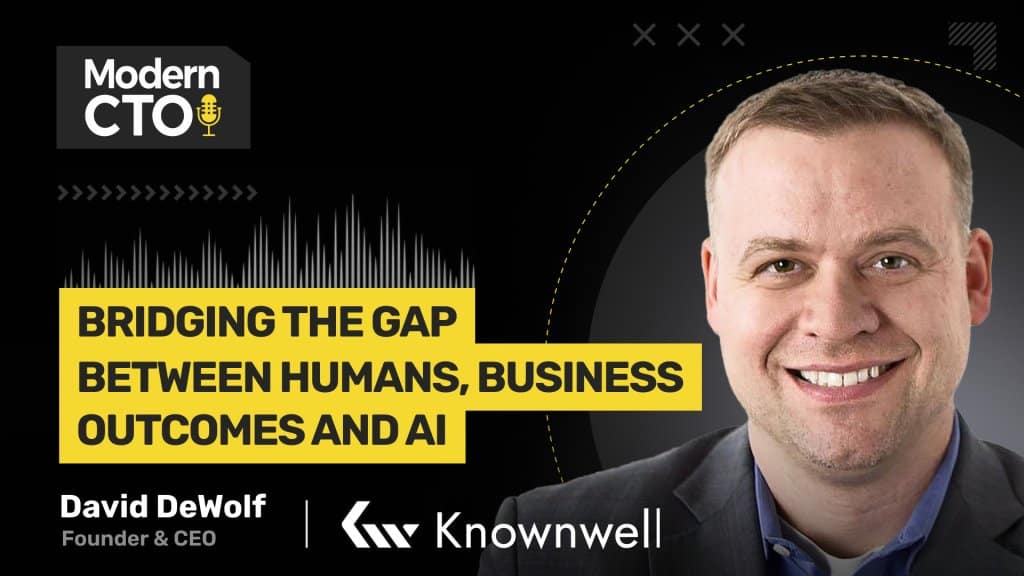
Bridging the Gap Between Humans, Business Outcomes and AI with David DeWolf, Founder & CEO of Knownwell
Today we’re talking to David DeWolf, Founder & CEO of Knownwell. We discuss the impacts and takeaways of David’s silent retreat, the perils that business leaders are facing with AI, and how he’s helping to solve these problems with a human-centered vision.
All of this right here, right now, on the Modern CTO Podcast!
To learn more about Knownwell, check out their website here.
Have feedback about the show? Let us know here.
Produced by ProSeries Media.
For booking inquiries, email [email protected]
About David DeWolf
David DeWolf is the founder and CEO of Knownwell, an AI solutions company that is reinventing the way businesses are understood and run in the Intelligence Economy.
Previously he was the Founder and CEO of 3Pillar Global, a digital product development organization that he grew to become the preeminent provider within one of the hottest sectors within technology services. Under David’s leadership, 3Pillar grew for 16 consecutive years to more than 2000 employees. 3Pillar operated in 10 countries and was named to the Inc. 5000, a list of the fastest-growing private companies in the US, ten separate times. David is the co-author of The Product Mindset and has been featured in Fortune, Forbes, Fast Company, and Inc. among others.
David is the Managing Member of DeWolf Family Ventures, a Family Office that invests in and supports the next generation of principled entrepreneurs and leaders. Over his career, as an operator, David has raised over $500mm of capital. He has delivered a 4.55x MOIC to investors and driven a 43% IRR across 5 separate funding rounds (3.80x MOIC and 96% IRR on a weighted average basis).
David is a frequent keynote speaker at events. David is passionate about leadership, entrepreneurship, and digital innovation. He serves on the Boards of various for profit and non-profit organizations including Chairman of Capango, where he is currently the Lead Investor, and 2x.marketing a Private Equity Backed Marketing-as-a-Service business, where he serves as Independent Board Member. We served as the Vice Chairman of the Board at the Franciscan University of Steubenville for 8 years and is currently finishing up his 12 year term as a Trustee. Prior to founding 3Pillar, David held multiple technology leadership positions, was an active member of the Apache Software Foundation.
About Knownwell
Knownwell, an AIaaS platform company, synthesizes an organization's natural communications, enterprise data, and public information into actionable intelligence to minimize client churn, maximize client growth, and drive operational efficiency. Knownwell equips mid-market professional services executives with the competitive edge they need—knowing their clients to strengthen client relationships, manage service quality perception, and calibrate alignment. To explore more about Knownwell's transformative platform, please visit knownwell.com.
Transcript
(Intro Narrator at 00:00:00) Today, we're talking to David DeWolf, founder and CEO of Knownwell, about how we can address the gap between humanity, business outcomes, and AI. You're listening to Joel Beasley, Modern CTO.
(Joel Beasley at 00:00:18) What's happening, David? How you doing, buddy?
(David DeWolf at 00:00:20) I'm doing great. Good to see you.
(Joel Beasley at 00:00:22) Good to see you. I was looking through the notes. We haven't done a podcast since October '22.
(David DeWolf at 00:00:27) Really? It's been that long?
(Joel Beasley at 00:00:28) We've talked in between enough to where I was like, it's been that long since we've had him on the show.
(David DeWolf at 00:00:33) That's funny. That's great.
(Joel Beasley at 00:00:35) You have a show now.
(David DeWolf at 00:00:36) We do. Yeah.
(Joel Beasley at 00:00:37) What's the show?
(David DeWolf at 00:00:38) It's called The AI Know-How, and we are talking about how AI is applied to business. So really taking the subject matter of business itself and how AI is changing and turning it on its head and talking about the business aspects of it. I find that a lot of folks are focused on the technology of AI or the application of it to very discrete use cases. We're talking about the transformation that's being driven from it.
(Joel Beasley at 00:01:04) Nice. And what inspired that podcast?
(David DeWolf at 00:01:08) Really just the passion. Right? Like, if you step back and look at all of the conversations going on about AI, you see three fundamental conversations. One is the LLMs themselves, the technology, how it's advancing. Really, really interesting. Tons of money going in that space, but it's really technological advancement. I'm more of a humanistic guy than a technologist. Obviously a technologist, but I love the impact of it. So that leaves me with two other conversations.
(David DeWolf at 00:01:35) The first one is very discrete use cases, right? It is all of the conversation around how are you leveraging ChatGPT, how is this writing content for you. That's interesting to me, but it's not transformative. To me, where humanity gets impacted by technology is when we start talking about the institution of business and how it's being flipped on its head.
(David DeWolf at 00:01:59) And I think there's a lot of question about that. There's a lot of conversation just about the fear, the uncertainty, all of those types of things. There aren't answers about it. Like, there aren't people actually painting the vision saying this is what the future is like, this is what we should be looking at and stewarding the adoption to make sure that the technology elevates humanity versus tearing it down.
(David DeWolf at 00:02:21) And that's my passion. I love talking about that kind of stuff. And to me, that is what leaders in businesses should be grappling with, not the bits and bytes of the technology.
(Joel Beasley at 00:02:32) Well, I'm glad you decided to have that conversation because the closest thing we had to that were organizations or influencers pointing fingers for irresponsibility and use, and that was getting into the mainstream consciousness of humanity. But it was very blame game driven, and I don't like to engage with that type of content.
(David DeWolf at 00:02:50) And where are the solutions? Right? Like, stop pointing fingers at it. And yeah, there are bad humans in the world for sure. I think most of it is actually just ignorance and people not putting the thoughtful guardrails in place.
(David DeWolf at 00:03:04) Right? And so, you know, one of the things I think as a society we have to get back to is really the humanities and thinking about what does it mean to truly be human. Right? And we've spent so much time on the STEM subjects that we have underinvested in history, the classics, philosophy, religion, all of those things that help us define what are ethics. Right?
(David DeWolf at 00:03:27) When we talk about human alignment, what is human intent? Like, who gets to define that? How do we shape that? And I think that conversation needs to be had.
(Joel Beasley at 00:03:39) So tell me a little bit about, you and I had a conversation last year, and we talked, and then you went on a silent retreat. After your silent retreat, you came back with this company that's going to change the world with AI. And so I want to know how that progressed. What was the silent retreat actually like, and how did you leaving that retreat or participating in it ultimately give you this clarity on where you wanted to go?
(David DeWolf at 00:04:07) Yeah. Well, there's three parts of that story, right? There's the before, there's the during, and there's the after. I think before, the context really matters. Right? I had stepped back from Three Pillar. I had led Three Pillar for sixteen and a half years. That's a lifetime these days. And it was just time for me to refresh, recharge. And I really took the first quarter of the year to focus on family, friends, reconnection. I traveled the world. I spent time intentionally in a way that I had not in a long time, just worrying about the most important relationships in my life. In May, so about five months in, on May 1st, I headed out for this silent retreat.
(David DeWolf at 00:04:50) And my original intent was to really just discern, like, what is next in my life? Because I didn't have an idea. All I knew was it was time to refresh, recharge, and take the next step in my journey and that God was calling me to something new. And interestingly, I fly to Boston. This retreat is near Quincy, Massachusetts, is where the retreat center was that I was going.
(David DeWolf at 00:05:17) And I land, and I'm getting ready to turn off my phone, because it's not just silent, but it's like turn off the noise. Right? And in doing that, I checked the news for the last time, and the headline of Geoffrey Hinton leaving Google because he was concerned around the ethics of AI was the last news article that I saw. And I then turned off my phone, and I spent the next eight days in silence, in prayer, really trying to listen in terms of what does God want from me and how is He really speaking to me in this moment, and then eventually led me to a place of just this realization that leaders cannot be running away from something they're scared of the ethics of. We need to be running towards it and stewarding it.
(Joel Beasley at 00:06:12) Did you call Geoffrey?
(David DeWolf at 00:06:13) I did not. I should have. I should have. But like, that just hit me and inspired me. And to be honest with you, I had no interest in AI till that point. Like, I had spent years in digital product development. I knew AI was impacting our world, remotely interested about it, but it wasn't a passion of mine. And all of a sudden, what really, really hit me was the need for intentional stewardship of the adoption of AI. And if I rewind back to think about the Internet and all of social media, all of these other kind of revolutionary changes that we've had, I'm not sure they have been purposefully stewarded in order to be pushed into society in a way that elevates the human, that honors the dignity of the human person. And in this world where the technology is so powerful and we've just come to what I consider to be the biggest technological advancement of our time, it is so essential that we have good people that care about people, that care about humanity, that are thinking philosophically, that are thinking about the ethics, that aren't just asking questions about ethics, but actually helping the world have that conversation.
(David DeWolf at 00:07:36) And so it became a passion of mine to figure out how can I help to shape that world? And it was exciting to me that I was on this period of sabbatical, this break from my career, at a point in time where I had the ability to dive into that headfirst. And that's where that motivation came from that as I left, I began to just continue to pray about and discern and think about what are the next steps, knowing that I had—my daughter was getting married in July. I had promised I wasn't going to do anything until after that date. So I had about a good three-month period of time to really take that vision and take that initial motivation and begin to shape it and figure out what it was supposed to be.
(David DeWolf at 00:08:18) And that really was the story of the retreat and what came to me and how I am where I am now was really feeling like this is what I was made for. This is what I was called for. All of my experiences to this date have shaped me to be able to enter into this space and to help the industry adopt this incredible technology in a way that advances, doesn't tear down, society and humanity.
(Joel Beasley at 00:08:45) How was the wedding?
(David DeWolf at 00:08:47) The wedding was awesome. The only way I can describe it, Joel, is this is my oldest daughter got married. And it was very emotional like you expect, but not in any sort of negative way. The only way I can describe it is my heart was more full than it's ever been. Like, just so many feelings, such an awesome experience, and I was so grateful that I didn't have a full-time job, right? That I had the freedom and the space to, like, sit in those emotions and live it up. And I also really realized how grateful I was that I absolutely love my son-in-law and how hard it would have been if I wasn't a hell yeah. Like, we were waiting for him to ask when he asked, and we were super—if that wasn't the case, boy, that would have been hard. So it was awesome.
(Joel Beasley at 00:09:37) Just a brief side note. So my daughter is almost seven, and I'd say every couple months or something, I just see her make that, like, noticeable growth. Like, one day she wakes up and it's like, wow, you look like a year or two years older just today. And then I'll imagine, like, what it'll be like to give her away at her wedding. Did you imagine that when they were younger?
(David DeWolf at 00:10:00) Totally. I mean, I remember—I think it's a natural thing for fathers to do, especially. Like, I remember multiple instances thinking about, like, even, like, you hear songs and you're like, that's going to be the father-daughter dance, you know, different things like that. And I think it's one of the rare points in time in your life where you have something like that that literally for decades you've been thinking about that then comes true, so that anticipation is so big. I think that's one of the reasons why your heart is so full in that moment, is it's just this very deep-rooted thing. It's meaningful.
(Joel Beasley at 00:10:37) She didn't marry Geoffrey Hinton, did she?
(David DeWolf at 00:10:41) She did not. She did not.
(Joel Beasley at 00:10:43) I am curious, though, when I hear people doing that, because I've seen that a lot—not just Jeff, but like other people, like—I know him now. Not just Jeff for short. But I see that happening a lot. Well, I left because of the ethics. And my question is always, like, well, couldn't you have impacted change there? And if you have left because of the ethics, is the new thing you're doing helping combat that, or is it just a detour? Like, just walking away from that entire situation because you didn't like it?
(David DeWolf at 00:11:10) Yeah. And I want to be careful too. I agree with all that. Those things go through my human mind as well. That said, we don't know anybody's personal experiences, and maybe they have—I've coached several people that have left an organization that have come to me saying, hey, I've tried this, I've tried to lead in this way, and I'm just in a spot where I can't have the impact. I do think there are certain situations where you get to a point in time you have to leave. I have no idea what the story is on Jeff and the inside scoop there.
(David DeWolf at 00:11:42) What I do know is I think the easy answer sometimes is to just walk away. And there are good people that stay and fight to the end. There are good people that stay and fight but can't make progress, so they decide to do it somewhere else. And then there are people that just leave and are abdicating responsibility. And I think we need more leaders that are intentionally entering the fight.
(David DeWolf at 00:12:05) Right? A great example. I think in the age of the Internet, if at the beginning of the Internet, we had more people running towards the Internet and saying, this is going to change our lives, let's figure out how. We may have an Internet today that if truly ethical people that really cared about humanity entered into it, maybe we wouldn't have pornography on the Internet today, and it wouldn't, you know, be devastating so many lives.
(David DeWolf at 00:12:32) Like, that's an example to me that I think is and was avoidable if the right people got involved early. And I think it's just a very unique point in time in the history of AI where we can get involved early, and we can have an impact on something that is truly transformative from a societal perspective. Like, we're talking global society, right? There's not a lot of times where you have the ability to make that big of an impact.
(Joel Beasley at 00:12:58) Yeah. And then there's different schools of thought too, and I'm curious how we could take the Internet as the example and apply it to AI. So for example, the Internet, originally, there was a strong culture around being open and free, right? Like, you can do what you need to do, and then it kind of got away from that. And so there's some people that are big proponents of it just being the Wild West, and then you choosing which areas you go to. And then that questions us how could we do that differently with AI? Right? Like, am I even making sense right now? I don't know if I'm hitting on something directly, but how can we take those lessons and apply them to AI?
(David DeWolf at 00:13:41) Let me tell you the one that I'm very focused on right now. I think Character.ai is a really interesting application of artificial intelligence. And it's interesting to me because I think there's some deep-rooted problematic aspects of it. What Character.ai is doing is using generative AI to basically have conversations with people. But I think some of the use cases that are starting to come out are intended to solve the loneliness epidemic that we have in the world.
(David DeWolf at 00:14:13) And I can tell you from thinking through the humanities and my human anthropology that a computer can never replace a person. You cannot know a computer. You cannot be known by a computer. True relationship, true connectedness comes from two people knowing each other in a way that a computer can't know. And it scares me to think about the fact that we are putting up these characters, right, these avatars as a replacement for human relationship.
(David DeWolf at 00:14:54) And I think we should be careful about that. We should speak about it. I'm not here to blame anybody. I think people are just pursuing opportunities they see, but that's the type of example that is the parallel to the pornography example I used before that I think we should just have our minds open and be really intentional and be willing to walk away from dollars for the sake of humanity and to be able to speak about that.
(David DeWolf at 00:15:19) That doesn't mean there's not a place for conversational AI. I think there is. I think when you're doing something utilitarian, like customer service and providing answers to questions, absolutely nothing wrong with having a communication conversation, even one that feels human in that situation. But when it comes to intentionally trying to solve your loneliness problem, you're not going to pull anybody out of depression. You're going to push them into depression if you're replacing human beings with machines.
(David DeWolf at 00:15:50) And I think we need to grapple with that, talk about it, and put guardrails in place.
(Joel Beasley at 00:15:56) I get a lot of questions sent my way about technology at church.
(David DeWolf at 00:15:59) Imagine that. Yeah.
(Joel Beasley at 00:16:00) Imagine that. So I have subsequently learned a large amount and with my kids growing, right? But they're all under seven, so there's some areas that I haven't had to explore yet. But basically, they've come to me with some of these issues. And one of the issues that actually came up was the issue of becoming addicted to the relationship chatbot, a type of relationship chatbot.
(David DeWolf at 00:16:30) Wow.
(Joel Beasley at 00:16:31) And it's just been this complete uphill battle because it's so addictive. And so my first thought was, well, how good is this? Right? So I went and I did a quick chat. I was like, act like my girlfriend or whatever.
(Joel Beasley at 00:16:44) And then just did a... Dude. And I looked at some of the stuff that the top apps in the App Store that are actually... Really? They're actually selling in the App Store, like, I will be your girlfriend, pay $5.99 a month and chat with me. Yeah. It is so good.
(Joel Beasley at 00:16:58) It is so good. But yeah, I just learned about Character AI from you. So are they doing that there too?
(David DeWolf at 00:17:04) I mean, that's the type of thing I'm talking about. Right? And I think these use cases are starting to play out where... I like, we need more people like you speaking up about it. Like, that is so good. Like, and I haven't experimented with it myself.
(David DeWolf at 00:17:18) I just know, I just read about it. I have seen the technology and what it's capable of, and it scares me. And I just think we need people really stewarding the adoption. Here's the thing.
(David DeWolf at 00:17:29) Let's talk about the flip side for a moment. I truly believe we can realize the full economic benefit of AI if we choose the positive use cases, not just those that can tear us down. We just have to be intentional about it and not flow where water flows. Right? I think it's easy to fall into kind of this pain point where solve technology with it.
(David DeWolf at 00:17:52) Yeah. But let's be intentional and pick the right ones. Alright? And I think we need to figure out how can we do this type of thing, but do it in cases that really elevate the human spirit, that really speak to who we are as humans and allow us. Right?
(David DeWolf at 00:18:10) What we should be doing is saving time, connecting real people, and allowing them to have real relationships in the progressive ages, not trying to replace humans with machines. Like, that just sounds like a recipe for disaster for me. Do you...
(Joel Beasley at 00:18:26) Do you know that there's a subculture called, I think like e/acc? Have you heard about this?
(David DeWolf at 00:18:29) I have not. Tell me.
(Joel Beasley at 00:18:30) Oh, well I know very little about it. Okay. Effective accelerationism. Mhmm. Technology's the god.
(Joel Beasley at 00:18:37) Technology's the answer. And humans are useless now.
(David DeWolf at 00:18:42) Yeah.
(Joel Beasley at 00:18:42) That's, and you can tell because the people on Twitter will use that, I guess, in their pronouns section or in some headline or something. It'll be e forward slash acc.
(David DeWolf at 00:18:54) Interesting. Yeah.
(Joel Beasley at 00:18:55) So pay attention to that when you're getting news.
(David DeWolf at 00:18:57) Yeah. I mean, this is the type of thing that I'm talking about. You know, I don't believe the majority of the world is there. I think when I talk to people, when I speak to your average person, I think overwhelmingly, people agree with the fact that there is something fundamentally different about a human being, that we are made to be in relationship with one another, that each and every person has a specific and special dignity just because we are people. Right? And the vast majority of society agrees with that.
(David DeWolf at 00:19:36) We don't talk about that enough. We don't put it front and center because what's cool and exciting is the technology. What's cool and exciting is all of the problems in the world, like all of the evil. Right? Like, that's what sells.
(David DeWolf at 00:19:49) But what people actually believe is the opposite. And I think one of the problems in our society is too often we buy into what Todd Rose calls collective illusions. Right? Which is all of a sudden, I believe that everybody else believes this thing, so it's expected of me to believe it. And it's this incredibly circular thing.
(David DeWolf at 00:20:14) And there's all sorts of research that's been done that there's a lot of what people believe about society that is just fundamentally not true. And I think that's the world we're living in right now. And so I think actually being vocal about and talking about these fundamental philosophical principles about humanity. Right? Do we believe that there is something special about the human being, that each and every one of us have a certain dignity and respect that is due to us as human beings that is different from that of a machine.
(David DeWolf at 00:20:47) Right? Those types of fundamental principles, we just have to talk about, get out, and then start to make decisions on top of.
(Joel Beasley at 00:20:54) And you'll find that there are people that don't believe that.
(David DeWolf at 00:20:56) Sure.
(Joel Beasley at 00:20:56) Right? The materialistic type people. What, there's a word for it. But yeah, I am a pro-human.
(David DeWolf at 00:21:04) I am.
(Joel Beasley at 00:21:05) I am on the pro-human side.
(David DeWolf at 00:21:07) Here's the thing. You're totally right that you'll find people that don't believe in it. The problem is they are more vocal, and there it is not in trend to talk about the opposite. And so people start to believe more and more as time goes on the exact opposite of what most people actually believe. Right?
(David DeWolf at 00:21:30) Simply because we're not talking about it and because they believe it's politically correct to agree with those who are speaking up and who are creating the narrative. So yes, you can find it, but I'd encourage all of your listeners to go out, go find the opposite. Go find the other people that disagree with that that aren't speaking up because I promise you there are more of them.
(Joel Beasley at 00:21:51) Oh, it's crazy. So I started running an experiment about two... You know that whole story about we sold everything, bought an RV, traveled the U.S. for a year. Yep. So it was bothering me because I had heard from someone similar to something you just said where it's like, such a small minority of people actually believe this, but they're like 80% of what you hear. Mhmm.
(Joel Beasley at 00:22:14) So it feels like they're huge. Yep. So we traveled all around the United States. Yep. And different cultures, different people.
(Joel Beasley at 00:22:21) It turns out that that is actually true. I have still yet to meet... Like, sir, I'm sure if I go to a protest or if I go to some specific gathering, I can run into these people. But just me participating in my everyday life and the general population, going to the pumpkin patch or the state fair, whatever. And I would, at the grocery store, I'll make a comment in the grocery line and like, people will laugh. Right?
(Joel Beasley at 00:22:44) And I'm like, testing the waters everywhere. I'm not finding these crazy people anywhere. Right.
(David DeWolf at 00:22:51) Right. Yeah. I mean, I highly recommend the book that I mentioned, Collective Illusions by Todd Rose, will actually dive into this and significant academic research that has been done on this topic.
(Joel Beasley at 00:23:07) I go into specific illusions? Very specific. Really?
(David DeWolf at 00:23:08) And research studies that have begun... Like, this is a phenomenon of being human. It exists, and the way it impacts behavior is mind-blowing.
(Joel Beasley at 00:23:17) So we have these things that we understand to be true that are completely contradictory to how the world's functionally operating around us.
(David DeWolf at 00:23:23) That's exactly right. Yep. And they typically start with believing other people believe something. Right? I think the earliest research that I remember from that book that happened, I want to say it was like in the 1950s and research actually went to a town and there was this collective illusion around, I think it was around prohibition and there was in this town this feeling that it was totally wrong to drink any alcohol whatsoever, and that was just a truism in this little town.
(David DeWolf at 00:24:01) But this individual planted themselves in society and did what you just said about the RV, just started to get to know people and found that over and over again, despite this being the entire sentiment very public in... Behind closed doors, people would open up a drink with them. And while they'd say one thing in public, it was totally different than on the inside. It turned out as he continued his research, they unraveled the entire thing to there was this one influencer who was the wife of the ex-pastor of the town who had passed away, who had this very strong belief and would talk about it all the time and made everybody believe that everybody around them believed that. And so people would say they'd even vote for pro-prohibition things, yet behind closed doors, they didn't like it. But they were just ashamed and afraid to speak out and say what they truly believed.
(David DeWolf at 00:24:58) But everybody else believed what they believed except for this one woman. And it's just this fascinating story and to hear the research and academically how they went through, and then it replicated that experiment over and over and found it over and over and over and over again to be true was mind-blowing.
(Joel Beasley at 00:25:16) That might be something interesting that AI could help us detect.
(David DeWolf at 00:25:20) Totally. Alright. Totally. And there you go. Guess what you just tripped over?
(David DeWolf at 00:25:25) A positive use case. How do we improve the human experience? There is economic value in the idea that you just expressed. Right? Absolutely, there is.
(David DeWolf at 00:25:36) You could unlock all sorts of things, but we have to find those and then breathe life into those instead of the ones that we're like, not sure I want my son playing with that one.
(Joel Beasley at 00:25:48) You know what's interesting is as I've grown economically in my personal life, you know, I started poor kid, grew up, whatnot. I have found that there is a culture of people that are high net worth individuals Mhmm. That will put money at things that are just to make humanity better.
(David DeWolf at 00:26:08) Mhmm.
(Joel Beasley at 00:26:08) And so that was kind of news to me in the past maybe six months. There was a decentralized AI project called Morpheus. Mhmm. I don't know if you've heard of Morpheus, but basically, these guys wanted to make sure that AI was decentralized so that if it became criminal to own a model over 20 gigs, you could still have access to the inference and be able to engage with the intelligence. Right?
(Joel Beasley at 00:26:31) Yep. And they started this project with this idea. They launched it in February of this year. And from February to today, they've amassed $500 million.
(David DeWolf at 00:26:44) It's amazing.
(Joel Beasley at 00:26:45) In staked ETH. So like, it's, people are staking their ETH and putting their... It's basically like interest in yields on a bank account. It's like, I'm parking my money here. It's safe, but all the interest is going to the project, which is like $15 million a year or a month in interest. So they did all of this, and all of these people are directing their money there.
(Joel Beasley at 00:27:03) And to me, that's a fascinating thing that's happening. Forget that specific project.
(David DeWolf at 00:27:07) Sure.
(Joel Beasley at 00:27:08) In humanity, our financial ecosystem is changing in a way that I can take my wealth and not risk the principle and point the upside at something that I believe should exist. And to me, that's like, I think that's an extremely positive thing for humanity.
(David DeWolf at 00:27:25) Totally. And I think it speaks to the goodness of people. Right? It's easy to point at these negative things and say we're not, you know, good in ourselves. Like, yeah.
(David DeWolf at 00:27:34) We are broken people that make mistakes, and there are evil people in the world. But there's good people that care passionately about certain projects, certain beliefs, and will put their money where their mouth is. And isn't that refreshing? Right? We don't talk about that enough.
(David DeWolf at 00:27:48) And we may or may not agree or be as passionate about every single project, but I do believe there are people out there that are doing the right thing for the right reasons. And there are also probably people doing the wrong thing for the right reasons, right, where they believe something and... But they're willing to put their... And the integrity of that is what I get excited about. Because to me, that's what speaks to the goodness is when your actions and your words are aligned.
(Joel Beasley at 00:28:15) Well, it's hard to live out of alignment. It's very stressful.
(David DeWolf at 00:28:19) Yeah. Totally. Totally.
(Joel Beasley at 00:28:21) People, that's my number one compliment is when people meet me in real life, and they're like, oh, you're like, pretty much just like you are on the show. I'm like, I try. I try.
(David DeWolf at 00:28:30) Pretty much meaning you don't wear headphones. You know? I don't wear headphones. Yeah. How weird...
(Joel Beasley at 00:28:35) How weird would that be if I showed up to that coffee house with you and I was like, wearing headphones?
(David DeWolf at 00:28:38) That's right.
(Joel Beasley at 00:28:39) You're like, I think we need to reschedule. So tell me about how you're making money. Right? Because I know the... We talked a little about the podcast and the retreat and then the company, but you're actually in alignment with what you're discussing here. You have a new company called Knownwell.
(Joel Beasley at 00:28:57) Is that correct?
(David DeWolf at 00:28:58) Yep. Knownwell. That's right.
(Joel Beasley at 00:28:59) And you have Knownwell. And not to be mistaken with the Know How AI podcast or the AI Know How podcast, but Knownwell. What are they doing? What are you doing Yeah. There to practically make a dent with economics associated with it?
(Joel Beasley at 00:29:14) Because you have to make money somehow.
(David DeWolf at 00:29:16) Yeah. Totally. Yeah. We are not ashamed about the fact that we are a for-profit organization, and we are building what we believe will be the next platform business. Right?
(David DeWolf at 00:29:28) We think that if you look over the history of these waves of technology, new platforms arise when big enough innovations come. And there will be a new class of intelligence that hits the enterprise. And we want to be one of those platforms there. So we're not ashamed of that. Here's what we have found.
(David DeWolf at 00:29:45) Like, go back to the fundamental premise of elevating humanity. There are a lot of tools right now that are focused on elevating the jobs of the line worker, of the actual productivity, of the execution that we do. We think the bigger opportunity is actually transforming the way that businesses are run. And so we are building what we're calling an intelligent operating system that really becomes the copilot of the executive leadership team, helping to make orchestration decisions within the business based on real customer data, based on the real communication and information flows that are running through the system. How do we serve up the intelligence that can really help leaders run a more disciplined organization that has greater impact?
(David DeWolf at 00:30:37) Okay? So the use case that we are applying that to first is in the professional services world. Services organizations do not have the transactional data that a retail business or a SaaS business have, especially when it comes to product or service usage by customers. And so because of that, service organizations lack client intelligence. They don't know their clients.
(David DeWolf at 00:31:11) They may know them personally. They may have relationships with them, but they don't know the fundamental things that it takes to retain and grow client relationships and ultimately to allocate resources operationally to promote the growth of those client relationships. And they don't know them because of that lack of data and because as you scale an organization, you don't have the ability to synthesize and distill all of those conversations that you're having. And that's where the data sits. It sits in conversations, not in transactions. And so we're using artificial intelligence to consume and drink from the fire hose of all of those communications and translate it into operational data to help client services and help service organizations to really understand how do we, number one, improve the perception of our service quality, number two, strengthen the relationship with our clients.
(David DeWolf at 00:32:09) And in these relationships, there are many-to-many very messy relationships. And then number three, align the commercials of an organization and providing real data as opposed to nuance and subjective anecdotes to that problem to give service organizations real client intelligence that they can operate their business off of.
(Joel Beasley at 00:32:31) What did... Did you say align the commercials?
(David DeWolf at 00:32:34) Yeah. Align commercials. The two organizations have strategic direction, budgets, personnel changes, different things that happen that can either continue to keep you aligned or push you apart. Right? And in a service organization, you've got to manage service quality perception.
(David DeWolf at 00:32:54) You've gotta have strong client relations, but you also have to have organizations that are aligned towards the same things. Right? And so a great example of this is if the strategic direction of a client changes, a service provider may need to change the way they are engaged or what they're working on for that client in order to make sure that they stay aligned to the direction of the organization. Or if an executive sponsor leaves and somebody comes in with a new perspective on how to work together, you may need to shift to a different model. Those types of events tend to disrupt the service provider to client relationship, and it's really critical that at the very least you're responsive to it.
(David DeWolf at 00:33:37) And if you can predict it and get ahead of it, even better.
(Joel Beasley at 00:33:41) I like that you said they don't have the service orgs because I'm running a service org and I run a SaaS business. Right? So we don't have the same transactional data. I can't see how many logins or how many things were done.
(David DeWolf at 00:33:53) That's right. All of that good stuff.
(Joel Beasley at 00:33:53) Yep. It would be interesting, you know, to understand the relationship. Churn would probably be a pretty good use case. Right?
(Joel Beasley at 00:34:03) That's a big one in the SaaS softwares. They'll say, okay, plug in to, you know, plug your application into our intelligence. We'll check everything that they're doing, and we'll pay attention to, notify you if customers are going to churn or if they're exhibiting behaviors of customers who have previously churned. But you can't do that in a service business. Right?
(David DeWolf at 00:34:21) You can now.
(Joel Beasley at 00:34:22) But you can now.
(David DeWolf at 00:34:22) That's what Knownwell does. Yeah, is we turn all of those conversations. Right? It's email. We have found that about 73% of communications in most professional service organizations, like B2B services companies, take place in email. If not, you've got call recordings, video calls, sometimes Slack channels. All of those communications are where the data is for a service organization, but we don't consider it part of our modern data stack. So what Knownwell is doing is just devouring all of those communications and turning it into the operational data you just talked about of what do you need to know right now to strengthen this relationship so this account does not churn.
(Joel Beasley at 00:35:04) I've been creeping on you on LinkedIn, and every couple months you're going and snatching up some new rock star to bring on to your team. Yeah. It's all some component. It's all like, oh, you got an AI guy over here who's brilliant. You got this person over here who's brilliant.
(David DeWolf at 00:35:19) Yeah.
(Joel Beasley at 00:35:20) Who are you looking for now, or do you have your core team assembled?
(David DeWolf at 00:35:25) We have most of our core team assembled. I will tell you the big area as an AI company that we need to continually grow in, that we're always looking for awesome people, is data science and AI engineering. Right? We are building a real data company and intelligence company, and we need to continue to attract the best of the best talent there. But we have our core engineering team, our core product team. We have data scientists, but we just have to continue to take all of that to the next level.
(Joel Beasley at 00:35:54) Nice. What... all right, I'm not even gonna attempt to say it, but it's AIaaS platform. It's like SaaS, but with AI at the front. How do you say it?
(David DeWolf at 00:36:04) As a service.
(Joel Beasley at 00:36:05) Yeah. But do you just say AI as a service?
(David DeWolf at 00:36:08) Here's how I say it. Since we are the first that we found that has published that, I'm gonna say I coined it, and I like to call it YASS. It's just kinda cool. Right? AI kinda says Y sometimes. Right? So it's just easier to say. It's YASS. My CMO hates it when I say that. So forgive me, Courtney. I'm sorry. But I think it's cool.
(Joel Beasley at 00:36:32) By the way, shout out to Courtney.
(David DeWolf at 00:36:34) Gotta love Courtney.
(Joel Beasley at 00:36:35) She's a rock star.
(David DeWolf at 00:36:38) Yep. Yes.
(Joel Beasley at 00:36:38) You should just use the letter Y then. Yeah. Right? Just start...
(David DeWolf at 00:36:44) I guess you could, but then nobody would know what it means.
(Joel Beasley at 00:36:48) But that's the intrigue. That's the intrigue. It's like, what is YaaS? Is that some new gen X, Z, Y thing? Like, what's going on there? And then they look into it, and it's like AI.
(David DeWolf at 00:36:58) You'll look back in four years, and people will pronounce AI as a service as YASS.
(Joel Beasley at 00:37:03) Yeah. I'm sure they will.
(David DeWolf at 00:37:05) Here's the thing. Here's what's different. Here's why we have coined a new term. I believe that software as a service, right, the fundamental model of subscriptions and buying compute on a subscription basis is here to stay. Right? There's a lot of power in that model. The problem is that SaaS has become stale in a couple of ways. And I think the most fundamental way is right now, it is very reactive in nature versus proactive in nature. And you're gonna see AI push intelligence, not information, in a proactive, not a responsive way. Right? So what we are actually selling is not access to software. It's access to intelligence to take the information, to take the software, take the workflow management to the next level, give you the answer, not all the discrete ingredients. Right? And we wanna do that in a proactive, not a reactive way. And here's why that matters. In SaaS, right now, go talk to anybody. And one of the biggest problems in middle market organizations is as they continue to grow and mature, they have to implement these systems that are not just a pain from an installation, implementation, integration perspective. But from a change management perspective, you have to get people to do things that are hard. Right? For example, I don't know any seller that loves to use Salesforce and keep their data clean. It's critical to how we run businesses, but it's a pain. But why can't we automate that whole thing? Why can't we just consume everything I'm talking about? Right? The emails, the Slack channels, the call recordings, and derive that data for you and then just serve up the intelligence versus making everybody go to a platform and log in. Right?
(David DeWolf at 00:38:49) It's really... second biggest client is at risk of churning because their client health score, what we call our Knownwell score, has gone down from a 127 to a 94 in the last three days. And here are the five reasons why. Take action. This is what you need to do about it. You didn't even know to ask the question about your second largest company. I want to actually proactively tell you. I wanna provide you intelligence. I wanna be your chief of staff, your executive officer that's at your right hand giving you the play-by-play of what do you need to know to be the best leader you are today. I wanna hand that to you in a proactive way. To me, that's intelligence as a service. It's not software as a service. You don't care about the software. You care about the results, the impact, the intelligence you're getting that enables you to run your business better.
(Joel Beasley at 00:39:52) No, dude. This is brilliant. It's gonna change the entire business world. And so you're mostly working with what type of companies right now?
(David DeWolf at 00:39:58) So right now, we're focused on B2B service companies. I would say that typically falls within three different subsegments that it resonates the most in. Number one is marketing and PR outsourcing companies. So outsourced PR and marketing. Number two, outsourced finance and accounting. And then number three, technology service organizations. So these businesses tend to have a more productized service that is kind of recurring revenue. They tend to be embedded within their clients where they're having these active conversations that we really can find a ton of just real intelligence that are... and we like to call it all these little signals get dropped along the way, but nobody picks up on them. And we're able to, regardless of who that conversation's going on with in between, because you have these many-to-many relationships between service provider and client, we can pick those up, connect those dots, find the signal in the noise, translate it into a real assessment, not an NPS score that is six months stale and somebody said this is what they think will be. Real operational data of here's how healthy that relationship is, and here's what you need to do today to strengthen it.
(Joel Beasley at 00:41:08) David, man, we made a podcast. How do you feel?
(David DeWolf at 00:41:10) It's awesome. This was so much fun, man.
(Joel Beasley at 00:41:13) Thank you so much for listening. And if you found this episode useful, please share it with a friend or a colleague who you think would get value from it. And if you have topics that you'd like to hear discussed on the podcast, either add me on LinkedIn, or send me an email [email protected]. Every time I get an email or LinkedIn message, it absolutely makes my day and inspires me to keep going.