
Episode 809 ·
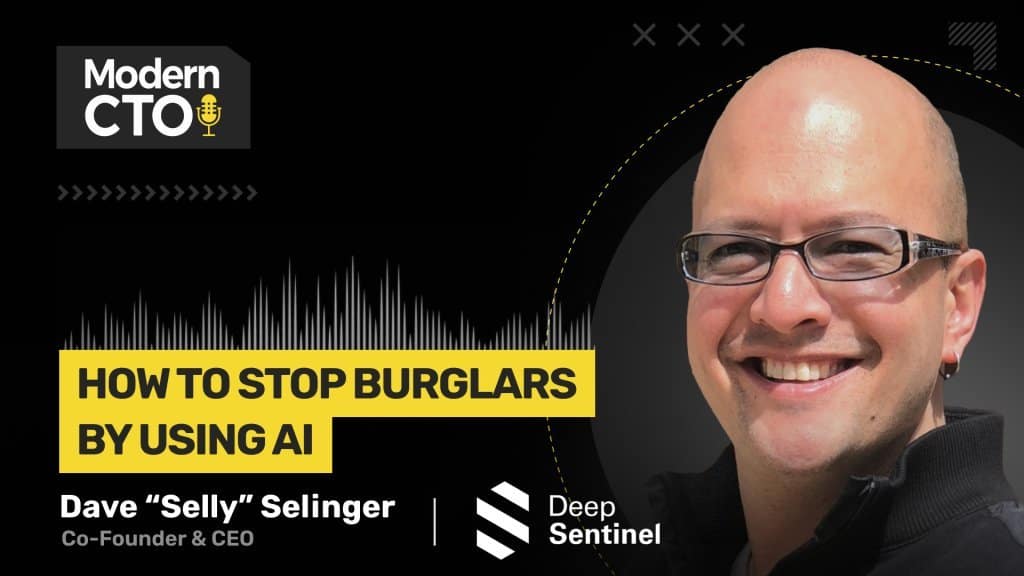
How to Stop Burglars by Using AI with Dave “Selly” Selinger, Co-Founder & CEO at Deep Sentinel
Today, we’re talking to Dave “Selly” Selinger, Co-Founder & CEO at Deep Sentinel. We discuss the ways that Dave is fighting crime with AI, how Deep Sentinel gets physical with its deterrents, and what Dave learned as the co-founder of Redfin.
All of this right here, right now, on the Modern CTO Podcast!
To learn more about Deep Sentinel, check out their website here: https://www.deepsentinel.com/
Produced by ProSeries Media: https://proseriesmedia.com/
For booking inquiries, email [email protected]
About Dave Selinger
I'm a technologist at heart and have been fortunate to be the founder of a number of successful start-ups, including Redfin and RichRelevance (and some unsuccessful ones too!). On the NGO side, I have gotten to serve on the board/advisory board of a number of non-profits including MyTwoFrontTeeth (now a part of Family Giving Tree), The Darfur Stoves Project (now Potential Energy) and most recently Silicon Climate.
My favorite technology right now is deep learning, specifically as applied to image and video object detection/recognition. This technology is undergoing a disruptive improvement and will change numerous industries. That's why I started Deep Sentinel--which puts deep learning to the practical use of protecting families in their homes. I am a fan of Tesorflow, Keras and am even teaching Stanford's CS231n course out in my hometown of Pleasanton :)
I'm also deeply engaged in my most challenging role so far--being a dad--while remaining connected to the community through advisory roles, board roles and a few investments.
About Deep Sentinel
Deep Sentinel is the only security system that delivers the experience of a personal guard at every customer's property. Deep Sentinel's 24/7 guards review and respond to alerts from cameras positioned around the perimeter of customer's properties. This ensures that any suspicious activity is identified within seconds and crime can be stopped before a potential burglar even gets a chance to enter.
The product uses deep learning with wireless security cameras to enable live guards to intervene within seconds of a perimeter breach and before the criminal enters the property -- at this price point, everyone can now access the protection of private security guards.
Transcript
(Intro Narrator at 00:00:00) Today, we're talking to Dave Selinger, co-founder and CEO at Deep Sentinel, about how AI is radically improving smart security. You're listening to Joel Beasley, Modern CTO.
(Joel Beasley at 00:00:18) So we were approached by your PR person, and they were telling us about Deep Sentinel. And I thought that was pretty interesting. Can you tell the audience what the company does?
(Dave Selinger at 00:00:29) Deep Sentinel is the most interesting company you're going to learn about on this podcast ever, period, full stop. And I'm not saying that just because I happen to be the CEO and founder, but it really is an amazing company. It's in the physical security space, as the name might suggest. And it stops crimes. And what is ridiculous to me, and the reason I think it's so interesting, is because I built Deep Sentinel because the entire United States has been lulled into a state of idiocy by the solutions that are available right now. And idiocy is a term that I think is absolutely correct. I apologize to anybody who got their feelings hurt in the last 10 seconds, but here's my story. My neighbor had a home invasion. I'm an engineer, so I, of course, run the neighborhood watch and make sure everybody has cameras and alarms and everything like that. She has a home invasion, so we have the police come. And the police are there, and we say, "Hey, we have an alarm. We have all this video footage. Why haven't you solved the crime? Why did this happen? How did this happen?" And the police officer looks over at me and he's like, "You're the tech dude. What did you expect the alarm to do? It wasn't armed. She was home. What did you expect the cameras to do? Jump out and stop this crime? You don't realize that 100% of the crime fighting tools that you have available to you do absolutely nothing to fight crime. They do nothing to solve the only problem that matters to you as the buyer or the business owner or homeowner."
(Dave Selinger at 00:02:07) So I built Deep Sentinel to take the available technology, push it forward a couple of steps, and stop crime. So when you come to my house, you step onto the driveway, there's cameras that are streaming your video to an AI within about a half a second. That AI can determine suspicious activity in under a tenth of a second, and then a live guard is told what's going on in the situation, what the scenario is, and the severity of the situation, whether they should intervene. Intervene by talking to the person, intervene by yelling at the person, intervene by calling the police. And we even have some, you know, kind of more controversial products like pepper spray, smokes, strobes.
(Joel Beasley at 00:02:48) Let's do it.
(Dave Selinger at 00:02:49) Things like that.
(Joel Beasley at 00:02:50) How is that controversial? If it was, like, maybe 50 cal bolo, it would be overkill because you only need, like, nine millimeter.
(Dave Selinger at 00:02:57) I was going to say, you go with a nine millimeter. Even just a 22, right? So that you hobble away. I mean, those are regulated responses, is why it's a little bit controversial. And people have told me, like they do about everything that I do, that you can't do that, which is, I think, the best motivator to get me to try to go make it happen.
(Joel Beasley at 00:03:20) It is my key button in life. Yes. Someone's like, "You're an idiot. That's never going to work." I'm like, well, now it's got to.
(Dave Selinger at 00:03:26) Yeah. Now you pushed the big red button. You could have pushed any of these other buttons. We would have been fine. But now you're in control of my life, and I have to go do that.
(Joel Beasley at 00:03:34) So it stops crime. So one of the methods is the live guard. There's a speaker system, so they could be like, "Hey, don't do that, porch pirate," or whatever. And then, as the homeowner, can I scale it up? Like, can I get pepper spray AI tools at my home through you?
(Dave Selinger at 00:03:51) You cannot get pepper spray at your home right now. But yeah, I think the best way to describe this would be a specific example. So almost exactly a year ago, the second week of September in 2023, I had a man come to my house armed with a crossbow, of all weapons, with the intent of breaking in and stealing stuff.
(Joel Beasley at 00:04:14) With a crossbow?
(Dave Selinger at 00:04:15) With a crossbow. If you don't believe me, you can Google it. I have video. I didn't believe it. Let me just put it that way. So I wake up to my daughter running in my room, screaming that Deep Sentinel has set off the siren outside, and I'm sound asleep. So I'm like, "Okay, maybe she's overreacting." So I go outside and I go to my cameras. I talk to my cameras, and my guard says, "No, the police are on the way. Go back inside, sir." And this is a real situation. So I immediately, now I'm freaking out. I go inside. I go back and I look, and then, sure enough, there was a guy on a bike with a crossbow. Pulls up to my driveway, walks down my driveway. The AI detects suspicious behavior. The AI played an automated—
(Joel Beasley at 00:05:04) Is this it? Oh, this is your video? Dude, this went viral. I saw this on my own social.
(Dave Selinger at 00:05:09) This is legit my house. And I don't always have trash in front of my house. So that's horse jumps from my daughter. You can see the crossbow right there.
(Joel Beasley at 00:05:19) You're a founder. Times are tough.
(Dave Selinger at 00:05:23) She eats.
(Joel Beasley at 00:05:24) She eats. She eats. Okay.
(Dave Selinger at 00:05:27) There's me. Yeah. So that's, thank you. That was legitimately what happened at my house. So there was a guy. He ended up stealing some stuff off of that table. You heard the AI trigger.
(Joel Beasley at 00:05:40) Oh, the alarm went off before he even really did anything. And then—that's brilliant.
(Dave Selinger at 00:05:45) And the guards are yelling at him, telling him to go, and the police are deployed. So the thing that a lot of people ask about is, "Tell me about the police dispatch." I'll tell you the big secret in Deep Sentinel is that 99% of the time, we don't have to dispatch police because most of the time, criminals don't want to get caught. They don't want to know that they're going to get in trouble. Whether that's a petty crime, I just don't want to be bothered, or it's a serious crime, and I definitely don't want to go to prison. So that said, though, 99% of the time, the sirens, the strobes, the guards are enough. But when we do call the police, "Hey, I've got an armed male with a crossbow coming to a residential home that has people inside that are scared for their safety," I challenge you to find a police officer that does not know how to prioritize that call. And so we get super fast police response. We get consistent response. We get the right response. They are able to identify the right suspect. They're able to execute correctly.
(Joel Beasley at 00:06:43) That is amazing. That is so cool. How many other people are doing this?
(Dave Selinger at 00:06:51) Zero. That's where, you know, again, when you say, "Tell me what you guys do," we're literally the only company in the world that does that.
(Joel Beasley at 00:06:58) So I just got a new system two years ago. So we moved out to a little seven-acre farm outside of Nashville. And when I was shopping the systems, I was just so disappointed. I literally told my wife, I was like, "If I was in the middle of my business right now, I would go start a business to solve this." Because the option, it was so garbage in the resolution and what you could see, and then just the feature set was not there. It was stuck in the '80s. Yes, it had, like, 4K video, and that was the quality. So that was okay. But as far as what I could do with it, the scrubbing, trying to watch back stuff, it was so archaic and old. And then at the end of the day, it's like, what is it actually going to do?
(Dave Selinger at 00:07:41) Yeah. I mean, Joel, let's even take that to the next step, the thinking process that I went through, which is, all right, what's the difference between a 4K and a 720p or 1080p video? And let's say you could scrub it. You still have now a 4K scrubbed video of some guy stealing all this stuff from your house, breaking in, scaring the crap out of your family. It's, right, it's only, even if you do all of those technology innovations by themselves, you're still only just scratching the surface of the problem. Which is why I just said, "I'm done." I'm not going to even worry about the resolution of the camera. I personally, for my home, I would rather have a 1K camera with a live guard than an 8K camera without a live guard. Period. Full stop. Easy peasy. Because what I care about is stopping crimes. I don't care about having an awesome video that I can search.
(Joel Beasley at 00:08:39) All right. Here's, be like Elon Musk here. Here's what I want in Tennessee. You know, he does all the cool things to his products. I want to be able to put in Tennessee mode, and then when it sees it, no alarms go off, nothing. It just sends me a text that says, "It's hunting time." And that's it. That's all I need.
(Dave Selinger at 00:09:03) We'll call it Joel's Tennessee mode specifically. Right?
(Joel Beasley at 00:09:07) Yeah, yeah. Or I could choose the music that plays to the person.
(Dave Selinger at 00:09:15) Yeah, that'd be good. You know, our goal is to do something good for society, so we—
(Joel Beasley at 00:09:23) Phil Collins would be good for society. I can see it coming, and then the guy's just creeped out. Bose is involved with a sponsorship deal. We could, it could go big.
(Dave Selinger at 00:09:35) I will think a lot about this. But your example reminds me of one of my favorite movies I watched with my daughter called Tucker and Dale versus Evil. Have you ever seen that?
(Joel Beasley at 00:09:46) No.
(Dave Selinger at 00:09:47) It's a horrible, horrible, horrible, horrible movie, and it's so rad. It's about these two backwoods guys that accidentally have all these unaliving events with all their neighbors. But just to be very, very serious, though, Deep Sentinel's goal is to prevent people from having to be in that situation. Because no matter how prepared you are for one of those situations, our goal is to just not be in it, not be in a situation where there's an escalation of a level of force where you, or a peace officer, or a criminal, are exposed to that. Because that's, I think there's too much of that in society. There's too much of those types of situations. Things are getting way too escalated instead of getting de-escalated. So while we do have a lot of folks that own weapons, the way that they tend to think about it is just like you said: "I want early notice. If I am going to have to use lethal force, I need to be prepared. If I'm going to have to use lethal force and I have somebody who's chosen to approach my property with that level of escalation, I want to be as early as possible. I want to distract them as much as possible, and I want to be in the strongest situation and control the environment as much as possible." And so, you know, it is kind of funny, but we see guns every day. We see things that are at that level of escalation every day. And I think one of the things that I'm really proud of is almost all the time, we're able to de-escalate it and remove the threat of life from the situation.
(Joel Beasley at 00:11:35) Is this smart enough to know if I walk out with my—I have a shooting range on my farm. If I walk out the front door with my shotgun, is this smart enough to know that it's me, or will it just—
(Dave Selinger at 00:11:45) Are you going to have that beard, or are you going to shave the beard?
(Joel Beasley at 00:11:47) The beard's going to stay.
(Dave Selinger at 00:11:49) So beards are problems.
(Joel Beasley at 00:11:52) Beards are problems.
(Dave Selinger at 00:11:52) Yeah. But no, it is. And a big part of that is the way that we respond. And so in that particular case, you have an armed person coming up taking something. They know that it's not me or anyone in my family. It's 2:00 in the morning. And so it's able to look at the totality of that situation and know the right response is immediate escalation. And in a situation where you've got a firing range, we've seen you numerous times going out, your behavior does not suggest that you're running for cover, then we would respond accordingly.
(Joel Beasley at 00:12:25) Interesting. This is so cool. I'm so glad that this exists. Now, do you have drones that can chase the burglars?
(Dave Selinger at 00:12:34) That was actually the very first thing that I built at this company. We have not deployed it. I want to. But, again, I mean, just from a practical standpoint, I also really, really want to make money. And so, I know. The thing that is the most effective and the most cost effective for our customers is not the drones. It's just that really decent two-way audio and the stationary—
(Joel Beasley at 00:12:57) I'm telling you. Yeah. The idea, for me, what would cause me, it would be even cooler if your stuff could exist with existing systems. Right? If you could just hook into my Reolink and I just pay you a subscription fee so I don't have to go reinstall all my cameras. That would be—
(Dave Selinger at 00:13:13) Yeah. So we do. For a lot of the wired camera systems out there, we're able to take over those systems and then add this service on top.
(Joel Beasley at 00:13:22) Oh, that is fascinating. Do you have, other than your personal story, have you guys been able to clip and create any type of reels from customers if they've given you permission to kind of show you stopping stuff?
(Dave Selinger at 00:13:35) Yeah. So that video that you just showed a little bit ago, that's actually the name of that video series. It's called our Stopped series, and we produce a compendium of some of our more interesting crime stops from the past week. We used to do it every week. It's a lot of work to produce those. To kind of put that in context, we stop about 45,000 suspicious events a year, about 45,000 crimes or potential crimes a year. And so going through on a weekly basis the 1,000 interventions that we do, it's a lot of work. And so we've kind of tailored that down to about once every two or three weeks. But yeah, if you go to our YouTube channel, it's youtube.com/deepsentinel, you will see dozens and dozens, hundreds in fact, of videos of us stopping various types of crimes, everything from armed hostage-taking to just little trespass to vandalism to people trying to break in with a crowbar to sexual assault. I mean, we stop everything. It's what we do. It's rad for me personally, not financially, not professionally. I love what we do. The fact that we make people actually stop committing crimes makes the world a little bit safer.
(Dave Selinger at 00:15:07) And, you know, this is a little bit personal for me, but I had the opportunity to retire and not start another company or do anything more. And I decided that I wanted to start another company, and I wanted to have it be something more than just for profit. I've always been on the boards of between three and five nonprofits for the last 20 years, but I wanted to make sure that the business that I started was good enough for the world that I didn't need to be on any nonprofits. I didn't need to be involved in any nonprofits because it was a for-profit that was built for scale, built to actually make the world a better place. And so the fact that we do all those things, I kind of jokingly say it's super important to me, but it really, really is. And, you know, we were talking about my daughters just a second ago. I started this business with them. And not like, "Hey, you know, as a family," but literally sitting at our kitchen table talking about, "Okay, Daddy's going to start a new business, and I want it to look like this. Do you guys want to make the first logo? What's important that we do? What are the services that are important to you guys to make sure that we provide safety to this class of business or this class of people, and we do it in this particular way?"
(Dave Selinger at 00:16:28) And the ability to kind of bring my whole family into that has been absolutely critical for me.
(Joel Beasley at 00:16:33) That is amazing. How have you taught your kids about giving back? You said that you're a charitable person. You just described all of that. But I'm a dad.
(Joel Beasley at 00:16:42) I've got three under the age of seven, one girl, two boys. And my wife and I already bought them the cash flow board game, teaching them finances, and, you know, we teach them about what we give back from our income. But how do you do it? How did you instill those values into your kids?
(Dave Selinger at 00:17:00) So I don't think we did a great job, but we continue to work on this. I'll tell you what we did, though. So starting about eight years ago, nine years ago, we got our kids onto an allowance split system. We use one called Greenlight, which is an automated app. And so as they get their allowance, automatically 20% of it goes to savings.
(Dave Selinger at 00:17:23) I think 40% of it goes for their fun spending, and then the remainder goes to giving. And once every six months or a year, we sit down as a family and we talk about what are the causes that we want to give to as a family. And the agreement essentially is if you guys decide on one together and you really kind of come up with a reason and a purpose behind that, then mom and dad will match it and we'll put a ton more in behind that. And so it gives them a sense of independence, but also kind of a little bit of gamesmanship. Right? I mean, this is one of those dynamics that, okay, so I'm not just doing this in isolation.
(Dave Selinger at 00:18:07) This isn't just my money. It might be my money plus this money. And then we go through different things that are meaningful to them. We happen to be dog owners. We love animals.
(Dave Selinger at 00:18:18) We have—
(Joel Beasley at 00:18:18) Oh, nice.
(Dave Selinger at 00:18:19) Four dogs, a bunny, three horses, 75 fish, just all kinds of animals everywhere, thousands of frogs. And so one of the ones that we always talk about is do we want to give to the local animal shelter? And I would say in the last two years, I think we've given to that animal shelter twice. So out of the four times that we sat down, it ended up being the animal shelter. So that one always ends up being it.
(Dave Selinger at 00:18:46) But then you think about globally, right? So one of the things that I did early in my career was I built a lot of schools and orphanages in developing countries in Africa and in Central America. And as great and as self-sacrificial as that may seem, it was actually a very stressful initiative for me because I found that being the American, the Westerner on a plane bringing money over, not only does it feel good when you are able to accomplish something, but it also creates this kind of secondary effect of codependency where there's an expectation that I'm going to continue to support this for every one of its problems going forward instead of a self-sufficiency. And so we talk about things like that. And then we talk about, do we want to find somebody who's tried to solve that and give our money to them?
(Dave Selinger at 00:19:39) Globally, do we want to be domestic and all over the U.S.? Like the American Cancer Society is one that we donate to right now. Childhood cancer—we have three or four friends right now who are battling childhood cancer, so that's one that we donated to most recently. And then we'll look at again just local animal shelters and our local homeless shelter.
(Dave Selinger at 00:20:01) One of the things that I would recommend to parents is that soup kitchens are overwhelmed between December 5 and January 10 and then massively understaffed for the rest of the year because everybody wants to teach their kids about giving during Christmas. But if you really want to teach your kids about giving, just do it anytime other than Christmas, and that's what they really need.
(Joel Beasley at 00:20:27) You heard it first, your public service announcement from David.
(Dave Selinger at 00:20:29) PSA right here. Yeah. If you would like to serve the country, the way to do so.
(Joel Beasley at 00:20:35) Yeah. Pumpkin spice season, not Santa season.
(Dave Selinger at 00:20:39) Oh, stop. Okay. Pumpkin spice, that's a no-go word at my family.
(Joel Beasley at 00:20:44) You're not allowed to eat pumpkin spice in the Selinger household?
(Dave Selinger at 00:20:47) No. My kids love pumpkin spice, and I hate everything that pumpkin spice stands for. Right? I mean, it's August, and they just started serving pumpkin spice. So we are solidly four months from Christmas.
(Joel Beasley at 00:21:01) It's a little early for pumpkin spice. I was just looking at the notes real quick. You also were the cofounder of Redfin?
(Dave Selinger at 00:21:08) Oh, yeah. Yeah. That too. Yeah. So I was in the real estate space for a while, about 15 years ago. So I saw Redfin come about.
(Dave Selinger at 00:21:18) I love Redfin. I love real estate. I still love real estate to this day. Yeah. I mean, I was at Amazon, and I was looking at buying a house in Seattle.
(Dave Selinger at 00:21:29) And I'm gonna say this really frankly because I think that's the only way to communicate with people. But I would also say it with an apology and with all respect due to the real estate agents that take their profession seriously. But I hired one that didn't. I hired a guy that had no education and no knowledge, no knowledge about records or values or comps beyond the 25-minute YouTube video that he had watched before having a meeting with me. And I was sitting there with my buddy Russell, who also worked with me at Amazon, and we're sitting there expecting to have a conversation with an expert.
(Dave Selinger at 00:22:11) Somebody who is clearly less educated than we are in a space in which we are not educated at all. And he's telling us, oh, no, these prices are normal. This is gonna go up. This is a great location because it's up-and-coming. And it turns out we go with him to this location. It's a meth lab. It's a Superfund zone that needs to be burnt to the ground and never used again. And that was just this stark experience. And so after that, I decided real estate is a space that could really use media through the Internet to figure out what is this property really like, use mapping to figure out what are the comparables and is that really a good price.
(Dave Selinger at 00:23:02) And so we built Redfin. We built Redfin to be the very first interactive digital mapping application that was worldwide. And it was an amazing experience. A lot of people don't know that about Redfin, that Redfin predated Google Maps. Redfin predated any sort of interactive mapping.
(Dave Selinger at 00:23:21) And we built the very first interactive mapping application in the world.
(Joel Beasley at 00:23:28) Oh, really? Yeah. That didn't come up on my—for some reason, I thought Redfin came about in 2007 or '08.
(Dave Selinger at 00:23:37) That was when you saw that. Google Maps was actually built using Redfin as the prototype.
(Joel Beasley at 00:23:44) Oh, really? Yeah. So wait. When did you found Redfin?
(Dave Selinger at 00:23:48) 2002, 2003.
(Joel Beasley at 00:23:51) Oh, so I was just late to the party. I just didn't pick up on you guys until—
(Dave Selinger at 00:23:56) Yeah. So when we launched, I remember the day that we launched because it was, you know, like all technology things, it was down to the last minute. It was super hard. And so I was up till like three in the morning finishing everything up, and then, you know, the big push enter, which is always dramatic in movies, but it's actually like, okay, enter. I'm going to bed.
(Dave Selinger at 00:24:15) Right? And so I push enter. I go to bed. I send the email to my cofounders. It's live. F off. I never want to see you again. I hate you for the rest of your lives. I'm exhausted. So I go to bed and then I wake up at like 7:30 or eight. It's like four hours of sleep.
(Dave Selinger at 00:24:30) And I've been living on three, four hours of sleep for months at this point. And I'm still working at Amazon. So I gotta get up early and head over to Amazon and be smiley, cheery, and pretend like I wasn't up all night working on something else. And so I go to my favorite coffee shop and it's this shop called Caffè Ladro.
(Dave Selinger at 00:24:51) And I get my coffee, which is a no-sugar mocha, and I turn around and I realize that more people than usual have their laptops out. In fact, everyone at the coffee shop is sitting, looking at a laptop together. And so I'm drinking my coffee and again, I'm still 100% not awake. And I kid you not, true to the T, every single person in the coffee shop had Redfin's website open and was zooming around all over Seattle looking at properties on the website and just amazed at how fast the map moved and all the information that we were providing, all the past sales, all the comparables. Everybody looked at Bill Gates' house.
(Dave Selinger at 00:25:39) That was the big thing that everybody eventually did. And there had been an article about us in the INRI, which is the real estate news and in the Seattle Times, and it had just exploded. And I went to Starbucks after that. I stopped at Starbucks on the way to work, and everybody in Starbucks was doing the same thing. Everybody was blown away. It was one of those, just as a technologist, as a product person, one of those incredibly magical moments where you realize you made something that people really care about.
(Joel Beasley at 00:26:11) No, it's a beautiful feeling. 100%. Well, I know you have a hard stop, so I wanna say thank you so much. And can I buy your systems online? Do you just go onto your website? Or how does that work?
(Dave Selinger at 00:26:25) To buy Deep Sentinel, all you have to do is go to www.deepsentinel.com.
(Joel Beasley at 00:26:38) I feel like you're gonna say for English, press one.
(Dave Selinger at 00:26:42) My one of my classmates at Stanford, her dad was the Moviefone guy.
(Joel Beasley at 00:26:47) I don't know if you guys are too young to know Moviefone, but he was the guy that said—
(Dave Selinger at 00:26:51) Welcome to Moviefone. And, dude, she was so popular just because, I mean, before the Internet, that was Moviefone. It was rock.
(Joel Beasley at 00:27:03) I remember. Yeah.
(Dave Selinger at 00:27:06) Yeah. So but to answer your question seriously, yeah, so you can go to our website, www.deepsentinel.com. And I highly recommend it if you really are interested in security for the purpose of security, not for checking the box. You really want to take it seriously for your business or for your home, schedule a consultation. We've got people that do this for businesses and homes all around the country. We know the different types of businesses. We know the different types of homes, and they can help you solve these problems because this is a unique system. It's the only one in the world that stops crime.
(Dave Selinger at 00:27:37) And so where you put your cameras, how you configure them, all those different things, they're a little bit different. And so if you're really interested, I highly recommend just schedule a consultation.
(Joel Beasley at 00:27:47) Thank you so much for listening. And if you found this episode useful, please share it with a friend or colleague who you think would get value from it. And if you have topics that you'd like to hear discussed on the podcast, either add me on LinkedIn or send me an email [email protected]. Every time I get an email or LinkedIn message, it absolutely makes my day and inspires me to keep going.