
Episode 553 ·
The Modernization Of Healthcare with Claus T. Jensen, Chief Innovation Officer at Teladoc Health
Today we’re talking to Claus T. Jensen, Chief Innovation Officer at Teladoc Health; and we discuss the modernization of the healthcare ecosystem; how to healthily disrupt an industry; and why genuine stories impact our perspective in healthcare and beyond.
All of this right here, right now, on the Modern CTO Podcast!
Check out more of Claus and Teladoc Health at https://www.teladochealth.com/
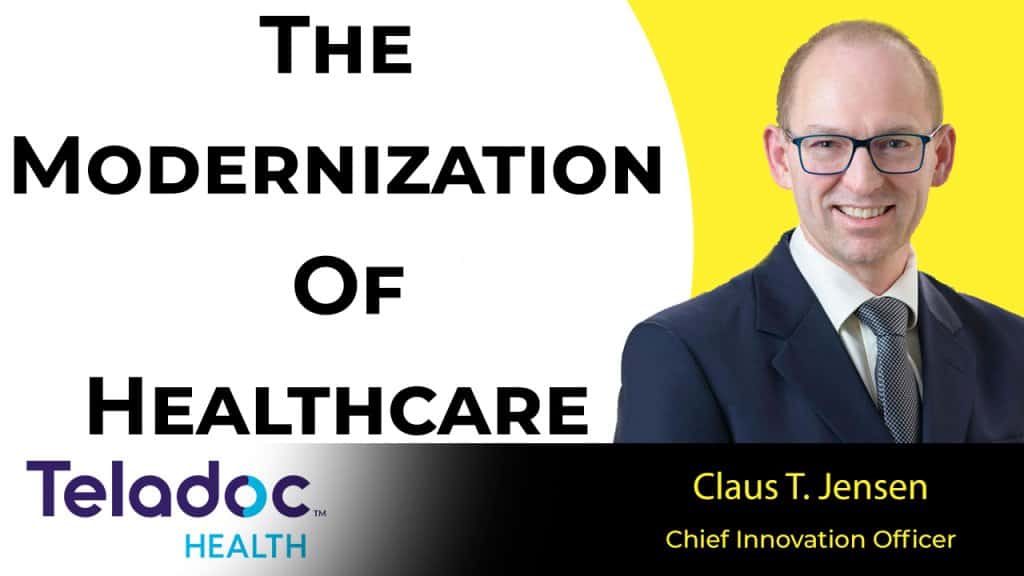
About Claus T. Jensen:
Claus Jensen leads technology and innovation at Teladoc Health. Under his direction, the research and development team applies product innovation, data science, technological expertise and clinical excellence to transform how people access and experience healthcare around the world.
Dr. Jensen brings 20 years of experience leading digital transformation at enterprise healthcare and technology organizations. Prior to Teladoc Health, Dr. Jensen served as chief digital and technology officer at the Memorial Sloan Kettering (MSK) cancer center, where he oversaw the integration of data and technology resources that enabled MSK to meet critical care and research objectives. Previously, he was chief technology officer of CVS Health-Aetna, and also held leadership roles at Danske Bank and IBM.
Dr. Jensen holds a bachelor’s degree in mathematics and a PhD in computer science from Aarhus University, Denmark. He has authored numerous publications and holds 14 patents covering integration, APIs and transformation.
About Teladoc Health:
Teladoc Health is on a mission to empower all people everywhere to live healthier lives by transforming the healthcare experience. Recognized as the world leader in whole-person virtual care, Teladoc Health addresses the full spectrum of health and well-being — powered by human expertise, advanced technology and insights—to deliver improved clinical outcomes at scale. Serving more than 175 countries and ranked Best in KLAS for Virtual Care Platforms in 2020, Teladoc Health leverages extensive expertise and data-driven insights to meet the growing healthcare needs of consumers and healthcare professionals.
Transcript
(Intro Narrator at 00:00:03) Hello, my friends. Today we're talking to Claus, Chief Innovation Officer at Teladoc Health, and we discuss the modernization of the healthcare ecosystem, how to healthily disrupt an industry, and why genuine stories impact their perspective in healthcare and beyond. All of this right here, right now on the Modern CTO podcast.
(Joel Beasley at 00:00:32) To you. This is the Modern CTO podcast. How did you meet the people at Teladoc?
(Claus at 00:00:44) It was one of those where they were looking for someone to come in and help think through how do you practically merge clinical science, technology science, logistics—because there's a lot of logistics—behavioral science, and a good bit of data science to build the foundation for how do you drive a different kind of care model. It's really, really fascinating because healthcare has some century-old problems that haven't really ever been addressed. If you think about it, as healthcare became more specialized, and we all want that—look, I worked for Memorial Sloan Kettering Cancer Center before this, and if I get cancer, that's where I'm going to go. But specialization also comes with fragmentation by definition. When you specialize in one thing, you usually can't be equally good at all the other things.
(Claus at 00:01:31) So we've been on this road for a century of high degrees of specialization. If you think about what that does to the people that need care, it's who's putting the pieces together? Nobody is. That's now us. And you can call that the best doctor's paradox. I want the best doctors to take care of me, but I also want access to specialized healthcare.
(Claus at 00:01:52) And for about a century, you have not been able to solve that Gordian knot because we just didn't have the tools, the technologies, the glue, if you will, to put the pieces back together. I do believe we do now. And if you look at what we're trying to do, we're all on a journey to make healthcare better. There's a very good chance that three to five years from now, you're looking at a natively whole personal care model that takes care of a lot of the gluing together for you and sort of hand-holds you throughout whatever wellness or disease needs that you have.
(Joel Beasley at 00:02:24) Okay. So explain the glue again.
(Claus at 00:02:27) Multiple kinds of glue, right? So one kind of glue is how do you make sure that if you meet two clinicians, they actually know what the other said? Interesting problem, right? Because they might not necessarily work for the same organization. They certainly don't have the same specialty.
(Claus at 00:02:43) So you have an encounter with one. EMR solved that sorta. They capture some of the data, but again, that doesn't transcend the boundaries of one healthcare institution. It doesn't give you the combination of data with whatever you have in your wearables, right, in your phones and whatnot. It doesn't necessarily help you manage a chronic condition because if you're in a physician's office, chronic conditions happen in between. They don't just happen in the office. Chronic condition means they're different.
(Claus at 00:03:11) If you think about mental health, that's anything from your consults with your psychologist or psychiatrist all the way through what are the tools that we give you to give you some amount of self-help in between. You can start thinking through what that looks like. Data glue, experience glue, clinical insight glue, people glue—there's myriad kinds of glue that you have to put in place. The difference is we can't go back to one person taking care of all your needs. That doesn't work because now you've lost the sophistication of modern healthcare. Nobody wants that. But I want the same kind of experience of everything sitting together as if it was one person that took care of me. That's just a hard problem.
(Joel Beasley at 00:03:55) Now I have personal experience with this because there's a lot of doctors in my family. And so when you're talking about that, I know exactly what happens. They hand a file or they fax it or something, then the doctor gets it, and he goes, "All right, here's my stack of people I have to read for tomorrow." And he just scans through it, and then they get there, and then they focus on like, "Okay, what's going on? Where's the fire? And then what tests have been run?" And then they try to figure everything out. How do you help that process, specifically?
(Claus at 00:04:22) So in a couple of different ways, right? One way is we have a lot of stuff in-house. We actually have the ability to help you with acute episodic—let's say you have a fever and you just need someone to help you figure out why you have a fever. Or primary care—that's a little different. That's a permanent relationship with a primary care physician. We've launched a primary care offering that we're having some really good experiences with in terms of the people that use it. And that includes then integration into local infrastructure, like how do you get a lab done? You need your blood work done. You need to have your weight measured. You need to know what your blood pressure is. Otherwise, you don't actually have a primary care visit. So that was an integration problem we had to solve.
(Claus at 00:05:04) In-house, we also have mental health. So disease-centered mental health that basically says that comes in the package. You can start commingling the two. So if you can build this right, then we become the one entity where it's different clinicians, but all operating under an integrated system solution kind of perspective. Same as if you were an integrated health system, but now happening virtually.
(Claus at 00:05:27) And then you can add chronic conditions where we don't just do coaching and visits. We also give you devices where appropriate, whether that is a blood glucose meter or a blood pressure cuff, or it could be a weight scale. And we build it so that they are always on. That actually matters. If you're on and about, if your device isn't always on, that's great, right? But if that data point doesn't get to your care team in a real-time fashion, then that becomes a problem. You can imagine the following scenario, which actually happens. If you have a recently diagnosed diabetic that is driving down the highway and all of a sudden feels not so well—well, if you know anything about diabetes, it's probably because your blood sugar's off.
(Claus at 00:06:16) So if you're in the middle of the highway somewhere, you don't know anyone, the nearest gas station is miles away, what do you do? That's potentially dangerous. What actually happened in this case is because our blood sugar measurement device is cellular-enabled, we get the data point as soon as you measure blood sugar. And we know that your blood sugar is low and we can reach out to you actively. And I think it begins to illustrate that if you can build ambient healthcare solutions, you can totally change the equation.
(Claus at 00:06:49) So what does it mean that it's ambient? It means it's just present in the environment around you. You don't have to consciously think about it. When you need it, it's there. That's a very different experience from having to book an appointment three months in advance, and then maybe you remember what it is you want to talk about when you get three months hence. I'm not saying those aren't necessary, because they are. We're not trying to replace the existing care system, but there's a spectrum of capabilities you can put in place which are more natively just part of your life, ranging from how you manage your chronic condition all the way up to self-help, coaching, and then encounters when you need them.
(Joel Beasley at 00:07:25) So I like this for a couple of reasons. First of all, the ambient stuff, I'm hearing more of that. For one example, I was talking with Sri, the CTO of PayPal, and he explained to me the future of payments being ambient payments. He said, "When did you actually pay for your Uber? You never actually clicked the pay button. You ordered the Uber, you got into the Uber, the ride ended, and your card was charged." And I was like, "That's fascinating." So I'm hearing more and more about this ambient stuff. The second thing that I think is fascinating is you're being disruptive. You're disruptive to—I mean, look, dude, the business model is standard. I'm a doctor. I hustle people in and out. I charge them, and I can't sit there and focus and actually coach through one person. So it sounds like the way that you're setting this up is that you can be sort of the coach as they go on this journey. And tell me if I'm wrong because that's how I'm interpreting it.
(Claus at 00:08:21) No, no. You are on the money. What's important, though, is you can be disruptive in two different ways. You can be disruptive when you say the current system is totally messed up, going to try to replace it. And my very first data point was that's a bad idea. Almost lost. Because now you're losing the capabilities of modern healthcare. The other way of being disruptive is to say, "Okay, I live within the existing system. I want to retain all the good things of the existing system, but I'm going to step up and try to put the pieces together in a more holistic fashion. I'm going to build partnerships with employers, with health plans, with health systems. I'm going to actually invest in the glue capabilities we talked about, some of them. And in addition to that, I'm going to make sure that there's a core set of capabilities we can deliver in an integrated fashion. You choose how many of them you want us to deliver to you. If you want everything delivered to us, that's a better experience. But if you want to work with other parts of the healthcare system, we'll have the ability to integrate you in. You can think of it as last-mile integration. I don't actually think the answer is virtual or bricks and mortar. It's virtual and bricks and mortar, and that's just not how people talk about the problem.
(Joel Beasley at 00:09:28) Right. I'd say 80% of the services are either virtual or brick and mortar, and you're sort of combining the two.
(Claus at 00:09:36) We're very deliberately trying to create a care model that meaningfully integrates the two. We will never be a brick-and-mortar kind of company. That's not what we do. If you ask our CEO, he would say that's just not who we are. We also don't want to go out and compete with the existing healthcare system, but we do think we can supplement it. We think we can amplify. We can make the whole have greater value than the sum of the parts. It's that kind of game. So yes, that's disruptive, but not in the negative "I'm going to replace you" fashion. It's more in the innovative "I can imagine a better future by working together differently."
(Joel Beasley at 00:10:18) Yes. I meant it in the "you're going to make a lot of money." And the reason why I say that is because I'm a consumer, right? And that's one of the things you have in common with all the people that you interact with is everybody's a consumer of healthcare, right? And so when you said that, my first thought was, "Oh, that's great," because, you know, most people don't have the luxury that I have of having doctors in the family, and I can go to them and bounce stuff off them, and they can send me to places and come back. And I thought, you're sort of playing that role that my doctor family members play with me, right? But usually, people don't have that to the point where, you know, I would even try to help some of my friends and get my stepmom in a good mood and be like, "Hey, can you just take a look at this case?" and so on. But it sounds like the quality of experience is going to be awesome for people because they'll feel heard, right? And then they'll have direction on where to go. Now, for you, what role are you playing in all of this?
(Claus at 00:11:14) So the title is Chief Innovation Officer. What does that tell you? Not a whole lot because different people have that title and in different companies it means different things. The traditional technology organization, AKA the Chief Information Officer, rolls up to me. The CTO, which is all the product engineering, rolls up to me. The Chief Product Officer rolls up, and then there's the team that does the clinical product assignments. And so if you look at my organization, it's really all about how you go from vision of what you're trying to achieve all the way down through the steps to roadmap, to planning, to execution, and ultimately have something you can deploy that becomes the foundation for a service. There are other parts of the company that are super important like member engagement, there is clinical operations—so there's all kinds of other things. But the fundamental combination of clinical and technology products is what my team delivers, which is just busy. It is quite fascinating how much more you can do when you put all the pieces together instead of having some kind of real delegation model where, you know, you go to your part and that's just the recipe for disaggregation.
(Joel Beasley at 00:12:21) And what qualifies you to have this position?
(Claus at 00:12:25) Well, what qualifies anyone to have any position? I mean, usually it comes down to a demonstrated ability to actually do that kind of thing. But what I just described to you is something that's relatively new in healthcare. I mean, there's not that many organizations that do that. I've been around healthcare a lot. I worked for a health insurance company, worked for a payer. Worked for CVS—that means retail pharmacy, so you know what that looks like. I worked for an academic medical center. That's very different. So I've seen lots of parts of healthcare. I believe I understand the moving parts. I have physicians in my family as well, by the way, so I have my own sort of backing group that tells me what it's like to be a physician. I think more than anything else, it comes down to two things. I think I have a knack for asking good questions, and I also have a knack for receiving lots of bits and pieces of stuff and trying to synthesize what all the parts could look like. Not necessarily must, but could look like together. And if you think about what we just talked about, those are two good qualities to have. If you can ask good questions and if you can create some kind of meaning out of lots of moving parts, it's not a bad start. And then we will continue to iterate based on what's the right experience and what's the right value, and we'll get to places.
(Joel Beasley at 00:13:39) Well said. You took something that I've felt and have said and stumbled around a lot and said it in a very succinct way. What was your first job as an individual contributor? What were you doing?
(Claus at 00:13:50) My first job, a long, long time ago, was all the way back when I was in, of all things, high school. So my uncle knew this guy who owned a transportation company. So he owned like 200 trucks and a whole bunch of truck drivers, and he was shipping stuff around Denmark, which is where I lived at the time. And it was early days of technology as we know it now. Think PCs. This was back in the mid-eighties. And all of a sudden, out of the blue, I get a call from this German that I don't know who owns a transportation company, and he said he'd talked to my uncle and he needed someone who knew computers. Well, you're talking to someone who's, at that point in time, in the ninth grade. So this guy who owns the transportation company called me out of the blue. "Do you know computers?" I was like, "I guess so. I know a little bit of home programming." So what he wanted me to do was he wanted me to write a piece of software that could calculate the result of a pigeon race. He was racing pigeons, and he had gotten very tired of the manual calculation of the geospatial computation as to how fast these pigeons flew. So my very first individual contributor job was I got paid in the ninth grade to write software for a gentleman who wanted to calculate the result of a pigeon race. And then I cornered the pigeon racing market in Denmark. There were five pigeon racing clubs. I sold the software to all of them. So that was it. I cornered the market, sold it five times. Pretty cool. Financial trader.
(Joel Beasley at 00:15:17) I want to clarify. Racing like pigeons?
(Claus at 00:15:21) Yes. You have homing pigeons, right? So you basically try to breed pigeons that can fly very fast and are very good at finding their roost. The way you do that is you pair up a pigeon with a male and a female, and they want to go back, right? So you get them attached to their roost. You take the pigeon, put it in a cage, put it in a truck. That's where the gentleman who owns the truck, the transportation company, his trucks, right?
(Claus at 00:15:43) So you put all the pigeons in all the cages from the entire city in a truck. You drive the truck a couple hundred miles away. You let go of all the pigeons, and then you try to calculate which pigeon flew the fastest home to the roost.
(Joel Beasley at 00:15:56) Is this still happening today?
(Claus at 00:15:57) Yeah. Oh, yes. People still raise pigeons.
(Joel Beasley at 00:15:59) I wonder if the ninth graders of the day are like taking video and doing machine learning on the video.
(Claus at 00:16:05) But it was a truly odd first job to have, but that was my first job.
(Joel Beasley at 00:16:11) And then what was your first, what would you say, like, real adult job?
(Claus at 00:16:15) The first adult job was actually at college where I found that I had — I would have sworn I did not have a love of teaching. I mean, both of my parents are high school teachers, and that was actually not what I was going to do. But what often happens is you got an assistant teacher job of some sort when you go to college, and I actually did teaching for a long time. So that was like a college job. I don't know whether that counts as an adult job. What happened after that was I got a software engineering job for a bank. I got to work for the largest bank of the country. So if you want to say full time, like, real adult job, that was the first one. So that was in the beginning of 1995.
(Joel Beasley at 00:16:55) When did you realize that you were good at coaching people?
(Claus at 00:17:00) It took a long time because it's the kind of thing where, you know, unless you have a level of self-confidence that most of us are not born with, it's not necessarily something that you would sort of expect of yourself. And especially, and I've seen that in a lot of people I work with over the years, when you have a highly technical, even technological background, they don't really teach you a whole lot of that stuff when you go to engineering schools. They didn't when I went to engineering school. So it was after a couple of jobs. I mean, I got into being the go-to person for the bank that I worked for, and at one point, they said, "Hey, we need you, Claus. You need to be our new Chief Architect." I said, "What's that?" "We have no idea, but that's now your job." That was in 2000 at the time. Chief Architect was not a thing. Right? That was just brand new. And that was in the two years after that was when I realized that, yeah, I'm actually good at the people part. Because when you're trying to stand up a function that literally doesn't exist, nobody knows what it looks like, and you're going to have to not just teach people what it is, how to do it, but also the rest of the organization why it matters. Because you can stand up the best architecture function in the universe, if people don't want it, then it's not going to have any effect. So in those two to three years between 2000 to 2003, 2004, that was probably the time in my career when I realized that the people part is important, and I learned how to do it well.
(Joel Beasley at 00:18:27) Yeah. I'd agree with you. Designing a process out of nothing, as an entrepreneur, that's one of the hardest parts.
(Claus at 00:18:33) Totally is.
(Joel Beasley at 00:18:34) So what are you looking for when you're recruiting members of your team? What sort of traits are you looking for?
(Claus at 00:18:42) Great question. Personally, I look for curiosity and affinity for learning. I mean, yes, you do go look for your typical skills, and is this a job you've done before? That's what your resume is. I mean, if your resume has the right texture, you know the person can do the job. So we're looking for other kinds of traits. How do you choose to show up as an individual? How do you communicate? What are your dreams? What are your visions? What do you aspire to? One of the questions I always ask is, "What makes you happy at work? What do you actually like to do?" Which is not necessarily a textbook question to ask, but it tells you a lot about someone if you can get them to actually tell you what matters to them when they go to work. You learn a lot about someone. The last question I always ask: "So what question have I not asked you yet, but I should have?" And the reason I ask that question is because that tells you something about, are they able to think out of the box? Literally, I'm turning the tables on them, but if you were me, what question would you have asked? It's fascinating how people react to that.
(Joel Beasley at 00:19:45) Oh, I love it. We're going to become best friends. That's one of my favorite questions. And the interesting thing about that question, tell me if you've experienced this: a certain percentage of the time, people will tell you the worst thing about them by telling you to ask them about it. Like, "You didn't ask me about..."
(Claus at 00:19:59) Absolutely. And then you get some candidates where they're just totally stumped and end up saying, "I don't know." But that also tells you something about that person, so it's fascinating when you do it.
(Joel Beasley at 00:20:11) That's cool. Who, as you were going through this and you worked many different places in a variety of fields, which helped prepare you for what you're doing now, but as you went on that journey, was there like one mentor-type person or a person that you learned from that really stood out to you?
(Claus at 00:20:28) There was one person that I had as a mentor when I worked for IBM. That was sort of the interlude after I moved from Denmark to the U.S. I spent seven years with IBM, so you get to see a lot of large organizations when you work for IBM and then start traveling and meeting with clients. It's actually a really, really good learning experience. But I'd never had a mentor. It's not a thing in Danish sort of work culture, having mentors. So I never had a mentor. I joined IBM, which was expected. So how do you find one? That was the first problem. But I found a couple of — in fact, two of the fellows were kind enough — well, you're a fellow, you're something, right, at IBM. You've been around for a long time, and you're very accomplished. So a couple of the fellows sort of agreed to mentor me, and I tried to get them to tell me, "How do you succeed at IBM?" I'm like, "I just moved from Denmark. What do I know? I'm in the U.S. This is a new company, so I just want to do well." And both of them wouldn't answer the question. One of them ended up giving me probably the best advice that I've ever gotten in my career, and I still remember it. What he said was, "Claus, you can be good at many things, but you will only ever be great at the things you love to do. Find the things you love to do, you will do well." It's wonderful advice.
(Joel Beasley at 00:21:44) What are the things that you love to do?
(Claus at 00:21:46) We talked a little bit about it. I love to create holistic value out of a bag of bits, right, that weren't necessarily meant to come together, but I can see how you can fit the pieces together and create something that's really meaningful. It matters to me that I leave behind a better team. That's the coach, that's the teacher aspect of my persona. It matters that I leave behind a better institution or company. If I don't feel like I can have a meaningful, positive impact on the place I work, not just the team, probably not for me. It matters in the end that it has an impact on the world around us. There's a reason I'm in healthcare, because, you know, same as you, I have a lot of experience with healthcare, and I believe it can be better. So I love to do those things. And then the last thing is what I found over the years is I love storytelling. I didn't actually know that was in me until relatively late in my career. And, you know, same as many engineering-based kind of personas, I grew up a little more shy, right, than you will meet me today. But I found a love in telling stories of my own, right, to my own team, to the people we're trying to help, and to the world in general.
(Joel Beasley at 00:22:56) Have you ever come across Robert McKee?
(Claus at 00:22:59) Heard of, but not...
(Joel Beasley at 00:23:00) Yeah. He's written several books on the concept of storytelling. He's a big movie writer, TV show writer, but I read one of them, and it blew me away because they discussed the different principles and story arcs and all of that. And then you can be intentional about, "Okay. If I want to tell a succinct story to get people to understand how I arrived at a point, this is how you do it."
(Claus at 00:23:23) Stories resonate with us as humans, right? It is almost wired. If you look at history and biological evolution, right, the notion of storytelling is a very old tradition. And there's various research out there — don't ask me how they came up with the number, right — the research says a story that resonates impacts you 22 times more powerfully than any number of facts.
(Joel Beasley at 00:23:45) Yeah. My initial response to that is I have no problem believing that, because when a story impacts you, it actually stirs your emotion, and facts rarely do that. And when they do, the fact that you're consuming, the fact is usually in text and not in story form. Right? It's usually a bullet point. Even if it does stir you, like, it's a disturbing fact or statistic, it doesn't have the same resonance and duration of feeling as when someone tells you this story that you're interested in listening to, and then it ends in some big point.
(Claus at 00:24:17) And that was very eloquently put. And what's fascinating about healthcare is that if we can find a way to tell stories about their lives, you can totally change the equation on how people engage in their own care. And I'll give you a very simple example, and this is a true story. I had the privilege of listening in to this particular conversation with consent, that I had the privilege of listening to this particular conversation. It was between a male roughly my age at the time — I was younger, this is years ago — so mid-50s. And he was having a conversation with a clinical nurse. They knew each other. They had conversations before. And the nurse tries to explain to him, "You're not on a good track, you know. Your vitals are all over the map. This is just not going the way it's supposed to." And it was like throwing water on a goose. He was like, "Yeah, yeah, I know, I know. We talked about it. You know how that goes." It's like in one ear and it goes out the other ear. And then he started talking about his life and what he was looking forward to. Turns out his daughter had just gotten engaged, and they were — he was — gonna get married a couple years from now. He was very much looking forward to that. And then the nurse, who was an experienced nurse, gently turned the table and pretty much delivered the following message: "I just want to let you know that on your current course, you are not going to walk your daughter down the aisle." Now it's about something he wanted, not what the science said he should do. It's the difference between the contextualization of, "What are my objectives for life, so I will choose to do these things" versus "My doctor tells me I should."
(Joel Beasley at 00:25:49) Yeah. People change when they have to, right?
(Claus at 00:25:52) Absolutely.
(Joel Beasley at 00:25:52) For me, it was having kids. So my oldest is five years old, a three-and-a-half-year-old, and a two-week-old. But before my first shot of my daughter — I mean, like, I barely ever went to the doctor. I never got screened for anything. I didn't care. Like, I just was, you know, really focused on business and trying to build something and really enjoyed technology, and I was just really, really, really focused on me, right? And then I have this kid, and I'm like, "Oh my goodness. I need life insurance. I need health insurance," because I was just playing it by ear. I was relatively healthy, but I needed to, like, work out. And so I prioritized all of these things that I wasn't normally focused on. I was only focused just on work and growing and things like that and learning and things like that. But I really prioritized my physical health because of exactly that. I want — the first driver for me wasn't the wedding. The first driver for me was, "I want to live long enough so that they don't forget me if I die."
(Claus at 00:26:56) That's a good start.
(Joel Beasley at 00:26:57) Yeah. And so I was like, "All right. Well, that, for me, whatever that was, that was the emotional hook that I could grab onto and use to push myself forward."
(Claus at 00:27:06) And if you think about where we started the conversation, right, the notion that healthcare is sort of compartmentalized and there's no yellow brick road that ties the pieces together. It's not just how you put together solutions. It's how you attach to the emotional desires of the people you're trying to help. How do you make it meaningful to the individual? Healthcare is super personal. And because it's about me and my journey of health or disease, it's actually also personal on the provider side. We don't talk as much about the providers. We talk a lot about the patients, the members, the health consumers. But a lot of providers are really frustrated because all they want to do is help people, and what they see is a fragmented environment that doesn't really make sense to them. "Can I just get a holistic picture of the whole person? I want to help this person, but I can't help as much as I would like to without understanding the bigger picture." So I think it's all around, not just on the consumer side, but also on the provider side, that there's a deep-rooted desire for more connective tissue and for more holistic views.
(Joel Beasley at 00:28:14) Everyone I talk to — I mean, it's the recurring conversation every Thanksgiving with my brother and my stepmom. We all sit around and they say, "Okay. You're talking to all these people in technology. They're in healthcare. We talk about all the different advancements that we've experienced or seen." And then, inevitably, the topic of the EMR healthcare systems, right? Is that what they're called? The...
(Claus at 00:28:33) EMR, electronic medical records. Yes.
(Joel Beasley at 00:28:37) Why aren't they combined? And do you think they ever will be, or do you think some newer thing will come along that will surpass that?
(Claus at 00:28:47) I think the real nature of the problem is multifaceted. There is one aspect that well-integrated EMRs can address. Now they have to be separate in disparate institutions for regulatory and for privacy reasons, right? So you can't just throw it all together. But interoperability is improving. Having said that, there is a semantic overlay to the medical record, which you won't be able to just magically interoperate. The semantic overlay is the clinical interpretation of what's going on represented by the physician's or the nurse's note. That note is one of the most valuable components of the entire record, and they will never be interchangeable just like that using syntactical standards. So our ability to use sophisticated technology to translate the semantics, the tenor, and try to extract something that's meaningful from it is another piece of the equation. And then you can add to that the data that you can't capture in an encounter-based record, like the wearables, the chronic condition management monitoring, all these other things that represent meaningful data sets. And you can add to that, if we ever get to truly ambient technology — I think we will — you're talking smart home environments. So there's lots of data points that come from that. I absolutely think all these pieces are addressable, but they're not addressable through a unilateral "let's just build a single EMR and have a standard for that." That will not solve enough of the problem to make the clinicians or the health consumers happy. Will it get solved? Yes. But it'll get solved through a much broader set of solutions than people imagine.
(Joel Beasley at 00:30:29) So when someone comes into the practice, one day they'll be able to open up some magical screen or system that has notes with some insights about the combination of notes maybe through AI or something like that?
(Claus at 00:30:44) Yes. But this was a "but," not an "and." It has to be a synthesis of the information. Because if you think about the nature of the encounter, you can't shift the focus from the patient to "I need to internalize, you know, pages and pages and pages and pages of stuff," right?
(Klaus at 00:31:02) So the foundation needs to be there. You need to be able to drill down into details should you still desire. But something needs to generate a synthesis of information that is the most meaningful pieces of information that are relevant for the dialogue. Like between the nurse and this person we talked about, it is the conversation that matters. So you have to empower both the patient and the provider to have meaningful conversation by giving them just enough information in context. And that's the second or third of the problem compared to just putting the data together.
(Joel Beasley at 00:31:34) Are other systems, hospital systems, collections of doctors, are they coming to you to look at how you've structured this within your practice?
(Klaus at 00:31:44) They're coming to us from the perspective, you know, saying, what can you do to enable my providers? If you look at a portion of what we do, is we actually enable providers from hospitals and health systems. And we do it in a couple of different ways. We do it by, you know, software technology that helps you do some of these kinds of things, be that, you know, execute on a virtual visit that's somewhere integrated into your environment, be that exchange information between your EMR and our platforms. We also build hardware devices that will help you connect to a patient room in an inpatient setting.
(Klaus at 00:32:22) So why is that important? Because we increasingly live in an environment where you can't easily assume that you can magically physically move the physician or the nurse into the physical setting. It's getting more diverse. It's a hybrid care model. We have solutions, TeleStroke is an example, where you get a stroke, there's actual drugs that you can get that means you will recover very well.
(Klaus at 00:32:47) They're very expensive and they're not healthy for you if you're not suffering a stroke. So you have like an hour, hour and a half to decide, is this individual suffering from a stroke? If you've never seen a stroke before, you don't even know where to begin. But if you could beam in a stroke specialist with enough high grade audio and video for that person to actually meaningfully assess whether this is a stroke victim or not, you just totally change the game. So we also built, call them robots, that have high grade audio and video capabilities that allow a remote physician to perform a pretty advanced level of examination.
(Klaus at 00:33:24) You can't have hands on, right, but you can have an in-the-room clinician that's with the patient that can do whatever needs to be hands on. But you can do a lot through audio and video cues if you think about it.
(Joel Beasley at 00:33:37) That's pretty interesting, specifically the fact that you can bring it into the patient room. Because there are those rooms at the hospitals where they can go in and do that consultation with other physicians. I just, like I said, I have a son who's two weeks old, and so he had a specific medical problem. And the doctors went away into the room and, like, talked about it with this other physician that was at a larger hospital, you know, nearby, that they piped in that knew specifically about those types of things, specialists. Then they came back and then they sort of told us about it. The idea that that could have all happened in the room while we were sitting there is just amazing.
(Klaus at 00:34:13) And what it takes is a self-driving robot that you can basically move around. It's actually even remote controllable by the remote physicians, so the remote physician can control it. So that's one possible solution. Or you put smaller devices into every single patient room and you just enable them in that way. They do slightly different things.
(Klaus at 00:34:32) I mean, obviously, if you have a larger robot, you can get higher grade audio and video, but you can still meaningfully project your presence into a patient room at a smaller scale by something you can install in every room. If you can create like a set-top box kind of version of remote presence, that's a meaningful delivery capability for a hospital.
(Joel Beasley at 00:34:52) Yeah. Like doctor robots walking around just doing their whole futuristic thing with robots walking around, taking care of you. Yeah.
(Klaus at 00:35:01) It's a little...
(Joel Beasley at 00:35:03) Throwing vitamins at your mouth.
(Klaus at 00:35:05) I mean, those kinds of solutions, I don't know where I want robot to throw vitamins at my mouth, but those kinds of solutions actually also address, you know, care access and health equity, both from an access one perspective because you can all of a sudden project a different level of skill meaningfully, right, into a local setting. But also for that matter, internationally. I mean, we have deployed solutions to Africa through our not-for-profit, where we basically deployed solutions into sub-Saharan Africa. When there was an overwhelming crisis around the pandemic in India, again, we can ship equipment that will help you create more elasticity in your ability to deploy meaningfully health care resources into local environments that don't have enough. That's actually, I think, one of the ways in which we can meaningfully contribute not just to an institution, but that's a worldwide problem.
(Klaus at 00:36:02) So it's fascinating to work for a company that has a richness of capabilities that serve members, AKA health consumers, providers, ours, and third party, that serve the employers in terms of we actually partner with them around certain employee populations, and we stand up programs that mainly help the population. And then, of course, the health plans because we also sell our services to big health insurance companies. So it's literally where I started, which is we try to provide the connected tissue that makes it meaningful for everybody and makes the whole thing work as the parts.
(Joel Beasley at 00:36:39) One of our team members, after learning about you, used your service and had great things to say about it. So it was Chloe. She came back, and she's like, hey. I actually used Teladoc this weekend or something of that nature. And I was like, well, how was it?
(Klaus at 00:36:57) You wanna know how good or bad we are? Yeah.
(Joel Beasley at 00:37:00) No. She said it was fantastic. And it's really interesting. Last year, I spent ten months traveling around the United States in an RV with my kids, you know, from the pandemic. So we, like, sold our house, bought an RV, went on that sort of mission adventure.
(Joel Beasley at 00:37:15) And one of the things that was difficult was getting care because, you know, you got your doctors down in Florida where we were from. And luckily, the COVID restrictions were happening, but then the COVID restrictions, like, the benefits they got from COVID, the freedom they got from COVID expired. Right? And so then I got, like, dropped. Like, as a patient, they said, okay.
(Joel Beasley at 00:37:36) You know, we're gonna drop you. You've got ninety days to find someone else. And I'm sitting here, like, I'm in a different city every two or three weeks. How am I going to do this?
(Klaus at 00:37:44) It's hard. And I think in some ways, we're still catching up to what is now possible. The world expanded a lot over the last two years. I believe, we believe, it will continue to expand. There is a new care model coming, but we sort of have to catch up with all of the thought models that fit quite well in what has happened for the last century or so, which has been the increased specialization and the focus of brick and mortar.
(Klaus at 00:38:14) A hybrid care model is just different. And as you called out, the mobility that many of us will have, if we don't have it already, actually changes in a very material fashion what our needs are.
(Joel Beasley at 00:38:26) I always like to do some sort of call to action. So what do you use as a call to action? Is it like an emergency thing or if people need a new primary care physician? What's the thing that you would say to call Teladoc? Why would I call Teladoc?
(Klaus at 00:38:38) If you have a desire to both have a partnership with one place, one institution, right, one organization around your care journey as a whole, but at the same time, you realize that your needs will change over time. You need access to specialists from time to time. If you wanna marry those two kinds of things, and I'm not talking about the holistic whole person care model, we are a really good destination. In the smaller end of the spectrum, I would say, if you get a fever and you have access to us and you just want to get someone to have a conversation with you within five, ten, fifteen minutes, again, we're a really good place to go. Or if you have a chronic condition where you feel that you could use more coaching or maybe a program that's clinically driven and centered around it, again, you should reach out to us.
(Klaus at 00:39:32) What makes us unique is that we bring the combination of clinical science, technology science, logistics to operate at national scale, and behavioral science to help you figure out what your needs are. And we bring that together in a package. And we tend to think of health tech as being one thing and clinical services as being a different thing, but that's a symptom of the disaggregation of health care that does not necessarily help you as a human being. Right? So if you want someone to help you put the pieces together better, you should call us.
(Joel Beasley at 00:40:06) And then how do they call you? Or is it a phone call? Is it an app? Is it a website?
(Klaus at 00:40:10) There is a website. There is an app. There's a phone line you can call. So any or all of the above. I would say in the modern age, you know, go to the App Store, get our app, or go to our website and register. Obviously there's two models of engaging. We have 90,000,000 people in the US that have access to one or more of our services. The way they got that was because their health plan or their employer contracted one or more of our services. There are other things we can offer you on a direct basis, but if you wanna use more of our services, the starting point is almost always, many, many, many people have access to one or more of our services through either their employer or their health plan. And all you have to do is to go check, you know, in your benefits package when you have access, and if you do, you can go register digitally and you'll be up and running.
(Joel Beasley at 00:40:59) This is awesome. We made a podcast, Klaus. How do you feel?
(Klaus at 00:41:03) I feel good about the podcast.
(Joel Beasley at 00:41:04) Dude, it was amazing. You're a fantastic speaker. It's been a pleasure. Thank you so much for listening. And if you found this episode useful, please share it with a friend or colleague who you think would get value from it.
(Joel Beasley at 00:41:15) And if you have topics that you'd like to hear discussed on the podcast, either add me on LinkedIn, or send me an email [email protected]. Every time I get an email or LinkedIn message, it absolutely makes my day and inspires me to keep going.