
Episode 700 ·
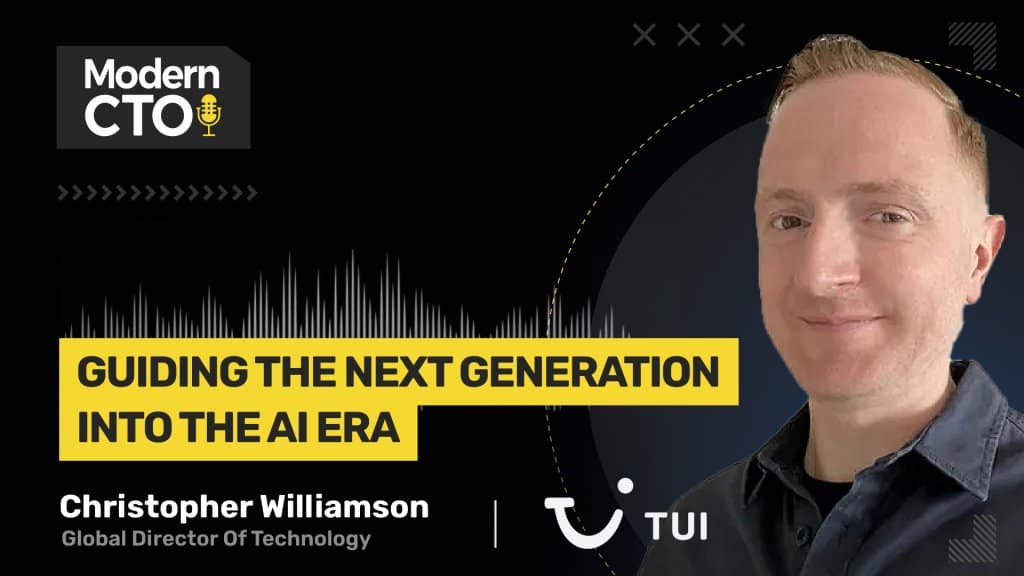
Guiding the Next Generation into the AI Era with Christopher Williamson, Global Director Of Technology at TUI
Today we’re talking to Christopher Williamson, Global Director Of Technology at TUI. We discuss Chris’s methodology of going from idea to project, the ways in which AI is being utilized to further TUI’s technology, and the ways that Joel and Chris approach technology for their kids and the next generation.
All of this right here, right now, on the Modern CTO Podcast!
For more about TUI, check out their website: https://www.tuigroup.com/en-en
Have feedback about the show? Let us know here
Produced by ProSeries Media.
About Christopher Williamson:
I ACCELERATE GROWTH OF ORGANISATIONS BY ACHIEVING EXCEPTIONAL TECHNOLOGY OUTCOMES, CREATING OPPORTUNITIES THAT INCREASE REVENUE, RAISING BRAND PROFILES AND CREATING ORGANISATIONS THAT PEOPLE WANT TO BE PART OF.
- Innovative excellence
- Relentless improvement
- Authentic human leadership built on trust
- Empowerment of teams & individuals
- Embracement of diversity
These guiding principles have served me well in my technology leadership journey where I have been able to maximise value of teams, increase innovation and improve experience for people.
I have worked in Travel, Banking, Telecommunications and Manufacturing, and I have partnered with some of the world’s most innovative brands including Apple, Google, Paypal, Visa, MasterCard, Amex and Amazon Web Services. These roles included setting strategies for Mobile, Web, Data, ML, Payments, Contact Centre, Cloud, Mainframe and Legacy Technologies.
I love making an impact and driving positive change. I enjoy people and am energised by my teams as together we focus on innovative excellence, innovation and constant improvement. Experience has taught me that the best results are achieved when we hire and develop the right people and when we create memorable experiences. This guides my dedication to coaching, leadership mentoring and people experience.
WHAT SETS ME APART
⋙ The ability to build relationships at all levels through trust, openness, and empathy.
⋙ Technology and business acumen with a focus on achieving exceptional results through people.
⋙ Vision, energy and passion that motivates my teams and gets the job done.
⋙ A determined commitment to continuous process and performance improvement.
⋙ High capacity for driving complex, deep-impact initiatives that power positive change and focus on ensuring this lands well.
⋙ Devotion to leadership coaching, development and mentoring.
HOW I'VE MADE A DIFFERENCE IN TECHNOLOGY
⋙ Enhanced ways of working, reduced attrition and improved recruitment at TUI to enable scaling of technology teams so that outcomes for customers can be improved.
⋙ Led digital transformation at first direct (HSBC) resulting in award winning digital experience for customers and improved experience for colleagues.
⋙ Delivered multimillion £ programmes at Lloyds Banking Group which have enabled innovation for customers such as Apple Pay and G Pay.
⋙ Consistently maintained employee engagement well-above averages.
FAVOURITE QUOTE
“Let’s go invent tomorrow instead of worrying about what happened yesterday.” – Steve Jobs
About TUI:
We’re adventure seekers. Smile givers. Impact makers.
We’re TUI, a leading global travel and leisure experience company that makes holiday dreams come true for people around the world.
We believe in the power of travel. It broadens horizons for our customers, and for our people too. Places to live, new roles to explore, new communities to join. It’s yours for the taking.
We are one of the world’s leading tourism groups counting 1200 travel agencies and leading online portals, five airlines with around 130 aircraft, over 400 hotels, and 16 cruise liners, and most importantly over 60 000 colleagues around the world. What unites us is making holiday dreams come true for our 21 million customers.
Besides the expansion of its core business with hotels, cruises via successful joint ventures and activities in holiday destinations, TUI is increasingly focusing on the expansion of digital platforms. The Group is transforming itself into a digital company.
Global responsibility for sustainable economic, ecological and social action is at the core of our corporate culture. With projects in 25 countries, the TUI Care Foundation initiated by TUI focuses on the positive effects of tourism, education and training and the strengthening of environmental and social standards. It thus supports the development of holiday destinations. The globally active TUI Care Foundation initiates projects that create new opportunities for the next generation.
At TUI we simply say “Let’s TUI it”. For us, that means making people smile. Tackling challenges every day together, with a positive, can-do attitude, and finding solutions even for the most unexpected situations.Our teams across TUI are just as diverse as our destinations. Whether you have lots of experience or none at all. If you want to work in an office or feel best in the field. No matter if you’re an accomplished tech whizz, an aspiring entertainer, or simply in love with flying. There’s a place for you here.
Transcript
(Joel Beasley at 00:00:15) It's a huge company. There's like 20 plus thousand employees.
(Christopher Parsons at 00:00:19) Had 67,000 employees.
(Joel Beasley at 00:00:21) 67,000? Wow. To do travel stuff?
(Christopher Parsons at 00:00:26) To do travel stuff. It's big. Yeah. I mean, TUI is a huge organization. We're headquartered in Germany. We're not just a travel agency. We've got our own cruise ships, 16 cruise ships. We've got over 400 hotels. We also have our own airline, you know, a fleet of over 130 aircraft, as well as our own travel agencies. So we're a massive organization. We do a lot for sustainability to promote sustainable tourism, and we also have our own company that does trips, excursions, and tickets. So a lot more than just that core product of a holiday. In my tech area, I have people all over the world. So I've got people in the UK, people in Portugal, Ukraine, Spain, Belgium, India, Bulgaria, Romania, Moldova, Poland, and Sweden, and that's just in my area. In our overall technology function at TUI, we've got 3,000 people across 30 countries, and that's split between 24 domains. So it's big. And, you know, within TUI, the employees that we have cover a wide variety of roles all the way from, you know, aircraft engineers and pilots through to technologists through to travel agencies. So it's a really exciting place to be.
(Joel Beasley at 00:01:40) Oh, very cool. And then you work out of what location?
(Christopher Parsons at 00:01:44) So I'm based in London. Right now, I'm sitting in the office overlooking the Tower of London. We've got a really great prime location in London. The sun's out. People are on the balcony drinking beer now because it's after 6:00 in the UK.
(Joel Beasley at 00:01:58) Wow. All right. So you reached out to me on LinkedIn.
(Christopher Parsons at 00:02:02) That's right. Yeah.
(Joel Beasley at 00:02:02) You were talking about, I believe, AI and the travel industry a little bit. And, you know, my background, software engineering, so my brain exploded with all the possibilities. But there are so many things. So the first question is, how do you decide which one to start experimenting with?
(Christopher Parsons at 00:02:18) Yeah. Really interesting question because there is so much out there. You know, if you look at the explosion of conversational AI with ChatGPT, Google Bard, and, you know, other players, it's just come from, you know, people kind of knowing that this thing was going on to something that's almost, you know, becoming mainstream very quickly. So we kind of looked at lots of different options. We have at TUI an AI lab, and that AI lab is, you know, just really kind of playing and experimenting with a lot of the different solutions out there to see which ones will give us the best results as an organization. And within my role, I do all of the mobile apps stuff, all of the payment stuff. And my guys are experimenting at the moment with ChatGPT specifically. So there's some quite good stuff that we can do to kind of integrate with OpenAI and use a lot of their tech to kind of help make it easier for our customers to kind of find really great products for them and personalize their experience. So, yeah, it's an exciting time to travel, and I think AI is going to revolutionize how customers find their experiences and then get support along their holiday as well.
(Joel Beasley at 00:03:26) It seems like a perfect example because I did a lot of travel before the pandemic. I do a little bit now, but I just want to talk to it and say, hey, find me a flight. It's got to be a nonstop, and it has to be within these hours because I don't want to leave my house earlier than 5 AM. And then get me a hotel, and I want it to be medium quality. I like not super fancy, not crummy, just like a nice solid place to be. And then I also want a seat that's no more than 10 rows back, right? So I can get on and off really quick and easy. Doesn't have to be first class, but like this. And then, yeah, go find me that. And I want to talk to it like that.
(Christopher Parsons at 00:04:09) Yeah.
(Joel Beasley at 00:04:09) And then it come back to me with like two itineraries, and I can be like, two or three itineraries. And I can either say, regenerate more itineraries, or I could say, oh, I want that itinerary, but change this or something. And then it just knows my card and ambient payments is the term. So like Uber, you don't actually pay them. You book the ride, you get in it, you walk out, at some point, the transaction happens, but you're not clicking a button to make the transaction happen. And I can just say, yeah. Make that happen, and it just makes it happen.
(Christopher Parsons at 00:04:36) Yeah. Can we do that today? We can't quite do that today, but that's certainly, you know, the vision of where we'd like to go with it. And I think for me, I see it as being, you know, very conversational where you start with, you know, I'd like to go to this destination. But actually with the use of tools like OpenAI, we can then build on it. So we can say, you know, hey, how about this? But then you can kind of say, well, you know, I'd like to sit a little bit further back on the flight. I'd like this. And, you know, almost like that product builds as the customer's starting to see things. They're starting to see what their experience could be like, and that's starting to kind of, you know, bring up real thoughts of how they want the experience to be, and they can then develop it. We can then use the AI tools to then personalize it and make it the right experience for them.
(Joel Beasley at 00:05:21) So you're running labs. Are you responsible for those labs or someone on your team? How does that work?
(Christopher Parsons at 00:05:27) So, yes, at TUI has its own AI lab. It was set up by our Group CIO who did a great job of getting a lot of our talented minds together to form this lab. The tagline for the lab is it's all about innovation meets collaboration and really kind of looks at all of the tools out there to make sure that we're assessing options and looking at the best tools for TUI so we can drive a great customer experience. They look at the rapid evolution of generative AI technology, and they're trying to create a low barrier to adoption for our teams. So, you know, really helps teams like mine to be able to understand what's out there and to make the right technology decisions and, you know, really kind of form some guardrails so that we can use the technology in a responsible way that allows us to generate great products in a way that doesn't cause any problems for TUI.
(Joel Beasley at 00:06:21) Now I'm not sure if you can answer this, but I am kind of curious. When these experiments are happening, you know, it's a larger organization. You said 60,000 plus people, right? But when this experiment happens, how does it actually go from just an idea, maybe two people having coffee within the company that said, hey, maybe we should try this, to it actually being a project? Do they have to put together business cases? How does all that process work?
(Christopher Parsons at 00:06:48) Yeah. So, Joel, good question. I've worked in a lot of big organizations, and it can be quite difficult to do innovation because, like you said, there's a business case and you've got to get some people allocated, you've got to get some product people thinking about it, you've got to get tech people thinking about it. You've got to go through various forums. And that works for a lot of things. But for this particular thing that we're doing in my team now, we took a different approach. And what I did is, you know, I was talking to my business counterpart. We said, wouldn't it be cool if we could do something with OpenAI? And then what I actually did is just kind of spoke to three guys in my team, three of my most talented people. So, an iOS engineer, a solution architect, and my head of technology, we kind of said, look, try and do something. Think about how you could make it really cool. Look at what our competitors are doing. So, you know, Expedia and Kayak, for example, are doing some stuff in this space. And I literally said, make it cool. Try and do something better. Make it a commercial opportunity and see what you can do with it. And you know what? Because it's really cool tech, these guys found it so interesting. They worked evenings. They were in the office late having sort of pizza, drinking beers, talking about it. They were working weekends to kind of look at it. And within, you know, like, two weeks, they came up with something really exceptional. And, you know, I can't say too much about it because it hasn't been launched yet, but it is really cool. And I think sometimes when you're trying to do innovation at a large organization, you know, coming through a lot of the standard process and just getting some people to think about how they can use the tech and come up with something cool could be a really good way to deliver something quickly. So that culture of experimentation is a great way for us to innovate. But once we kind of get there, we need to kind of mature that experiment to make it fit for purpose for our customers. And the way we're doing this, you know, we then get our product teams together to kind of look at what we're doing and make sure it's really customer friendly. We get it into one of our delivery teams to mature it and to scale the tech. We involve other areas like our AI lab that I mentioned earlier and our data science teams to really kind of refine some of the algorithms and make sure we're taking the right approach, and also working with some of our business areas to make sure that the proposition is good. In this case, we're working with our excursions area who do a lot of the kind of trips and excursions within TUI. We then have governance forums, as I'm sure you can imagine, just to kind of make sure that what we're doing meets all of our organizational standards. We've also done a lot of things like hackathons across the organization, where we've got teams of people to look at problems and opportunities. I think if we really kind of embrace this experimentation, we don't spend time debating and consulting teams so we can get something out, but then we make sure we consult all of the right people to make sure that that experiment becomes scalable and is a workable solution for customers.
(Joel Beasley at 00:09:45) And do you have a significant presence in the United States?
(Christopher Parsons at 00:09:50) We don't have a massive presence in the United States at the moment. It is an opportunity that we're kind of looking at because we're such a big brand, such a big organization. But, yeah, I think there's definitely an opportunity for us there. And I know, you know, a lot of the players there. I'm not sure there's anyone that really does the whole offering that you get with TUI. But one of the really exciting things for me about TUI is that, you know, it's not just that digital front door that you see to kind of book the experience, but because we own a lot of the assets and the infrastructure under that, it gives us the opportunity to really have quite a connected ecosystem between the digital experience and the physical. And we can always look at opportunities in the future to kind of converge the two. And we're looking at really cool technologies, like things like augmented reality and virtual reality to immerse the customer in that experience before they book it. And, yeah, there's just a lot of possibility.
(Joel Beasley at 00:10:41) I could see that happening pretty quickly, especially. I was fairly against the current. I wouldn't put on the Oculus. I mean, I have, but I just tried them on just to see what they're like. I'm excited to try the Apple one because I have a feeling, typically, every Apple product I use is just beautifully done to the point with a human. So I'm excited to try. I'm thinking maybe that's going to be the one that I say this is great technology. And maybe I'd put that on to see what it's going to be like in the Bahamas or whatnot.
(Christopher Parsons at 00:11:13) Yeah. Definitely, Joel. I mean, I'm in a similar position. I've tried a lot of these products. I've not really had the incentive to purchase one myself. I mean, the Apple one's pretty expensive, so, you know, I think it's going to be a really good piece of kit with that. And they generally launch things when they really get it right. So I agree. I think it's going to be great, and I'm looking forward to trialing it myself.
(Joel Beasley at 00:11:35) Yeah. My buddy Derek was like, hey, you going to buy one? I'm like, absolutely. No question. And then he sent me the link to it, and it was like over $3,000. And I was like, all right. Well, hey, you've got to understand what this tech is like, or maybe I'll go over to a friend's house who has one.
(Christopher Parsons at 00:11:52) Yeah. Definitely. Definitely. Yeah.
(Joel Beasley at 00:11:54) Yeah. Yeah. Because I don't mind buying it if I had some like known continuous use. I was building software for it or there was some very specific work related thing. But just to put it on for ten minutes, I was like, ah, maybe I'll just go try it first. But I have this feeling. I've got three kids under the age of seven, and I just when I saw it, I instantly saw in my head them being 12 or 13 laying in bed after school or whatnot, and then just watching whatever or playing a game or in some sort of digital space with all their friends. And for some reason, that looks like the future. Regardless of what you think about it, that's to me what I see in my head.
(Christopher Parsons at 00:12:33) Yeah. Definitely. No. I totally agree. And, you know, personally, I'm a real sucker for Apple products. I have pretty much everything that they come out with, and I just like how everything works together and is a good experience. So I'm really sure it will be great.
(Joel Beasley at 00:12:47) And so the company is called TUI. Is that am I speaking right?
(Christopher Parsons at 00:12:50) TUI is how you pronounce it. Yeah. Yeah.
(Joel Beasley at 00:12:52) So because I don't have a lot of experience with it, and I am curious. You did mention Expedia and Kayak. In your part of the world and that markets you operate, you would be an alternative to one of those.
(Christopher Parsons at 00:13:05) So, yes, we're definitely an alternative to those players. Whilst we do sell flights and hotels, we're much more than just a digital travel agency. Our business vision is all around excellence and leisure experience, and our brand purpose is around creating moments that make life richer for customers. So, you know, it's a really great mission to get behind. And because we have all of these assets around cruise ships, hotels, aircraft, it means that we can deliver a really bespoke experience for our customers. We're not just selling other products. And with that, we have excursions, trips, tickets so that the customers can really personalize their experience beyond the core holiday.
(Joel Beasley at 00:13:50) Being in your position, how do you look at emerging products within your market? The startup, the people in their garage. How do you keep up with that? Do you just wait till the people around you bring it up, or do you follow it in some way?
(Christopher Parsons at 00:14:05) Yeah. I definitely follow it. I mean, you know, I mentioned what Expedia and Kayak are doing with ChatGPT. So, you know, I've got an awful lot of travel apps on my phone and like to kind of see what the others are doing. And when they come out with features like that, I like to kind of have a play with it and, you know, book holidays to alternative providers as well just to kind of see what they're doing. And I'm always, you know, looking at where the industry's going, and I like to kind of tinker with the tech myself as well. So I'm doing a part time master's in computer science specializing in artificial intelligence, just to kind of stay on top of the tech and kind of be in the detail, as well as kind of looking at the industry and where that's going.
(Joel Beasley at 00:14:46) Where are you doing that at?
(Christopher Parsons at 00:14:47) So I'm doing it at a university in the North of England. So I'm actually whilst I work in London a lot, I'm based in the North of England, and that's a university in Newcastle upon Tyne.
(Joel Beasley at 00:14:56) Oh, very cool. So how does that work? Do you just get together for a couple weeks out of the year, or is it continuous?
(Christopher Parsons at 00:15:03) It's continuous. It's kind of like out of hours. So I do a lot of evening and weekends type stuff to stay on top of that. But it's something that I can phase and take breaks in and things. So I can balance that with my role at TUI.
(Christopher Parsons at 00:15:19) Okay.
(Joel Beasley at 00:15:19) So because you have such a leadership role, you're using this as a way to continue to improve your technical skills and stay aware of what's going on?
(Christopher Parsons at 00:15:28) Exactly. Yeah. And, you know, I'm a big believer from a leadership point of view in knowing where the technology is going, but also knowing what my guys and my teams, my engineers are facing, what they're working on. And I do quite a lot of work to get involved in the teams at ground level to see what they're doing so that I can talk to them about their challenges. And, you know, I see my role as a leader to make the environment positive for them so that they can develop, they're enjoying their work, and it's an environment that allows them to do great work.
(Joel Beasley at 00:16:03) And then if we fast forward ten years, how do you think your company or your teams would look differently in ten years given the advancements of AI?
(Christopher Parsons at 00:16:13) So I think AI is going to take, certainly, a lot of the manual and the less valuable work away from people. I think people are going to do the more interesting stuff and almost steer AI. And for me, I think people should really embrace it and get to grips with it, experiment with ChatGPT, Google Bot, and understand how it works because I think that is where we're going. And I think people who can harness the power of AI and mold it to do what they want to do will be really successful going forward. You know, I'm using it a lot for communications, things like LinkedIn updates.
(Christopher Parsons at 00:16:51) And it's really great because I can put out an awful lot more content on LinkedIn, basically just telling ChatGPT what I've been doing for the day very briefly, and then ChatGPT will write me a really well-written LinkedIn post. And I see that's where it's going. I think, you know, writing code and doing other things, tools like ChatGPT will do a lot of the legwork, and then the engineers and the product people will then just need to steer that to get to where they need to be. And, you know, I'm very hopeful that it will ultimately give us more leisure time as well. And then the time that we do spend at work will be really sort of more value-add.
(Joel Beasley at 00:17:29) 100%. Yeah. I read—I think this was an Amazon report. I'm not sure. But some company was studying their engineers at scale and the effects of assistive coding tools.
(Joel Beasley at 00:17:41) And what they found was it made the top people slightly better, slightly faster, but it took the new people and ramped them at an incredibly accelerated rate. So you can get these newer people up to speed, up to the higher level while the higher level people are coaching them, and then you can just move faster that way.
(Christopher Parsons at 00:18:04) Yeah. Definitely. And one of the challenges I see post-COVID is we've got a scheme at TUI where we bring graduates in. And also, I've just agreed a partnership with an organization to bring junior people in who are maybe changing industries and really want to get into tech. And when you've got those junior guys who don't have the background, haven't really worked for organizations much, it's difficult because, you know, much of their work is remote.
(Christopher Parsons at 00:18:33) They're not in an office where they can just speak to somebody next to them to say, look, I don't understand how this bit of code works. Can you help me with this? The AI tools can really help them understand those. And I think what we need to focus on is we need to focus on ensuring that people don't get lazy and just rely on AI doing stuff. Because certainly my experiments with it don't always get it right.
(Christopher Parsons at 00:18:55) So you've got to know enough about how the code works to look at what's produced, make sure it's right. But you're right. It can be a really great tool to help new people and to make the whole process of coding applications more efficient and effective.
(Joel Beasley at 00:19:10) Yeah. I 100% agree. I think we've been doing this for a while as humans. For example, you know, bicycles or cars. Let's use cars.
(Joel Beasley at 00:19:20) Like, I could walk down to the grocery store.
(Christopher Parsons at 00:19:22) Yeah.
(Joel Beasley at 00:19:23) I could use my legs and propel myself down there. But I have this technology that helps me get there. Did I stop walking? No. I'm still walking around.
(Joel Beasley at 00:19:32) I get into my car and then I go there and then I walk in the grocery store. Well, I see it very similarly to how I've been using it a lot like how you described, where I have these ideas and I can really rapidly stream of consciousness, bullet point out things, and have some fragments. And then just yesterday, I took—we started building podcasts for other companies. And so I had a call with this company about building them a show. And they were saying, okay.
(Joel Beasley at 00:19:58) Well, like, here's what the executive team likes about our—they already had a show so it was a takeover. Like, here's what they like about it. Here's what they don't like about it. And they gave us all this information. I just kept asking them questions, you know, like, where do you want it to go and what's the financial justification for this on your end. And we went through all of this stuff and I had really good notes and transcript notes.
(Joel Beasley at 00:20:19) But I used mine and I fed it—I told ChatGPT-4 or whatever the four variant is. I said, hey. I'm working with this company. We're putting together a business case. Here's an example of a business case I really like.
(Joel Beasley at 00:20:33) And I went and Googled around and I found one that I really like from Adobe. They had a really great example one. So I pasted the Adobe business case in there and then I said, here's all the notes from the conversation and here's the key points I want to communicate—and I bulleted it out—and I want to communicate these points, and I want to answer these questions, and I want it similar to the format that I shared with you. Dude, it took me like two little back-and-forths of refinement.
(Joel Beasley at 00:20:57) Like, it didn't pick up the first time that they already had a podcast. So I just refined that and it adjusted. And there was one or two other little things that I changed. But within five minutes, I took my fragments and a group of notes and some Google searches, and I turned it into this beautifully, wonderful, amazing business case.
(Christopher Parsons at 00:21:17) Exactly. Yeah. And it can even write VBA code, so you can just create it straight in PowerPoint for a presentation. So you don't even have to do that. And I think it's—I mean, I've experimented with that, and it still, you know, it doesn't look great.
(Christopher Parsons at 00:21:29) It needs a bit of work, but I'm sure where it's going, you know, it's going to look great soon. And, yeah.
(Joel Beasley at 00:21:38) Yeah. One of my friends actually—I was making a joke about Ryan Reynolds being a superhero. And then about two hours after we make that joke, we were talking about something and it came up. And he sent me these four images of Ryan Reynolds merged with the superhero that he had gotten from Midjourney, and they were so amazing and perfect. And I thought to myself, wow.
(Joel Beasley at 00:22:02) We're getting all these really bright, interesting, shiny things, and I think they're about to come together in a really cool way.
(Christopher Parsons at 00:22:10) Yeah. Definitely. Or, you say that. I did the same thing, but I did a presentation at AWS last week, and I got the OpenAI image generator to generate an image of me. And what it produces is pretty scary, I think.
(Christopher Parsons at 00:22:25) So it's—yeah. So some of it's good. Some of it's not quite there, I think.
(Joel Beasley at 00:22:32) Yeah. And then you see all these advancements in the specialized areas. Like, there's people that are working on specializations for Midjourney just for generating humans. Right? And because you can generate all types of stuff. There's people that are using it to generate PowerPoints and slides and—
(Christopher Parsons at 00:22:47) Yeah.
(Joel Beasley at 00:22:48) Brands and color schemes and logos, and everybody's working in their own little niches, and it's all about to come together over the next, I think, five to ten years. And I'm just really excited because it gives so much more opportunity to people. Right? Like, now you and I can do a project as if we were a huge company even if it was just us as individuals.
(Joel Beasley at 00:23:10) And, I mean, I was just thinking back to fifteen years ago when we were learning about frameworks for the first time and how cool it was that it wasn't just all, you know, one big—the way you could do the projects with like CodeIgniter or Rails and all of that. When I found those systems, I was like, this is blown away. But if that happened in fifteen years, where are we going to be in another fifteen years?
(Christopher Parsons at 00:23:37) Exactly. I completely agree. I think all of the technology pieces are coming together now, and we are on the verge of a massive revolution that we're going to see over the next few years. And, yeah, I know there's a lot of nervousness around AI, where it's going to take us. Personally, I'm very excited. I think it's going to transform our lives. And I just think about, you know, when my grandfather was alive, I used to talk to him about his experiences. And one of the things that he told me which really stuck was that over the years, things have got better for people and people have got more leisure time and things.
(Christopher Parsons at 00:24:11) And, you know, he started his career back in shipbuilding and he was working, you know, six and a half days a week, only got half a day off. Very long hours. It was very tough work. You know, things like they didn't have washing machines when he was doing that. And then tech's come along and improved things, and it's ultimately improved humanity and given a better quality of life.
(Christopher Parsons at 00:24:32) So, yeah, I think we're going to see that big acceleration over the next few years.
(Joel Beasley at 00:24:36) I'm massively grateful for the people that came before us. I mean, you and I live better than any human on the planet a hundred years ago.
(Christopher Parsons at 00:24:43) Exactly. Exactly. Yeah. Yeah. Yeah.
(Joel Beasley at 00:24:47) Another thing that makes me optimistic and okay with the advancements and not necessarily running scared is when I do take time off, it only takes me a couple days before I'm stir-crazy wanting to do things. Like, I'm a very—I like to do things. I like to accomplish things. You know? And so for me, I think about that, and then I also pair that with the idea that, you know, currency is a medium of exchange for doing work for each other.
(Joel Beasley at 00:25:21) And so you'll likely get—as long as people continue to want to do things, there will be work.
(Christopher Parsons at 00:25:27) Yeah. Yeah. Definitely.
(Joel Beasley at 00:25:28) So that makes me feel okay because we're going to go build amazing technology. We still have to learn to harness the power of stars, you know. There's so much more that we need to do. We could go into—obviously, we're going to be going into space in a very big way over the next, you know, couple decades. And all of those things remind me that it's not the end of the world.
(Joel Beasley at 00:25:52) AI is just going to make us better. It's going to amplify—it's like money. Money will amplify your personality. If you get written a big check, it's going to amplify your personality. If you're generous, it's going to amplify that. If you're rude, it's going to amplify that.
(Joel Beasley at 00:26:06) And I think that this technology is just amplifying human productivity.
(Christopher Parsons at 00:26:10) Yeah. I agree. And I think, you know, when you talk about what you want to do in your spare time and if AI is going to allow us to have more spare time, people are going to crave really great experiences and, you know, different things to do. I mean, personally, I really like things like kayaking and rock climbing. In my spare time, I take my son to do those sorts of things.
(Christopher Parsons at 00:26:31) So, you know, that's why it's a really bright future to work in travel tech as well because travel companies can use these sorts of new tools and technologies to enable those experiences for people in this new world.
(Joel Beasley at 00:26:44) How old's your son?
(Christopher Parsons at 00:26:46) Seven.
(Joel Beasley at 00:26:46) Seven. Oh, nice. Yeah.
(Christopher Parsons at 00:26:48) Yeah. That's pretty cool.
(Joel Beasley at 00:26:50) Yeah. My son right now is four. He's four turning five, and so it's an amazing thing. And what type of technology is he currently interested in?
(Christopher Parsons at 00:27:02) Do you know what? I try to keep him away from it. So I don't really let him have any, you know, like an iPad or any devices like that. He is a super Star Wars fan. He's a massive Star Wars fan, so he watches that on the TV.
(Christopher Parsons at 00:27:18) But other than that, I try to keep him out of it. He goes to a sort of like a forest school, which is very about the environment and sustainability and things. So, yeah, I just know there will become a time very soon when he will want devices, and it will be very difficult for me to keep him off devices. So I'm trying to play that as well as I can.
(Joel Beasley at 00:27:40) It is so tough. I think about it all the time because the learning content is so good. It is so good, and you have to put a lot of time into it as a parent to figure out permissions, privacy controls, how you're going to set things up correctly, which tools are good, which technology and apps are good.
(Joel Beasley at 00:28:00) It's—I mean, it's almost like you have to be a parent.
(Christopher Parsons at 00:28:04) Yeah. Exactly. Yeah. Yeah. Yeah.
(Christopher Parsons at 00:28:07) I mean, we've trialed, like, he has sort of coding tools, or he's had those since he was quite young, where it's, you know, not screens and things, but different toys that get him to think about logic and coding logic. Like, it's a mouse that you can set up around a maze, and you've got to give it different commands and things. So we do things like that, but, yeah, try to avoid the screens where we can.
(Joel Beasley at 00:28:32) Yeah. There are so many cool tech kits that will teach you all sorts of different things for $50 on Amazon. It is unbelievable.
(Christopher Parsons at 00:28:43) Definitely.
(Joel Beasley at 00:28:43) Well, that is pretty cool. So have you ever handed him your application, your travel app, and said, what do you think of this?
(Christopher Parsons at 00:28:50) Yeah. In theory, it'd be a great tester, and it'd be a good thing to do. But not yet. The only thing I have done is when we look through holidays together, I will get him to look and see what he likes. So we haven't booked anything for the summer yet, but we're looking at booking something.
(Christopher Parsons at 00:29:05) And I've had him looking at different things that he wants to do. And at the moment, he really wants to go on a cruise ship, and he's learning about ancient Rome at school. So he wants to go and see Rome. So we're looking at maybe doing that in the summer.
(Joel Beasley at 00:29:18) Is he on computers at school?
(Christopher Parsons at 00:29:20) Yeah. He started doing some stuff at school. It's pretty basic, but, yeah, he started doing some computing at school. Yeah.
(Joel Beasley at 00:29:27) Yeah. That's the tough balance of, you know, they need these skills because we're in technology. They need these skills for the future. But you also need to get them connected to nature.
(Christopher Parsons at 00:29:40) Yeah.
(Joel Beasley at 00:29:40) So the approach we have taken is that we lock down their devices to only educational content, and then we review that educational content to make sure it's, you know, what we want them learning. Yeah.
(Christopher Parsons at 00:29:56) That's good. Yeah.
(Joel Beasley at 00:29:56) Then we also locked down—you know what was really hard to lock down? Roku. So you can't put a pin on launching an app on Roku.
(Joel Beasley at 00:30:09) Yeah. And you can't do it on almost all the devices. And then I just found out the other day that Apple TV will let you put a PIN per app because I want my apps on there for the stuff that I watch with my wife, but I don't want my kids going in there and meddling around. You know?
(Christopher Parsons at 00:30:25) Definitely. Yeah.
(Christopher Parsons at 00:30:27) No, I totally agree. And yeah, we have the same thing with the TV because, you know, my son's very keen to go and watch his stuff. And the problem is with things like Disney Plus, if he, you know, flips his channel to watch some of the Star Wars content, it does show an awful lot of stuff that isn't massively appropriate. So it is a challenge.
(Christopher Parsons at 00:30:47) And I think it'd be good if some of the content providers could provide more bespoke controls to make sure that parents can allow their kids to see what they want them to see, because different parents have different things that they want their kids to see, and children are different as well. Right? What one child of a certain age group could see and be okay with, it might negatively impact another child.
(Joel Beasley at 00:31:11) Yeah. Well, I'm glad you're talking about this because our kids are little AI algorithms, Christopher, and we need to be really careful about the data that we train them on.
(Christopher Parsons at 00:31:19) Yeah. Definitely. Definitely. I mean, maybe the easier idea than a drone would be a camera that almost monitored reactions and, you know, you can see whether the content is driving certain emotions in the child and, you know, so it gets it right. And obviously, you build that picture of your child from their reactions to the content.
(Joel Beasley at 00:31:40) I'm just waiting for Musk to hurry up at Neuralink. Yeah. Just want to put a chip right in their brain.
(Christopher Parsons at 00:31:46) Then he can control them.
(Joel Beasley at 00:31:52) I want to make sure that, you know, they're your kids and you raise them, and you can train them on the values that you believe will give them the most success in the world. And then they go out into the world, and they make their own realizations and deal with it. I've never met a shortage of people who have ditched the way that their parents raised them. It's not like something that's so sticky you can't change it. It happens all the time.
(Christopher Parsons at 00:32:21) Exactly. And I mean, our kids are of a similar age. And just imagine when they're starting to think about work and going into work and what their technology is going to look like then. It's, yeah, it's got to be crazy.
(Joel Beasley at 00:32:34) My daughter wants a show. She sees me on YouTube, and she'll be like, "Daddy, how are you on YouTube?" Because she likes these other things that are on YouTube. And I was like, "Well, I have a show." And then sometimes when they miss me, my wife pretends that it's a live stream, and she's showing them prerecorded stuff of me.
(Christopher Parsons at 00:32:51) Yeah. Cool. I mean, that's so real, though. Like, it's big in the UK as well. In schools, people do want to go into social media and do stuff online.
(Christopher Parsons at 00:33:02) And when you ask kids what they want to do, that is a really popular answer now.
(Joel Beasley at 00:33:08) And it's crazy because who am I to say? I can't sit there and say, "No. You shouldn't have a show and you shouldn't learn how to make online content when the house, the land, the food, everything is paid for by that show, by my content."
(Joel Beasley at 00:33:21) Definitely. Yeah. Yeah.
(Christopher Parsons at 00:33:22) Yeah. It's just really interesting to see how people are changing through the generations. So, you know, I mentioned about grads coming into TUI and the younger engineers. And one of the things that I see as well is they come in, they have their core job to work as a software engineer at TUI. But then you look at their LinkedIn profile, and they're also, you know, they have their own startup company that they're also running on the side. And that's very different from certainly from when I went to tech. In big companies, anyway, you don't really see that, and it's a lot more popular now. So I think younger generations are definitely thinking about more, you know, entrepreneurial mindset, start things up, as well as working for the bigger companies. So it's, yeah, it's really cool.
(Joel Beasley at 00:34:06) That's, I'm glad you brought that up. That's actually an area where I think I'm in the process of going back on my original view.
(Christopher Parsons at 00:34:14) Okay.
(Joel Beasley at 00:34:15) Originally, I thought, like, "Oh, that's perfect. You know? Have your job. Have your side hustle." Yeah. But then after my life experience, what I realized is that you can do one thing good. You decide that you want to do this one thing and you put all of yourself into it. Like, as much as, you just do it and you just laser focus on it and ignore all the other opportunities and just put your blinders on and just hit that one note over and over and over. And, you know, years will go by, but you will get it. Right?
(Christopher Parsons at 00:34:49) Yeah.
(Joel Beasley at 00:34:50) And so it's really hard to be doing, you know, two different things at once. I'm not saying it can't be done. But for me, personally, I've had the most success when I just put the blinders on and just, you know, did that one thing over and over. And I want people to have success. I also believe if you're an entrepreneur and you say you're an entrepreneur, that there's a lot that gets tagged on to that. And I am an entrepreneur. And if you're going to do it, you've got to commit to it. You've got to go be poor most often. You've got to work your face off. You've got to really commit to it. And when you do that and then you have success, otherwise, you can find yourself, you know, working a main job and dropping side projects and picking them up over the course of years and never really having success and always kind of wanting to do that, but never actually getting to do it. But if you just cut off all other possibilities and just say, "I mean, I'm willing to work out of my city's homeless shelter." Right? It's definitely easier when you don't have kids and you're young.
(Christopher Parsons at 00:35:54) Yeah. Exactly. Yeah. I agree with that. Yeah.
(Joel Beasley at 00:35:56) Yeah. But, yeah, I don't know. Yeah. I go back and forth.
(Christopher Parsons at 00:36:01) Exactly. I mean, I agree with what you're saying from my personal experience, but maybe it's because we're of a similar generation. For me, what's got me to the position I am today in the corporate world is having that focus and just thinking, "This is what I want to do. This is where I want to get to." Yeah. And just going at it. And, you know, I've had that from a very young age, you know, from my early twenties as the type of guy that set myself goals to say, "Right, this is where I want to be in five years. This is where I want to be in ten years," and kind of that. And then revisited that and worked on it and learned from successes and failures and kind of built things from there. So I personally agree. But, yeah, it'll be interesting to see where a lot of these startups with some of the junior engineers that I work for kind of go to and how that balances with their main roles.
(Joel Beasley at 00:36:51) Yeah. Yeah. It's definitely interesting. The junior engineers, though, that you are seeing, other than that, other than this idea that a lot of them are having what they like to call side hustles or startups on the side, what other trends are you seeing about how they maybe think about things or how they act behaviorally?
(Christopher Parsons at 00:37:12) So we see a real variety, which is good because we have the grads who are just, you know, coming out of university. They've got technology degrees, and they have an understanding of how to code, and they'll build, and they'll work on that. But we are seeing some people that come on our grad program who will maybe start off in a role like that, and then they'll switch. We've had one person in my team who's kind of switched to more of a design role. But what excites me as well is we're starting to do more at TUI, where we're bringing people in from different backgrounds, from career switcher backgrounds. And we've just signed an agreement with a company that specializes in bringing more females into technology because it's still an underrepresented area. And, you know, for me, it's really exciting to see those different types of people and how they deal with upskilling and becoming technologists. And, yeah, we see slightly different approaches because, you know, people who've got that structured software background from university take a slightly different approach to somebody who's coming from a completely different job and really kind of, you know, just experiencing technology for the first time.
(Joel Beasley at 00:38:23) Interesting. Yeah. One of the other things that, I'm trying to figure out how to leverage people that have side, what is that saying about somebody when they have a side hustle? Right? I think it's saying that they want more.
(Christopher Parsons at 00:38:34) Yeah. Yeah.
(Joel Beasley at 00:38:35) Right? They want more. So it's like, for us as leaders, how do we see that and then know how to coach the person differently that has the side hustle? You know? Because I feel like that person would be somebody you could pull aside and be like, "Hey, I see you've got the side hustle. It seems like you want more. Like, yeah. Here's how to get more." And then you can direct them on how to get more and what the path would look like that you could, you know, help them with.
(Joel Beasley at 00:39:01) Yeah. Maybe growing within your company or growing within your industry. Right?
(Christopher Parsons at 00:39:04) Yeah.
(Joel Beasley at 00:39:05) And you could show them that, and then maybe that could get them really excited to produce results inside of your organization.
(Christopher Parsons at 00:39:13) Yeah. Definitely. I agree. I mean, you know, the example I mentioned about the R&D in AI stuff where we just got a, you know, a small group of people to look at what they could do, and they managed to do something really great. I think it's the same sort of thing if you can direct that and say, "Right, that interest that you've got. If you could think of applying that to TUI and looking at, you know, changing the experience for customers." I think you can with that person and maybe a few more senior people could come and help produce something really great. But I think as well, it's, you know, with AI coming and AI taking more of a role in the future, we might see people, you know, not just doing what we've done and focusing on one thing and driving that, but, actually, AI may be giving them the ability to have a few different things going on at the same time.
(Joel Beasley at 00:40:03) Yeah. Oh, the future. It's amazing. I really like this conversation. And, Christopher, we made a podcast, buddy. How do you feel?
(Christopher Parsons at 00:40:11) Excellent. Yeah. Really enjoyed it, Joel.
(Joel Beasley at 00:40:14) Thank you so much for listening. And if you found this episode useful, please share it with a friend or colleague who you think would get value from it. And if you have topics that you'd like to hear discussed on the podcast, either add me on LinkedIn, or send me an email: [email protected]. Every time I get an email or LinkedIn message, it absolutely makes my day and inspires me to keep going.