
Episode 723 ·
Supercharging the Future of Mobility with Chris Helsel, CTO at Goodyear
Today we’re talking to Chris Helsel, SVP of Global Operations and CTO at Goodyear. We discuss what the future of mobility looks like, the technical methods behind Goodyear’s approach to making travel more efficient, and why the fundamentals matter most when it comes to being an effective leader.
All of this right here, right now, on the Modern CTO Podcast!
For more about Goodyear, check out their website: https://www.goodyear.com/
Have feedback about the show? Let us know here
Produced by ProSeries Media.
For booking inquiries, email [email protected]
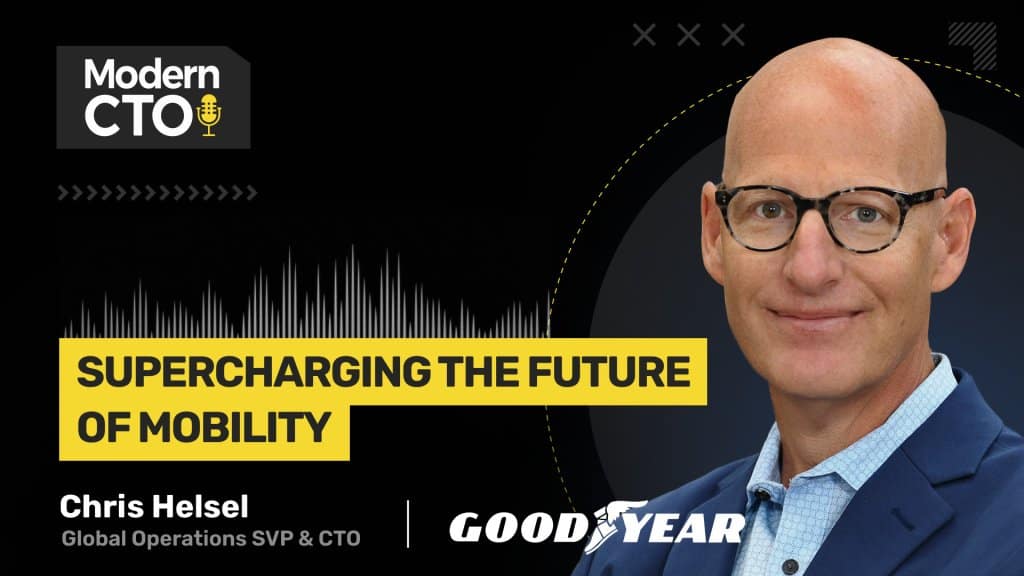
About Chris Helsel
Chris Helsel is Senior Vice President, Global Operations and Chief Technology Officer of The Goodyear Tire & Rubber Company. Mindful of the inflection point in mobility, Helsel and his team operate with duality, working to enhance Goodyear’s core tire product while innovating “beyond” tires to enable the evolution and future of movement. Applying this segregated but synced approach, Helsel is responsible for a global network of tire technology, innovation, research and product development operations, focused on creating industry-leading solutions for consumer, commercial and off-the-road vehicles, in addition to aviation and racing. With a devoted emphasis on improving a legacy invention, Helsel’s team has concentrated on developing a global portfolio of products bolstered by a record amount of technology releases.
This focus has delivered a diverse set of products customized to consumer and customer needs garnering respected, third-party validation while concurrently increasing productivity and reducing complexity.
Upon taking this role in 2017, one of Helsel’s initial decisions was to establish an office in Silicon Valley to take advantage of an epicenter of mobility with intent to co-disrupt with like-minded partners. That office has grown exponentially since and additional “innovation labs” have been established in other global locations.
Goodyear’s innovation team is focused on enhancing connectivity, safety and solutions with respect to intelligence in tires, new architectures such as non-pneumatic tires and maintenance-free tires aided by sealant.
Guided by the trends he defines as FACE (Fleets, Autonomous, Connected, Electric), Helsel has established a long-term vision to develop great products and services that respond to and anticipate customer and consumer needs.
Helsel serves on the Exascale Computing Project Industry Council and is a lead executive partner with Sandia National Labs. He recently served as a keynote speaker at the American Automotive Summit and the Tire Society Conference and has been interviewed by the Wall Street Journal, Forbes, USA Today and Business Insider.
He joined Goodyear in 1996 and has worked in computer modeling, tire design and tire technology. He has deep experience in Goodyear’s commercial tire business, including leading the retread business in North America. His Goodyear tenure includes a stint in Luxembourg where he led project management and technology development.
Helsel earned his undergraduate degree in mechanical engineering from Cleveland State University and his Master’s from the University of Akron in the same discipline. He lives in Medina, Ohio with his wife and has 3 children.
An avid reader, Helsel’s favorite business book is Playing to Win by Lafley and Martin and The Theodore Roosevelt Series by Edmund Morris is his top biography pick.
About Goodyear
Goodyear is one of the world's largest tire companies. It employs about 72,000 people and manufactures its products in 57 facilities in 23 countries around the world. Its two Innovation Centers in Akron, Ohio, and Colmar-Berg, Luxembourg, strive to develop state-of-the-art products and services that set the technology and performance standard for the industry. For more information about Goodyear and its products, go to www.goodyear.com/corporate.
Transcript
(Intro Narrator at 00:00:00) Today, we're talking to Chris Helsel, SVP and CTO at Goodyear, about the future of mobility. You're listening to Joel Beasley, Modern CTO.
(Joel Beasley at 00:00:15) I read all the notes from you and Josh's call, and inevitably, there was this tiny little section that says something about lunar tires. And there's a little asterisk saying, "Chris probably won't be able to talk a whole lot about it." And I said, "Josh, can we make the whole interview about it? I want to know what's going on with tires on the moon. Are we doing that as a society, as a civilization? Are we making these things?"
(Chris Helsel at 00:00:36) You know, first off, I would point back to maybe some of Goodyear's heritage. We did have some of the first tires on the moon, right, as part of some of the original Apollo missions. And in fact, there's out for consideration—I don't think it's not public knowledge—is the return mission. So I think, if I'm not mistaken, is it called Artemis?
(Joel Beasley at 00:01:00) Yes. Yes.
(Chris Helsel at 00:01:00) And so there's a lot of companies out there who are forming these partnerships. We had an announcement out there with some of the collaboration we're doing with GM and Lockheed. And of course, our contribution to that would be the idea of tires or a tire-type structure, something to connect the vehicle to ground. Right? That's what we specialize in. Connect vehicles to ground, pass all the forces, and do it efficiently, giving you traction and braking. So when we think of this though, it's not a tire like you would understand normally when you're putting air in it. It's more like—and some of these have showed up before on the internet—they're almost like wire meshes. And so very advanced alloys, and they give you the ability to actually sink down into the moon dust, but yet once they get in there, they can start providing traction. So they actually see that surface or that dust will actually be flowing through this mesh of a tire while it's moving and rolling the vehicle. And kind of like a mining application where they can really dictate the amount of materials they can move and how fast they can move them is really based upon the tire's durability. It's kind of the rev limiter on it. It's a similar type challenge. You know, if you want to move things around on the moon under really advanced conditions—a lot of this thinking is you're going to do it on the dark side of the moon, no Pink Floyd reference intended—and, you know, it's a much harsher environment in terms of coldness and temperature and things. So it's a real challenge. So yes, we are working on this to enable those next type of generation vehicles.
(Joel Beasley at 00:02:46) You should tell them for product testing that you want to be one of the test people and you want to go to the moon.
(Chris Helsel at 00:02:51) Yeah, I'm not sure if I'm going to sign up for that, but theoretically, I could, I guess. I don't know. I'd be a little concerned if my boss is willing to let me go do that. You know? He'd be like, "Oh, yeah, he should go do that."
(Joel Beasley at 00:03:06) "Do I need an insurance policy?" "No, no, no. It's cool."
(Chris Helsel at 00:03:08) He says he has a really strong succession plan for me.
(Joel Beasley at 00:03:12) Have you seen that animated video that is a time lapse of the number of SpaceX launches that there have been?
(Chris Helsel at 00:03:19) No.
(Joel Beasley at 00:03:20) So it shows, you know, it rolls it back, like, ten years, and it's got the dates on the bottom as it's going. And you see one, like, every three months. So there's, like, a little blip and then a little blip. And then it looks like a machine on fire essentially with these rockets taking off. We are launching so frequently as a civilization compared to anything we've ever done. It's mind blowing. It's becoming almost an everyday activity.
(Chris Helsel at 00:03:43) Right. And, you know, when you think about it and what's going to be possible. And it's actually starting to happen and exciting, you know. That's that spirit of innovation that gives you the optimistic view of the future. Right. And probably what made me become a CTO. Right. Just getting into the technology, being able to solve problems. So yeah.
(Joel Beasley at 00:04:06) Where'd you get that optimism from and that engineering side from? Do you think your parents had influence over that or?
(Chris Helsel at 00:04:12) Interestingly, neither were college educated. So I was first generation. But my dad was very mechanical, so I was always working on cars and things with him. I think as much as anything else, he wanted somebody who could still crawl underneath the car and loosen up the oil pan and let that old oil drip down. But the bottom line is I think you get into that and you like doing it. And that's what took me into mechanical engineering versus the others. But I think at the heart of it all was really the problem solving. And problem solving, you know, to me leads to a bit of that optimism, probably when connected, especially with a lot of inquisitiveness. I was probably raised to be really inquisitive, but I was the youngest of four and it was a lot around, "Well, why is that?" You know, "And then just go try it." You know? And so I was always probably very experimental. And, you know, that inquisitiveness, I think, gives you the optimism. And you made a reference, I thought it was always really impressive, when you hear about some of the things like a company like Tesla is doing, it was a different question. Right? Which is, "Well, what would have to be true to be able to do that?" And that, I think, leads to a very proactive, "Well, well, geez, we would just have to do this and this. Okay. Well, let's go solve that." So that inquisitiveness leads to that, you know, wanting to move forward, be proactive, come up with that new. I think that's kind of, you know, that's what really gets me excited. Gets me up in the morning. Right? Being in the technology.
(Joel Beasley at 00:05:51) So you guys refer to yourself as a mobility company. That was news to me. Tell me about why you use that phrase, mobility.
(Chris Helsel at 00:05:58) It really comes from us thinking about, again, back to, what is the core thing we do? And at the heart of it, we connect vehicles to the ground. And, you know, we could say, "Well, because of that then, what we do is we're a tire manufacturer and we sell tires." And the answer is, yes. Very true. We've done that very proudly for a hundred and twenty-five years. And as of right now, there's no better way to do that. But we've done that traditionally with the physics, chemistry, very traditional sciences. And now when you see this immersion of the Internet of Things, we start saying, "Well, couldn't we do that maybe with some of those new technologies?" And so that quickly gets us into, well, putting a sensor in the tire, and that sensor has to monitor temperature, pressure, accelerations, and give us some different information as to what's happening at that contact patch. And now what can we do with that? And so I'll just give a couple of things we could do. One, we could help you be very, very efficient in moving things, like for fleets. Why? We can help you prevent a downtime incident because we're real time monitoring, is that tire up to the job to be done? Right? Is it properly inflated? How much wear is left on it? We're able to do those kind of things when we combine those signals with our knowledge through algorithms and then, of course, interacting with somebody who could take action. Or secondly, we've done demonstrations of just knowing the tire and knowing how worn it is, recovering lost stopping distance. So think of that as a safety type feature that, you know, yes, do we provide some enabling to braking systems today because of the type of rubbers and things we pick, but now we do that in a whole different way by telling you digitally information about the tire. So that's caused us to think about, well, those are new things then we could do or new ways we could build upon the job we've done for a long time and then connect with others to bring whole new products to market or bring them to market ourselves.
(Joel Beasley at 00:08:07) Are any retail purchasable vehicles running with the smart tires with the chips on them?
(Chris Helsel at 00:08:13) So before the end of this year, our first OE fitment will be on market. So, actually, as the original equipment manufacturer—I can't name them—is offering their vehicle, it'll have those smart tires in there. And then think of it as a new way that they can unlock new features or new driving modes, the new what have you, in the vehicle. You know, knowing is it a summer tire, a winter tire, an all-season tire, you could change the characteristics of some of these control systems.
(Joel Beasley at 00:08:45) How do you keep things secret like that? You have 20,000 plus people working at the company. When you're going to do that with a manufacturer, right, there has to be APIs, data, testing. Obviously, your chip's connecting to some interface, and there's a whole technical system to inspect. How do you keep things quiet when you're doing these types of deals, or is this information not sought after so it's not heavily protected?
(Chris Helsel at 00:09:11) I would say, you know, number one is, clearly, we're creating IP. Right? But probably more importantly is we are talking about it. We're doing releases as we're doing these pilots. And so, actually, if you go see, we've been laying breadcrumbs out there through maybe things I'll comment on through interviews like this or other interviews, or the CEO will do the same. So we have been talking about these probably since about 2020. January 2020, we had a big kind of coming out at CES where we talked about some of these new things that we're doing. Of course, COVID kind of obviously turned a lot of things around, but we've continued this work and continued laying out some more examples. Another one being Gatik, who's a middle mile delivery company. They've been doing a lot of work where think of it as, you've got a large inventory at a distribution hub, and you want to get it out at nighttime to restock shelves, let's say, at the local stores in the area. And they started out doing work with, like, Walmart. They do groceries up in Canada and Georgia-Pacific. They do a lot of different companies. And we've been doing work with them to put these sensors in because for autonomous driving, you get this—you know, now you have a digital feedback for things that you used to do as a driver. And we've been talking about the progressive work we've been doing with them in various announcements for a while. And including this past year at CES, we gave them real-time friction prediction where we could even use local APIs connecting into weather. We use that weather to give you then, "Geez, it's an 80% chance there's snow on the road. Based upon snow, here's your friction that you can expect based on the tire it is, the condition of that tire, and, you know, all the things that I've described." So it's kind of cool. You know? And now we'll start really working to hardcore integrate that into the driving system, make different decisions. So we keep laying out nuggets with these announcements. This is also an area where to get people like Gatik and those collaborations, because they're a startup where we use our corporate venture fund.
(Joel Beasley at 00:11:28) Oh, cool. You guys have a corporate venture fund.
(Chris Helsel at 00:11:30) Yep. That's one of the key enablers. You know, it's a strategic fund where, you know, we're investing in those folks who are driving mobility. Again, you said, why do we call ourselves a mobility company? You got to get around those thought leaders and those people who are really doing something different and then collaborate with them. Right? So oftentimes with our investment comes some agreement around some strategic work that we could do together.
(Joel Beasley at 00:11:57) When am I going to get some, like, maglev tires? I want some floating apparatus with a track, I guess, underneath me. When are we going to get that?
(Chris Helsel at 00:12:06) I can't—let me put it this way. That's probably not getting the highest amount of my current R&D investment on the roadmap.
(Joel Beasley at 00:12:14) So we'll say winter?
(Chris Helsel at 00:12:16) Yeah. Why not winter? I can't remember. Yeah.
(Joel Beasley at 00:12:18) It'll be winter.
(Chris Helsel at 00:12:19) Winter. Sure.
(Joel Beasley at 00:12:22) It'll be winter 2040. Here we go.
(Chris Helsel at 00:12:24) No. But when you were talking about, you know, answering my question about mobility, you sparked that in my mind. It's like, yeah. It's a tire today, but it might be something else in the future. For example, for a closer to home example, the company that takes care of my lawn, right, they have these interesting hard tires that they're using. And I've always seen those, like, a lot of people moved to that. And I figured those just were just good in grass, right, in those types of different terrains. That's why we don't have them on cars. Is that right?
(Chris Helsel at 00:12:58) So you're referring to now to some of the concepts of non-pneumatic. And a non-pneumatic is basically—it has a big challenge. Let me just start with that. And then let's go into the applications for it. Because we also did some experimentation with that same segment with Bad Boy Mowers. At one time, we were in market with them. And think of it this way, that the pneumatic tire as we know it was really invented in the eighteen hundreds. And why has it been then the structure that we continue to even build upon today is because air carries load. And, you know, go back to my mechanical engineering, there ain't a lot of materials out there as cheap as air. And so now you've got to carry the load with a real material. And as soon as you do that, you add significant cost. Okay? And so that's the challenge with these architectures. Now at the same time, I would also say, go back to your autonomous driving. There's some killer apps that you could get your head around that could more than justify putting that material in. So one example would be, you know, if one of the last things holding back full autonomous driving is the edge case around rapid air loss in a pneumatic tire. Well, come up with an architecture that could never have rapid air loss, right? Autonomy, you know, when you think of even, like, flying, right, and autopilots, there's lots of redundancy. Well, there's not redundancy in your tires. So it's a way in which to almost make them, we'll call them, bulletproof. And so now if you're taking out an $80,000 driver on a truck, you'd be more than willing to pay a few hundred more dollars for that extra material in the tire. Right? So I think it's about—these things have a challenge to compete on the traditional attributes of the tire, tread wear, rolling resistance, traction. But it's when we move to these new mobility modes that I think you have the opportunity to use these new architectures to solve problems that aren't the problems that you're solving today. Does that make sense?
(Joel Beasley at 00:15:15) That makes complete sense. So what does your day look like? You get to explore projects with this fund. You're running the technology. I mean, 20 plus thousand person company. Where do you spend your time throughout the week?
(Chris Helsel at 00:15:29) Yeah. So kind of crazy is I'm not only our chief technology officer, but I'm also responsible for our global operations. So that's the traditional things like manufacturing and procurement and quality, safety, plant optimization, those kind of items as well. And you'd say, "Well, how the heck does that go together with this technology role?" Because my technology role really breaks into the traditional tire technology, which has a huge interaction, product, and process. Right? How you make and mix rubber really dictates how it's going to perform. You know, it's a really interesting material to work with. So the traditional tire technology and your traditional manufacturing really strongly link if you really want to make step changes in how to advance those. So that's the logic of putting them together.
(Chris Helsel at 00:16:27) But then I have this whole area of digital and new business models and things that doesn't quite go together with operations. Right? So my job jar for a day is filled with kind of working between those three buckets. Very traditional things like cost to manufacture this product. You know, what are we doing to drive down manufacturing costs?
(Chris Helsel at 00:16:50) What are we doing about new safety programs? And then the next meeting I'll go to might be around, "Hey, are we on time with this release of the next greatest all-terrain tire that we're coming to market with?" And the meeting after that might be, "Let's talk about that new business model and how we're going to use that intelligent tire." So my day kind of really goes all over. And, of course, all the just running day-to-day, you know, budgets, as well as all the people-type opportunities.
(Chris Helsel at 00:17:19) So it's a really fun day because lots of variety.
(Joel Beasley at 00:17:24) Yeah. That sounds like it keeps you busy.
(Chris Helsel at 00:17:28) You know, I'm like any leader. You've got to have a great staff. Right? And I've got more than a dozen folks who help really run the day-to-day on these things, and it's more me making sure that things aren't getting in their way. Right? And I'm helping them put together kind of the—a bit of the, well, where do we want to go? Right?
(Chris Helsel at 00:17:46) You know, management really comes down to three things. Make sure you've got a direction, make sure you've got a process to know if you're on track towards that direction or if you need to pivot, and then get the right people on the bus. Right? I mean, it's basically those three things that you just constantly are cycling through. You know?
(Joel Beasley at 00:18:07) Yeah. It's interesting when I got into the leadership space. Right? Because my background, just so you know, software engineer for about 17 years. Then I started the podcast as a hobby. So I just built software engineering teams and things like that.
(Joel Beasley at 00:18:20) And then I've done north of, you know, 700 episodes talking with different CTOs, asking about leadership. And what I found is—because there's so many leadership books and there's so many different angles and there's so many different ways of looking at it. And I'd say after all those conversations, what I find with the successful people like you is that they've boiled it down to some very simple things that they can hit and hit repeatedly, and then they just focus on those. And they might all be different, slightly different across all of them, said different ways or, you know, touching similar principles. But the one thing that's true is they know what they are and they pay attention to them. And they all say those three things.
(Joel Beasley at 00:19:03) You know, they track it somehow. They have to have the right people and directions. So I used to ask people all the time, "When are you going to write a book?" And now I'm like, you know what? They don't need to write a book.
(Joel Beasley at 00:19:13) Yeah. It's really only three things. It'd be a pretty short book.
(Chris Helsel at 00:19:16) You know, I was a real business book junkie, you know? And look, super bright people have written so many of these. But I tend to start finding that they really kind of take and pull on one thread of a few fundamental ideas, and maybe they really enhance that idea. But at the core, you know, it's those three things.
(Chris Helsel at 00:19:40) You know? And you go back to your Andrew Grove High Output Management. Right? There's a couple of real fundamentals that then everybody's kind of built off there. Maybe some of the nuance is in some of those things, and they're helpful. But with my job, I just pound fundamentals.
(Joel Beasley at 00:19:57) You can't go wrong doing that. It's like the basic principles of our lives. Now speaking of—let's go first principles. There we go. Tie it back to my next thought is I know I mentioned Elon Musk earlier.
(Joel Beasley at 00:20:09) Well, you're in a big business. You're in manufacturing. You're pushing the boundaries of your industry with mobility. When you watch this Elon Musk character—I'm not sure how much you follow him—but when you watch him and you hear him talk about how he runs his factories and manufacturing and business and all of that, well, I guess the first question would be, do you pay attention to him? And if so, have you learned anything from watching him operate?
(Chris Helsel at 00:20:34) Yeah. Look, first off, Tesla is a fantastic customer of Goodyear. Right? So we'd be silly not to understand our customer, and to understand your customers, you understand their leadership. And so I think it's really impressive when we see somebody come in and do things different. Right? And they ask different questions. And so, for sure, right, it's been very inspirational. Like I said, I picked up that item around asking people a little different question of, well, you know, "Why won't this work?" because that gets people stuck versus, "Well, what would have to be true?" And it gets you into the same place, but that kind of came from there. Right? So I think when we see people stretch and almost—I don't want to say break things, but they break those paradigms—it behooves us to go try to understand, well, how do they get people to work differently? Right?
(Chris Helsel at 00:21:29) Or what is it that they brought to the table differently? And, you know, we organized a few of the things we do in terms of our operations and technology around something called BOGLs. And that completely came from, you know, really looking at, well, how did other people get organizations to really step out and do something different? And it went back to—in this case, it wasn't Elon Musk. It was actually from Procter & Gamble in their Playing to Win.
(Chris Helsel at 00:22:01) And step one was, well, you've got to have aspirations. Right? And so sometimes as a leader, you sit there and go, "Well, that's pretty obvious," but you weren't doing it before. You know? And now once we did, we put in place these 11 bold goals that we relentlessly use as our North Stars.
(Chris Helsel at 00:22:20) And then it's every year when we do our annual operating planning, it's as simple as, "Are we on track? What do we got to do this year that's meaningful? What do we need in order to get that done?" And then we have a monthly cadence to get together and really throw the, you know, throw the facts on the table of, "Are we on track or not? And what do we got to do about it?"
(Chris Helsel at 00:22:39) Each member of my staff owns one of them, and their job is to facilitate that debate, discussion among all of us because these goals go across multiple functions. Right? So, you know, I know you asked your question about how inspired we are by somebody like Elon Musk—very much so—but you could find that inspiration from some others as well. Right? And then the key, though, is you've got to do, you know, do something with—you know, it's not—you can read it and say it's interesting, but until you try to apply it, I'm not sure you could comment on how effective some of those things are.
(Chris Helsel at 00:23:17) But, you know, I love seeing when somebody solves a problem differently. Right?
(Joel Beasley at 00:23:23) Is there any tires that are specifically for electric vehicles?
(Chris Helsel at 00:23:27) So, yes, for sure. We've got a couple of lines of tires that are very, you know, specifically named in terms of electric vehicles. But more importantly, probably whether they're named, you know, eco-friendly or EV-ready or, you know, the different naming and branding and sub-brands, it's really around the new challenges that have come with electric vehicles. And that's with the additional weight. It's basically a corresponding challenge around providing the same amount of tread wear is number one.
(Chris Helsel at 00:23:59) Now people equate that to the torque. Yes. When you first get it, you want to feel the torque and acceleration, but it's really more around just you're driving around with more weight. The second thing is because you don't have motor noise or engine noise, it's more challenges around quiet. And so we've done some innovations like putting actually strips of foam on the backside of the tread to kind of absorb some of that drum resonance that can happen.
(Chris Helsel at 00:24:27) And there's nothing else to mask that in the vehicle like there would be for traditional internal combustion. The third area, of course, is the range anxiety and trying to still deliver that great rolling resistance, which is—every time rubber, again, one of the neat things with rubber is as you pull on it and then you release it, it does not follow the same stress or, you know, force displacement curve like metals do. And so that energy loss in that loop is called hysteresis. Since this is CTO, I think we could geek out a little bit. Right?
(Chris Helsel at 00:25:05) That energy loss. And so every time a tire rolls, there's actually energy loss because of the rubber properties. And so our challenge has been a little greater on how do you deliver that tread wear, even more rolling resistance, because those two can be a trade-off, and make the tire even quieter. So that's just today. What do we see emerging even beyond that is a lot of focus on maybe some new lightweight architectures because you've got that inertia, you know, that you've got to accelerate and decelerate.
(Chris Helsel at 00:25:38) So lightweight design is up and coming, and then heavier load-carrying capability from that more weight. And so all of these things form new engineering trade-offs and, you know, opportunities for some innovation.
(Joel Beasley at 00:25:53) Who buys the most tires?
(Chris Helsel at 00:25:55) Who buys the most tires? You mean a certain individual? Or?
(Joel Beasley at 00:26:00) Well, you're talking about innovation. Right? And like, I own a small business. Right? It's small.
(Joel Beasley at 00:26:06) And we noticed that we started to get really picky about our customers because we realized that if we take different type—like, if we focus on just this one type of customer, that's the one we really want, and then our product gets kind of shaped around that. Right? And so I know you guys have crazy resources, and you can do it. But I was just curious because I was thinking about it recently at my business. I wonder who buys a lot of tires.
(Chris Helsel at 00:26:29) So, you know, there's various segments of the market, and I'll start—of course, we've talked a little bit. We've named some of these great customers like Tesla or General Motors and Honda. Those original equipment manufacturers, they buy lots of tires. Right? The great thing about them as well is they tend to be stretching a little bit some of the performance requirements for the tires because they're maybe meeting regulatory or, you know, they're the ones putting a new power plant in it, like an electric vehicle.
(Chris Helsel at 00:27:01) Right? So that's a great place for us to be present, not only from the selling lots of tires, but also because you're on that edge of what's new in vehicles and being able to meet that. Right? And so, you know, that's a big part of the business. Every bit as big a part of that business, though, is the replacement.
(Chris Helsel at 00:27:24) And so those tires get sold through a lot of different channels, a lot through our own company-owned distribution, where the recommendation is a lot of times made at that counter when the customer comes in. You know, they'll ask, "So do you do a lot of highway driving? You know, do you favor more wear? Do you want more traction? Do you want this? Do you want that?" We'll have various offerings depending on that. On the commercial side, though, might be an area—and this is really an emerging trend—you can think about more and more with rideshare is the fleet and fleet customers. Now we have these huge mega-fleets. We do a lot of commercial truck business.
(Chris Helsel at 00:28:04) I actually ran our retread business at one time. And so you see the big orange trucks, you know, like Schneider Trucking—great customers of ours. You know, there's too many to name. Ryder.
(Joel Beasley at 00:28:16) What about UPS?
(Chris Helsel at 00:28:18) You name all the big fleets. They use lots and lots of tires. The post office—lots of tires. So those fleets and—the question's got to be, you know, we had to come back out of COVID. This shared economy, if it picks back up again—it has started coming back, right, to that rideshare.
(Chris Helsel at 00:28:41) And if people don't have personal car ownership, you can almost think of the consumer-type tires industry moving into some bigger proportion that's fleets. Right? There's some of it, but predominantly, it's individual car ownership. Maybe autonomy will be the thing that'll flip it too because the cost of a vehicle, you know, has to now incorporate that driver system as well. But, you know, we're well positioned whether we're selling to OEMs, whether we're selling to individuals or fleets.
(Chris Helsel at 00:29:11) I would say they all buy lots of tires. Right? And we love them for it.
(Joel Beasley at 00:29:16) So my father-in-law, he has been driving for UPS, the semi-trucks, for 30 years. Right? And he's always got interesting stuff to share. I never have anything interesting because I don't know much at all about trucking and tires. Do you have any cool fun trucker tire fact I can share with him at our next family dinner?
(Chris Helsel at 00:29:37) Throw in there, say, "Well, you know, on your current truck you're driving today, how many of those are new tires and how many are retread?" You know? Because by and large, about two-thirds of a big fleet's number of tires at any given time are retreaded tires. They're not brand new.
(Joel Beasley at 00:29:54) What do you do to retread a tire?
(Chris Helsel at 00:29:56) So it is—it's really great because you think about it from two things. Number one, there's a very big efficiency here for fleets, but number two is it's a real sustainability play. But here's how you do it. You basically bring in that tire after the tread has basically been worn down. And commercial truck tires are designed so they can be retreaded two, three times.
(Chris Helsel at 00:30:20) Okay? So typically, you've got a brand new tire, though, on a steer position, the front of an 18-wheeler where there's only one on each. When that wears down at about 150,000 miles, we would take that for a big fleet like a UPS. We would actually take the whole rim, the whole assembly, and everything. We then break that down at one of our retread factories.
(Chris Helsel at 00:30:45) We take the wheel and it goes over and it gets all cleaned, repainted, and, you know, serviced. And then we take the tire to the other side. Step one is you inspect it for injuries. So make sure there's no nails in it, there's no holes in it. If so, they require repairs, so we've got some inspection techniques for that.
(Chris Helsel at 00:31:05) After that, you buff. You just basically think of it almost like an automated file. You go around and you remove that old rubber that touches the road. You then go to the next step and you put some uncured rubber. So think of it as almost like it's going to—once you put it under heat and pressure, it'll harden up just like the rubber that you currently touch on your tire.
(Chris Helsel at 00:31:29) We then premake a tread, a piece of tread, and it could be a ring, which is a technology we have called Unisteel that gets stretched and then put over that uncured rubber. You then take that, put it into a large chamber, you pull a vacuum and put it under heat, and out comes basically a glued-on new tread. And it's ready to go.
(Joel Beasley at 00:31:52) That's pretty cool.
(Chris Helsel at 00:31:54) And so you're reusing—
(Joel Beasley at 00:31:55) You really know how this stuff works.
(Chris Helsel at 00:31:56) 80% of the mass of the tire. So it's a real great sustainability play.
(Joel Beasley at 00:32:01) That is awesome. All right. Well, see, now I know how retreading works.
(Chris Helsel at 00:32:05) There you have it. You got next Thanksgiving's dinner conversation.
(Joel Beasley at 00:32:09) I do. Well, what else, Chris, do we want to get out there to the world? Do we have any calls to action? Go buy a Goodyear tire. Do we have anything to put out there to the world?
(Chris Helsel at 00:32:19) You know? Well, thanks, first off. It's been kind of a fun conversation. I would say, number one, my call to action would be keep air in your tires. Because number one, they're going to last longer, which, again, is great for the environment.
(Chris Helsel at 00:32:33) You might think that's crazy. Why am I telling you make your tires last longer? I can sell you more if they wear out faster—just because it's the right thing. Right? We look at our sustainability like many others with people, profit, planet.
(Chris Helsel at 00:32:45) And if you really look to balance those, I want those tires to last as long as possible. Second thing is, if you keep them properly aired, that's how they've been designed to really function at their best. So some good stuff. You're going to get better fuel economy. You're going to get better treadwear.
(Chris Helsel at 00:33:01) You'll have less durability type challenges, all good stuff to help keep you safe. So that's the number one message that I always give to everybody. I think number two is when you're out there making choices on tires and if you really step back, I think a lot of the times we're tempted by super low prices. And if you really, again, step back and you want to balance the best safety, your safety, your sustainability, the long-term performance that you're going to get, it's one of these where maybe I would just ask people, do your whole homework to say, you know, if I pay a little more and I get a real high-quality product, will it last me longer? I think it's like other industries.
(Chris Helsel at 00:33:48) People are challenging that with, like, clothing even. You know? Don't go buy disposable clothing all the time. Buy something a little nicer. Hold on to it longer.
(Chris Helsel at 00:33:55) Maybe even get it repaired, right? And it's better for the planet. It's better for all of us. And hopefully you have a better experience. And so I think when you think of Goodyear, think of us that way.
(Chris Helsel at 00:34:06) Lastly is, you know, understand we're a one hundred and twenty-five year company and we're trying to transform, right? And we are going to transform into that mobility company. We're on that journey. So just watch out for some of those cool new innovations, you know, like intelligence and things. Somebody might say, well, geez, you never put chips in a tire.
(Chris Helsel at 00:34:27) Well, you never would've put chips in your refrigerator and all these other things either, right? But it's happened. And it's here and it's coming, right? And so we're really excited about that and how we're going to make people even safer and hopefully do it even more efficiently.
(Joel Beasley at 00:34:43) Thank you so much for listening. And if you found this episode useful, please share it with a friend or colleague who you think would get value from it. And if you have topics that you'd like to hear discussed on the podcast, either add me on LinkedIn or send me an email [email protected]. Every time I get an email or LinkedIn message, it absolutely makes my day and inspires me to keep going.