
Episode 778 ·
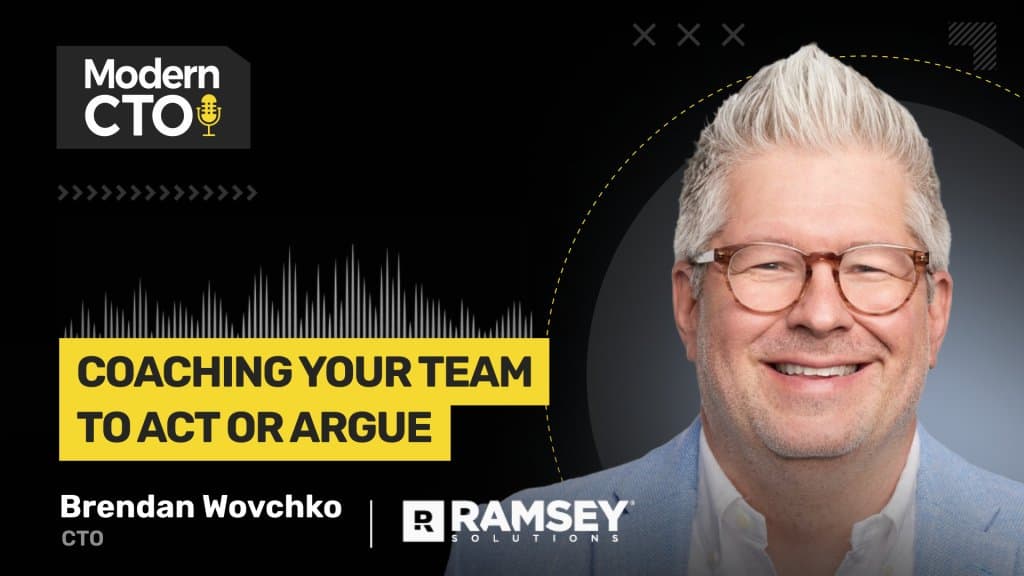
Coaching Your Team to Act or Argue with Brendan Wovchko, CTO at Ramsey Solutions
Today we’re talking to Brendan Wovchko, CTO at Ramsey Solutions. We discuss Brendan’s new adventures in hiking and how it has shaped his life recently, the need for leaders to create a culture of urgency, and why your team should be trained to either act or argue.
All of this right here, right now, on the Modern CTO Podcast!
To learn more about Ramsey Solutions, check out their website here.
Have feedback about the show? Let us know here.
Produced by ProSeries Media.
For booking inquiries, email [email protected]
About Brendan Wovchko
Since the late 1990’s I’ve invested heavily into learning how to build world class consumer-facing software products. That pursuit has taught me a lot about critical thinking, engineering, product management and effective collaboration—as well as how to run a business. But most notably, it’s caused me to become a student of leading people.
About Ramsey Solutions
Ramsey Solutions provides biblically based, commonsense education and empowerment that give HOPE to everyone in every walk of life. New York Times best-selling author Dave Ramsey created the company in 1992 as a means to provide financial counseling and education. Ramsey Solutions has since grown to more than 1,000 team members.
Ramsey Solutions measures its success by the number of lives changed through our message. “The Ramsey Show” is heard by more than 20 million listeners each week on over 600 radio stations and digital platforms. More than 5 million people have been through Financial Peace University, and over 1 million people have attended Live Events across the county. Foundations in Personal Finance, a high school and college curriculum, is offered in more than 10,000 schools and educational institutions.
Ramsey Solutions also offers speakers and personalities that cover a variety of topics. Rachel Cruze, Ken Coleman, Dr. John Delony, George Kamel, Jade Warshaw, and Eddie Culin have spoken to thousands of people across the country and worked with many media outlets.
Transcript
(Joel Beasley at 00:00:00) Today, we're talking to Brendan Wovchko, CTO at Ramsey Solutions, about creating a culture of shared urgency, his latest hiking adventures, and more. You're listening to Joel Beasley, Modern CTO. Last time we talked, I looked at the notes. It was in the middle or the end of twenty-two. So was it really?
(Brendan Wovchko at 00:00:25) Time has gone by. Well, you came out to Ramsey, though.
(Joel Beasley at 00:00:29) I did. Yeah.
(Brendan Wovchko at 00:00:29) Yes. You visited. I remember that. But yeah, I guess it has been a while since I've actually been out here.
(Joel Beasley at 00:00:34) How are things going over there?
(Brendan Wovchko at 00:00:36) Oh, man. It's crazy. Growing is always the answer to that question. Fortunately for us, it's never a question of growing, not growing. It's just growing how much. You know? So nice, all good things.
(Joel Beasley at 00:00:48) And how are you doing?
(Brendan Wovchko at 00:00:52) How am I? See, that's a different question. I'm doing good. Yeah. I mean, just personally, last couple years, I've been focused on me quite a bit doing, you know, I've had a lot of weight loss.
(Joel Beasley at 00:01:04) Yeah. I noticed that.
(Brendan Wovchko at 00:01:05) Lost 60 pounds. And I'm wondering how far into that journey I was the last time I was here.
(Joel Beasley at 00:01:14) Let's just go with you're always looking better.
(Brendan Wovchko at 00:01:16) Oh, yeah. Yeah. Always. Yeah. Always looking better. So, yeah, been a big weight loss journey. Picked up a couple hobbies.
(Joel Beasley at 00:01:19) Like what?
(Brendan Wovchko at 00:01:19) My son's, you know, about to be off on his own in the short term. So hiking. I have gone full tilt on doing hiking adventures. So I got one coming up in a couple weeks. I'm doing Half Dome in Yosemite, which will be a lot of fun.
(Joel Beasley at 00:01:43) Are you doing it around here?
(Brendan Wovchko at 00:01:45) Not as much around here. I do it to kind of get away.
(Joel Beasley at 00:01:49) Okay.
(Brendan Wovchko at 00:01:49) As a means to get away.
(Joel Beasley at 00:01:51) You're going to go there for the hike?
(Brendan Wovchko at 00:01:52) Yes. Okay. It's almost always destination hikes. I'll go out to Grundy County every once in a while and do, you know, hikes around Money Eagle and Tracy City and, you know, the plateau over there because there's lots of cool waterfalls and stuff like that. But for the most part, I do do it as almost a spiritual retreat. I'll go find someplace to go far, far away. So, you know, I'll go to Yosemite. I think around this time, June of last year, I did the Napali Coast on the island of Kauai in Hawaii, which is probably one of the most beautiful places on Earth. It's where they shot Jurassic Park.
(Joel Beasley at 00:02:35) Oh, nice.
(Brendan Wovchko at 00:02:36) And let's see what else.
(Joel Beasley at 00:02:38) Who do you go with?
(Brendan Wovchko at 00:02:39) I did Catalina Island a couple months ago off of the coast of Los Angeles, which was cool. I'll either go with my best friend, my son and my best friend, or just completely alone. Okay. So all have their distinct advantages. You know? But ideally, the trips where I get the most rest and recovery are the ones that I do by myself.
(Joel Beasley at 00:03:03) Is that where you think up these great leadership topics that you're talking about?
(Brendan Wovchko at 00:03:08) No. I try to think about nothing, actually. That's the great, to me, that's the great thing about being in the outdoors and, or particularly hiking. And especially if you're hiking a particularly treacherous trail because you can't really let your mind drift because you're kind of in dangerous territory. So you kind of actually just have to focus on the really simple things that are in front of you, and it's a nice way to get yourself out of your head.
(Joel Beasley at 00:03:35) Ever gotten lost on a trail?
(Brendan Wovchko at 00:03:37) Oh, I've definitely gotten lost. Yeah. I may do this activity a lot, but I'm by no means an outdoorsman. Not really. I'm just trying to figure it out. So, yeah, I do. Every hike, I get lost at least once for ten or fifteen minutes. Nothing, never anything scary. You know? But I'm out there for five or six days at a time. They're not day hikes.
(Joel Beasley at 00:04:00) Oh, really?
(Brendan Wovchko at 00:04:01) Yeah. No. I'm sleeping outdoors for, you know, four or five, six nights.
(Joel Beasley at 00:04:05) Oh, no way.
(Brendan Wovchko at 00:04:06) Yeah. So—
(Joel Beasley at 00:04:06) It's not like you're going for a three-hour hike. No. You're going for a hike, and you're sleeping, and you're bringing a pack.
(Brendan Wovchko at 00:04:12) Oh, yeah. It's ultralight backpacking. Yeah. So you're going for lunch.
(Joel Beasley at 00:04:17) And you'll do that by yourself?
(Brendan Wovchko at 00:04:18) Mhmm. It's awesome. You should try it.
(Joel Beasley at 00:04:22) Yeah. My wife's like, you're not leaving me with three kids, going on a hike to find yourself.
(Brendan Wovchko at 00:04:27) Well, I got a 17-year-old, so my wife's like, do what you want. You know? Like, life is changing. So yeah.
(Joel Beasley at 00:04:35) Okay. So that's definitely a development since we last talked.
(Brendan Wovchko at 00:04:39) Yeah. Yeah. Yeah. So it's, I've never been really one for hobbies. The problem is I turn all my hobbies into careers. You know? So I started messing around with computers, you know, did that. And then pretty much every career turn I've taken has started as almost like a hobby-like interest, even inside the craft of engineering, you know, whether it was agile software development or, you know, product management or anything else. You know, it's almost always started as a hobby, just kind of an unplanned pursuit of interest, you know, and then poof, before you know it, you're way down the rabbit hole. So I think that's probably more of my personality type than anything else.
(Joel Beasley at 00:05:20) I have no idea what you're talking about. There's no way I can relate. Yeah. That's—I've had that conversation with my wife more than once. My biggest problem is I turn my hobbies into businesses.
(Brendan Wovchko at 00:05:29) Yeah. Yeah. Yeah. So I am bound and determined not to do that with the outdoor stuff. So—
(Joel Beasley at 00:05:36) Well, I hope it happens for you.
(Brendan Wovchko at 00:05:38) Just a hobby.
(Joel Beasley at 00:05:38) Just slap a GoPro. It seems like I'm doing it right now.
(Brendan Wovchko at 00:05:41) No. Slap a GoPro.
(Joel Beasley at 00:05:41) License that content out. No way. No. Alright. So we talked a little bit about your trail walking, but you had sent over—I reached out to you, I think, on LinkedIn or text, and I was like, what's going on? We haven't talked in a while. And you sent over, I believe it was two talks. And one of them was about creating a culture of shared urgency. Okay. And is that—did that come from you being out on your walk and realizing that you need this somewhat anxiety, this tiny bit of urgency in order to keep moving forward? Or—
(Brendan Wovchko at 00:06:17) No. I would say where that talk came from was, I think, a really fundamental question that I think at some point in every leader's experience, they're going to end up asking, which is, why the heck is leadership so hard? You know? So the probably the reason why I go out on these outdoor adventures is because, or I started doing it, was to try to cope with, you know, just the pressure of actual success. Right? Like, it's cool to start a company and start a team or, you know, be involved in something really early stage and always have the hope of it growing and expanding and exploding. But then the reality is when it really does, the amount of emotional toll that it puts on you is crazy. Right? So, you know, at some point, you're going to open your eyes and just say, why in the world is leadership so hard? You know? And so I, you know, I spent some time over the last couple years just trying to explore that topic head-on. And because it's not always hard. It doesn't always have to be hard. You know? And I came across this kind of idea of shared urgency as a response to that because, you know, my experience as a leader is I was walking around every day feeling like the weight of the world was on my shoulders. Like, I was doing it alone. I was all by myself because, you know, a leadership position, and especially the kind of leadership position, you know, here, this audience, you know, chief technology officers, you're kind of at the top of the pyramid. Right? And it's a very isolating experience. You got a lot—you're around a lot of people all the time, but you're alone largely because you can't talk to them about a lot of the pressures or things that you're going through. And so what I started to realize in my leadership experience is, hey, this thing's really hard. I have to start figuring out how to lower the stress of it. You know? And where I kind of got in the journey was that, you know, it can be an isolating experience because, in a large way, decisions in businesses are really hard. You know, you come to a decision, which in itself can be a freeing thing. But actually getting that decision out there for, you know, and getting other people to adopt it is always a harder thing than you think it's gonna be. Like, I've always taken a great deal of solace in a story of an organization. It's of an organization I respect a lot, which is Chick-fil-A. They've got an amazing leadership organization. And I heard the story once that when the executive team at Chick-fil-A decided that they wanted all of their frontline stores to start saying, "my pleasure," you know, as part of the transaction, you have any idea how long it took them to get that rolled out to all their frontline stores?
(Joel Beasley at 00:09:15) Three years.
(Brendan Wovchko at 00:09:15) Six years. It took six years.
(Joel Beasley at 00:09:19) Mhmm.
(Brendan Wovchko at 00:09:19) Right? So if you have this amazing leadership organization like Chick-fil-A, and it takes them six years to get something, you know, rolled out that's that simple. In the world of technology that we all work in, how much harder is it to get these far more complicated, you know, complex things, you know, rolled out? And so—
(Joel Beasley at 00:09:38) Why is it so hard?
(Brendan Wovchko at 00:09:40) Well, I mean, I think that's kind of what the talk that I sent you addresses, which is, you know, I have had to learn as a leader to, when I make a decision, to have expectations tied to them. And my expectations are pretty simple, but the reality is I've spent a really big part of my career not actually speaking those expectations to anybody. So they kind of hang out there in that unspoken expectation space, which is not a good thing. And for me, decision making has started to become real simple, which is, you know, if a decision is out there or I put a decision out there, I make a decision. And, you know, in terms of my team, my most direct team, they've got choices they can make. Like, they're either going to agree with that decision because it resonates with them and they kind of naturally align with it, or they're going to disagree with it, which is equally okay. Right? Like, as leaders, we should invite disagreement. But where my expectations are is if somebody agrees with me, I expect them to act. And if somebody disagrees with me, I expect them to argue. So this principle started to emerge that I started using on my team of act or argue. And if you can manage to occupy that space, your experience as a leader is going to be great. But the problem is that the reason why leadership is so stressful is because in most organizations, on most teams, in most leadership environments, it's not just a two-dimensional decision. There's a third dimension to it. And it's that third dimension that can make leadership a pretty miserable experience, which is some folks will choose not to act. They'll choose not to argue. What they'll choose to do is actually just ignore the decision. And we would all like to think that as leaders, that does not actually happen.
(Joel Beasley at 00:11:43) Because we said it.
(Brendan Wovchko at 00:11:44) Yeah. Because we said it.
(Joel Beasley at 00:11:45) It was discussed in the meeting. Everyone shook their heads up and down. And yeah.
(Brendan Wovchko at 00:11:49) Yeah. Yeah. The whole head-nodding thing is a whole different—you know, that's a whole another topic. You know, if you're a leader in a room expressing something, you have a bunch of people nodding their head. That does not mean they agree. It just means they heard you. Right? So I have tried to move into a culture of leadership where I've made it really clear to everybody. Hey, listen. You don't have to agree with me. That's okay. You can disagree. Disagreement is just fine. Agreement is preferred, but if you disagree, that's just fine. But if you disagree, you have to argue. You have to constructively engage in the conversation because if you don't and you just kind of hang out in that space of ignoring, I call folks that hang out in that space of just ignoring, I call them energy vampires.
(Joel Beasley at 00:12:38) Mhmm.
(Brendan Wovchko at 00:12:38) Because if you're in a situation where, you know, leadership above you is giving you some sort of direction or some sort of plan, and you're just ignoring them, whether you realize it or not, you're just actively drawing the life energy out of that leader. Like, you're slowly killing them, you know. And so as a leader, you've got to actively fight against that, that it's become a socially acceptable thing to ignore, you know, decisions.
(Joel Beasley at 00:13:12) Yeah. You just go to the meeting, nod your head, and then continue on with the things that are, quote-unquote, important.
(Brendan Wovchko at 00:13:17) And do what's important to you.
(Joel Beasley at 00:13:18) Yeah.
(Brendan Wovchko at 00:13:18) You know? And that's a really unhealthy way to participate in a team. You know?
(Joel Beasley at 00:13:24) I can feel it when it does happen. I'm like, I feel like everybody's just agreeing so they can go about their day.
(Brendan Wovchko at 00:13:30) Yeah. Yeah. It's kind of terrible.
(Joel Beasley at 00:13:33) It is. It is. And so I typically get self-reflective. I'm like, alright. Where did I go wrong? Is it, was it timing? Was it the way I presented it? Was I not clear about the definition of done? Or, you know, I go through my mental checklist.
(Brendan Wovchko at 00:13:46) Well and, I mean, all that illustrates is you're a really empathetic person. I'm the same way, and I would say that by my nature, that's how I react too. But particularly when things, you know, start to—you have some success, things start to scale up in a big way, and you're not spending regular time with your team. I mean, you're spending regular time with your team, but your team's too big for you to regularly spend with all of them. Like, if I couldn't have lunch with everybody on my team in three years if I wanted to. Right?
(Joel Beasley at 00:14:19) A big cafeteria.
(Brendan Wovchko at 00:14:20) It is a big cafeteria. I mean, I could put them all there, but I couldn't have a one-on-one lunch with that many people in three years. You know? So just by nature, you're not going to be spending a ton of time with people. And when you have that kind of, when you have that just natural distance because of what it is, you can't—you've got to shift some of the responsibility to be incumbent on those other people versus it always be, well, what did I do wrong?
(Brendan Wovchko at 00:14:51) I mean, you always want to maintain a level of self-awareness and a high level of ownership around things that you could have done better. I'm not saying not to live in a growth-oriented mindset. But what I mean is you actually have to expect things of other people at a certain size. You've got to be able to say to people, obviously, we're not all going to have a one-on-one meeting with each other this week, right?
(Brendan Wovchko at 00:15:14) So if you've got a problem with anything that we're saying or doing, it's incumbent upon you to actually be courageous, step up, and speak up. And then really, your responsibility as a leader is to foster an environment where that's safe and okay to do.
(Brendan Wovchko at 00:15:29) If you don't actually foster that environment of creating some shared urgency—and the way I kind of define it is, shared urgency is a commitment to courageousness, that you're going to act and argue in decision making.
(Joel Beasley at 00:15:50) So signs of urgency would be that people are either doing the act or argue, or is there another way that you—if you walk into a team, let's say you've got your team, but let's say I bring you over to another company, right, and does this have a lack of urgency? How would you identify that?
(Brendan Wovchko at 00:16:06) Well, so actually, I mean, when I do the actual stage talk on this topic, I've got a drawing where you do four quadrants and you do some personas and you kind of talk it through that way. But you can actually measure people's likelihood to act and their likelihood to argue. And so, for example, you could observe someone after working with them for a little while, and you could say, well, this person—they're pretty likely to act, but they have a very low likelihood of arguing. And if you were to encounter somebody like that, there are some specific things that you can do to actually coach them.
(Brendan Wovchko at 00:16:52) So I actually see those two as kind of variables: act and argue. So you'll have people that are inclined to act but not inclined to argue. You'll have some folks that are the flip of that. They don't really like to act, but they're highly inclined to argue.
(Brendan Wovchko at 00:17:09) And then obviously the other two—act and argue are both strong, and act and argue are both weak. But depending on the characteristics of the person, there are some very specific ways that you can kind of coach out that behavior. But that's on an individual basis. I think the thing that you were asking about is more of a company-wide behavior.
(Brendan Wovchko at 00:17:30) I would say, as a generality, if you looked at companies as a whole, the vast majority of corporate America has a shared urgency problem. In fact, the vast majority of all companies have a shared urgency problem.
(Joel Beasley at 00:17:48) Can I tell you that I fully agree with that statement? We sell into businesses, and sometimes I just sit there after the call and I ask myself, how did that company get that big?
(Brendan Wovchko at 00:18:02) Yeah. Oh, well, a little tangential to this idea that we're talking about—I'm not a big fan of the idea of labeling things generationally and stuff like that. You'll hear people wail on millennials or whatever, and that kind of stuff is annoying. But I will say that there have been some shifts, particularly in our space, the software development world, in the last 20 years that have been really interesting. Mind if we talk about it a little bit?
(Joel Beasley at 00:18:37) Yeah, yeah.
(Brendan Wovchko at 00:18:37) So, when I got into software development, I remember I never asked, what does this pay? What are my opportunities for advancement? Those ideas never entered my mind. I was just a computer nerd. I was enthralled by the possibility of manipulating a computer. It was just fascinating to me back in the nineties. And to me, those first and early experiences I had where I got to mess with something on a computer and got it to do something were mind-blowing. A lot of those moments are still etched into my brain, right?
(Brendan Wovchko at 00:19:24) And so when I got into the commercial world of software, I still wasn't really success-minded or money-minded or advancement-minded. It was all just about the sheer innovation of getting out there and trying to do something new. And, fortunately, life becomes more complex and you think about those other things with time. But I've been very fortunate that my motivation has always fundamentally been around using technology to make a difference in the world, right?
(Brendan Wovchko at 00:20:02) And the big shift that I see happening in technology right now is the same shift that I imagine probably happened in the world of law and happened in the world of medicine. I imagine a couple hundred years ago when somebody was pursuing a career in law, they were predominantly driven by the idea of justice, right? And I would say by the world that we live in now, this highly litigious society that we live in is probably the result of people growing up and losing kind of that pursuit of justice and saying, well, I want to be a lawyer because it's good living. I can make a lot of money. I can have some influence. I can have high social standing. And in some ways, I've seen it happen in the medical world too.
(Brendan Wovchko at 00:20:52) I've got two doctors in my life. And one of those doctors, every time I go into the doctor's office, is talking to me about the American Medical Association and all the numbers and all the figures and where my stats line up according to that and how I'm either exceeding the average or behind the average. None of the advice is ever personal. It's all diagnostic. And then I've got this other doctor, this chiropractor, who the first time I showed up to his office and I got out of my car, I noticed he was peeking at me through the shades.
(Brendan Wovchko at 00:21:29) And he watched me get out of my car and walk into the building. And when I walked in, the receptionist said, oh hey, we'd like to check you in. And he was like, we'll do that later. And literally grabbed me by the arm and pulled me into the back, and he's like, okay, this is what I noticed how you're walking when you walked into the building, right? And this particular chiropractor—I'm not saying this about all chiropractors—but this particular chiropractor that I have, I think of him more as a healer than I do a doctor.
(Brendan Wovchko at 00:21:56) In the same way that I might think about some lawyers as somebody, a lawyer that's predominantly motivated by justice instead of policy, right? And what I see happening in our space right now in engineering, I think is that same metamorphosis that's happening. The folks that were drawn into this industry because they wanted to use technology to make a difference in the world, that motivation is starting to shift. And what you're seeing is people come into the workplace who are predominantly motivated by money, influence, and power.
(Brendan Wovchko at 00:22:32) And I personally think it's a huge problem. Huge, huge problem. And I think it's, in a lot of ways, why you've seen a lot of the really big tech companies, their innovation curve slow way the heck down—whether it's Apple or Google or, I mean, there are some interesting things happening at those companies. But, you know, the—and by the way, well, just to be clear, I'm not saying that this is an age thing. I have met my fair share of 22-year-olds that have the same vinegar and passion that I did when I was their age too. It's not really an age thing.
(Brendan Wovchko at 00:23:12) No, it's all about the fundamental motivation. What caused you to do it?
(Joel Beasley at 00:23:16) I meet people and I had the age thing in my head. And yeah, it is a trend and it can describe large amounts and it does work some of the time. But you really sell yourself short if you don't take each person for an individual on an individual basis. I've met 60- and 70-year-olds who think as sharp as 35-year-olds, and I've met 35-year-olds who are thinking like 12-year-olds.
(Brendan Wovchko at 00:23:41) One of the great mentors in my life, he is probably creeping up on probably 70 years old right now. When he retired, he retired as the head of North American sales for Microsoft. And you might think, well, Brendan is a software engineer. That's a pretty weird mentor to have, the head of sales. To this day, he can still write code faster than I can. It has nothing to do with age. In fact, some of the highest potential software engineers I have on my team today are within five years of graduating college. I mean, they're just amazing, highly motivated, ridiculously hungry people.
(Brendan Wovchko at 00:24:44) But when you're talking about the average that exists out there today, I think I see over and over and over again in the interview process that what people are motivated by today is very different than what people were motivated by in the past. And it's actually sad for them because the reality is they're going to get a very different outcome in their career than I've gotten, right? You're not going to have the same kind of forward motion, excitement, and monetary benefit in your career if you're just showing up every day and trying to walk out the door the first moment that you can, and you're not really passionate about the problems that you're solving, and you want to push the envelope forward. You're not going to get all those benefits.
(Joel Beasley at 00:25:09) What motivates you today?
(Brendan Wovchko at 00:25:11) Same thing. Today, I've become more aware of—so I would say 20 years ago, I was a technical guy in search of a problem. And today, I am a problem guy who knows how to leverage technology. But the motivation's still the same. I've always been fundamentally fascinated by the human condition and how technology can kind of reach into that world and make a difference and an impact in people's lives.
(Brendan Wovchko at 00:25:40) For years, I worked in entertainment. And when I worked in entertainment, it was about—really, entertainment at its core is really how to encourage someone and bring some light into their life. For me now, I'm far more interested in kind of the more, almost scientific process of actual material life change. And both of those things can look kind of similar to each other. But the problems I'm interested in solving now are still the very similar problems to what I wanted to solve in my twenties.
(Brendan Wovchko at 00:26:19) But how do you fundamentally make a difference in people's lives? Not as easy as people think to do with a five-inch square of electronics, or rectangular rectangle of electronics.
(Joel Beasley at 00:26:30) We call it a glowy rectangle.
(Brendan Wovchko at 00:26:31) A glowy rectangle. My wife's right.
(Joel Beasley at 00:26:33) Put down the glowy rectangles. Yes, the all-knowing glowy rectangles. You just put them down and have some human time. So last time, when I went and had lunch with you, first of all, everybody that I met—I think I interacted with four or five people—super sharp, on top of it people. So that always is a good sign when I get to meet other leaders and their teams are really bright. But then you had also said that there was this release of these new characters essentially coming to the Ramsey companies. And I think Ken was there when I was there. He's been there for several years.
(Brendan Wovchko at 00:27:05) Oh, you mean our personalities?
(Joel Beasley at 00:27:06) Yeah, your personalities.
(Brendan Wovchko at 00:27:06) Yeah, personalities.
(Joel Beasley at 00:27:07) So what new personalities?
(Brendan Wovchko at 00:27:08) I would love to call them characters, by the way. I don't think they would like that, but I may just do it anyway. They are characters. They are characters. Yeah, yeah, yeah, they are. But yeah, we call them personalities.
(Joel Beasley at 00:27:19) Okay. So who? Just maybe one or two of the new personalities at Ramsey company.
(Brendan Wovchko at 00:27:24) Oh yeah. I mean, all of them are fantastic. But I think the one that people would probably be most likely to have heard of most recently is John Deloney. So, you know, what Ramsey is known for traditionally is helping people make better money decisions. And when we look out into the future, the reality is that people need a lot more help in their lives than just with their money. I mean, money is one of the key things. But parenting, marriage, relationships—all of those things are really important. And we were very, very lucky to intersect with this guy named John Deloney a couple years ago and just have an immediate connection.
(Joel Beasley at 00:28:17) Was he already making content?
(Brendan Wovchko at 00:28:18) No, not at all. He was a dean of students at Belmont University. Oh, wow. But a brilliant communicator. In fact, we invited him to come share kind of an encouraging message with our whole team at one of our team meetings. And I think he just kind of gave us one of these stock speeches, like he would give to a group of incoming freshmen or something like that. And I mean, we're all on the ground afterward. I mean, he is such an amazing, compelling speaker, and all of our personalities are that way, but we're just talking about him for the moment.
(Brendan Wovchko at 00:28:55) But yeah, John came on board, and he came on board about six months before COVID started, which I think was a real godsend. And, you know, he kind of took a little while to just figure out, okay, I'm going from a dean of students to a guy that makes content. And then right as I think that all clicked in, then you had COVID, which, honestly, if that's not one of the most challenging emotional times in our society from a mental health perspective, I mean, I don't know what is. I don't know. Hopefully, we'll never have anything like that ever again.
(Brendan Wovchko at 00:29:34) And so that's where he cut his teeth, is in the moments of answering really hard questions. So, you know, he did something a little unusual. He started an actual live call-in show, which is not what people are doing nowadays. Everybody's doing podcasts and things like that, and those mediums are awesome. But when you actually do a live call-in show with people that are having real life relationship challenges, marriage challenges—
(Joel Beasley at 00:30:01) Delilah.
(Brendan Wovchko at 00:30:06) You said it, I didn't. But yeah. But, you know, an actual real live call-in show where people are talking about issues they're having with their kids not being in school and mental health issues and stuff. I mean, for the people listening that haven't heard The John Deloney Show, go listen to it. I mean, I'm not just saying that because I work with John. Literally, I would say three out of seven days a week when I go home, my wife says, well, John said something on the show today we need to talk about.
(Joel Beasley at 00:30:40) She listens?
(Brendan Wovchko at 00:30:41)
Oh, yeah. Oh, wow. But she's like a, you know, she's a definite fan. I'm a fan of the show too, but I mean, she's like a hardcore listener. And so, you know, and it's funny when you work with a guy like, you can, you know, you can go sit down and have a meeting with him, and like three hours later, your wife's like, "You should listen to him more. He's smart." Kinda sets up a little bit of a weird dynamic, but that's okay.
(Joel Beasley at 00:31:02)
You know?
(Brendan Wovchko at 00:31:02)
He's amazing. But yeah, John's absolutely amazing. We've got George Camel, who I've heard of him. Yeah. George has been starting to do more of our money content. He's sitting alongside Dave Ramsey and—
(Joel Beasley at 00:31:17)
Oh, is he a younger guy?
(Brendan Wovchko at 00:31:18)
With a beard?
(Joel Beasley at 00:31:19)
With a beard?
(Brendan Wovchko at 00:31:19)
Yeah. He's actually not as young as he looks. But he does look a little younger. He does look younger. Yeah. Jade Warshaw, who is kind of the newest member of the cast. And man, I mean, she—
(Joel Beasley at 00:31:33)
I just looked him up. That guy? I've been seeing him in clips like crazy.
(Brendan Wovchko at 00:31:36)
Oh, yeah. I mean, yeah, the whole clip world, whether it's, you know, YouTube Shorts or TikTok, loves George Kamel.
(Joel Beasley at 00:31:46)
I know. One thing I just wanted to touch back on. So, you know, our youngest son is special needs, Down syndrome.
(Brendan Wovchko at 00:31:52)
Okay.
(Joel Beasley at 00:31:52)
And he's two. And we have TEIS, Tennessee Early Intervention Services.
(Brendan Wovchko at 00:31:57)
Yes.
(Joel Beasley at 00:31:58)
So three times a week, he has some form of OT or PT or follow-up, something like that, to make sure that he tracks in progression. We've had a number of conversations with the, for lack of a better term, I call her the TEIS girl that comes over to our house, Kelsey. She's amazing. And we've talked with Kelsey, and she echoed the same sentiment about COVID as you did. Because they study early childhood development. And there is a massive epidemic of speech delay because kids were not around other kids learning to speak. And so there's just so much of their caseload is related to delayed speech. Yeah.
(Brendan Wovchko at 00:32:42)
And yeah. I mean, it's a complicated topic, and everybody finds a way to pick a side on it. But I don't think anybody enjoyed COVID.
(Joel Beasley at 00:32:52)
Nobody enjoyed—I think that's everyone agrees on that.
(Brendan Wovchko at 00:32:55)
Everybody can at least agree on that. And without turning it into a politically divisive issue, like—
(Joel Beasley at 00:33:03)
Which you guys don't do, by the way. When I asked you about politic personalities and stuff, you're like, yeah, Dave Ramsey's company doesn't do that. Yeah.
(Brendan Wovchko at 00:33:11)
We won't—listen. It's impossible to have people who talk for a living that are not eventually going to reveal their political leanings. Like, it's pretty impossible. Right? And we're not shy about it or ashamed at all. Like, we're very forward about, you know, the things that we believe as an organization. But I do think we draw the line at actually doing a show around politics or—
(Joel Beasley at 00:33:42)
Daily Wire's got that covered.
(Brendan Wovchko at 00:33:43)
Yeah. Daily Wire's got that nailed, and they're just down the—
(Joel Beasley at 00:33:48)
Down the road.
(Brendan Wovchko at 00:33:48)
Down the road from us.
(Joel Beasley at 00:33:49)
Franklin's becoming—I know, man—hotbed for media companies.
(Brendan Wovchko at 00:33:53)
I know. It is. I mean, it has been for a long time. I moved to Nashville in the nineties, and it was then. And now it's—
(Joel Beasley at 00:33:58)
Oh, yeah.
(Brendan Wovchko at 00:33:58)
I mean, every record label in the world practically has an office in Franklin, Tennessee. So, but now it's getting more into broadcast media and, you know, influencers. And you can't go grocery shopping nowadays without bumping into somebody you've seen on TV. It's pretty crazy how it's changed over the years. But yeah. I mean, we've kind of, you know, I don't know that this will be the decision forever, but I've certainly never been part of any conversation where we were like, "Oh, let's get into politics." Like, you know, every time anybody ever brings up getting into politics, you know, with like, if you hear a fan or whatever say to Dave, like, "Oh, when are you gonna do a thing?" And he's always like, "Nope. Not gonna do it." So—
(Joel Beasley at 00:34:45)
But you are getting into AI a little bit. I wanna brief touch on this AI voice of Dave Ramsey. What's going on with that project?
(Brendan Wovchko at 00:34:53)
Oh, yeah. Well, that was kind of at the heart of the joke I played the other day. I think I mentioned that a second ago. So yeah, we have been playing around with voice AI. It's a really interesting thing. When you're in the business that we're in, which is, you know, we've got these public-facing personalities that are out there, you know, in different broadcast mediums every day, talking, talking, talking, you know, teaching and sharing things with people. Of course, the idea of voice AI is gonna bubble up to the top pretty quickly and be like, "Oh, I wonder what we could do with this." You know? So we have definitely been exploring it, but I played a prank on Dave the other day. It was April Fools, or I guess it was a couple weeks ago. April Fools Day, we had staff meeting, and I got up on stage and said, you know, kinda set up this joke and said, "You know, hey, sometimes when you're having a rough day—you know, a lot of people don't know this, but Dave will just kinda drop you a nice voicemail just encouraging or whatever." And I said, like, "I'd like everybody to hear one that he just left me." And up until that point, the team, the 1,100 people in the room, did not know we were working on voice AI. And so I played back this voicemail that was just completely ridiculous in every way. It's like things that Dave would never say, like, you know, like, "You're like a son to me," and, you know, just really gushy stuff. And I thought he was gonna fall out of his chair, because he happened to—he was up, he was kinda emceeing the staff meeting, and I was doing an update. So we're up on stage at the same time. And so that was kind of the first introduction to the team that we were even working on voice AI technology, and he thought it was hilarious, and the team thought it was hilarious. It was kind of a fun moment. But yeah, we are working on it. But we're not—we're not pursuing AI, I think—you know, so much of the AI conversation right now is a weird conversation to me. Like, people are—you know, you have some people that are super afraid of it, almost wanna outlaw it. Then you've got this weird sort of obsession that people have about how many jobs it's gonna displace, you know. And I mean, all those things, I mean, they're real things. I just don't fundamentally understand why those dimensions of the topic of AI are so dominant. Right? Because for me personally and the job that I do, the greatest idea behind AI, particularly voice AI, is to humanize things that are not human today. Like, you know, if you're a weight loss company or a company that is trying to help people free themselves from chemical addictions, or you're in the business that we're in, which is, you know, helping people find freedom from debt and build a solid financial future where they feel a sense of freedom. You know, the problem with YouTube and TikTok is all of that content is becoming shorter form and shorter form and shorter form. And the reality is you really can't teach people much in a thirty-second clip. Like, you have to have longer exposures to people in order to teach them principles that will hopefully lead them out of a behavior that they're in the middle of that's not serving them well. Right? And so, like, how do you do that? Well, you know, gone are the days of making a two-hour VHS that people are gonna watch. It's not gonna happen anymore. Right? And all of those experiences have moved on to the phone. The problem with the phone is that it is a totally sterile experience. There's no humanity in it. Right? There's no encouragement. There's no excitement. There's no tacit sense of connection. Like, the phone does not feel like a helpful human. Right? And like, to me, the thing that is really interesting and stimulating about not just voice AI, but AI in general, is the possibility to actually humanize a very sterile experience. And even with just ChatGPT, somewhat recently adding the ability to interact with ChatGPT using voice—it's amazing. I mean, I find myself using the voice interaction stuff more than I do just typing into—yeah.
(Joel Beasley at 00:39:22)
I don't know. I've just been typing.
(Brendan Wovchko at 00:39:23)
Yeah. But there is something very real, something human, despite the fact that I know the voice is not human on the other end. But, like—
(Joel Beasley at 00:39:33)
It voices back to you?
(Brendan Wovchko at 00:39:34)
It voices back to you.
(Joel Beasley at 00:39:35)
Oh, it does.
(Brendan Wovchko at 00:39:36)
So I talk to it. It talks right back to me.
(Joel Beasley at 00:39:38)
Oh, wow.
(Brendan Wovchko at 00:39:38)
Yeah. So, and actually—
(Joel Beasley at 00:39:38)
In the standard GPT app?
(Brendan Wovchko at 00:39:44)
In the standard GPT app on iOS. Yeah. It'll do it. We're gonna see.
(Joel Beasley at 00:39:46)
I'm opening it. This is news for me.
(Brendan Wovchko at 00:39:49)
The headphones?
(Joel Beasley at 00:39:49)
Yeah. There you go.
(ChatGPT Voice Assistant at 00:39:52)
Hello. I'm really excited about teaming up with you, and I'm all set to dive in. So how can I make your life easier?
(Joel Beasley at 00:39:58)
Oh, it says enable microphone and settings. Oh—
(Brendan Wovchko at 00:40:00)
Yeah, yeah. You gotta do that. You got some setup to do. But, you know, that right there, I mean, that's just the initial foray. Right? But, you know, let's say that you were really stressed out about money and you're overwhelmed by school loans. You know, when your school loans got kicked in after you graduated from college, you realize, "Oh, man, this fantastic job I got, you know, I'm not making enough money to cover my school loans and all my expenses and kinda living the lifestyle I want, and I feel like I'm starting to drown in debt, and I really need some help." And you tell yourself, like, "Hey, you know, I need a budget." Right? So you go to the iOS App Store, and you start searching around. You find this thing called EveryDollar, which is our budgeting app. Right? I think now, I don't know, twelve, thirteen million people, you know, have used the platform. And you go in there and you create yourself a budget. But, man, wouldn't it be awesome if, you know, every day when you were driving into work that you could get personalized, tailored advice from a Ramsey perspective on where you could be making better budget decisions from that EveryDollar app? Like, while I'm driving in. Like, "Hey, you know, it looks like you went to Chick-fil-A, like, 19 times in the last week and, you know, Starbucks and, you know, did you really need to spend that amount of money?" You know, whatever. Like, it—where we could begin to interact with consumers in a way that felt like a helpful human and not just a sterile budgeting experience. Because, you know, I mean, you don't even need AI to do all that analysis, but you certainly could use AI to do that kind of analysis on somebody's budgeting data. And so to me, those are the really exciting things. Like, how can I—I've got a secret spreadsheet where, you know, I know the 272 strategies that Dave Ramsey uses when he financially coaches someone. Like, if I could take that and combine that with a large language model and then be able to feed in people's actual real budgeting data and give them a voice-based interaction with Dave Ramsey himself on their specific financial situation and real actionable things they could be doing today, tomorrow, the next couple months with their finances to help kinda get to the place of freedom that they want to. I mean, that is an absolutely mind-blowing use of that kind of technology. But we're all caught up with worst-case scenario stuff, which is not to say that we shouldn't ever talk about that either. But as technologists, we need to see the bright side of it and the dark side of it and kinda manage both. But I'm far more fascinated by the potential of that technology than I am worst-case scenario things. We'll let Elon Musk do that.
(Joel Beasley at 00:43:00)
I'm optimistic in general. Yeah. I think the biggest issue that we're gonna have is simply the conversion. So, for example, the horse and the car situation. Yeah. There was a long period of time. I think it was a year or two or three for that transition to take place because of the physical limitations of people getting things and making things. Well, now I believe entire industries can consolidate overnight or entire job functions can consolidate overnight and just wake up tomorrow and now have this new capability that everyone can immediately access that day, which will result in job loss to some degree. And then we have to figure out how to repurpose those lost jobs into the new things. And so that's the system, and it's true, and it's been going on through time. The new things come and then it's just accelerating.
(Brendan Wovchko at 00:43:53)
It is. But, I mean, look at the Industrial Revolution. Like, yeah. Sure. That, you know, decreased the number of people that were chiseling rock and laying brick. You know, the—but the Industrial Revolution created more opportunities than it diminished. Right? And when I look at the world of AI, I think the same thing. Like, even as software engineers, our world's gonna change. Like, look at what, you know, GitHub has done through, you know, Microsoft and, by extension, OpenAI with all this code completion stuff and all the cool—I mean, Copilot. Yeah. All of us can just kind of imagine where that's gonna go. And sure, as a software engineer, I mean, I've had people that are in code school right now come to me and say, like, you know, "Should I even be getting into this field?" I'm like, "Of course, you should be getting into this field." Like, you know, when I got into this field in the mid-nineties, the number of people who were employed to go, you know, hang in a basement for eight hours a day in server cages managing physical servers, the number of those people were almost as many software engineers that were in the market. And now we have Amazon Web Services, and almost all of those jobs are gone if you don't work for one of the cloud providers. And I have not heard of a single systems engineer that's out on the street. You know, they've all found a way—at least the good ones. Right? There's probably some percentage of everybody in the technical field that probably needs to go find something different. You know? But the really good ones find a way to adapt. And I think engineers will do the same thing. I think everybody's gonna do the—you know, we'll just adapt. We'll find a way to use it as a tool, and we'll adapt. That's the human way.
(Joel Beasley at 00:45:35)
Yeah. Yeah. And then as the pain becomes greater, we'll figure out how to handle certain situations like, what do we do with those people if we are at the point where we wake up and there are two million people out of a job tomorrow because of AI?
(Brendan Wovchko at 00:45:49) Do you think we're in a Wall-E situation? Or do you ever get concerned about that?
(Joel Beasley at 00:45:54) No. I just—again, I'm very optimistic. I think that the problem that we'll face is the acceleration of the consolidation of specific functions. I think it's still going up, and I think we can wake up tomorrow and, you know, have you seen those AI salespeople now that they're coming out with?
(Joel Beasley at 00:46:17) No? They're getting good.
(Brendan Wovchko at 00:46:20) The technology wouldn't have to be much better for me to like it more than human salespeople.
(Joel Beasley at 00:46:28) It's getting really, really, really good. I listened to an AI make a sale from nothing. Really? From a cold call to a sale, making jokes. There's videos of it.
(Joel Beasley at 00:46:42) Yeah. Yeah.
(Brendan Wovchko at 00:46:43) Seriously though, how many CTOs do you really know that pick up their phones when salespeople call?
(Joel Beasley at 00:46:48) Well, I'm talking about sales in general.
(Brendan Wovchko at 00:46:50) Oh, just sales in general?
(Joel Beasley at 00:46:52) Not selling to a CTO.
(Brendan Wovchko at 00:46:53) Oh, okay. Okay.
(Joel Beasley at 00:46:54) Five.
(Brendan Wovchko at 00:46:55) Yeah. Yeah. My ringer is permanently turned off.
(Joel Beasley at 00:46:58) Right? I am in do not disturb twenty-four hours.
(Brendan Wovchko at 00:47:01) I have to.
(Joel Beasley at 00:47:01) I have to.
(Brendan Wovchko at 00:47:02) Yes. I have to.
(Joel Beasley at 00:47:03) Yeah. I like to use my phone, not let my phone's notifications use me.
(Brendan Wovchko at 00:47:07) Yeah. That is true.
(Joel Beasley at 00:47:08) Yes.
(Brendan Wovchko at 00:47:09) But oh, that's interesting. So you weren't talking about in the domain of our world, but just in general out there. You've seen some interesting sales stuff done.
(Joel Beasley at 00:47:18) Yes. Yes. And to the point where, you know, it's been three years and first you see it and you're like, "Oh, no. Not really." And then it's like, "Oh, that's actually pretty good." And then you watch it actually do it, and you're like, "Well, I guess by all measures, it's here." I mean, it's made the sales.
(Joel Beasley at 00:47:39) And then they were showing this company that built this technology was showing how many millions of dollars this tool made by calling people and selling them over the phone. Really? And I was blown away. So then I did my BS analysis and they had gotten—after they had success, they had raised, I don't know, a hundred million dollars or something. Something enough to know that the firm looked into it before writing them the check. Right. You know, they did their due diligence and the thing's actually making sales and working. And then they're just customizing it. Yeah.
(Joel Beasley at 00:48:11) Yeah. So, I mean, it's out there and it's happening. But again, I'm not a fear person because the thing is money is the way that humans exchange value with one another. Humans are not going to stop exchanging value with one another over time. What's going to happen is that value is going to change. The value from, you know, fixing the horse to fixing the car, fixing the car to fixing my spaceship. Right? Like, it's gonna—
(Brendan Wovchko at 00:48:35) I love that that's the leap you made. I really—no. Genuinely, I'm not—I think that's fantastic. I can't wait to have my first spaceship.
(Joel Beasley at 00:48:43) Well, you technically already do. If an alien came here, that would be your ship in which you traverse space on the planet. That would be a spaceship.
(Brendan Wovchko at 00:48:52) Yep. I'm still on a waiting list for one of those flying cars.
(Joel Beasley at 00:48:58) Are you? One of the Tesla flying cars?
(Brendan Wovchko at 00:49:00) If it is now. The Blackfly. Oh, okay. Which was the first one. I guess one of—you know, a couple of the Google guys invested in it pretty early on. And, uh, at least I think I'm on the waiting list.
(Joel Beasley at 00:49:13) I've seen a lot of—
(Brendan Wovchko at 00:49:14) It's been four or five years since—
(Joel Beasley at 00:49:16) I've seen a lot of the drones scaled up. Like, if you imagine a DJI drone—
(Brendan Wovchko at 00:49:20) That's what they scaled up. The Blackfly was the first one. I think it has six rotors on it or something like that. But, yeah, it was the first one that hit the YouTube world as, "Oh my gosh. This is actually coming." Right? It still hasn't yet, but—
(Joel Beasley at 00:49:37) What happened to Uber air taxis? Did that become a thing? They were building—did you hear about that?
(Brendan Wovchko at 00:49:42) Yeah. I did hear about that.
(Joel Beasley at 00:49:43) They were building the giant platforms, I think, in Texas and somewhere else to do air taxi.
(Brendan Wovchko at 00:49:47) That's all FAA regulated. So, you know, it's gonna move at the speed of government. So however fast that happens, I guess.
(Brendan Wovchko at 00:49:54) Yeah.
(Joel Beasley at 00:49:55) Yeah. But well, we know that our government's known for being expedient and competent, so—
(Brendan Wovchko at 00:50:00) I mean, you know, it's been twenty-five years since cookies came out, and Congress has just recently taken interest in them. So, yeah. So the privacy debates are starting to kick up now and, you know, you're like, "Oh, okay. Yeah. Twenty-five years. Yeah."
(Joel Beasley at 00:50:22) Well, we did it, man. We made a podcast. How do you feel?
(Brendan Wovchko at 00:50:26) That was the fastest hour of my life, maybe.
(Joel Beasley at 00:50:29) That's a compliment.
(Brendan Wovchko at 00:50:30) Yeah. Thank you. You make it easy.
(Joel Beasley at 00:50:32) Thank you so much for listening. And if you found this episode useful, please share it with a friend or colleague who you think would get value from it. And if you have topics that you'd like to hear discussed on the podcast, either add me on LinkedIn or send me an email: [email protected]. Every time I get an email or LinkedIn message, it absolutely makes my day and inspires me to keep going.