
Episode 583 ·
The Creepy Personalization of AI's with Brad Sousa, CTO at AVI Systems
Today we’re talking to Brad Sousa, CTO at AVI Systems; and we discuss what determines the “creepy meter” of AI; the phenomenon of AI creating more data than humans; and why radical giving can be the key to your growth as a leader.
All of this right here, right now, on the Modern CTO Podcast!
Check out more of Brad and AVI Systems at https://www.avisystems.com/!
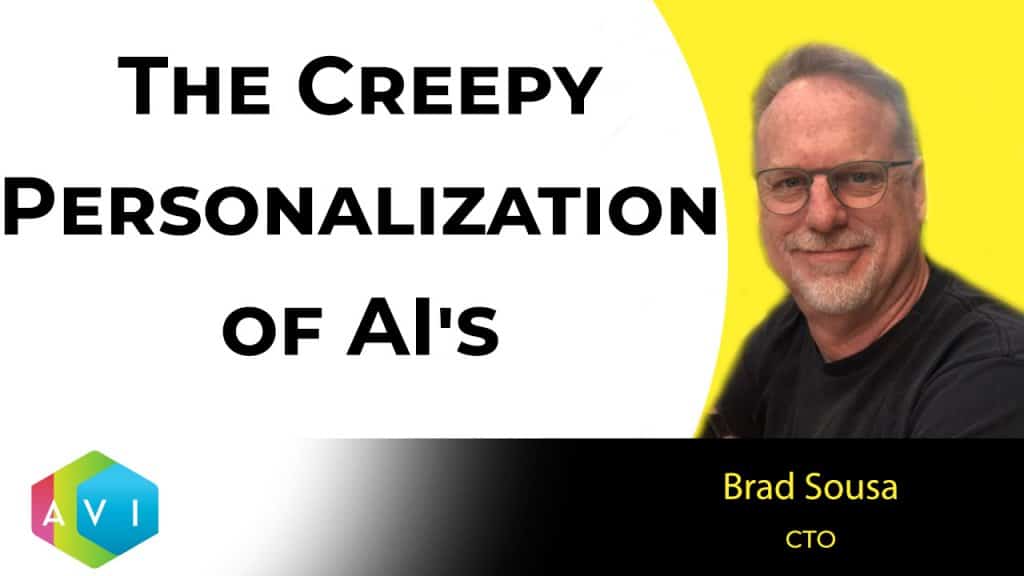
About Brad Sousa:
Industry authority on visual collaboration, Unified Collaboration, digital media, video over IP, collaboration within classified applications, and visual collaboration for healthcare and distance learning. Brad’s experience and expertise makes the difference between integrating collaborative technologies, and create enterprise-wide adoption that changes organizational cultures and accomplishes broad organizational strategic initiatives. Brad is a key note speaker at symposiums and workshops addressing the application of technology in education and the effects on academic outcomes; the use of classified and unclassified visual collaboration; how enterprise collaboration and adoption of visual communications improves productivity and ROI.
Pioneered the use of MPEG multicast for statewide and district-wide distance learning applications with notable programs such as Hacienda LaPuete’ USD (three time recipient of the Smithsonian Award for Technology in Academics), the Modern Red School House (Kayenta USD) and The Cascade Consortium (distance learning network supporting central Washington State).
About AVI Systems:
Communication Liberation Most organizations have one principal requirement for their audiovisual (AV) technology: that it frees them to do their jobs. That’s why the best system is one that opens the lines of communication, then gets out of the way. It’s also why AVI designs our systems to be easy to integrate, intuitive to operate, and simple to maintain. This is our definition of Communication Liberation, and it's reflected in the incredible diversity of AV solutions that we provide for business, commercial, education and government clients across the U.S. Founded in 1974, AVI Systems has 16 offices throughout the Midwest, Central Southwest and on the West Coast, giving us a regional presence and national reach. We owe a great part of our success to having the most highly trained, capable and motivated team of experts in the AV industry. As a 100 percent employee-owned company, we are able to attract and retain the most qualified people by treating every individual as a crucial member of AVI. We provide them the opportunity and encouragement to grow in their careers and empower our employee-owners with stock ownership via 401(k) matching, dividends and profit sharing. The people of AVI not only share in the success of our company, they share a conviction that technology should liberate, not impede. And working together, we provide integrated audiovisual solutions that remove barriers instead of creating them, freeing our customers to seize opportunity and imagine new possibilities.
Transcript
(Intro Narrator at 00:00:01) Today, we're talking to Brad from AVI Systems about the creepiness of personalized AI. You're listening to Joel Beasley, Modern CTO.
(Joel Beasley at 00:00:14) Hey, man. How are you? Good to see you.
(Brad at 00:00:16) It's always good to see you. I don't know what it is, dude. Every time I see you, I just start smiling. I love it. It's the beard, maybe.
(Joel Beasley at 00:00:24) Maybe. It's the beard, baby. What's going on? Are you expanding globally? Have you already been global?
(Brad at 00:00:31) So we've been doing business globally for a while. But during the pandemic, we acquired into an organization called GPA, and GPA is our global brand. And that company, GPA, is co-owned between a number of companies. We're the largest shareholder. That got us into 65 markets, 50 countries, overnight. And so our global business is nuts right now. On top of that, I sit on the board of Avixa. You probably don't know who Avixa is, but in the electrical engineering space, you have IEEE that manages all the standards and the community and all that kind of stuff. In the collaboration AV media production space, that's Avixa. Avixa is the standards committee and the governing group.
(Brad at 00:01:28) Avixa is the certification group. Avixa also produces one of the top five largest trade shows in the country called InfoComm, and I'm on the board of directors of Avixa. And so that's a global organization. Spain is actually a trade show in Barcelona that's related to Avixa. That's why I'm going.
(Joel Beasley at 00:01:49) I see your LinkedIn posts. It's always a cue on stage and some caption. I always give it a thumbs up and go, "Woo, Brad."
(Brad at 00:01:55) Yeah. That's right. That's right. Yeah. It's fun.
(Joel Beasley at 00:01:59) Yeah. So you do a lot of the speaking at the trade shows. What are you talking about there?
(Brad at 00:02:03) So I'm doing a half-day workshop in Barcelona on AI and integration into smart workplace and what that's all about. There'll be a show coming up in Orlando in June. That's InfoComm. That's the US version of it. I'll be speaking there on a similar topic. I'll be leading a CTO community, global community there. And then I'm also, it looks like I'll be talking about the emergence of esports, specifically collegiate esports and what that looks like for private colleges and universities, that kind of thing. There'll be a keynote that they've asked me to do. So those are the kind of stuff I'll be talking about there.
(Joel Beasley at 00:02:47) Now I have a million questions.
(Brad at 00:02:48) Tell me.
(Joel Beasley at 00:02:49) I want to talk about the AI stuff. What's the workshop? What's going on in the AI world?
(Brad at 00:02:53) Oh, man. So here's an interesting thing. So post-pandemic, everybody's trying to figure out what's the purpose of the office. I mean, is it kind of legacy? You don't really need it? Do you need it for some purposes and not for others? What's that really looking like? We've been at the forefront of those discussions with architects, spatial planners, customers, large global enterprises for about two years now, trying to understand what it looks like. The nutshell for us, our best experience and our best knowledge today says that the office is not a place that you go do work. Generally speaking, it is for some. But for most people, that's not where I go do work. I can do focused work anywhere. I go there because I have an experience that I can't get over video. I go to the office because I need to rebuild a sense of workplace community. Or I go to the office because I need time and proximity with others to create consensus, define a big initiative, push that forward. Those are kind of the three big reasons why people are going back to the workplace. Back to the office, I should say, because the workplace now is everywhere. Right? The notion though is that there's three kind of customer personas that are new data consumers. So let me frame that up, and then I can get to AI. Is that all right real quick?
(Joel Beasley at 00:04:18) Yeah.
(Brad at 00:04:21) So here's the notion. So I have one data consumer around the workplace or the office that is the corporate real estate operations team. So imagine I've got a downtown office and maybe it's four floors. And imagine that about 60 to 70% of my workforce is in the office downtown at any given time. That means that I could probably shut down one of those floors, turn off the power, turn off the HVAC, turn off the network, all of that kind of stuff, reduce my carbon footprint, reduce my operating costs. The question is, can I predict who it's going to be and where they're going to work and kind of sequester these people into neighborhoods rather than letting them pick where they want to go work and as a result, obtain those operational savings? That's kind of one thing. Second thing is I'm a corporate portfolio manager, corporate real estate portfolio manager. And I don't just have this in downtown Nashville. I have this in 50 markets worldwide. And is there a way that I can either reduce my overall corporate footprint, real estate footprint, or sublease it and turn that real estate holding into some sort of working capital, invest it somewhere else in the building? And so corporate real estate portfolio managers are trying to figure out, can I rationalize how much office space I really need? That's the second thing.
(Brad at 00:05:55) The third thing is there's these workplace transformation leaders. Sometimes you hear titles like workplace happiness or chief people officer or whatever it is. And they're trying to figure out how do I use the office as an effective workforce resource. And by doing that, bring workers back to the office because we want them back at the office and enable us to consume that workplace in a different way. And the reality is that smarter people than me, people at JLL and other property management firms, they've monetized this. They say that across the corporate footprint, my real estate costs are about $30 per square foot per month. My operating costs are about $300 per square foot per month. And the cost of enabling workers to consume and use that space for productive work is about $3,000 per square foot per month. And so they're all trying to figure out how do we do this in the post-pandemic era. This is where AI comes in.
(Brad at 00:07:10) So we've been working on an initiative about 18 months. We're in probably the, you know, moving from pilot to a production phase of it. And it's a handful of large global customers who are really interested in understanding and solving this problem. And AI brings us some really interesting tools. So let's say for an example, you live or work in Nashville and you're getting ready to go to the corporate office in San Diego. I don't know who would be doing something like that, but somebody like you, I'm sure would. Somebody like me does. But I have no idea what the resources in that office are. So my first idea is how do I book a meeting space? How do I do that? And then the second thing is I need to work someplace. How do I find a desk? And we have some AI tools that enable me as a worker to now, without having knowledge of that space, I can understand what meeting spaces I need, where I can get a desk. Oh, by the way, Joel's going to be in the office on Monday. Do you want to fly in early and spend some time with Joel? Oh, and I can see that you're staying at a hotel, which means that you're driving from your hotel. Do you want us to reserve a parking space for you? And then when you enter the building, you use your phone as your badge to get through security and all of that kind of stuff. So it's this integrated approach around sensors and occupancy and access control and meeting spaces. And all of this AI begins to correlate this data together to give the operations team what they need. Maybe now they recognize that people are going to be in this space and not this space. I can turn power off. Gives the portfolio managers what they need to start rationalizing some decisions. And the workplace transformation leaders are excited about it because the worker now is excited about going to the office because it's an experience now for them, not just a place to do email or do work.
(Joel Beasley at 00:09:23) How long till we get to the point where the AI will tell you that one of your members on your sales team, if they were to go to this location at this time when these people are going to be there, the likelihood of them closing a deal would be X?
(Brad at 00:09:36) Yeah. So today, you can rationalize there's data around things like experience centers or customer visits into offices that have a direct correlation and metric to close ratio and size of deal and all of that kind of stuff. I don't know that we can today have a meaningful metric that says if you're working in the office, this is the amount of business that you close. And if you're not working in the office, this is the amount of business that you close. We haven't quite gotten there yet, but I imagine it's probably 18 months away before we can start having some predictable models like that.
(Joel Beasley at 00:10:10) My understanding of what you do changes almost every time I talk to you. So did this opportunity come up because of the buy-in to the larger global organization and people within that community were talking about these problems and you had the capabilities and the resource to help solve them? Or how did this come about?
(Brad at 00:10:29) So we have a pretty distinct kind of innovation model that we follow. And I say that because it's partially what you just described, and it's partially customers that are asking us to solve the problem. And so that customer might be a large, think of a large global brand, like a Mercedes or a 3M or whoever, right, which are customers of ours. One part of that organization sees us as a media production company. The other part of the organization, more the IT stack, they see us as a UC company and a UC service provider and somebody who provides collaboration resources, which might be conference rooms, it might be cloud services, it might be voice services. It's all of that kind of stuff. And it was actually that customer who began to engage us. They came back and said, "You know, you guys have provided to us UC AV. You provided us thousands of conference rooms across the planet. Do you have any idea how people are going to consume the office post-pandemic?" That's how it started. We began to really formulate some forward-thinking opinions, and most of those opinions turn out to be true. And that's kind of given us a bit of a head start. But they engaged us because they wanted to have a conversation around, are people going to return to work? Are conference rooms still needed? And if they are, what do we need to do to help workers feel comfortable, safe, and then excited about going to the workplace? That's how that started. Now, here's the other part. So we have customers in the US that are engaging us with that. That's swirling around on this side. And then there's me that's an innovation leader within, globally within GPA, which is our, like I said, our global brand. And I'm talking with other CTOs and technology leaders globally. And this topic comes up as part of the conversations. And they go, "Hey, you know what? Have you heard of The Cube in Berlin?"
(Brad at 00:12:31) "Well, yeah. Isn't that that super cool next-generation building blah blah blah?" "Yeah. Well, we did this thing with them, and this thing was around worker consumption and AI technologies that help people understand how to use the technology in the space." "Oh, that's interesting. How did that go?" And so they brought with them some innovation and experiences that I would not have had domestically here in the US. And our business unit in Australia, we had some experience with some software that they had been consuming. And between all of that, that began to create this global approach to how you make the office much more accessible to the worker who doesn't work in that office regularly. And that's changed the way that you host customers. Because if you're not familiar with the space, you're not very confident in your conversations. But when you're familiar with the space, now you're hosting that customer in your home, and it changes the dynamics of those conversations. And that's kind of where we've been headed.
(Joel Beasley at 00:13:43) That's smart. So if you can build tools that allow unfamiliar spaces to feel familiar.
(Brad at 00:13:47) Yeah. Things like, you know, "Brad, AI says you like sushi. There's a sushi place down the street from here that we would recommend." That helps me feel more comfortable and excited about going to the workspace. But now I know that I can take my customers joining me down the street or whatever. Right? So it's a little different because it's not focused specifically on the tech that you're delivering to the customer. It's completely focused on the human consumption of it.
(Joel Beasley at 00:14:18) So what is it looking at? My expense reports to see I ate at a sushi place? Or is it tied into my Neuralink? And it...
(Brad at 00:14:24) It might. Right? It's tied into your expense report. It's tied into probably more than that, it's tied into your Outlook calendar. And it's starting to correlate things like, what did you schedule in your calendar? And then with IoT sensors, you reserved a desk and you can sense that people are working at that desk. And so not only did you reserve it, but we see that you're there. And we also use the app as your badge to get in so we can predict that the person at the desk is actually you. And then you go into the meeting room data, and it's Outlook plus occupancy plus, you know, whatever your cloud service is, and you're now starting to correlate all of that data together. And it says, "Yeah, you know, Brad actually was in that meeting and used the technology this way or that way." And that rationalizes for those different consumers of data. It begins to rationalize how they're thinking about workplace happiness or how much corporate office I need.
(Joel Beasley at 00:15:34) That is really cool.
(Brad at 00:15:35) Yeah. That's the fun, man. It's actually, to me as a nerd, it's super interesting how it's, you know, how AI is driving these decisions. There's a, and we're learning a lot of things like there's a very, very real creepy meter on AI. Right? And you don't actually know when you're tipping the meter over to the really uncomfortable phase. You just know from human behavior. People don't generally say, "Hey, I don't like that." They just avoid it or stop using it. And so you have to kind of start looking at those trends. And then you might sit down with a focus group who says, "Nah, it's just it's creepy when they know that it's me." "Oh, okay. We'll dial that back then." Right?
(Joel Beasley at 00:16:18) Yeah. The sushi thing kind of creeped me out.
(Brad at 00:16:21) Did it?
(Joel Beasley at 00:16:21) Do you ever struggle? Yeah. Well, I mean, so when I say creeped me out, I mean it in the way that I'm curious as how they got the data. It's like, how did you, I don't ever remember explicitly giving you my dietary preferences. Had I done that, I would be like, "Yeah. Okay. That's awesome." And it knows I, if it asked me, "Hey. You know? What's your favorite places to eat?" Or something like that. Or if it said, "Hey. We noticed from, you know, your corporate credit card that you tend to go to chicken restaurants. You know? Is this something that you enjoy? Do you want us to look for these in the future?" And I could, you know, be more involved in this curation of data versus it being magical.
(Brad at 00:16:56) Yeah. Right. So I guess that if you're going to dial back the creepy meter on that, it might nudge you. Right? So it's not recommending. It's nudging, which is a little bit different. It's a little bit more passive. And it might nudge you on, you know, "Do you want to make lunch plans? Outlook says this..." Might be a little too aggressive. "Outlook says that you eat at places like this. Let me recommend." That might be too aggressive or it might nudge you.
(Joel Beasley at 00:17:22) I don't think it's that aggressive when we know where it's coming from.
(Brad at 00:17:26) That's interesting.
(Joel Beasley at 00:17:26) So I, this is just me. It's subjective. I've done no studies on this. I don't mind predictive AI, and I don't mind it extracting insights and trying to improve my life.
(Joel Beasley at 00:17:38) But if it does it without telling me how it came up with the information, now that bothers me. Because I feel like if I know where it came from, I have the ability to turn it off. And so if I feel like, ah, I don't want them to know that, I know where to go turn it off at. But if I don't know where it came from, I'm like, you shouldn't have that information. I don't know where it came from, and I don't want you to have it. And I get real defensive real fast.
(Brad at 00:17:57) Okay, so the disclosure of the source is meaningful to you. And I can totally understand that.
(Brad at 00:18:07) It might be that the nudge is more gentle in the beginning, and that nudge is, do you want to make a reservation for lunch in the app? And it puts sushi in the top because it's seen something in the past, but it's not exclusively sushi. And then from now, at that point, the app is keeping track of where you like to eat and makes recommendations based on that. But, I don't know. You don't have to do it at all. You can, the idea is that you could turn it off.
(Joel Beasley at 00:18:38) Yeah, no, I love it. I personally, I think it's brilliant to use your company lunch location data. You know, it would be really great if, and now I'm being product Joel. It'd be really great if the thing comes up and it's like, you know, lunch plans, okay, and this has got a list, and then there's this little asterisk saying, you know, list ordered based off of Outlook preference, restaurant. Find some way to word that. And then a little button where I could click Settings and turn it off if I don't want it to be accessing that data. That's beautiful user experience. But if it sends me a text message like, I think you might be hungry, there's a CC restaurant, my name is Hal, you know?
(Brad at 00:19:13) Like Uber Eats does at noon, right? When you have an order.
(Joel Beasley at 00:19:18) Did they do that? Oh, wow, they do that?
(Brad at 00:19:20) Yeah, Uber Eats will pop up on my phone, and it might be that I might be having a conversation with somebody like, you know, hey, you wanna get some Vietnamese? Do you like Vietnamese? Hey, I got a great Vietnamese place. And then, you know, twenty minutes later, Uber Eats says, boop, are you hungry? Try to order Vietnamese. You've ordered there before. Like, no, okay.
(Joel Beasley at 00:19:41) I know.
(Brad at 00:19:42) I don't know, but Zuckerberg told us, you know, under congressional testimony, that it doesn't work that way.
(Joel Beasley at 00:19:47) So, oh, but it does. I mean, it 100% does. You can go in and turn it off. How can he say it doesn't work that way when you can go turn it off?
(Brad at 00:19:56) Just saying, man. Yeah.
(Joel Beasley at 00:19:58) Well, I don't know. There might have been a delay from when they were more open. I don't know the date of his testimony on where we're at today, but there's definitely the ability to revoke the advertising voice things inside of the Facebook ecosystem. But by default, it's on. They try to put it on by default.
(Brad at 00:20:15) Yeah. And isn't it interesting? I think the consumption of AI starts with things that are understandable, right? You kind of opt in. And that might be things like, you know, meeting room reservation and that kind of stuff, which is, you know, there's nothing threatening about that. There's nothing creepy about that. But the next step, what we learned, and by the way, we've learned that every organization socially has that creepy meter as well as the individuals within it, right? So one of the things that we learned is that you turn these things on or off based upon very specific cultural attributes that you're trying to help develop. And so one might be the system now knows that I'm going to that location and it knows that I've reserved a conference room and a desk, and it's told me that friends that I work with are going to be there, so it put us all in a neighborhood together and all of that kind of stuff. That's not creepy. I think that's kind of helpful. The next thing might be, you know, Brad, you haven't had a security update on your laptop because you work from home for ninety days, so I've scheduled you to stop by the Genius Bar, or whatever, the IT support desk at this time. Would you like to do that, accept yes or no? And those, I think, are helpful, but they're all AI-driven. Those are more helpful. Don't seem particularly creepy, but some of the others can be, I suppose.
(Joel Beasley at 00:21:50) And I think it matters. So you nailed it from the beginning. The creepy meter's hard because I remember calling a pizza place, like, seven years ago, and they said, you know, hey, you ordered this last time. Do you wanna order that again? And, like, right off the bat, like, that's how they answered the phone. They're like, hey, so-and-so, you know, you ordered this last time. Would you like to order that again? And I was just like, yeah, that's exactly why I called. And I didn't think it was that creepy in my head. I was like, okay, well, they probably just have an order system that's connected to my phone number. And so my brain could figure it out, and I was like, that's what I believe it would be, right? I could see how, though, across different generations, that could really have some vastly different reactions.
(Brad at 00:22:30) Generationally, for sure, and geographically. So let me give you an example. The idea of the software recommending a parking spot for you in San Diego would seem kind of odd because parking is generally pretty plentiful. But if my office is downtown Chicago and it recommended, would you like me to reserve a parking spot for you? And this is where it would be because this is the door you're going to enter or this is where your office is. That would be, like, super helpful because you can drive around for an hour in downtown Chicago and never get a parking spot. So I think there's geographical differences that are interesting. And you're absolutely right. Generationally, there's very distinct opinions on expectations of how secure my personal data is. So that's very different generationally.
(Joel Beasley at 00:23:30) I think the platform matters too. I've noticed myself, I like that this conversation went to creepy AI because I haven't gotten to talk about this, but I noticed myself actively not wanting to give Google more data.
(Brad at 00:23:43) Right.
(Joel Beasley at 00:23:43) So I'm not necessarily retracting my data and things like that, but they've had my Gmail for twenty years or however long it's been. And there's a lot of tools that we use that are related to it, and sometimes I just feel like you're involved too much in my life. That's why I use the Alexa and I don't use the Google Home, right? I also got to interview the employee number one at Alexa, Dave Isbitski, and he told me that the most important thing for him when he was designing the first Alexa was that when you hit the mute button, that's a hardware mute. So it actually shuts power off to the chip or whatever, however they technically do it, but he goes, that's a hardware mute. There is no way for the platform to get audio when you hit that mute button. And I got to interview him several times and kind of become friends with him. So I trust him. I believe him. He seems to be a very ethical type person. You know, it's kind of weird how that shaped my decision because it made so much sense for me to get the Google Home thing or whatever because, you know, I'm already integrated into the ecosystem, but I'm just making these decisions like, I don't want you to have that, you know? I'm getting old. I might be becoming an old man.
(Brad at 00:24:52) Well, do you mind, I'm trying to think, I think you have an iPhone, but do you mind when Siri knows that you're driving someplace and it pops up on its own and says, you should leave now if you're gonna get there in time, or here's the best route for you to get there? You haven't asked. Siri just offers it to you. Is that creepy?
(Joel Beasley at 00:25:15) No. So when I'm creating my event, it, well, I don't know if I have it off. I know that there's some feature I have when I'm creating the event that I could say remind me when it's time to leave, right? The thing I use Siri for is I say call my wife, so I have my wife in my phone as my wife. And so I use it for that, and then I use it to set, I set alarms for, like, 10 times a day, like, set an alarm for thirty-five minutes or something. And that is pretty much the extent. I don't use Apple Maps. I use Google Maps.
(Brad at 00:25:46) Yeah.
(Joel Beasley at 00:25:46) I think they're superior as far as actually getting me to the destination. Although the integration with my vehicle, the Apple Maps is superior. It's amazing.
(Brad at 00:25:55) Amazing. Isn't it?
(Joel Beasley at 00:25:56) Yeah. Mhmm. It's so cool.
(Brad at 00:25:58) Yeah. So for me, the interest as a CTO on AI in smart workplace fits into two categories. There's the engineering part of it and the architecture and systematic part, and then there's the human adoption, human consumption, how do people respond to it part. And one of the things I find really interesting about this is that what for me started as an engagement with this workplace transformation team, or workplace happiness leaders, that's how we first got involved. But now there's other consumers of data that I would not have thought would be consumers of the data that we're creating. And that's part of the interest to me. And then there's another part, which is kind of down the road a bit, which is the amount of data that's being generated. And I was working with Applied Materials recently on some stuff, and their leadership said, I wanna say it was that 2023, more data will be created by AI and ML than by humans. Think about that for a minute. Yeah. So if that's true, imagine the amount of data that is being driven through software and machine learning. How do you organize that, manage that, store it, decide what you're gonna do with it or not? And all of that is a byproduct of AI.
(Joel Beasley at 00:27:31) Yeah, I had a conversation yesterday, so it hasn't aired yet, with the CTO of Dun & Bradstreet.
(Brad at 00:27:37) Oh, yeah.
(Joel Beasley at 00:27:38) And I asked him, I was like, hey, what are some of the big things that you're focused on and challenges that you have? And he said, like, expansion of data. He goes, you know, how do you move five exabytes around every night around the globe successfully through 40,000 APIs? And I'm like, whoa. I was like, that does sound like quite the challenge. And, yeah, so that's what people are thinking about at that level anyways.
(Brad at 00:28:03) Yeah. I mean, for us, we've recognized that data has gravity, and that means it might be portable. You might technically be able to port it from one place to the other, but just the weight of it, moving it from one to the other, means it's very unlikely it's gonna get moved. And if you don't think about that when you're starting the data architecture discussions, you find yourself in a place where you've got really valuable data and you can't figure out how to move it to the next level. The other thing is that we're learning right now because data has gravity, as the data cycles and begins to churn and gets more and more refined, it attracts other applications to it and other data to it. And if you're not thoughtful about how you're going to manage that and integrate that together, it becomes unwieldy really, really fast. Because to your point, you know, you're moving big data. And to the point I was making earlier, it's not big data because people are keying it in or creating it. It's big data because your ML applications, your AI applications, they're creating it on their own. And without understanding how you're gonna architect it and manage it, it gets pretty unwieldy pretty fast.
(Joel Beasley at 00:29:29) Yeah. Elon Musk is talking about that. He says, like, organic data or human data versus silicon, basically. He's saying that the machines are coming, right? They're vastly outnumbering us as far as how many of those you have creating data versus us creating data.
(Brad at 00:29:44) Right.
(Joel Beasley at 00:29:45) And I think that is interesting. I also wanna know, you just gave me this thought. We might need to talk to a physicist or something or some sort of scientist because I'm curious as far as the weight of data that's being pushed around the planet. Like, do electrons have weight? I mean, I'm assuming they have some sort of weight. And if you're actually transferring this data, you know, like, how much weight? How much do the electrons weigh of five exabytes that are getting pushed around the planet? Because then you just brought up this gravity thing, and I was like, initially it was like, gravity, he, I guess he means, like, metaphorically or, like, you know, this visual in your head. You imagine it has gravity because, you know, it pulls things to it. And then I was like, wait, it probably actually could have gravity. You know, it could have weight.
(Brad at 00:30:26) Right.
(Joel Beasley at 00:30:27) And I'm curious to know about that. You're not a physicist or anything?
(Brad at 00:30:29) No, I'm not a physicist. But you know what? I'm gonna be talking, so Sandia National Labs has been a long, long-time customer and partner of ours. And one of the programs that we're tied to is their advanced compute initiatives. I'm going to bring this up my next conversation with them, and if there's interest and thought about it, I'll point that back to you too. Because I think that's a fascinating, I was not thinking of it from a physical perspective. I was speaking to it metaphorically, but you're right. Somebody's creating the resources to store that data, and that has mass to it.
(Joel Beasley at 00:31:11) Yeah, that's a clear one, you know, the mass of the drive or whatnot.
(Brad at 00:31:15) But then your point is even if it's being, you know, the transport is light waves, it's fiber optic, or it's, you know, photons, phonetic, that has mass associated with it. Could you theoretically calculate the mass? And I'm sure you can.
(Joel Beasley at 00:31:33) Do you get to play in your free time with, like, the DALL-E or the OpenAI or any of these sort of consumer-facing, news headline-making tools?
(Brad at 00:31:41) You know, I really don't. I haven't. My personal time, as it relates to tech, has been more focused on where technology and people meet. That's been kind of the fascination for me and where I spend most of my time thinking about it. But people on my staff are, and they're clearly thinking about it from that perspective. It'd be interesting to have that conversation.
(Joel Beasley at 00:32:07) There's two things I want to draw your attention to. So I don't spend a lot of time there. And whenever I get this stuff, I'm always trying to focus on what's the thing that is at least somewhat here today, right? Like, it's kind of the very first, earliest version of it's here, not the thing that's just theoretical, right? I like to focus on things that are closer than that. And there are two things that have caught my attention this year. The first one is what the ChatGPT is doing specifically with the Microsoft and GitHub code assistant project, where it's, like, have you seen this?
(Brad at 00:32:42) Yeah. I haven't seen it. I don't have firsthand knowledge of it, but it's part of the conversations that we're having.
(Joel Beasley at 00:32:49) Yeah. If you just go to the website, they have a video on the home page. It basically can, like, auto-complete your code, or you can talk to it and say, hey, I want you to write a class that can do A, B, and C, and it'll just spit the code out. And it's, like, 90% right.
(Joel Beasley at 00:33:03) And for me, I was blown away because the amount of code it's generating, it makes you realize really quick that programming for the detailed lower level part, it can become automated, at least assistive automated, human in the loop automated, really, really quick to help people write code much, much faster. So that's been fascinating. And the second thing is we're an audio production podcast production company. Right? And we have these fourteen, fifteen shows other than ours, and now I think we have five full time audio engineers.
(Joel Beasley at 00:33:40) And I had this idea the other night as I was falling asleep, and I was like, you know what? With all this advancement I've been seeing, especially with ChatGPT coming out and all of these things, I've kind of been just gleaning from guests. I was like, I wonder if it's at the point yet where I could take the voice. Everyone's trying when they're editing audio. Everyone's trying to take the signal and then improve that signal, remove the background noise. They're trying to do something with that core signal.
(Joel Beasley at 00:34:06) And at the same time, the transcriptions are virtually perfect now. They weren't five years ago when we started the podcast, but now they're virtually perfect, and they can separate speakers and everything. And then I found that there's this voice print AI where you can speak into it for 40 sentences, and then you can type, and then it'll say in your voice what you want to say.
(Brad at 00:34:28) So I—
(Joel Beasley at 00:34:28) said, okay. Well, how good are those? So then I was like, well, why are we trying to correct this audio, this dialogue audio, when we could just make a voice print because we have an hour of them talking, have it transcribed, and then have the voice print read the transcription with the training data of them actually saying it, and then we'll have a new source. Well, it turns out, I don't know if that's how they're doing it, but there's three companies that have it, and it's out today.
(Joel Beasley at 00:34:51) And we dropped a file in it of our worst. I called Josh, and I said, hey, Josh. Give us our worst audio that we've ever had recording, and they gave me a couple samples. I dropped it in there. Within ten seconds, it was as high of quality, if not higher than what we had done.
(Joel Beasley at 00:35:06) Yeah. And they're like, is my job automated? I was like, that's only 20% of your job. No. No. No. It's not. It's not. We're good. It's not taking your job.
(Joel Beasley at 00:35:16) It's 20% of what we do, but it's kind of interesting, though. Right?
(Brad at 00:35:20) Yeah. It really is. And you can see the value of it in terms of production quality, but also in terms of language translation and understandability and all of that other kind of stuff. It really has the potential of solving some real human problems. As you're describing it, a friend of mine who has been a leader in our industry, a great innovator, super smart guy, passed away last year from ALS, and it attacked his voice early on. And so we'd be having meetings together, conversations together, and he'd be typing, and it would be reading it out because he couldn't make his voice work the way that he wanted it to.
(Brad at 00:36:10) And so that was the way he was communicating. Something like this would be a really interesting improvement to that process. Right?
(Joel Beasley at 00:36:19) Yeah. And then it also brings up the whole deep fake conversation. Right? At what point can I be sick and Josh can be pretending to be me because we're on a video call? I mean, there's hundreds and hundreds of hours of me talking and me being filmed.
(Joel Beasley at 00:36:35) I think they use a lot less than that when they do those sort of model actors. Have you seen them for the learning tools they have on? Yeah. So, man, the future's going to be really interesting on how they solve that, the authenticity issue of is this actually a president or a world leader or is this a deep fake? That's going to be interesting too.
(Brad at 00:36:55) Yeah. The ethics behind it is going to be an interesting challenge. And it's not unlike a lot of the conversations that I had today around the metaverse where there's some really powerful tools. There's really big opportunity to go bad too. I was having a conversation with somebody recently, and they asked me, so how do you decide what technology you're going to spend time on and what you're not?
(Brad at 00:37:22) My response to them was, if it's a cool gadget, I'll observe it. But if it changes the human condition about a problem that's close to me, that's when I'll get into it. I see a human problem. I see how this new innovation can solve that human problem. That's what moves it up the stack and something I'm going to really spend some time with.
(Brad at 00:37:51) So I think whether it improves the human condition or not is going to be the outcome of what really sticks and what really gets energy behind it or not.
(Joel Beasley at 00:38:03) I like that. That's a good test.
(Brad at 00:38:06) Yeah.
(Joel Beasley at 00:38:07) For where you spend your time. For 2023, we're gearing up. Right? Where are you going in '23? How are you deciding?
(Joel Beasley at 00:38:16) Let's give some advice to the technology leaders right now that are getting ready for this new year. How do you prepare for the new year?
(Brad at 00:38:24) So for me, I think it starts with cause and purpose first. And if I've got a good handle on the bigger purpose, then purpose for me translates into some sort of destination. There's a place that I want to end up. Right? And if I've got a good picture of that, then I'm going to organize kind of the big things in my life around helping me arrive where I feel like or believe I'm supposed to be in life.
(Brad at 00:38:54) That includes work and everything else. I think for me, in '23, as it relates to work, if I'm kind of reading the landscape properly, I think there's an opportunity for me to not only lead other technology leaders, but maybe build a community around CIOs, CTOs, and help develop that community as well. I'm finding myself being drawn into relationships with other CTOs, CIOs that are like minded. And I've watched you build that community, which is awesome and amazing in and of itself. I'm not talking about it from that perspective.
(Brad at 00:39:36) I'm talking about it from a much more of a microcosm of just a handful of leaders. So I imagine that my voice will be added to leveling up a community of CTOs, CIOs that are near me. That's going to be probably one outcome that'll happen this year, I would guess. We're going to be driving the part of our business around collaboration, and that part has been on fire since the pandemic. I mean, as fast as you can run.
(Brad at 00:40:07) That's going to continue to grow, but I think it's going to get the attention around it. It's probably going to get eclipsed by creating experiences, workplace experiences. And it's probably going to get eclipsed by some form of, I don't even have a good language around it yet, but it's really around corporate broadcast, corporate messaging. It's this notion. I heard a CMO friend say this the other day.
(Brad at 00:40:32) He said, you know, Andy Warhol was famous for saying everybody gets their fifteen minutes of fame. His comment was not everybody's going to be famous, but everybody's going to be a content creator. And I think that the executive level of global corporations are waking up to that. And I want to help us figure out a way to do that well rather than just create stuff.
(Joel Beasley at 00:40:58) Now do you create stuff in an agency sense? Will people come to you and say, hey, we need this type of ad campaign or video? What's the context in which you create multimedia?
(Brad at 00:41:08) Yeah. So we won't generally—I mean, we do create some creative, but it's pretty rudimentary. You know, we'll partner with content creation firms that are really focused on that and do that well. So that's not our space. Our space is not what's being said, but creating the environment of how it's being said and who it's being said to.
(Brad at 00:41:32) So there's a level of interconnectivity in that. So it's pretty common. I'll give you a kind of a classic example. It's pretty common that executives that are customers of ours are using the technology that we've created for them. And they're going live from their house or from their office or something straight on CNBC or Fox Business or Bloomberg or whoever.
(Brad at 00:41:59) And in the past, that was a studio that they would have to drive to to make that happen. And today, it's not. Today, it's just wherever they happen to be at. Kind of like what I'm doing today. This is my office, but for this hour, it's a studio that I'm broadcasting from.
(Joel Beasley at 00:42:17) Yeah. I had to walk 25 yards, man.
(Brad at 00:42:19) Well, yeah. You got a rough life at the ranch where you broadcast from.
(Joel Beasley at 00:42:23) This is good. I think we should wrap up the podcast, and we could talk a little bit about some personal stuff. And let's just end with, what is the best piece of leadership advice that you've ever received?
(Brad at 00:42:38) Oh, dude. I'll share with you at least one of them. Right? So I remember early in my business career, a friend of mine, a mentor of mine was CEO of a company in the Pacific Northwest called Fred Meyer. And Fred Meyer was a retailer, and two thirds of all, two thirds of the population in Portland, Oregon was in a Fred Meyer twice a month.
(Brad at 00:43:12) That's how impactful they were in the industry. And he decided he would have lunch with me one day at my request. And I was trying to rationalize how business worked as a young man because it seemed so cutthroat to me and that in order for me to win, somebody else had to lose. It was more of a competitive thing. And he was probably the first to input into me that the idea of good business is an expanding economy for everybody involved.
(Brad at 00:43:46) And it's all around how can I help expand this thing that we're all doing together? And that obviously has stayed with me since then. His name was Dale Warman, and he was a great, great mentor and friend to me. Can I tell you one other one real quick while I'm thinking about mentors that gave me some good advice? Another mentor of mine, Janelle and I were living in Burbank at the time, so I must have been, I don't know, 28, something like that.
(Brad at 00:44:18) Glenn Taylor was his name. Glenn was a mentor, and he was one of those guys that somebody who was 28, a busy young businessman. He had more money than God, and I just couldn't figure out how he got there and how it just kind of all seemed to work. And we were living in Burbank at the time, and you couldn't go anywhere in LA and not where he was not known. He was just one of those kind of guys.
(Brad at 00:44:42) Right? And he said to me one day, he said, Brad, how do you handle your money? And so I tried to explain it to him. And then he said, well, do you tithe? And so I tried to explain it to him.
(Brad at 00:44:59) And he goes, you know, I don't think you're getting the point that I'm making. Like, alright. Well, make it clear to me. He says, my wife and I—Vera was his wife. My wife and I live on 10% and give away 90.
(Brad at 00:45:16) You're struggling to get yourself into a place where you live on 90 and give away 10. He said, that's not your goal. Live on 90, give away 10. Your goal is to live on 10 and give away 90. And man, that changed everything for me.
(Brad at 00:45:37) That was a huge, huge moment in my life. Live on 10, give away 90. And that's true in every business transaction or relationship I live with.
(Joel Beasley at 00:45:51) Boom. Nailed it. That's mic drop moment. I can't add anything better than that.
(Brad at 00:45:56) Super good.
(Joel Beasley at 00:45:58) We made a podcast.
(Brad at 00:45:59) There you go. How do—
(Joel Beasley at 00:45:59) you feel?
(Brad at 00:46:00) It's always good doing it with you, man. I love it.
(Joel Beasley at 00:46:02) Thank you so much for listening. And if you found this episode useful, please share it with a friend or colleague who you think would get value from it. And if you have topics that you'd like to hear discussed on the podcast, either add me on LinkedIn or send me an email [email protected]. Every time I get an email or LinkedIn message, it absolutely makes my day and inspires me to keep going.