
Episode 559 ·
The AI That Measures Human Emotion with Beni Gradwohl, CEO at Cognovi Labs
Today we’re talking to Beni Gradwohl, CEO at Cognovi Labs; and we discuss the impact of human emotions on decision making; why only 6 out of 10 people with chronic illness actually fill their prescriptions; and technology that’s deciphering emotion from human communication.
All of this right here, right now, on the Modern CTO Podcast!
Check out more about Beni and Cognovi Labs at https://cognovilabs.com/!
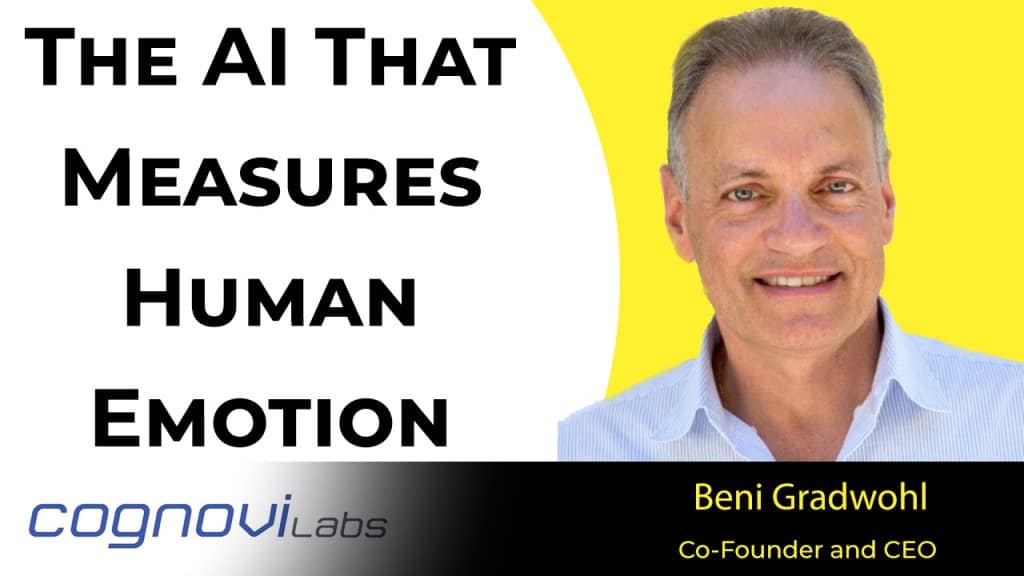
About Beni Gradwohl:
Beni Gradwohl is Co-Founder and CEO of Cognovi Labs, Inc., an artificial intelligence (AI) company that focuses on measuring the emotional drivers behind human decision-making. Cognovi’s award-winning psychology-driven AI helps clients in the commercial, health and public sectors reveal how audiences are feeling in the moment, predict their action and intent, and then communicate with the emotions to maximize impact.
Beni has been on a journey to understand how people behave and find a systematic way to measure our decision-making for more than 20 years. During that time, Beni held senior leadership positions at Citi, Morgan Stanley and various investment management firms. An astrophysicist by training, he spent the first decade of his professional career in academia and research.
Widely featured in the news, including Inc., Forbes and the Financial Times, Beni is frequently invited to speak on topics at the intersection of AI and behavioral psychology, the role of emotions in human decision-making, and how to engage emotionally to drive a better outcome. Beni received his Ph.D. in Physics from The Hebrew University, Israel.
About Cognovi Labs:
90% of human decisions are based on emotions, yet never before has anyone been able to scientifically measure and anticipate these decisions before they are made. Until now.
Cognovi Labs empowers you with the predictive tools to engage, inspire and maximize your impact. Our revolutionary psychology-driven AI reveals how your customers are feeling in the moment, what drives their decisions, and how you can communicate with emotions that will both strengthen your bond and shape your desired outcome. And since emotionally connected customers are 7x more likely to purchase your product, you can’t afford to miss out on this powerful technology.
Transcript
(Intro Narrator at 00:00:01) Today, we're talking to Benny, CEO of Cognovi Labs, all about how our emotions impact our decision-making. You're listening to the Modern CTO podcast.
(Benny at 00:00:16) Hey, hey, Joel.
(Joel Beasley at 00:00:16) Hey, buddy. How are you?
(Benny at 00:00:18) Good. How are you doing?
(Joel Beasley at 00:00:19) Good, man. This is gonna be exciting. Are you pumped up?
(Benny at 00:00:21) Yeah, always.
(Joel Beasley at 00:00:23) So when I saw what you were doing, I was super interested. I've got lots of questions, but I sort of wanted to start with just hearing how you describe what you're building and what you're doing.
(Benny at 00:00:36) Yeah, happy to. What we do is we try to measure how we as human beings make decisions. We think we are rational. We're actually not that rational. I wouldn't say we're irrational, but the majority of decisions we make are really made by the subconscious mind based on emotion. So majority of decisions are really subconscious. And so if they're based on emotions, is there a way for us to measure those emotional undertones while we talk, while we write, while we communicate in some shape or form, to really understand what that means in terms of the decision-making and anticipate what that means in terms of next actions and how we can change that outcome for the better?
(Joel Beasley at 00:01:15) So that's a lot. How does this work? Can you give me a real example? Like, is my iPhone all of a sudden going to start reading my emotions 24/7 and then suggesting products to me? Like, how do you put this into practice?
(Benny at 00:01:29) Yeah. So we're exactly trying to stay away from that. We're not trying to use emotion for micromarketing. What we're trying to do is really understand emotions at the aggregate level. And I'll give you one example. Pharmaceutical companies have a problem, or we actually as a society have a problem. A lot of people who have chronic diseases go to the doctor. You go to the doctor, you go through all the tests, you get a diagnosis, and then you get a prescription. What happens then? Well, six out of ten times, nothing. Six people out of ten never fill the prescription, although they have a chronic disease. It's amazing. And so pharmaceutical companies come to us and say, "Hey, guys, we can't understand why. We go to the patients, to the doctors, we run our surveys, we ask what the issues are, and sometimes we hear it's reimbursement, it's the price, sometimes it's side effects. But when we change that, what we can change, it rarely makes a difference. So what are the reasons?" So they come to us and we run an analysis. And we run an analysis either on publicly available information like social media, discussion forums, blogs, where people talk about their specific disease and whether they take medication or not, or we run it on internal conversations or surveys from the companies. So they run their surveys, they have free-form conversations. We analyze the responses, and that tells us what are the emotional blockers and the emotional drivers why people do or do not take the medication. And by understanding what the real reasons are, we then work with the pharmaceutical company and say, "Hey, if that's the reason why people don't take it, why don't you change that conversation to alleviate that concern, to bring down that barrier so people will take the medication?" And eventually, it actually saves lives because it turns out lack of medication adherence, not taking medication, kills 125,000 Americans every year. And so if you can change that, you save lives.
(Joel Beasley at 00:03:47) It was funny because I got briefed on this episode, what you guys do and the problems you're solving and all of that, about, I don't know, maybe a month ago. And I got that statistic, right? The six out of ten don't fill their prescriptions. Then it just so happens that we went to my wife's friend's birthday party, and her husband, who I hung out with at the party, is a regional pharmacist, and he oversees 20 or 50 stores in Tennessee for—he's gonna kill me if I don't remember—it's CVS or Walgreens or one of them. And I asked him about this, and he's like, "Absolutely." He goes, "Yep, that's what happens." And he said that there's a lot of money in solving that problem. And I'm not gonna attempt to redescribe the business model, but there was something between how people get paid and incentives and business deals and things like that with buying certain amounts of volume of prescriptions. And there was some business interest into solving this problem. I don't know if you know about this part of it, but he told me there was a couple other technologies that they were also exploring to try to help solve this problem of people not picking up their medication.
(Benny at 00:04:56) There are a lot of attempts to do that, and a lot of them have to do with cognitive biases and little parts. So there are tools, once you have a medication, to help you take it on a regular basis, correct? It's not just filling the prescription, it's actually adhering on a regular basis to the dosage you need to take. And so there are tools out there which try to give you a prompt and say, "Hey, the time has come, take your medication now." But it doesn't go around—first of all, you can always turn off your tool if you don't want to do that and not be, if you have an issue with the medication. But the first problem is even the activation part, not even the adherence. The activation in terms of filling the prescription in the first place. And that's a major problem. And you're absolutely right. It's big, big dollars. I think the statistic I've seen a while ago, and it's a rough statistic, was around $350 billion in the US alone in terms of lost revenues. So yes, it is a big business for pharmaceutical companies, and that's why they come to us. We view it from a much more social benefits point of view. If we can change that health problem, it literally saves lives because people will start taking the medication. And it's fascinating what some of the reasons are why people don't take the medication, and they are different than the ones they would tell you. I'll give you another example if you're up for it, Joel.
(Joel Beasley at 00:06:11) Yeah.
(Benny at 00:06:11) It turns out that according to some analysis earlier this year that in Ohio, 40% don't take the COVID vaccine. And the health authorities in Ohio did a large-scale research survey to better understand why. And they came back and it was all over the news at the beginning of the year talking about, "Here's one reason, and the more important reason is this, and the most important reason is that." So it turns out that COVID vaccine safety, so the safety around the vaccine, is important, but it's only important to around 16% of respondents. There are other reasons which are much more important. The most important one is side effects. Fifty percent of respondents said side effects are important—that's why I don't take it, I'm scared, whatever the reason is. So we had a client who came to us in Ohio trying to help them better understand what's happening. And so we looked at purely publicly available data in this case: social media, discussion forums, blogs. And we looked specifically in Ohio, conversations over a three-month period, the last quarter of last year, because the survey came out at the beginning of the year. So we said, "Okay, let's look at the fourth quarter of 2021." And when we analyzed that—and in our technology in real time, you can say, "Okay, what are people talking about? Side effects? What are they talking about? Safety?"—what we found is that volume-wise, the conversations are roughly the same. Emotionally, it's roughly the same in terms of the amount of emotions. But in terms of what motivation, what intent it creates by taking the emotions and mapping to our psychological framework, we saw that it's exactly the opposite of what they thought it is. In fact, the importance of safety was doubled for people in Ohio than the issues around side effects. And so understanding not what people say, but how they feel and how that leads to motivation and intent is much more important because now the authorities in Ohio can go out and have a marketing campaign focused on what's really important to them, which is the safety and not what they said. That changes behavior.
(Joel Beasley at 00:08:47) Yes. And I am curious about what the options were to select. So obviously, the science for vaccines is amazing. There are fantastic things. They exist. They help us not have polio and all these diseases. Me personally did not take the vaccine. And my brother is a physician, and my stepmom's a physician, and they obviously are taking the vaccine and everything. But for me, it came down to I was asking myself—I was trying to be introspective. I'm like, "Why am I so against this?" Right? Like, what is it about me? And I spent a lot of time thinking about it, actually, and talking with my wife because she felt the same way. And what I came down to was two things. The first thing is, well, I'm an entrepreneur, and I have an extraordinarily high tolerance for risk. So my risk tolerance is significantly higher than, I guess you would say, the average American. And when I saw, "Here's the byproduct of having the disease," and then, "Here's an option to take a vaccine," I weighed those, and for me, it just wasn't there. So that aspect for me personally was not there. I was like, "Yeah, I'm okay with that." And the second part was I've spent my entire life developing products, and never have I ever had somebody wave a bunch of money and push something very quickly and it be perfect or work out super well. So I was not interested because of the time on market specifically. They were advertising it as, "Oh, look what we've done as humanity, how quickly we've been able to take this known technology—it's been around for 20 years—and adapt it and make this vaccine quicker," and all of this stuff. And to me, I was thinking just like, "No, that's an opposite of an advertisement for me." And I don't—I'm not one of the people that tell other people what to do with it. I'm just always interested, and one of the reasons why you're on the show too, is because I like psychology. I'm always interested in why is the monkey Joel doing what he's doing?
(Benny at 00:10:50) So it's very interesting. By the way, our technology is agnostic, correct? Politically agnostic. It's agnostic of taking a situation. What it does is it measures. It measures the emotions, and it measures the emotional undertone to figure out what's important, what's not. And you just said it, Joel. You essentially confirmed what we found, which is it's the safety issue. You looked at it, risk-return, you thought about it, it was pushed too fast in your mind. It's a safety issue. Is it secure? Is it really validated? Correct? That's exactly what our technology uncovered, which was opposite to what people actually told during the interviews.
(Joel Beasley at 00:11:28) Yeah. And it's amazing. And when I saw this technology, I was like, "We gotta talk to the people who are making this stuff." Now I did ask myself one more question, and we can move on from the vaccine stuff. But I did ask myself, how bad would it have to be for me to take the vaccine early? And I've come up with, if it was like polio—like, paralysis—or if people were getting these weird, disgusting skin things all over, if it was scary to me, that is the moment I would be standing in line. I don't care if it's brand new or whatnot. If it was scary to me, I'd be first in line to get it. Now I vaccinate my kids. I was vaccinated. We definitely pick the schedules of which we vaccinate our kids, and we've got three young kids. But yeah, so I was asking myself, how scary? Did you guys do any research on that? Like, how scary it would have to be?
(Benny at 00:12:22) Yeah. You bring up something incredibly interesting, and I know we haven't really talked about what the technology does, but what we do is we go two steps beyond what's usually done in the industry, which is you start with natural language processing to understand what people talk about, and then we extract emotions. Most people just extract sentiment. Sentiment analysis: positive, negative. We go a step beyond to extract emotions, so we could talk more about that—10 emotions in context, not by the words, but the words in context, natively in 20-plus languages. And then once we have the emotions, we map that through a proprietary psychological framework into action tendencies, how you're acting. And the reason I'm telling you that is because it gives you the answer to what you just asked. When we think about emotions, you ask somebody on the street, "Hey, what's a good emotion? What do you want to feel?" You say, "Well, I want to be happy. I want to be joyful," correct? "And hopeful, maybe trustful." And that's true, we'd like to have that. And we always talk about good emotions or positive emotions and negative emotions. We are strong believers from a psychology point of view: there are no good or bad emotions. We feel those emotions all the time. And the question is, what is leading to certain behavior or what's not? So let's take risk, correct, which is exactly fear in your case. Let's take fear. Fear usually is bundled into, "Oh, it's a bad emotion." No. Fear is not, depending what kind of fear and in what context and how much. So if you go through the woods and you have a grizzly bear standing in front of you, you're overcome with fear. You're completely awake, but you're not going to move. In psychology, it's called the appraisal theory, so you don't have control. You're not in control. You have valence, you have arousal, but you don't have any control, so you're frozen. But the point is a little bit of fear is actually very activating. Why? Look at marketing companies. Look at companies who sell you a program and a coupon: "Hey, if you get on board by the end of the week, you get another 20% off." It's fear of missing out. So understanding what fears, what fear level, and in combination, by the way, with other emotions will lead to action—and you, personally, to take the vaccine—it will mean that there's a combination. A little bit of fear, correct, obviously, but not to a level where you're going to be frozen. A little bit of disgust, but not too much that you walk away. Probably some anger, anger at coronavirus, correct? So it's activating. And then hopefully some hope and trust in the vaccine. So the whole combination leads to an action tendency, which we actually quantify. We quantify it in aggregate to say, "Oh, people are activated." Well, the first question is, are they talking about it? Second, are they emotional about it? So we measure that, how emotional. And then are their emotions leading to an activation for people to move away, actively move away, withdraw, actively sit there and observe, or actively embrace and chase after it? And by measuring that on an aggregate level, we can figure out what is really the motivation. And that same works for individuals.
(Joel Beasley at 00:15:51) Can you detect one's ability to control or work with their emotions? Like, some people have higher levels of discipline than others. Can you detect any of that, or is that outside of your use cases?
(Benny at 00:16:04) Yeah, yeah. So it's yes. And you're going into an area where we are very passionate about right now. So we have two parts of our technology. One is analyzing incoming conversations. And as I mentioned, it could be social media and discussion forums, blogs, deep web, or anything. Or it could be transcripts from phone calls from our clients or our clients' data. It's all anonymized, de-identified, aggregated. And then we have the outgoing. So we have the Explorer—explore what drives your customers, your audience, real decisions. And then the Communicator—do you communicate with emotions? And so you can take any communication, any text, whether it's an email you're writing right now, or you can take the transcript from this podcast if you'd like to, or I can run it for you if you'd like to.
(Joel Beasley at 00:16:55) Yeah, we should. Yeah, you run it.
(Benny at 00:16:57)
Through the communicator in real time, and it will tell you whether you create emotions in your content. Because at the end of the day, if you are able to engage emotionally, which is emotional intelligence—do you understand somebody else's emotions? Do you create your own emotions? Can you manage that?—you are able to engage much more and increase your EQ, which drives performance.
(Joel Beasley at 00:17:23)
I don't want to forget this. How do you do that? Because you've got to make it objective to some degree and how people react. Like, okay, if you go put on, I don't know what's one extreme, Jersey Shore, the MTV thing, right, with all the kids and their attitudes and stuff, and then you look at maybe attorneys. Right? Do you have a profile of persons? Like, I'll tell you about who my customer is, you create a profile, and then you scan that, and then it runs it against my average customer. Or are you doing it against the world? Or how are you doing that?
(Benny at 00:17:55)
Yeah, an important question because people always ask, is it absolute? Is it relative? How do we think about it? How do you do segmentation? So a couple of things. When we pretrain our deep machine learning to extract emotions, we extract 10 emotions. Six of them are the Paul Ekman emotions. Paul Ekman was a psychologist, or is a psychologist, who in the seventies said that joy, anger, disgust, fear, sadness, surprise are key or primary emotions. And then we supplement that, because of our own research, with amusement, contempt, hope, and trust. So we have 10 emotions. We measure them in context, in any written or transcribable form, in 20, as I mentioned, languages. And we trained it specifically on tens of millions of posts, each one of them. Now, why are we doing it in multiple languages? It's because we want to capture those cultural and linguistic freedoms. People may express emotions or talk differently in France or in China or in South America than they do in North America. And so it's important to capture the language specificity or the linguistic freedoms in each language. And so when we train it, it's very broad and very generic. When you then apply it and you put in your own text and it predicts the emotions through what it exposes there, you have to think about it in those terms as this is based on a very large benchmark. Now, if you're a lawyer and you talk differently, or you're a school teacher and you talk differently, or whatever it is, you have to adjust it. And there are a couple of ways to adjust it. First of all, you can adjust it, or we can when we work with a client, to retrain or change the thresholds in a way that it's aligned with or fine-tuned to that use case. So working, for example, with lawyers, you know, legal documents are much drier than Twitter.
(Joel Beasley at 00:19:56)
Yeah.
(Benny at 00:19:57)
And so how people talk on Twitter and how it comes across may not be what the intent is necessarily in more business or legal environment. So we can retrain and fine-tune it to that use case. But what's more important, or even more important, is it allows you to test yourself over time relative to yourself. So you could write something today and say, hey, why am I more angry this morning on a Thursday morning or Thursday afternoon than I was a week ago in these same settings? And you can start understanding your own emotion and measure it and improve the communication to come across in the way you want to do.
(Joel Beasley at 00:20:42)
About six or so years ago, I had downloaded this app that allowed me to track my emotions. It would ask me several times throughout the day. And what I found that was the most important to me that impacted my life the greatest was the amount of sleep I've got. As much as I love the Tony Robbins and the David Goggins and the Jocko Willinks of the world, my body genetic makeup needs eight to eight and a half hours of sleep to be the best version of myself. I wish it was six. I could get more things done. I can do it at six, but it's not worth it. It's worth it to get the full. So the result of that is I just, I still get up early. Like in the morning, I just go to bed early. Like I put my kids to bed, and then I go to bed.
(Benny at 00:21:29)
Yeah. And was that an outcome of the app? So you saw that sleep will actually improve your emotional health?
(Joel Beasley at 00:21:37)
Yeah. So it would ask me questions like, okay, how much did you sleep last night? And then it would ask me about how much water I drank or what foods I ate or how soon I ate before bed. It was a variety of different things, and I also had the ability to customize it. I don't remember the name of the app. But basically, it helps you sort of find these different triggers in your life that can help you. Like, I think we're always kind of cycling through our emotions, even throughout the day. You know, you get hungry at lunch, you can get into the hangry emotion. Is that one of your 10? Is hangry one of your 10?
(Benny at 00:22:11)
Yeah. No. But you're probably angry that it's not lunchtime yet or something like that. But no, that's interesting. Yeah. And there are a lot of them. I mean, there are 20,000 mental health and mindfulness and health apps out there. Obviously, the majority of those apps, and they have great intentions, they may not really work that well because it does require, as in your case, to answer a few times a day, be active and answer any question. Not everyone does that. People like to have it in the background. And so there's a very large fallout within 14 days, really, if you have to be actively involved. Majority of the apps are also not validated through research or clinical trials, but that doesn't mean they're not useful. And as you see, they can be very, very useful. So what our technology does is it really does it in the background. It does analysis in the background, or you can put something into a text, into a communicator, and you can analyze that. And it does change behavior. And so when we work with clients, they obviously ask, well, if I make my websites, my marketing more emotionally engaging, you know, can you tell me by how much my KPIs go up? How much is the engagement rate, the click-through rate, the likes, you know, the shares go up? And we can actually quantify that. And we can show them that if you create and generate emotional content, and especially if it's emotional content which is motivating and activating according to our psychological metrics, you will drive performance. And if that works for marketing, it works also, as I mentioned, on the healthcare side for patients who don't take medication, correct? And so it's not just making more money, it's changing behavior. And you know, funny enough, we actually launched a publicly facing dashboard this morning.
(Joel Beasley at 00:24:03)
Oh, that was just launched this morning? Because I pulled it up before the show. I didn't know that.
(Benny at 00:24:07)
Yeah. Yeah. Yeah. We just launched this morning. And, you know, we have a history of trying to, our mission is to do social good. And it's an incredibly powerful technology. So how you use it is incredibly important to us. And so we want to make sure we follow responsible AI, we follow the wellness of society. That technology does good and it changes behavior in a way that it's meant to change. Reduce anxiety, increase emotional health, make, you know, increase or augment the emotional intelligence in conversation because that's good for us. It improves our society, our human beings. And so that's the third time we launched a publicly facing dashboard. The first one was just when COVID started. We knew that there was an issue because we had an application in the Bloomberg Terminal which was signaling us red flags about a month or six weeks before COVID really started in the US, before March. And so we knew that things were happening. So we created a dashboard and launched that, which was analyzing or measuring the overall anxiety towards COVID. Anxiety in general, anxiety around safety, personal safety, health issues. Shopping was a big issue, correct? You may remember the runs on toilet papers and water.
(Joel Beasley at 00:25:27)
Yeah, yeah, I do.
(Benny at 00:25:27)
Remember that? Not that long ago.
(Joel Beasley at 00:25:29)
It was like hurricane season, but there were no hurricanes.
(Benny at 00:25:32)
Well, it was the, you know, the COVID hurricane. But so understanding that, because once you measure it, you can also then change the behavior. You understand what is important for the population, and when in the media, or you're a politician, you can really focus on what's important. Not what they say, but again, what's important for population to bring down the anxiety. So we did that there. We did it again around the COVID vaccine confidence. And now we just launched it for the job confidence index. So we really understand the job environment. And with all the transitioning happening after COVID, coming back from remote to hybrid to in-office work, losing the flexibility, the work culture and diversity and how important managers are and job security, and how that impacts. You know, we talked about the Great Resignation, and now more and more we're talking about the quiet quits, right? People are, and so the question is why? Because people are leaving the workforce or trying to quit or change behavior because they're not happy. They're not engaged. There's an emotional health issue. And so it's not just for employers to understand how to bring people back in. It's for us individually to feel less anxious and solve those issues. And so we launched that dashboard. You can see, you know, click on it on the cognovilabs.com website on the first page. You can play around with it. And it's quite amazing what you see and how it aligns. But in real time, it measures all that information, but how it aligns with a lot of research which happens. There has been, you know, Gallup poll recently showing that the engagement has been going up. And actually just two days ago, there was a report from the Conference Board talking about how people are actively disengaging from the work. And there are different reasons. One of them is not just necessarily not working from home, it's losing the flexibility and time. So not so much location, but actually the time. I can't work at night anymore, early in the morning. I still have to be nine to five. Another one is the managers. How the managers, which is not just the managers, it's the employers overall. How they engage with their employees. And that's where the psychological disconnect comes. And it's actually called out as in a Gallup poll write-up that people are psychologically detaching themselves. And so it's, and that's not good. It's not good for the economy. It's not good for companies. It's definitely not good for employees and for us individually, because work should be a satisfaction, should be an emotional engagement, should be something which is not increasing the anxiety, but actually reducing it. And so we have to solve that.
(Joel Beasley at 00:28:25)
I always found it was interesting when I started, you know, running my own business and everything in person. The first time I had ever had in-person people who weren't software engineers, you know, working with me. And one of the things that I found very fascinating was some of the people would say things like, oh, there's the work version of myself, and then there's the outside, and then I'm with my friends, and they had this sort of completely separate version of self. Now for me, I don't have that. I don't know why. I just never picked that up for whatever reason. It's not, you know, good or bad or anything, but I don't do that. Like, I am just like, if we hung out next week at a pizza place, I'm not going to be a different person when we get together. Is that what you're meaning? Like, they psychologically disconnect? There's different versions of themselves, or they don't care about work? Explain that more.
(Benny at 00:29:20)
No. I don't believe this concept exists that people are different at work than they are at home or anywhere else. I think it's the same person. They have the same emotions. They may try to force themselves to behave or come across differently in a forced way, but emotionally, ethically, they are the same. It's one person. But the personality and the emotional engagement does change. It changes by topic. It changes by situation. It changes over time. And so when I talk to you about our technology, I may feel a different passion and level of emotions than when I talk to you about politics. I'll talk to you about, you know, the latest, you know, baseball game or whatever it was, correct? And so by topic, I may reflect different emotions because it drives me differently. I'm still the same person, but it drives me differently. And it's very interesting that you say that people came to you and said, hey, I work differently than I am in my private life. That's what they say. But if you had taken conversations without asking them about their social life, was their private life, was it their work life, and would have looked at the emotional, you would have seen that it's probably completely different than what they tell you. Our mind tries to create stories. We are incredibly effective in creating narratives, correct? But we know that 90% of decisions roughly, some say 70, some say 95, depending on who you ask and what setting. The majority of decisions are made by subconscious mind based on emotions. A fraction of a second before the prefrontal cortex, the rational mind recognizes that the decision was made. So there's no way that our brain will ever understand, the brain will never understand why the decision was made ahead of time. And so it tries to find a narrative. And that's why when you ask people or they come to you and tell you a story, the story sounds okay, sometimes incredibly nice, but it's not necessarily the truth.
(Joel Beasley at 00:31:38)
Yes. I've got a lot of different ways I want to go with this. Storytelling and marketing is obviously, I don't understand how companies do marketing without storytelling. I'm curious, application of your technology, I want to get you as much exposure as we can. Right? You're currently in market. You're doing this for people. People can come to you and engage with you and do business with you currently with this technology?
(Benny at 00:32:03)
Oh, yeah. It's a phenomenal technology. We developed it over the last few years. The underlying NLP component came out of Wright State University in Dayton, Ohio. It was developed there with millions from the Air Force, Department of Energy, National Science Foundation. We took that technology into Cognovi, and we own that technology, the license, the underlying patent, and have built an entire psychological frame on top of that. And what we do is we work with clients to understand their audience, their customers, and help them create an emotional engagement to drive the change they're looking for. So very active on the consumer side, especially on the pharma side, working with multiple companies, working in different areas. The uniqueness of our technology is it's one technology, applicable everywhere humans make decisions. Because everyone who makes decisions, humans, whether it's B2B or B2C, has to understand what drives their customers' emotions. And if you don't do that, if you don't understand that from a corporate point of view, you're in trouble. I'll give you an example, and from a client who wasn't a client of ours, but we had a private equity firm who came to us a year and a half ago doing an analysis, asking us to do an analysis on a home and gym equipment manufacturer. I'm not going to say what it is, but it starts with a P.
(Joel Beasley at 00:33:25)
I think I have one, both of their products.
(Benny at 00:33:27)
You may have one of those stationary bikes. Yeah. So Peloton wasn't a client of ours. But a year and a half ago, we were asked, as I mentioned, by the private equity company to figure out what we think about Peloton because they had their own financial reasons. So we looked at their website, Peloton's website, and it was the beginning of 2021. Just the vaccine was coming out, correct? The big brunt of COVID just happened. Obviously, Peloton did phenomenally well during COVID, correct? Everyone stayed home, bought new equipment for their gym, worked out, didn't go to the gym. The stock went through the roof. Revenues went through the roof.
(Beni at 00:34:09) When you looked at their website in 2021 to figure out what their strategy is, it turned out it was all about price. Because who do you think were, in their mind, their biggest competitors? The gyms. Because if the world opens up again, everyone goes to the gym. And so they thought they have to compete against the gyms.
(Beni at 00:34:32) And everything on the website was around it's only $49 a month, we're not as expensive as a gym membership, you know, and it was all around price. So we went to publicly available information, social media and discussion forums, and we put on Peloton. We created that, backfilled it in. We backfilled the data and we had at our fingertips a way to analyze Peloton left to right, from top to bottom, figure out what people talk about, or if you have your own hypothesis, check it out. And so we checked it out.
(Beni at 00:35:05) And what we found is, indeed, people do talk about price. Peloton is expensive, right? So when you talked about price or expensive or whatever, there was quite a bit of conversations. But here was a big red flag. Everyone talked about it.
(Beni at 00:35:22) Nobody emotionally cared. So not only were the right emotions triggered to change the impact and the motivation to go out and buy a Peloton, there were no emotions to begin with. The majority of conversations were emotionless, meaning no emotions, no decisions. In other words, people talked about it. It was not a key emotional driver of why people went out and bought a Peloton.
(Beni at 00:35:48) What was the driver was the fact that it was a social status, it was a luxury good, people loved the instructors and the online classes. And so when you looked at that, you saw it was much more emotional, and it was much more driven towards intent. And so we told our client, not sure they fully understand their clients from an emotional point of view. And if that happens, they may run into revenue problems. And, you know, the rest is history.
(Beni at 00:36:19) So our emotional tool, our emotion AI, is an incredibly important, I would say, even critical tool in your toolset if you're going after human beings to sell them something, whether it's B2B or B2C. It doesn't mean you shouldn't do surveys. It doesn't mean you shouldn't have other tools and focus groups. And good focus groups, think about it, good focus groups is all about not just listening to what people say, but look at the body language. And that's exactly what we do at scale.
(Beni at 00:36:51) We look at, you know, in quotation marks, the body language in the text. And that tells you much more. And so if you're a company and you're trying to sell whether it's in media, whether it's travel, whether it's healthcare, anywhere, even if you are a marketing company or a communication company, not only can we help you increase your engagement, we can make it meaningful for your customers, which will then in turn drive your performance, which, by the way, we can measure with real KPIs.
(Joel Beasley at 00:37:24) I love what you're doing. Several years ago, I spent three years working on software that would look at news feeds and figure out how they connected with stock prices. And, ultimately, the biggest driver that we were able to find was not sentiment. So everyone was, like, focused so much on sentiment, you know, positive, negative, run all the content, look at all the news, and and figure it out from there. But what we did find, I said, you know what?
(Joel Beasley at 00:37:56) Let's look at this problem like a marketing problem. How many people see this and interact with it? So what we started doing was we made a list of trusted news sources, and that's subjective. It's whatever the person would put in. Here's my list of trusted news sources.
(Joel Beasley at 00:38:09) And then it would track them, and you can weight them and everything. It would track them and figure out the distance between the story spreading. So the first thing it had to do that was unique was detect a unique story amongst the story being in several places. Right? So it detect a story, and then it would track the trends of what was happening, and then it would map that against the stock price.
(Joel Beasley at 00:38:31) And if something trended and went across your outlets at a certain rate of speed, that was more important. Obviously, if a story breaks and seven outlets cover it within twenty minutes, that's very different than seven outlets covering it over the next seventy-two hours. Right? So I personally have spent a lot of time in here. So when I saw what you were doing and everything, I was like, this guy's awesome.
(Joel Beasley at 00:38:54) This is so cool. Super excited to to talk with you. I do have one more question about the product and and your research, if that's okay. The different periods of time, like, let's say, the 1800s versus the 2000s, have you done analysis on text written then and text written now to see if, like, amongst humans, emotional patterns are different or if there's any unique information there?
(Beni at 00:39:19) Yeah. So we haven't done an analysis, historical analysis, to go back to the, you know, nineteenth century. But what we are doing is analyzing public figures' speeches. And actually what we did is, and we wrote some articles on it and you can find it, there's an article I wrote a while ago around, you know, Putin and Zelensky and President Biden.
(Beni at 00:39:45) How are they engaging in their conversations, in their speeches? Are they rallying the troops? And do we see then the response on social media vis-à-vis support or not? And it's fascinating what you see. So you're looking at Putin and how he changed his emotional undertone, or how President Biden initially wasn't as effective, but then all of a sudden was quite effective when he went to Warsaw.
(Beni at 00:40:11) I don't know if you remember when he went to Warsaw, had a talk. Or Schwarzenegger, who had a video that we analyzed. And so understanding how people come across, because how they come across will reflect or will impact how people will engage. Because there's a mirroring effect, correct? If somebody comes to you very angry, in rage, in front of you, you're going to get angry by definition.
(Beni at 00:40:36) If somebody comes to you very happy and smiles, you're gonna smile. And so what our media, our leaders, our corporations, we personally put out there will have an impact to how people will engage. And it was always amazing how, you know, President Zelensky has an incredible engagement. And you saw this, the kind of support he got from day one. And so we're looking a lot at that.
(Beni at 00:41:01) We're looking at other speeches. We're looking at marketing campaigns. Sometimes for fun, we're looking at songs, or recently we looked at Hemingway. Hemingway had a love letter to Marlene Dietrich, and analyzed that. And, you know, it's a lot of fun to see how they emotionally engage.
(Beni at 00:41:21) And I can tell you, we also have some videos and happy to share that to whoever wants. But, you know, even taking something like the I Have a Dream speech from Martin Luther King Jr. and analyze that. So we analyze that to figure out. And incredibly, how emotionally he picked the right profile to engage.
(Beni at 00:41:39) It's just you measure it and it's in front of you, and you say, now you know why it worked.
(Joel Beasley at 00:41:46) You mentioned songs. I had done some research about, I don't know, a year or two ago. I got to make friends with, you know, one of the people that work on the Alexa project, so I was, you know, upgrading my Alexa and making sure I was using it before the conversation, so I was current on the product. And I was like, hey, play top pop music.
(Joel Beasley at 00:42:07) Right? And it was just depressing because I'm usually listening to my stuff that's, like, from me growing up in high school and all of that, the things I know and I'm usually listening to, like, that type of music, not necessarily new music. And so I was like, what? Skip that song. I don't like those lyrics.
(Joel Beasley at 00:42:24) This is a weird way of thinking. And then I heard it again, and I was like, what? So I went and sat down, and I said, okay. I'm gonna pull ten titles. I looked at the top 100 billboard, and I picked the top ten from the seventies, the eighties, and then today.
(Joel Beasley at 00:42:38) And, oh my gosh, it is incredibly different. It is so night and day, like, just the titles of the songs. And I was like, man, why is everybody so unhappy? Like, if you were just to look at that list, if I showed you two lists of song titles, you're like, yeah. Clearly, this person's depressed, and this person's happy.
(Joel Beasley at 00:42:58) And in the seventies and eighties, people would be happy, and that today would be depressed. What do you think of that?
(Beni at 00:43:04) Yeah. Look. Things do change, but understanding what you're putting out is, look, music is also music. There's that whole music component, not just obviously the lyrics. But if you look at the lyrics, you will see that good lyrics, like a good report. Oh, by the way, a good investor report or earnings report.
(Beni at 00:43:24) When we work with clients, we work also with the investor relationships group to make sure that the reports are right. You have to understand what you're targeting. Now in terms of music, it's similar to a movie. You have to take the audience through an emotional journey. Think about a movie.
(Beni at 00:43:40) If you don't have any emotions in a movie, you're going to turn it off in two minutes. It's boring, correct? If it's all joy and hope, you're gonna turn it off in seven minutes because you fall asleep. It's boring. What you need is an emotional engagement.
(Beni at 00:43:55) There's a villain which comes, creates some disgust and some fear, some anger, maybe some contempt. Then here comes some surprise, some hope, some trust, some joy maybe, and the villain comes back. There's an entire emotional journey. That's why narratives work. Narratives don't work because of the words.
(Beni at 00:44:14) Narratives work because they trigger or evoke an emotional journey. That's why they work. So why not do it systematically using data and science to create the one you want? If you have an investor report where you have some bad news, do you wanna get them aggravated or you wanna bring their anxiety level down and down-regulate them? On the other hand, if you have a great quarter and you wanna get them engaged, yeah, get them engaged, correct?
(Beni at 00:44:45) Call to action. But understand what you're trying to do upfront.
(Joel Beasley at 00:44:49) Is this how you raise so much money for your company? I don't even know if you raise money, but that's what I would have done. I would have been like, what is in my pitch deck?
(Beni at 00:44:57) That's exactly the case. And it's fascinating how we work with marketing companies and communications. And we work with some communication companies and they give us their own posts, LinkedIn and Twitter, what they did over the last year or two. That's a starting point, a very quick pilot. They give us their post.
(Beni at 00:45:16) We analyze the content of the post and map it to their own KPIs, likes, clicks, engagement rates, whatever that is, or in email campaigns, their open rates. And lo and behold, it's not rocket science. You generate emotions, KPI goes up. You generate emotions with a higher intent score, the KPI will go up more. It's not rocket science.
(Beni at 00:45:41) You emotionally engage with your audience. You will drive behavior. It's like a spell checker. If you wanna be sure that what you send out doesn't have any typos, you want a spell checker. We are the spell check of our emotions.
(Beni at 00:45:56) Check the emotions, make sure you make an impact. Otherwise, why waste the time? So first of all, understand what's important for your audience. Correct? Is it really price for Peloton or is it something else?
(Beni at 00:46:08) Or the job index, is it really working from home or is it something else? So you can create your programs around that, whether it's marketing, communication, investor relations, whatever it is, and then make sure you communicate in the right way to create that emotional engagement to get to the outcome you're looking for. It's good for you. It's better for the audience.
(Joel Beasley at 00:46:29) Do you have an API?
(Beni at 00:46:31) Yeah. Everything we do is we create customized dashboards, and every data point is accessible to an API. Easy handshake.
(Joel Beasley at 00:46:41) Is it open in the sense where I can go on right now and just sign up, have API access, and throw data at it and get data back?
(Beni at 00:46:49) It's interesting you talk about that because we were just discussing that yesterday. So far, we've used it as a SaaS product. And so with clients, absolutely. If you're a client of ours, you have an API, you do whatever data you want.
(Joel Beasley at 00:47:03) Open it up. Open it up. You're gonna be an amazing platform. The technology, because my first thought as you're describing that was, I wanna take my listen data of the shows, and I want to map emotions on top of that data and see where drop-offs, like, where, what emotions are causing people to drop off, or why are episodes more successful? What emotions am I creating that are actually just for interest?
(Joel Beasley at 00:47:28) And I was like, you know, if that was an open API, I could just, you know, call up my engineer, Nick, and I'd be like, hey, Nick. Map this against our data because we already have an API to our podcast host. So I'm pro you opening it up.
(Beni at 00:47:41) Yeah. And as I said, we just had the conversation, and I can't go into details with that. That's the intent. That's where we're going. Because I think that technology should go beyond just B2B, you know, where we engage with customers with SaaS program and to really create a platform which is accessible.
(Joel Beasley at 00:47:59) Well, and I promise you that there are people out there that wanna use your tool, but they don't wanna give the data to anybody other than the company that holds the data. Right? So they'll trust their developers to run it and throw it at the system, but they don't necessarily want, like, all of their stuff out there. Like, people want to experiment in private, you know.
(Joel Beasley at 00:48:17) And I know it's still data's still hitting your system, but it's definitely more private when an internal team gets to just sign up and experiment with some data, maybe some customer service data, throwing it at it and learning about, you know, chats and things like that versus having to go contact a company, do an engagement, have it very clear about, like, everything that's happening between two businesses. And do you do private hosted solutions too?
(Beni at 00:48:40) Yeah. And so what you just said, by the way, is already available. So we have clients who will throw their data, which we never see, into our technology. The emotions are thrown back. Nothing is saved on our, you know, stored on our end.
(Joel Beasley at 00:48:55) So—
(Beni at 00:48:55) We already have that. It's just available soon in engagement right now, and we're talking about opening up more broadly. You can have exactly what you said today. And there's one thing I want to mention because you mentioned a few years ago, you created those, you know, patterns of topics, topic clustering and how they evolve.
(Beni at 00:49:15) Just think about you have that, everything you just said, in addition, you have a filter which says not just this topic is is trending up, it's emotionally important or not emotionally important.
(Joel Beasley at 00:49:27) That'd be brilliant. I wish that existed.
(Beni at 00:49:29) Yeah. Well, we have it. And so that's exactly because very often it's not the loudest topics which are important, the loudest narratives, but the one which have certain emotional profiles, which are much more important on impact. So take what you have, add the emotion layer on top of that. We have that capability right now working with clients to implement that.
(Joel Beasley at 00:49:52) I fully agree. I mean, you won me over when I read your description, and I think one of the first lines in there was, like, 10% of decisions are made from logic, 90% are made from emotion. I'm like, that's right. Everybody likes to pretend it's the other way, but it's really that way.
(Beni at 00:50:08) Yep. Yep. You got it, Joel.
(Joel Beasley at 00:50:09) This is great. So can you spell the website for me so we can direct people there? We'll also put a link in the description.
(Beni at 00:50:15) Yeah. It's cognovilabs.com. That's it.
(Joel Beasley at 00:50:19) We'll put it in the description, and I appreciate this. We made a podcast. How do you feel?
(Beni at 00:50:23) I feel perfect. Thanks, Joel.
(Joel Beasley at 00:50:26) Thank you so much for listening. And if you found this episode useful, please share it with a friend or colleague who you think would get value from it. And if you have topics that you'd like to hear discussed on the podcast, either add me on LinkedIn, or send me an email, [email protected]. Every time I get an email or LinkedIn message, it absolutely makes my day and inspires me to keep going.