
Episode 429 ·
Modern CTO Behind The Scenes: 2021
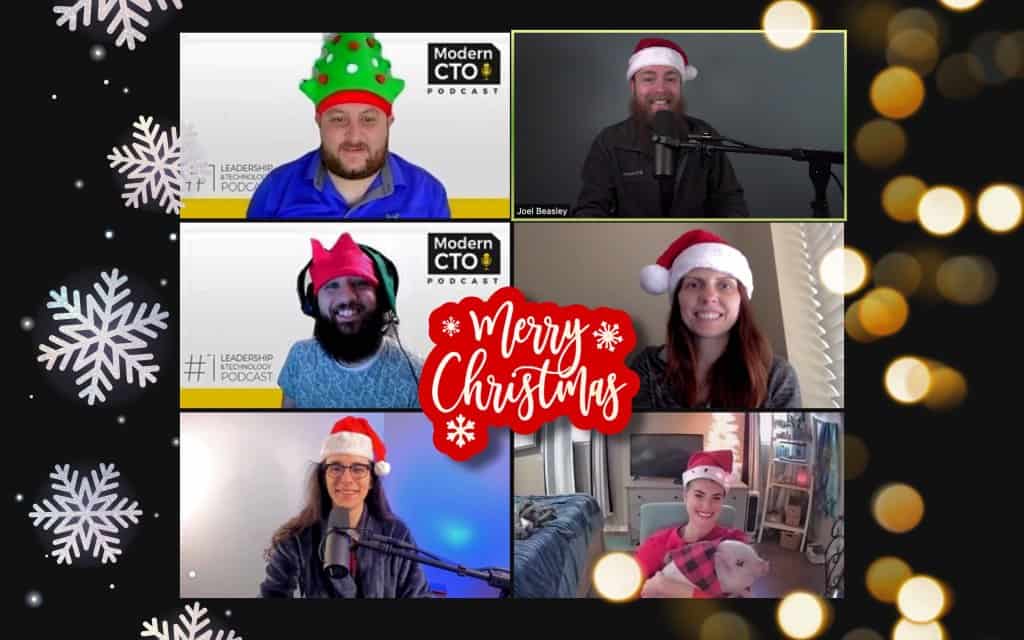
Today we have a special Behind the Scenes episode, where Joel, Adam, and our producer Jesse reflect on the past year of Modern CTO. We talk about how our community has grown, how we’re starting to build and manage podcasts for other companies, our favorite moments from 2021, and what we’re looking forward to in 2022.
All of this right here, right now, on the ModernCTO Podcast!
If you're interested in joining our tech leadership community Elevate150, learn more at https://elevate150.com
If you're interested in having us produce a podcast for your brand, book time to speak with us at https://moderncto.io/dmm/
Transcript
(Adam Sage at 00:00:03) Hello, my friends. Today we have a special behind the scenes episode where Joel, myself, and our producer Jesse reflect on the past year of Modern CTO. We talk about how our community has grown, how we're starting to build and manage podcasts for other companies, and our favorite moments of 2021, as well as what we're looking forward to in 2022. All right, welcome to the behind the scenes episode, gentlemen.
(Adam Sage at 00:00:51) So I think it'd be fun to start out by just sharing some of our favorite guests we had on this year that were super cool, then some of the coolest moments that maybe didn't air because they were too cool, or maybe they did air and they were super cool. And then we got some other stuff we can talk about, updates on the company from the year and whatnot.
(Joel Beasley at 00:01:13) All right, let's talk about the business instead of the podcast, because that's where my head's been the past six months.
(Joel Beasley at 00:01:27) Sure. Yeah. So one of my favorite moments was when Adam started doing the summer takeover so that we needed an excuse so I could go on vacation. And we saw that some people do this thing called the summer takeover where they have a guest host. And so Adam asked if he could do that and we said, okay, cool. And he did a couple episodes and then everybody loved it. And we're like, all right, let's keep Adam on as a regular host. So I thought that was really exciting.
(Adam Sage at 00:01:45) Yeah, that was super cool. I mean, I can't believe how lucky I am. I mean, for one, when I just started working here as a producer, that was just really cool to get to work on a podcast that's talking to such interesting people that I really enjoy. And then I end up leading our little production team here, and I'm in my first management role. And suddenly I get to talk to CEOs and CTOs and ask them how to do it, face to face. And that is just incredible. And I'm really grateful that I have that opportunity, and that also it's useful for other people to also hear those conversations and learn the things I'm learning. Yeah, it's just, I don't know, I'm kind of mind blown at where I am and what I get to do. Super fun.
(Joel Beasley at 00:02:39) So let's say that you also are in a band. Let's say that you're at one of your shows, right? Friday night, you're at one of your shows. You're on stage. After you get off stage, you know who walks up to you? Elon Musk. And he says, hey Adam. He says, I've got something to show you back here. He takes you backstage. He's got a brand new time machine. You go into this time machine and it just takes you back to the first week you started here as an intern. You get 15 seconds to give yourself one piece of advice. What would it be?
(Adam Sage at 00:03:08) If you don't know, make it up and tell Joel later. That's, I mean, that's always been the answer when I'm like, hey Joel, how do I do this thing? And, you know, figure it out. And I've learned so much by figuring it out. And I feel like I took a little bit, like you had to tell me figure it out probably a couple more times than was necessary because I kept going back like maybe he'll just answer the question this time. But that's not like, it's, I'm saying it's a good thing because I learned so much by figuring it out. And yeah, that's why I'd probably say, like, you know, it's okay that you don't know stuff. Just try. Just try.
(Joel Beasley at 00:04:01) Yeah. I'm really good with things as long as they're thought out, as long as they have logic. So if somebody does something and I ask them why they did it and they say I don't know, that typically to me is a red flag. If I find somebody that does something and it explodes and I ask them why they did it and it was a huge failure, and they explained to me some form of logic that I can conclude makes sense as well, I'm okay with the failure. So I really focus on there being purpose behind the action and awareness of what you're doing and why you're doing it.
(Adam Sage at 00:04:36) Yeah, absolutely.
(Joel Beasley at 00:04:37) And then a whole lot of making stuff up. I mean, that's what we're doing. I mean, what is creating a company other than creating something out of thin air, you know?
(Adam Sage at 00:04:45) Yeah. And by making stuff up, I don't mean just pulling the first thought that comes into my head. It's like you make stuff up by looking at data and creating and having an educated approach to what you're making up. And maybe you don't have all the information, but you get that when you succeed or you fail.
(Joel Beasley at 00:05:06) Absolutely. We talk about failures a lot in the Elevate groups that happens.
(Adam Sage at 00:05:12) Yes. Yes. We launched, so right before our behind the scenes episode last year, we had just launched Elevate not too long before that. Now we're got a full year of the Elevate community under our belt and it's grown. Joel and I know that we've had some really cool people join the community in that year too. Joel, do you want to give a little Elevate update on how that's going?
(Joel Beasley at 00:05:37) Yeah. So we started the year with basically nobody in the group, just a few people. And then I think now we have over 100 people in the group. So it's pretty exciting. We've tried all of these different things on how to make it interesting. And what we came up with is we'll get a guest to come talk. Sometimes it's from the podcast, a previous relationship we have from the podcast, or sometimes it's just somebody recommending someone else or someone from the group. But the group decides the topics that they want to hear about. Then we source people to come talk. The first 15 minutes is the individual, the speaker, giving a background of the conversation and what we're going to be discussing and what we hope to get out of it. Then you break into small groups. So you get put into a room with three to four people, you get to know the people in that room and they give you some discussion topics for that. And then you go back, they present another idea and you go back in discussion and then you come back out and it's open conversation. So it gives you the ability to talk to these guests right in person directly with your questions. And what we found is the most beneficial part to everything is the relationships formed in those breakout sessions. And those continue through, we have this awesome Elevate Slack, and everyone continues to talk there throughout the week. So it's a lot of fun. I personally really enjoy it. We did this thing where we sent out a link to everybody. We said, hey, record what your experience has been. And then we did a montage and put it on elevate150.com so you can hear what people say in their own words about what it's like.
(Adam Sage at 00:07:14) Yeah. That's like, it's something I've been reflecting on a lot recently. And I know you've reflected on this a lot, Joel, because it's the reason you created this company. But I haven't really articulated this before, but realizing the value of the relationship economy, that obviously relationships are super valuable for building your career and building any kind of business. But realizing that you can provide value to others by giving them access to relationships, and that in turn can end up a dollar amount that lets you sustain your life and a company, and everyone wins. I don't know how well I'm saying this, but just realizing what a large sub-ecosystem there is in the economy dedicated to relationships and that we're able to play a role in there has been just, I mean, it's what we do at our company through Elevate, through the Modern CTO podcast. And rolling into 2022, we're booting up what we're calling decision maker marketing, which is basically podcast production services for other companies where they can have their executive be a host of a podcast and talk to other brilliant executives and build relationships through that, and also build relationships with the audience. And it's just another level of this relationship economy we've been engaging with. That's something I'm super excited for. I feel like, so this is probably kind of the formal public announcement of our launch of decision maker marketing.
(Joel Beasley at 00:09:07) Yeah, it's exciting. It seems logical in hindsight, right? Like we make a top podcast, we go through 400-plus episodes, we get really experienced at it. And then people start asking us to make them podcasts. We're like, oh, okay. Yeah, we can do that for sure. I definitely want to touch on the Elevate thing one more time because it's not like I created Elevate myself. So Etienne De Bruin, he owns Seven CTOs, which is executive groups for CTOs, typically high-end executive groups for them, where they get together once a month, typically in person. And there's a facilitator. It's pretty great. And Elevate was born out of that because they had some people that couldn't afford those groups, or they had some people that didn't have the commitment time for those groups because they're pretty rigorous in their participation. And so he had a collection of these people and started having them do these weekly meetings. And then he came to me. He's like, I really don't know what to do with this. We have this thing, it's going on. And I was talking with him. I said, yeah, at the same time, I've been feeling that we should create a group to get these podcast listeners together because people had written me on LinkedIn and sent me emails asking me if we were doing groups. And I was just like, no, I don't know how to do groups. So those relationships came together. Like Etienne with his experience knowing how to manage groups and knowing how to manage a community like that, and our experience with having an audience and knowing how to push information out. So it was a really good pair. So we're business partners together in Elevate, and he's definitely the one that leads the community side of it. So I'm super grateful that he does that because that's something I can't do right now.
(Adam Sage at 00:10:51) Yeah. No, Etienne is really cool. And then you get to hang out in person during your RV trip. Oh, actually, dude, share a little bit about your RV trip. That's a thing that happened this year. You abandoned your house.
(Joel Beasley at 00:11:08) Yeah. Yeah. Okay. So we have two little kids. Currently they're ages four and almost three. And we decided that we wanted to relocate when the pandemic was happening. We're like, hey, we want to relocate. We were in Florida and it was open and free. So we were looking for other places that were open. So we found Texas and Tennessee and some other places, and we said, all right, let's go visit them. So we put the kids on a plane, went out to Texas, and it was the worst experience ever because you have to carry all of this stuff for the kids. Their ears are popping, they don't know what's happening, they're freaking out.
(Adam Sage at 00:11:45) Oh, flying was the worst experience.
(Joel Beasley at 00:11:47) Oh, flying. Yeah, flying. And then we had to rent a car and then I had to carry their car seats, man, to the terminal and then take them out and then put them in the rental. It was this big ordeal. Then we got this Airbnb and we had to go, it was just a huge ordeal. And we were just thinking, hey, we have some friends that have an RV and go camping and they have all their stuff with them all the time and they don't have to do any of this. So when we got back, we said, hey, let's start, let's get a camper. So we got a camper, we got this thing called a fifth wheel. So it's like a 40-, 50-foot RV thing that you tow with a big diesel truck and decided to get a truck too. And then we started just traveling around the United States. So we first went like this big circle around the U.S., and that was five weeks. And we did that and we were like, this is kind of awesome. You definitely don't want to travel continuously. You want to stop and stay in a place for a while. So that five weeks was kind of hard to do. But it was fun too because we got to meet you guys out in Nebraska. So we put our company meeting out in Nebraska and then we drove up there with the RV. And then Jesse got a hole in one in mini golf.
(Jesse Shirley at 00:13:01) I got a hole in one in mini golf. That was my first company trip with you guys. That was a lot of fun.
(Joel Beasley at 00:13:06) Yeah. So he got a promotion because of that. And then, so then we go around and we come back to Florida and we're like, we really like this. We didn't want the trip to end. And so within one week we sold everything in our house and sold our house and we're in the RV full time. So we drove up to Asheville, North Carolina, where I've got some family around here. And I know the area because growing up I'd be here visiting family. And I rented a little executive suite office. That's why the background's a little bit plain. There's this temporary studio here. And we've been here for four or five months. And right when it started to get, the fall was beautiful because the leaves were changing and everything. And right when it started to get super cold, we're like, all right, we're done. We're natives to Florida. We don't deal well with 20-degree weather. So we're sitting there shivering in bed, my wife and I, and we're looking at Zillow and realtor.com and all of these things. And we find this place in Tennessee, which is like a little farm, like a little five-acre farm. They have chickens and all this cool stuff. And it actually had a separate building on the property that was heated and cooled that was 700 square feet. And I was like, that's perfect. We can buy this land and this house, and then it's got this giant building on it that I can turn into a big podcast studio and make it look really cool. And I thought, this is perfect. So now we're in the process of doing that. So by the middle of January we should be moved in there. So that's the full circle of learning to RV, selling the house and then doing the RV, living in RV for six months, and then being like, we're done, and then buying another house.
(Adam Sage at 00:14:57) That's awesome. That'd be a really cool experience and probably exhausting because, I mean, you're living in an RV with toddlers, right?
(Joel Beasley at 00:15:07) Oh yeah. Yeah. Well, I mean, the thing is when you go out, because we're in this beautiful park that we're staying in, you want to spend so much time outside. It got hard when it got too cold to go outside and play, or at least too cold for the kids. When it's 20 degrees during the day, that's a little too cold to be outside playing. I bet you people in Canada are laughing at me. But yeah, so that's the full experience of selling everything. It was really scary. It felt really weird because we were born and raised in the city we lived in. So my wife and I had both been there for our entire lives. But we always talk about getting outside of your comfort zone. And that was one area where we hadn't stepped out and we did, and we've made so many cool new friends and have so many great experiences. So we're super happy.
(Jesse Shirley at 00:15:58) I'm super excited to see the little farm cabin studio, right? That's going to be awesome.
(Joel Beasley at 00:16:05) It is.
(Adam Sage at 00:16:06) Go set it up, Jesse. We're the professionals.
(Jesse Shirley at 00:16:09) Yeah. Yeah. Let's go. I'd love to.
(Joel Beasley at 00:16:12) I know we're going to talk about this in the production meeting, but I can't wait. All right. So I found online this weekend this rail. It's like a six-foot-long rail and it's called a Genie or something like that, like a Genie III. And it's got this multi-rotating axis thing and you put the camera on it and it slides to get those sweet shots, those movement shots that you see on a news desk or something, like side profile, and you can control them remotely.
(Joel Beasley at 00:16:39)
So I was like, we need to set one of those rail systems up and put one of the cameras on it, and then have the production team controlling it remotely so we can get different angles in the interview and make it more interesting to watch on YouTube.
(Adam Sage at 00:16:51)
That would look insane.
(Jesse Shirley at 00:16:53)
Yes. That would be really cool.
(Joel Beasley at 00:16:55)
Yes. I'm super pumped about that. I'm talking about all the things, like all of these things I didn't bring up in today's team meeting, because I didn't want to create distraction from our current business model. All right, we sold all these podcast ads. We have tons of podcast sponsors. We're doing great, making good money, but there's only so many sponsored episodes you can sell.
(Joel Beasley at 00:17:14)
And then we moved into, we need recurring revenue and let's manage podcasts for other companies. And so we got our first two within the first month of even trying. So that was pretty exciting. And now we're going to grow that for this year. So the focus for 2022 is recurring revenue through decision maker marketing, which is managing podcasts for other companies.
(Joel Beasley at 00:17:33)
So I'm excited about that. But now, because we're on a show here, we can get super distractified. I can tell you about all the cool stuff that I'm thinking and dreaming about. So one, the rail system, super pumped about that. I think the additional shots would be really cool.
(Joel Beasley at 00:17:47)
Two, once we build that studio out, I want to do like one episode a month, at least, of some big name guests that we fly in and we get to do it in person. I really want to do that. I think that'd be really great. We can even fly Adam or Jesse up if we need to, and we can do something in person. The next thing I want to do is the second week of this business, we tried to create a second podcast called Tech in the Morning.
(Joel Beasley at 00:18:12)
Failed miserably. We did one pilot episode and we never even published it other than to our friends and family who loved it. But we had to focus on Modern CTO, so we just kind of shelved it. So I've got the Tech in the Morning handles on all the social medias, the web domains, all of that good stuff. And I want to come back to it. I want to reboot that show.
(Joel Beasley at 00:18:31)
So I want to hire another production person that'll be responsible for that show. And then it can essentially be like me and Jesse, or me and Adam, just talking about the tech headlines for that day, quick short podcast, super off topic, possibly inappropriate, but a lot of fun. And I think that that'll work really well because that's very shareable content. Like if we're sitting there telling about Boston Dynamics and we're showing the robot running and we're just having fun with whatever comes to stream of consciousness, those little clips would get shared and my aunt would be interested in it and like it and comment and share versus what we do now over here is a little bit different. We bring in all these great leaders and yeah, it's a little fun. Educate, entertain, and elevate is the three principles that we have, but it's also a little bit more serious.
(Joel Beasley at 00:19:20)
And we're trying to figure out how to be a great leader and how to help this next generation elevate. And then also it's kind of cool to hear about what they do sometimes. So I think that if we had this other outlet, Tech in the Morning, to kind of be fun, wild, and weird about cool tech stuff, I think that would be really cool for us. What do you think, Jesse?
(Jesse Shirley at 00:19:38)
Yeah. I agree. I think that'll definitely hit a much broader audience. Because our thing is, like you said before, with this podcast, we found a niche and we own it. Modern CTO is the number one leadership podcast. But doing something like that will be interesting to everyone and would be a whole different avenue.
(Joel Beasley at 00:19:57)
Yeah, I think it'd be fun. And definitely, production's really tight right now. So, you know, we've got that new production hire starting next week in the new year. And then I figured after we get him settled, Tech in the Morning is probably something we would do in March or April after we get our first DMM clients launched and figure all that out. We don't want to do too many new things at once.
(Joel Beasley at 00:20:19)
But I thought if we could be sitting here next year, the three of us, doing our next end of year summary, if we could be talking about Tech in the Morning, right? If we could be talking about, I want a Tech in the Morning newsletter and I want a Tech in the Morning show. And the reason is, is because my favorite newsletter is TLDR and I read it every morning and it's great. And he collects—we had him on the show—and he collects all of these great, interesting tech things that happen and puts them in a newsletter and sends them out in the morning. And I'm like, that's great.
(Joel Beasley at 00:20:52)
And then I want to hear about it in podcast form. I want to see it in video form. And he's currently not interested in doing that because he's building another startup. He's a super successful guy and he just does it as a hobby. So I said, all right, fine.
(Joel Beasley at 00:21:05)
You know, the way this world works is if you want something to exist in it and it does not exist, you go and create it. So that's what I want to do.
(Adam Sage at 00:21:11)
Absolutely. I was just thinking about next year, our behind the scenes episode. Since we're launching the DMM podcast, we're going to hopefully be hiring lots of producers this year. So audio engineers listening, listen up. But our next behind the scenes episode might have a panel of 10 producers here.
(Joel Beasley at 00:21:34)
Yeah. That's right. And if you guys are audio engineers, you can look up Adam on LinkedIn, Adam Sage, S-A-G-E, and just message him and say, you know, how do I get my resume out to you guys? Adam is our head of all the production staff, so super grateful to have met him and have him in my life. Also, Jesse, dude, you're fantastic. What do you guys think candidly about our team this year compared to last year as far as strength or competency?
(Adam Sage at 00:22:06)
All right. Well, I don't want to wax too much, but I feel really, really good about our team. Me and Jesse just work so well together. I really, really enjoy getting to constantly implement changes and innovate and have that freedom on the podcast to be like, yeah, if we want to change the way all of our titles are structured, we can do that.
(Adam Sage at 00:22:36)
Also, the thing I would say is really cool about our team today is how flexible we are on every level. If we need the sales team to start some other process to help us out—like, Jesse and I just recently developed a need for the sales team prospecting specific emails for us. And they're like, yeah, absolutely, we got you. And everyone here is so flexible and malleable and willing to work and support each other, and that is awesome.
(Joel Beasley at 00:23:10)
Yeah. And everybody has a really great work ethic too.
(Joel Beasley at 00:23:13)
Yeah.
(Jesse Shirley at 00:23:14)
Yeah. I can't speak for last year, obviously, because I haven't been here for quite the full year yet, but I can say, I love, like Adam was saying, our agility. If we want to make a major change, it can happen within a week, within a day even. Just the communication across the company is awesome. And it's super easy to just notify everyone of something we want to do different and get it done.
(Joel Beasley at 00:23:41)
And Adam, we don't want to pick on specific people. Right? But where my perspective was coming from is I'm working on this new leadership book for the new Modern CTO leadership book, and I'm taking way more care than the first book, right? And I'm working with a way more experienced author who's met with entrepreneurs many times, and that's his whole thing. So I'm really excited about it. But he had shared a story with me that we're probably going to put in the book about this soccer coach or football coach over there in the UK.
(Joel Beasley at 00:24:16)
He's from the UK. And by the way, they call locker rooms, dressing rooms. So when he was talking about the dressing room, I just kept thinking of a department store. Like, why are they in the dressing room? But so he was sharing the story about this coach over there that coaches soccer.
(Joel Beasley at 00:24:31)
And the skill of the coach wasn't necessarily picking the most popular people or the best people as individuals, it was that he could get a group of people to work together unbelievably well. So I think we've had incredibly talented people here over the course of the, since we've started, we really have been blessed with that. However, I think the difference now, this year compared to last year is that, forget the skill level of a specific individual, but the way we are all operating together, I think that is a little magic that we've achieved. And so now I feel like between the five or six of us, that we've defined the culture in a way where we have good work ethic, but we aren't working after hours. But a salesperson will still close a contract at 7 PM, right?
(Joel Beasley at 00:25:27)
If it comes through on their email and they see it, but we don't have a constant work 24 hours a day type culture. We need to have lives, we need to have relationships outside of work. We need to take care of those relationships. The better your relationship is with your significant other, the better you're going to perform at work, no matter what you say, that's just reality. And for me, I think that I've done a lot of that this year as well.
(Joel Beasley at 00:25:53)
So my relationship with my wife, because of this pandemic, most people would think, oh, you guys went into an RV and you're even in a closer space and you've got two toddlers and you're traveling the country and you don't have a home. Wouldn't that be maximum stress? And you would think so from the outside, but being in it, it forced us to build a really strong relationship and rely on each other. And when you have to rely on each other, the entire dynamic changes. So for me, I'm super grateful all that stuff happened because my relationship with Michelle is significantly better now.
(Jesse Shirley at 00:26:27)
Awesome.
(Joel Beasley at 00:26:28)
That's fantastic.
(Adam Sage at 00:26:28)
Yeah.
(Joel Beasley at 00:26:29)
But we still fired her. I'm kidding.
(Adam Sage at 00:26:36)
I have a couple of questions I wanted to ask you, Joel, on this podcast here. And so this is a question that sometimes we ask guests on the podcast, but a lot of times, it's not something people really want to share. But I know it's something you will share openly, and I'm excited to hear your answer. So I know you've been an entrepreneur for a long time and done a couple of companies. And we talk about failure a lot on the podcast.
(Adam Sage at 00:27:08)
Everyone kind of nebulously says it's important to learn from failure. But I want to hear a story from you of a time you really crashed and burned and what you learned and how that's helped you.
(Joel Beasley at 00:27:25)
Okay. Well, there's lots of them.
(Joel Beasley at 00:27:29)
Let's go back to, I'm trying to think of the most painful one, the most painful one. And I'm definitely trying to think of the one that I would never share so we can share that one. All right. I'll just talk it out and see how it goes, because this one actually involves legalities. And so there are certain things I can and can't say about this.
(Joel Beasley at 00:27:52)
Bottom line is I ended up essentially homeless in my house with no electricity, couldn't afford it. And I know I can prove this too, because if you take candles and you light candles and you try to sleep by candlelight, you will wake up with soot all over your nose, in your face. So I was in the house, car repossessed, defaulted on my mortgage, no money. It's like, how did I get there? Right.
(Joel Beasley at 00:28:23)
And how did I then come back out of that? So I got there from a series of bad decisions and not taking ownership and a sense of entitlement. So those are the things that got me there from principle. I essentially involved myself with too many projects. I over-leveraged my time.
(Joel Beasley at 00:28:43)
Previously, I had made a bunch of money. So I had built some stuff up and I had a good chunk of cash. I burned through that cash thinking that, oh, it's really easy. I can just make another software and sell it. And it didn't happen for me.
(Joel Beasley at 00:28:56)
For some reason I got really lucky one of the first times I did it and then thinking I could do it again, I failed and I didn't do it again. And so I ran out of money trying to do it again. And that's when I learned about margin, having margin in your life and savings and how to do all of that. Because I was just a single guy in my 20s, buying things I probably shouldn't have. And so what happened there was this guy had come to me, his name was Robert, when I first made my first amount of money.
(Joel Beasley at 00:29:26)
And I remember this day 100%. We're walking down the beach because we're with my family and he's there. He was my grandparents' financial advisor. And he was saying, Hey, I heard you guys, you had some success. Congratulations.
(Joel Beasley at 00:29:39)
I was like, Thank you. He's like, Come by my office. I'm going to show you what to do with your money so that you don't run out of money. And I was just like, Psh, I got this. I was like, I got it.
(Joel Beasley at 00:29:47)
I was like, Yeah. Okay. And in my head I was like, I'm not giving my money to somebody else and then having them charge me to invest it. I was like, I know what I'm going to do. I'm just going to build another app and I'm just going to sell it again.
(Joel Beasley at 00:29:59)
I'm going to be fine. And you listen to all the motivational stuff, like never give up, push through, keep going, do this until you're homeless. And then, so I did all of that. But then that happened. And I remember this day where I had enough gas to drive to my parents' house, which was an hour away, but I didn't have enough gas to get back home.
(Joel Beasley at 00:30:22)
So that was the last—I tried so hard to literally, my last $4 that I put in the gas tank so I could drive up to my parents and ask them for money or food and stuff. And because I didn't want to go back and face them because, you know, they'd all see me as successful and they tell all their friends and they're always like, oh, you know, Joel's this and that. And that made me feel good and I liked it. And so I drove up there and I told them, and I said, I just need some money, just invest in this app. And they said, look, you go talk to Robert.
(Joel Beasley at 00:30:53)
They said, if Robert says it's a good idea to invest in it, we'll talk, but you go talk to Robert. And then I remember taking out of their fridge all of their frozen food so I could take it back to my house and they gave me some gas money. And then I felt super ashamed, that whole experience. And then the next day I went and saw Robert and Robert said to me, tell me what happened. So I explained the whole story to him.
(Joel Beasley at 00:31:22)
And he had a financial advisory practice. I think he had one or two locations. And he said that he wanted to help me get back on my feet. Dude, Robert's one of the best guys I've ever met in my life. And so he said, let's found a company and you'll be 50% owner and I'll be 50% owner and I'll fund the cash and you can help me automate some of my stuff inside of my business and come hang out with me, come to my office, hang out with me, see, pay attention to what's going on, help me automate some of this stuff so I can scale my business.
(Joel Beasley at 00:31:51)
And then we'll take that software suite and we'll go sell it to other financial advisors. And I'll pay you a salary, how much money you need, all this stuff. And it was just unbelievable. I got so lucky to have that guy in my life. And so that's what we did.
(Joel Beasley at 00:32:08)
And so we spent several years working together and building up this software suite. By the time it ended, I think he had five locations. So he had really, really grown. And we had hundreds, if not over a thousand financial plans being generated by this software through his company. And he goes, the next step was to go sell it to these other financial advisory companies.
(Joel Beasley at 00:32:35)
And he said, It's too successful. He goes, I want it for myself. And so I remember he called me up. Actually it was his assistant had called me up, but they basically wrote me a check and they said, drive up here. You'll meet with Robert after his next event.
(Joel Beasley at 00:32:54) He does a lot of speaking seminars, so I got to learn a lot from sales watching that guy make these sales, watching how people—I would watch on like a baby monitor him doing sales and interacting with these people. And so I would see how people would respond. That was my first real experience into sales. And because I was making the software that they would look at, the visualizations that they would look at, and then we would track if they were purchasing from them, if it worked or not.
(Joel Beasley at 00:33:18) So he wrote me a check, and then I went and did a big government project and made good money there and built out some teams there. And then I had a nice chunk of savings. So those three to seven years, however long that was from the time Robert was—it took me about seven years to get back on my feet from the time the thing happened and I first met Robert to the time where I had built my savings back up and I was completely stable.
(Joel Beasley at 00:33:43) I had a relationship with who now is my wife and all of that. So she actually saw me go from the house getting foreclosed into a one bedroom apartment. And she was totally cool with it. She didn't care at all. And she's like, "If you did it once, you can do it again."
(Joel Beasley at 00:34:00) And I was like, "Yes, exactly." And so she was really, really awesome supporting me in that way. And so then we just built it up over the course of several years. And then my mom passed away suddenly. She got a stomach ache, went to the hospital.
(Joel Beasley at 00:34:16) They said, "You've got six weeks or a year to live." And then she passed away in six weeks. So that was really tough. So I was in the middle of getting back on my feet as that happened, or I had just finished getting back on my feet as that happened. And I just looked at it and I said, I'd played with this idea of writing the Modern CTO book.
(Joel Beasley at 00:34:37) I had a couple drafts. I'd tried and failed a couple times. But after holding her hand in that room and watching her pass away, it just was like this "oh crap" moment for me where you go about life, you don't think about dying all day. But when you see it and it's like, "Oh man, that becomes real," it becomes super, super real to you when you see it happen in person. And then I just decided that I'm going to try harder because life is short and you die ultimately. And that's when I got really serious and invested some money into hiring this guy Vincent, who helped me write the first Modern CTO book, investing money into promoting the book.
(Joel Beasley at 00:35:16) And then about six, eight months later, the government project had ended. And so I didn't have any income, but I had a lot of savings. And then my wife was due to have our first child in September. So I said, "This is a really scary moment because I don't have any active income flow. I have some good savings."
(Joel Beasley at 00:35:35) So I took like $250,000, and I'd been listening to this guy named Gary Vaynerchuk, Gary Vee. And he was talking about bringing value based off of what you know. You don't have to be a world class expert, but take what you know and share it with the next generation. So I was like, "All right, that's a good principle." And he said, "99% of the people don't have the discipline to do this, so I don't mind sharing all these secrets for free."
(Joel Beasley at 00:35:57) And I said, "Well, I'm one of those people. I'm one of those 0.01% people. I do have the discipline to do that." And so I started and I took that chunk of cash and I put it in and I hired this guy through a friend of a friend. And I was like, "Do you know how—" He was going to school for software development.
(Joel Beasley at 00:36:15) I was like, "Do you know how to do podcasts?" He's like, "No." I was like, "All right, but you could probably learn because you're not a programmer and you're good with computers." So he's like, "Yep." And he really liked podcasts too.
(Joel Beasley at 00:36:24) He was a big listener of some other podcasts. So we just kind of started. I rented this one room office that was really small and we just started going there. When I interviewed him, I interviewed him out of my house. And then I leased that office.
(Joel Beasley at 00:36:37) And then that's when the Modern CTO podcast started. The book was released and we were interviewing people, discussing the book. And then it just kind of—that was four years ago. So it's grown into what it is today. It's crazy.
(Adam Sage at 00:36:51) That is crazy. I hadn't heard the beginning part of that story before. Thanks for sharing that. That's really incredible.
(Jesse Shirley at 00:36:58) Yeah. No idea. I didn't know you had like a rock bottom on it like that.
(Joel Beasley at 00:37:08) Robert's so great too. Oh, and by the way, on top of all of that, when I told him I was doing this podcast thing and starting this business, he said that's—or when I started turning it into a business, like six or seven months after the podcast started was when I started trying to turn it into a business. And so he had seen what I did with the podcast over the six months. And remember Robert had hit a lot of his success. He was really great at marketing and advertising.
(Joel Beasley at 00:37:36) Robert had a lot of his success from doing a radio show with like a local guy named MJ. If you guys are in Tampa area, you probably know him. He had a really popular morning show, but he did a financial show and that's how he got a lot of business. And he was always like on TV and news segments and stuff. So when he saw me get into like the media space and start having all these people on the podcast and growing it and watching the audience grow, he was like, "That's unbelievable."
(Joel Beasley at 00:38:00) And I told him I was starting—I went, met him at Starbucks. I was like, "Hey bud, how's it going? Are you catching up?" He's like, "Good."
(Joel Beasley at 00:38:07) "Good." And I was like, "Yeah. So I put all my money into—" This was like an almost rock bottom moment. I think Robert's like a superhero, but I was like, "I put all my money into this podcast and look what I did and look at the results we've gotten." And he's like, "Yeah, it's pretty cool."
(Joel Beasley at 00:38:25) And I was like, "What's going on with you?" He's like, "Oh, I just bought two airplanes or something." I was like, "That's cool." He's—he's like, "Yeah, I'm going to fly right now." He's a pilot by the way.
(Joel Beasley at 00:38:36) And so he heard what I was doing and I was like, "Yeah. I was like, so payroll's gonna be a little bit tight this month or whatever." But I still made it because some other person came out of nowhere and like asked me to design some app for them. And so I made a bunch of cash from it real quick. It was like a small, like, ninety day project.
(Joel Beasley at 00:38:55) And so I was just barely making—making it by. And I was like, "I wanna turn this into a business and look at what I've been able to do. And if I can hire like these two people and make sales, like, we could do something big." And he's like, "I like it." And so he wrote me a $50,000 check.
(Joel Beasley at 00:39:10) And I was like, "Thank you."
(Adam Sage at 00:39:12) What a guy.
(Joel Beasley at 00:39:12) I know. I know. I know. Everyone's like, "Who's this Robert guy?"
(Jesse Shirley at 00:39:15) So has he—have you had him on the podcast?
(Joel Beasley at 00:39:19) No, I should though. I can't
(Joel Beasley at 00:39:21) get him on the phone.
(Joel Beasley at 00:39:22) He has a podcast studio. He actually retired. So I was pretty surprised. So I've kept up with him obviously, because he's like—him and my parents own a boat together. They are connected to my family.
(Joel Beasley at 00:39:33) So I keep up with him and his family. But it was funny enough, my parents actually bought a business from him. His wife started this hair loss business type deal, and then they ended up buying it from them. So anyways, that's where we're at. And so, and this worked out.
(Joel Beasley at 00:39:48) And obviously there's been ups and downs with this business as well. But back to that concept of margin, I started saving cash with the business and when we were doing really well, I didn't increase expenses and I kept saving cash so that personally I'll never be in that position again. And with the business, we'll never be in that position again. Jeff Bezos says make the company bets. He doesn't make the company bets.
(Joel Beasley at 00:40:13) If I make this bet, it has a potential to put the business out of business, but you also have to be risky with the capital that you have to be risky with. So we have to take shots, we have to fail, we have to make mistakes, but we have to make sure that the underlying infrastructure of the organization is not affected. And so that's where we're at today, which is why I'm excited about doing a new morning show, growing the DMM, bringing on new people, because these are all things that we can do comfortably. And so that makes me really happy. Yeah.
(Joel Beasley at 00:40:44) Thanks to our awesome sponsors.
(Adam Sage at 00:40:48) Man, I feel a little bad following that story up. But Joel, do you have questions for me?
(Joel Beasley at 00:40:56) I do. And by the way, I was not planning on—I don't think I've ever shared that story with anyone other than like my immediate family. So that'll be fun to see how that goes. But yeah, awesome. If you're going to use candles for light, don't use the scented ones.
(Joel Beasley at 00:41:12) I'm so serious.
(Adam Sage at 00:41:13) I had no idea.
(Joel Beasley at 00:41:15) Oh, it was horrible. I had tried to light—I had like, you know, I call them sexy candles. Those are like the only candles I had at the time. They're just like—
(Jesse Shirley at 00:41:21) You call them sexy candles?
(Joel Beasley at 00:41:23) You know, the ones, you know, you light on your nightstand or whatever. So those are the only candles I had at the time. And man, there was so much black soot. I was like, "I need to—I need help. I need to get my electricity back on."
(Joel Beasley at 00:41:38) I was at one night. Yeah. I was laying there with my dog. I was single at the time, laying there with my dog. And I remember just needing light and lit the candles and then woke up with soot all over my face.
(Joel Beasley at 00:41:50) And I just said, "Yep, I need to go do something about this." A question that we used to ask at the end of every episode. The other question I have for you is where do you think you got your work ethic from?
(Adam Sage at 00:42:08) I'd say my dad and sports. Because for one, I was always super passionate about sports. I've done like—when I was little, that was kind of my job, where when I was really young, I was super into swimming, and I'd have like at least an hour of swim practice every single day. And then I'd usually stay after and swim for like an extra hour because I wanted to be the best super bad. And my dad always was very, very encouraging to me with that. And like, I remember it was like my thing was blueberries were my power food, and he'd always make sure I had a fresh pack of blueberries before every swim meet.
(Adam Sage at 00:42:50) And I actually swam in an old swim league in the state of Florida that went under right after I stopped swimming. So in that dead swim league, I still hold some state records for the eight year old division and the ten year old division. So—
(Jesse Shirley at 00:43:10) That's cool.
(Adam Sage at 00:43:11) I'm pretty proud of that. And then after that, I was really passionate about baseball for a while, but the people that play baseball aren't super my crowd. I'm a little weird for that. So after that, I got really into running.
(Adam Sage at 00:43:37) And that was a case where I had some natural ability, but I wasn't super good. And again, like my dad really encouraged the crap out of me and gave me all the resources I could possibly have to be successful there. So I was like up running for an hour before school multiple times a week, and then I'd run for another hour after school every day. And then I'd go from there to the gym every day. So it was like some days, three workouts in a day for that, and I just basically come home and go to sleep and then wake up at 4:30 or five, go run again. But yeah, that was just like learning the mental game of running and how so much of being good at running is just being tough mentally and being okay with being in pain.
(Adam Sage at 00:44:33) So that was, I guess, swimming and running, like those endurance kind of sports where it's just a direct correlation between how hard you work and how much pain you put yourself in to how well you do really taught me to just work hard and get good. That's like it's like a pet peeve of mine when I see people—I don't know. For ex—like, I mean, I play music in a band. And when I see other bands that are like raising a GoFundMe for $20,000 to record, produce, and promote an album, I just look at that.
(Adam Sage at 00:45:16) I'm like, stop. Just get good. Just get good at every part of it. Work really hard. Get good at the production and the promotion and the management and the booking.
(Adam Sage at 00:45:29) You can do—you can do all that if you just work hard. So stop begging people for money when you could just get good. So that kind of went all over the place, but those are like thoughts that I have on work ethic.
(Joel Beasley at 00:45:47) I love it. What other question should I be asking you?
(Jesse Shirley at 00:45:50) Well, that counts as one.
(Adam Sage at 00:45:54) Yeah. That was wild.
(Jesse Shirley at 00:45:56) Sorry, Joel. That was your third question.
(Joel Beasley at 00:46:01) Let's hope he rambles a little bit then.
(Adam Sage at 00:46:05) I do wanna share some of my favorite moments that happened on the podcast this year because it's a really cool year for the podcast. We learned a lot from some really cool people. We had the inventor of the World Wide Web on the podcast. Like, I got to speak with Tim Berners-Lee. I didn't host that episode, but I got to like talk to him in the prep process and hear this man that has shaped so much of my life, and I got to tell him to adjust his microphone level.
(Adam Sage at 00:46:47) And that was just crazy. Another really cool thing that happened, I got to book and speak with the director of quantum computing at Microsoft, where—I don't remember if they're actually building quantum computers, but they've built like quantum virtual machines where you can test quantum code. And they also built, like, there's Azure Quantum, where you can actually, through the Azure cloud, run code on real quantum computers that Microsoft is partnered with. And she was like in charge of all of that and talking about it, and it was super cool.
(Joel Beasley at 00:47:28) Yeah. That was a fun one. I like that one. And yeah, you're right. They were like—they're like the sales arm, essentially, with partnerships, so I think it's running on someone else's or someone else's like developing the technology. I was it maybe at IBM or something?
(Adam Sage at 00:47:40) They've partnered—yeah. So they've partnered with Honeywell Quantum Computer. We spoke with them in 2020, and Microsoft Quantum partnered with a couple other people, companies. And the guest that came on, Julie, who's the director of Microsoft Quantum, she actually spent some time developing a quantum computer at another company that Microsoft is currently partnered with. So, yeah, that was a super cool one.
(Adam Sage at 00:48:08) One of the funniest things that's ever happened on this podcast happened this year, which was we had on this guy that's doing lab grown salmon, which I—I don't eat meat. And so when Joel was like, "Hey, Adam. You're allowed to book people on the podcast now," I was like, "Heck, yeah. I'm gonna get a guy that's making fish out of stem cells in a lab."
(Adam Sage at 00:48:33) "That's cool." And I remember Joel was just like, "Uh, I mean, okay. I did give you permission."
(Joel Beasley at 00:48:40) And I remember that production meeting because I was like, "Oh, this must be Adam's get, right? This is the person Adam wants, right?" Yeah. But this—I was like, "It's cool, so we'll do it."
(Adam Sage at 00:48:49) But he was amazing. I mean, he was—because, I mean, to do that, you gotta be incredibly smart. So he's a molecular biologist and also a cardiologist. And I remember he was talking about how his early days of researching were in like the specific lab in Japan where they first started doing mRNA therapeutic research, which like laid the groundwork ten or fifteen years ago for like the research that was done in 2020 to develop mRNA vaccines. And like this—and he was talking about like what a crazy experience it was to like see all of that come to fruition.
(Adam Sage at 00:49:33)
And also, being in the lab-grown meat industry, we had a little bit of conversation about—so you, Joel, and him had a little bit of conversation about the how the dairy industry is reacting to—
(Joel Beasley at 00:49:50)
Oh, man. You're gonna say it, aren't you?
(Adam Sage at 00:49:53)
I'm gonna say it, and I wanna leave it in, but bleep it out because that's originally what I wanted to do when we cut it out of the episode, but we decided against it. So, Jesse, just adding a bleep here. The dairy industry lobbied really hard to call any kind of milk that comes from soy or a nut—
(Joel Beasley at 00:50:17)
Oh, that's so gross.
(Adam Sage at 00:50:20)
And that was said on the air on the podcast.
(Joel Beasley at 00:50:23)
I know. I'm sitting there looking at this guy. I'm like, did he just say nut—? Like, that is so gross.
(Adam Sage at 00:50:33)
Yeah. After the fact, we all agreed it was probably best to, you know, cut that out of the episode. But—
(Joel Beasley at 00:50:38)
What was the thing on the billboards, Adam, that we saw?
(Adam Sage at 00:50:42)
Oh, so Joel and I both independently—if you drive from Florida up the East Coast, there are several billboards put up by the dairy industry. It's just a black billboard with huge white print that says, "Nut milk is not milk." Yeah. They really don't want you thinking that's milk. But, yeah, that was one thing I wanted to bring back up.
(Adam Sage at 00:51:09)
And because every last year when we did the behind the scenes episode, we were like, what are some things that we had to cut out that we can talk about here? And we couldn't really come up with any, but that was one I thought of. Yeah. Jesse. Oh, big update. Sorry, people listening. Jesse is our new associate producer who joined the team back in May and has been absolutely crushing it. He's produced over 100 episodes already. So, Jesse, introduce yourself and tell us some of your favorites, dude.
(Jesse Shirley at 00:51:48)
Hello. I'm Jesse Shirley. As Adam said, started in May, been knocking out episodes left and right since then. And I made a little list of probably my three favorites. It's hard to choose. There's just so many cool guests, but in no particular order. Corey Bertram from ROKT. He was one of the more interesting guests we had on because—can't say we've had any other guests since I've been here that had dreads and a beard. And when researching him, I found a couple of YouTube lectures he did about chaos engineering where he's drinking a beer the whole time. Gotta love having a super casual CTO like that. But don't let that fool you. Definitely works super hard. He basically pioneered chaos engineering for Netflix. He shared a story about how he, like, completely broke Amazon and AWS when working at Netflix trying to—well, he was trying to break it a little bit, but Amazon apparently really shut down, and he got a bunch of angry calls from them, which is pretty funny. Number two was Brett Cooksey from Sunrise Banks. He's one of the guests we get on every once in a while that is super impact-driven. You know? Everything he does has, like, a mission behind it, and I really respect that. He's telling the story how he was working at some big company, and he just kinda quit on a whim and moved his family up to Kenya for, I think, like, a couple years to build schools and basically just do charity work. And it wasn't just him. He moved his entire family out, which I thought was pretty crazy. And then he got back into the corporate world and went to, like, social impact banking and making sure people who traditionally can't get loans are able to and stuff like that. And he was just, like, a really funny, cheery guy, and he was really into music and likes Vulfpeck, which is one of my favorite bands. So that got him a lot of brownie points as well. Yeah.
(Adam Sage at 00:53:39)
I heard in our—when I first met him, Joel hosted the episode, but I met with him ahead of the episode. And he asked me what I played. And when I told him bass, he immediately brought up my favorite bassist, Joe Dart. He was like, "Oh, you know that guy?" And I was like, uh, yes. Oh my gosh. You're so cool.
(Jesse Shirley at 00:54:02)
Yeah. Definitely on the left field. Wasn't expecting that. And then I guess the third person is Tim Urban from Wait But Why because I love his stuff. I love his webcomic. It's really funny, really informative. I really like what they call, like, edutainment. And he definitely writes that line. And I think my favorite thing about him is you could really tell in the podcast that he is really just such a curious person who gets his mind blown all the time. He just—whether it's, like, human history or the Fermi paradox or anything like that—you can tell he really, really cares and is super interested and does a lot of deep dives to be able to try to explain to people everything he learned.
(Adam Sage at 00:54:49)
Yeah. It's like his style of writing is so casual. And when you get—and it just sounds like he's getting his mind blown, which, I don't know, could be just a style of writing to be relatable. But then you talk to him, and he's like, "Yeah, dude. When I found out about, like, this technology, I just couldn't believe it. And when I got to talk to Elon Musk, I fell on the floor." And it's like, wow. So you're being authentic, and that's super cool.
(Jesse Shirley at 00:55:18)
And another funny part about that is that whole episode, there's just a lot of Tim and Joel just kind of, like, just speculating funny things like, what if humans are part alien? You know? What if we can upload our consciousness to machines? Like, a lot of cool, bizarre what-if questions and definitely not something we get on a lot of the other episodes. That's for sure.
(Joel Beasley at 00:55:43)
Mhmm.
(Adam Sage at 00:55:44)
Joel, what were some of your favs?
(Joel Beasley at 00:55:46)
ClickUp is cool. The Alex guy from ClickUp—like, they used film, they are essential to our process. American Eagle is not the clothing company. That was so funny. When this guy, Derek, came on from American Eagle, I thought it was the clothing company the whole time. I think we even had some prep, like asking questions about, like, their online sales, but it was not—do you remember what type of company it was?
(Adam Sage at 00:56:11)
They built websites. They actually built whitehouse.gov for the Obama administration, and they were, like, hired on super short notice. And I believe they only had, like, ninety days to do it. And they had whitehouse.gov up and running by inauguration day.
(Joel Beasley at 00:56:30)
That's pretty cool.
(Adam Sage at 00:56:31)
Which I thought was really cool. And I also learned from that story about the inefficiency that every new administration has to make a new website.
(Joel Beasley at 00:56:41)
Yeah. Catalog. I didn't realize that was a year ago. So Catalog DNA—they literally store data inside of DNA. Definitely one of the most interesting episodes. Essentially, the formula is a football stadium full of servers can be compressed down into something that can fit inside your hand. So they can compress all this data. The way that they search DNA is just fascinating because it's biology. And the only thing that's holding the technology up or the thing that we're watching is the speed at which it can read and write the DNA. So they've made serious advancements over the past four or five years. And now they're just now at the point where they're taking it to market and they're going to be selling it specifically. And we should get them to sponsor the show, right? We're talking about them. They're selling it specifically for—right now the use case is to replace tapes. So if you have a lot of tape storage, some people have, like, a warehouse full of tape storage and the tape degrades, so you have to keep copying it, but the DNA doesn't degrade. I mean, we have DNA from dinosaurs from, like, millions of years ago. So if you don't have, like, a super fast need to—I think he called it write once, read never. So if you have that type of data, then you might want to store it in DNA, which I think is pretty cool.
(Adam Sage at 00:58:05)
Yeah. Oh, yeah. We had David Rager from Hans Robot, which is now known as Neurorobotics. And at the end of that episode, he, like, shared his screen. He was like, alright. You can't—
(Joel Beasley at 00:58:15)
Oh, that's right. He did show us, like, the next generation of robots. That was pretty cool.
(Adam Sage at 00:58:20)
Yeah. That was super cool.
(Joel Beasley at 00:58:21)
That was something we had to cut out. Yeah. Oh, we had BattleBots on. That's right.
(Adam Sage at 00:58:26)
We had the referee from BattleBots come on and talk strategy on fighting robots.
(Joel Beasley at 00:58:33)
That was a good episode. David McCall or David—QTS data centers, they're the largest data centers in the world, I believe, by square footage. He is a really cool guy. And he was one of those relationships where, like, I'm on a text basis with him. Like, we still talk. Really interesting guy. Josh Roth from Ring Doorbell. Yeah.
(Adam Sage at 00:58:56)
Oh, yeah. Yeah. He's talking about they have, like, an autonomous indoor drone that can chase down burglars and film them. And I believe on that episode, Joel pitched him an idea to have a drone that shoots a net at burglars to catch them. And I don't think it really fits. So that company is still up for grabs for anyone that wants to—
(Jesse Shirley at 00:59:22)
Like Joel said earlier, if there's something in this world that you want and it hasn't been made yet, you need to create it yourself.
(Joel Beasley at 00:59:27)
That's right.
(Adam Sage at 00:59:29)
That's right.
(Joel Beasley at 00:59:31)
We had such a good year. Groq. Oh, John. So that was the episode where I officially realized I'm a Neanderthal. That guy, Jonathan Ross, is so next-level smart. He made my head hurt.
(Adam Sage at 00:59:45)
But yeah. I mean, if you need a chip that can do processing for AI algorithms, that's better than a truckload of GPUs. Yeah.
(Joel Beasley at 00:59:53)
I don't know if we're allowed to say that. Because I think that was something we had to cut, isn't it? Or we just had to cut the brand GPU?
(Adam Sage at 00:59:59)
They said they said a brand.
(Joel Beasley at 01:00:01)
Yeah. We had to cut the brand name out.
(Adam Sage at 01:00:03)
And then, oh, man. Kirk Anderson from SQ4D, the guys that are 3D printing houses. That was super cool. I thought that was a really fun episode because this guy, like, kinda just logically came up with the idea for 3D printing houses because he worked in construction. And you were coming at the interview, like, thinking this guy was, like, this crazy technologist that, like, invented some, like, crazy new technology. And every time you ask him a question, he's like, "No. I mean, you just kinda, like, build a house. You know? It's—but with a printer, you know? It's not that crazy."
(Joel Beasley at 01:00:43)
I remember he said something like he was thinking about the idea, and then he saw someone local in his town, like, in the newspaper or something, and he literally just went and knocked on their door. And that's how he became CEO. There were two tech guys that were working on it. And I think he brought his construction on, and I'll have to listen to the episode again, but it was cool. He was a cool guy. And it was—I wonder if they ever sold that house on Zillow. They were taking applications. They had so many offers to buy it.
(Adam Sage at 01:01:12)
Because they were the first people to ever list a 3D printed house on Zillow.
(Joel Beasley at 01:01:17)
Look at that.
(Adam Sage at 01:01:17)
Yeah.
(Joel Beasley at 01:01:18)
In April, we had Brad Sosa. He's awesome. He's become a personal friend. And then Derek—I can never say his last name—Knudsen. He was at Alteryx. He just started somewhere new. Do you know where? I don't remember where. Oh my gosh. There's just so many. Peter High, brilliant. The godfather of technology podcasting.
(Joel Beasley at 01:01:46)
Yep.
(Adam Sage at 01:01:47)
I know I said one a month, but I really wanna highlight David Myers.
(Joel Beasley at 01:01:50)
Oh, Stellar? The creator of Stellar cryptocurrency? Yeah.
(Adam Sage at 01:01:53)
Yeah. That was crazy. I remember he was talking about how, like, the Stellar cryptocurrency network, like payment network, is like email for money. Yep.
(Joel Beasley at 01:02:03)
And then—alright. There's also some other people that need to be mentioned here. We got Peter High, we got David from Stellar, and then Ryan Romer from Formidable. I have worn the hoodie that they have—I have four hoodies from Formidable. Their hoodie that they give their employees, it's worth working at Formidable to get. It's by far my favorite hoodie that I have. And they don't sell them. They won't sell them to you, but—so I'm not, like, advertising them, but they have some amazing swag because I get to walk around with a hoodie that says "Formidable," and that's, like, basically like tough. It's pretty cool.
(Adam Sage at 01:02:43)
Josh Goldman, he was super cool. Oh, yeah. He's using AI to find more raw materials for batteries because we have all these plans for going green on the planet, but it's not super talked about that we would have to find, like, five to 10 times the raw materials than we currently know about in order to create enough batteries to go globally electric. So his company is trying to solve that problem, and that was a really cool episode. Yeah.
(Adam Sage at 01:03:15)
Josh Cole.
(Joel Beasley at 01:03:17)
I follow him on LinkedIn. They've had a couple pretty cool updates, and they're only becoming more and more necessary. Yeah. JP Morgan Chase. You know what I regret about that episode with Rohan? Super brilliant guy. That was in one of the months where I was traveling around the US in the RV and I used my AirPods. And so my audio was horrible. And I did the same thing with the other Jonathan that does software developer team.
(Jesse Shirley at 01:03:43)
Oh, yeah.
(Joel Beasley at 01:03:44)
Yeah. Jonathan Jacobson. Yep. Him. And that aired on his channel too, and didn't have great audio. So that's—Jonathan.
(Adam Sage at 01:03:53)
They're both really great episodes.
(Joel Beasley at 01:03:56)
They are. Really smart people, really brave people. And then Tim Urban?
(Adam Sage at 01:03:59)
Yeah. That was a really, really cool experience for me because Tim Urban is the guy that got me interested in technology when I was just, like, a little nerd in school reading his stuff. And as soon as I was granted the power to book people on this podcast, I reached out to him immediately. And his team got back and they're like, "He's busy. Hit us up in nine months." So I put a reminder in my calendar, and I reached back out in nine months, and they said, "He's busy. You can book him in six months." So I booked the date way in advance, and he finally came on this past year, like, two years into me working here. It was so cool. Like, I got to meet him, and he came. And Joel and him nerded out about the future of technology. It was an awesome episode.
(Joel Beasley at 01:05:00)
Let's see who we got for September. Oh, Coinbase? That was a good one.
(Adam Sage at 01:05:06)
Yeah. That was, like, right before or right after they went public. So it was really cool, like, the timing of when we had them on. It was also while Bitcoin was worth, like, $60,000 or something. So I'm grateful that their PR team let him—
(Joel Beasley at 01:05:24)
I know. And he talked pretty openly about—they were not, like, super strict. They were really cool.
(Adam Sage at 01:05:30)
Yeah.
(Joel Beasley at 01:05:31)
Yeah. Some PR teams are different than others. That's all I'll say for people listening. Some PR teams are very different than others. Some are very restrictive. Some are super cool. We got to say The Zebra because—
(Adam Sage at 01:05:45)
All right.
(Joel Beasley at 01:05:45) So Nitesh, he came on within the first six months of us starting this podcast, but his episode never aired. And then I ran into him at one of Etienne de Bruin's, the Seven CTOs guy, I ran into him at one of his meetups in Austin, Texas when I was on my road trip. And I walked right up to him and he was standing with this other guy. I don't remember his name, but Nitesh was standing with this other guy.
(Joel Beasley at 01:06:08) And I was like, "Hey." And they're like, "Oh yeah, you're Modern CTO. You're Joel." And I'm like, "Yeah." He's like, "Why didn't you ever air my episode?"
(Joel Beasley at 01:06:14) And I was like, "Oh, that's right." And then this guy standing next to him, he's like, "Yeah, and you never responded to my email." And I was like, "Pete, are you messing with me?" He's like, "No, I emailed you. I had some serious questions and I sent them in." And I was like, "Oh my goodness."
(Joel Beasley at 01:06:27) I literally got punched in the face by these—I walk right up to these two people thinking I'm going to get a bunch of love, and they're just like, "You didn't air my episode. You didn't respond to my email." I was so frustrated.
(Joel Beasley at 01:06:41) And so I actually went and pulled his email up and it was sitting in my inbox unread. And I just felt like garbage, because I mean, I get a lot of emails and I get a lot of people that reach out to me and ask me for things, whether it's to talk with them or questions or whatnot. And so I try to do my best to reach out to them and take the appointments. I took a call last week from a guy who was in college and he just got some seed money and he wanted to get my thoughts, and another person who had just started a podcast.
(Joel Beasley at 01:07:14) And so I try to help out when I have time on the calendar. So if you're trying to reach me by email or if I have never responded to you by email, send me more emails. Just keep sending me an email until I respond. That would be the answer. I'm not going to get upset if you send me a hundred emails, unless you're a salesperson trying to sell me something.
(Adam Sage at 01:07:36) Alright. Well, you know how to get in touch with Joel. Let's wrap up. We're really excited for this next year. We're launching our new DMM podcast production services.
(Adam Sage at 01:07:49) We're continuing rocking with the Modern CTO podcast. Look forward to the Tech in the Morning podcast since you're going back into the office now. You can catch up on tech on your way to work, hopefully March or April 2022. And we're growing our team, and we're really excited.
(Joel Beasley at 01:08:10) And the new book's going to come out probably before summer, probably around that time. So I'm excited about that. Thank you so much for listening. And if you found this episode useful, please share it with a friend or a colleague who you think would get value from it. And if you have topics that you'd like to hear discussed on the podcast, either add me on LinkedIn or send me an email: [email protected].
(Joel Beasley at 01:08:37) Every time I get an email or LinkedIn message, it absolutely makes my day and inspires me to keep going.