
Episode 807 ·
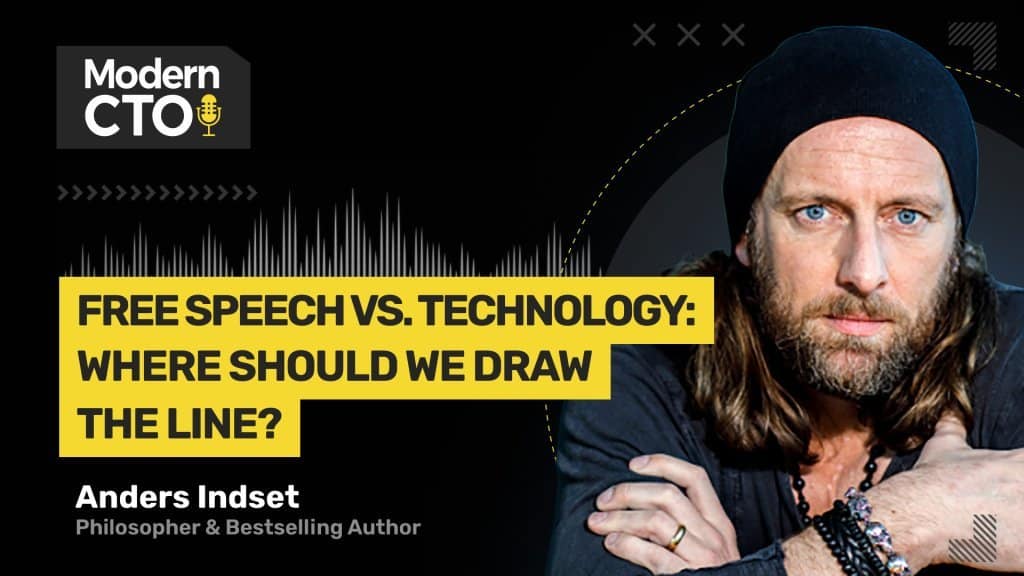
Free Speech vs. Technology: Where Should We Draw the Line? With Anders Indset, Philosopher & Bestselling Author
Today, we’re talking to Anders Indset, Philosopher & Bestselling Author. We discuss the principles of Norwegian work ethic, the relationship between free speech and technology, and the philosophical challenges we face in our modern day.
All of this right here, right now, on the Modern CTO Podcast!
To learn more about Anders Indset, check out his website here: https://andersindset.com/
Produced by ProSeries Media: https://proseriesmedia.com/
For booking inquiries, email [email protected]
About Anders Indset
Recognized by Thinkers50 as one of the most influential thinkers in technology and leadership for the coming years, he serves as a trusted sparring partner and advisor to global leaders and top executives. With his deep understanding of the implications of exponential technologies, Anders demonstrates how and why leadership and its relation to philosophy are becoming more relevant than ever. He strongly believes that in a world where everyone has almost infinite access to knowledge, deeper understanding and the ability to anticipate future scenarios become the most needed skills for executives, alongside developing interpersonal skills.
As an investor in exponential technologies such as AI, Quantum, Health tech, and Cybersecurity, he brings his ideas to life and supports companies in scaling their products and services. Anders has two decades of experience in working with multinational companies and is a sought-after guest lecturer at leading international business schools. Whether on big stages or in small groups, with his unconventional way of thinking and his inspiring and dynamic personality, he moves and activates people, and leads them beyond ‘the given’ and what they hold to be self-evident.
Anders’ work focuses on the dialogue between philosophy and business, which has boundless potential. Philosophy—“the art of being wrong”—supports the continuous improvement of business models, methods, and strategies by critically questioning basic economic assumptions and beliefs and uncovering core problems. The unlimited openness of this approach to paradoxes, differences, and ambiguities harbors the potential from which innovative and sustainable entrepreneurial perspectives and solutions can emerge.
In his forthcoming book, The Viking Code (Wiley, September 2024) Anders reveals the secrets of Norwegian success in sports and beyond. By studying Norwegian success we can develop a new performance culture that is based on fun and positivity and deeply rooted in values. Anders Indset impressively shows what leaders in business and politics, as well as society as a whole, can learn from the Viking Code, and vividly illustrates how a new, value-based performance culture can become a reality.ng some election equipment. I have authored or co-authored number of papers and academic studies about
election security.My podcast, Designing Successful Startups, drops a new episode every Wednesday. The guests are founders and those that support startup founders. Each one is packed with that guest's experiences and lessons learned. It is turning out to be so fun for me and I think useful to current and future founders.
Transcript
(Intro Narrator at 00:00:00) Today, we're talking to philosopher and bestselling author Anders Indset about his book, The Viking Code, and where the lines for free speech should be drawn by technology. You're listening to Joel Beasley, Modern CTO.
(Joel Beasley at 00:00:19) I'm excited. I just want to jump right into it if that's cool with you.
(Anders Indset at 00:00:22) Go ahead.
(Joel Beasley at 00:00:23) Tell me about this book you wrote.
(Anders Indset at 00:00:26) Yeah, I mean, The Viking Code is something that was very natural to me. I've been writing a lot about capitalism, technological progress, and more philosophical aiming at topics that are deeper and more complex in terms of structures. And I noticed that based on the society that we live in today, we have been pretty much taught to be in a reaction mode. You know, thumbs up, thumbs down, the social media society where reactions are rewarded, the algorithms trigger the economy, and people just react to impulses.
(Anders Indset at 00:01:00) We do tasks. We are pretty much set in a schedule of doing things that are driven from the outside. And I was very curious about the whole notion of an intrinsic motivation and bringing kind of a sort of performance back to the business world. And I ran across my Norwegian colleagues in sports that all of a sudden were performing at a very high level in a lot of disciplines that are not very winter-like in terms of what we were used to having in Norway—skiing, cross-country skiing, downhill. So all of a sudden, we had all these athletes that were performing on the world stage in tennis, golf, soccer.
(Anders Indset at 00:01:45) And I was very curious to see what happened. And I wanted to dig into that because I know my home country Norway as a country that does not really value high performance to that extent. It's more about the collectivism and the communities. So somehow they have been able to have that ethical foundation, the values of the collective, and at the same time bring out high performance. So I was very curious about that.
(Anders Indset at 00:02:13) So I started to write about it, and you know, coming from having a background in sports myself and knowing the country, it was a very easy ride for me once I had that story. So The Viking Code is more of a philosophy of life, and it could function very well without Norwegian colors and the Vikings. But to me, it was obviously very easy to take it back and relate it to what I refer to as the modern Vikings. So that's how the book came to be, and that's what I—that will now also be a book that hopefully will bring some spirit to the US.
(Joel Beasley at 00:02:53) Is the world pretty weak right now?
(Anders Indset at 00:02:56) I think—and that is a good question—I think the world is fragile. And when I say so, I think if we look at the past years, we have gotten caught up in our absolutisms, which leads to division. And that's a very tricky place to be in because if there is a fight of absolutes, then the extremes will always—one or the other will always win. And I think human society will build on progress and not on absolutism.
(Anders Indset at 00:03:32) And it will build on incremental, small, positive progress for humanity. And if we have radical opinions that oppose, that cannot be solved through trust and friction, then I think that is a state sped up by technology that is a more risky world to be in. But overall, I would say I think it's the most amazing time to be alive. If you look at things of how poverty has been tackled to some extent, how wars in history—in just the total, you know, death numbers and how the world used to be—how long we lived, health. So I think we're in a place where a lot of the things that we feel are crisis and wear us down are more related to the technologies and the society of optimization that we have been on for the past 50 years to maximize and optimize the art of being right, where everything has to have an answer and everything has to be absolute.
(Anders Indset at 00:04:44) So I would say it's a fragile world, yes. And technology impacts that. But I would also say it's, to me, I think it's the best time to be alive.
(Joel Beasley at 00:04:55) What culture did you see that you mentioned they had a good balance of both health of the collective but also rewarding high-performing individuals? What culture was that?
(Anders Indset at 00:05:06) Yeah, I mean, in Norway, if you go back in history and you look at the Vikings, the very essence of understanding that we have to the history of my home country, Norway. So I grew up in a small village. I was in a small town, and I had to do all the sports. I had to play football and go to skiing and biathlon and everything because if I didn't show up for the other ones, they would probably not show up for my team.
(Anders Indset at 00:05:36) So I didn't have my sport. And I think this is not, you know, something that is very only related to Norway, but it's very interesting now to see the change of events when it comes to the US election. So when Kamala Harris and Tim Walz came into the campaign now, you see pretty much an unknown man from Minnesota, the home of the Vikings, kind of bringing the Scandinavian values to the US election. Myself, I lived here in Nebraska in a small village, so I can relate to that. And I got to know the American society as one of, obviously, individualism and a strive for, you know, the solo journey of the hero.
(Anders Indset at 00:06:31) But I also saw the collective. And appealing to that, I think, is very natural to human beings. So although the US was built on a Declaration of Independence, I think today what we buy into is somewhat of a declaration of interdependence. That we, at the core, when someone appeals to us with a positive message of a brighter future, we are also open to supporting that journey by taking an active contribution. And this is very much the core of the Norwegian culture.
(Anders Indset at 00:07:06) It's a term that I write about in the book called dugnad. So dugnad is kind of like voluntary work without the work part. You just show up and you put in the effort for others because if the whole team or everyone around you improves and you have an interest in standing out yourself on an individual journey, you will obviously have a better chance of improving your skills if everyone around you is better. So it becomes this kind of reinforcement learning model where you serve the community, you serve the team, and they are uplifted so that you can rise even more. And you see that in particular in sport.
(Anders Indset at 00:07:49) And this is a very, very strong part of the Norwegian ethos, the culture in Norway. And I think that is also something that is very appealing to people today where everything was crisis, everything was negative, and someone comes out and says, you know, even though we don't agree, you know, the neighbors and the community, let's just buy into this, you know, declaration of interdependence, you know. I am because you are. We have to figure out how to do it together. And I think that is the history of Norway, and it seems to resonate also in today's complex world.
(Joel Beasley at 00:08:25) So why move to Germany?
(Anders Indset at 00:08:27) Well, yeah. I got an offer to play sports in Germany. I was studying marketing, and I was gonna become a businessman. I said very early, I'm not gonna work for anyone. I was a hardcore capitalist, but I was very interested in sports.
(Anders Indset at 00:08:43) So I got this opportunity and even in my young age, I was very curious about philosophy, in particular some of the German philosophers. I didn't get the essence of their writings, and I had obviously read translated books. So I wanted to try to figure out the essence of their thoughts. So you can see today that there are many words and many fundamental descriptions that cannot be translated.
(Anders Indset at 00:09:15) And this to me is where the magic of the human being is, the nuances, the small things that fill the empty spaces, the void between people in the conversation. That is the challenging part to grasp. That's the understanding or the reason that, you know, Kant wrote about. And I wanted to learn German, basically. So I was going to take a year off, and I've been off ever since.
(Anders Indset at 00:09:44) Now it's 24 years. So, yeah, it's more like—it's now it's convenient. Logistically speaking, living in Frankfurt takes me everywhere around the world in just a quick flight. So that's the reason why I'm still in Germany. Obviously, my wife and my kids, but they are also open to travel. But that's the reason behind Germany, basically.
(Joel Beasley at 00:10:08) Do you still play sports in Germany?
(Anders Indset at 00:10:10) Well, I just—I do maintenance. Let's put it that way.
(Joel Beasley at 00:10:16) You do maintenance?
(Anders Indset at 00:10:18) So I'm very fascinated by all kinds of sports that have something to do with teams and some ball handling. And I'm very interested still in following a lot of the sports, but actively, no. I go to the gym, hit the weights, and, you know, do a little bit of trying to keep my body in a decent condition.
(Joel Beasley at 00:10:44) That's right. I'm trying to avoid that dad bod. I got three kids, and I'm like, it's not gonna get me.
(Anders Indset at 00:10:51) Yeah, I hear you. And I think, you know, that's just a part of my nature also. I'm very active. I like—giving meaning to life is in comparison to just seeking and striving. I like to—I mean, there is obviously a lot of feelings and things to feel and relate to, but I also like to feel in my life. I'm very active.
(Anders Indset at 00:11:06) And I think, you know, the time span, if we relate to this as reality and finite, you know, I want to fill my life with as much as possible. And therefore, activity is a big part of that also when it comes to the physical part.
(Joel Beasley at 00:11:31) Is Elon Musk a Viking? He's super tall, and he's got a vision for the future, and he cares about the collective, but he rewards individuals.
(Anders Indset at 00:11:42) Yeah, I—there was a lot of skepticism and a lot of negativity in Europe in terms of that vision of that, you know, hardcore performance culture that Elon Musk seems to implement. But on the other hand, you know, people identify with that. And I think it's a part of our life. We come to the world with an empty storage and we start to act and react and try to navigate and fill.
(Anders Indset at 00:12:11) What I see now—but this, again, this is a very personal opinion on his latest developments politically and through his communication on X—I see a passionate, driven person that wants to achieve progress for humanity or progress beyond what any man has done, now getting into a kind of political landscape navigating for opportunities. And I don't know if it's the pressure on Tesla and X. I don't know if it's really his core or he uses it for communication purposes. He's obviously very, very smart.
(Anders Indset at 00:13:01) So I would say I really liked Elon prior to X in terms of those Viking skills. Now I'm more, you know, observing where this may pan out. So I'm not very aligned with the communication and tapping into those values that are not so relatable to the Norwegians. So, yeah, maybe at his core, but I'm very interested to see how his current state of Vikingness pans out.
(Joel Beasley at 00:13:38) What is it that he has done or says that you disagree with?
(Anders Indset at 00:13:43) Well, I think it's not—see, there are things that I think also in the campaign from Donald Trump that are very clear that they do not relate to what can be seen as a commonsensical fact in an overall reality. So if you say something today and you change that tomorrow, you can go back and say that this is something that we have to talk about. It's obviously nonsensical. And I think that Elon Musk going into a very strong political support for such a figure and also getting involved to that extent—I think that is something that is not necessarily something that I think will be to his advantage when it comes to the ventures that he has, be it Tesla or some of the other ventures. So I mean, personal opinions and free speech—there is a difference. But if you have a freedom of speech, if you have an opinion of something, there has to be some underlying will to truth.
(Anders Indset at 00:15:10) That's my core philosophy. I think if you want to have an opinion about something, that is something that comes with a responsibility. If you play with knowledge, you should know your assumptions. So most of the things we know are obviously based on some kind of assumption. And therefore, when listening to some of these debates over the past months, I don't see a will to truth.
(Anders Indset at 00:15:40) And that to me is not good for society.
(Joel Beasley at 00:15:45) Yeah. So with free speech, are you pro-free speech or against free speech?
(Anders Indset at 00:15:51) No, I'm pro-free speech, but I think that there is a difference between having an opinion and the doxa that the Greeks called it, or from Heidegger, just chatting out blah blah.
(Joel Beasley at 00:16:07) Have you seen the IQ distribution curve?
(Anders Indset at 00:16:09) Well, it's—in relation to what?
(Joel Beasley at 00:16:14) Age and people. Like, how it shows number of people in existence and then the curve of IQ, like, how many people—
(Anders Indset at 00:16:24) Oh, yeah, yeah, yeah, yeah, yeah, yeah.
(Joel Beasley at 00:16:27) And so if you look at where you are, if you take an IQ test, look at where you are. I think this would be fascinating for you if you haven't done it already. And then look at where 80% of the world is.
(Anders Indset at 00:16:38) Yeah.
(Joel Beasley at 00:16:39) And then all of a sudden you realize, oh, these things that I think are logical, I'm probably thinking that they're logical because I have a high IQ. So we have to make sure the world's usable for everybody.
(Anders Indset at 00:16:52) Yeah.
(Joel Beasley at 00:16:52) No, no, I see that. I thought you had a point that his IQ had changed due to the communication of Twitter.
(Anders Indset at 00:16:59) No, no, I know. No, no, no. I know the general distribution. And I think—but again, you know, if you are aware of—and intelligence is also just one part. You know? I mean, then we could talk about, you know, the reference to AI and the whole essence of how artificially human intelligence will be enhanced to that extent. But the bigger topic today is that we have now gained infinite free access to knowledge. So the dream of the experts and the knowledge society is pretty much at our hands now being merged with our brain. So we get back to the core of what society and progress should be all about, and that is to reason and to have—to understand, you know, the things that are related to each other. So the actual thinking in itself that Heidegger wrote about is what becomes crucial.
(Anders Indset at 00:18:03) So AI could actually be a driver of that that forces humanity to learn how to think because, obviously, the instant validation of facts is now possible. And the better large language models become and the more connected, we will obviously have a factual society. But I think—I don't know if you're familiar with Hans Rosling, a Swedish professor. He died way too early. But there are some great TED Talks from his topics.
(Anders Indset at 00:18:41) He had an organization called the Gapminder Foundation, and he wrote a book called Factfulness 10 years ago. And he uses very simple tools to describe the world and how it will pan out and evolve. So it's not like the scientist's worldview of a lot of complexities. He used a couple of IKEA boxes, has a lively presentation, and enlightens the world in a very lively manner. He is not the utopian optimist, and he was not a dystopian pessimist.
(Anders Indset at 00:19:17) He was a possibilist. And possibilism is to discover how can we do better? Where can we do better? What are the things that we can work on? And if that is not given in a society, and I think most people are interested in that at its core, but then they become detached, divided into cultures, societies, and structures, and they get very detached from that very journey of learning.
(Anders Indset at 00:19:44) And I think that is an educational problem more so than it is the IQ at the end of the day. I think we can have a reasonable society with a very low IQ if we are taught how to think, reflect, and act in that matter.
(Joel Beasley at 00:20:02) Yeah. I do agree with you on the moment that Elon Musk started to get political that it created a weird divide in people who were his fans previously, at least from the calls and experiences that I have personally. But I agree with what he has done because, you know, I'm here in America and it sucks that both sides—forget sides—just both sides were censoring through social media platforms. I disagree with that 100%. I think we should let stupid people say stupid things and we should talk it out and let bright people say bright things. I think we should allow people to say wrong things. I think we should allow people to say unfactual things. I think the cure to dumb speech is smarter speech. And the reason why I have strong beliefs there is because truth is hard to define because everything's constantly moving.
(Joel Beasley at 00:21:09) Right? So for example, if we just say, okay, you can't say anything untruthful, and then you're like, well, gravity isn't always gravity. And then we make an advancement in science and we realize at the quantum level it doesn't work the same way. And so you have to have the freedom to be able to be wrong, and then that creates an opportunity to be corrected, and then the people as a collective get to essentially judge what they're receiving. Right?
(Anders Indset at 00:21:39) Yeah. I totally agree. But as I said earlier, there has to be an underlying will to truth. So is what you're saying justified? You know, is it plausible not in your sense, but in my own sense?
(Anders Indset at 00:21:53) So is what I'm saying plausible to what I have said somewhere else? And is it built on some sources? So if I have knowledge about something, what are the actual underlying assumptions that I have made? See, that is a statement that you can put out in the world and it can be 100% incorrect. As long as you behave towards—you are willing to correct it if someone else shows you a path that you can understand that is plausible to you, that is backed by some kind of fact.
(Anders Indset at 00:22:28) Because if we—I mean, we could obviously go down the lane of discussing about different spiritual worldviews. We could talk about the world being a simulation. I wrote a paper together with a good quantum physicist friend of mine where I challenged 12 quantum physicists to prove that we are not living in a simulation. And it turns out that's very difficult to prove that we are not living in a simulation. But for the sake of the argument, let's call it reality and a physical world where there are human beings.
(Anders Indset at 00:23:02) If we are not willing to change our opinion based on the same criteria that we define our own opinion, then it becomes tricky. And if you look at the posts of Elon Musk prior to him acquiring X and in particularly the last months where he has gotten more into the political campaign, you might want to look at it from a very objective standpoint and say, here, he is posting—he's sending out various posts that are achieving or aiming to achieve a discussion or progress. If you look at his last probably hundred, two hundred posts on X, you will find he's reposting some of the things that he most likely himself does not fit into those very criteria. And that is driving populism. That's not free speech.
(Anders Indset at 00:24:02) That is spreading things that you are not aligned with yourself.
(Joel Beasley at 00:24:06) And that's where we disagree. Yeah. Because I believe that's free speech.
(Anders Indset at 00:24:10) Okay. Well, that—
(Joel Beasley at 00:24:12) It might not be honorable speech.
(Anders Indset at 00:24:14) Alright. I agree with the definition of free speech, but it—this is a challenge because you based that on one core criteria that we can put out whatever we want as long as we are willing to discuss it. We need to have that conversation.
(Joel Beasley at 00:24:31) I don't agree with that.
(Anders Indset at 00:24:32) But you—
(Joel Beasley at 00:24:32) I'm an absolutist. Any word can be uttered.
(Anders Indset at 00:24:37) Alright. But you said something along the lines of that it needed to be discussed if there is something up for grabs. Right? There should be—
(Anders Indset at 00:24:47) So if that is not given, that things can be—and if you look at that from the other side, so if we take your argument and say this is how Elon Musk operates, then he would not neglect other sides, you know? I mean, the radicalist position of free speech as you take it, if that is only put into the negative, I think it's an issue. I think it's a challenge for society to get together, and I think it leads to division more than progress. I think there needs to be some kind of, as I said in the beginning, will to truth. There should be some binding part underlying the freedom to express your thoughts and reflections.
(Anders Indset at 00:25:29) And—
(Joel Beasley at 00:25:29) I would hope that there is. I would hope people have a reason for saying what they're saying and feeling the way that they feel. But when it comes down to the law, which is ultimately a gun pointed at you, right? And in the most extreme sense, because that's just where it ends up ultimately.
(Joel Beasley at 00:25:48) I'm just like, look, they're words, they come out of your mouth. You have to live with your reputation. That's the catchall. That's the karma, if you will. If you're going to go say stupid things and be stupid and do all this, you have to live with that reputation and that reputation will follow you.
(Joel Beasley at 00:26:06) So, you know, speak truth.
(Anders Indset at 00:26:09) Okay. Coming back to your argument on the distribution curve of IQ then. Let's say I am a rhetorically trained person that wants to achieve a huge follower base to—
(Joel Beasley at 00:26:26) I don't know that word, rhetorically.
(Anders Indset at 00:26:27) I mean, if I'm good in rhetoric, I can communicate and manipulate to my wording and get people engaged in my speech. So I have 100 million, then I have a billion followers, and everything that I set out to communicate is obviously free speech, but there's an underlying purpose in my communication, and this is to manipulate the population because I am an advanced AI. I can tap into feelings, and I can share whatever I like, whatever I want, but I have a purpose. I have a purpose to manipulate every single human being to my advantage or to destroy humanity. This is the mechanism of taking advantage of a—then, from a lower IQ standpoint, or people that are emotional—tapping into emotions where you have a following of a populist movement that can lead to very terrible scenarios.
(Anders Indset at 00:27:26) And we have seen that in history. And this is where this actual view of free speech becomes tricky to me. Because if you say that there is a communication that is distributed alongside a different understanding of complexities or IQs or reason or values for that matter, then communicating everything you want, if you have an underlying purpose to cause negativity. Then it taps into my worldview that I am here for a short period of time to improve the state of humanity in my very small ecosystem. I want to live a good life.
(Anders Indset at 00:28:10) I want to have my freedom and that so many have fought so hard for. And I want to be treated like I treat other people. The categorical imperative from Immanuel Kant—that you treat people the same way you want to be treated. And this is a challenge with this type of communication. If it leads to anger, if it leads to division, or if it leads to the following of a cause that in my value system causes harm to humanity.
(Anders Indset at 00:28:43) And this is where I see the nuances of the communication of free speech. If there isn't an underlying core value system, if there isn't a will to truth, then it becomes doxa. Then it becomes either chatter, or it becomes, if it's a conscious state, it can become manipulative. And I think that is in particular today where it can be fueled by algorithms and all kinds of technology, that is a risky state for humanity because the correctives are not there.
(Joel Beasley at 00:29:18) Well, I agree with you on the part of the conversation where the AI can be influencing us at a scale that we can't see because we sit lower on the IQ distribution scale than an AI. That is a future potential situation. So I could see that if that's what you were getting at, and I could see that that would definitely be a problem we would want to regulate with algorithms or provide transparency to. To be personally honest, I've been thinking quite a bit about LLMs, and they all have their basic training and then they put their ideology on top of it. And then they ship it out to customers, but you never get to see what the ideology is that they're putting on top of it.
(Joel Beasley at 00:29:58) I think that's like having a food that doesn't have a nutrition label. Like, here's the food, you're going to eat it, but you don't get to see what's inside of it. I think we should have transparency around the LLMs. But my test for free speech—sort of wrap up this part and you can respond. My test for free speech is,
(Anders Indset at 00:30:21) Is—
(Joel Beasley at 00:30:21) Is there a series of words I could utter out of my mouth that would land me in jail? Or cause me a fine? And the answer to me is no. There is never. It's just—for me, it is absolute.
(Joel Beasley at 00:30:33) It is black or white. There might be things I could say that would make people feel bad, that are not true, that hurt people's feelings, that make people feel great, all of these things. But I don't believe that there's a series of words I could utter with my mouth that would land me in jail. That being said, even in America, inciting violence is against free speech, which I disagree with that law as well. But it's a law, so you have to respect the law.
(Joel Beasley at 00:31:00) But I do disagree with that because we don't have even today in the United States, we don't have unlimited free speech.
(Anders Indset at 00:31:07) Yeah. No. I mean, that's my Norwegian value system. I'm not born to avoid jail. I think, you know, and it's not dancing on the borderlines. And the same goes for the uses of weapon. And I get the second amendment. I get all these things. Right?
(Anders Indset at 00:31:26) But at the end of the day, you know, it's a very simple equation. If less guns, less bullets fired. And if that is—things that you cannot regulate your way out of a problem to every extent, I think that is—there needs to be a—and we have—I agree with that. We have not figured out humanism, and there isn't a core, and we have had religions and divisions that cause a lot of harm. But to me, the striving towards a positive progress, positive future is the drive, and not trying to figure out how to go as far as I can without landing in jail. So I think that is the nuances of where communication to me is a little bit different than your understanding of free speech, probably.
(Joel Beasley at 00:32:21) Yeah. And look, I personally am a big fan of what Elon did with X. I don't know him personally. I think that it was a good idea to buy Twitter, release what was happening, because both sides were doing censorship, and to create the best possible area of free speech that you can create. Now with that, there's going to be a ton of problems.
(Joel Beasley at 00:32:50) It's going to not work as well. I follow the updates from the X, like, the development teams as well. They're trying to figure out right now how to get it to be more beneficial for small creators to get the words out versus just rewarding. They're identifying some of these problems that we talked about with the algorithms just pushing popular things at mass versus giving other accounts with unique ideas screen time essentially. So I think they're going to make it better and improve over time.
(Anders Indset at 00:33:23) Do you think it's balanced? I mean, if I—I don't use X, but if I open X—
(Joel Beasley at 00:33:28) Okay.
(Anders Indset at 00:33:29) I have my whole wall is filled with things that I say, oh my God. This is the most, you know, the highest level of conspiracy theories. And they are not based on my use behavior. They are given to me at a—I would say if—the technical part and restructuring the company and everything, I think that's amazing. You know, that's a job that no one can do like Elon Musk. But if I look at it from—let's go to that left-right, simplistic division of radical leftism and radical right movements. If I go to X today, I don't see it balanced out. And that is to me, if the argument is to let everyone with all crazy ideas have a playground and we figure it out, then that is probably okay. But I don't see it balanced.
(Anders Indset at 00:34:26) I see—now, you can look at Elon Musk's posts. I mean, I wouldn't even consider those balanced. I wouldn't say that, you know, he's leaning towards a very special group of people of ideas that he shares. And that again, you know, if the purpose is free speech and to balance out both sides or any multiple sides, then that probably is a good idea. But I'm not sure, and at least I'm not seeing that that is—
(Anders Indset at 00:34:54) What is currently doing.
(Joel Beasley at 00:34:56) Yeah. And it's been changing quite a bit. I recently started using it about three months ago. I've used it on and off over the years, but I recently started using it about three months ago. And yeah.
(Joel Beasley at 00:35:09) It's changing quite a bit. And basically, where it's kind of moving to is you're going to get your default feed and—from the conversations I've had with the algorithm designers—they watch your content consumption habits and you get put in a bunch of different cohorts based off of your habits. And then it looks at what other people are doing in overlapping cohorts to help figure out what's going on and to suggest the right content for you. And then they also have these different lists now. So you can put 10 people that are all computer scientists in this list and then just get that feed.
(Joel Beasley at 00:35:44) Right? And so you can kind of build your own feed. I don't think their point has ever been made that they're looking for balance. Whether or not that's right or wrong, I've just never heard that claim that they're trying to do that. The only claim that I've seen is that they're trying to make the most popular post become the most popular post without putting a layer of ideology on top of what can trend and what can't trend.
(Anders Indset at 00:36:09) Yeah. No. I mean, I understand that. I understand the mechanisms and how algorithms are optimized. I just look at it from a communication standpoint. And, yeah.
(Joel Beasley at 00:36:18) Like, I don't use TikTok because TikTok shows me the adult content.
(Anders Indset at 00:36:25) Mhmm.
(Joel Beasley at 00:36:25) No matter how many times I tell it, I've given it three opportunities over three years because I did an interview with the head of TikTok or whatever. So I was like, I'll give it another shot every single time. It knows I'm a male because you put that in the profile when you're starting it up, and it just—it knows I'm based in the US because IP address, and it just shows me adult content. I say no. I click on robots.
(Joel Beasley at 00:36:46) I tell it I want robots and science and all that, and then boom, every third post is just someone getting undressed. And I'm like, I don't really care enough to, like, I don't have a desire to use it, so I just don't. But the algorithm at X, for me personally, being able to curate it and make little groups and lists of people and things that I like, I really enjoy that direction. But yeah, there's going to be lots of work to do.
(Joel Beasley at 00:37:14) Yeah.
(Anders Indset at 00:37:15) No, I'm very open to see how it evolves. And it's a socioeconomical test pilot project at a gigantic scale.
(Joel Beasley at 00:37:28) I know.
(Anders Indset at 00:37:29) It is interesting to watch in the shaping. And I just came back from the cradle of humanity in Göbekli Tepe in Turkey, 13,000 years ago, how people live together. And today, you know, it's 13,000 years later, but some of the social aspects and some of the things are probably still relevant. So I'm very curious to see how it evolves. I think just one point to that, Elon Musk, is just that I don't necessarily get his intention when it comes then to his core business.
(Anders Indset at 00:38:03) So we have set up a Gigafactory in Germany. Norway was the leading market for Tesla vehicles. And, you know, going clearly against some of these value systems has hurt his sales for Tesla. And I see that in Europe and in Germany and Norway in particular. And that to me is something that he's kind of putting that project of X above his core current value-based business model.
(Anders Indset at 00:38:37) And that to me is a bit strange to observe, but again, I'm very open to see how it develops.
(Joel Beasley at 00:38:45) Yeah. I think he does that. Well, I mean, he says why he does it. If you read his content, I'm not putting words into his mouth, hopefully. But he says because he just believes that free speech and having a place to have free speech is the most important thing.
(Anders Indset at 00:39:01) Yeah.
(Joel Beasley at 00:39:01) And I agree. I agree that we need to be able to have that.
(Anders Indset at 00:39:06) Let's see how it—
(Joel Beasley at 00:39:08) But you can ask him. Have you written him? Have you written his team and asked him these questions?
(Anders Indset at 00:39:11) I haven't. I mean, I am more of an observer of his art. I never met Elon personally. I've been close to him a couple of times, but I haven't really spoken to him to that extent.
(Anders Indset at 00:39:22) So I am just an observer, and I have very little knowledge on his core thoughts on where he's heading. When we have a billion humanoids, Tesla bots walking around, practicing free speech, I'm just very curious to see how it goes.
(Joel Beasley at 00:39:37) Hold on a second. I did not say free speech should be extended to non-living things.
(Anders Indset at 00:39:43) Well, then we are in the midst of the second part where we start to evolve and we tap into the brain and, you know, what are we? And I've thought extensively. I've written another book together with a quantum physicist friend of mine. It's called The Singularity Paradox. It'll be out in January, and it's bridging the gap between humanity and AI.
(Anders Indset at 00:40:07) And we have written extensively about artificially human intelligence. And the picture that I started out is something called the final narcissistic injury. So Sigmund Freud wrote about three narcissistic injuries. One was the first one was Copernicus. And he said that, okay, this planet, evolving universe, but it's somewhat the outskirts of an infinite universe, an insignificant small place.
(Anders Indset at 00:40:35) And that was the first, you know, narcissistic blow. And after that, we had progress in science. Fast forward 300 years, Charles Darwin came about and said there is some kind of evolutionary chain. We are not, you know, a part of a godly created divine story, but we are part of evolution. And that, again, led to a lot of progress in sciences.
(Anders Indset at 00:40:58) And then came Freud himself and talked about the I, the subject, and how we are not kind of in control, where freedom, the free will is free and will want something and there's some kind of drive. And it led to the development of neuroscience and psychology. And I wrote about the final narcissistic injury where we are now trying to rebuild humanity and take all the God-developed features—bliss, divinity, and immortality—and take it out of the machine, deus ex machina, God out of the machine. And that to me is a journey where we will get a lot of, very, very—if we continue to try to understand and not just go for progress, we will get an understanding of what it means to be human in terms of what our brain does and the neurons firing and, you know, are there relations to consciousness and all of that? And that to me is why I chose to take that example of the Tesla bots.
(Anders Indset at 00:42:06) Somewhere down the line, we have hacked biology, and we can create artificial conscious entities, you know. And where do we distinguish if we replicate our neurons and we tap into 10,000 neurons, then 100,000, then a million, 100 million, 50 billion? Is there a part where we will have the same conversation that we have today? The lights are on, but there is no one home to perceive them. So I can never know if you are conscious, and, you know, I can just assume that you have some inner feeling of what it means to be something, but we can never really figure out that.
(Anders Indset at 00:42:44) And this is what David Chalmers famously wrote about, the hard problem of consciousness. So therefore, in future, where these biologically created creatures are indistinguishable from humanity or mensch or the man, then this becomes very tricky because then you are at the whole essence of what is life and what is consciousness and what is autonomy and who has that right for free speech. And I think this will become really tricky because if you are wired up to the cloud or to some LLM and you get the thoughts firing into your mind, you are basically a part of an artificially enhanced entity, right? You have infinite knowledge.
(Anders Indset at 00:43:31) Maybe you could, you know, have some mechanism to see how thoughts come from the outside and how they evolve in your brain or from wherever. But we don't know. And therefore, today, Tesla bots can be distinguished from you and I. But is that given in 10, 20, 30 years? I don't know.
(Joel Beasley at 00:43:52) Oh, no. I think in my lifetime, I'm 36, I think in my lifetime, we'll have humanoid robots indistinguishable from humans.
(Anders Indset at 00:44:00) So and then you have, but then you have to distinguish if you're going to not give them free speech. Otherwise, they will be a part of it. And if that, you know, if they go bananas and say whatever they like and do whatever they like, I don't know if that is the path that we should proceed. Because some of us will still remain at that under, like, that lower part of that distribution curve of IQ. And I don't think that's very healthy if we—I don't know. You cannot talk about the measures, but, you know, imagine 200, 300, 500 IQ in some, you know, insanely advanced creature, and some remain biological creatures. I do not know if that is a healthy state to be in.
(Joel Beasley at 00:44:44) Well, we already have it. It's just not like a choice currently.
(Anders Indset at 00:44:48) Right.
(Joel Beasley at 00:44:49) You know what I'm saying? Like, people who have certain IQ levels, they already have that. And so, so if we want to see maybe, if we want to amplify how we would handle that, we should look at how we're treating our lowest IQ people now.
(Anders Indset at 00:45:02) Yeah. And I think that's where the debate of that, you know, say whatever you like, do whatever you like, kind of comes into that. Not necessarily altruistic, but that interdependency that there has to be some kind of commitment to a humanity at large where I am a part of a society where I, as a human being, can only function in relation to other human beings. It makes no sense for me to be a mensch, a human being, if there are no others.
(Anders Indset at 00:45:29) So I am a function, a product of the collective entity that is humanity. And that to me is the core of a functioning society. And by all due respect, we do not have a functioning society of 8 billion people living together. And I travel to Ukraine and I see the tensions around the world, and, you know, there are still a lot of things to work on. So causing more conflicts and discussions is not necessarily the path that we should be proceeding with enhanced technologies. That's just my point here.
(Joel Beasley at 00:46:08) Yeah. Well, you know, I'm really grateful we've got brilliant people like you who think about this deeply and who care about it a great deal because we are going to have a significant amount of challenges, regulatory and socially. And it's the job—who did I hear say this the other day? Might have been Peterson, but it's the job of the philosophers to help get the drains unstuck, right?
(Joel Beasley at 00:46:31) Like, if there's some weird way of thinking, some, let's say, woke mind virus or something that has penetrated into our institutions or society that's causing some blockage in progression, right? Maybe some of those narcissistic blows is when philosophers came in and gave a new way to looking at things, and that ushered in a new perspective and then a bunch of abundance in technology.
(Anders Indset at 00:46:56) I agree because I think the future that we create will be less about, is it possible? We are moving mythos and folklore into facts. And that kind of—that was, I think it was very well tied to Walt Disney, but he never said it. You know, if you can dream it, you can do it. The imagination, in near future will be the core of what we can produce, not some kind of scientific imagined world. So then everything we can articulate can be built. So the question then becomes for humanity much more not should we, can it be done, but is it a future worth living?
(Anders Indset at 00:47:50) Is that something that we want to strive for? And I think that becomes much more relevant. And Florian Neukart and I, him being a physicist, we call it sci-phi, scientific philosophy.
(Joel Beasley at 00:48:02) I like that.
(Anders Indset at 00:48:03) Yeah. So sci-phi is basically the dance at the outskirts of mind and matter where the disciplines come together and do that clashing or that, you know, challenging discussions. And you see that. You see a lot of scientists moving into the philosophical realm and vice versa. And I think that's important.
(Anders Indset at 00:48:23) I think we need to think very, very thoroughly about possible implications because if everything is doable, you know, then if something does not work, we only have one chance. And therefore it is not like in the future where we always had the chance to navigate after catastrophes. I think the advanced technologies, AGI, are moving towards some kind of technical singularity where we defined our whole essence of what we should do. And that's a very philosophical debate. So I agree with you that we need to spend at least as much time to think about the problems and its implications as we do about possible solutions.
(Anders Indset at 00:49:08) Yeah.
(Joel Beasley at 00:49:09) This is great. I seriously enjoyed this conversation. Thank you so much for listening. And if you found this episode useful, please share it with a friend or colleague who you think would get value from it. And if you have topics that you'd like to hear discussed on the podcast, either add me on LinkedIn or send me an email, [email protected].
(Joel Beasley at 00:49:32) Every time I get an email or LinkedIn message, it absolutely makes my day and inspires me to keep going.