
Episode 811 ·
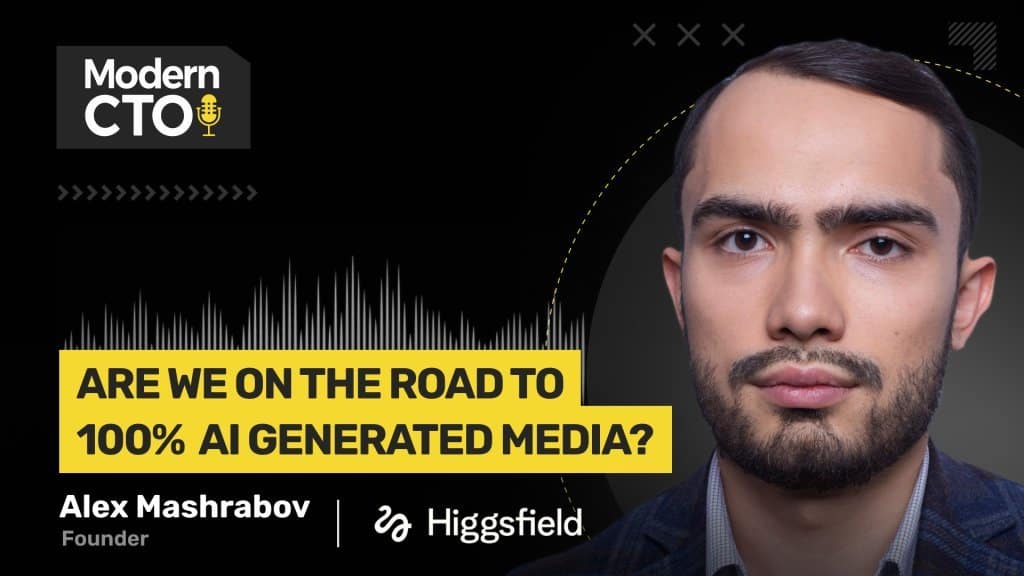
Are We on the Road to 100% AI Generated Media? with Alex Mashrabov, Founder at Higgsfield AI
Today, we’re talking to Alex Mashrabov, Founder at Higgsfield AI. We discuss the developments of AI generated video, how Alex has leveraged Google Cloud to build his business, and how modern tech will continue to revolutionize the way we consume media.
All of this right here, right now, on the Modern CTO Podcast!
To learn more about the Google for Startups Cloud Program, check it out here!
Interested in the virtual Google Cloud Startup Summit? Sign up here.
To learn more about Higgsfield AI, check out their website here.
Produced by ProSeries Media: https://proseriesmedia.com/
For booking inquiries, email [email protected]
About Alex Mashrabov
Experienced product & engineering leader with deep experience in Generative AI, Product, Strategy, and Mobile Apps.
Launched several cutting-edge AI consumer products at high-scale with 100s millions of active users.
Deep expertise in consumer applications: worked on User Acquisition to bring apps to the top of AppStore and Creators programs to scale content creation from 0 to 10,000s videos a day.
Love to learn and solve problems through curiosity.
About Higgsfield AI
We're a video AI company dedicated to democratizing social media content creation to everyone.
Transcript
(Intro Narrator at 00:00:00) Today, we're talking to Alex Mashrabov, founder at Higgsfield AI, about his outlook on Gen AI video creation, how Google Cloud supports them as a startup, and more. You're listening to Joel Beasley, Modern CTO.
(Joel Beasley at 00:00:20) So I wanted to start with—I was kind of surprised about this—but the idea that everyone needs to be prepared because in the next three years, 90% of pixels will be generated by AI. Is this true? How did you come to this conclusion?
(Alex Mashrabov at 00:00:38) Thank you very much for jumping straight to this. So there is a great possibility of this happening, for sure. I think there are several trends which tell us that we definitely move in this direction. So first of all, we definitely are seeing that the long tail of content is actually increasing. The importance of the long tail of content is becoming critical.
(Alex Mashrabov at 00:01:14) We're seeing an explosion of faceless channels on YouTube. Each of them is—I mean, there are probably not so many AI-generated faceless channels on YouTube just yet, but many faceless AI channel creators make a few thousand dollars a month, and we can find these stories on Reddit. I believe that generative AI can deliver personalization across this long tail of content. And we also are seeing that the quality of AI-generated videos is just getting better every month. If this pace of innovation continues and no major regulation appears, then we're very likely to wake up one morning and realize that most of the content that we consume is generated with AI.
(Joel Beasley at 00:02:10) And I like your take on it. Your take—and I'm probably gonna most likely mess this up—but there were several value props on your landing page for your application. And one of them I found fascinating, and it's that they put you at the center of the story. So I can take my picture, just one photo, and it will map onto the male in a story and act out that story, short story.
(Joel Beasley at 00:02:37) But then it looks like I'm watching a small short movie with me in it. And I never thought of the "you" component. I thought I would be driving home from pizza and I would tell my AI, "Hey, I wanna watch a new Adam Sandler movie with my kids," and it would be ready by the 45 minutes by the time I drove home, right? I could click play and I could watch Adam Sandler. So I thought about it in the sense of my existing habits. I never thought about it in the sense of putting myself into the story. That's crazy.
(Alex Mashrabov at 00:03:08) Yeah. And I think this is probably maybe the easiest type of personalization generative AI enables. You probably can remember that maybe two years ago, there was a popular application called Lensa, where everyone was generating pictures of themselves being astronauts and so on. And I think this is just the beginning. Everyone—I mean, it's just gonna become so easy to create any type of content, including content featuring you and your friends.
(Alex Mashrabov at 00:03:44) And I think this definitely sparks human creativity of where it can go. I think there is definitely a piece about deepfakes and concerns about that, and I'm really glad that over the last maybe few months, some leading companies in this space like OpenAI and Google, they are starting to establish new standards in that space.
(Joel Beasley at 00:04:12) And, you know, at first, I thought deepfakes were a concern, and then I found a bigger concern. And it's just the fact that there will be people—it'll be indistinguishable for us to tell the difference between is this a group of AI agents that are influencers? Are they real people? Are they fake people? They will surpass us in population because they can copy themselves and be at an instant maturity level immediately. It's gonna be a really weird world.
(Joel Beasley at 00:04:42) And I'm not concerned about somebody making some politician say something they shouldn't have said. I'm concerned about just humanity as a whole not being able to even understand what's real and what's fake.
(Alex Mashrabov at 00:04:55) Yeah. I really love that you brought this point up. I think this is a very important point which people probably should discuss more broadly. And I think very often, it just goes back to the conversation about deepfakes and politics, and I really love that you bring up this different angle. So let me please go back four years.
(Alex Mashrabov at 00:05:17) I was head of Gen AI at Snapchat, and TikTok was one of the largest advertisers on the platform on Snapchat. Four years later today, teenagers in the United States, they spend more time on TikTok than on Snapchat and Instagram combined. This is absolutely crazy. This enormous growth happened just in a few years. The way I think about that is Snapchat is about authentic connections, is about friendship connections.
(Alex Mashrabov at 00:05:52) Instagram was primarily a way to subscribe, to get updates from famous people whom you admire, different creators and influencers, right? And it feels to me that TikTok actually proved that we care about this less in general as humanity. We care less about this human connection—human connection to a celebrity, let's say I admire David Beckham, or to my friends.
(Alex Mashrabov at 00:06:23) We care less about these connections, and we are more willing as society to watch these random videos on TikTok. I call these videos from TikTok "random" because they're actually recommended by AI. Very often, we don't necessarily care if the video we should watch on TikTok, where it comes from. Is it AI-generated or not? Is this person in the video, is this person real?
(Alex Mashrabov at 00:06:55) Where does it come from? People just don't care. They just consume the content. So I think as humanity, we're already going in this direction where the authenticity of the content doesn't matter that much.
(Joel Beasley at 00:07:10) Yeah. And I think the solution for that is to go outside. Go stare at the woods, watch a live stream with fish in it, you know.
(Alex Mashrabov at 00:07:24) Yeah. Definitely. And I think that we may be going in a way that large creators will be able to actually be media empires through building these authentic connections. And a lot of traditional media who are basically reposting the same news will basically go down because their job will be automated by AI. I mean, AI is very, very good at taking, let's say, news announcements and transforming them to YouTube Shorts.
(Alex Mashrabov at 00:08:05) There are lots of such content on the YouTube Shorts already today, and I think authenticity is going to matter a lot for creators to avoid being consumed by AI.
(Joel Beasley at 00:08:21) And before we get too deep into it, I did wanna say a special thanks to Google Cloud because they connected us. I was talking with Madison over there, and they have this special program where they give up to $350,000 in credits to AI startups that meet certain criteria. And when I was talking with her, I was like, "Alright. Well, what's the criteria?" And she gave me a link which we'll post in the show notes.
(Joel Beasley at 00:08:43) But I also said, "Has anyone actually gone through the program and used it and had success with it?" And that's how we got hooked up. So can you tell me a little bit about what your partnership is like with Google Cloud?
(Alex Mashrabov at 00:08:55) Totally. So Google Cloud is an amazing partner for startups. When I was back at Snap, we definitely used Google Cloud a lot. We had these premium treatments. Google Cloud specialists were responding to us within a few hours.
(Alex Mashrabov at 00:09:14) And this was not surprising because Snapchat is a huge customer of Google Cloud platform, right? And I was so surprised when we got the same level of treatment here at Higgsfield. A very small startup of just 22 people gets this premium type of support where turnaround time is sometimes just one, two, three minutes. And very often, actually, Google Cloud team operates even faster than we do, and they push us to implement certain recommendations coming from their side. And this is absolutely true that Google Cloud supports startups and allocates these credits.
(Alex Mashrabov at 00:09:55) And I can tell you that sometimes it actually goes higher than just that.
(Joel Beasley at 00:10:01) And then are you speaking at the virtual Google Cloud Startup Summit on October 8?
(Alex Mashrabov at 00:10:06) Yeah. I'm really delighted to be part of this summit. I think that out of many large cloud providers, Google Cloud provides the best treatment for startups, and I think this is very important. This builds awareness about this so that early-stage founders can make the right choice for their company, especially—and this is extremely hard to get the first steps right without having that much support. And Google is exactly this type of partner who can provide all necessary support.
(Alex Mashrabov at 00:10:48) And what I like specifically about Google Cloud is that they have a set of different infrastructure solutions which allow you to build applications and scale as well, and actually focus on innovation, focus on delivering value to customers, while Google infrastructure can handle the rest.
(Joel Beasley at 00:11:10) That's pretty cool. Have you used Gemini at all?
(Alex Mashrabov at 00:11:13) Yeah. Definitely. So we work in the video space. And what we build is basically a multi-agent system. Definitely, video review is one of the key components of that.
(Alex Mashrabov at 00:11:24) Out of all large models available there—I mean, including GPT-4o, including Claude model—I believe that we found out that Google Gemini is the only model which is actually able to do video understanding. Since we are working on longer-form content creation today, being able to track consistency throughout the video is quite a difficult task. And image-based systems, like one from OpenAI or Anthropic, may not be able to track the consistency across the video. This puts Google Gemini model really well and sets it apart from the competition.
(Joel Beasley at 00:12:09) Well, yeah. If you're gonna generate a full movie, it needs to make sure the characters look the same across multiple scenes. They can't be driving a red truck in one scene and then the camera angle switches and they're driving a blue car immediately. Yeah.
(Alex Mashrabov at 00:12:22) Exactly. Yeah. Exactly. So I guess Google Gemini—I guess we are seeing that there is a recent model by OpenAI which is doing some sense of reasoning. And very often, we can see that for a very simple question, it goes with 80 calls.
(Alex Mashrabov at 00:12:39) And that's why it's so surprising that Google Gemini model has some sense of video understanding and reasoning behind that. And it doesn't need to do these 80 calls, right? It works much faster. This is really surprising to me. I think there is some breakthrough which they don't sell to the public.
(Joel Beasley at 00:13:02) Of course. Did you see the NotebookLM, the podcaster feature?
(Alex Mashrabov at 00:13:06) Yeah. This is truly amazing. I think—look, I can tell you privately that I was approached by multiple different large companies, large corporations, not Google size, maybe a little bit smaller, but much larger than Higgsfield. And a lot of them are actually looking into the podcast space.
(Alex Mashrabov at 00:13:27) This space got very quickly saturated by startups as well. So it felt like this is a red ocean. And this is so surprising that Google is actually bringing the best and fastest products in this space. I mean, a lot of creators say this is day and night. This makes a huge difference.
(Joel Beasley at 00:13:52) Now I wanna talk to you a little bit about your actual application. So I didn't have much exposure to it until today. I downloaded it. It was a pretty good user experience, by the way, for onboarding. It struck a nice balance of showing me what it could do without being annoying, and so I thought that was pretty good.
(Joel Beasley at 00:14:14) Could you tell me a little bit about what the most popular feature is in your application currently?
(Alex Mashrabov at 00:14:19) Yeah. Definitely. Thank you very much for the kind words. We definitely worked a lot on improving user experience. What we actually learned is that most consumers, they don't understand generative AI.
(Alex Mashrabov at 00:14:35) I think this goes back to my time on Snap. When we pioneered chatbots for large consumer audiences, it's hard to communicate to a regular teenager in the United States what actually a chatbot can do, what it cannot do. And here at Higgsfield, we had to probably launch 50 A/B experiments every month to get to this onboarding flow, which has quite high completion rates and leads to a very good activation rate as well. I think one of the—we probably had over 30 releases of this mobile application called Diffuse, and we actually came to the learning that the most retentive functionality is people watching themselves. People watching themselves be the hero of a story drives the highest engagement across all other use cases we have on the platform. That's why we're working on major updates to bring this concept to the next level.
(Joel Beasley at 00:15:55) Tell me about it. Can you share?
(Alex Mashrabov at 00:15:58) Yeah. Definitely. We actually were able to achieve a breakthrough in longer-form content creation where videos of five, ten, twenty minutes length can be generated with AI end-to-end. We're already seeing 100x cost, product cost efficiency in terms of the production, and there is no physical production involved at all. This is really exciting, and eventually, we believe we will open this as a platform to enable people's creativity.
(Joel Beasley at 00:16:42) Twenty minutes is the length of a TV show without commercials.
(Alex Mashrabov at 00:16:48) Yeah. Exactly. And the way I think about that, it is just going to be a new media format. This is a really deep topic, but let me please try to go a little bit deep into that. I studied the history of innovation really carefully, and my parents are professors.
(Alex Mashrabov at 00:17:09) So I try to take a scientific approach as much as possible. I have, obviously, a computer science background myself. So I really looked at the consumer space from the data perspective. We have seen a huge burst of successful consumer companies around maybe twelve years ago. We have seen Uber.
(Alex Mashrabov at 00:17:31) We have seen multiple hyper-casual companies, Instagram, Snapchat, and so on. All these companies were actually propelled by increased adoption of mobile phone usage. And I think generative AI is just going to create a new wave of consumer companies. There are some changes in consumer behavior. People are willing to watch this kind of random content on TikTok.
(Alex Mashrabov at 00:18:03) We definitely also see that mobile-native content brings a lot of value, and there is actually a very new trend in the United States that there is a new genre of content called short drama, which is actually exploding. So short drama content is basically a type of content where each show is just 100 minutes and it consists of 100 episodes. So one episode is roughly one minute. There are three companies in the United States—Shortmax, DramaBox, and ReelShort—which already dominate these markets, and they total make around $1 billion a year in revenue. This market grows more than 10x year over year.
(Alex Mashrabov at 00:18:49) This market in China is already at $5 billion. So this actually tells us that there are lots of unmet needs on the video consumption side. Consumers wanna find more mobile-native content. And I think this is a very interesting change in consumer behavior which can be clearly filled with AI. That's why we work very hard to make this true, and we bring the differentiation to the market by actually enabling this personalization by making consumers the hero of a story.
(Joel Beasley at 00:19:32) They're making hundred-minute video series, but each episode's a minute. They're just posting it on their feed. So people see this come to the feed and they start following this story, essentially. It's like following a movie feed. That's crazy.
(Joel Beasley at 00:19:46) Is that correct?
(Alex Mashrabov at 00:19:46) Yeah, exactly. So these companies, I mean, these companies, they take a very aggressive approach.
(Alex Mashrabov at 00:19:53) They promote heavily through social media. You get only five videos for free. Then you have to go to the mobile app, and then you can watch the rest.
(Joel Beasley at 00:20:06) That's what they're doing. They're emotionally captivating you and having you buy in to the characters and the stories that you want to understand the resolution of the storyline.
(Alex Mashrabov at 00:20:15) Exactly. And they changed the streaming model. Typically, the way how streaming used to work is people subscribe for Disney Plus or Netflix, and they kind of forget about this. They pay maybe $8 a month, then $10 a month. And I think today, Netflix and other companies, they charge $20 and more.
(Alex Mashrabov at 00:20:37) And these short drama producers, they actually figured out that consumers are more willing to pay smaller amounts, maybe $1, maybe $2, just to unlock the next episodes. And very often, eventually, consumers spend more than a regular monthly subscription. This is actually fascinating that there are still opportunities to create a new business model and there are still unmet needs in the consumer space. Because it feels like it's already saturated. It feels like all the companies there are copying each other's functionality.
(Alex Mashrabov at 00:21:17) That's why I'm so excited about working in the consumer space, because we live through this change. We live through these exciting times when consumer behavior is changing. And clearly generative AI can address these unmet needs. So this is the time where—
(Joel Beasley at 00:21:38) Women buy this more, right?
(Alex Mashrabov at 00:21:41) This is actually another very interesting topic. So when I looked into this, I had the same intuition. It's like 70% of consumers are women, or maybe from 70 to 80.
(Alex Mashrabov at 00:22:00) When we launched this in our mobile app, we actually saw that in our early experiments, we're seeing that women are more attached to this content. At the same time, one of the companies in the space called Dramabox, they actually have parity between female and male. So the ratio is roughly one to one. That's why it's actual—and I think I have decent intuition about consumer experiences because I worked in the space for 10 years.
(Alex Mashrabov at 00:22:30) That's why I still can't understand that men get hooked to this soap opera type of content, like, you know, romance novel type of content. So I think there are lots of—and I think that's where probably AI is going to do a better job. Like, I think the future of interfaces is obviously going to be very different.
(Joel Beasley at 00:22:51) Mm-hmm.
(Alex Mashrabov at 00:22:52) I can try—I mean, my kid is, I think he's 21 months old today.
(Joel Beasley at 00:22:58) Oh, really? That's nice.
(Alex Mashrabov at 00:23:00) Yeah. And I think I'm already seeing that he's much more open to voice interfaces. This gives me a sense of hope that he will not get addicted to just the screen and that this is going to be, like, voice hands-free interface in the future being the main way how we communicate with AI.
(Joel Beasley at 00:23:26) I think that it's definitely not the glasses as Zuckerberg said. But I think it's the voice. My kids love Alexa. They've been using Alexa since they could speak. And my kids are seven, five, and two.
(Alex Mashrabov at 00:23:41) Congrats.
(Joel Beasley at 00:23:43) Yeah. And they love Alexa. And, yeah, they're really easy to adapt to technology. And, you know, we noticed their habits too. Like, we have a couple of rules.
(Joel Beasley at 00:23:54) One of the rules is that they're only allowed to have, like, three apps on their tablet that are, like, fun or games or something like that. Everything else has to be educational or school. And those three applications that they're allowed to have for fun must offer a paid version of it so they don't have to have ads, because I refuse to subject my kids to ads. It's like giving the advertisers direct pipeline to your children. And so they can't use any technology that can be injected with ads.
(Joel Beasley at 00:24:27) So we'll pay for whatever application they want. But that's our family rules. And typically, it's pretty cheap. It's $3.99, no ads forever type deal.
(Alex Mashrabov at 00:24:37) This is really smart. I think your decision about limiting exposure of your kids to ads is really smart. Working in this space, I can tell you that a lot of other companies, they actually buy user data. And I think we know about this Cambridge Analytica scandal from 2018, I guess. Definitely since then, Apple introduced a lot of privacy measures.
(Alex Mashrabov at 00:25:04) Although the user data market is still huge, and this data is getting aggregated, and the level of personalization is actually insane. So I always try to lean towards the types of media where I don't get exposure to ads.
(Joel Beasley at 00:25:35) Me too. I want to be respectful. I know you had a hard stop. Anything else we want to get out there to the world?
(Alex Mashrabov at 00:25:42) I just think we all need to be positive about the future. I think there may be some harmful applications of this technology, although we have to really focus on making it useful for humanity. Maybe a lot of people, they exaggerate how quickly—including myself, probably we're all a little, since we're technologists, we're probably a little bit overhyping generative AI and say that 90% of pixels will be generated with AI in the next three years. This may be an overstatement, maybe.
(Alex Mashrabov at 00:26:36) But maybe not. At the same time, clearly in the next 10 years that's going to happen, right? So one way or another, we need to make sure, regardless of our views of how quickly the technology progresses, we all need to work to make this actually net positive for all of us.
(Joel Beasley at 00:26:58) Yeah. And that's not hard for me to believe at all, especially when you get down to, well, what is a generated pixel in AI? Like, are you talking fully? Is it on top of a human mask? Is it special effects in a movie?
(Joel Beasley at 00:27:11) Like, what is it? And I have some friends in the data center space, and they showed me a graph of what happened when generative AI hit the mainstream, and they are accelerating at an exponential rate. The amount of content being generated by generative models is going to dwarf the amount of content. And this is just the current mathematical function that humans generate. It's going to be crazy.
(Joel Beasley at 00:27:39) I agree with you. I agree with you.
(Alex Mashrabov at 00:27:41) And I think going back to this point, I think there are lots of unknowns about the economic model. There are certain challenges in the search space with attribution of materials to a specific media source. Like, there are famous lawsuits of New York Times against OpenAI, and I think Forbes against Perplexity. I think videos are much more difficult to produce compared to text. And this question of—I mean, this unresolved question of the copyrights related to generative AI may hurt us much stronger in relation to video and generative AI. Today, this is very wild space.
(Joel Beasley at 00:28:37) It is. And I could talk to you about this all day, but I do know you have a hard stop. Thank you, Alex, so much for doing this, man. I really appreciate it.
(Alex Mashrabov at 00:28:45) Thank you so much for having me, Joel. Your podcast is amazing.
(Joel Beasley at 00:28:50) Oh, man. Thanks for the kind words. Thank you so much for listening. And if you found this episode useful, please share it with a friend or colleague who you think would get value from it. And if you have topics that you would like to hear discussed on the podcast, either add me on LinkedIn or send me an email: [email protected]. Every time I get an email or LinkedIn message, it absolutely makes my day and inspires me to keep going.