
Episode 796 ·
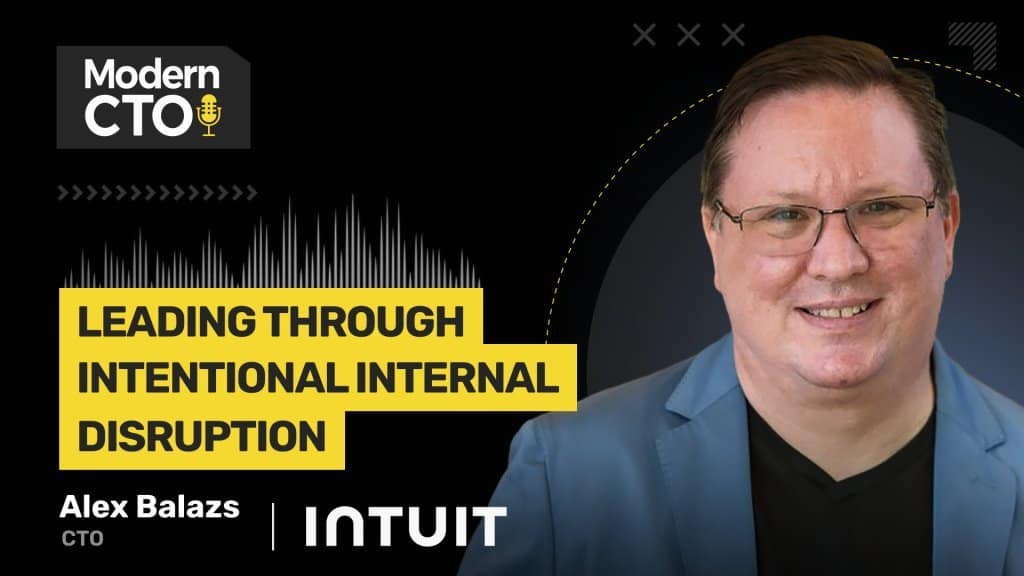
Leading Through Intentional Internal Disruption with Alex Balazs, CTO at Intuit
Today we’re talking to Alex Balazs, Chief Technology Officer at Intuit. We discuss the rapid pace at which technology is evolving and how Alex is harnessing the power of that technology to continually disrupt Intuit into the modern age.
All of this right here, right now, on the Modern CTO Podcast!
To learn more about Intuit, check out their website here: https://www.intuit.com/
Produced by ProSeries Media: https://proseriesmedia.com/
For booking inquiries, email [email protected]
About Alex Balazs
It’s a great honor to serve as Intuit Chief Technology Officer, where I lead the development of innovative products and services to help our customers prosper. I oversee Intuit's technology strategy and lead all of Intuit's product development, data science, information technology, and information security teams.
Over the last four decades, Intuit has evolved from Windows to web, mobile, cloud, and now artificial intelligence. I joined the company back in October 1999 as a software engineer. My first role had me working on a very early version of QuickBooks Online. The idea was to revolutionize how small businesses could go beyond the desktop and manage their finances on the internet.
That same innovative mindset shows up today in our AI-driven expert platform and products, including TurboTax, Credit Karma, QuickBooks, and Mailchimp. I'm passionate about creating an environment where our technologists can thrive and do the best work of their lives, all in service to powering prosperity for millions of consumers and small businesses worldwide.
About Intuit
Intuit is a global technology platform that helps our customers and communities overcome their most important financial challenges. Serving millions of customers worldwide with TurboTax, QuickBooks, Credit Karma and Mailchimp, we believe that everyone should have the opportunity to prosper and we work tirelessly to find new, innovative ways to deliver on this belief.
We encourage conversations on this page and will not delete comments that follow our terms of use. In order to keep this a safe community, the below posts may be removed: Repeated posts of the same content, spam or posts from fake accounts or profiles, offensive language or material, threats to others in the community, posts deliberately aimed to have a negative effect on the community or conversations.
Transcript
(Intro Narrator at 00:00:00) Today, we're talking to Alex Balazs, CTO at Intuit, about how he's moving his team forward with cutting edge tech. You're listening to Joel Beasley, Modern CTO.
(Joel Beasley at 00:00:16) We got introduced to you from the Credit Karma.
(Alex Balazs at 00:00:19) Is that right? Yeah. Yeah. So Ryan Graciano.
(Joel Beasley at 00:00:22) Yeah. Ryan said you were the man. I was like, Ryan, do you know anybody else who's really good, good technical leader, strong person? He says, Alex at Intuit. And I said, oh, that's awesome. All right, let's talk to Alex.
(Alex Balazs at 00:00:34) Oh, fantastic. I'm excited to talk to you, Joel. I was catching up on many of your podcasts over the past couple of years, and I really enjoyed several of them. I think the one with Ryan, I think, was great. You guys had a great conversation about AI. I like the one with Kevin Scott, the CTO of Microsoft. I think that was a great one where he talked about being more optimistic and thinking about AI, as opposed to some folks who are a little doom and gloom about it.
(Joel Beasley at 00:01:02) It's been a while. I haven't had him on, and he was actually like the first big, big guest that we had gotten. I was so nervous too before that interview.
(Alex Balazs at 00:01:11) Well, everyone's just people. Right? We just talk to each other. You know, I had the great opportunity several months ago to meet Steve Wozniak. And, you know, I told Steve, I learned how to program on an Apple IIe in BASIC when I was 12 years old. And he said, yeah, I created the Apple IIe and BASIC, which I know you did. So thank you. Thank you for starting me on my journey when I was this kid in a simple green on black monitor, pre-internet, typing code from magazines into the computer, seeing what it did, and learning how to write code. I was just, I had such fond memories of those early days.
(Joel Beasley at 00:01:53) And that's not even one lifetime.
(Intro Narrator at 00:01:55) No. I mean, that's crazy.
(Joel Beasley at 00:01:57) How much technology has advanced.
(Alex Balazs at 00:01:59) So much. I mean, just to think back about the tools that we had back then, and, you know, there's these famous or infamous clips that you have of folks saying, no one's ever going to need a personal computer, or why would anyone ever need more than 64K of RAM? Right? To think about what we do now and you see, you know, Jensen Huang pull out one of these NVIDIA chips that basically defies the laws of physics because they're so close to each other, they act like one chip. It's just unbelievable how fast things have come in less than a lifetime.
(Joel Beasley at 00:02:39) How do you stay on top of it?
(Alex Balazs at 00:02:41) Well, you read a lot. I think, part one is you read a lot. You know, you try to find through different mechanisms, whether it's traditional newspapers, different social media accounts to follow, different blogs to follow, podcasts to listen to. So, you know, reading and listening. So I think that's part one. But really, the best way is hire amazing talent and then talk to them. So just some of the amazing talent that exists across the company, and then folks that I meet at conferences. You know, I love to network at conferences, so I'll just walk up to random people and just start talking to them, just to see what's on their mind and what they think about and the questions that they ask and everything. And you just learn so much, obviously, from talking to other people. And so what I found is that, you know, there are several folks on my teams, for example, who stay up to date on what are all the different white papers that are being published in the AI, generative AI space. And they read these things, they download open source projects that are already implementing them, and then they have an opinion on them already. And so I talk to them and I listen and I learn, and I, you know, construct thoughts and try to weave threads through what I hear from multiple people and really turn it into strategy.
(Joel Beasley at 00:04:04) And how did you become the CTO? I had it in the notes. It said, and I'm fact-checking these notes that I have here. It says became CTO without direct reports for 18 years. Is that correct?
(Alex Balazs at 00:04:18) Yes. So, I'm a geek. I'm an engineer, and I loved being an engineer. I was hired in 1999 at Intuit, late 1999. So I'm almost at 25 years at Intuit. I was hired as a senior software engineer. I was part of the team that was creating the first SaaS product for Intuit. So I joined a desktop software company, and we created the first version of QuickBooks Online and some of the services associated with that. And I loved being an engineer, a frontline engineer. So I went from senior to staff to principal to distinguished to fellow. And actually, the first 18 years of my Intuit career, I was an engineer. I got very senior level, got all the way to senior vice president, technically still as an individual contributor. And then a couple of leaders, one in particular that I reported to, said, you're too good of a leader. You have too great leadership skills not to actually lead teams. And so I started leaning into leadership, and I was given some, you know, smaller teams to lead, and then some more, and then some more. And then, eventually, as I became chief architect of Intuit, I wasn't just chief architect. I was actually leading the platform organization as well. So I was kind of playing a dual role of being the lead engineer for the company and also leading a significant chunk of the engineering team as well. And I had spent time in the businesses in both the QuickBooks business and the TurboTax business. I had led platform teams, you know, functional organizations. And so, nine, ten months ago, when Marianna took over as the general manager for QuickBooks, Sasan gave me a call, the CEO of Intuit. And he said, Alex, I'd like you to be the next CTO of Intuit. And so it's been maybe a little bit more of a less traditional path to get to this seat, but, you know, I always worked on my leadership skills. I love boundaryless leadership. I love influencing even when people don't report to you. I think it's a really valuable skill to have. And I also wanted to stay really, really technically deep. I loved being in the code. I loved being in the technology. I loved sitting down with the frontline engineers, and it's something I still love to do today. I don't write, unfortunately, production code anymore, but I still dabble. I still do code reviews, and I still, you know, hang out with the frontline engineers.
(Joel Beasley at 00:06:44) So I should just direct all my QuickBooks Online support tickets to you?
(Alex Balazs at 00:06:48) Yeah. Sure.
(Joel Beasley at 00:06:49) Absolutely. Do people do that, by the way?
(Alex Balazs at 00:06:52) Oh, absolutely. Yeah. It's the number one reach out I get on LinkedIn. Is it really? Oh, yeah. As people reach out and, you know, they try to be patient, and we are constantly on a journey to improve our customer support, customer success. We're heavily leveraging AI and automation to improve the process, and it's become significantly better than it was historically. But there are still moments, individual customers who don't encounter the best experience, and they reach out to me, and I connect them to the right people and, you know, resolving every single customer's problem is important to us. So we follow up on every single customer complaint. You know, a customer complains to me about some problem that they have, I forward it to a senior vice president of engineering, and they go take care of it.
(Joel Beasley at 00:07:42) Nice. It's been amazing, to be honest with you. I just, my bookkeeper has it. They do their thing. They kick it off to the tax people who also are like authenticated users, and they can do their thing. And it makes my life as a business owner easier because I don't want to be doing any of that. Right?
(Alex Balazs at 00:07:58) Well, absolutely. So, it's kind of the evolution of software that early on, software was digitizing a human manual process. So instead of doing your taxes on a piece of paper, do it digitally on a form. And then we said, well, digital form, that's cool, but what if you don't want to see the forms? Okay. Cool. We'll invent interview, and you can just answer these simple questions, and we'll fill out the form for you. Okay. That's cool. What if I don't want to do my taxes at all? Well, then you can either delegate to a human and use a product like TurboTax Live that's enabled by technology and AI. Or with the advent of the mainstream AI, generative AI, in many cases, the software will just do it for you, and you could just ask questions about it. Hey, what did you do here? Why is this deduction higher? Why is this deduction lower? Right? And so, really, software is transforming from digitizing a human process that I'm used to, to I do it for you. It's just done, and then you can ask questions about it.
(Joel Beasley at 00:09:09) Yeah. What are your thoughts on all these LLMs coming out? They're just doing things for you now.
(Alex Balazs at 00:09:14) Yeah. I mean, it's really remarkable. It's really remarkable, the pace of innovation. Just when you think that you've read everything there is to read and you've understood everything that's been released, something new comes out. And they all seem, I, you know, I've obviously, this is a very unique time in the history of technology. But still, I mean, there have been other innovations. Right? And the degree to which seemingly every release leapfrogs the previous one, I've just never seen that before. The pace of innovation is only accelerating. And so, you know, when you see these LLMs come out and you see the way they can create audio and video and create avatars that are completely realistic, the way that they, in some of the more recent examples that I saw both outside of Intuit and some of the things that we're testing internally, is being able to interrupt a video avatar. So it's in the middle of a conversation with you, and you can say, whoa, whoa, whoa, don't talk to me about that. Tell me about this instead. And it adapts. Right? That's the kind of thing that through traditional technologies, you couldn't do that. It was kind of a prescribed call tree of what it could do. And now, that call tree is completely randomized, and you can interrupt it. You can send it in a different direction. So, yeah, all the innovation that's going on at the big players, you know, Google and AWS and OpenAI and Microsoft, and then all the little players as well, or all the kind of upstarts. I shouldn't say little because these are, you know, almost all of them are unicorns at this point. So it's just, it's amazing, the pace of innovation.
(Joel Beasley at 00:10:57) It is. It reminds me when I, I'm 36. When I was a child, and my parents would drive between like two cities for various events and things like that. And I would see these billboards, and it was like Pentium One processor. And then six, a couple months later, Pentium Two, Pentium Three. And it was like, is this ever going to end? They're just every couple months, they're just coming out with like this new doubled version. It was a ridiculous thing in my mind. And until I saw these LLMs, I don't think I had seen another technology that had just, I mean, I can tell the difference within my first prompt or two if I'm in the wrong selection with ChatGPT, totally, because of how sophisticated it is. 4o is like unbelievable.
(Alex Balazs at 00:11:45) Absolutely. I was playing around with 4o the past couple of weekends, doing some stuff and just really testing the bounds of what it can do. And it's interesting because I think with some of the early LLMs, it was more like task-oriented or question and answer. And now what I've at least realized, or the way I treat this, is it's almost, you have to interact with it like it's a human. And because you have to interact it with like a human, you start to think about, like, if I'm talking to you, Joel, and if I start talking about some topic and you have no context, I'll give you some context. Right? And so if you approach it that way with 4o and some of these others that have come out, the newer ones, and you treat it like it's a human, then you'd say, well, if this is a human, I have to tell it what kind of human are you and what context do you need. And feel free to ask me questions. And then tell it what you want it to do. And when you treat it like a human, it kind of behaves like a really, really smart human.
(Joel Beasley at 00:12:53) Yes. Yes. I learned that as well. And it reminded me of a lot of like writing work proposals, like things that I need my team to do. Right? And I've been doing that for years. Right? If I have an idea, I don't just run and go do it as much anymore. I sit down and try to think through it and write it out about what actually needs to get done in context of why. And communicating with the LLMs like that, look, it's smarter than a lot of people I know. It just is.
(Alex Balazs at 00:13:24) It just is, yeah.
(Joel Beasley at 00:13:25) You know, one of the interesting things that we saw is we did some tests internally on hyper, hyper, hyper training an LLM. So have it become remarkably smart in one specific area. And maybe not surprisingly, it got really, really smart in that area, and it actually became a little bit dumber in other areas. And so that's almost like another way that it's very much like a human. Right? Because you have people who hyperfocus their education in one area, and you ask them basic questions about other areas, and they're like, I can't answer that question. And the LLMs kind of behave that way too.
(Joel Beasley at 00:14:05) That's exactly what frustrated me about the OpenAI update. Because I logged in about two months ago, and it says we now share knowledge across all the chats. Whereas before, they were isolated in these little buckets. So like that thread, I tuned it to do like one specific thing. And now it's like it knows about my kids from the social media post thread where I'm, you know, taking pictures and having it connected to business with social media posts that are interesting. And now it's bringing that into other conversations, and I don't like it. And I don't know if there's a way, Josh, can you make a note to see if there's a way to turn that off? But so far, I haven't seen any ways to turn it off, and it's really frustrating. Have you seen that happening? Have you seen it bleeding in in like unrelated conversations?
(Alex Balazs at 00:14:52) Well, yeah, it does it in both directions. It seems indeterminate, at least indeterminate to, at least at this point, a human mind of like, why do you sometimes connect the dots and other times you completely ignore the dots? So I've seen both of those things. And, you know, I think that's why the experimentation in applying generative AI is so important, and testing it in real-world scenarios with real people, with real customers is so important. Because I don't believe that the answer is some omnipotent AI bot. Right? It's likely that specialization and context is an important way to convey and articulate AI to the average person. It's one thing for you and I to play around with this stuff. It's another thing for the average person to play around with this stuff and to convey it with them in the context of them solving everyday problems. Right? So for us, it's taxes and accounting and payroll and payments and personal finances and small business marketing and things like that.
(Alex Balazs at 00:16:05) And as with most companies, I think we approached the problem first as, "Hey, let's bolt on a Q&A interface to the existing UI." And now we've taken a completely different approach, which is, if we were to reinvent the company from scratch, what experience would you build? So given what you know about the data you have, the AI that's available, the mediums that are available, what customers do, what experience would you create from scratch? And that's the way that we're looking at the experience, and it completely changes how you approach solving problems.
(Joel Beasley at 00:16:40) Do you have a separate team that does that, gets stacked like that?
(Alex Balazs at 00:16:43) We have some. So we have a couple things. One is we have a separate team that basically creates radical experiments. Like, radical stuff that we don't actually let outside of our four walls until we've gone through ethical AI evaluations and legal evaluations and things like that. But they just work completely unconstrained. So that's part one.
(Alex Balazs at 00:17:06) Part two is we have some teams that are specifically chartered to just horizontally move across the business and move as fast as they can and innovate in solving customer problems. And so they ship daily or every other day, and they'll ship something and test it. And it could be a five-person test or a 10,000-person test. They figure it out, but they're constantly testing. And then the third thing is we are injecting AI savviness into all of our engineering teams so that over the course of time, they can all start to behave this way.
(Joel Beasley at 00:17:42) Are you the oldest employee at the company? Like, have you been there the longest?
(Alex Balazs at 00:17:46) Oh, oldest tenure? No. No, no.
(Alex Balazs at 00:17:49) There are some people who are 30-plus years at Intuit. Really? Yeah. Yeah. Wow.
(Alex Balazs at 00:17:56) Not many left who exceed me, but there's definitely still some. There's probably a handful, at least five or 10 that I'm aware of.
(Joel Beasley at 00:18:06) Why did you stay? Why have you stayed so long?
(Alex Balazs at 00:18:09) So a couple things. I mean, one is I really believe in the mission. It hasn't always been our mission articulated this way, but powering prosperity around the world—I believe that leveraging technology to raise up people is the right thing to do. And there's this wonderful book by Thomas Friedman, "Thank You for Being Late."
(Alex Balazs at 00:18:39) And there's this chapter where he talks with Astro Teller from Google X. And they talk about the fact that historically, the way innovation worked in technology, society, and the environment is that there would be some disruptive activity and then society would catch up, and some disruptive activity and society would catch up. And very specifically with technology, it's like the personal computer is invented, it's disruptive, and then society catches up. And the internet's invented, it's really disruptive, people catch up. But what they were saying is that the pace of innovation right now is so fast that society will never catch up, ever.
(Alex Balazs at 00:19:21) And so then the question is, what do you do about it? And I look at that as an amazing challenge, because the same technologies that create this thing that they refer to as the dislocation—so between the pace of innovation and the ability for society to catch up—the same technology that creates that can actually be used to bridge it. And I've always felt like Intuit has been in the business of bridging that dislocation. It actually makes it, use technology to solve for the average person, for the little person. So that's part one. Part two is, it's unbelievable how self-disruptive Intuit is. We're constantly, when we think about the next thing that we build, there are these moments in time, and they're pretty frequent, like every five to six years. We think about—we don't think about how do you make the existing product better.
(Alex Balazs at 00:20:13) We think about, if I had a startup and I was going to kill Intuit, what product would I build? And that's what we start building. So we're constantly disrupting ourselves. And so I just thought that was really cool, and I just loved working for a company that was not afraid to disrupt itself. So I think that's part two.
(Alex Balazs at 00:20:30) And then, you know, the third is the people side of it. Just amazing people that I've met. I've had amazing managers and mentors and coaches, and Intuit's really leaned into me with leadership training. And I've had amazing managers who've really challenged me to grow myself and grow my career, and, you know, obviously, I've been able to build a great career for myself here at Intuit. And I've had lots of interest from the outside. I've had lots of people reaching out to me, especially in the last 15 years.
(Alex Balazs at 00:21:02) I've become a senior engineer and an engineering leader, but I just always found that everything that I needed and wanted was actually here. Nice.
(Joel Beasley at 00:21:13) That makes me feel warm. Warm inside. Alex loves Intuit. Yeah. Maybe that's the title of the episode.
(Joel Beasley at 00:21:22) Maybe. Okay. So what's the coolest thing that you're doing that you're allowed to talk about publicly?
(Alex Balazs at 00:21:30) Sure. So I think, you know, just recently there was a press release about a week or two ago about some of the things that we're doing in Mailchimp. And, you know, Mailchimp started off as a means by which it was easy to collect a list of customers and then send them marketing emails. And that is very valuable. What we realized is that, A, there's other channels that we should be using.
(Alex Balazs at 00:21:58) So we added things like SMS, and there's other channels that we'll be adding. But more importantly, the reason that you're doing this is because you want to grow your business. You want to generate more revenue. And we're actually—now we've just announced the Revenue Intelligence Engine, which basically has the ability to look at what you're doing and what others like you are doing, and to have a combination of both predictive models and generative AI that basically automates the entire process of growing your revenue. And so you don't have to decide when to send emails, what the email should say, who you want to target, any of those things.
(Alex Balazs at 00:22:42) As a small or mid-sized business, it's done for you. You can basically review, tweak, ask questions, but all the work is done for you. And I just think that that is just unbelievable in terms of the automation. And it's not even just automation, because many of these things, you actually can't do it unless you hire an expert to do it. And all the reasoning as to why you should send certain emails with certain subjects and certain messages about certain products to certain people—it's all in the data. It's all in the data.
(Alex Balazs at 00:23:21) And so now being able to use that data to actually optimize revenue and help small businesses, mid-sized businesses grow—I'm just really excited about this. It's a fundamentally different thing than saying, "Hey, here's a tool so that it's easy for you to do your own thing." That truly is realizing the dream of, we will do it for you. We will literally do it for you.
(Joel Beasley at 00:23:44) That's crazy talk. So let's let—
(Alex Balazs at 00:23:47) Let me—
(Joel Beasley at 00:23:48) Let me pull that apart. So, like, I'll tell you how my company works, and you could tell me how this might—so we have an email sending platform that we do, like, lots of cold emails. And we, you know, test different content and do all of that. And those emails then get people—you know, we'll target, like, a certain job title at a certain type of company, a certain industry. And then we'll also use some—oh, what's the name of it? There's this other tool that'll personalize it and use LLMs to personalize it. And then it sends it to those people and attempts to book a meeting to then, if they're interested in the product services, sell them the product service, give them a quote. So you're saying it would do that, like, whole front part for you?
(Alex Balazs at 00:24:34) Yes. 100% automatically. It will craft the subject. It will craft the email. It will figure out who to send it to. It will create cohorts of users. It will check on conversion. It'll check on click rates, view rates, optimize, resend, all of those things for you. And it will graphically show you what it has come up with, and you can go in. You can tweak it.
(Alex Balazs at 00:24:56) You can view it. You can modify it. You can give it suggestions, but it basically becomes your marketing expert.
(Joel Beasley at 00:25:04) You blow my mind. I didn't think we'd get into email marketing stuff at all. This is where I spend a lot of time in my business, and it's changing so fast. And the personalization and the tools have gotten just crazy good since LLMs. Like, it'll go look at the person. It'll have, like, 15 possible paths that it could choose, and it'll choose the best path on how to personalize it. And so it's so much more now than just variable replacement of personalization.
(Alex Balazs at 00:25:33) No. Totally. And, you know, obviously, as we all know that LLMs are probabilistic, they're not deterministic, right? And these are probabilistic problems to solve, and so they tend to solve them really well. Right? In other words, there's multiple sets of content that could work, and therefore there isn't a single right answer. And so Gen AI is actually really good in this area.
(Joel Beasley at 00:25:54) One thing I wanted to talk with you about—your wife has a sci-fi book series. Tell me about that.
(Alex Balazs at 00:25:59) Yeah. She does. So she goes by the pen name of S.G. Blaze, and she has a book series that's called "The Last Lumanian." And she has four books out, book five on the way. She's won a bunch of awards, many, many awards for the book series.
(Alex Balazs at 00:26:19) And we've started to grow it past just being books, which has been a lot of fun. So we started attending various Comic-Cons. We've had booths at Comic-Cons, and so we've been at LA Comic-Con a couple times, WonderCon a couple times, and we'll be at San Diego Comic-Con with a booth for the first time this summer. And it's been a lot of fun. We create immersive experiences.
(Alex Balazs at 00:26:40) We hire actors to cosplay characters in the book, and they act out scenes in the booth. And it's just—it's an amazing experience for me to, you know, during the day, I'm the CTO of Intuit. In the evening and weekends, I get to be my wife's booth barker to bring people into her booth and really drum up some support for her. And so it's been a lot of fun. And then also, I've been able to use some of the generative AI tools to really learn how to do some of the things that you just talked about. Like, how do I think about marketing campaigns on KDP and Facebook and other places.
(Alex Balazs at 00:27:19) And so it's been a fun way for me to continue to learn some of the technology as well.
(Joel Beasley at 00:27:24) Oh, no. I have a fiction book.
(Alex Balazs at 00:27:25) Oh, awesome.
(Joel Beasley at 00:27:26) Yeah. What book is that?
(Alex Balazs at 00:27:28) What book is that?
(Joel Beasley at 00:27:29) It's on Amazon, and it's on Audible too, but it's called "Patriots and Traitors."
(Alex Balazs at 00:27:33) Okay.
(Joel Beasley at 00:27:34) I wrote it—I published it about a year ago, and it makes a couple $100 a month. It's okay. But for me, my whole thing was I had the story for, like, five years, and I was like, I really want to tell this story. And then finally, I decided to do it, and I did it. And it's awesome.
(Alex Balazs at 00:27:52) Well, it's awesome. I'll definitely check it out. I'm an avid reader. I love reading in my spare time. So when I'm not reading about generative AI, I'll read your book.
(Joel Beasley at 00:28:00) Oh, thank you. Awesome. Well, we did it. We made a podcast. Awesome.
(Joel Beasley at 00:28:04) How do you feel?
(Alex Balazs at 00:28:05) I feel great.
(Joel Beasley at 00:28:07) Thank you so much for listening. And if you found this episode useful, please share it with a friend or a colleague who you think would get value from it. And if you have topics that you'd like to hear discussed on the podcast, either add me on LinkedIn or send me an email: [email protected]. Every time I get an email or LinkedIn message, it absolutely makes my day and inspires me to keep going.