
Episode 402 ·
Aaron Suzuki, Founder & CEO at SmartDeploy - Desktop Management Reimagined
Aaron Suzuki returns! Today we’re talking to Aaron Suzuki, the Founder and CEO of SmartDeploy. And we discuss how companies have to provide the right compensation and mission in order to attract top talent. How old tools are getting replaced by better, simpler tech in every industry, and Joel makes a special promise: the first listener to try SmartDeploy and integrate it in their work flow has an open invitation to come on the podcast!
All of this, right here, right now, on the Modern CTO Podcast!
To learn more about SmartDeploy, check them out at http://smartdeploy.com/ModernCTO
In case you missed it: check out our first episode with Aaron Suzuki.
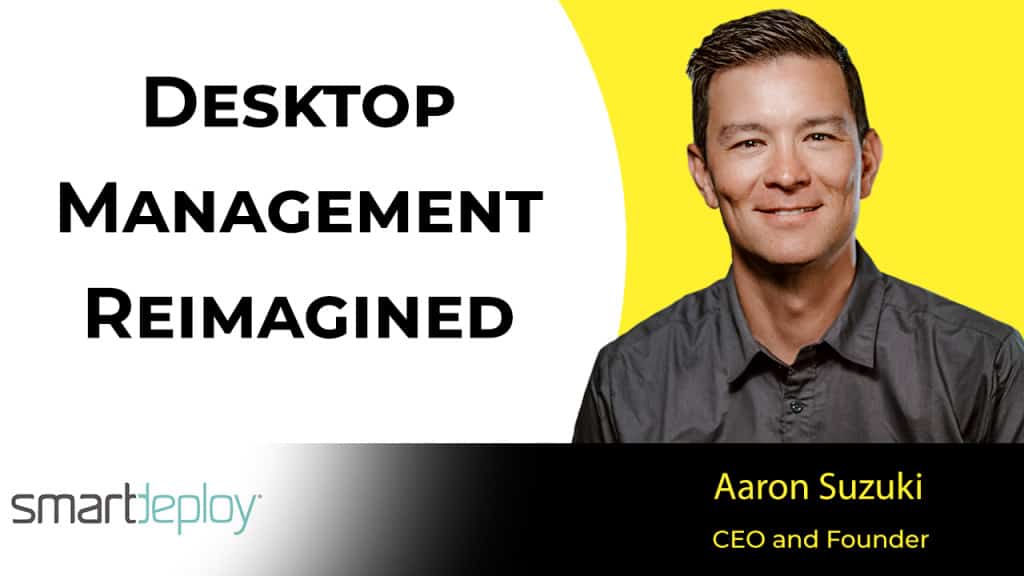
About Aaron Suzuki:
Aaron Suzuki is the founder and CEO of SmartDeploy, a Seattle-based IT management software company. Aaron applied his experience and vision to build software that applies mobile and cloud computing principles to PC desktop delivery. It is through this foundation that SmartDeploy addresses increasingly complex technical requirements with out-of-the-box automation and the simplicity of a consumer application for business customers of all sizes. Prior to SmartDeploy, Aaron founded and grew a successful Seattle-based consulting business called Prowess Consulting. A thriving business today, Prowess made its mark in the early 2000’s using virtual machines to massively improve the efficiency of technology sales and marketing teams. This experience in part informed the decision to start SmartDeploy in 2009. Since then, Aaron and the team have continued to adapt and expand the software to fit today’s corporate IT requirements and have grown SmartDeploy into a top-rated, leading endpoint management solution chosen by thousands of organizations worldwide to manage over 3.2 million endpoints. Earlier in his career, Aaron served as director of Business Development at Entirenet and president of Inetz Media Group. An avid cyclist and passionate alpine skier, Aaron holds a B.S. degree from Brigham Young University and an M.S. degree from the University of Iowa. Aaron is also a respected voice in the technology community. You can hear his technology insights and experiences monthly as a co-host on Petri.com’s Enterprise Dish podcast.
About SmartDeploy:
Founded in 2009, SmartDeploy allows over 3,200 customers globally to easily manage their endpoints. By providing simple yet intelligent desktop management software, SmartDeploy saves customers days and hours of their time on imaging, hardware refreshes, updates and more. In addition, SmartDeploy is one of the only providers with the flexibility of deploying via the cloud. Deploy to and from anywhere, without a VPN connection.
SmartDeploy is a leading provider of modern endpoint management software with a unique layered approach that enables centralized, single-image management of Windows and applications. SmartDeploy’s award-winning technology combines the best of progressive solutions like SCCM, centralized solutions like VDI and legacy imaging solutions like Ghost without any of the drawbacks of these solutions. More than 3,000 organizations, including Aetna, the US Department of Transportation, Nissan, Nintendo, ETRADE, and GE Healthcare, rely on SmartDeploy for endpoint management. SmartDeploy is a private company headquartered in Bellevue, Washington.
Transcript
(Intro Narrator at 00:00:03) Hello, my friends. Today, Joel is talking to Aaron, the founder and CEO of SmartDeploy, and they discuss how companies have to provide the right compensation and mission in order to attract top talent, how old tools are getting replaced by better, simpler technology in every industry, and Joel makes a special promise. The first listener to try SmartDeploy and integrate it into their workflow has an open invitation to come on the podcast. All of this right here, right now on the Modern CTO podcast.
(Intro Narrator at 00:00:40) Here we go.
(Joel Beasley at 00:00:41) This is the Modern CTO podcast. We didn't talk enough about SmartDeploy last time. After I got off that podcast, I was like, we did a really good job at hanging out. But I was like, we could have, I think we could have pushed SmartDeploy a little bit harder. So when I found out you were going to be a guest again, I was like, alright, we're going to jam it down people's throats.
(Aaron at 00:01:06) That's really tough of you. You know what I mean? I think part of my problem is I am, by nature, a kind of natural salesman, I've been told. And so, you know, talking about how much I love things or whatever is natural. Kind of thinking about that marketing message first is not second nature to me. And so I could be better, and so I appreciate you bringing that up. And a lot has been happening. We had a major, major release since we last spoke, and it was really a pretty fundamental overhaul to accomplish all of the things, so better performance and, you know, poise us for a mobile app, which in our world is now pretty mainstream. But for our world of endpoint, especially from an IT administration perspective, some of those tasks are really more in the domain of the RMM people, which is, of course, the natural direction for the things that we do. So a very, very important set of new capabilities to make it so that larger organizations get better results. All the stuff that you hope you keep doing as a software company. And part of it as well is to respond to what's coming, which is, and now is out, which is Windows 11, which has been this whole other amazing surprise, right? I mean, I feel like the world has grown, I don't know, callous, or it's almost like it's a new car. Oh, it's the new, it's the new, you know, who gets excited about the new Corolla? Nobody cares about the new Corolla. You go to the lot, and if you're in the market for a Corolla, there it is, and it's better than the last one. But it's not news anymore. And I feel like Windows has kind of gone that way. But the irony is that a change to Windows affects many, many people on Earth. Pretty much everyone listening to this probably is affected by that change in some way or other. So, and this one is sort of interesting. It was, no one expected this to be the case. Everyone was under this impression it was, you know, Windows 10 was the last one that was going to do what Mac OS has done, and that's not what happened for many, many crazed reasons that we're living every day. So it's great because SmartDeploy now is poised to not only address that, but because of the changes to the platform, you know, keep pace with everything everyone's doing, which is different than the way it was, right? So the other bit here is that we're still in the pandemic, which maybe I can't remember if we talked about that being over by the time we reconnect today. Definitely not over. So we're still in the deep end digging through that, but, you know, that plays into the same landscape for IT, which is, you know, the remote work will become some degree of permanent. How much? Well, now with more and more time elapsing, we're seeing more companies saying, yeah, you can have more flexibility forever. So our sense is that maybe up to a third of workers will have a more permanent or more permanently flexible remote work scenario, including IT people. So further to this notion that the work that we're doing on SmartDeploy is going to be very important for customers and important for IT going forward. And then another crazy factor. I'd be very curious for your take on this too, Joel, but the great resignation, right? That everyone's quitting and the popularity of quitting via text and all of this. Fortunately, we personally haven't had a ton of churn, but we are feeling kind of the downdraft of that, which has been positive for the business, which is more demand. People are needing more help, so they're looking to automation, and they're looking for ways to allow the people who are not resigning to be able to be really effective and feel less pain, so they're not motivated to resign. So I don't know if you're kind of feeling any or observing any similar behavior or trends there.
(Joel Beasley at 00:05:31) Well, I mean, I definitely observe the behavior. When I drive by Chick-fil-A and they say starting wage is $19 an hour, I'm like, what's going on? Then, you know, I usually tend to bury my head in the sand and focus on business and bringing value to people. Rarely do I lift it up to understand what's happening in the atmosphere, the political atmosphere or the larger economy. And then when I do, it's like, what is going on? It's pretty crazy. But the way it personally impacted me was actually something that I don't hear talked about a lot. I had made a bunch of hires. We grew 300% during COVID, right? And we hired all these people all over the United States. And what happened was when, in the summer, this past summer, a lot of the businesses opened back up, in-person business, they opened their offices again. And I lost four salespeople in one week. And to me, that's 75% of my revenue just gone because they wanted to go work in office. And I get it. I've been a remote worker my whole life. I made the mistake that, they're like, oh, we love remote working. I didn't think to be like, you know, because all the people I'm around from engineering, that's their whole life. They've been doing remote work or familiar with it their whole life. So I didn't do the normal steps. And so I learned that. Now we've got a more rigorous, we're remote and we make sure that people have experience working remote and they like it.
(Aaron at 00:06:57) Yeah. That's a great point. And it's been interesting as well. What we've observed is a shift in the trend. Initially, it was work from home. Everyone was excited for work from home, but maybe their old job wasn't very good as a work from home, so we're going to go find a new job. And so I don't know, maybe you saw the same thing. We had really good luck finding talent for a while, better talent more easily than for years. Super excited. This is great. We've got, it's a new normal. And then the great resignation began. It's like, well, where'd all the talent go? What's the deal? And like you, everyone's now advertising how this great benefits package they're offering and all the pay they're throwing at people, which is something we've never seen in this country before anyway. And now the big employers in our area, which are all with a lot of big tech, of course, they are paying up. So now they're winning back a ton of talent, so it's getting more competitive for us again. So, you know, all these things, you know, I, like you, it's not my favorite topic necessarily, but being a founder and CEO and being, you know, sort of interested in ensuring that we're keeping pace, you know, setting the business model for the things that we do, it's important that we're heads up about all of this and making sure that we can keep customers happy. And I think, you know, again, further to what we've been working on with the product has been, are we in a position to be as flexible as we can be for where the world is going to turn next and the series of turns it's going to take? I think that the last 18 months or so has been merely a precursor of this future for several more years that is going to be a series of right and left and right and left. It's not going to be straight up the middle. So, you know, and the good news is we are very well poised and positioned to be able to be that for organizations, increasingly and larger and larger organizations as well. So, you know, work from anywhere and IT working from anywhere and any devices and all the places and all the different environments and network settings and what have you, but also sort of employee tastes and IT taste and what are they want to do or not want to do? How far do they want to go with all of this? We brought into the product from a very, very early stage in the product development. So this would have been, you know, the aughts, as everyone says, right? Late '08, '09, which was a very scary time to be developing software, you know, Great Recession time frame. But the whole idea of doing things in logical layers, so tearing things apart and taking this monolithic computer and allowing you to manage it piece by piece by piece. And that early indication, the things you'd hope to see as a product manager, got people excited. So that was really encouraging. But what that amounts to then is this ability to adapt to the way that IT is changing. And so going back to our pandemic metaphor, brought about this great rush to the cloud, and now everyone's there. I predict that we're going to see, I guess it's that time of year for predictions too, so maybe this is time we...
(Joel Beasley at 00:10:31) Let's do it.
(Aaron at 00:10:33) Yeah. That this rush to the cloud, and this is sort of one of my favorite pet topics, is that the cloud isn't cheap. And so if you're, if you rush to the cloud and it's all cloud, well, if you're not doing a smart job with that, you're quickly going to start overpaying, and then it's going to move back on-prem. And the right answer is to manage it intelligently, and it's somewhere in the middle. But like the whole work tastes and all of that, I think IT infrastructure is going to take some of these twists and turns, and that the rush to the cloud is going to come back to people deploying more on-prem. It's just simply more cost effective for certain workloads, and that the reality will be some kind of hybridization. And that increasingly, IT executives, IT managers need to be thinking about what is the right set of tools or right way to think about tools and systems that's going to give them the flexibility to move. And I think that's one of the great risks still of the cloud is this notion of lock-in. And everyone's got more friendly with each other's platforms and things, but still, once you're on, you're kind of committed. So you want to be really smart and careful about what you're doing. And we're in a fortunate position that we do enable that kind of hybrid interoperation. Use the cloud the way you like. Use your cloud platform of choice the way that you like. Use the cloud storage you've already bought. And that's another whole element of this that we learned the hard way. This is one of these things where you're like, everyone's going to go to the cloud. They're going to be all in. It was about, oh, six, seven years ago now, we said, okay, we're going to do this full cloudified thing. We were a little early. It was a little overly complex, but that wasn't the hardest part for customers to digest. The hardest thing for them to digest was, you're going to make me buy cloud storage again. I already have 24 terabytes of it that I'm not using. I don't want to buy another terabyte from you. And that was sort of a chin scratch. It was like, wow, really? We're going to break up over a terabyte of cloud storage? But that was where it was at. So all of this is to say that where we are and where it's going is really different from where it's been and where it was. And the future is only going to be this sort of cyclical change is my expectation and belief. And we're in for a really, really wild ride, right? We think the last 18 months was interesting. Oh man. Buckle up, right?
(Joel Beasley at 00:13:07) Oh yeah, for sure. The automation is going to increase. We're competing with companies. We used to think about competition with companies as maybe technological, and we could be young and scrappy. Well, turns out mission-driven people have a price. And if you double their salary and they've got infinite cash on hand, then it actually makes the talent very hard to come by. When I started seeing some of the, and I think we should actually talk about numbers a little bit just to sort of help the audience understand. What's the highest senior engineer salary that you've seen?
(Aaron at 00:13:40) It's a great, sort of a tricky question, because salary-wise, it seems like that hits a price, you know, sort of in terms of what your actual W-2 paystub says. Usually, I mean, it's high. It's, you know, $200,000 a year-ish, you know, and some more, $240,000, $280,000, which is a lot. But then the real money is made in the variable compensation, your bonus, your options. And that's where, you know, humble independent software vendors like us have to really, to your point, and I loved what you said about mission-driven people, they want to believe that they're on the right side of the program, right? The program being what the organization is about, right? And so there are a lot of people who are still very coin-operated, and that's what matters to them is improving their standard of living and quality of life. I don't think that there's anything wrong with that. That's a great thing, and usually that is your own mission of improving my situation for my family, getting my kids a better education. Nothing wrong with that. I think what you're hinting at is the upcoming generation that says, yes, education is very important, but it doesn't have to be a trade-off between achieving a quality of life and great education for myself and my children and having an organization that stands behind diversity, equity, inclusion, and belonging and has great sustainability initiatives and has a goal of net carbon zero. They want it all, and they know they can get it. And so they're not compromising. The really scary thing is when those things cross and the organizations that are able to deliver on both. And I can't, off the top of my head, think of an organization that today would really be able to deliver 100% on both sides of that equation. And so that's why we still have a chance with talent, right? We're, you know, we've got the solar panels and we live in this forest, and so we had to thin the trees in order to maximize the kilowatt hour output of the solar panels to drive down our power utilization. We do very little hosting on-site, but still, we're consumers. You know, what are all the things that we're going to do? What are the DEI steps we're taking? Et cetera, et cetera, et cetera. What are the cultural attributes? And we really do win in that regard as an organization. And it's been about prioritizing a sustainable business model. We have to be profitable. It's not a charity. There are other charitable things that we're doing, but the business itself, it has to be driving respectable profit like any software business would in the face of that.
(Joel Beasley at 00:16:36) Go ahead.
(Aaron at 00:16:38) Go ahead.
(Joel Beasley at 00:16:39) Well, it makes it, kind of as you're talking, I'm thinking of the Maslow hierarchy of needs, right? And so, you know, you want to worry about these DEI things, but if you're a day one startup, it's like, okay. So a big part of the competition is companies that have already established themselves and have cash and can worry about these higher level concepts. They can address those. And then the smaller companies are like, let's just get it off the ground. So it's interesting, the different dynamic. But what I really want to make sure we touch on, because I know we know each other, I know we got to talk a lot before, but I want to know exactly what SmartDeploy does and what problem they solve.
(Aaron at 00:17:18) Got to get right into it. I love it.
(Joel Beasley at 00:17:21) You have to.
(Aaron at 00:17:21) Yeah. SmartDeploy is an endpoint management product for especially PCs and workstations. It also works great on servers for the delivery of workloads, meaning the operating system and all of its constituent apps and the data that resides on it. So almost at a PC lifecycle management level of old, but done the new way through logical layering, which makes the manageability so much easier, especially in our increasingly diverse device landscape. There is a very important job that has not gone away.
(Aaron at 00:18:10) And because the PC died, quote unquote died five or seven times in the last seven or eight years, and this is maybe we talked about this last time, but the PC died when the mobile phone arrived, the PC died. Then again, when the tablet arrived, the PC died when the virtual, you know, virtual machines really came to the fore, you know, and on and on and on. When in fact, it hasn't. And especially because the pandemic, adoption's at an all time high, utilization's at an all time high. You know, more PCs are being embraced by more organizations in more different ways.
(Aaron at 00:18:49) What has happened is the ability of organizations to allow people to use the device that they prefer is true, and that's a reality. There is convergence between the capabilities of mobile devices and PCs. And so the devices are getting more complex, which makes the IT challenge more difficult. So what SmartDeploy does is make it as easy as Legos. I need these device drivers in order to make any operating system work on this computer.
(Aaron at 00:19:25) I want to use this operating system with these security settings and these apps, and you click, click, click, and it goes. This is a job, so the OS deployment and ongoing management of the PC, deployment of operating systems, applications, and patches, is a job that's existed since PCs basically came out twenty five, thirty, thirty five years ago. When they were adopted at scale, the network became the thing. It is unsustainable for organizations to do this one by one. You have to have automation, mass automation.
(Joel Beasley at 00:20:05) I wanna jump in there. Yeah. You're kinda like robbing people of the fun of, like, staying up all night and doing tons of manual the coffee. Come on.
(Aaron at 00:20:16) You're exactly right. What IT person doesn't love wrenching? The joy of IT for the IT implementer is in solving a problem. And if there's a problem, it is just a thrill to figure out what it is and say, I got it. And now you're smarter and you can fix it next time.
(Aaron at 00:20:38) The challenge is there are so many problems, and some are more strategic than others. Troubleshooting device driver problems, why your display won't light up when you dock, is not a very high value problem. Troubleshooting how to organize your data so that you can get the CEO that crazy revenue metric or the conversion rate metric that's been so elusive, that is a high, high value problem. So the real value of SmartDeploy is in taking this very complicated task that really you shouldn't be spending as much time on and allowing the IT person to make that essentially a really highly automatable problem. To make it so that the joy of that problem is simplifying it and architecting the way that you use SmartDeploy in the most high leverage way so that no matter what device comes in, you've got the fully automatic weapon and you just open fire and it's done.
(Aaron at 00:21:52) And you say, yeah. That company which we just acquired, they will be online, fully configured, fully secured, policy compliant in four days. You know? And that's not unusual. We've onboarded hospitals during COVID.
(Aaron at 00:22:08) 700 endpoints in a weekend after they've done battle with all these other solutions that promised great things, and they just couldn't even get it off the ground. So you're exactly right. There is a joy in fixing things and in solving complicated problems. The thing the IT person has to think about is the benefit to the organization. There is a massive fundamental benefit for workers to stay maximally productive.
(Aaron at 00:22:42) And the PC failing is one of these problems where everyone makes noise and it makes IT look really bad. The best IT organization is the one that just proactively communicates we're gonna be taking this service down for regular maintenance. Please be aware that you're gonna do this and do that. Please be sure you, as opposed to hearing it the other side that I can't get IT to fix my this or that. I can't get anyone to get me onto the latest this or that.
(Aaron at 00:23:14) That's the IT you don't want. The IT you want are the ones that just give you regular updates and say the regular service is complete. All services are back online. And the way to get there is by embracing these new tools. And so where all this kind of comes back together is that we are in a new era.
(Aaron at 00:23:36) I guess I think that's not an understatement. In fact, when we got in the pandemic, I was like, hey. I think we're headed into a whole this is going to be a milestone event. This will mark an era. So if we believe that, we're in this new era.
(Aaron at 00:23:50) We're getting a new Windows operating system, we've got more interesting, more powerful, more diverse devices interacting with centralized corporate hosted services, albeit increasingly in the cloud, from a variety of sources, which introduces lots of new risk. How do you do all of this with all of these new demands with the old tools? You really can't. You really can't. And because this is an old problem and the PC died, tons of people forgot about this.
(Aaron at 00:24:25) They just left it behind. Like, it was like, oh, well, you know, our value added reseller takes care of that for us. Well, that's not a great solution either because, great, you know, whoever your reseller is is out there and they'll ship you the device and, yeah, it's kind of preconfigured, but the first thing that happens when you plug it in is you're waiting for the updates to happen and you're quarantined VPN quarantined until things are running again the right way. You can't access this service because you're out of compliance while you're waiting again and you're first thing you're doing is pinging IT again. SmartDeploy gives you this unique ability to have all that happen from your home connection so that on first boot, it's perfect.
(Aaron at 00:25:08) No operational issues, no compliance issues, minimal security risk. And that's what's changing it for people, especially in these organizations that don't have very, very large IT teams that can specialize and solve these kinds of problems, that can justify their existence saying, oh, we got 50,000 endpoints all taken care of in this amount of time, and it's a team of eight or 10 people all high fiving and patting themselves on the back. What if that was one person and they didn't need a team and it just worked? That's the problem we're solving for.
(Joel Beasley at 00:25:44) Okay. So if I'm listening to this and I have a team of eight, ten people that are managing endpoints, like just provisioning them or updating? Like, is it more than just the initial provision? Is it
(Aaron at 00:25:54) It is. It's updating and it's pushing and cutting apps. And so the future, the coming year is going to be doing more of the things that people are used to doing from their endpoint management suites that we're going to do in our way using this layered approach. So if you, and by that, I mean asset management and things like that. So, you know, IT can know, well, we are paying this much to Adobe for all of these products.
(Aaron at 00:26:27) Well, it turns out we're only using about a third of our license allocation. We're grossly oversubscribed. Awesome. Not only can you hold that up to your Adobe rep and say, we're not gonna keep paying three times as much as we need to be paying. Yeah.
(Aaron at 00:26:41) Okay. Okay. Okay. You know, the vendors are always happy to get it right. They wanna retain your business.
(Aaron at 00:26:47) Then the thing is, great. Pull all those licenses and prove to us. That's all you got out there. Awesome. You know?
(Aaron at 00:26:52) And it's the same exact thing. It's not gonna be this team of eight. It's going to be click, click, click. These groups, these teams, all of these people, and accounting doesn't need all those IT products or all those Adobe products anymore. Sales doesn't need anything but Acrobat Pro.
(Aaron at 00:27:10) You know, whatever it might be. And at a group level, at a divisional level, however people wanna do it, again, it's as easy as unclick the box, next finish, and you get notifications and you can see in the nice little pie chart the whole thing. So that's where it's going. And there are other tools that allow you to do that. We're certainly not the first on the scene.
(Aaron at 00:27:33) We're just the first ones to make this work in this new way, in an efficient and reliable way where you don't need the PhD in rocket science in order to have your computer not blue screen.
(Joel Beasley at 00:27:48) I think on your website before we talked last time, I think you actually had screenshots of competitors' interfaces versus yours. It was some content like that somewhere because when I remember seeing it and I was like, oh man, that's like a refreshing glass of water, right? Like that's what you want.
(Aaron at 00:28:05) That's exactly right. And so very much in that same spirit as we've talked about partnerships or, you know, potentially even doing some inorganic growth, some acquisitions as we look at other people's products, we sometimes are stymied immediately because it's like this does not work for our customers. People are quickly getting used to this better, simpler, cleaner way of doing it. They're not gonna go back to, you know, the seven thirty seven cockpit that has knobs and switches everywhere, and you need weeks of training to figure out how to do this thing safely. That's not how the product works.
(Aaron at 00:28:44) It's, you know, simple questions a couple at a time and it goes and it's done. And we do all the hard work for you.
(Joel Beasley at 00:28:52) And those products are harder to make. It's harder to make a product that just kinda like is really simple and easy and does it for you versus just, uh, exploding every single configuration item onto a screen.
(Aaron at 00:29:05) Absolutely right. And part of this goes back to this dark art of product management, and I think I brought this up last time as well, which is how what do people really want? People want it to be done in an easier, more reliable way. And it's really easy. Oh, faster and easier and more reliable.
(Aaron at 00:29:25) Everybody talks about that. It very much goes back to the speeds and feeds discussion. But when you really get into the weeds, if you're doing good product management, you're looking at how things work for a customer now and how they would like it to work and how they think they would like it to work and how they would really like it to work often are kind of different things because they may not realize what's possible. And it's easy as an engineer to get really excited about software and technology. Oh, we can use this cool thing and that cool thing.
(Aaron at 00:29:57) That's really not the point. And that's, I think, where things really got off track in the nineties and early two thousands is we can do all these amazing things, and that's when you get this dashboard that has a million switches. And then you leave it up to IT, and, yes, you cultivate this group of rocket scientists who are super good at that, but the point is you don't need to be. And especially today, you know, price pressure and the circumstances we're in presently, that's not cool anymore. That's really not cool.
(Aaron at 00:30:29) Now we're having a hard time getting some of those people's attention because we're a threat to their jobs. But what is cool is the ability to have it be kind of instant on self-service, show that it works in a really short period of time, and pop out the other side with it working properly. That how exciting would that be to anyone listening? You know? Well, yeah, that Especially with a product like this where it typically is big proof of concept led by a system integrator.
(Aaron at 00:30:59) Right? And then this validation process and a, you know, six or seven or eight digit investment in terms of the budget allocation versus the modern way of just like you adopt anything, right? Free trial, it works or it doesn't, start with a little bit, scale up as you go, renew annually, Bob's your uncle.
(Joel Beasley at 00:31:22) Yeah. No. The threat to jobs type of people are just people that haven't figured out if they work themselves out of the job, they'll make more money.
(Aaron at 00:31:32) That's right. And sort of and you see this in certain places, kind of older industries with older IT see more of this entrenched, Oh well, no, we've got to stay we do it this way, we got to stay on this track. You know, so much more. It's really fascinating. The architectural firms.
(Aaron at 00:31:54) Interestingly, lots of law firms, really competitive manufacturing. Even though they're sort of old guard, they have so much pressure, downward pressure on operational functions and administrative functions. At IT, they're trying to get as much efficiency as possible. We win all the time there, all the time. And it's just fascinating to see what people say and don't say.
(Aaron at 00:32:19) We're also seeing a lot of rapidly growing companies. So the companies who don't have sort of this legacy of the old way, and they've got an open mind and they're coming into it saying, we have to solve it this way. Outsourcing it isn't working anymore. Tried the other stuff. This is crazy what you guys are doing.
(Aaron at 00:32:40) And they come in really excited. Invariably too, sometimes a courageous edge case is the IT person in a branch office or in, you know, the foreign office gets budget, has a little more autonomy, a little bit of a longer leash, buys it, shows how quick and easy it is, and then all of a sudden, the follow on orders are like, every month, we're getting more and more and more and more until we have the whole enterprise. That's another very common adoption pattern. So, yeah, you're exactly right that eventually they'll all come. It's really just, you know, a timing thing and sort of a maturity thing, really.
(Aaron at 00:33:25) And very much to the audience that's listening, you know, the new way is coming for all of the old tools, and it's just a matter of time. How long did it take for FreshBooks to show up and show QuickBooks how it's really done? Right?
(Joel Beasley at 00:33:42) Oh, yeah.
(Aaron at 00:33:42) And then and now now QuickBooks has followed right into its amazing company, do a really good job, super onboard with this fast failure thing, great product management people there. But I think it did take them by surprise and took the whole process.
(Joel Beasley at 00:33:55) A dinosaur. And then they saw all of these modern invoicing solutions come out. It was, like, right around the time too Stripe took everybody's money because they just came out with something that was so easy.
(Aaron at 00:34:06) Awesome example. That's an even more powerful example because that industry had a few things come along. They had PayPal come along. They had all these other things. So it was like, well, why wasn't this this way? You know? And so that is the posture that we're taking in this IT infrastructure, IT endpoint management space with the architecture we have, sort of the philosophical intellectual approach. We're trying to put behind that a strong culture so that we can attract and retain the people who are gonna help us make a difference. And, you know, it appears from our growth that it is working.
(Aaron at 00:34:48) So we're really excited about what's coming because we think the future plays really well to this as well, especially given the pandemic, especially given Windows 11, especially given long term work from home, you know, especially given increasing device diversity and convergence of mobile technologies into our laptops and desktops, and the more that laptops look like tablets and that there's really not so much a dividing line in between. And yet
(Joel Beasley at 00:35:13) Oh, I know. It's really blurry.
(Aaron at 00:35:15) Isn't it crazy?
(Joel Beasley at 00:35:17) So awesome. They're like, this is a tablet with an attachable keyboard. I'm like, it's a laptop. That's a
(Aaron at 00:35:25) laptop. Right. IPad Pro? Tell me that's not a laptop. Right?
(Aaron at 00:35:28) Giant display with a keyboard. So it's it at the end of the day, you know, we got kind of fatigued in, you know, the early teens, 2,000 teens, reiterating this that no. All we're hearing from customers is that they need help, that they're not happy with what they got, that this has to improve, and that it's not going to be tablets replacing these devices. They're not powerful enough or easy enough to use. They can't secure them properly, etcetera, etcetera, etcetera, etcetera.
(Aaron at 00:36:01) And part of that was a device maturity thing and you haven't gotten there and that's all good. But the fact remains that having that local computing power, every one of us who has a PC has an amazing amount of power and very high performance, and the value of that is not going to be readily washed away. And so, you know, I liken it to, you know, your stove or your refrigerator. Stove's a better example because we have microwaves, and the microwave was gonna, you know, do away with the stove. Remember those days? I'd be probably old enough.
(Aaron at 00:36:38) And no. We have both. Just as we all have phones and a tablet probably and a PC. And in our house, we have lots of all of them as many people in IT do. But it's not that one's gonna replace the other.
(Aaron at 00:36:53) You do certain things on one. You don't bake a turkey in a microwave. You just don't. Right? You're not doing big heavy duty data work on a tablet. You don't and you won't. And I don't necessarily—I mean, I know that there are a lot of people who would disagree, but I don't see a future where that would really work. In fact, what we're seeing is more of a stratification of this. And, indeed, the same kind of specialization we've seen throughout all of computing is happening at the endpoint where there is a whole category of workstation devices that are going even bigger and deeper and harder into that space. Laptops, there's a neat crossover category of laptops, workstation class laptops that are getting lighter weight, more elegant, while more powerful and better battery life.
(Aaron at 00:37:43) The highly mobile laptop. I mean, it's just amazing what's going on. That plays right into what we were talking about in terms of SmartDeploy's value proposition that you still need to cater to all of those things in a highly scalable way without making any security compromise. And this is the other kind of ancillary point that I've been dancing around a bit is the security landscape is horrible and scary. Right?
(Aaron at 00:38:09) And people are—you don't see as much of this now, but the whole SolarWinds thing, which wasn't just SolarWinds, the whole Kaseya thing, which wasn't just Kaseya, but they, you know, for better or sadly, they got smeared in this process, puts light on the fact that there is so much risk out there. And what are we doing to manage and control that? It all comes back to the weakest link, which is all of us sitting in front of our inboxes are inviting disaster. And so how do you control that? You gotta control the endpoint. So it's almost like we're digressing back to this. Oh, yeah. Actually, on second thought, the endpoint is super, super important and super strategic and super valuable, and we need to spend more there to control that and manage that. But we can't give up on all these other new frontiers of data and AI/ML and all the new things that we need to do that we don't understand as well where we kinda have to throw more people at it. In the meantime, hasn't anyone automated this endpoint stuff anyway? Oh, actually, now that we look at it, turns out there are some alternatives.
(Aaron at 00:39:09) So that's the world that we're in and how this is unfolding before us and what the opportunity is that we see. And it's more open than covered is how certainly we see it now, particularly because of nearly two decades of neglect. But it's certainly throughout the pandemic, as I'm sure you could appreciate, gotten very popular once again. Right?
(Joel Beasley at 00:39:38) Oh, yeah. Now, I wanted to talk about Windows 11. So I didn't know there was a new Windows 11 until I saw some memes that were talking about Windows 11. I was like, oh. And then the next day, I was doing the prep for this call and they were talking about, you know, asking about Windows 11 and any changes there. And I thought it was, like, beautiful timing. So did it change much for you guys at all or is it just normal routine work?
(Aaron at 00:40:01) You know, I think the only thing that changed were people's senses of humor maybe a little bit at the office. The reality is—and I'm sure that some of our listeners already know this—that some of the major releases of Windows 10 were like new operating systems anyway. So this notion that Windows 10 was the last—no. That's not. That's already not how it was.
(Aaron at 00:40:26) And in fact, some of the update changes, and this was a scenario we were seeing play out with our product regularly, is some of the update changes in the course of Windows 10 releases were disruptive enough that they were redeploying the operating system entirely for some of that stuff. So it was like an OS migration anyway. So what happened with Windows 11? Well, Microsoft decided they wanted to make another go at this kind of minimal Windows 10 operating system, something that would run on a more stripped down lower cost device, presumably something to compete with Chromebook. They got into it well. And then there was this moment as well of we want a multi screen, foldable screen device. You know, it's sort of conflicting directions here. Actually, I think it started with the foldable screen, multi screen, then it got rounded down to the Chromebook competitor, and then all of a sudden they announced Windows 11. And so our hypothesis is, and I haven't verified this with friends that I know who work on this stuff, and I don't think they'd tell me anyway, is that it was a matter of resource allocation, and these were just prudent kind of following the ball product management decisions. This is a non trivial undertaking at Microsoft.
(Aaron at 00:41:42) These are very smart people who do this very, very well, and they're entertaining an insanely large install base. So all this together, I think it was a prudent decision on their part to say, we're going to take these user interface changes and advancements that were coming out of Windows 10 X and some of these other capabilities that would just flow into laptops anyway, and we're just gonna make one new Windows operating system and just do this right. So the thing the question was, how different is it really? Right? And this is where it comes back to SmartDeploy.
(Aaron at 00:42:17) We have to ask these very complex technical questions so that IT doesn't have to. And we're really good at it. We have these great people who've been doing this for decades and decades in the field, in enterprise, very, very large enterprise, you know, 150, 200,000 seat organizations, as well as, you know, kind of an SMB, which is most of the people who buy our stuff because they are the ones least equipped to do it. And so we quickly realized and a great example of this is the hardware requirements. We have this very high bar for hardware. You gotta buy a new device. And so the tinfoil hat crowd said, oh, they're just doing this because they got a deal going with the OEMs. Well, they're their own OEM, and why would they get in their own way? And, you know, whatever. But then it turns out, well, yes, you should have that, but it's not a requirement.
(Aaron at 00:43:13) And oh, but you still have to have this minimum spec, and then Microsoft themselves documented the workaround for that. So you could still install Windows 11 on older devices, but you can't take advantage of the security features, security features that are off by default and that were in Windows 10 and also off by default in Windows 10. So we're all back here saying, dude, what is going on? And I think the point is that Microsoft wants badly to encourage people to have a better security posture. They know that it's very important. They don't wanna leave open those holes in those risks, but they can't really force enterprises to go down that road. And on by default means insane support problems for Microsoft to deal with that they don't wanna deal with and customer satisfaction problems they don't wanna deal with. So it gets rounded into this basket of goodies that turns into a new operating system with a million small changes, and it's not as onerous as anyone thought. Still completely different. Still is a migration. But the nice thing is too because of the folly of Windows XP migration being challenging from an AppCompat perspective, Windows Vista being somewhat of a stillbirth, you know, all of these learnings, they're giving people plenty of time.
(Aaron at 00:44:31) And so our advice is start planning now. Don't get caught unprepared. You're gonna want it. You're gonna wanna take advantage of the security features. It's good to follow the guidance. There are ways to manage this. And it's a really great opportunity. At the end of the day, it's a really great opportunity to come back to the way that you're managing Windows and saying, are we doing this in the most efficient, most intelligent way possible? For most organizations, the answer is going to be no. So what are your alternatives?
(Aaron at 00:45:11) And this is where we play in spades is to say, shouldn't it be a cloud based solution? Shouldn't it be flexible to do everything with higher reliability and better automation? Shouldn't it allow workers to use, practically speaking, any device they want, but still work within really good kind of security compliant, you know, corporate governance compliance standards? And if the one that checks those boxes is the one you should adopt even if it means moving away from something that you've been using for a really long time. So that's further to this whole premise is this whole Windows 11 interesting thing.
(Aaron at 00:45:51) It really only underpins the SmartDeploy value proposition in this monumental way. And it is an opportunity to come back to the PC and say, man, this thing's really important, and we need it more than ever. And the better we make this happen, the more productive the business is going to be. Right? And our ability to put our best, brightest people on the hardest business problems is to realize that this crazy hard problem of PC management is being solved better than ever by a few leaders.
(Aaron at 00:46:30) And so that's where we say, come take a look at SmartDeploy.
(Joel Beasley at 00:46:33) And so you can just go try—there's like a free trial type deal. Right?
(Aaron at 00:46:37) Free trial smartdeploy.com. Download. It works like everything else. You know, create a login, install it. In an afternoon, you can get a feel for it. If you're good, you can probably get some manageability actions done that afternoon. We have some people who've won internal wagers on that. We're also gonna have a webcast very soon. I mean, it might be concurrent with the release of this one, but, and people can watch it anytime on sort of the whole state of Windows 11, how that dovetails with SmartDeploy and our latest release. So I think people can absolutely not only have a good listen here, take this right to SmartDeploy, download, and then go check out the webcast and get the tips and tricks.
(Aaron at 00:47:22) And we'll have our smart people who don't love to get in front of the microphone, but will get on and tell the story of kind of how to deal with this and the way to think about it. And when and when too. Like, that's the only thing is, strategically, how should you come at this thing that's coming up, and how much hardware do you really need to buy, and all those other kind of complicated expensive considerations.
(Joel Beasley at 00:47:47) Yeah. I love it. And so it's smartdeploy, smartdeploy.com.
(Aaron at 00:47:54) Yep.
(Joel Beasley at 00:47:55) And then there's a special page too I saw on the notes and I didn't know if it was working, but I checked it out. It is. If you go to smartdeploy.com/moderncto—
(Aaron at 00:48:02) I love it.
(Joel Beasley at 00:48:03) You got like a special splash page and you get manage 15 machines for free forever. And there's more important than that, I think, because a lot of people are listening to this and they're hearing it for the first time. I would say if you go smartdeploy.com/moderncto and scroll down, like, three quarters of the way to the bottom, there's some interesting, like, GIF animations that really allow you to understand exactly what you guys do at different layers.
(Aaron at 00:48:30) Absolutely. That's a great point is that it's easy to understand in the picture, and I've tried to do it justice with words. But it really is sort of this Lego thing, if you wanna think about it that way. And people in IT know the pain of drivers and, you know, everyone has problems with them all the time still. Updates make them worse. There's a million things going on. And so we are on a journey, overused technology and business buzz phrase, but we are. And the end state is something that's really, really amazing and impossible to attain. But already in our journey, we've attained more, I think, objectively, than anyone in this space has to this point in terms of making this a really reliable, really easy to do thing. And it's definitely worth, you know, an afternoon of a couple of your people to touch and grind around on.
(Aaron at 00:49:28) So we welcome people to look.
(Joel Beasley at 00:49:31) Yeah. Adam is our producer on this one. I think it's either Adam or Jesse, but let's make a note of that event that you just mentioned. When is it again?
(Aaron at 00:49:42) Oh, it's in a week or two, so it'd be early November. So, again, it'll be on demand once it records after it airs live. And I think we'll give away even more licenses there for people who wanna join. But it's great if you take advantage of the free offer. It really is a free subscription indefinitely. It's like, you know, having Google Photos or something.
(Joel Beasley at 00:50:04) It's brilliant.
(Aaron at 00:50:05) But it's a gnarly, crazy IT product. So hop in and take a look and take it for a spin and start using it maybe in a lab or with a branch office and see how it works. And I think you'll find that it works the way that 3,000 other people have said, which is we want more. So it's a good thing.
(Joel Beasley at 00:50:26) I like that we did this by the way. I had completely forgotten about it until just now. Because our biggest problem is that we're a podcast, so either people are watching on YouTube or listening in their car and they'll just remember SmartDeploy and they'll go to smartdeploy.com. And then attribution is so difficult. So when, like I'd say maybe like one out of 30 of our customers will make a page like this. So I love it when companies do things like that, partially because it's super easy for me to push to the audience because it's not salesy. It's, hey, if you're having this problem, come learn. And if you're having the problem, people are like, I love it. If they're not having the problem, they're just like, all right, I don't have that problem. And so it's a really easy way to do marketing, which is what I like.
(Aaron at 00:51:06) Awesome. Yes. smartdeploy.com/moderncto—15 free forever. Hard to go wrong. Right? And even if it's, like, a later thing, make an account, get a download, and have it kind of hot, and it's, you know, it'll be good. And then if you install, like, in six months, you might get prompted for an update just like any other software. But at least you've got it. Right? And you're registered and ready to go.
(Aaron at 00:51:32) So no risk. No harm. We won't love you too much.
(Joel Beasley at 00:51:35) I love it.
(Aaron at 00:51:35) Yeah.
(Joel Beasley at 00:51:36) Right? I mean, it looks cool. I like things that are really useful, man. It's just people have pain points and when you solve their pain points, they look great. And then when I put that out there and they find—I like to push really great solutions because then—we reject a lot of people that want to advertise on the podcast. But when we see something that we really like, and we're like, oh, that's really good. And then I push that out and then people, they try it and they go and they experience your company and your culture and the whole onboarding process. They experience all of that. Then they like me for it. And if they had a bad experience, then they're upset at me for it. You know?
(Aaron at 00:52:12) It's a very nice two way street if it works out that way. Right? And yes. And, yeah. We can make it so.
(Aaron at 00:52:19) And hopefully, we can do this again, and maybe we'll try to get a customer or someone, hopefully, who discovered it through Modern CTO and get them on to be like, yeah, Aaron wasn't kidding. And I'm not. There you go. Quickly realized, like, this is what people really say.
(Aaron at 00:52:35) It's great. Tons of great reviews. Check it out.
(Joel Beasley at 00:52:38) If you're listening and you—we've never done this before, but here we go. We're gonna see how this plays out. If you're listening and you go use SmartDeploy and become a customer, or you just use it and have a fantastic experience, you can have a free pass to come on the Modern CTO, but it's first come, first serve.
(Aaron at 00:52:54) So I have a—
(Joel Beasley at 00:52:55) 100 people come to us. Again, do 100 episodes on SmartDeploy customers, but the first people that come, we'll have them on and we'll have them talk about it.
(Aaron at 00:53:03) Awesome.
(Joel Beasley at 00:53:07) Thank you so much for listening. And if you found this episode useful, please share it with a friend or colleague who you think would get value from it. And if you have topics that you'd like to hear discussed on the podcast, either add me on LinkedIn, or send me an email [email protected]. Every time I get an email or LinkedIn message, it absolutely makes my day and inspires me to keep going.