
Episode 782 ·
Leadership Realizations, Acting Your Age, and Catching Up with Etienne de Bruin, Founder of 7CTOs
Today we’re talking to Etienne de Bruin, Founder of 7CTOs. We discuss what he’s realized recently as a CTO coach, what he’s learned about aging, and just spend time catching up with an old friend of the show.
All of this right here, right now, on the Modern CTO Podcast!
To learn more about 7CTOs, check out their website here.
Have feedback about the show? Let us know here.
Produced by ProSeries Media.
For booking inquiries, email [email protected]
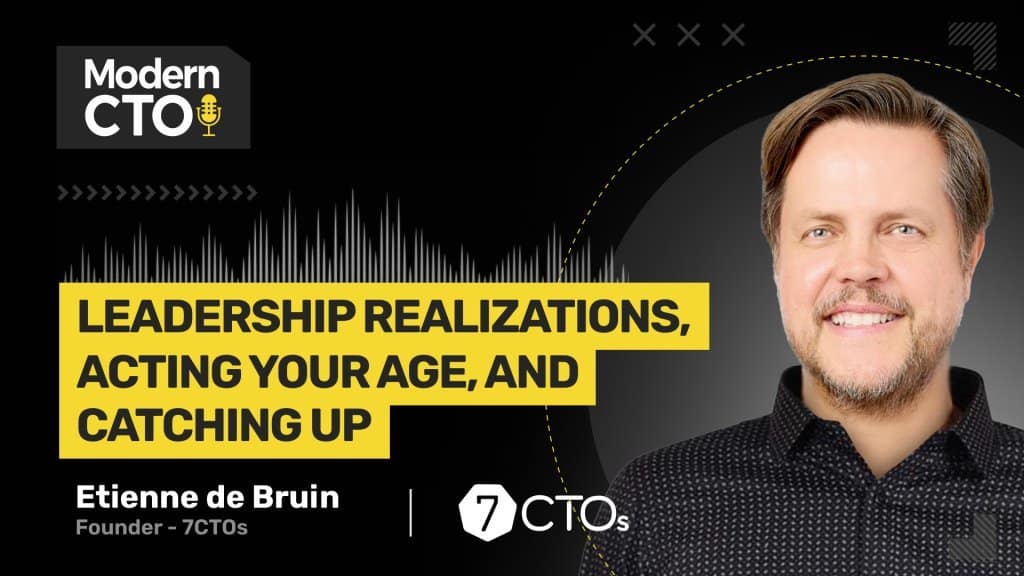
About Etienne de Bruin
I was born to code. I am passionate about startups. I obsess over innovation. I am a lover of people. I experienced plenty of failures, one significant exit as co-founder and CTO. I am currently building 7CTOs as a peer group and coaching organization for technology leaders.
About 7CTOs
We help Chief Technology Officers grow into world class leaders. We do this through in person forums that connect, enlighten and soundboard technology strategies.
Transcript
(Intro Narrator at 00:00:00) Today, we're catching up with Etienne de Bruin, founder of Seven CTOs, about his most recent leadership revelation and more. You're listening to Joel Beasley, Modern CTO.
(Etienne de Bruin at 00:00:17) How's it going, man?
(Joel Beasley at 00:00:19) Twice in ten days. We're getting to talk a lot. I am pro us spending time together.
(Etienne de Bruin at 00:00:25) Me too, man. Me too.
(Joel Beasley at 00:00:28) What's going on in coaching land?
(Etienne de Bruin at 00:00:29) What's going on in coaching land? You know, I kind of had a revelation about it just a few hours ago where I was realizing that sometimes when I coach people, I'm trying to do too much for them.
(Joel Beasley at 00:00:46) So...
(Etienne de Bruin at 00:00:50) You know, we talk often about the coaching mindset where I am willing to partner with somebody and see what the partnership creates and be inside of the awkwardness of that collaboration and that partnership, but see it as an equal partnership and not like I am gonna carry the load for you or I am gonna make things work for you. And I had a revelation this morning that sometimes I try to do that too much. Like, I'm gonna help you out of this, or I'm gonna—we're gonna do this. And I think sometimes I snap out of coaching and more into a consultant where I'm like, I'm gonna literally help you fix the problem.
(Etienne de Bruin at 00:01:39) When I think a coach is a lot more comfortable to say, I'm gonna reflect stuff back to you, and it's my job to be courageous to say the things that I see, and it's up to you to go fix it.
(Joel Beasley at 00:01:54) Well, you're a helper. You like to help. So when you see the pain, you see the problem, and you have the technical skill to assist, then you're making that transition from coach to consultant.
(Etienne de Bruin at 00:02:06) All the time. And so I think—that's exhausting, actually.
(Joel Beasley at 00:02:12) Do you have a consultant that you can, in your mind, mentally say, whenever I go down this path, I'm giving this to consultant person?
(Etienne de Bruin at 00:02:22) That is what I just wrote here was "work through others" as a bit of a reminder to myself that the best work I believe I can do is to show up as coach and then have—like you said, and I do have a few. I mean, I have a massive network, and I have a lot of people I refer business to. But I have to learn how to—like you said, when that coach-consultant thing flips in my head, I need to notice it myself and then say, and be okay with saying, you know, this is where I stop. And my friends, my network, my consultant buddies, they begin. And I think I have to be okay with that. I think sometimes I don't feel okay with that because somehow I'm trying to deliver value, and when I'm like, oh, but someone else can do this, I'm like, is that an admission of not being an expert? And I know the answers to this cognitively, but I'm just saying, in the moment as a coach, it's really important to see the conversation as a partnership of which you don't know what is gonna be produced and that you're okay with that, and less you're excited to explore it with your client or with the person you're talking to.
(Joel Beasley at 00:03:54) Knowing the information and training yourself to make it your default reaction are two separate things. I'm working on the same thing. It's similar. I would say it's the same thing, but it's very similar. I'm working with my direct reports right now.
(Joel Beasley at 00:04:11) By the way, Dan Martell, great clip on this. Love that guy. I've never met him before, but I—he had a great clip on this on social media, and it just stuck right in my brain. And he was saying, show them what done looks like and then act like an idiot.
(Joel Beasley at 00:04:26) So for example, we're in the process of doubling our sales meetings, which we've successfully done month over month. And so when I was going through that project, I hired three or four people, freelancers to help me do this. But my main person, Andrea, who leads marketing and runs all my meetings, I had to keep reminding myself. I actually wrote down on a piece of paper. I was like, look, just keep showing her what done looks like. Don't help her. So when she had to make a HubSpot workflow, I could do it in five minutes and I could teach her and it would be great, but I was like, nope. Contact HubSpot support. Get someone on the—you know, whatever.
(Joel Beasley at 00:05:05) So I just kept acting stupid. So I just said, I don't know. She's like, well, how do we do this? I don't know. You know? What does done look like? Done looks like—I was like, I need some screen of some type. I don't know if it's a PowerPoint or an Excel. I don't know what it is. I need some screen that shows me everybody who's interested in booking a meeting, everybody who's booked a meeting, everybody who's rebooking, and everyone who's completed a meeting.
(Joel Beasley at 00:05:29) So that's the magical screen I need. And I just repeat myself. So every time she comes back to me, I'm just like, this is what I need. I don't know how to do it. This is what I need. And then I just go back doing my work and the things that I have to focus on. Whereas before, I would say, here's what I need. You do it in HubSpot. Let me go show you what I do know about HubSpot. And then—you know, figure it out from there.
(Joel Beasley at 00:05:51) But that's like me getting too involved with their work. And so that's what I'm working on now. Show people—and I constantly catch myself. I constantly find myself trying to go a level or two deeper, and they're like, stop. I apologize. I'm backing up. I just want it done, and here's what done looks like.
(Etienne de Bruin at 00:06:09) I love that. I love—this morning, my operations admin and I were processing a pretty angry email we got from someone. We had sent out an email to all our members, and I guess this guy was a previous member of Seven CTOs and sort of slipped through the cracks. And while we were on our daily sync, she said, oh, I just got this really angry email. So we opened up the email together.
(Etienne de Bruin at 00:06:41) And in my mind, I was thinking, is this a great opportunity for her to respond to this person? Like, should I respond to this person, or should she respond to them? And I think what I love about what you just said is she didn't actually know what done would look like in that situation. So in that moment, I basically modeled to her what an overly friendly response—like, hey, so sorry, don't take it too seriously. We sent the wrong—we thought you were on the list. Blah, blah. You know? And I realized in that moment that that wasn't me doing it for her. That was me showing her what a response looks like in this type of situation and then afterwards for her to go off and do it herself.
(Joel Beasley at 00:07:34) And I think that's bad now. I think that's—I personally, I think that's bad now because—and here's my reasoning for it. If I—I noticed I spend a lot of my time modeling. Right? Like, not taking pictures of myself, but telling people, like, here—here it is and, like, you know—but I have then found that if I just say the outcome is that they respond and that they're happy and the things go well, and just saying, like, that's the outcome, that's the outcome, that's the outcome, they will figure it out eventually or they won't.
(Joel Beasley at 00:08:11) If they do, great. If not, you find a different person. But my real question is, how do I wanna spend my time? Do I wanna spend my time constantly imagining for people what they could do, or do I wanna spend my time just telling people, here's the objective, make it happen? And I realized really quickly that I'd rather spend my time saying, here's the objective, make it happen, and they do good.
(Joel Beasley at 00:08:38) And then I can coach them around how I thought that went. But then it's more meaningful to them because they thought about it. They did it. They spent time doing their own thought.
(Etienne de Bruin at 00:08:51) No, no.
(Joel Beasley at 00:08:51) And now I'm telling them, okay, it's 10% happier, you know?
(Etienne de Bruin at 00:08:57) I get that.
(Joel Beasley at 00:08:58) But it sucks. It's hard. It's not easy. We just need the money fairy to just come sprinkle money, and we don't have to—then we won't have to grow and improve. That would be a horrible existence, dude.
(Etienne de Bruin at 00:09:10) Yeah. I think that CTO types—the extent to which we are doing things ourselves, I don't even think we realize how much we're still doing ourselves. Like, even in that example, which I think is a great example, here I am modeling how to respond to an email where there's another layer above that, which is the one that you described, which is, hey, Nina, I see the email. Let's just make sure that he knows—he feels good about the fact that we made a mistake or something like that. And then off she goes and writes the email, or I'm not typing it out with her.
(Joel Beasley at 00:09:58) Yeah. You're tasking her there. Right? So you'd say, hey, Nina, I see this. The task is respond, making him feel good. Go. And just let her figure it out. No. It's so hard to do.
(Joel Beasley at 00:10:16) It is so hard for me to do. But that's been the last two or three weeks of my—by the way, you know Dan, don't you?
(Etienne de Bruin at 00:10:24) Yeah. I know him very well. Yeah. I consider him a fairly close friend. I think he calls me one of his best friends, but I don't know.
(Joel Beasley at 00:10:36) That's hilarious. Could you text introduce me?
(Etienne de Bruin at 00:10:38) 100%.
(Joel Beasley at 00:10:41) Yeah. When I found his content, it was mostly about helping SaaS founders be better at scaling the company. Maybe some product stuff in there a little bit or how to do your sales calls as a startup, something like that. But now he's coming into my feed as business guy, like, Cardone, Robbins—like, business-level guy.
(Joel Beasley at 00:11:09) And I'm like, that's awesome because it's good information. That whole thing about what I'm working on right now for the past couple weeks stemmed from not being so detailed, not imagining for my employees, and instead just giving them the outcome. And then—it also creates stability. That was another thing I found. I don't know if he mentioned this or not, but what I have found is it creates stability for my employees.
(Joel Beasley at 00:11:32) They know that when they come back to me, the only thing I'm going to do is restate the outcome, and that's it. And so they will just figure it out and then come to me with the outcome, and then my life's easier. Now there's obviously the hard part is the inefficiency that you'll experience in them learning that skill, learning how to walk. But then you ask yourself, does that outweigh the long-term benefits? No.
(Joel Beasley at 00:12:03) It's like the long-term benefits are they can just achieve outcomes that you state.
(Etienne de Bruin at 00:12:08) Yeah. And I like what you said there about training your people that when they come to you, it's going to be about the outcome. And I think it also forces me to live in outcome land. And I think immediately when I think about, you know, for instance, Seven CTOs doesn't really do marketing, and we really have to get on that.
(Etienne de Bruin at 00:12:34) And then I think about marketing as starting from zero marketing and what are the steps we can do to start small and really hone that in and then add the next thing? And that's such a waste of time. And it's such a terrible way to think about it. Because if I just say, hey, I'd love to have a stream of people who are interested in exploring and joining Seven CTOs, and I make that the experts' or my team's or a consulting or an agency firm—make it their issue, then what have I done?
(Etienne de Bruin at 00:13:09) I've just built—I've just helped lead my company. Instead, I'm like, well, how am I gonna write this little lead magnet? Or how am I gonna—it's like, no, dude. Come on, man.
(Joel Beasley at 00:13:20) Look, take your gross revenue and divide it by hours that you work, and then you're just like, nah. That's not—and don't even do that. Take your gross revenue, multiply it times three, and divide it by the hours you work, and then be like, oh, this is totally not worth my time. This is really not something—first of all, the problem with the entrepreneur, it's me and you, is that we know we can learn how to do anything. Gotta learn how to be a leader who gets things done through others. Right?
(Etienne de Bruin at 00:13:48) Through others, man. That is my—walking into this conversation with that. Like, wow. Somewhere in the last, I think, three years maybe, I've sort of—I think as you reach the different ceilings of scale or what you've done before or what you know or what is familiar, and as you go to that next level of the unfamiliar, you know, you kind of go into, I've got all this stuff I've got to learn now. I've got to learn how to do this and manage this and do that. When really, you just have to stay focused on the outcome—understand what is the outcome that you should chase and then bring people in.
(Etienne de Bruin at 00:14:30) But I think it's incredibly hard.
(Joel Beasley at 00:14:34) It is. You know what? My favorite business tip is—you can see it floating around in clips and all that stuff—is just to write down, like a bullet point, like, the one thing you want done on a piece of paper and just putting it in your pocket. Because then every night when you take your clothes off, you gotta pull it out of your pocket. It's always in your pocket. You're always touching it. And so for me, what I did over the past three or four weeks has been just double meetings. You know, it's—Josh, jump in here real quick. Josh, in every sales team or every team meeting update, what do I say?
(Intro Narrator at 00:15:06) We're doubling meetings. That's what we're doing.
(Joel Beasley at 00:15:07) We're doubling meetings. Every day I wake up and I say, we're doubling meetings, and then the only question I have for myself on how I'm gonna spend my time is, what's the one thing that I can do today to make sure that meetings double? And that's like—I hired, you know, Elias, a new guy. And when I posted that job posting, by the way, I did the Dan Martell thing, and I said, I don't know how to create meetings. I know how to—I've made millions of dollars. I know how to make meetings all day. I was like, I don't know how. Can somebody tell me how to get meetings? And then I just looked at all the applicants, and the market is good, man. The market's good. The right people will stand out to you. And then I found this person. I was like, that person knows exactly what they're doing. And then hire them and then just let them run. And then he wants to get into the details about how he's getting the meetings. I'm like, I don't really care. I look at your name and your number of meetings booked per week, and that's how I know if I pay you or not for the future. And I've done that. I did it.
(Joel Beasley at 00:16:03) So I had Andrea. She's generating five. Brought on Elias. He started generating five a week. Brought on Anna. She started generating three to five a week. And that's it. And then now we're gonna keep building. I'm gonna buy another person that can generate five, another person that can generate five. I'm just gonna keep doing that over and over and over again. And then whenever I interact with them, I just say, this is how many you got this week. You know?
(Etienne de Bruin at 00:16:25) Facts be facts.
(Joel Beasley at 00:16:27) Yeah. I don't—you did what you did, but this is how many meetings you got this week, and this is how well they converted. Proposals got sent on these. Proposals didn't get sent on these. And then I just am spending my life every day waking up doubling meetings.
(Etienne de Bruin at 00:16:41) And doubling meetings, in other words, to meet with someone who might be interested in being on the show?
(Joel Beasley at 00:16:47) Sales calls. No. Sales calls. Yes. We get booked up six months in advance, people that wanna come on. No. No shortage of that.
(Etienne de Bruin at 00:16:54) So what—so when your salesperson says, well, I mean, what assets do we have? What do we send them? What questions do we ask? I mean, I'm assuming that is all then stuff that's been pre-created. Like, when you say I don't know, it's not like you're saying, here's a blank canvas.
(Etienne de Bruin at 00:17:15) Here's what I want. Go off and recreate the wheels. There's a modern, or there's a Pro Series Media way of doing things that that person gets trained on, how to leverage and go and book more meetings. Is that my right on that?
(Joel Beasley at 00:17:29) I fired all my salespeople. You're talking about sales specifically, so I'm gonna give you a sales-specific answer. I have a friend. I have two friends. Only two friends.
(Joel Beasley at 00:17:40) No kidding. I have two friends. One of them is Dominic. His company grew from like zero to 2,000 people in five years, very upsetting for me because he founded his company after I started mine.
(Joel Beasley at 00:17:50) And it's a marketing company. It's called 2X Marketing. So I got to know Dominic through a friend, and then there was another two or three people I had the same conversation with. But I basically sent them my financials.
(Joel Beasley at 00:18:02) And I said, what am I doing wrong? Because I can't break past this like $2 million a year barrier. And I keep going up, and then I crash, and then I go up. And they looked at my stuff—P&L and balance sheet and all that—and he asked me some questions, and he goes, "Okay, I know what your problem is." Like, what's my problem? He goes, "You stopped doing sales. You stopped doing sales." He goes, "Every time you make money, you do sales, you make a bunch of money. You have a ton of money, a bunch of cash you're sitting on."
(Joel Beasley at 00:18:33) "You go hire a bunch of, you know, three or four salespeople. You train them. So now you're time training them while you're not doing sales calls. Get them to do sales calls, and then it takes six to eight months. You burn through your savings."
(Joel Beasley at 00:18:44) "They kind of do okay to wash out. You cycle a couple of them." He goes, "And then you say, 'Oh, crap,' and then you start doing sales again, and then the business starts taking off." So he said this to me. So here's the tangible, tactical advice. Good question, too. Thank you.
(Joel Beasley at 00:19:03) Here's the tangible, tactical advice. Here it is. This is like the best stuff I've been given in private calls I haven't had a chance to give on a podcast yet. He said, "You are a $300,000 to $500,000 a year person. Like, if I go out in open market, that's what I'm gonna make as some whatever." And I said, "Yeah."
(Joel Beasley at 00:19:19) He goes, "People pick up, and they know when they're talking to that level of person." And he goes, "When you're hiring $60,000 to $100,000 salespeople and training them up and giving them the best education of their lives—" but he goes, "You're trying to make that work, but it doesn't matter how much you invest in them. They're not you. They haven't made a thousand episodes."
(Joel Beasley at 00:19:39) "They haven't built 20 podcasts. Like, they're not you." He goes, "So here's what you need to do. Don't stop doing sales until you hit $15 million in recurring revenue." He goes—he was, he's at $100 million plus, right? But he's like, "I still am on every—like, basically every single sales call."
(Joel Beasley at 00:19:51) He goes, "I'm still a salesperson." He goes, "Don't stop doing sales, and don't even hire another salesperson, one of those $60,000 to $80,000 people or whatever. Don't do that until you hit $15 million in sales."
(Joel Beasley at 00:20:08) He goes, "Then when you hit $15 million, go hire someone that's a $300,000 to $500,000 person." Wow. "And you'll have the money." He goes, "You just, you can't get around it. Like, when we're on a call with like a CMO of AWS or something, like they know—you know the quality of the person that you're talking to. And you're like, 'I'm not gonna spend $100,000 with this level of person.'"
(Joel Beasley at 00:20:34) "'I don't trust that they're gonna be able to deliver on that,' you know." And you want to feel like you're talking to a competent peer.
(Etienne de Bruin at 00:20:41) Yeah.
(Joel Beasley at 00:20:41) Right? You want to hand a competent peer the money. And so every time I—and I know this is funny because when you and I were talking, my first name was like, "Etienne, you gotta get salespeople. You gotta stop doing the sales calls yourself." And here's where it went wrong. Where it went wrong was all these people I was talking to had 100-plus employees, and that's the game they're playing.
(Joel Beasley at 00:21:02) They're playing, "I've already at tens of millions of dollars in revenue." Yes. "And now I need to hire a force of all of these like account executives and meetings that—like I need to hire all these people because that's how we're gonna get from $100 million to $500 million." Yes. So it was the right strategy for the wrong time.
(Etienne de Bruin at 00:21:21) Wrong time. Absolutely, dude. I love what you're saying because I think I am—this is a realization I'm having. You know, 7CTOs is my baby. We've had seven or eight years of me talking to every single person who comes in. And it's almost not even a sales call. It's like casting the vision and showing what is possible, and like, "Do you want to be part of it?" And I have spent the last three years, four years—like I had it in my head.
(Etienne de Bruin at 00:22:03) "I have to have a CEO. I have to replace myself as CEO. I have to get out of sales." And meanwhile, the—like you said, these are all succession planning thoughts when the company really hasn't even begun yet. And, you know, in my weakest moments, I think, "Dude, 7CTOs is just a hobby that, you know, pays a couple million dollars. That's all it is."
(Etienne de Bruin at 00:22:29) "And it hasn't gotten to escape velocity." And 15 million is a great number to think about a little bit, because man, that's a long ways away. And that's a lot of hard work ahead. And you read all these damn entrepreneur books are like, "No, you gotta get out of—you'd scale, scale, scale, scale." And I think all of us million dollar, $2 million startups are all reading these books thinking there's something wrong if I am still doing certain activities inside of my company, because the books keep telling me that I need to scale.
(Etienne de Bruin at 00:23:07) But what you just did with what you said is you just—like, "Dude, take a deep breath. You started the race well, but that's where you are, is at the start." And it doesn't matter if ten years has passed. Your company still exists. Your brand has increased.
(Etienne de Bruin at 00:23:25) Your reputation is intact. So well done on the first ten years. Now let's ace the next ten.
(Joel Beasley at 00:23:35) Yeah. And that's it. I liked—my favorite thing you said is living in Outcome Land. I'm gonna move there. I'm moving my family there this weekend.
(Joel Beasley at 00:23:44) We're going to move to Outcome Land, and we're gonna live there. It's going to be themed like Super Mario Brothers background themed, but it'll be called Outcome Land, and that's where we will live.
(Etienne de Bruin at 00:23:56) We will both park our RVs next to each other in Outcome Land.
(Joel Beasley at 00:24:01) Yeah. Lots gone. We're adopting a kid. Did I tell you about that? What?
(Joel Beasley at 00:24:06) Yeah.
(Etienne de Bruin at 00:24:07) I cannot imagine. Honestly, I love people who do that, but I can't even imagine resetting. We are older parents, and we're done. We're exhausted.
(Joel Beasley at 00:24:20) Yeah. How old are you?
(Etienne de Bruin at 00:24:22) 51.
(Joel Beasley at 00:24:23) Holy crap. You're 51? That's amazing.
(Etienne de Bruin at 00:24:27) Does that change things for you and me?
(Joel Beasley at 00:24:29) I'm gonna—we have to end the call right here. Okay. You know what's cool is that you say it. I talk to a lot of executives that won't say their age. I'm like, "Just say it. Who cares? It's just a number." They're like, "Easy for you to say, 36."
(Etienne de Bruin at 00:24:42) I have to stop saying it.
(Joel Beasley at 00:24:47) No, it's great. Honestly, I remember sitting in a booth with you at some restaurant, and you looked at me, and you were just like—you had that realization that this guy is like 15 years younger than me. I was making some stupid mistake that I was thinking about all night after I said that, but you just gave me this look, and I was like, "Oh no, it's like Dad looked at me." I was like, "He gave—" I was like, "We don't have that type of relationship," so that like stood out to me.
(Etienne de Bruin at 00:25:11) Yeah. Here's one thing I'll say about aging. I think it's really important to understand that you are aging, that your place in society is shifting. You're not gonna hit on the 20-year-old at the bar anymore as a 60-year-old.
(Etienne de Bruin at 00:25:36) Of course, some people do that and, you know, whatever.
(Joel Beasley at 00:25:39) I was just thinking like when you're a billionaire. No, I'm kidding.
(Etienne de Bruin at 00:25:42) No, no, no. So, but what I'm saying is, I think that there's an understanding. Like, a lot of my colleagues at 7CTOs are in their early 30s. A lot of CTOs I meet who joined 7CTOs now are sort of in their 30s. And I am two decades ahead of them. And while I like what you said around, you know, it's about—it's really about the energy and the chemistry, and it's like the construct we have of each other. If it works, it works, and it's usually void of age.
(Etienne de Bruin at 00:26:16) And I think you and I are proof of that. Like, you feel like my peer as well. Absolutely. But I think that one thing I am noticing, especially as I'm moving along with my friends who are aging, that there is an upgrade that you have to make in your cognition that your place in society is shifting. It doesn't have to be bad.
(Etienne de Bruin at 00:26:43) I'm not saying it's negative, but I'm saying it is shifting whether you like it or not. And I think that's an important thing to be cool with and to embrace. And I wish that for more people, to be super comfortable with the fact that they are aging.
(Joel Beasley at 00:27:02) It's so important because it creates an internal pressure. So you know that you're going to get to the stage where you need—you're gonna want to give back instinctively. That happens in your 50s and 60s. Everybody wants to give back and share the knowledge and compress it down and share it with the next generation so they can do better than they can do. That's like a human instinct.
(Joel Beasley at 00:27:22) So knowing that you're gonna get to that point, and knowing that I'm 36 or 25 or whatever it is and that I'm aging towards that point, puts this internal pressure on, "Man, I need to use my 20s and my 30s and my 40s to do like meaningful, useful work so that when I get to that stage where I instinctively want to give back, I actually have something to give back." That's what I—that's how my internal pressure system works. Like, I have to have something to give back.
(Etienne de Bruin at 00:27:49) And here's a crazy thing to think about. You talk about doubling meetings. Think about doubling your age. Like, I remember as a kid, I would be like—when I was 20, I'd be like, "Okay, well, at least if I live my life again, I'll only be 40."
(Etienne de Bruin at 00:28:05) You know, for you, when you double your age, you'll be 72.
(Joel Beasley at 00:28:09) 72.
(Etienne de Bruin at 00:28:11) I'm dead. I double my age, I'm gone.
(Joel Beasley at 00:28:13) Yeah.
(Etienne de Bruin at 00:28:15) So I mean, I know that the doubling is longer. So that's not my point. My point is just that awareness that time is shifting. And then everything inside of our Western culture is, "You can look younger than you are. You can live longer than you can. You can be—it's not about age." I mean, every single time I talk about my age, people's natural response is, "Oh, no, your age is just a number. Oh, no, age—" I'm like, "No, shut the fuck up."
(Etienne de Bruin at 00:28:45) Yeah. Age is gonna kill you, and your time is expiring.
(Joel Beasley at 00:28:57) Yeah. So you can't coddle people.
(Etienne de Bruin at 00:28:59) Yeah. Get real about that and understand your place in society. Society needs me to give back. Society needs me to own that I am in my 50s. Society needs that. Society doesn't need me to be acting like a frickin' 20-year-old and do double, triple flip-flops on my snowboard.
(Etienne de Bruin at 00:29:26) Maybe some—maybe that's okay. But society needs me—needs that for me. And I guess what I'm trying to pontificate on here is just that that realization for me requires an active learning.
(Joel Beasley at 00:29:41) You're exactly right. That's what society needs from you.
(Etienne de Bruin at 00:29:44) Society needs me, full stop. Yeah. Here's a realization that I have, which is my dad is 78. I am—I'm almost 52.
(Joel Beasley at 00:29:58) Wow, he's 78. Yeah.
(Etienne de Bruin at 00:30:00) So I am a short 20-plus years behind him. You know? So I look at him as this very old, sort of aging—the frailty is starting to set in. Mhmm. I feel very young.
(Etienne de Bruin at 00:30:15) I don't feel 50. I feel like I'm 42, maybe 38. But I am right behind my dad, really, just short 20 years. And so I think it's really special and important for us to look at—to know our place and to just say, "Hey, you know, I have 20 years left. Maybe I have 30 years left."
(Etienne de Bruin at 00:30:40) But to understand that and to see that as a—like you said earlier, to light a fire and say, "Hey, let's get this done."
(Joel Beasley at 00:30:50) Thank you so much for listening. And if you found this episode useful, please share it with a friend or colleague who you think would get value from it. And if you have topics that you'd like to hear discussed on the podcast, either add me on LinkedIn or send me an email, [email protected]. Every time I get an email or LinkedIn message, it absolutely makes my day and inspires me to keep going.