
Episode 312 ·
Art Hu - CIO at Lenovo
Today we are talking to Art Hu, the CIO at Lenovo and we discuss what it looks like to have high alignment on the organizational strategy, the importance of having humans in the loop when implementing AI, and how to find the pattern in failures to see the bigger picture and solve bigger problems.
All of this, right here, right now on the Modern CTO Podcast!
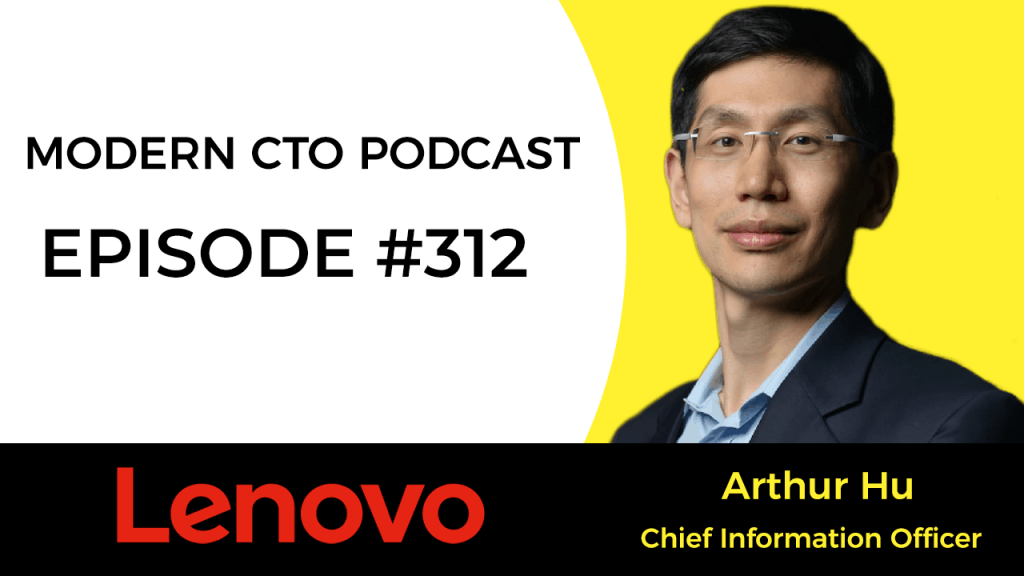
About Art:
Mr. Arthur Hu has been Chief Information Officer of Lenovo Group Limited since August 25, 2016 and has been its Senior Vice President since June 8, 2017. Mr. Hu is responsible for the overall delivery of information services, digital technology and business transformation.
Mr. Hu serves with the business units to drive business model transformation for more competitive capabilities and oversees a portfolio of strategic initiatives to further strengthen IT management and business collaboration. He served a series of leadership positions within the Lenovo, covering IT Strategy, Information Security, Enterprise Architecture and Business Transformation and Digital Go-to-Market Solutions Delivery.
Prior to joining Lenovo in 2009, Mr. Hu was with McKinsey & Company, where he focused on high tech, strategy and technology management and operational and strategic programs to deliver transformation impact across global organizations. He served in software engineering at a variety of companies, including Amazon.
Mr. Hu holds both a Bachelors and Masters Degree of Science in Computer Science from Stanford University.
About Lenovo:
Lenovo (HKSE: 992) (ADR: LNVGY) is a US$50 billion Fortune Global 500 company, with 57,000 employees and operating in 180 markets around the world. Focused on a bold vision to deliver smarter technology for all, we are developing world-changing technologies that create a more inclusive, trustworthy and sustainable digital society. By designing, engineering and building the world’s most complete portfolio of smart devices and infrastructure, we are also leading an Intelligent Transformation – to create better experiences and opportunities for millions of customers around the world. To find out more visit https://www.lenovo.com, read about the latest news via our StoryHub and follow us on the social media platforms listed below.
Transcript
(Joel Beasley at 00:00:00) Hello, my friends. Today we are talking to Art Hu, the CIO at Lenovo. And we discuss what it looks like to have high alignment on the organizational strategy, the importance of having humans in the loop when implementing AI, and how to find the pattern in failures to see the bigger picture and solve bigger problems. All of this right here, right now on the Modern CTO Podcast. This is the Modern CTO Podcast.
(Joel Beasley at 00:00:37) So what's been going on this past year for you?
(Art Hu at 00:00:40) It's interesting timing because we're just past the one-year mark when the US really started to shut down in mid-March of last year. And so I think we've learned a lot about ourselves in terms of resiliency and what is possible or what is not. And I think a common theme really is that a lot of things that people didn't think was possible, or the speed, really turned out to be possible. And it was really just having a burning platform, so to speak, to make a lot of the changes. And so I think that's the first-order effect.
(Art Hu at 00:01:09) And then, interestingly enough, one year on, there's still a lot of uncertainty about what the future looks like. And so as that emerges, it'll be interesting to see what second-order effects or what other factors come into play as hopefully we see some light and optimism at the end of the tunnel to emerge into what might be called post-COVID or post-pandemic.
(Joel Beasley at 00:01:32) How was it? I know you get to travel all over the world, and I know you have family all over the world. Did you get separated from your family during COVID? How did that play out for you?
(Art Hu at 00:01:43) Yeah. So the timing was interesting. I was in China on a business trip right before 2020 Lunar New Year. So already then there had been some initial and early coverage about the spread of what was then novel coronavirus before it became formally known as COVID-19. And as soon as I came back from that trip, the Lunar New Year started and China shut down.
(Art Hu at 00:02:10) And then in February, the rest of the world was still trying to find its footing and seeing if this was serious. And so I continued on some more business trips within the US in February, right up until, basically, the US declared that we were shutting down as well. Luckily, I was able to stay with my family. We're still in California.
(Art Hu at 00:02:33) And from then on, it's been long blocks of working remotely, as I think probably you have been as well. Interestingly, towards the end of last year, I did carve out time to spend a few months in China. And so that was just a fascinating contrast with how we had been living under lockdown and near-shutdown conditions for many months at that time versus being in China, which, in terms of daily life, was much more normal than it was in other parts of the world.
(Joel Beasley at 00:03:08) Are autonomous vehicles more popular over there?
(Art Hu at 00:03:11) I think it's certainly an active area of investment. I think electric vehicles certainly are gaining mind share. But, again, in most places I would characterize it as electric vehicles are very popular, but a lot of the settings in which it needs to work—it's probably similar in terms of adoption. There's a lot of research, a lot of interest, but it's nowhere near the so-called level-five hands-off, you don't really need a driver in the driver's seat. So I think there's equal interest. And for example, even companies like Baidu, they're looking to go international and expand their footprint with autonomous driving.
(Art Hu at 00:03:51) But the technology is still under investment. And I'd say we're still a fair ways away. So you definitely don't see—I think there's certainly interesting trials just as there are in the US, but there's certainly nothing at scale where you have fleets and entire fleets of cars that are entirely autonomous yet.
(Joel Beasley at 00:04:10) I did see an article that showed it was in China, and it showed a small autonomous vehicle that was KFC. It was the restaurant KFC, and they had these meals and you could walk up and you could order from this autonomous vehicle and then take the meal out. And I said, that's unbelievable. They have autonomous KFC vehicles. That's out of this world.
(Art Hu at 00:04:38) Yeah. Well, and it's interesting because, broadly for technology, it tends to be easy to do the one-off or the interesting science experiment. And then the question is—let's put it the other way, flip it. I don't believe they would say we're going to close 90% of KFC stores and you just walk up to a KFC autonomous car at this point.
(Art Hu at 00:04:59) So certainly the technology there as a proof of concept—there's a lot of interesting things you can do. And then the question is, how do you scale that up? And sometimes what we see is that you can do an interesting, almost PR-like, "Hey, check this out of what we can do," one, ten, fifteen vehicles.
(Art Hu at 00:05:16) And then over time, time will tell if they continue to make the investment and how they want to complement their existing retail formats with that.
(Joel Beasley at 00:05:25) Yeah. I didn't dig too deep. It could have just been in a closed business complex, a PR move. And I was actually reading a lot of the news about Lenovo, like, ten minutes ago. I was just sitting there on Google scanning through the news.
(Joel Beasley at 00:05:40) I'm like, oh, I wonder if there's some interesting questions in here to talk about with Art. And then as I got to, like, page four of the results, it was just content posted in the past two days. There's so much content that's coming out of Lenovo, and you're like a face for Lenovo, right? So how do you keep up with it? Or how do you handle when people are asking you things?
(Joel Beasley at 00:06:05) I mean, you can't see every new story that comes out.
(Art Hu at 00:06:09) Yep. No. So luckily, we have—I think we have high alignment around our strategy. And so, hopefully, what you've been seeing has been largely reflective of where we're going as a company. Because you're right, it's impossible for any leader to know all the details. That would just be literally inhuman to have that kind of memory or attention span. But I think it goes back to having clear thematic elements around the story that we're telling about what we're doing. And last time we talked, we were earlier down the road, and now we're much farther.
(Art Hu at 00:06:43) And we've really coalesced and solidified the strategy around our transformation, which is going to be the intelligent transformation and also a services-led transformation. And so all the stories that you see—hopefully you can let me know differently—but it's really around our strategy of moving away and moving towards much more customer centricity, offering services and solutions. Because the world continues to get more complex. There's a lot of pace of change with technologies.
(Art Hu at 00:07:13) And so how do we offer, in this new world of edge-to-cloud and client-to-cloud, where along the way you need to integrate a lot of assets to make a meaningful solution for businesses? Lenovo is well positioned from client devices to edge computing to cloud to hybrid cloud management and also intelligence. And so it's really around the themes that we spend a lot of time helping our customers, as well as the public, understand what it is that we're trying to do. So that helps.
(Art Hu at 00:07:44) When you can anchor on some of the themes that we are working on, then it becomes much easier. And, hopefully, we're not spreading our efforts too thinly in terms of communicating all different things, but it's really around some of the themes in our services transformation.
(Joel Beasley at 00:07:58) How do those themes come about?
(Art Hu at 00:08:01) The themes come about—I think it's a combination of multiple streams of thought. One, obviously, is keeping up in the industry. And here, clearly—I think at this point it's been more than ten years since Marc Andreessen's famous "software is eating the world" editorial came out. But that's continued to come true.
(Art Hu at 00:08:23) A lot of the profit pools, a lot of the industry dynamics are shifting into the software layer. So we have within Lenovo a long-term technology outlook where we look at the macro picture of what's changing. And so that is a constant output as well as consideration for how do we think about the technology trends that are going to be relevant to our business, and where are the next opportunities?
(Art Hu at 00:08:52) And the second one is we spend a lot of time listening and engaging with our customers, whether they're consumers—and we're able to engage with them more and more—and then we hold a variety of advisory councils, whether that's with our partners, our suppliers, or our large enterprise customers. And they represent really valuable feedback.
(Art Hu at 00:09:14) And when we listen to them, there's also a strong pull for integration and services and solutions. There's a lot less interest—and I can even tell from my view as a CIO. If you want to come talk to me and you want to sell me a box or an appliance or a piece of kit, it's not really compelling. What's compelling is if you can tell me a value proposition about how that's going to make me more successful in something that I'm looking for. Maybe it's code quality. Maybe it's engineering maturity.
(Art Hu at 00:09:45) Maybe it's turnaround time and agility. Whatever it is, that's the way to get my attention, and I don't think I'm an exception. When we listen to our customers, that's increasingly what they're asking for as well. So by looking and staying closely engaged with the market—the technology as well as our customers—I think those form the key inputs for when we brainstorm where are we today and then where should we go next.
(Art Hu at 00:10:08) At the nexus of those forces is where the conversation gets interesting and starts generating some of the outputs.
(Joel Beasley at 00:10:15) Well, the best thing in the world is when you're experiencing a problem running your business and you go and you find that there is a mature solution that does exactly what you need, and you can just purchase it and then move on to the next problem.
(Art Hu at 00:10:30) Yes, exactly. And it's interesting because I think there's obviously a very healthy startup community and a lot of enterprise, a lot of companies and startups, both in China, in the US, as well as elsewhere. And I think one of the good things that technology has made possible is really the elimination or the significant reduction of boundaries, meaning that it's easy to start these companies up. It's easy to discover. With the rise of software as a service, it's also easy to try a lot of these things with fairly low friction.
(Art Hu at 00:11:02) And that makes the experimentation—I know last time we talked about, well, how do you make better experiments? How do you make better decisions? And if you're going to make a mistake, let's at least make new mistakes that are treading new ground and generating new learnings. And so I think we continue to see technology reducing the entry costs for companies as well as testing out the adoption of those technologies, which is quite positive.
(Joel Beasley at 00:11:26) Yeah. One of the things I was actually thinking about this weekend—I wasn't sure who I would ask this question to, but I was just running it around in my mind—it's that I try not to make the same mistake twice. That's a goal for me. But I'm human. I'm not perfect, and so it happens. Sometimes I'll find myself making the same mistake and I'll just—that'll create a pressure for me to change.
(Joel Beasley at 00:11:54) And so I'm curious, in your experience, what's a mistake that you found yourself making over and over and then you finally were like, "I'm done. I've had it. I'm never repeating this mistake again"?
(Art Hu at 00:12:06) Yeah. Well, that's a fascinating question, because I think it goes back into the level of abstraction that you think about. And what I mean by that is a mistake—you're very unlikely, if you're at all thoughtful, to repeat an exact mistake. The same situation, the same context, the same system. But where I find—I'd like to move faster, and I've been working with my team on how do I identify patterns, really the patterns. How do we find classes of mistakes that really might have more similar root causes?
(Art Hu at 00:12:35) So let me give you an example. For a while, we went through a period where we were having higher production-level incidents that were causing significant impacts to the business. We might not be able to ship. Maybe we couldn't answer the call center in a region for a time, or maybe our manufacturing line went down at a critical moment. And we have a process within Lenovo called Fupan, but that's literally a kind of a metaphor of replaying the board of chess. It's a retrospective in a sense that goes very deep on the root causes.
(Art Hu at 00:13:17) And what I found is we would go very deep on what I would call the proximate cause. The teams were excellent about firefighting to say, "Okay, well, for example, in this case, the hardware had a failure and we just had a single-node setup. And so how do we fix that? Okay, well, we should make it a high-availability setup." In another case, it might be, "Well, the high availability didn't work the way we thought it would work." So even if we had high availability, it didn't cut over the way we thought.
(Art Hu at 00:13:56) And so what was happening is we were getting deep on a particular problem, a slice of a problem, but we weren't necessarily taking that and trying to expand it to say, "What is the class of failures?" So, for example, hardware failing. One week it was, "Well, the server failed." The other was, "The storage failed." The third was, "The firmware and the controller node failed." And we were treating them as separate things. It's like, "Okay, well, if the firmware level fails, let's do this. If the storage fails, let's do this. If the network interface card on this port fails, let's do this."
(Art Hu at 00:14:21) And while those were all addressing that very narrow proximate cause, what we were missing was, "Well, guys, why don't we step back and think and put on our hat of—we keep seeing different types of these failures, but they're all related to some kind of hardware failure somewhere in the stack." And it doesn't matter if it was the storage, if it was the disk, if it was the motherboard, if it was an IC, like a 50-cent IC somewhere else on the chip. The broader problem to solve is how do we solve and how do we tolerate arbitrary hardware failure?
(Art Hu at 00:14:57) And so if you put your hat on that way, then you can reorient yourself and think differently. It's not, "Well, let me just think about it very technically." It's actually there's an entire discipline around this—around SRE and site reliability engineering—and how you engineer assuming that there's going to be failure at different points. And then there's techniques and patterns that you can adopt to go fix that.
(Art Hu at 00:15:15) So not so much mistakes, but I think the mental framing we took was too narrow in a way that forced—I would say not to repeat mistakes, but for not stepping quickly enough to identify the synthesis to say, "Hey, look, there's a broader way of looking at this." And when you look at it more broadly, you do have to be down in the nuts and bolts to fix the proximate issue. But if you can think correctly and group and identify the classes of issues, then you can multiply the effect you get by fixing just one issue into, "Well, how do we fix an entire class of issues across the company?"
(Joel Beasley at 00:15:55) That's brilliant. You say stuff sometimes, Art, and I'm just—my mind is just so focused on what you're saying. I'm not even thinking of another question. I'm just wanting—I'm taking notes. It's great.
(Art Hu at 00:16:10) No, I mean, it's—and I think it's not me. It's the team. I think that's part of the value of dialogue, which is you're constantly thinking, as a leader, what else is at stake.
(Art Hu at 00:16:20) Right? Because you're not gonna be the person who's best fit to diagnose, well, what's wrong with the firmware version and, you know, how many patch levels am I away? Am I n minus one or n minus two? Right? The teams are going to be on top of that.
(Art Hu at 00:16:31) And so a lot of the value add is really thinking with the team about, right, these right mental models. Right? Are we thinking about it the right way? And so for example, it was like a light bulb for the team. It's like, well, instead of laboring every time when a production issue comes up, like this whole class of issues, we should bring. Right? And there's a whole body of work. Right? This is the whole point of, you know, how do you share knowledge and how do you, again, to your point, not make the same mistake twice? You can draw on people who are way smarter and at different scales than you and have done different variations to accelerate your journey.
(Art Hu at 00:17:04) So the next time you're confronting something new, it's really net new that you can spend your brain cycles on.
(Joel Beasley at 00:17:11) So the result of those issues was site reliability engineering?
(Art Hu at 00:17:16) Well, it was introducing elements of that. Right? Because I think, obviously, it's easy to say, oh, we should just do site reliability engineering. But because it's a, right, there's a practice, there's a methodology, there's role definition around it as well as architectural implications. Right.
(Art Hu at 00:17:30) That sets the team down a mindset, right, change, right, up to and including shifting from a very reactive mode from incorporating a much the mindset of how to incorporate quality from the beginning. Right? How do we design in so that critical applications are more fault tolerant? Right? Because there's a whole, right, there's a whole different way of engineering, right, at different levels.
(Art Hu at 00:17:52) You can make, you know, application logic choices, right, you can make deployment pattern choices about your cloud and if you use private cloud or public or on-prem. So even on the technical side, there's a whole, it drives a whole different set of downstream discussions that we need to then think about. How do we allocate skill to go do that? And the other interesting thing that happens is also, right, it raises good business questions. So it flexes those muscles.
(Art Hu at 00:18:17) Because now if you want to engineer a solution that's much more robust compared to what we've traditionally done, well, there's a cost and a time associated with that. Right? It's not free. It, like, if you think about the childhood, you know, parable about the three little pigs. Right?
(Art Hu at 00:18:30) Do you want to build a straw house? Do you want to build, like, a stick house? Or do you want to build a brick house? Right? They don't all cost the same.
(Art Hu at 00:18:38) And they certainly take different times, but they have different characteristics about their resiliency and fault tolerance and the usability characteristics. And that's an interesting discussion with the business because normally they're just like, oh, just make it right. And sometimes you have to have a bit of the discussion to say, yes, we can make it right. But let's really talk about what right needs. And by the way, there's no value judgment in that.
(Art Hu at 00:19:00) It's just a discussion. Sometimes the straw house is okay. Right? I just need this for six months to the promotion season, and then we'll build it again next year, right, with the learnings of that. And that'll be the brick house for the long term.
(Art Hu at 00:19:10) But for the next year, we'll just make do with the straw house.
(Joel Beasley at 00:19:15) The awareness of what you're building and why you're building it and how you're building it is very important.
(Art Hu at 00:19:21) Exactly. And I think, again, as one of the things that I think as a trend has further progressed is really around the business taking a broader interest. And, again, last time in our previous discussion, I remember that we spoke about, right, the business is already starting to pick up on this several years ago for those leaders who were very acute and more forward thinking, right, where they would take my charts and start explaining, like, why microservices are interesting and, you know, if we think about how Lenovo is using artificial intelligence, right, it's really gone really broad in the organization now. Right?
(Art Hu at 00:20:02) You can basically walk to any team, right, whether it's HR, finance, supply chain, product development services, just anywhere around the company. I can point to a couple of really solid use cases where the teams have picked up on techniques in artificial intelligence broadly to go enhance either the decision making or the efficiency within their domain. And so what we've seen is technology continues to elevate in importance. Right? And so even now at the corporate strategy level, kind of broadly speaking, the umbrella term about digital transformation, but really enveloping the automation, the intelligent instrumentation, deploying AI throughout all aspects of our business that's founded on, right, responsible use of the data that we have.
(Art Hu at 00:20:51) Right? That's really taken off. Right? And I hear more business teams talking about it, and making that a pillar of the strategy. Right?
(Joel Beasley at 00:21:01) Have you done anything with AI ethics?
(Art Hu at 00:21:04) AI ethics. I think this one, so because currently, where we focused a lot is on the operational side. Right? So unlike some of the really large kind of social media companies, right, we tend not to run up against the ethical considerations because a lot of our use cases are for intelligent recommendation. Right?
(Art Hu at 00:21:25) Because we're not in general, given our business model and our configuration, we're tending not to brush up against the political and social issues. Right? So I think a couple of examples. Right? Maybe, and then you can feel free to, we can, you can challenge me on this if you see differently from the various discussions you've had as well.
(Art Hu at 00:21:42) But, you know, for example, we'll think about, you know, how can we, a really good one where we use computer vision was to really help out on the quality cycle. Right? Because literally before, right, we do things around burn-ins. Right? We have to, you know, check for quality issues on screens.
(Art Hu at 00:21:58) And so literally one use case was, you have to, because failure modes need to be diagnosed. Right? And they're not straightforward. And if you miss it, then you miss it. So instead of having a trained engineer looking at the screen for eight hours a day to, you know, kind of note the failure modes, right, you can just use computer vision, log the exceptions, right, and then actually save a whole ton of time and make it a whole lot better.
(Art Hu at 00:22:21) Right? Another example, during the pandemic, right, we've really deployed AI to help improve our supply chain end to end. Right? We've been supply constrained. I think the semiconductor industry has, at this point, pretty well documented kind of structural shortages due to the explosion of demand.
(Art Hu at 00:22:37) Right? And so we've had to apply more intelligence to create a better experience, whether that's better planning, right, to how do we better forecast plan ship dates, how do we make sure we plot the right logistics for our in conjunction with our third-party logistics providers so that things can use fewer mileage, right, or rack up fewer miles on the way to customers. It's greener. It's faster. But it reduces our footprint.
(Art Hu at 00:23:02) But a lot of, so most of our use cases are going to be around really hardcore cost operations and customer experience improvement. And so based on the broader array that we've seen, there hasn't been much on, again, the things that we might consider the more social aspects. Right? Because it doesn't touch on the sphere of, right, is this a social justice issue or not? I just wanna make sure that, Joel, you, right, and Modern CTO and our customers can get the best experience when we're provisioning and deploying and getting solutions and equipment to our customers.
(Art Hu at 00:23:37) Does that make sense? Yeah. I'm curious to hear, you know, what you think about that.
(Joel Beasley at 00:23:42) So I previously thought it was more, like, the social injustice. Like, when I would hear people talk about AI ethics, that's where I was. Until I had a conversation with the head of AI ethics for Deloitte. And her name is Bina. And she shared with me this, like, different view of it.
(Joel Beasley at 00:24:01) Her example was detecting failure rates in a, like, a plane engine. Right? And if you're tasked with detecting those failure rates and running your algorithms on it and figuring out, well, it turns out that the way the pilot is driving the plane impacts the engine. And so, if they're driving it a little more recklessly or a little harder than other pilots, should that data, that they've been able to figure this out, should that data pipe up to, let's say, their review process? Like, their, you know, one-on-one type reviews.
(Joel Beasley at 00:24:37) And then that would create this interesting ethical question of should it? And for me, I was thinking, well, I didn't think about that at all from an ethics standpoint. I just see an engine and I need to figure out why it fails and, you know. I didn't see that other perspective of it. Another one is, like, if you're doing a recommendation engine, the famous story with the supermarket, I think it was Target.
(Joel Beasley at 00:25:00) They were recommending baby products to teenage girls that didn't even know that they were pregnant yet. Because of their purchase habits and patterns. And so I was just curious, like, how the ethics comes up, like if you have someone. Obviously, you'll have people, your organization is large enough. You've got smart people who care about this and think about this.
(Joel Beasley at 00:25:23) But I was just curious if you guys had, like, an ethics person or if that's just something that's not coming up a lot.
(Art Hu at 00:25:31) Yeah. For our use cases, right, I think we definitely have for our philosophical approach, right, it very much is in terms of responsible use to have a human in the loop, first of all. Right? Because I think the first one is we shouldn't assume. It's only as good as the data that we give it.
(Art Hu at 00:25:46) Right? And in general, we know that, you know, for many of the decisions, we actually get better results by partnering kind of the outcomes from recommendations with kind of human judgment. Right? And or, like, kind of supervised training over time to make sure that there are, you know, reasonable outcomes or we see outcomes if they're skewed, right, on recommendations, for example, that we can review them. Right?
(Art Hu at 00:26:13) So we have that mechanism where we don't let it, it's just unsupervised, and it goes on over time where we train it and forget it, and it just keeps going. So I think that's the first point about responsible use of data. And, you know, I think, and because of, I think, the nature of how we engage currently, it's not, we tend not to get to those things that are sensitive, but you raise a good point. Right? To the extent that we instrument our businesses and our interactions more and more so that we can get intelligence about the needs and better serving.
(Art Hu at 00:26:45) Right? I think those will increasingly come up, right, to your point. And for us, right, because we, you know, we're not gonna be the firmware that's flying a plane. We haven't gotten to the sensitivity yet where we say, boy, that's really interesting. Because at this point, for example, a lot of our operational decisions are really around kind of the products that you wanna buy and how do we drive more efficiency.
(Art Hu at 00:27:06) Right? How do we create better? Right? And I think we do have a process so that if there are kind of ethical considerations that come up, right, we do review regularly the use cases and the impacts and how they're being deployed. And so we would surface it that way.
(Art Hu at 00:27:20) Luckily, I think we care about it, and that's why we have a human-in-the-loop process. But we haven't really run across very sensitive cases, just given the nature and the profile of AI use cases that we've deployed to date.
(Joel Beasley at 00:27:32) Yeah. And your style of business. Right? You build a lot of infrastructure. You build a lot of tools.
(Joel Beasley at 00:27:37) A lot of the lower level stuff. The consultants that are solving some of these problems, like, for example, with the turbine or the jet engine, you know, there's just different levels of the stack where ethics will come up in different ways.
(Art Hu at 00:27:52) Yep. And I think around that, right, to the point about as this gets more and more embedded and we do roll out use cases, it's not to say that it won't happen or we won't have more at Lenovo. But I think, again, there's an opportunity to your point about what the head of AI ethics at Deloitte was saying. Right? I think as part of it is an ethics issue, but part of it is also a long-term, you know, how do we, what's our relationship with the data, and how do we integrate it in our lives? Because rather than say, well, you know, then taking a, versus taking a perhaps a more punitive stance that says, well, you know, you drove the engine too hard and you pushed it 5% above tolerance. So you shortened its lifespan by 20% because it's a nonlinear function. So now you get docked on pay.
(Art Hu at 00:28:33) Right? If it's really real-time, right, rather than, we can actually flip it to say, well, if we're getting this data real-time, why don't we turn this into a coaching for the pilot? Right? Because the pilot's not out to, right, to degrade the engine purposely. Right?
(Art Hu at 00:28:46) Maybe he's trying to make up time on a flight. Right? Maybe he's just, he was trained a different way in the simulator. Who knows? And so I think the flip side on the opportunity for responsible and positive use to make it the win-win would be really compelling, which is to say, well, forget review time.
(Art Hu at 00:29:02) Right? Like, after the flight, it's like, hey. These were the things you did. Are you aware you did those? Right?
(Art Hu at 00:29:07) And so there can be a review process for the pilot to first think, okay, and if I did these things, maybe there were wind conditions that required it or something else that happened. And you don't have to wait for review time, but it's something that it's much more, you know, real-time feedback for improving. Right?
(Art Hu at 00:29:22) The pilot hopefully improves, and then hopefully, the airline and the engine manufacturers also get the benefit with reduced maintenance hours. And that's, I think, philosophically, what we've been trying as well. Where we've had the most success has been around finding win-wins. Right? Because when we, when we've kind of gone in and we had to learn the lesson the hard way, when the teams felt that it was AI coming to take over their jobs, they would sabotage, literally.
(Art Hu at 00:29:47) Right? They would give bad data. They would try to exclude data from the model so we couldn't train up. And so, of course, we had worse results. Right?
(Art Hu at 00:29:56) But where we found the win-win is to say, look, you know, forget AI, you know, as a thing. Right? But look, if we have this new tool for you, if you work with it, you will have better KPIs, and you'll have a better performance score, and you'll have a better bonus.
(Art Hu at 00:30:09) And that flipped it entirely. They said, oh. Right? And then from there on, right, they actually worked to make it better. And then we actually did see better outcomes.
(Art Hu at 00:30:18) Right? So I know we kind of veered a little bit, but I think that's really the opportunity. Right? I do believe, you know, responsible use and ethics are very important. And I think the way we can do that is to be aware that, you know, human in the loop is likely for the majority of cases to be important.
(Art Hu at 00:30:34) And then as we move to even more real-time and deeper embedding of data and instrumentation in the process, right, we look for those win-wins because I'm confident they're there in almost every use case. Right? Whether it's the computer vision, it's automation. When it works properly together, people are excited about it. And the key is to find those win-wins and not lose sight of the fact that it is another tool.
(Art Hu at 00:30:57) And just as with any other technology, there's going to be guidelines that evolve about responsible use and making sure that we can detect those and tackle those as they come up.
(Joel Beasley at 00:31:06) That's been a trend of the conversations I've been having is using the carrot. The carrot, not the stick. Everybody that I'm talking to these days is just trying to figure out how to make better work experiences, higher quality of life for everybody, and then how we can use technology to improve our lives, get more freedom, more time with our families, the things we wanna do.
(Art Hu at 00:31:26) Yeah. And, you know, one is life. Like, imagine the engineer, 50% of your job was staring at a screen with Excel or a notebook saying, okay, here's the failure mode at, like, you know, 12:00 AM. And the next one was, you know, 3:30 AM. Right? An hour and a half later, you've just been looking at the screen. That's a huge quality of life and efficiency improvement. Right? And the other level around some of the deployment of AI, the reason we've really deployed it around whether it's productivity or profitability around all parts of our value chain is, on the people side, on the talent side, I think it's actually a great development tool. Right?
(Art Hu at 00:32:03) And, you know, people who are embracing it can really fundamentally reimagine what their jobs are like over time. Right? If I think about just people who are in the call center. Right? I think they started with, again, a very basic kind of one level scripted AI bots. Right? It's like, if you match this string, right, this bot will spit you back an answer. If not, right, then it says, sorry, please call an agent. But from that very humble beginning, right, because that's a very basic form of AI. But from that very humble beginning, right, now they've advanced to have kind of multilevel engagement in multiple languages with a much broader knowledge base. And so a team that was originally, well, I just answer phone calls, to then, well, I just kind of create a database to answer robotic issues, is now fundamentally a very different team. Right? Because the skills of someone who can answer the phone and read a script, vastly different. And the team themselves have now, they now think of themselves as kind of process engineers and knowledge engineers that are curating the knowledge base, right, setting up the knowledge graph and the structures, applying, right, kind of the AI logic to reason across the knowledge base to give answers in an ever expanding and more dynamic way.
(Art Hu at 00:33:13) Right? So for them, they're totally in a different space and a career and a capability set than they were when they started. And that's another aspect. Right? It's not, it is quality of life. And over time, right, if you really embrace it, it fundamentally helps evolve the nature of your job and what you do and even how you think of yourself. Right? Because these people are super excited. They're like, I can go and get a job anywhere. I'm an AI expert. Right? Because I can build knowledge graphs. I know how to train these models. I know how to use bots. Right? And that's such a far cry from, I pick up the phone and read a script.
(Joel Beasley at 00:33:44) Did you think we'd be here when you were just a young version of Art winning table tennis championships?
(Art Hu at 00:33:54) Yeah. Well, this goes to the nonlinear nature of technology. Right? Yeah. I would say, I think for many of the use cases, you know, I wouldn't have expected them not knowing beforehand. Right? So it's been tremendously gratifying to see it take off and for teams to run with it. Right? Because a lot of this wasn't even, and that's, I think, the beauty of if you set this up properly, it's not even about telling the team exactly what to do. Right? It's saying, hey, here's an area of huge opportunity. And over time, they run with it and make it their own. Right? So I've been pleasantly surprised and delighted by some of the use cases that the teams have, you know, found occasion to deploy. Right? So, yes, I would say, you know, you go back ten years, I would not have imagined we would be able to do a lot of the things that we do today and having now deployed AI much more broadly.
(Joel Beasley at 00:34:48) We glossed over that table tennis championship thing way too quick. I have to hear more.
(Art Hu at 00:34:55) We can take a quick detour there.
(Joel Beasley at 00:34:56) We should, because the beard's new, but also our company's grown. We have just under 15 people now here at the podcast, which means we have awesome researchers, and they find all sorts of interesting stuff. And so I was super excited when they said, dude, he's a table tennis champion.
(Art Hu at 00:35:14) That does feel like a prior life. Right? This one is more serendipity, but I did grow up in The US. And so I remember in middle school and high school, people would play tennis, baseball, soccer. And I like those things. But my father happened to be a table tennis fan slash fanatic. And so that's where I ended up spending a lot of time. And we belong to a local table tennis club, and I think just following him around. Right? He was quite into it. We'd have videos. We would go to the tournaments. And so I was very much active on that scene up until, you know, basically the middle of high school, I would say. And so it was quite a thing. It wasn't well understood then, but it was a lot of fun.
(Joel Beasley at 00:36:04) What's your thing that you do with your kids?
(Art Hu at 00:36:08) Yeah. Well, I think the pandemic has made it very different, right, especially with a lot of the team sports. For our kids, I think just in terms of mind and body connection, the baseline is you have to have some physical activity. Because, you know, if we're sitting at our desk all day, I think that's been physiologically shown to be negative for long-term health outcomes. So with our kids, what we've taken to doing during the pandemic is biking. Right? So we got everyone a bike. And then on the weekends, we'll find kind of a new biking odyssey and adventure to undertake. That's been our preferred mode of, you know, getting out and also spending time as a family.
(Joel Beasley at 00:36:48) So you load up all the bikes, go explore new trails and new areas?
(Art Hu at 00:36:53) Yes. Exactly. And we get some sun, we get some wind, and we get some exercise. And it's very liberating just to be out of the house sometimes. Right? Because you don't realize it until you spent most of the week sitting in front of conference calls or in front of, for them, classes. So that's really been a good thing, both physically, but also as time to reconnect as a family.
(Joel Beasley at 00:37:15) Yeah. We got a camper and started going to different campgrounds and, you know, setting up camp. And it's a lot of physical activity because then you get to walk around the campgrounds. You get to explore new areas. We got to go over to, like, NASA and camp over there where they're doing some rocket launches. So we've just been exploring.
(Art Hu at 00:37:36) What's amazing. Is there a kind of camper ethos or culture that goes along with that?
(Joel Beasley at 00:37:41) Oh, it is way, way larger than you could imagine. It's like, I can't even, like, right now, we were gonna go camping this weekend, but they're all booked up. So there's just no availability. I mean, some of the places, like, so there's these dark sky places which are, you can't have white light. It's so you can see the Milky Way galaxies, you can see the stars. So you have to have, like, red light everything. But some of these campgrounds, to go to them, they're booked up six months in advance.
(Art Hu at 00:38:13) Wow. So that cuts down a little bit on the spontaneity in that case.
(Joel Beasley at 00:38:17) Yeah. Well, for that specific type of campground. But, you know, it depends on if it's season or not. Also, I live in Florida, and everybody in the world is moving from, like, the Californias and the New Yorks and down to where it's warm and more open. Right? So, for example, here, the value of my house has gone up significantly. And the average days that a home will be for sale on the market is like a handful. And there's no availability to rent. The real estate market where I live is just, it's chaotic.
(Art Hu at 00:38:53) Well, it's good that you're on the ground floor then.
(Joel Beasley at 00:38:55) Right. There's the bonus. Yeah. Because we were gonna sell and move. We're like, look how much the house has gone up, like, let's sell and then, you know, move farther out East or find a rental. But there was nothing. So we're just gonna hang out here for a couple more years.
(Art Hu at 00:39:11) Were you thinking about moving in state or actually picking up and doing something different for your operations and base?
(Joel Beasley at 00:39:17) Yeah. So I'm in the office here. We have, like, 3,000 or so square foot office. Everybody was here before the pandemic. When the pandemic happened, we were partly leadership software, partly podcast, and we became 100% podcast just because shorter sales cycle and we needed the growth. Right? The changes that happened and occurred in the business, obviously, the roles will change. And we ended up hiring people all over The United States. Right? Like, Nebraska, Chicago, Tennessee. And so, as of today, no one's been coming in the office for at least a year. We figured out, we got into a rhythm of how to work fully remotely. And I just come into the office when I have to record the podcast.
(Art Hu at 00:40:02) Yeah. Yeah. That's nice to have the flexibility. Right? Again, I think when confronted with the situation, humans are endlessly creative, right, about how to make things work.
(Joel Beasley at 00:40:13) Well, so now we have the flexibility. So we went and explored. We went to Texas, and we took a plane ride there with two kids under the age of five. And it was a task. Right? And the people on the plane weren't very happy about it. And it was after that move to Texas we explored, and we decided that we need to go visit multiple places to figure out where we wanna relocate. And it would be best if we got a camper and we just drove everywhere because then we could have everything with us and, you know, drive at night when the kids are sleeping and then be able to have everything with us along the way. So we haven't, I guess, right now, we're kind of in a holding pattern. We have a desire to go. We have the flexibility where financially we can, and organizationally, we're not tied to this physical location. It's just, I'm a big fan of the universe and of God and of timing. And when it all comes together and clicks, that'll be the perfect moment. I'm just being patient and waiting.
(Art Hu at 00:41:13) Right. Well, and again, I think we're privileged. And it's great that you're doing well to have that flexibility and that choice.
(Joel Beasley at 00:41:20) Yeah. How are you doing with all of this? Are you getting to go into an office? Or are you just 100% at home?
(Art Hu at 00:41:26) Yeah. Aside from my trips to China, and when I do go, because they actually have a quarantine period, when I last went in the later part of last year, it was fourteen days. Now it's twenty-one days. So at this point, if you want to make a business trip, in order to make it worthwhile, you tend to stay for a while. You wouldn't spend fourteen days in quarantine and then, you know, spend a day and then try to fly home. So, but aside from that, it has been at home. Right? For us at Lenovo, within The US and most of the other parts of the world outside of China, there's no rush back to the office. As you said, I think, you know, we really have figured out what fully remote means. But there is a real longing, including on my side. When I went back to China last year, I knew I missed the people, but I missed them, how do I say, much more than I would have thought. Right? I thought, oh, yeah, it'll be nice to see the team again. But when I actually saw them, I was just happy beyond all bounds to actually, you know, share a meal and to share some personal time with the team after so long.
(Art Hu at 00:42:28) And so I think that's been interesting. The flexibility on the work stuff is definitely no issue. Right? In terms of task orientation, the technology makes that easy. I can see you, and I can see what your output is. We can collaborate in some real time. We can talk real time. But at the end of the day, though, even work is not just work. Right? There's still kind of a personal and social capital aspect, which isn't quite the same. And I saw that because my team has had, right, we've brought people on board. Right? And the newer members, it's harder to build those connections when you've been all remote. You just don't have that feel. And as a technologist, it feels weird to say. Right? It's very touchy feely. Right? But at the end of the day, that human connection element, I think, does go hand in hand with the technology to make us more effective. Right? And I think the long-standing relationships that are built on trust, right, those tend to be strengthened. And it has been, I've noticed, harder to establish newer connections than, you know, compared with before when you could actually see people in person. But otherwise, right, I think, otherwise, mentally, right, physically, as long as you get into a rhythm, right, things have been going quite well. It took a while with the pandemic onset to adjust. But now that in this so-called new normal, at this point, pretty used to the cadence and the operating rhythm.
(Joel Beasley at 00:43:47) So I wanna go back. So you go to, I just wanna complete the story. Because I have this, like, timeline in my head. And that's why I've got the Art who is doing the table tennis with dad growing up. And then I have Lenovo Art. What happened in the middle?
(Art Hu at 00:44:06) Yeah. So I grew up on the East Coast. And then for college, I was deciding between, you know, some schools on the East Coast and being on the West Coast. And, you know, as I remember it, I kind of visited because I never really spent significant time in California before. I stepped off the plane, and it was one of those kind of famous California days. Right? Spring, blue skies, very moderate, very temperate weather, just sun shining. People are playing like volleyball on the lawns, things like that. And so that convinced me to try something different, and that's been a theme. So I said, and so I came out to California for school, ended up doing computer science and studied that and graduated. And after there, I took something different. Right? Rather than joining a tech company per se, I went into consulting. Right? Again, to try something different. So if there's a theme, you know, trying something different is not a bad idea. Right? Because at that point, I joined McKinsey as a consultant. And from there, I had the privilege to work in different geographies around the world. I started on the West Coast, but I quickly transferred to Asia to work. And so, you know, after that, I spent the next, the better part of fifteen years, either in Asia, right, or on the West Coast working. And so I alternated between those locations. It so happened before I joined Lenovo. Right? When I was a consultant, they were one of my clients. And there came a time when there was some transition. There was an opportunity that meshed with the vision of where the company vision and the company need meshed with what I was looking to do, right, which is really to own something, right, and to really kind of be on the other side and versus, you know, offering advice to actually, you know, providing my own and then actually executing on that. And so there was the right opportunity towards the, I think, in 2009 when I joined Lenovo, where that came together, and I decided to make the switch. And at Lenovo, I've had the fortune to rotate through a variety of leadership roles within the IT and technology organization, right, including strategy, enterprise architecture, infrastructure, before becoming the CIO several years ago.
(Joel Beasley at 00:46:27) I love that. I connect with you deeply on that. I like when I have responsibility, when I have ownership of an outcome that I need to achieve. Because if I know what the outcome is and I know what my available resources are, it feels good to be able to achieve that. And then, I also love working with really, really, really bright people. So figuring out that, you know, the technology could change, everything could change. But I really like owning outcomes and working with brilliant people. Like, those are the two things that are requirements for me.
(Art Hu at 00:47:02) Yeah. And again, if you look at Modern CTO, I think it's great. Right? You've kind of built up a network of, you know, really cutting-edge thinkers on a variety of topics, right, for a variety of enterprises. Right?
(Art Hu at 00:47:15) So you kind of have this great network, and you can see that accumulated over time, right? And maintaining those relationships and seeing how the world evolves along with them. And you kind of are at the front, the leading edge really, of, well, I guess, management and technology thought, right?
(Art Hu at 00:47:32) And that's super appealing to see what you've built over time bear fruit. And some of the things, right, since we last spoke, similarly on seeing the outcomes, right, to have a hand and see the power of technology, right, as part of our business of driving deeper. And there have been several, you know, and at this point, Lenovo is over $50 billion, right? But, you know, we've had, and directly as a result of some of the things that we've worked with the business on enabling with technology, we have multiple new billion dollar businesses that are high growth, right, where I can point to and say that's something that we helped build in the last, you know, in the time since we last spoke two and a half years ago, right? So similar to you and seeing some of the arc over time, you're saying, boy, I helped build that. And that's really something, right? That gives me a tremendous sense of satisfaction.
(Joel Beasley at 00:48:24) Well, see, that's what I'm hungry for. That's what I'm excited about because it's mind blowing to me that I get paid to do this. But then, I'm curious because, you know, we've grown to just under 15 people. And the act of putting this all together and building this and me growing and getting to talk to all of these people, it's just my entire life's changed. And I say it in the most humble way, but I am living this unbelievable dream. It's so cool. And so, for me, the next level of excitement is larger scale, right? Like, instead of the million dollar levels, why don't we get the $100 million levels or the billion dollar levels. So I'm young. I'm only 33. So I'm very much looking forward to the future. And I'm just keeping my head down, working hard, meeting great people, and just being the best human I can be and working on myself a lot. Sorry. All right.
(Art Hu at 00:49:18) That's really cool. No, that's awesome, right? There should be a few things where, you know, you couldn't predict. But if you look back, you're like, yeah, right? Like, that's awesome that it happened. I wouldn't have imagined it could, but I'm super glad it turned out this way. Again, Joel, on a personal side, just, you know, a book that I read a while ago, but I will revisit, you know, regularly is, and you may have heard of it, from Clay Christensen, right? Of course, he passed last year, I think. But, you know, the Innovator's Dilemma fame, famous business school professor. But he wrote a kind of a very different book called, you know, How Will You Measure Your Life. And it wasn't a business book at all, right, but really a much more philosophical reflective piece about thinking about what's important, right? And so if you haven't read it, it's certainly worth a read to help put things in context.
(Joel Beasley at 00:50:07) I definitely will because I did, when he passed, there was a lot of social media posts and I said, well, I hadn't heard of this person. So I watched a TED Talk. And I think the TED Talk was maybe a preview to measuring your life and, man, that was deep. It really stuck with me.
(Art Hu at 00:50:24) No, it's, yeah, it really helps put things in context, right? If you're having one of those days, and we all do, right, where, you know, things aren't quite going the way you think it is. So it helps keep things in perspective.
(Joel Beasley at 00:50:36) So we have a hard stop in about four minutes. But I've got just a couple product questions for you.
(Art Hu at 00:50:40) Yeah. Please.
(Joel Beasley at 00:50:41) Okay. So I saw the foldable PC. That was, like, one of the coolest things I had ever seen. Do you actually, just ten minutes before the show, I saw it. Is that real? Like, do you have one?
(Art Hu at 00:50:54) I have one in Beijing. I don't have one.
(Joel Beasley at 00:50:56) But they're out. They're out. Like, you can buy them.
(Art Hu at 00:50:59) Yeah. Yeah. You can buy them. They are, yeah. They're a lot of fun, right? You can make it a tent mode, right? You can, and a part of it's just the novelty, right? That's kind of a gear head. It's just really cool tech, right? Yes. It's like I can fold it, but it doesn't break, and it doesn't bend, and it doesn't show like a fold in the screen afterwards. It's just really neat tech. And so I spent a lot of time playing with it.
(Joel Beasley at 00:51:19) So you've got the foldable PCs. I think that's cool. I'm gonna get one now that I know that you can buy them. The fingerprint, you've got, you're doing some stuff with fingerprints. You're doing some projects with Barnes & Noble designing their Nook. You're doing some stuff with the ultralight Chromebooks. What are the interesting parts about those three or which one would you like to talk about in the last minute or two here?
(Art Hu at 00:51:43) Well, I think one of the interesting things we'll continue to explore will really be this notion of separating computing, right, from the display. And I think there's been a lot of experiments over the years, but I really think that it's something we can continue to think about, right? We're at a very interesting time with the with ARM computing, right? And I think we're probably on the cusp of some computing architecture changes and system on chip and what that means in the next five to ten years. And so I think the space to watch that I think is super interesting will really be around, is there a decoupling of, you know, the compute from the display, right, so that your phone can connect to a display but provide enough processing power so it's pretty seamless, right? And so I think we're continuing to innovate and explore on that front to offer more choice to consumers about how they can have a good computing experience. Because at the end of the day, people don't care what they carry, right? It happens to be a mobile phone today because that's the most convenient, right? But what if, actually, you can just take your mobile phone and plug it in or it's actually even wireless and you can power any display and kind of seamlessly does whatever you were doing before without thinking about, oh, am I on an ARM version of Windows? Am I on Android? Am I on, right? So I think that's something that we continue to look at, which will be interesting. And then maybe just quickly, the other thing that we'll look at is around edge computing, right? I think with 5G coming, and this is less in the consumer space, so might be less consumer visible in the near term. But there will be a tidal wave around the Internet of Things as 5G becomes much more broadly deployed. And so I think that's a very fascinating space to watch as well.
(Joel Beasley at 00:53:26) Art, we did it, my friend. I always super enjoy talking to you. Is there anything that we didn't get out that we wanted to get out for media reasons? Or we should go check out Art's interview with Peter High. We're gonna have Peter High on next month. So people should definitely check out your interview over there because it was really fantastic.
(Art Hu at 00:53:43) Yeah. And Peter, Peter is a great guy. Peter is absolutely wonderful and master interviewer and discussion partner.
(Joel Beasley at 00:53:50) Anything else?
(Art Hu at 00:53:51) Yeah. I think in closing, right, you know, Lenovo has been, you know, fortunate in that the, and we're the beneficiary of some of the computing industry changes, right, as really demand has shifted to one device per household to one device per person. And not just any device, but a high quality device that you spend a lot of time with. And as a result, right, the demand for services and our shift to offer everything as a service is something that we have been working very hard to reimagine from soup to nuts, from end to end to provide that experience. And so, and we talked about building billion dollar businesses, and I think look forward from our transformation roadmap and digital enablement to making everything available for our users and our customers over time with a new modern foundation. And so I think that's really the next wave as well in experience that we're very much looking forward to deliver.
(Joel Beasley at 00:54:46) Thank you so much for listening. And if you found this episode useful, please share it with a friend or colleague who you think would get value from it. And if you have topics that you'd like to hear discussed on the podcast, either add me on LinkedIn or send me an email [email protected]. Every time I get an email or LinkedIn message, it absolutely makes my day and inspires me to keep going.