
Episode 311 ·
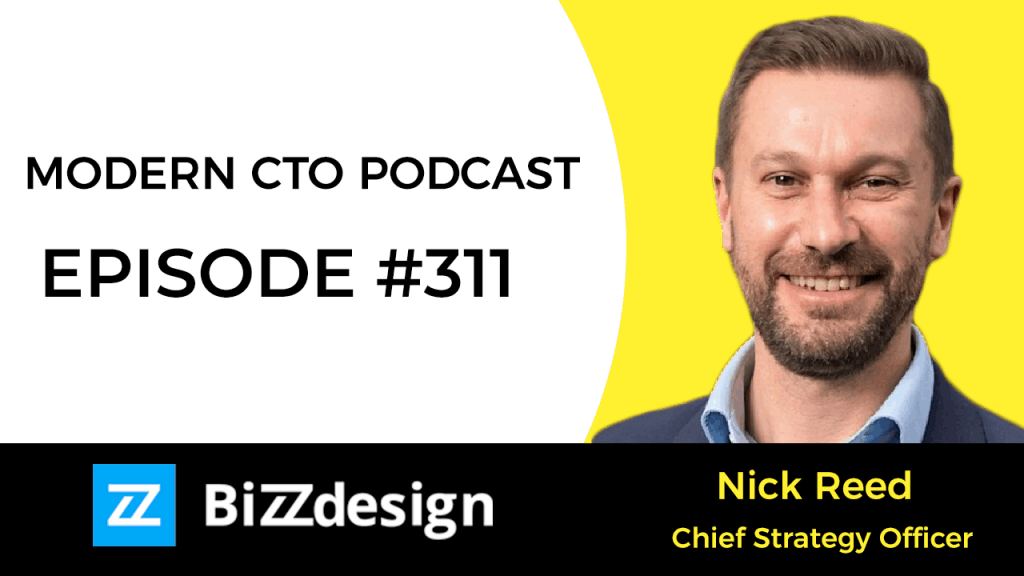
Nick Reed - Chief Strategy Officer at BiZZDesign
Today we are talking to Nick Reed, the Chief Strategy Officer at BiZZdesign. And we discuss how BizzDesign is enabling large organizations to design and plan for the future, Nick helps me understand the digital transformation paradox and how to implement the 6 S’s of strategy in your own organization.
All of this, right here, right now, on the Modern CTO Podcast!
Check them out now at BiZZdesign.com!
About Nick:
Nick joined BiZZdesign in June 2016 and is responsible for consulting, training, support and presales functions. Nick’s goal is to ensure every customer gets maximum business value from their investment in BiZZdesign software. His team acts as the ‘Voice of the Customer’ within BiZZdesign, working with the product team to ensure customers’ needs are captured and fed into the product roadmap, and collaborating across the organisation to drive improved customer experience. Prior to BiZZdesign, Nick held roles in multiple software companies including customer success management, professional services management, product management, sales, presales and consulting, including starting his own venture in 1997 through to eventual sale of the business.
Nick has a BSc in Mathematics from the University of Bristol, and is Vice-Chair of the Association of Enterprise Architects London Chapter.
About BiZZdesign:
BiZZdesign is a leading enterprise transformation software vendor based in the Netherlands. Founded in 2000 as the commercial spin-off of an R&D institute, today the company enjoys a global presence and is recognized by industry analysts as a market leader. BiZZdesign HoriZZon is deployed in blue chip companies and government organizations across all continents, where it plays a key role in enabling meaningful business change
Transcript
(Joel Beasley at 00:00:00) Hello, my friends. Today we are talking to Nick, the Chief Strategy Officer at BiZZDesign, and we discuss how BiZZDesign is enabling large organizations to design and plan for the future. Nick helps me understand the digital transformation paradox and how to implement the six S's of strategy in your own organization. All of this right here, right now on the Modern CTO Podcast. This is the Modern CTO Podcast.
(Joel Beasley at 00:00:38) So we're just going to hang out and talk. Is that cool?
(Nick at 00:00:42) Absolutely.
(Joel Beasley at 00:00:43) Awesome. I read your notes. So I saw them. My producer forwarded them over to me, and I was like, this person is thorough. You had some really great notes, and I was super excited about them. And I was just curious. I started to think about communication and how important communication is, and then the role that you're at in your company and how it's growing, and you chose this title, Chief Strategy Officer, when you have a lot of software background and growing technology teams. And so I was curious. The first question that I had was, you know, why did you choose that title?
(Nick at 00:01:21) So when I was considering this new role from my previous one, there was a lot of focus around the strategic initiatives for BiZZDesign, the company I work for, and how we need to evolve ourselves and some of the key things we need to do to support that. And it wasn't directly a sales job. It wasn't directly a marketing job or a product job, but it was kind of connecting various different dots across the organization and joining those things together in a unified way forward, in support of our evolving value proposition for those customers that we want to target and how we want to create value for them from our products and services. And so there wasn't a nice existing pigeonhole that that role fits into. It was really dealing with the strategy of where we are going as a company, but also the strategic initiatives that we need to execute on to support that. That's where we came up with that title. That seemed like a good fit with that.
(Joel Beasley at 00:02:40) And did you always want to do this? Like when you were a little kid playing at the playground, were you dreaming of being a Chief Strategy Officer for a tech company?
(Nick at 00:02:50) No, I'm pretty sure I wanted to be a footballer at that time.
(Joel Beasley at 00:02:56) What happened?
(Nick at 00:02:57) Yeah, where did it all go wrong? I mean, it's a really interesting role and I love doing it. And you get to have a lot of really interesting conversations with customers, with partners internally and externally. And for what we're doing at BiZZDesign, we get to have a lot of interesting strategic conversations with large organizations who have very big problems to solve, which for a company of 90 people based out of the Netherlands is actually a really interesting place to be.
(Joel Beasley at 00:03:32) And what was your first job? Like your first big job?
(Nick at 00:03:36) So my first job after graduating from university was actually as a financial journalist. And I studied mathematics, and so that's not the most obvious career start for a mathematician. But it was in the specialized area of financial derivatives and risk management and all those complex financial instruments that kind of blew up the world economy in 2008 with that credit crunch. And there was a need for people who could write about that stuff but also understand the subject matter. So maybe that's where my thorough notes come from, is that journalistic background and writing everything down.
(Joel Beasley at 00:04:23) I love it. Yeah, but it prepared you well because communication is such a critical thing. And your ability to take your thoughts and put them down in a simplistic way and let other people be able to make decisions on those, that is critical to working together and leading an organization.
(Nick at 00:04:44) Yeah, and I think in tech, people very easily get focused on the bits and the bytes and the technology. But at the end of the day, it's always all about what people do with that technology. You know, how does it improve their lives? How do enterprises leverage new technologies to do new things and do something for their customers? And it's all about communication, ultimately. And if you can't communicate the reasons why you want to do something and the value of doing that thing and how you're going to go about doing it, you can't bring people with you on that journey.
(Joel Beasley at 00:05:22) I saw a post on LinkedIn the other day, and it was like a graphic, a meme type thing, and it says the college says minimum requirement, seven pages for a paper. And he goes, the real world says explain it to me in seven seconds or less.
(Nick at 00:05:41) Yeah, absolutely. Absolutely. It's that first minute of a meeting is where you get people's attention or you don't. And that's where communication is absolutely critical.
(Joel Beasley at 00:05:53) So what's the core business model for BiZZDesign?
(Nick at 00:05:57) So BiZZDesign is a software company, software as a service, and we are in the enterprise architecture management space. And maybe I can explain a bit about what that is by using an analogy. But in short, it's around helping large complex organizations define or design their future business and then plan how they're going to get there and how they execute on that in the best way. And so, to explain what is enterprise architecture, Geoffrey Moore, who wrote Crossing the Chasm, just published a great blog on digital transformation. And the main subject of that blog was the following paradox where he says, you cannot digitally transform your enterprise without software, but software cannot digitally transform your enterprise. So you need technology, but it's not just about the technology. And digital transformation is not just about digitizing and automating your existing processes and how you do things. That's just automation, not transformation. So digital transformation is about changing what you do and how you do it. And in the current climate, it's also about doing that really fast. And that requires designing some kind of desired future state for what you want your business or your enterprise to be. And so Geoffrey Moore says in this blog, if you don't have a clear design for your future state, you have no North Star by which to navigate your digital transformation, and you can't possibly succeed. So that's what enterprise architecture is all about. It's about designing the future enterprise in terms of what the enterprise does, so the business model and its capabilities, and how it does it in terms of its operating model consisting of people, process, data, and technology. And then building roadmaps for how you get there to that future enterprise design from where you are today, which is probably quite radically different from that future state. So enterprise architecture is all about modeling that stuff, so creating digital models of the enterprise across those different dimensions of the enterprise. So business capabilities, business processes, but also data, technology, people, and the change efforts that get applied to change all of those things, and importantly, making the connections between those things. So it's very much a connected kind of model, graph style data model combining all of these different dimensions so that you can analyze it, understand the dependencies and impacts of change, and how your strategy kind of guides that change.
(Joel Beasley at 00:09:05) So if you're going to model a future state, the first thing you have to do is create a model of your existing state.
(Nick at 00:09:12) So you don't have to create a model of your current state in order to create your future state model. But obviously, if you want to get from where you are today to where you want to be as defined by that future state model, you've got to understand where you are and what you need to change in order to get there.
(Joel Beasley at 00:09:29) Yeah, that's like saying you don't need a license to drive.
(Nick at 00:09:33) But it helps.
(Joel Beasley at 00:09:35) If you drive without a license, you're going to get in trouble. Yeah. I mean, it sounds really interesting. I don't have these problems at scale right now. My company is less than 15 people. But I am connecting a lot with the fact that I get to talk to people that run large organizations constantly. And it's interesting how the same things are on their mind that are on my mind. What's my next product? What do my customers want? How do I serve them best? Who's going to come out and sneak up on me? Like, for example, I have a background in financial services and insurance technology. And when smartphones were coming out, there were a couple of applications that would give you quotes right from the application. You could just download and install the app. But they weren't really insurance companies. I forget the names of some of the brands, but they were completely dominating because people just would rather click an app, scan their license plate, type in their data, and then get a quote in real time and click purchase rather than calling an insurance agent, getting a paper quote, coming in, signing, giving them a check. And so these companies paid attention to what the customers wanted and that gave them a leg up in the market, then they grew. And then the bigger companies either scrambled to try to buy them or the founders wouldn't sell and they ended up becoming dominant forces in the industry. But it's fascinating because you're always having to look at what's happening in the marketplace and then figure out how to position your business. And I can only imagine at a thousand plus employees how much more difficult that would be if you say, we know we want to go over here, but now we've got to get a thousand people to go over here.
(Nick at 00:11:22) Well, and then imagine that when you've got 250,000 people across operations in 50 or 60 countries and you've got four main different business units, vertical lines of business, each with their own management structures. And, you know, you've grown by acquisition over the past 30, 40, 50 years, and you've got all of that baggage that comes along with those acquisitions where it's just nuts. And I've literally had conversations with senior executives in financial institutions where they're saying, well, you know, when our commercial banking team in Mexico, you know, all the other people in our organization who are doing that thing, and so, you know, we keep reinventing the wheel. We keep doing it in different ways using different technologies. And that accumulation of technical debt becomes an ever bigger anchor holding back the ability of the organization to change and change at the speed it needs to.
(Joel Beasley at 00:12:38) That's really interesting. I didn't even, I've never thought about that. If we have such a large organization, 250,000 people, how much technology is recreated within the organization, you know, in its own way? And then you have to maintain it. And then it even reduces the ability for cross pollination because if we do this type of thing this way and another part of the organization does it on their own custom system a different way, the developers aren't even transferable over easily versus if there was a concept within the organization and they all kind of did it the same way.
(Nick at 00:13:10) Absolutely. And, you know, that particular company in question, when you ask about how much technology is being created and used, certainly at the time we had those conversations, they had more developers than Microsoft. So, you know, the mind just boggles about how much stuff is being created. And so the challenge for CTOs these days is how do you get your arms around all of that complexity, all of those moving parts, and try and drive alignment and agility across, at scale.
(Joel Beasley at 00:13:48) So you must have two parts of your business. You must have the technology, but you also, I couldn't see your ability to sell this without having a consulting side that understands this. Do you guys do consulting too?
(Nick at 00:14:00) We do. So we have a consulting arm that operates both pre and post sales and provides that, if you like, expert practitioner advice and guidance to help our customers get the most value from the technology. So it is one of those areas where it definitely helps to have that best practice advisory in terms of how you deploy and get value from it. But in terms of where we're headed as a business, we're certainly looking to productize as much of that expertise and IP as possible to make it a simpler, more intuitive, kind of guided process.
(Joel Beasley at 00:14:43) That's the name of the game, right? That's the future of AI. We take the intelligence, and then we can all party once we have all the AI running everything.
(Nick at 00:14:53) Yeah, I'm not sure it's quite that simple. But, you know, certainly having a more kind of product-led approach to our product design to, at each step in that user journey, understand, well, what does the user need to be achieving in their role, and kind of building that into the design of the product is where we're going.
(Joel Beasley at 00:15:12) Yeah, and I meant party in a responsible way, like family cookouts, campfires, not like nights at the club, right?
(Nick at 00:15:23) Yeah.
(Joel Beasley at 00:15:24) Oh, man. This is great. You know, when I was reading about the digital transformation paradox, I was pretty interested because, you know, Geoffrey Moore, obviously a really popular author, right? And he explores ideas from a general perspective. And when I heard this concept that software is not digital transformation, I was thinking, well, clearly, right? Obviously. But then I also instantly started thinking about like quantum physics. Like the things down really, really low don't operate the same way as the things up at the top, right? And we don't know why. But I'm really in software, and so I could imagine how some executives, you know, how it could be completely normal for them to just be in a world where they start seeing software change everything and think, okay, let's throw software at it. That's like the most, that's like step one of your learning experience, right? Let's just throw a bunch of software at it. And then you slowly peel back the layers and realize that's not working. And then you start reading really great things by Geoffrey Moore and getting a deeper understanding of it. Where do you think the market's at in terms of Geoffrey Moore's paradox? Do you think half the market believes that if you just throw software at it, that's digital transformation? 10% of the market? Where do you think the market's at?
(Nick at 00:16:47) So I'm not sure it's as simple as, you know, one or the other and or, you know, it's just, I don't think it's as simple as people thinking, if we just have a nice new website or a nice new mobile app, that solves our digital transformation challenge. I think there's a genuine awareness that digital opens up new possibilities for a lot of companies to do something different or leverage their existing core business and core capabilities to provide new digital products and services. But in many cases, I think a lot of companies are still struggling with, well, how do we go about that? You know, how do we get started on that journey? How do we change our existing management structures and approaches, and break down those silos to kind of unleash that creativity and innovation in a digital world? And, you know, that is tough, and I think there's still only a minority of companies that are doing that really, really well.
(Nick at 00:17:52) But if you think about the fundamental nature of the change of some of these things, and maybe I can give you an example, you can see why it's challenging. So let's take a medical device manufacturer, for example, and they've probably spent most of the last century making mechanical products for some specific medical purpose, maybe measuring heartbeats or something like that. And with the advent of electronics, those devices maybe get a bit smarter, a bit smaller, faster, and maybe cheaper. But ultimately, it's still a physical mechanical product to measure heartbeats. And then with the emergence of the Internet and ubiquitous connectivity and cloud computing and Internet of Things, these devices are now a source of real-time data with the opportunity to provide all kinds of new data-driven services that leverage that data.
(Nick at 00:18:51) So maybe providing predictive health analytics and predictive health apps for users where they can take a more proactive approach to managing their health. And, you know, that's all driven by spotting patterns in the data using machine learning and AI and matching those patterns with people who had similar patterns in the data and who had specific health outcomes. So you can start matching these outcomes with what you're seeing in the data. So that's a fundamental change of business model and operating model, moving from physical devices where you ship them off to the customer, and that's basically it, maybe save for a bit of product maintenance, to real-time digital services, much more personalized. And that's a strategic choice.
(Nick at 00:19:41) You know, do you want to pursue that new market? And obviously, the type of capabilities you need as an organization to do that are very, very different from building your physical devices and shipping them off to customers.
(Joel Beasley at 00:19:55) Yeah. You'll have to boot up entire new teams and have a business model to justify the investment in them.
(Nick at 00:20:02) Exactly. And you've got to design what is that business model, how are we going to operate that business model, how does that translate into people, process, technology, and data, and, you know, what do we need to change in order to get there, and how are we going to roadmap that? And that's where enterprise architecture comes in to help you model that, design it, and understand, okay, how do we get there from where we are today?
(Joel Beasley at 00:20:29) Now when customers come to you, have they typically already gone through the process of market research and an idea of the direction that they want to head, and then they need help to model that? Or are they coming to you saying, we don't really know what to do. We have, like, 17 potential paths, but we don't know how to test them and figure out which path to go down.
(Nick at 00:20:54) I would say mostly the customers for our software already have some important and high-priority and urgent change imperative driving them to need to find a better way to change. It's not always the case. I mean, there are companies, and particularly in the Netherlands where we grew up, enterprise architecture is a well-established discipline. Lots of companies do it as a best practice for modeling what they do now and where they're going in the future. But where it really comes into its own in terms of value creation is where there is an urgent imperative to change.
(Nick at 00:21:36) And that's where, you know, typically they'll contact us. Now what we don't do is get into the nitty gritty of guiding our customers between their specific strategic choices. So that's their business to decide where they're going to play and how they're going to win, but we help them with the tooling to model that stuff out so they've got a clear set of strategic choices to make. And they can understand them, understand the implications of each of those strategic choices, and find the best way forward for them based on fact-based decisions around a single source of truth that gets everything onto an apples-to-apples footing where, you know, if you're talking about something in one division in North America and there's another division in Europe that wants to do something slightly different, how do you really compare those from a speed, cost, risk perspective in a way that you can start really comparing it on the same footing?
(Joel Beasley at 00:22:41) Do you get a lot of work from private equity firms or companies trying to do mergers and acquisitions?
(Nick at 00:22:48) Certainly, mergers and acquisitions is a big use case for what we do, especially where there's already been a merger or there's a planned acquisition or merger. And, you know, you've got two companies coming together where there's going to be a big overlap between things both of them do. So all the kind of core supporting activities of IT, HR, finance, you know, that's typically—every company does that in some way, shape, or form. So the driver in that case is usually to how quickly you can put those things together onto a common platform. And it's usually, do we take company A or company B's approach and then migrate the other one onto a common platform to run that stuff at minimal cost?
(Nick at 00:23:40) And then you've got those differentiating business capabilities, which is usually the primary strategic driver for the merger or the acquisition—is where you create the value from these things in terms of differentiation. And in those cases, it's more a case of, okay, how do we arrange the parts? You know, which operating model do we take from which company and plan for speed and time to market in those differentiating capabilities where the new product innovation's happening, where we're really able to create those new products and services that differentiate from the competition and other drivers of how that organization wins in the market. So there's usually different drivers for change depending on the type of business capability.
(Joel Beasley at 00:24:31) Now I'm starting to understand your title of Chief Strategy Officer.
(Nick at 00:24:36) Well, and there are companies out there who've really made their mergers and acquisition process a strategic competitive advantage. So, you know, there are companies out there who make lots of acquisitions, and they really have this process well documented and how they do it in terms of when they're acquiring a company. They look at the business capabilities of this acquisition target, and they compare with their existing business capabilities. And they can very quickly identify, you know, here are the three key differentiating capabilities of this company we're acquiring. We'll let those carry on going in the way they currently do things.
(Nick at 00:25:23) Everything else, we're replatforming onto our core enterprise platforms, and we do that as fast as possible. So they're realizing the financial economies of scale of that acquisition with all the supporting capabilities and then really nurturing those differentiating capabilities to drive that strategic advantage.
(Joel Beasley at 00:25:44) Yeah. I mean, an entire industry—I mean, that's what a SPAC is. Right? Special purpose acquisition company. Right?
(Nick at 00:25:51) Yeah. But you think about some of the big tech companies who are out there, you know, they're always—that's true. They have this kind of ongoing rolling process of buying up smaller companies that give them some specific capability. But all of the financial, HR, IT stuff, they're just replatforming it immediately.
(Joel Beasley at 00:26:11) Well, that's the beauty of the market. Right? The entrepreneur can create, build up the revenue, and then sell off to a company that's looking to grow. And then the market consolidates as you get to the top.
(Nick at 00:26:26) Yeah. Absolutely. Absolutely.
(Joel Beasley at 00:26:28) That's what we're doing here. That's the name of the game over here. We're looking, like, where can we sell to? Where could we be useful? Because, you know, I've talked to a lot of founders, and I have found that the difference in growth—and this is just, you know, my personal opinion and my conversations with some founders—but they would have made the same money if they would have sold it around 5 million that they did at 50 million because of the different investors they had to bring in and the dilution that happened. And so I talked to a couple people and they're like, yeah, it would have been a lot easier to sell at 5 million than 50 because it just would have been, you know, three years faster and a whole lot less work. And that's when the different parts of the market and the different financing levels started to emerge to me and for me to really understand them because, you know, I want to be useful to the marketplace.
(Joel Beasley at 00:27:26) And so you have to know the rules of the game that you're playing and the different levels that exist in order to be useful. Right?
(Nick at 00:27:34) Absolutely. And, of course, nobody's got that crystal ball of how things are going to play out in the future. And at risk of showing my age, I remember when Amazon was still an online bookstore and they went public. And at the time, you know, there was a lot of discussion around, you know, wow, that's a crazy valuation for a bookstore. And then you look at Amazon today being in cloud tech and media and everything else. And, well, Jeff Bezos clearly made some good decisions along the way and is probably very glad he didn't sell out at 5 million.
(Joel Beasley at 00:28:13) Right. Right. I'm glad he's looking better too. Like, when you look at the picture from him doing his interviews in 1999, he looks horrible. And then you see the pictures of him now, and he's all tan and jacked and everything. I'm like, alright, so being the richest man in the world does make you more attractive. Or like he's like the second richest man. I think Musk just bumped up past him.
(Nick at 00:28:36) Okay. Okay. Yeah. Well, I'm sure that wealth can buy a whole lot of good lifestyle choices.
(Joel Beasley at 00:28:44) Right? You could see he went bald. Right? He decided to shave, but Musk decided to get his hair. We're completely off topic. We're not turning into People Magazine for tech. This is what happens when I do early podcasts, you know. Get too much energy in the morning, and I get off topic. Okay.
(Nick at 00:29:06) Yeah. Well, maybe just to recap on one story from the past as well, having just spoken about Amazon. You know, I have kids. They're teenagers. And, you know, you asked me earlier about what I like about tech, and I love how it improves our lives. And, again, at risk of showing my age, you know, I try and tell my kids about what life was like when I was young. And if you wanted to know something, you know, you went to a library, and you looked for a book in the library on the subject that you wanted to know about. And if you were lucky, the book was there in the library. And if not, you know, someone else already had the book. And then, you know, you'd write in a card and say, I'd like to have this book, please. And then you'd wait for the book to come back to the library. And you'd go down there every once in a while. Or if you were lucky, they might phone you to say the book's back, and that could take a few weeks. And, you know, now if you want to know something, search on your phone or ask Siri or whoever a question. And in a few seconds, you've got the answer and you've got pretty much any knowledge that you want.
(Nick at 00:30:12) And I try and explain how amazing this is to my kids, and, you know, they give you that look that only teenagers specialize in. You know, the one that says, what the hell are you talking about, you loser? But they just cannot understand what pre-digital life was like.
(Joel Beasley at 00:30:28) But it's got to feel good to some extent. Like, I'm a dad. My kids are under the age of five. But all of these experiences I'm having, I'm thinking, oh, you know, I waited thirty years to have these experiences. Right? To be on the other side of things, to not get the snack when you want it. Right? And to understand why. And so it must be a little bit rewarding to see that look in their face.
(Nick at 00:30:54) Absolutely. Absolutely. And, you know, virtual reality, I think, for me is one of those things. And, you know, buying a surprise VR headset at Christmas, I was hero for the day.
(Joel Beasley at 00:31:07) Yes. When do you think that will get mass adoption? Or do you think the technology has to be good enough to be like a contact for it to get mass adoption?
(Nick at 00:31:19) That's a good question. And honestly, I don't know is the answer at this point. You know, the technology is pretty good and it fits into a relatively small space right now. I guess, you know, cost and ease of use and portability is still one of the key challenges there. But it feels like we're not far away from that breakthrough where it starts becoming mainstream.
(Joel Beasley at 00:31:49) Yeah. I think there's going to be a spectrum. Right? A number of technologies that come out over time before ultimately one wins. I think the one that wins is going to be the Neuralink type technology, where it's just embedded within us and we're one with the technology. But along the way, you know, I see the VR headsets super useful in training, like, if you're training firefighters or certain types of industrial activities. It seems to be very popular and very useful as business cases over there. But, recreationally, I think, you know, like we're talking about earlier, the holograms. I think that technology, when we don't have to put it on, I just think there's something weird about putting the headset on. If I can put it on and it not feel—like, if it were equivalent to me putting on my sunglasses, there's a win. I think that would take off. Or if it were just around me, in an ambient way, that would take off. But the bigger headsets that strap to your head, I think it's only going to be in very specific, like, oh, I'm doing some training for work, or I'm doing something for work-related. I don't think, recreationally, people are going to be wearing those for long periods of time.
(Nick at 00:33:05) No. I agree. I mean, it's—the ergonomics of it are not ideal.
(Joel Beasley at 00:33:10) Yeah. We don't like to put things over our face. Like, we don't like to cover and wrap things around our heads as people. Okay. When I was reading your notes, I got this concept that people are mistaking automation and transformation. Is that happening?
(Nick at 00:33:27) Yes. Definitely. Now, there are clearly benefits in digital from automation and, you know, robotic automation. It's delivering step changes in productivity and profitability. But there is a difference between automating an existing process and actually redesigning an operating model and really transforming the organization on that basis.
(Joel Beasley at 00:33:57) So people will mistake the two. They'll think, alright, we're going to do some automation, and that is—or they'll use the terms interchangeably.
(Nick at 00:34:07) Yeah. In some cases, I mean, not everyone. And clearly, there are many organizations out there, you know, reinventing themselves, the digital, coming up with new business models. But I think a lot of what gets lumped in under the headline of digital transformation is really digital automation rather than transformation.
(Joel Beasley at 00:34:31) And of all of your experience helping these companies do these models and be strategic and, you know, change their organizations, transform them, what are some of the one or two patterns that you see over and over between your customers?
(Nick at 00:34:49) So, you know, very common themes that we see are communication and actually getting everybody onto the same page. So it's one thing to have a strategy that's created in the boardroom with some consultants who come in and design that strategy. It's quite another thing to have that driving transformation at scale and having everyone in the organization aligned and pulling in the same direction to make that happen. And so communication is key, as we said at the start of this podcast. But having the means of communicating that at scale, giving each of these different roles that need to be involved in transformation the right information to play their part as a joined-up, coherent whole is really important. And, you know, that's where our kind of tooling comes in. But it's a common theme that we see that you've got people in the project management office who need to be allocating budgets, planning key milestones of getting from one stage to the next.
(Nick at 00:36:08) And they're thinking about time scales and money. You've got people operating those individual business units who are responsible for making a profit, selling more widgets. And you got process owners who need to get the work done for the daily operations. And then you got developers and technologists who need to be creating all this new tech that's going to transform the organization. And then you got the risk managers who want to keep everything safe and stop the bad guys hacking in and make sure everyone's complying with all the legal and regulatory stuff. And, you know, all of these people need different answers and different insights to play their role, but they all need to be ultimately singing from the same hymn sheet and understanding where this business is going and how they're going to do that.
(Nick at 00:37:03) And that's where having these digital models and being able to get insights from these models in the right form for the right stakeholder is really important. And I think that's one of the biggest things we see is just how do you get everyone aligned in an integrated way to all move in the same direction.
(Joel Beasley at 00:37:29) Is that where the six-strategy—what is it called? The six-S strategy? Is that where that comes in?
(Nick at 00:37:34) The six S's. Yeah. So that's, I would say, coming at it from a very technology focus. So if you think about the challenge for a CTO as part of a digital transformation, you've got all of this business change going on. You know, there's top-down strategy coming from the boardroom, but then there's all this bottom-up innovation happening in the teams on the ground.
(Nick at 00:38:00) And, yes, there's Saul Van Goerden, Head of Tech at Wells Fargo, articulated these six S's of technology strategy. This really talks about skills, security, stability, scalability, speed, and satisfaction. And you can think of the first three of those as the kind of defense strategy of the CTO. So, you know, taking the first one, skills—ensuring that the organization has the skills for today while developing the skills they're going to need for tomorrow, which, as we see with transformation, could be very, very different from the skills of today. Second, security—so ensuring the right cybersecurity controls are in place, but also establishing the right security principles to ensure that all that new stuff that's being created is secure by design. So you're naturally guiding people in the right direction. And stability is the third of those things, so ensuring the resilience and the reliability of the services. And there's a big automation aspect to that because if you're automating a process, you're taking out that manual, error-prone activity from that process. And, obviously, things like DevOps, continuous integration, continuous deployment drive that reliability of services.
(Nick at 00:39:34) And it's, you know, understanding, basically, the sources of risk upfront and planning for that and fixing it upfront. So that's the kind of defensive aspect. And then the offensive strategy is more around scalability, so ensuring that you've got these on-demand, elastically scalable services where you can scale up, scale down that capacity in line with demand or throughput. Speed—so, again, this whole digital transformation thing in the pandemic, that created an amazing forcing function where all of a sudden, everything's got to be online, everything's got to be remote. And we literally had customers saying they made more progress in two weeks in the pandemic than they'd made in the two years previously in terms of getting their services online, making them digital, making sure everyone could operate remotely.
(Nick at 00:40:34) And so that was a really interesting aspect of this notion of driving speed and agility. A lot of companies have really realized if they can strip out the noise, create that focus on business outcomes, get everybody aligned, they can actually move much, much faster than they previously thought they could. And then the last of the S's is around satisfaction. And that's all really about making sure the products and services that you're creating for customers, be it internal customers or external customers, actually create value and satisfy those customers. Because you can do all of the other five S's really, really well, but if nobody wants to use those products and services, it's kind of all a waste of time.
(Nick at 00:41:27) So, you know, that relentless customer focus and really designing everything around customer needs is incredibly important, more so than ever, I think.
(Joel Beasley at 00:41:39) Yeah. And Wells Fargo has some fantastic technology. I mean, they've been a leader in mobile banking since the beginning.
(Nick at 00:41:47) Yeah. And, you know, we're all used to using Twitter, Spotify, modern applications. And there's definitely a big theme in the enterprise now that actually enterprise technology should be as usable, as intuitive as consumer software. And this idea of consumerizing the user experience is getting really key. And, you know, I'm sure there's lots of people familiar with using enterprise applications where they're like, "Oh my god, this user interface is so difficult." And expectations have changed, and people are inherently going to move towards whichever solution is most effortless for them to use.
(Joel Beasley at 00:42:37) If you were a CTO and you hear this advice, you know, the six-S strategy, right? Obviously, they can look up the article and find out some more information. But how, as a CTO, VP of Engineering, maybe just manager who wants to be very useful to the executive team and show that they're trying, how would they actually walk through an evaluation of the six-S strategy?
(Nick at 00:43:05) So that's a good question. And what I would say is using this concept of business capabilities as a way of framing, you know, what is it we need to assess and how do we get our arms around this mass of technology and data and change and innovation, and really get it into a manageable framework where we can assess it in a structured way and have some kind of apples-to-apples, consistent way of looking at this stuff and prioritizing what is it we're going to do. And so if you think about those six S's, you can create assessments that you can apply to applications, processes, and business capabilities, where you can assess each of those things according to, you know, what skills do we need? Is it secure? Is it stable?
(Nick at 00:44:10) Is it scalable? How fast can we change it? What's the customer satisfaction for it? You can do your NPS surveys. And by then collecting those assessments and building it into your business-as-usual processes, you can define the metrics by which you're going to measure how effective are we being for each of these six S's.
(Nick at 00:44:38) And by then putting that into a framework of business capabilities, you can then start prioritizing. Okay, where do we have the gaps between where we want to be and where we are today in terms of those six S's? And importantly, by looking at it from a lens of business capabilities, you can understand, well, which of these capabilities are actually our real strategic, important capabilities where we're driving our differentiation and competitive advantage in the market? So maybe we want to place higher priority on the gaps we see in those strategic capabilities versus the supporting capabilities where we're really looking to drive efficiency and standardization.
(Nick at 00:45:24) And, you know, there may be different priority you place on the different S's depending on which type of capability it is. So you remember before, we were talking about those strategic capabilities that are giving you competitive advantage in the market. You probably want to be focusing on satisfaction and speed and scalability—so the offensive S's, if you like, for those capabilities—whereas in some of the more supporting capabilities, it may be cost and efficiency and quality that is a bigger driver in those other capabilities. But it's really this concept of capabilities is how you can make that connection between strategy, business model, and operating model, because that's really the one key concept that links your strategy and your strategic choices with what you do as a business and how you do it.
(Nick at 00:46:29) And it gives you that frame where you can really start assessing everything and getting your arms around it and getting some simplicity and clarity around where you need to put the focus, where you need to invest. And you can start identifying mismatches between where you're currently planning to invest your change budgets and where you really need to be doing it from a strategic perspective.
(Joel Beasley at 00:46:53) What type of media would I consume if I wanted to brush up on strategy? For example, YouTube channels, blogs, books, podcasts—any type of content do you like?
(Nick at 00:47:09) Well, clearly, and, you know, shameless plug here. But BizDesign has lots of good content on our website on these kinds of topics. You know, podcasts, blogs, webinars, case studies, all that stuff. Beyond our content, there's a whole bunch of interesting—you know, I subscribe to McKinsey newsletters. They're pretty big on this kind of thing.
(Nick at 00:47:35) Jeffrey Moore on LinkedIn regularly posts interesting articles. There's a bunch of CIO resources that have regular articles and blog posts on this stuff. There's business schools. MIT has some great articles. Harvard Business Review as well.
(Nick at 00:47:55) So I don't think there's one single go-to source for this stuff, but there is a ton of interesting information out there.
(Joel Beasley at 00:48:07) Thank you so much for listening. And if you found this episode useful, please share it with a friend or colleague who you think would get value from it. And if you have topics that you would like to hear discussed on the podcast, either add me on LinkedIn or send me an email, [email protected]. Every time I get an email or LinkedIn message, it absolutely makes my day and inspires me to keep going.