
Episode 301 ·
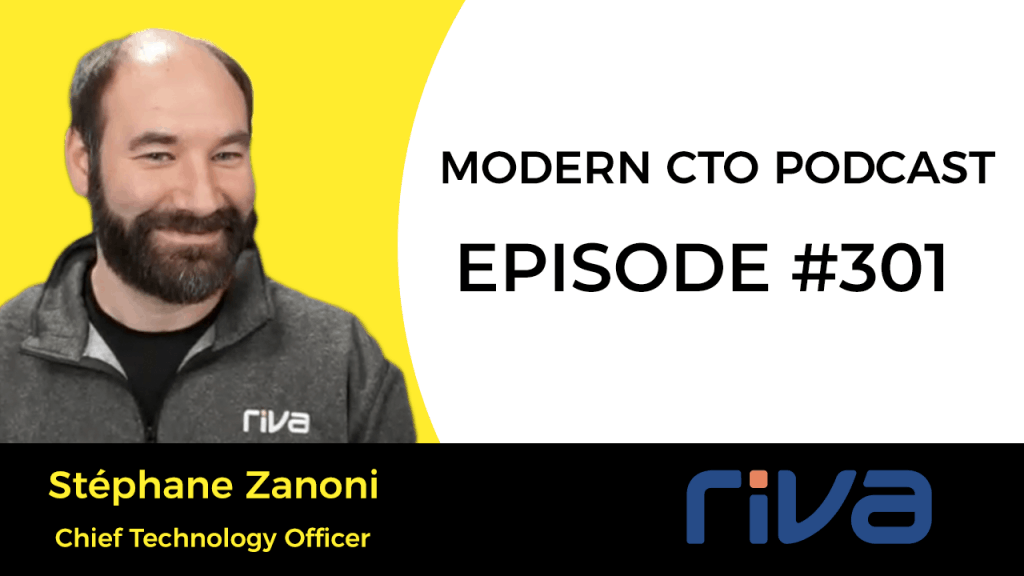
Stéphane Zanoni - CTO at Riva
Today we are talking to Stéphane Zanoni, the CTO at Riva. And we discuss the ways they are bringing a customer centric approach to the CRM space, how their technology gives meaning to customer relationships, and why being customer funded requires you to respond to the customers needs
All of this, right here, right now, on the Modern CTO Podcast!
Check them out now at RivaEngine.com!
About Riva:
Riva offers innovative technology and data operations to help sales, marketing, and service professionals in regulated industries deepen customer relationships and meet strategic goals. Our Relationship Engine securely and intelligently conditions, curates, and synchronizes customer data so that it gets placed into the right context – whether that is a long-term relationship, a busy inbox or calendar application, or a complex multi-platform enterprise environment. Riva’s solutions make leading CRM platforms and business applications like Outlook, Exchange, and Google Workspace interoperable – securely and at scale. By doing so, we deliver a reliable, compliant, and actionable Customer 360 to 850+ global enterprises.
Transcript
(Joel Beasley at 00:00:00) Hello, my friends. Today we are talking to Stéphane, the CTO at Riva, and we discuss the ways they are bringing a customer-centric approach to the CRM space, how their technology gives meaning to customer relationships, and why being customer-funded requires you to respond to the customer's needs. All of this right here, right now on the Modern CTO Podcast. Here we go. This is the Modern CTO Podcast.
(Joel Beasley at 00:00:36) All right, Stéphane, what's going on, buddy? Hello. Hello. Where are you located?
(Stéphane at 00:00:42) I'm in the lower level of our research and development building in Edmonton, Alberta.
(Joel Beasley at 00:00:50) Canada.
(Stéphane at 00:00:51) That's right.
(Joel Beasley at 00:00:53) You've got some beautiful nature out there.
(Stéphane at 00:00:56) We do. We do. We just got out of the frigid onslaught of minus 30.
(Joel Beasley at 00:01:02) And you're such a fascinating person. You're also—I don't know how to say the word. A common folk like me would say beekeeper, but you're the first beekeeper CTO that I've ever met. What's the correct word? Is it apiarist?
(Stéphane at 00:01:15) Apiarist. Yeah. I've got two beehives in our backyard.
(Joel Beasley at 00:01:21) Do they—do you have to keep them warm? How do they survive with the cold?
(Stéphane at 00:01:24) Well, they've got a kind of—during the regular season, they've got kind of a 20-day growth cycle, and they effectively self-regulate their temperature and get to the point where even if it's minus 20 outside, inside the hive itself will still be 25 degrees. So they consume the honey that they produce throughout the year and generate heat to keep the hive warm. And that's how they survive the cold winter months.
(Joel Beasley at 00:01:57) Now do you do this just to have fun? Do you borrow some of their honey? How does that work?
(Stéphane at 00:02:03) Yeah, you borrow some of it, but yeah, it's just for fun. Just to learn. It's a system, right? It's a—there's a cycle to it. It's a system that you can kind of change the inputs, and then the outputs kind of change as well. So it's the kind of thing that I'm attracted to, if you will—the input and output subsystems. And it just goes right into technology. Understanding the inputs and all the variables that you can adjust to get something out of it, whether it's beekeeping or gardening, right, greenhouse gardening. Those are kind of two systemic patterns, if you will, that I find neat. They're just really interesting.
(Joel Beasley at 00:02:54) Yeah. It's cool when we get to design and build processes and systems all day, and then we get to watch them operate in nature. That's fun.
(Stéphane at 00:03:00) And they're super well optimized. You just have to stay out of the way and inspect and look at it. And then just tiny—you can make tiny adjustments, but you don't really have to do anything. The system is super well—how do they survive the winter? Well, they've basically been working all spring and all summer to grow enough so that they can survive through the winter so that they can survive through the next winter. And so whether that's applied to technology or to building technology, that cycle is something that we live and that we apply in the office or that we apply building the technology or the products that we do.
(Joel Beasley at 00:03:43) Yeah. What type of stuff do you build at work?
(Stéphane at 00:03:47) So the Riva relationship engine is the product that we build, and it is integrated into the business applications that corporate teams use every day. So you can picture—it's an extension to your sales and support CRM, email, calendaring, your task management, and your contact lists. And so that type of customer data is at the core of our business. And so our teams really understand that data very, very well, and it's a space that we're really passionate about. I think the timing for a product like that is really good in that everybody's remote. Everybody's now using new technologies, and we're all looking for ways to scale with technology. So it's Riva's ability to understand and synchronize those customer interactions gives teams the ability to effectively treat every customer as though they're the only customer.
(Joel Beasley at 00:05:00) It's super important. When I was reading about who you guys are and what you stand for, I was really interested for two main reasons. Okay, the first reason—well, I'd say three. I'll even back it up. Three reasons. First reason: family. You guys started it as a family, or there's some family component to this, correct?
(Stéphane at 00:05:18) Correct. Yeah. Father, son, mother—family. The family founders.
(Joel Beasley at 00:05:25) That's amazing because I've done some work with my parents who own a business, and it's always so interesting to feel out and figure out that dynamic of the relationships and how you both have a family—you participate in this family unit together, holidays and things like that—but you also have to learn how to work together professionally, and that's always challenging.
(Stéphane at 00:05:46) It is. The family connection for us gave us an advantage in that my focus was the technology and product, and Al's focus was on the business, and then Michelle, my mother, her focus was on the finance. And so we were able to separate those areas of responsibility and know that, you know, we have someone who's got our back no matter what. And that's really been at the core of what we've built here. But then at the same time, it's growing that family approach and bringing others in to go from the five we had 15 years ago to the 120 that we have today. And to have every team member feel like being a part of that family—that family approach, I think, is kind of embedded into the culture of Riva and making sure that everybody feels like this is some place where you want to be. This is a place you want to come to work. And, you know, it's really neat to have the team ask, when can we come back into the office? Looking forward to being able to come back into the office. And you hear all the stories about technology companies saying we're going to go 100% remote forever now. I don't know. I think the choice will likely be there and maybe a better balance—life-work balance. But the desire that some of the team members have of wanting to come back and collaborate and work together, I think, is just neat.
(Joel Beasley at 00:07:33) Yeah. Everybody has their own preferences, and it's whatever the culture wants, whatever the company wants. For us, we were pretty small. We're under 15 people, and we ended up shrinking up a little bit right when it happened. And then we've since grown rapidly. And through that elastic process, we ended up hiring people all over the United States because a bunch of talent just became available all across. And so we made a choice to be remote-first. And what that looks like today is not necessarily what it'll look like in five years. But today, what it looks like is we all fly everyone in quarterly and we have a quarterly dinner. We get together, we work a day in the office because we still have the beliefs and the physical office that I'm in now. So we all work together for a day, have a dinner, get to hang out, do a little life together. We do it right on a Thursday-Friday so that everyone, you know, isn't rushed and we all get to hang out for a little bit. We just do that once a quarter, and for right now, it's good. It's working.
(Stéphane at 00:08:38) Well, I would see us applying something similar to that where every—we run our product and engineering teams in 10-week cycles. So every program increment, I think we'd have everybody kind of collect from across the country—Canada and the United States—kind of all come collect. And then, you know, whether it's quarterly or we do 10 weeks. But I think we would apply something similar to get everybody connected. There's just something about having everybody around the dinner table and having them sharing a meal, doing some sort of potluck or something like that. That's something that we often used to do. So I think that would be something we'd want to keep.
(Joel Beasley at 00:09:20) We have this weekly group that we do called Elevate, where we have 200 CTOs that get together and we'll have a guest speaker. So we did it today because we do it on Wednesdays. And today's topic was this guy—he owns a consulting group. He was referred from one of the other members as a speaker, and he talked about creating culture and the importance of how to do it and what it looks like at different companies. And he gave this very short example about the Navy SEALs and when they go through BUD/S training. When you do difficult things, when you have these experiences together, they're bonding moments, right? And how important those are to culture. He gave three other ones. I don't exactly remember. I can send you the recording if you want. But you're hitting on it, right? It's these moments that we go through. It's being together at the dinner table. It's doing backflips underwater while ice diving.
(Stéphane at 00:10:14) Yeah, we call that shared trauma around here. Shared trauma. Yep. There you go. So, you know, whether it's that late night helping a customer upgrade or troubleshooting some sort of really weird challenge, that kind of shared trauma experience creates the bond.
(Joel Beasley at 00:10:37) Yeah. It definitely ties to memory, you know. I can remember back in my childhood—they're usually remembered by the small accidents or physical injuries I had, you know. But yeah. That's super, super interesting. Here's the other reason I was really excited to talk to you about: CRM. Because everybody knows CRM. I don't know how you would have a business even at day one when you're just you as an entrepreneur. You have to have some sort of CRM for follow-up and things of that nature. And that's your entire industry. So whenever I do these interviews, I try to figure out what's the one area this person eats, sleeps, and breathes, and I want to know what's exciting—what's exciting that's happening in the CRM world right now.
(Stéphane at 00:11:21) Well, we got into CRM before CRM was really a commonality, right? And so when we started our software development company, we transitioned from a services entity that transitioned into software because we had lots of customers asking for the same kinds of things. And so we ended up building some software initially—just in-house tools that then we found out people wanted to buy. And so having gone from that transition of services to software, we didn't have a good integration between our email and our calendaring system to keep track of who's talking to which clients and how do we schedule meetings and how do we track the fact that these appointments were scheduled with which clients and how do we catalog all of those things. And so one of the first things we did is, you know, we adopted an open-source CRM and implemented that, but it had no really good integration into the day-to-day tools that we were using to communicate with our clients. And so we built one. We built an integration that effectively became the first incarnation of what we now call Riva. And that's the core technology—is that synchronization that brings and unifies the day-to-day communication platform with your sales automation platform. And so I can send an email. It'll automatically detect that it's a customer-facing activity and then relate it to the right opportunities or the right support tickets, or just identify the fact that, Joel, you sent me an email, but don't store any of the content. We're just identifying that there's an interaction between the two people and that we know each other and that the interaction was on this date. But we're going to keep the content confidential because it's not necessary to store that. So we've got a ton of different layers where it's the full integration, full synchronization, or just the key moments and the high-level interactions between people so that you can get an organization-wide view of who knows who, who's communicating, where are they in the life cycle. Because we know on our side, we know that if they're working with this team, then this is where they are in the customer journey. If a customer is working with these team members, this is where they are in their customer journey. So we're able to use that information to really thread together what that individualized customer journey looks like and where they are in the life cycle. Are they about to renew? Are they purchasing? You can tell by who they're interacting with where they are. So you're really bringing that kind of data-centric approach, which is what I love—is that the data is helping inform the decisions that you're making. And it's by aggregating all of that into a CRM-like system that you can make those types of business decisions. But then you've got the challenges of all this private personal stuff, my personal meetings that need to be redacted. So how do you separate business from non-business? And then how do you separate internal from external activities? And that's really where our technology really shines—is the ability to classify and in some cases automatically classify all of these different interactions.
(Joel Beasley at 00:15:02) That is actually really cool.
(Stéphane at 00:15:04) One that scales, right? That you can scale—whether you've got 100 employees on the team and you want to know who's communicating with which clients, or you've got 20,000 employees and you want to know what's going on. This is what Riva lets you see.
(Joel Beasley at 00:15:22) It's pretty cool. It's like, for some reason, I keep thinking of how the bees interact with each other. And to see some data on it—if you have 20,000 people, to see the data of how the different humans interact within the company or with the—there's got to be business intelligence in there.
(Stéphane at 00:15:39) Absolutely. And that's where our teams really—that's where we thrive. You now have enough information that you can start measuring the thoughtful interventions. So how do we reduce the number of—how do we reduce the number of meetings required to complete an activity?
(Joel Beasley at 00:16:02) And what do you call them in the code? You call them insights, or how do you refer to them internally?
(Stéphane at 00:16:06) Yeah. Well, there's the interventions, right? So that's the thoughtful interventions that you can apply, and then you can start to measure the impact of those interventions. And you can do that by putting the customer in the middle and then seeing who's communicating with that client and how is that communication different in cases where you've had high customer success or in cases where you've got some negative feedback and you didn't have the customer success you were looking for. And so now you can start comparing what does a happy path look like to what does a not-so-happy path look like and start applying those interventions to create more happy paths, if you will. And so it's by having access to the data—it is the number one element. But you can't do that if you don't understand and it hasn't been classified. So that's really one of the key elements to the technology—is allowing that classification to occur.
(Joel Beasley at 00:17:08) Now do other—if the company has an existing CRM, do they still use you?
(Stéphane at 00:17:14) Yeah. And that's—we don't bring a CRM.
(Joel Beasley at 00:17:17) Okay.
(Stéphane at 00:17:18) We're CRM-agnostic. So we'll support the industry-leading platforms, and we plug into those existing CRM systems, and then we'll bring in that data that you've got where you have your communication with clients, right? Whether that's Office 365 or Microsoft 365, whether that's Outlook or Google Mail. We have a connector that goes and aggregates and collects all of that communication profile, and we process it, and then we aggregate it and put it into your CRM system.
(Joel Beasley at 00:17:54) Okay. So if I'm a—let's say I'm a company, got 100 to 500 employees, got this data, right? I could call you up. I could say, "Hey, Stéphane, show me the happy paths. Show me the path to happy." And you could consume all that data and somehow show them happy paths.
(Stéphane at 00:18:14) This is every single interaction that a customer or a client had in order for that opportunity to close.
(Joel Beasley at 00:18:20) That's pretty cool.
(Stéphane at 00:18:21) Yeah. How many meetings you had to have? How many customer-facing meetings that occurred? How many internal meetings about the client? How many pre-meetings?
(Stéphane at 00:18:29) How many post-meetings, how many emails were sent, how many support tickets might have been created, and aggregate all of that information. And you can look at it on a timeline, or you can look at it in any visualization tool your organization has.
(Joel Beasley at 00:18:47) That's pretty neat because we do this exercise every three to six months where we take a list of our top clients, the clients that we would want a thousand more of. Right? We want 10x more of these. So we have all of our clients, and we have the ones that we just want more of. We really enjoy working with these people.
(Joel Beasley at 00:19:05) We want to figure out what drew them specifically to us because we want more of those top clients. And then we have the clients that maybe didn't have success because we don't want to keep attracting the type of client that we don't have success with. We want to just focus all of our energy on attracting the clients that really love us that we're serving and serving them really well. Right?
(Joel Beasley at 00:19:26) And so we go through this and we look at—we kind of do a manual version of what you're describing. And at scale, that's impossible. Right? When we're under 15 people and we have less than a hundred customers a year, it's possible to do that as an exercise. But you have, you know, 500 employees and thousands of customers. They could essentially just hand you a list and say, here's the list of my top 20% of my clients.
(Joel Beasley at 00:19:54) Show me what path they're experiencing. Here's a list of the bottom people. Show me what path they're experiencing, and you can figure out if there's opportunity between understanding those two paths.
(Stéphane at 00:20:05) Well, that's really what access to the data does, but also by putting the client or the customer in the middle of that equation. And, you know, you've talked about identifying that ideal customer profile and then taking that ideal customer profile and saying, what does success look like? And now you can look at a thousand of those clients and see how many interactions were required. So that gives you, as an example, it could give you forecasting capabilities. How many staff do we need if we want to grow by 20%?
(Stéphane at 00:20:38) Now you know how many meetings you need to have. You know how many emails you need to write. You know how many internal meetings you had. So now you can do resource planning, resource forecasting. So you want to double the size of your organization.
(Stéphane at 00:20:50) How many people do you need? And, you know, you can look at this information and really extrapolate out and project what you need to scale to in order to achieve those financial numbers too. And so it's another approach of looking at the data and looking at what does customer success look like.
(Joel Beasley at 00:21:10) That's interesting. Because that would be something the CEO and the CFO would ask. Right? Like, what's going to happen with the technology or what's going to happen with, you know, everything when we double—we get the—we raise this capital and we double business or how fast can we grow? I mean, these are types of questions where business owners are asking on a daily basis.
(Joel Beasley at 00:21:29) I mean, I watch cash flow every single day. It's the—I tell people it's like we're on a road trip and it's the gasoline. Like, you always have to be looking at the gauge.
(Stéphane at 00:21:40) Well, you know, in-house, we call that spending dime dollars. Right? So how do we apply technology to get the most out of our investment? And our most expensive investment is people and people resources. That's our biggest line item on our balance sheet is people.
(Stéphane at 00:21:58) So how do we get the most out of their time? And that's, you know, by looking at the information that Riva can surface. By looking at that information, we can not only tell you which customers the sales team wants more of, but which ones are actually the best for your cycle, and how do we reduce that cycle time? And it's by looking at the data and curating that data thoughtfully that you can start to make data-driven decisions. Or else you're just—it's a hunch. Do you really know who your ideal customer profile is?
(Stéphane at 00:22:32) Maybe you're going to target a customer profile that has a really long sales cycle with a long tail, which is great if you choose to do that. But then now you can look at the data and say, well, we've got another segment here that has a much shorter sales cycle. Now you've got two different personas you can target. And now you might have two different messages that you want to go to market with. And it's by looking at the data that we're surfacing that you can start to make those process changes.
(Joel Beasley at 00:23:05) Man, this is fantastic. The other main reason that I was really interested is because of, you know, reading through your content and understanding your culture. You just kept mentioning over and over how customer-centric you guys are, like, putting the customer first. And so I'm curious, like, what does that mean? What does it look like?
(Stéphane at 00:23:24) Well, for us, it's just how we've grown up as an organization. So, you know, being in we'll call it Northern Canada, there's not a lot of VC funding walking around. And so you're—it's really about building a sustainable business and building a sustainable organization. And we know we talked a bit about culture and making sure that there's that culture fit, but that culture has to sustain itself.
(Stéphane at 00:23:55) And to us, that's about customer success because being customer-funded and being bootstrapped as an organization—and that really being customer-funded forces you to respond to customer need. And for us, the customer-centric approach is very much listening to our customers. They're identifying pain that they're experiencing in their organization. How do we do X? How do we do Y?
(Stéphane at 00:24:27) We're trying to do this, but the compliance team says we can't do this because of that. And so, you know, you take that type of customer feedback and that kind of product feedback, and you turn around and apply it really quickly and then give it to them in as short a cycle as possible. And that's, for us, how we've applied that customer-centric approach is listening to our clients, having a constant dialogue, and applying those lessons learned, giving us the ability to respond to really high security requirements, like in-memory encryption of all of these things, on-disk encryption, server-side, custom keys, credentials have to be split across multiple servers. So we've got clusters of Riva servers, you know, fourteen, twenty clusters big or 20-node big clusters in order to scale the technology in some of the largest deployments. And so you run into a lot of—you get a lot of feedback, and it's by making sure you implement that feedback in a timely manner is that iterative approach.
(Stéphane at 00:25:33) And that kind of goes back to the seasons, if you will, and making sure that you've got that constant feedback loop built in. And I think we do. That's something that our team prides ourselves in is coming up with sometimes what are kooky schemes and then creating a process behind it and improving the technology and building a better product and then giving them something that exceeds expectations every time.
(Joel Beasley at 00:26:01) Yeah. Everything, you know, starts manual, just an idea. And you just have to figure out what works, get customer feedback. I mean, just the other day, we have this custom analytics app that we had to build because we post content on LinkedIn or Facebook or Twitter. We don't, you know, then we get views on YouTube.
(Joel Beasley at 00:26:20) We get views through our podcast app and Spotify. And there's just so many different sources where people are engaging our content. And we wanted to pull it all in and then be able to share it with people. And there wasn't any tool that could do that. And, like, even close to what we wanted to do, every tool was built just for me to understand my own reach for my brand.
(Joel Beasley at 00:26:43) Like here's all the Modern CTO content. Right. But we needed to isolate all the clips for your episode, all of that, and really understand, you know, what happened there. And so we just built something. Right.
(Joel Beasley at 00:26:56) That's just my natural thing. I tried to find it to buy it because I didn't want to build another something. But I said, we just have to build it so we understand what's happening with our metrics and what topics people want to hear about and things like that. But, yeah, we went through that whole process of building it and then listening back to the customers was just, you know, key importance to close that whole feedback loop of what we're doing. And, yeah, I get it, man.
(Stéphane at 00:27:25) There's often that debate, and we have it with our customers often. It's the build versus buy conversation. And it's how do we balance the total cost of ownership against the build versus buy discussion? Because a lot of the businesses that use Riva have more developers than we have on staff. Right?
(Stéphane at 00:27:47) Some of these organizations have a thousand developers that are in-house, and they could go build it. But what is their core competency? And do they want to be spending that resource time building something that's already been built, that is already highly customizable, or do they want those people building business-specific solutions that only they have access to the customer feedback for? And so if you've got a specialized space where you're getting customer feedback to build a better product that not everyone else is getting that feedback, then you'll have an edge in what you're bringing to market, whether it's a service or product or it's a product backed by a service or a service backed by a product. Either way, that niche capability of getting that customer segment feedback is critical to success.
(Stéphane at 00:28:43) And I think that's where we've really been able to take that very, very pointed customer feedback, apply it, and then get more feedback just like it from their peers in the industry. And that's how we've built and how we've scaled our technology.
(Joel Beasley at 00:29:02) I want to talk a little bit about Starlink. Right? Because you're out in a rural area. Have you bought Starlink yet, or have you subscribed to that? Subscribed. Waiting for it?
(Stéphane at 00:29:12) Waiting for it. So right now, we're too far north to get a reliable signal. But the minute that we've got a reliable signal, it'll definitely change where people live. I moved thirty minutes out of the city four years ago to an acreage.
(Stéphane at 00:29:33) And so we've got four acres. It takes thirty minutes to drive into the downtown from where I live. And for us, maybe that's quite the—you know, there's two cities in between there. So having the ability to live and work anywhere is, I think, going to change the reality of that work-life balance. I know that for us, being able to even just using a tether on my phone, being able to work from literally anywhere, being remote has never been a challenge.
(Stéphane at 00:30:05) But now I can literally go anywhere, and so there's no real need to be in a big commercial center. And so you'll see maybe that reversal of the urbanization where there'll be a segment that can work remote, be remote, and want to live outside of the city.
(Joel Beasley at 00:30:23) Yeah. That's sort of—that's the dream. Right? Have space? Or at least for me.
(Joel Beasley at 00:30:28) I'm sorry. No. Some people live in a city and they're like, we hate that. Stack more on top of me. I'm like, no. Thanks.
(Stéphane at 00:30:35) Well, for me, it was getting that space or having, you know, having a place where I can go home to, have four acres, where I can have a windmill. I can have solar panels. I can have a little shop where I can build things and break things. And that's the building and learning is the passion. And so whether it's applying it to technology or—I finally got a Raspberry Pi, and it's a meteor stargazer.
(Stéphane at 00:31:05) So it's got a camera that points at the sky and records the sky all night with the filters removed so that it can capture meteors. So it's part of a global meteor network to monitor the sky, and then they've got an algorithm that they use. So when there's a fireball that the camera catches, they can triangulate it with a number of different cameras and identify where the fireball came from, what group of stellar objects it originated from, and then they can often triangulate where it landed or where it—the area where it would have landed. So I thought that was pretty neat. So that was one of the things I built out there with the camera and the Raspberry Pi and get everything wired up.
(Stéphane at 00:31:52) Powering the camera over Power over Ethernet and running that 200 feet into the yard so that I have a dark space to run a camera. So if the neighbors drive by, there's a camera pointing at the sky. They must all be wondering what I'm doing. But, yeah, that's some of the fun stuff you can do in—you know, on acreage life.
(Joel Beasley at 00:32:13) There's a dark sky observatory. I'm sure you're very familiar with those or there's a lot of them up there. But here in Florida, I think there's only a handful of them. But there's one that you can camp at. It's, like, pretty popular.
(Joel Beasley at 00:32:28) And we tried—we have, you know, the travel trailers. We go and we're outdoorsy people on the weekends. And we looked to go to it, and they were booked up, like, six or eight months in advance. I was like, woah. That's crazy.
(Stéphane at 00:32:42) Yeah. Seeing the stars and then the moon, and then every night, you watch the transition. Right? And that's another example of that system where there's, you know, the ebbs and flows. And seeing that type of profile in the night sky or, you know, like some bees or whether it's snowboarding or ice diving.
(Stéphane at 00:33:04) You know, there's a rhythm to that system.
(Joel Beasley at 00:33:09) When they reach out to you, what's, like, the main reason—customer's first reason? What are they reaching out for?
(Stéphane at 00:33:17) They're typically reaching out because someone said that it couldn't be done, and they need to solve a problem. And the vendor-provided solutions might not have the right security approach or might not have the right data residency capabilities. And it's really ensuring that the data stays where they want it to stay. And an organization that has compliance and regulatory requirements doesn't want to take every single interaction throughout the entire organization and bulk-load it into their sales system. There's a ton of communication that's confidential.
(Stéphane at 00:34:03) There's a ton of meetings that you can't even tell other people that you're meeting with the attendees. But if all of that's being made public in your CRM, you're breaching a dozen regulations. And so really, they're coming to find a solution that can scale to the tens of thousands of employees that they have. And then at the same time, respect their information security policies, all of the network security requirements, and then at the end of the day, be compliant with their industry-specific regulatory regimes, whether that's financial services or insurance industry. They're really looking for a solution that gives them the balance of access to the data, giving them the ability to report on it while maintaining privacy, customer privacy, or employee privacy, but then balancing that against the all-or-nothing approach.
(Stéphane at 00:35:06) So it's how do we get just the right information while redacting or stripping out the information that's not relevant to this business problem.
(Joel Beasley at 00:35:17) And then if people want to learn more, where do they go?
(Stéphane at 00:35:20) I think our website's a good place to start—rivacrm.com.
(Joel Beasley at 00:35:25) Yeah. We'll post links too in the show notes and everything so people can get access to it really easily.
(Stéphane at 00:35:30) Perfect. Good. Yeah. No, it's—and, you know, being a—I'll consider us a relatively small software development company, and, you know, we don't have the opportunity to this kind of exposure.
(Stéphane at 00:35:43) And with all of the events being shut down, it's reconnecting with like-minded organizations is, I think, critical to everyone's success.
(Joel Beasley at 00:35:54) Yeah. And that's why I like talking about, like, when we go through the interview and we're just kind of like real-time conversation and broadcasting that and just hanging out and talking. I mean, that's how life happens. That's how change happens. That's how relationships are built.
(Joel Beasley at 00:36:09) Right? Like, everything great in life comes through relationships.
(Stefan at 00:36:14) Well, that's how we can take those relationships and foster them and make sure that we keep every relationship in our world, right? It's every customer and treating every customer as though they're the only one and, you know, ensuring that you've got the right cadence with that client. You can only really do that with a technology like ours and doing it at scale. When was the last time you reached out to this customer, or when was the last meeting scheduled with this account? Is anyone in the organization talking to this individual or to this team?
(Stefan at 00:36:57) And at scale, it's really hard to do that without picking up the phone and talking to a ton of people. And that's where, you know, a technology like Riva gives you the insights into all of those relationships. When was the last time you've communicated? What interactions you've had? And it's removing the individual. It's giving the teams back a lot of time.
(Stefan at 00:37:25) Right? It's giving them an opportunity to focus on what they love to do and what they enjoy doing versus updating data systems and updating tables and charts and spreadsheets as to when the last time I spoke with this person. Wouldn't it be nice if it just knew? And that's what we bring. We bring that kind of quality of life back into these systems where you can eliminate a ton of data entry and just make these systems more natural. And like you said, with the augmented reality, it's kind of that augmented data layer where it's always there and it's making those connections and ensuring those relationships stay up to date.
(Stefan at 00:38:09) And at the same time saying, hey, you haven't spoken to these people in a while or you haven't spoken to this client in some time. Wouldn't it be nice if you reached out when you've got some time? And you can set those patterns and those cadences, and Riva can help maintain those service levels if you wish.
(Joel Beasley at 00:38:29) Yeah. I want my salespeople doing the least amount of data entry and things as possible. I want them talking. I want them talking on calls with customers about what the customer needs, if they're happy, how we can help them, how we can bring value and add value to them.
(Stefan at 00:38:46) Yeah. And capturing those meeting notes in a meaningful place where you've got it centralized, and now you can go in and look, hey, the last time we spoke to these people, what was the common thread? And here are the meeting notes from my 15 reps. And you can read them as a business leader without having to have a post-meeting follow-up with every single meeting.
(Stefan at 00:39:07) Now you've got meeting notes that get shared automatically to everybody who's on the account team and your manager and your manager's manager. And automating that entire life cycle so that it's seamless is really where you have to apply those technologies.
(Joel Beasley at 00:39:23) Have you found a specific industry or niche where you notice a lot of customers, like maybe manufacturing or automotive, or are your customers just across the board?
(Stefan at 00:39:33) We've got customers across the board, but where we see the greatest impact are where the relationships have the highest value and the loss or a relationship going sour or the loss of a relationship has a significant impact. And so that's almost no more tangible than in the financial services space, in real estate, and industries where you've got high regulatory requirements, but it's non-transactional. And so it's about the relationship. You know the person that you're dealing with. You know the person you're buying something from. You're buying from them because you like the relationship that you have versus they have a product that you want to buy. It's, you know, that's where we tend to find the connection with our clients is that they have those relationships that are extremely valuable to them, and they want to apply technological solutions to remove the friction to let their teams focus on the relationship instead of focusing on data entry.
(Joel Beasley at 00:40:41) Right. Nothing's better than making a good living while getting to interact with people that you enjoy spending time with. I mean, that's freedom, right? It's like when you have your money part of your life that you have to satisfy because we're human and we live in this world. If you can do that and be enjoying it and doing it with people that you enjoy spending time with, I mean, that's just incredibly valuable.
(Stefan at 00:41:04) And that's the quality of life elements, right? It's the balance of work and the balance of building a business or building a product and making sure that you're taking the time to do things like go to Burning Man or travel the world or, personally, my trip to Antarctica was something like, you just gotta go do it. And to know that the team at home has everything that they need to continue to be successful and being able to take that time with your family or to take that time and be just as happy at work with your family is really where it's bringing that balance and having that culture of having a place you want to go to, I think, is really important.
(Joel Beasley at 00:41:57) Thank you so much for listening. And if you found this episode useful, please share it with a friend or colleague who you think would get value from it. And if you have topics that you would like to hear discussed on the podcast, either add me on LinkedIn or send me an email, [email protected]. Every time I get an email or LinkedIn message, it absolutely makes my day and inspires me to keep going.