
Episode 299 ·
Chris Schremser - CTO at Waystar
Today we are talking to Chris Schremser, the CTO at Waystar. And we discuss the radical change is happening behind the scenes in healthcare, how Waystar is helping to bring transparency to the process between patient and caregiver, and leadership advice to get the most out of your 1 on 1 interactions.
All of this, right here, right now, on the Modern CTO Podcast!
Check them out now at Waystar.com!
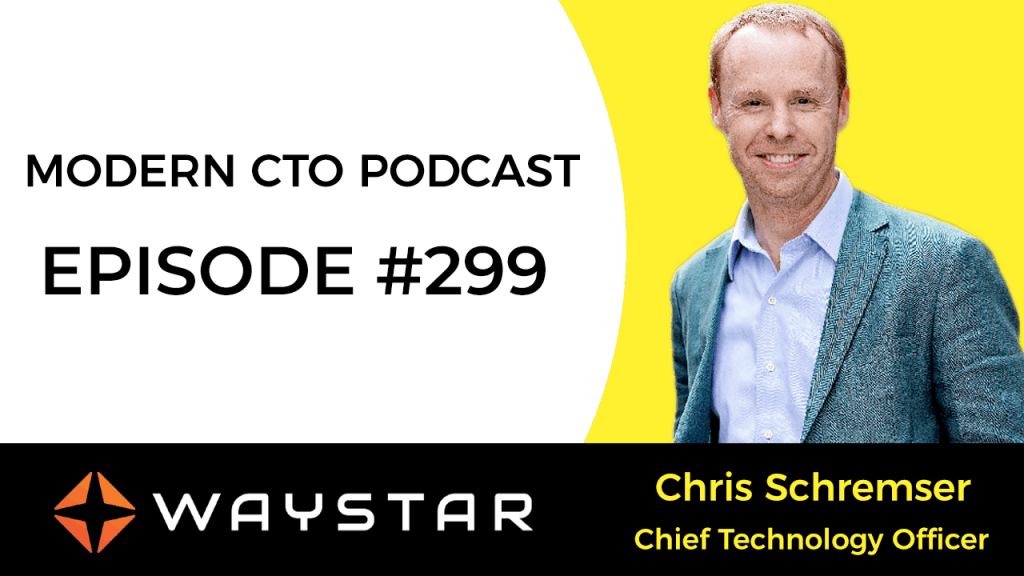
About Chris:
Chris Schremser oversees all engineering functions related to Waystar’s product, including its artificial intelligence and machine learning initiatives as well as the platform’s advanced security features and protocols. Chis is also responsible for defining and driving Waystar’s product vision, strategy and execution. A member of the team who formed Waystar, Chris was previously CTO of ZirMed, a role he entered in 2002.
Chris has a proven track record of success with diverse technology teams ensuring that all engineering factors mesh cohesively in order to provide and maintain a superior finished product. He has expertise in complex system requirements including HIPAA, HITECH, and PCI regulations.
Prior to his current role, Chris served as an IT engineer and consultant for InnerSpace Computers, where he specialized in network installation and configuration, firewall installation and support, application support and remote troubleshooting.
Chris also previously served as a Director for WAVE Television, an NBC affiliate located in Louisville, KY, where he was responsible for coordinating technical execution of various newscasts and feature programming.
Chris holds a BS in Telecommunications from the University of Evansville.
About Waystar:
Waystar provides market-leading technology that simplifies and unifies healthcare payments. Our cloud-based platform streamlines workflows and improves financials for healthcare providers of all kinds, and brings more transparency to the patient financial experience. The Waystar platform is used by more than 450k providers, 750 health systems and hospitals, and 5k health plans—and integrates with all major HIS and practice management systems.
Transcript
(Joel Beasley at 00:00:00) Hello, my friends. Today we are talking to Chris, the CTO at Waystar, and we discuss the radical change that is happening behind the scenes in healthcare, how Waystar is helping to bring transparency to the process between patient and caregiver, and the leadership advice for you to get the most out of your one-on-one interactions. All of this right here, right now on the Modern CTO Podcast. Here we go. This is the Modern CTO Podcast.
(Joel Beasley at 00:00:39) So one of the things that I was really interested to ask you about was you got started in media and telecommunications and then transitioned into technology. I'm curious. Tell me about that.
(Chris at 00:00:52) Very natural, natural transition, right, from media to technology. You know, it is an interesting story. I went to school believing that I wanted to do technical television, so I was behind the scenes. And this was kind of early. I mean, this was everything was all analog. Right? We were still four by three, but the digital revolution was just kind of starting. Newsrooms were beginning to use computers in a networked fashion rather than disconnected machines or typewriters, for goodness sakes. And so, but it was pretty early. And so I did news. I worked for the NBC affiliate in Louisville, Kentucky for five years, and ended up by the time I left, I was directing the six and eleven newscast, which at the time are the premiere kind of news time slots. And then when I wasn't doing those directing activities, I was kind of super engaged in all things technology and just kind of self-taught a bunch of tech pieces and worked with the team to build out a network in the building. And again, I mean, this is early days, right? This was back before internet was ubiquitous. Right? It wasn't everywhere. You know, we were still, if people were getting on the internet, it was dial-up modems. Or, you know, I remember we put in our first kind of ISDN line graduating to fractional T. Right? Like, those are big, that's a big deal, many, many years ago.
(Chris at 00:02:18) And what I found is that the news programs are, generally speaking, as you might imagine, well scripted. Right? They want to know exactly kind of what they're doing, and they have blocks, you know, first block, second block. And, you know, here's kind of the content that makes the first block, and here's the second block. And then you do the weather, then you do the sports, and then you do the wrap-up. And it's very well scripted. And what actually occurred to me as I was kind of in that spot is, I mean, I can do this and there isn't a lot of challenge. And there isn't, while the technology is changing, kind of the function isn't really changing dynamically. And I wanted to be in a place that I felt like I was more dynamic. And so I just took my self-taught skills, pivoted, started working first for a consulting firm. And this is, again, I'm going to kind of wind back the dials. This is 1998 before Dell was as big as they are and HP and, you know, Gateway 2000. Right? And there were a bunch of builders of machines. And then the alternate path was you built your own with a white box or you bought someone that built their own as a small OEM white box builder.
(Chris at 00:03:33) So I went to work for a small OEM white box builder that also did network consultation for small to medium-sized businesses that didn't have networks. We're talking about, I mean, again, it's so early, right? Or maybe they had, you know, they certainly didn't have Ethernet if they had anything, right? So did a lot of that conversion for a year and a half. And then one of our early clients was a company called Zirmed that was founded in a garage. And I was, you know, they called us in to both supply hardware, networking expertise, and ultimately we got pulled into some of the app development even though we weren't really, I mean, that wasn't really our thing. And they appreciated what we did and ultimately appreciated what I did and hired me full-time in February 2000. And so I've kind of been with Zirmed since that time. Zirmed was acquired in 2017 by Bain Capital. Then there was a change of ownership in 2019. But when we were acquired in 2017, we were put together with a sister company and out of that was born Waystar, which is the company I'm still employed for. And so Waystar then continued on through 2019 when we had an ownership change and EQT Partners, a private equity firm, came in and took the majority stake in the organization. So I've had this really bizarrely long career at the same place, which in technology is incredibly strange, I think, these days.
(Chris at 00:05:02) But it all came from television where, honestly, there wasn't the pace of change that was necessary, I think, to drive creativity. Although it taught me some very important lessons about, you know, when you're behind the scenes making all of the calls on what's happening and you make a mistake and the on-air talent looks, you know, like they're the ones who look like they don't know what's going on, they're not real happy about that. And by the same respect, when we're building software and something goes wrong and the people that interface with our clients, whether that's our sales team or our client success team, they feel the brunt of that. Engineering is really kind of insulated. Clients aren't calling engineering directly, nor did, you know, viewers call the director and say, why did you put the wrong camera on and make the anchor look silly? So it really kind of taught who's the client and how do we make sure that we're servicing the clients appropriately, which are our internal stakeholders, so they can serve, you know, our ultimate external stakeholders in the most meaningful way.
(Joel Beasley at 00:06:02) I always like talking to people who've been at companies for twenty years because we have these ambiguous conversations about digital transformation. And so as you talk about them, whether you're going to conferences or calls or hear consultants discussing it as they see multiple different companies, I always find it's really interesting to talk to someone who's been there for twenty years and just ask them, how did digital transformation look? Like, how did Waystar transform other than the SPAC roll-up it sounds like Bain did and then sold off? But from a technology perspective, how did Waystar transform over the past twenty years?
(Chris at 00:06:38) Oh, yeah. I mean, it is, it is a fundamental change, as you as you might imagine in that timeline. I mean, when we started, the software that we write really solves a problem around the administrative side of healthcare. And so we were very focused on, you know, the office, you know, the office personnel. Not the clinicians, not the doctors, but the office personnel that are managing the revenue collection for when you go and see a provider. So we have software that makes all of that process work much, much easier at the highest level. And we were talking to people, we were an early internet adopter back when the ways that this process happened were paper-based. Providers, if they had something that managed their office, you know, like their patients and the services that they provided, at the end of the night, they would print the claim on a form and mail those forms in to the payers, Humanas, Uniteds, Medicare. And then they would do character recognition of payers and reimburse the providers for the services that they had rendered. That was still very much in play, paper claims, when we started as an internet-focused company that was doing this new thing called electronic data interchange, which wasn't new at all in the finance world or the logistics world, but was very, very new in the healthcare space.
(Chris at 00:08:14) So you're talking to providers who don't have internet connectivity, or if they do, it's dial-up. And so, you know, in order to use our site, they would maybe they would have an ISDN line, maybe they would have a dial-up modem. And so you talk about, you know, in those days building to the smallest pipe, right? How does this site be, how is this site efficient on a 56k modem? Because there was some interaction required to really drive the best value from the software. And stop and think about, you know, where we are today with cell phones and all of the internet connectivity and 5G with massive pipes, right? And sometimes you can lose focus on how do you build efficiently in the world where we don't do paper claims anymore, right? Everybody, the world has moved to an electronic process for the administrative side of healthcare. It hasn't necessarily solved some of the complexities that still exist that our software helps solve. And there's another big wave of digital transformation that's upon us. I mean, you can even think probably, Joel, when you go to the, when you go see the doctor, you probably get a paper statement that drops in the mail that says if you have any money after you, you know, like, they file the claim and go to your insurance company. Like, hey, you still owe Joel $50. For like 80% of the statements that exist today, those are still paper, even though there's clear consumerization desire, consumer desire to have that be an electronic or a text message to my phone or whatever.
(Joel Beasley at 00:09:49) Oh, I talk, so my brother and stepmom are both physicians. And so this is a common, and my dad's an engineering technologist. So this is a common recurring holiday conversation, the intersection of technology and medicine. Because they have such a captive market, right? They have such a demand that when you see an industry that has such a high demand, the customer service drops off. Like the innovation, the need for innovation drops off because they're going to have customers no matter what, versus an industry where you're having to innovate to get customers. But I actually got so frustrated with the group I go to down here because they send me these paper things and I called the CEO of the medical group. Because it's like a 20-location group, it's not too big, right? I called them and I said, what are you guys doing? Like, there are all these payment processors out there. Like, I went to your site to try to make a payment and it was going to make me log in to an account that I have to call the front desk to even get. I was like, why is this, this is not an issue. Let me enter in the bill ID and then submit a payment. I don't need an account, and you guys would get your money faster. Don't you, you're the CEO. Like, wouldn't that be a good board update? And then two months later, they had it. They got it. I don't know who they used, but they put that option on there. And I was like, thank you.
(Chris at 00:11:13) The frustration that you are expressing is so common in the healthcare space, which has just been, you know, slow in many ways to adopt kind of the omnichannel communication and engage with, you know, with us consumers of healthcare in mechanisms that make sense. It is just a very laggard industry. And to your point, we have solutions that absolutely solve that. If you've got something where, you know, you want to communicate to the patient their remaining responsibility, we can deliver that electronically. We have the ability to collect that payment online via your smartphone. You can pay it with creating an account if you want to be able to come back. Or, to your point, just pay your bill with your account number and move on. And it depends on your use case. If it's maybe your primary provider, maybe you want to go ahead and save that and create an account so you can see your statements and all those kinds of things. And it is just very surprising how far behind in many ways the healthcare ecosystem is and how complicated it is unnecessarily.
(Joel Beasley at 00:12:12) What are you seeing? Are you seeing that you have a small 10% core group of people who want this stuff and you're innovating for them as customers? Are you seeing that you're having to drag the market along? What do you see over there?
(Chris at 00:12:28) Yeah. I think the trends, I mean, there's a very clear disconnect between what consumers are asking for and where the space is today. I do think that we'll see kind of radical change over the next, oh, let's call it five to ten years. But for sure, consumers are saying we want digital engagement. And providers, I'd have to go back and look to get the exact number, but again, the number of providers that support online payments is shockingly small. Even today, the number of providers that can send a statement about member responsibility post-service electronically is shockingly small, even though there is clearly a shift towards that digital, preferred digital methodology for communication. So there is a transformation coming, just as that back-end process that I talked about where providers used to print on paper a claim and mail it to the insurance carrier for reimbursement. That has all moved electronic. So too do the payment methodologies need to catch up. And it is shocking how many, candidly, how many providers can't even take credit cards, that take checks to the office still. I mean, this, you experience some of that, right? It's very real. And it's a great opportunity for us to innovate.
(Joel Beasley at 00:13:59) Yeah. That's what I was just thinking. I said, this white space. I was having a similar conversation with Yogesh. He's the VP of Technology at Backbase. They help banks, smaller banks compete because, you know, you go to, all of this PPP stuff drove a bunch of traffic to these regional banks. And then I'm interacting with their technology, and I'm thinking this is from the eighties. And I was like, let's go figure out if there's companies out there solving it. And we found them. We found Backbase and a couple other companies that were really interesting that were basically allowing these banks to, you know, build infrastructure and tools so they can compete with the Wells Fargos and the Chases of the world. Right?
(Chris at 00:14:43) That's right. And you see the, I mean, there are clearly, you know, there are clearly folks that have been processing credit cards or, you know, engaging with consumers in a digital mechanism for a long time. But when you think about some of the nuances of healthcare, there really are some opportunities to do some healthcare-specific engagement that, again, our platform does and we continue to iterate on, to ensure that the entire process is as transparent as it can be and as seamless as it can be. And there are still many, many friction points and great opportunities for continued innovation.
(Joel Beasley at 00:15:21) And how do you stay excited? So for example, you mentioned earlier that you had made the career transition early on in your career because of the structure and you wanted something more fluid and interesting and dynamic and happening. And then you're at this company for twenty years. How do you stay excited and not let it get routine?
(Chris at 00:15:42) Well, that's a fair question, and I'll answer it in two ways. You know, when I first started at Zirmed, there were, you know, two or three of us. And I was the CTO, you know, when maybe there were five of us. And the CTO of a four- to five-person engineering shop is very, very different than the CTO of a 400-person engineering shop. So just the nature of the challenge of the role is certainly one way to continue to learn, to continue to stay engaged. The other thing that I will tell you, and I have a really good friend that works at a well-known kind of B2C publicly traded company, he and I have this conversation all the time. They're located in New York. And he will say to me, man, like, why are you still doing that healthcare thing? Like, what? Like, you could, I mean, you could go someplace else. And my answer is, healthcare desperately needs this innovation. They need it on the clinical side and they need it on the administrative side. And think about it, Joel. When's the last time, if you stop and think about it, when's the last time you bought anything other than healthcare where you had no idea how much it was going to cost?
(Joel Beasley at 00:17:08) Never.
(Chris at 00:17:10) Never. Right? But today, as ridiculous as it sounds, we all walk in. We're going to have a procedure done, and sometime later, ninety days, a hundred and eight days, we get a bill. And it's three bills. Many times a surprise bill. We have no idea. Right? Or multiple statements. Right?
(Chris at 00:17:30) And so there desperately needs to be change for all of us that leverage the healthcare system today so that it is more efficient, more transparent. We take the administrative costs out of the system and allow providers, clinicians, to turn their attention back into—and those dollars that have to manage this broken administrative process today, turn those dollars back into care provision. That's meaningful. And so that's the way that I get excited because we still are—I mean, even after twenty years and lots of innovation, we still have a long way to go in the United States to get the healthcare system where it should be for all of us as all of us interact with the healthcare system. And all of us want this system to work as efficiently and effectively as we can.
(Joel Beasley at 00:18:28) Maybe you know more about this. I haven't been following it, but I had heard a while back that a couple big companies—I think it was Amazon, I know it was Amazon, and I think one of Warren Buffett's companies—but they got together and they were going to do something in the medical space, in the healthcare space.
(Chris at 00:18:43) It's a company called Haven.
(Joel Beasley at 00:18:44) There you go. And they got some really bright people together. And then the last thing I—I was very optimistic. I said this is going to be great. And then a few months later, I heard there were several departures from the executive team and I just haven't kept up with it since then.
(Joel Beasley at 00:18:58) What's going on there?
(Chris at 00:18:59) Yeah. So Haven actually just recently announced it would fully disband. Oh. And it would close. And I mean, you know, you can go read a lot around kind of why there was some—you know, there's a lot of interest in why Haven didn't work out.
(Chris at 00:19:21) And even the CEO, you know, kind of made a statement on why they, you know, why Haven didn't work out. But I think the reality is this. Healthcare is challenging. And, even as big as these massive—JP Morgan, Amazon, Berkshire Hathaway, as massive as they are—they still can't do it alone. And even, you know, when you think about you as a consumer wanting, I mean, I can't tell you how many of my friends in payment call and say, I've got this great idea.
(Chris at 00:19:55) What if I could shop for service in healthcare before I went in? I said, that's such a great idea. Let me tell you all the things that have to change in order for that to be real. You know, we need hospitals to provide data around how much procedures cost. And it's not just about the dollar amount, it's the quality outcomes as well and all of these things are tied together.
(Chris at 00:20:17) And, as of January 2021, we do have a new law that requires hospitals to publish their top 300 procedures and the costs around those procedures. But, Joel, does that mean you as a consumer can now shop well? Not really. You have one view of that. Okay, I can at least see how much this is going to cost.
(Chris at 00:20:45) How much is this going to be for me, depending on my particular situation of healthcare insurance coverage or not? And, how do I think about affordability? We still have, you know, lots of innovation to go and lots of process change that has to happen, but that little piece of just requiring these top 300 procedures had to be a federal kind of mandate for it to happen. So, you can see how some of the challenges, even with companies as big as Amazon, JPMorgan, Berkshire Hathaway coming together—sometimes there's government mandate that has to happen as well.
(Joel Beasley at 00:21:22) Yeah. I'm really interested to see how this plays out in my lifetime. You know, you always want to set up the environment so that you leave it better than you found it. This environment of the legal aspect to the medical world and all of these little things—because I don't want to get deep into it. But I've just had so many conversations with my family about it because they own medical practices.
(Joel Beasley at 00:21:47) Right? So they experience the business side of things. And there's so many reasons why the system doesn't work. But it's good enough, but it's not. For me, I mean, one time I went to the emergency room because I was really, really sick.
(Joel Beasley at 00:22:03) Just had the flu. I was really sick, very dehydrated. I was there for less than ninety minutes. They gave me one bag of hydration. You know, it's like a $20 bag of stuff.
(Joel Beasley at 00:22:16) And it was $6,000. I was like, less than ninety minutes, one bag of fluids. I could have just drove up an hour to my stepmom's clinic and got the bag of fluids. But $6,000.
(Joel Beasley at 00:22:28) And it wasn't even so much that it was a $6,000 bill. It was that, you know, you sign some paperwork while you're there. And then over the next six to nine months, you get a bill for 800, a bill for 1,200, a bill for 2,600, a bill for a thousand.
(Chris at 00:22:45) That's right.
(Joel Beasley at 00:22:45) And I'm like, this just feels like you're getting scammed. It's like, they just see if you keep paying them. And so finally, I think at around $4,000 I just was like, I'm going to challenge this because I mean, the—I looked up the market price of that. And if, let's say, I paid the person a thousand dollars an hour, let's say, give them $2,000 for the time they treated me for ninety minutes, plus the cost of the stuff, plus the rental room of a high-end hotel, we're still under $3,000 guys. I don't know how you get to 6,000.
(Joel Beasley at 00:23:17) I could have hired a private doctor in the most expensive hotel room in my town to come give me that bag of fluids and it would have been cheaper than going down to the hospital.
(Chris at 00:23:26) Yep. And there's a lot of opportunity for awareness. There's a lot of opportunity to kind of manage some of the—you know, help providers manage the administrative costs. And again, even working in, you know, ideas on value-based care and quality outcomes, you know, again, there's a lot of transformation that is going to happen in the healthcare space. And so, you know, what I get excited about is helping to drive the innovation in technology that overhauls some of these broken processes and provides better transparency and affordability and reducing administrative costs, which also help drive, you know, the dollars that you're spending as a consumer.
(Chris at 00:24:08) That $6,000 bill. There's certainly a fair amount of administrative costs in there. And as we can take that out, kind helps the entire system.
(Joel Beasley at 00:24:15) Yeah. How much money did they spend just on the paper to bill me 20 different bills?
(Chris at 00:24:20) Paper, the people, the—the whole thing, right? The systems—all of it, right, comes into escalating costs. So there's great opportunity here and that, like, that is for sure what keeps me engaged over a very long career that, again, I would say probably is more the exception rather than the norm these days.
(Joel Beasley at 00:24:41) And so these are the systems that you're building at Waystar. Right? You're building systems for payments to help them get their payments faster so we can, as a consumer, it's easier, it's smoother for me.
(Chris at 00:24:51) That's right. Transparency, that law that I talked about, we have solutions that the providers can plug in to give transparency to their consumers on their services that they offer, those top 300. We continue to remove, you know, there's all kinds—getting a prior authorization is incredibly painful and that's a huge pain—that's a huge administrative burden. If you need a drug or if you need to go see a specialty provider and your health plan requires a prior authorization, managing that process is incredibly complicated and very painful. And we have technology that helps solve for those pain points. Estimation. Not just how much is the service going to cost, but, Joel, how much do you—how much are you likely to owe?
(Chris at 00:25:39) Right? Which is a huge—like, to your point, how much am I going to owe for this thing that I'm walking in for? And there may be times you're unconscious where that's a little more difficult, but certainly if you're able to understand you want to. And that has to take kind of what the hospital is going to likely charge you. Plus, again, if you have insurance, what kind of plan are you on and how much of your deductible have you already met?
(Chris at 00:26:01) And all those kinds of things to come up with this way where we can say, Joel, it's going to cost you $300 for this thing. And let you understand that upfront. Yeah. So that you're not surprised six months later or nine months later with multiple bills. Right?
(Chris at 00:26:19) We have all of those solutions today that are really focused on providing better transparency and removing some of that, again, administrative friction.
(Joel Beasley at 00:26:28) Well, I'm grateful to you because, I mean, you're like a superhero. Right? Because you're reducing these—for me, I think I pay $2,000 a month. I've got a wife and two kids. Right?
(Joel Beasley at 00:26:40) And that's $24,000 a year. And I looked at our medical history because we're all—we're very healthy. We take care of ourselves. We don't eat junk food. We don't drink.
(Joel Beasley at 00:26:51) We don't even do caffeine. I know it sounds crazy, but we just—we don't. We're just really into a healthy lifestyle. And we looked at our total visits to like doctor visits for the past year. And it was like $2,000 worth of—if we would have just paid out of pocket, it was like $2,000 worth of stuff between me, her, and my two children.
(Joel Beasley at 00:27:11) And, you know, my daughter had a little infection or something here and there. Right? Because kids, you know, put stuff in the mouth and shouldn't—yeah. They're kids. Right.
(Joel Beasley at 00:27:19) But I thought to myself, I was like, we really do have a broken system. I spent $24,000 last year, and it and it would have only if I self-paid, it would have been $2,000. How does that make sense? Like, why can't I just have a—and meanwhile, I have insurance on my car. So if I got in a major accident in my car, I have insurance there. I've got some general umbrella policies for myself personally.
(Joel Beasley at 00:27:43) But it's just—it's amazing how out of control it is. Yeah.
(Chris at 00:27:48) It's complicated. Right? There's a lot of moving parts. There's opportunities to simplify all of that. And that is why I am excited.
(Joel Beasley at 00:27:57) AI. It's going to save us all, man. It's the last invention we'll ever make.
(Chris at 00:28:01) There are places where AI makes a ton of sense. There are places where it is less effective still.
(Joel Beasley at 00:28:07) Yeah. I'm still trying to use it to steal all the Bitcoin. It's not working out.
(Chris at 00:28:13) I definitely—I definitely want to know if you're successful on that.
(Joel Beasley at 00:28:15) I'm not. I tried. I had the creators of different cryptocurrencies on, had the head of quantum computing at Honeywell and Microsoft on. No luck there. No luck.
(Joel Beasley at 00:28:25) But are you guys playing around with AI at all?
(Chris at 00:28:29) Oh, yeah. Yeah. I mean, I don't think, you know—I don't want to—I think AI is meaningful and I don't want to oversell it and I don't want to overhype it. Yes. We have a team of PhD mathematicians that run all the latest, you know, kind of tools and whiz-bangs and frameworks.
(Chris at 00:28:44) And what we find today is it is still a little bit about the right tool at the right time. AI certainly has the ability to find, you know, needles in haystacks and things like that that hard-coded algorithmic rules don't. But there are times where the return on investment to kind of get the model to tell you and the investment on the model to tell you what you need, you know, you could move faster with a more traditional algorithmic approach. And so we leverage both.
(Joel Beasley at 00:29:14) Nice. Yeah. It's funny because I love the arguments. My background's software engineering. Right?
(Joel Beasley at 00:29:20) So the arguments of what is AI—somebody had some basic SQL that was learning based off of its input, and it's like, is that AI? And so people have argued what exactly is
(Chris at 00:29:32) Right.
(Joel Beasley at 00:29:32) The definition. And you're right. Traditional algorithms are sometimes just what you need.
(Chris at 00:29:39) That's right. And so for us, it's about right tool for the job. And there are times where we'll use neural networks to model out something that, you know, that makes our software, again, work more efficiently or provide better transparency. You know, when am I likely going to get paid based on all the factors on a healthcare insurance claim? There's lots and lots of data elements there to help providers understand, you know, cash or how much is an estimate going to—you know, if you're Joel, if you're going in for an estimate, you know, what is that dollar amount that you're going to owe?
(Chris at 00:30:11) There are places where hard-coded algorithms make sense, and there are places where machines can do a better job on that model. And, again, it gets into a lot of nuance when you start talking about trying to understand a contractual relationship for reimbursement between a provider and a healthcare insurance company. There are these contracts that kind of dictate what's going to be paid and at what rates and all these kinds of things. And there's a lot of nuance around that. So hard-coding that may be more challenging where that might be a great place for a model to help us understand, you know, how that payment is going to flow, for example.
(Joel Beasley at 00:30:47) Alright. So you go to the doctor. They fill out some chart. You're at checkout. They—you give it to them.
(Joel Beasley at 00:30:53) They're running it through your insurance. And then they tell you go and you don't know when—at some point in time it'll be approved or not. When will the technology—and I'm going to hold you to this number. When is the technology going to be fast enough or there's enough AI or whatever it may be, algorithms—to where the technology systems, I could be at checkout, like I could see the doctor in the room, give me the form, and then on my phone, it's going to give me a breakdown, everything's approved or not approved, it's going to tell me the cash, everything's going to be like just real time. When are—like an Amazon account?
(Joel Beasley at 00:31:24) Real time adjudication.
(Chris at 00:31:25) Real time adjudication is what you are describing. Real time adjudication. That would be the healthcare term that I'm certain if you talk to, you know, anyone in the offices for your family members that understand and manage the administrative side, they're going to say, when are we going to get to real time adjudication? The answer is really interesting, Joel. It might surprise you to find out that in, I want to say, 2005, Waystar then Zirmed had a relationship with Humana where we were able to do real time adjudication.
(Chris at 00:31:58) The problem isn't necessarily the technology. Now, to be clear, that was a pilot and of all of the procedures that could be done in a hospital or you're seeing the doctor, you know, it was a small chunk of those. But the problem wasn't necessarily the technology. The problem was twofold. Really, it's a workflow adjustment.
(Chris at 00:32:25) Right? You are there. You're checking out. And all these systems that the providers leverage, whether it's in a large hospital and it's something like an Epic or Cerner system or in an ambulatory, you know, 20-doc internal medicine practice running, you know, something like eClinicalWorks. All of these systems have the assumption of, we're going to do all these activities during the day and then at night we're going to batch up all the work that we did and we're going to send it on to the insurance carriers via this EDI pipe that I described that exists.
(Chris at 00:32:59) They're all batch-based. And so, you really have to change the workflow to have the system—have the doctor have everything codified as you check out in the system. And then, that system capable of, before you leave, making that real time call out to the carrier, running all of the technical wizard bang to understand what they're going to pay, which can then inform what you're going to receive or what your member responsibility is. The systems just, they're not set that way. And it seems crazy.
(Chris at 00:33:35) It's not necessarily a technical limitation, although there are some today. I'm not going to run from that. But there's a real, real non-trivial workflow adjustment that we, before we started this pilot, it's just like we didn't understand it. And then the pilot revealed, like, it was really hard to get pieces of this. Now you're beginning to see some of that, and even our own systems.
(Chris at 00:33:59) Our systems today are getting better at being able to understand what likely reimbursement looks like and being able to inform that in a more real-time fashion. As these systems, like the EPICs or the e-clinical work systems or the Cerner systems, as they get smarter and able to adjust with the providers their own workflow. But even in those cases, what we're really talking about—now you think about a multi-day visit in a hospital because you had a procedure done like a hip replacement or something like that, and codifying all that throughout your visit and making sure that all that is, as you check out, now available. Again, there's a lot of workflow challenges through that process and some technical ones too that make that the utopia that we are looking for. But candidly, you know, it's going to be a little while.
(Joel Beasley at 00:34:57) I'm going to buy you some red gloves.
(Chris at 00:34:58) Hope springs eternal, Joel. Yeah. Hope springs eternal.
(Joel Beasley at 00:35:01) Yes. No. This is great. What do you think is going to be accomplished as a result of your career? Let's look forward, like, 20 years.
(Joel Beasley at 00:35:11) And let's say you're on the beach, retired. You're not dealing with those balmy days anymore. You're down here in Florida with us.
(Chris at 00:35:19) That sounds great.
(Joel Beasley at 00:35:19) Where we at? Where we at?
(Chris at 00:35:21) You know, I do think there's going to be a tremendous move to greater—I think we will be in more control. The burden of payment is shifting. That's very clear. What you will hear referred to as the consumerization of healthcare. That's happening.
(Chris at 00:35:43) Either it's traditional insurance plans that are offered by major insurance carriers—United, Humana—and maybe you're getting them through perhaps the Obamacare, healthcare.gov site, or perhaps through your employer, or perhaps you're buying them independently. Many of those policies are still from the major insurance carriers. Right? And so, I do think what's happening is that they're adjusting the amounts that you pay for services on top of just, I'm enrolled in the program. And then there's this plan called a high-deductible health plan, which means—I think, generally speaking, I'm going to be a little bit over my skis here, but I think the kind of minimum is a deductible of $5,000 a year.
(Chris at 00:36:35) But that meaning, every time you go to a provider, up until you meet that $5,000, whatever the provider is going to bill, you are on the hook for 100% of that until you hit that high-deductible limit. And so, the burden of payment is shifting to the consumers. And, as a result, when the consumers are saying, "Hey, I'm getting surprised by—you know, I went in for surgery and I got all these surprise bills, like an anesthesiologist that wasn't in my network, and I'm getting this big bill and I didn't understand it," there's a big move, as the consumers are on the hook more, to push for more transparency upfront, and to understand payment optionality upfront, and affordability upfront.
(Chris at 00:37:27) So, I do think over the next, let's call it five to 10 years, we make real progress in moving to a place where before I have services rendered, I have some good understanding of what those services look like. I may have made some payment against those services upfront. I certainly think we're doing much—there's legislation that just passed which will help eliminate some of the surprise out-of-network bills. Out-of-network is a term where a provider doesn't have a contractual relationship with an insurance carrier, so they don't have agreed-upon reimbursement rates. And when that happens, what you will generally see is the provider will send a patient a bill for a very, very, very big dollar amount that doesn't have any contractual—you know, the insurance carrier saying, "Look, you're going to bill $500, but you can't really bill that. Your allowed, maximum allowed rate is $200." That's the contractual relationship of an in-network provider. The services that they render will have a maximum dollar amount that they're allowed to bill the patients. Out-of-network doesn't have that. So, you might go into a hospital for something you're going to have done, and somebody you never see—a radiologist, anesthesiologist—doesn't have a relationship with the carrier that you have.
(Chris at 00:38:50) They send you a bill for the entire amount that hasn't been contractually negotiated to something that's more manageable. So, there's legislation that just passed that will come into effect in 2022, the No Surprises Act, that will help, again, try to provide better transparency. So, I do think over the next five years, we make a major push towards supporting consumerization. I think digital wallets that are so prevalent in so many places, whether it's a Square or Apple Wallet or—I think that whole concept comes to healthcare. And, while you may want to pay your bill, as you mentioned at the start of this conversation, without creating an account, imagine if you could have one place where you could pay all of your providers, see all of your bills, understand what's happening, right?
(Chris at 00:39:46) Like, you go to the provider and they're going to submit a claim to your insurance carrier. Imagine if you could be proactively communicated with along the way. "Hey, just to let you know, you were in the office two days ago. We filed a claim with your insurance carrier. Nothing for you to do yet, but we wanted to keep you engaged so that you understand what's happening in the process." I think that's just going to be a big push around transparency to help manage cost containment. And that's not on the clinical side, right? There's going to be great things that happen on the clinical side.
(Joel Beasley at 00:40:16) Robot labs.
(Chris at 00:40:16) But I do think we get all kinds of crazy stuff. I mean, when you stop and think about a COVID vaccine and, oh my gosh, you know, under a year, that's amazing. Right? That shows some of the power of the investments in the clinical space. But, as we think about where we play in the administrative side, I think consumers will demand and will change their business. Like you said, I called the CEO. If he hadn't made the change, would you have changed providers? It's going to get to the point where the answer is going to be yes. For a better engagement experience, I will change providers, and that will wake us up and drive adoption and further innovation.
(Joel Beasley at 00:40:57) Yeah. Voting with our dollars. And so you think—my takeaway from this is that the hope for this to end up better than it currently is, the path is transparency first. The consumers, once they have clear transparency, that'll drive further change. But step one is let's make it all really visible.
(Joel Beasley at 00:41:20) One thing that bothers me is that I can't see my medical history record inside of my physician's computer. And it bothers me because they have the ability to share data with the insurance carriers. They have the ability to share data with anybody who they choose. You know, you essentially sign all your stuff away in the 80 documents you sign when you need a flu shot or whatever. And, that bothers me, and it specifically bothers me—I'm not going to get into details, but they put something wrong in my record and it keeps coming up because I'll go to a different doctor and they'll ask me about it. And I'm like, I don't know how you're getting this information, but for the hundredth time, that is not correct.
(Chris at 00:42:05) That's right. Yeah. Yeah. Because what you see is when you go from provider to provider, what they're doing is they're making a records transfer. But that's not on a central database and each system is very, very siloed.
(Chris at 00:42:19) There are standards, like FHIR, as a standard to try and promote interoperability and better information exchange. But, you know, there's a lot to do in this space, even around incentives. You know, in many cases, providers want you to stay with them. And, and so they want you to—and health systems want you to stay in the health system. And so, while what you will see is, you know, whether it's an Epic implementation or a Cerner implementation or one of these large health systems that have purchased—they have bought provider groups.
(Chris at 00:43:01) So, in addition to running their hospitals, they might have 2,000 physicians that are in the offices that have sold their business to the health system, and they'll all be under one of these big systems like an Epic or a Cerner. And then you get a little bit more of that visibility in the network. But they've made all this investment to keep you in the network. And so, in some ways, they are disincentivized to share that information unless you explicitly ask for it. There's a lot of opportunity to continue our interoperability for the consumer, and likely, just as I mentioned, some administrative push behind things like the No Surprises Act, which eliminates some of this out-of-network shock that I talked about, or even this publishing these 300 most relevant procedures. So too, there is likely to be some push necessary to get interoperability where it needs to be.
(Joel Beasley at 00:43:58) So as we start to wrap up, I want to talk a little bit about some leadership. So we have a group. It's called Elevate. We get together weekly. We do these calls.
(Joel Beasley at 00:44:07) We have a private Slack community and people put questions in there. So we go fish some of the questions out and then ask them to great leaders who have so much experience, being, you know, the third hire or so on the team, growing up to hundreds of people in a large engineering staff. So I want to just pick your brain for a minute on some of your leadership thoughts.
(Chris at 00:44:25) Yeah. Sure.
(Joel Beasley at 00:44:27) The first one is, what are some of your favorite questions to ask in one-on-ones?
(Chris at 00:44:34) I know this sounds incredibly simple, but I mean, one of my favorite questions to ask is—it's a variation on a theme—what do you want to do? Or, what do you think? Those sound so unbelievably small. But, when I'm sitting with my team doing one-on-ones where we're either talking in a coaching session or we're talking about a more tactical problem to be solved, I probably have an opinion. I mean, I've been doing this for a long time. But what I find that really drives conversation is just, okay, my team might present options, whether it's career path options or, you know, this is how we think we want to solve this technical problem. You know, we have these three options. Well, what do you want to do? Tell me what you want to do.
(Chris at 00:45:25) Tell me why you want to do it. And if you don't know, then let's talk about it together. And, and you will find, I have found through my career, many times if you say what do you want to do, people might say, "Well, I don't know. I don't know what I want to do when I grow up." I mean, if my boss were to ask me what I want to do, I might say, "I don't know what I want to do when I grow up."
(Chris at 00:45:44) But you can then probe, well, what do you like to do? What are you good at? What do you think you're not good at? Where would you like to be better? Where do you think your gaps are? And, as you begin to have these self-discovery and reflection conversations, you can really drive value out of them for both my own edification on where my team member wants to take a problem or a career, but also a really thoughtful way to engage. And, and what I will tell you is you can't—my experience, one of my team members said to me as we were going through COVID, and you can imagine with everybody distributing quickly, you're like, "How are you doing?" And you're trying to check in on people. And leaders have a tendency to do that. How are you doing?
(Chris at 00:46:27) How are you doing? How are you doing? Even as you think about what do you want to do and what do you think you should solve a problem, especially if it's what do you want to do, sharing equally after you hear is incredibly meaningful. Because if you're just asking questions, you're not communicating, you're interrogating. Right?
(Chris at 00:46:47) So if I'm going to ask somebody, how are you feeling? You have to be willing to say, this is how I feel. And you have to be willing to be a little bit vulnerable to really drive engagement. But when you do, it is magic.
(Joel Beasley at 00:47:02) You are exactly right. I love that. As you're talking, I'm thinking about this show and hosting it over, you know, hundreds of episodes. And I found early on, very early on, that if I just sit here and just throw question after question after question, it becomes an interrogation really quick. And if I want to talk about more sensitive topics, I first have to put my own self and my insecurities out there too.
(Joel Beasley at 00:47:31) So whenever the team, the production team, is putting sensitive topics or things that are that are touchy, maybe from the news or whatever for that company or that person, touchy areas, like I have to open myself up like 10 times before I even go there with them because it builds this trust. It's—but the way you articulated it, I'm going to clip that. We're going to clip that and put that out there and share that with the world. I thought that was really bright. I enjoyed that.
(Chris at 00:47:59) Well, be sure to credit Larry Briggs for "interrogation, not communication," because I'm going to—I can't—I stole it right from him. But I think it is meaningful. Right? And he was able to succinctly describe what it did take time to understand, which is you've got to be willing to share to get engagement.
(Joel Beasley at 00:48:18) I like used information. So I like when, you know, that guy Larry will say something, you'll go live with it for years. And then you come back to me and you say, "Look, over the course of my history, I've read 50 leadership books or every leadership book in the category." And of all the things—there's for me, I know what they're in the back of my mind too. There's like a handful of things that are just these truths that I can build an entire empire upon.
(Chris at 00:48:44) That's right.
(Joel Beasley at 00:48:45) Okay. Here's a more specific question. Okay. So how do you deal with succession planning? So this particular individual, they see potential for individuals to grow on their team. They see potential in their team. However, none of them really seem to be interested in the opportunity of growth. What are your thoughts there?
(Chris at 00:49:07) Oh boy. You know, here's what I will say. That is so common in an engineering world. It's unbelievably common. I have—and this might be true in other disciplines. I don't mean to sound arrogant at all. I spent a lot of time in technology. But it is very clear that the transition from engineer to manager is so hard. It is so hard.
(Chris at 00:49:40) It is so painful. And so sometimes when you see potential, it could be, man, you've got leadership or management potential. How do we unlock that for you, especially if you're resistant? And the answer is, I mean, I don't think you do. Let me clarify that. That doesn't mean you don't coach. Right? It doesn't mean that you don't say, "Man, you could—like, this thing that you did was great. How would you feel about doing more of that?" Because for Waystar, we have a program where you can be a technical lead that's doing technical coaching and mentoring without the HR administrative obligation of career pathing and some of the things that go with that. And there's a full pathway up from, you know, to an architect, or a senior architect that, candidly, we value in the same way as managers.
(Chris at 00:50:25) Because it's very important, I think—and I do not think I am unique in this line of thought—to create a path for individual contributors that love being individual engineers, maybe technically coaching and mentoring, but not leading people, and not cutting their career off such that they make the transition into management simply to make more dollars. Then you really have a bad manager and not someone that's necessarily good at their job. Right? So, for us, what I will say is we coach, especially when we see leadership, and we pull pretty hard, especially when we see wins, and we celebrate the wins. When you're a technical lead, we celebrate the wins. If you express, you know, any interest in a managerial role, we'll run you through the training gamut and we'll engage with you.
(Chris at 00:51:18) But if you really say, "Hey. I love being an engineer. Can you get out of my way and let me be an engineer?" Well, the answer is yes. Yes.
(Chris at 00:51:26) We can. And the big thing that we really do try to do is give people flexibility without stigma. Meaning, if you think you might want to be a manager and maybe I'm pushing you a little more, right, and you're feeling the pressure. Because sometimes people will feel that. Oh, man, they asked me to be a manager. I better say yes. I mean, that's what they want, right? So I thought I better do it.
(Chris at 00:51:45) I don't want to do it, but my boss asked me to do it. Oh, I've got to go do it. Go try it. If you don't like it in 90 days, no big deal. Put you right back in the engineering world that you love. But you might find that you like it, and we're here to help you. So I think you have to coach, but you have to offer a lot of flexibility. There has to, there cannot be any, and that's true in so many ways, right?
(Chris at 00:52:11) There can't be stigma for failure. We learn more from our failures than we do from our successes. But it has to be okay for somebody to try it and then go, this isn't for me. And we still have the career path that they can drive meaningful compensation because they're driving meaningful value to the organization, even if they're not managing people.
(Joel Beasley at 00:52:30) I like that. Yeah. And you're definitely not alone. I mean, the largest engineering firms in the world have those parallel tracks because—
(Chris at 00:52:36) That's right.
(Joel Beasley at 00:52:37) It's just different. Different people think differently, and you want to create an environment where people can come and do great work, and yet all the needs are met of the business. When did you notice, since you were at the ground floor for this and you've grown to hundreds of engineers—this is pulling on your memory a little bit—but at like what person count did you notice that you needed to start offering career paths?
(Chris at 00:53:01) Oh, did we notice we needed to do it early? Did we actually do it much, much, much later? I mean, I think if I had to try and put a magic tipping point, when we're a startup, man, everybody's doing everything and you're rowing the boat and everybody's just like, it doesn't matter. And career pathing doesn't matter. But, and it may even honestly, it may have changed because I do think people want to understand what their opportunities are even earlier, perhaps, than maybe they did when I was doing this. There might have been a little bit of a shift just in expectation. But I would say we started talking and building our career path in earnest when we were a 50-person organization. And we created levels, and we refined them through the years because it wasn't right. We didn't get it right out of the gate.
(Chris at 00:53:54) And we maybe were too heavy and maybe we were too big, bureaucratic. But you've got to start by painting the picture because when you're bringing in a young engineer and you're kind of getting to the, you know, in our experience, that 50- to 60-person, they're QA, you know, analyst that wants to grow up to be an engineer. Like, you've got to figure out how to articulate that pathway. So we probably did that. We did that work initially in 2005, 2006. And if memory serves, we were a 50- to 60-person engineering portion of the organization.
(Joel Beasley at 00:54:28) And then how do you pick like KPIs to structure bonuses around?
(Chris at 00:54:35) Oh, man, that is really, really hard. And so the answer is there are certainly corporate ones that are established by just kind of overall corporate metrics. And then every year, we will sit down as we roll into the next year, and the manager will have a conversation with the team member and say, what do you, team member, want to get done? Where do you want to grow?
(Chris at 00:55:03) And again, remember, this starts with that: what do you want to do? Where are you gapped? Where do you think you want to be better? You have to have those conversations at least once a quarter. And sometimes things don't change that rapidly, but sometimes they do. Somebody had a life event, and they went on a reflection path and it has changed. And so you've got to have these regular check-ins. And out of that, you have to build, you know, we kind of expect as a—I'll give you an example—as a department, not an individual, we used to have 50 things we wanted to do in a year. And we're like, well, these are aspirational, and if we had 70%—like, you can't, we can't, it's too much to manage. You have to keep the list really pretty small so that you can track and move the ball in a meaningful way. Otherwise, you end up with too many distractions. And so I would say for individuals, we tend to find somewhere between two to four kind of individual quarter-over-quarter goals. I want to take this class. I want to learn this skill.
(Chris at 00:56:06) I want to do this with the language. I want to solve this multithreading problem. I want to have an opportunity to technically coach and mentor and receive feedback. You know, like those are the things that you begin to understand in these quarterly check-ins. You document them in our HRIS, and then we come back around and review them to attempt to take some of that subjectivity of the end-of-the-year review out. But the answer is it's very much a conversation because each individual will have different goals. And you want to really try and capture those so that you're sure you're moving the individual's interest and career along the correct way.
(Joel Beasley at 00:56:44) Yeah, and I love that you said that, because life events—that's a good way to describe it. There are different—we have a leadership company that we do, like leadership software. And so we have these customers, right? And we're always trying to—everyone's like engagement, engagement, engagement. And what I noticed, because I didn't have a background in leadership when we started this, was that people have these natural rhythms to their life. They'll want to improve for a certain—people that want to improve don't always want to improve every second of every day. They have this natural rhythm. And so it's about—
(Chris at 00:57:17) That's right.
(Joel Beasley at 00:57:18) We were playing with our, like, re-engagement notifications, figuring out what was the right cadence to both encourage someone but not annoy someone, right? Like, yeah. And so, how do you gap enough time and then give them a little—before you just start all notification—give them a little, hey, you want to do a little two-week refresher and see if they bite. And then if not, leave them alone for some. But figuring out all of those cadences and how to do that taught me so much about what actually happens over the course of one, two, and three years in someone's professional career. And—
(Chris at 00:57:57) It gave—
(Joel Beasley at 00:57:58) It gave me a whole new perspective to take over into, you know, just leading my teams.
(Chris at 00:58:03) No, you're absolutely correct. And I mean, like, you know, hey, I just—my wife and I had a baby, and honestly, I'm just in survival mode for the next six months. Can we—like, I'm going to do my job, I'm going to do a great job, and maybe I'm only going to get one thing, but can we just—like, I need to take some downtime, right? Like, that happens. And you have to understand that. And sometimes it's like people are going along and then they have, you know, something that makes them reflect and go, man, I want to move my career. And I completely—like, I didn't think I wanted to do management, and I had this thing, and I listened to this—I listened to Joel on his leadership podcast.
(Chris at 00:58:38) And like, now I'm like, I want to go do this. And like, it can be—it can be like that. Yes, it can be like that. So you have to—our goal is to have a very formal case. Every one of our managers has to do some one-on-one with some regularity, but at a minimum—and this is the bare minimum, nobody does this—we enforce a quarterly check-in to have this conversation. How you doing? What do you want to do? Let me share how I'm doing. Now you tell me how you're doing. What do you want to do? And let's have a conversation about what your goals are for the next quarter.
(Joel Beasley at 00:59:12) Yeah. Like, it sounds like you have a fantastic culture. Are you guys hiring?
(Chris at 00:59:17) We are. We are constantly hiring. I mean, the reality is, look, engineers are—software, I don't know if software is eating the world, it might be software is the world. Yeah, we're in a simulation. That's right. And so, yes, we are always hiring.
(Joel Beasley at 00:59:35) And so we'll put in the show notes, we'll put a link to your careers page. We'll hunt it down—
(Chris at 00:59:42) That'd be great.
(Joel Beasley at 00:59:42) Figure it out, put a link in there that way people are interested, they can just, you know, search us, search the podcast, find the show notes, and click on it. And then do we need to do any other shout-outs or any other calls to action? Can people go sign up on Waystar if they have—like, who do any of your customers listen to this? Can we plug your business a little bit?
(Chris at 01:00:00) No, I know. That's a fair question. I don't know the answer to. Generally speaking, the people that we are—the people that are engaging with us are financial officers of a health system or, you know, an office administrator on the back end. Generally speaking, not the technologist, although not always. Sometimes there are CIOs in hospital systems. So I would say if there are health care professionals that are technical in nature and they're listening and they feel the pain of the administrative burden in their hospital, yes, you should definitely call us because, for sure, we can help.
(Joel Beasley at 01:00:36) Amazing. There we go. What I have found, too, just by doing the show is that it's always like the strangest connection. Someone will say, oh, you know, we like them because I heard—the CTO wasn't purchasing it, but the CEO is checking it out. And then the CEO brought it in, and the CTO is like, oh, I heard their CTO on the podcast. And I'm like, guys, it's just too crazy. It's almost as if every time I hear a story—I've heard stories of they heard a leader story, an engineer did. He reached out to them because they had something in common, and then moved halfway across the world and has been working for him for like a year and is best employee ever. And it, like, all of these great things just from having casual conversations about leadership, technology, and what you guys do.
(Chris at 01:01:21) It is amazing to me. I mean, you know, COVID has certainly reinforced for me, you know, we are human, and we need to learn from each other. We need interaction. Some of us more than others. I get it. We're engineers. But having those connections and the opportunity to engage and learn is so meaningful for so many of us. So I appreciate, I appreciate you having me on today, Joel, and let me tell a little bit about our story.
(Joel Beasley at 01:01:50) Thank you so much for listening. And if you found this episode useful, please share it with a friend or colleague who you think would get value from it. And if you have topics that you'd like to hear discussed on the podcast, either add me on LinkedIn or send me an email: [email protected]. Every time I get an email or LinkedIn message, it absolutely makes my day and inspires me to keep going.