
Episode 270 ·
Alex Yurkowski - CTO & Co-Founder at Clickup
Today we are talking to Alex, the CTO & Co-Founder at ClickUp. And we discuss the lessons learned from hiring early on in a start-up, ClickUp’s goal to be the one place to get work done, and why values and culture items can change as the company goes through different phases.
All of this, right here, right now, on the Modern CTO Podcast!
Check them out now at ClickUp.com!
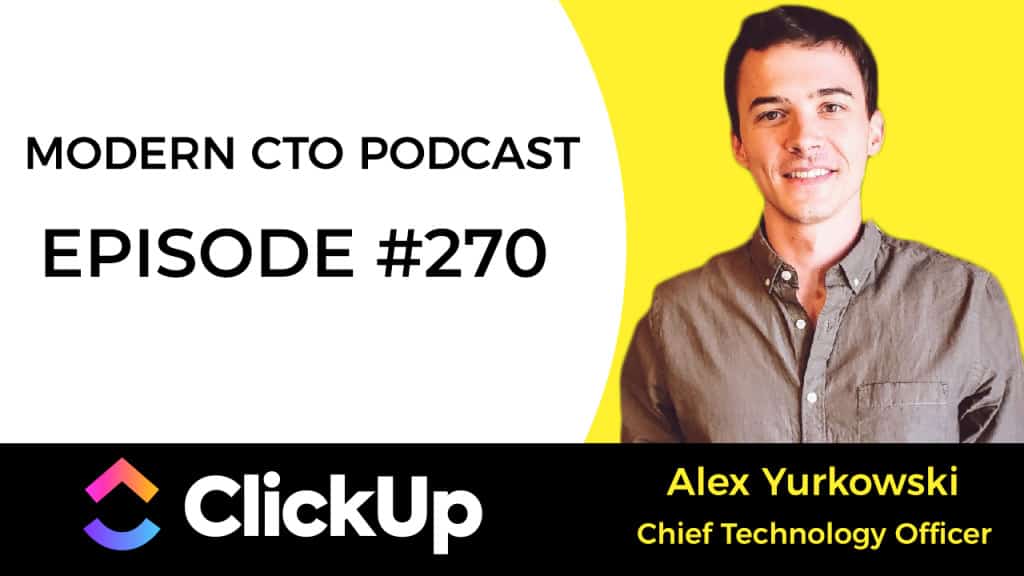
About Alex:
Alex Yurkowski is the CTO and Cofounder of ClickUp. Prior to founding ClickUp with CEO Zeb Evans, Alex was a software engineer at IBM.
About ClickUp:
Founded in 2017, ClickUp is the world's only all-in-one workplace productivity platform that services all departments of an organization. ClickUp helps teams of 2 to 2,000 people, at companies including Google, Nike, Airbnb, Netflix and Uber, be more productive with less apps by replacing or integrating with all workplace apps on one seamless platform. To date, ClickUp has helped more than 200,000 teams and millions of employees lead a more productive life and save at least one day every week.
Transcript
(Joel Beasley at 00:00:00) Hello, my friends. Today we are talking to Alex, the CTO and co-founder at ClickUp, and we discussed the lessons learned from hiring early on in a startup, ClickUp's goal to be the one place to get work done, and why values and culture items can change as the company goes through different phases. All of this right here, right now on the Modern CTO Podcast. Here we go. This is the Modern CTO Podcast.
(Joel Beasley at 00:00:35) Alex.
(Alex at 00:00:36) Hey, Joel. How are you doing?
(Joel Beasley at 00:00:38) Dude, I'm fantastic. How are you feeling today?
(Alex at 00:00:41) Pretty good.
(Joel Beasley at 00:00:42) Where are you calling in from?
(Alex at 00:00:44) I am in Los Angeles.
(Joel Beasley at 00:00:46) You guys still locked down pretty hard?
(Alex at 00:00:48) Yeah, we can't do anything.
(Joel Beasley at 00:00:54) Is that pretty difficult for you, or are you handling it well?
(Alex at 00:00:58) Handling it pretty well. I've worked from home for years, so not too weird for that. Except for that there's no escape. You used to have the escape either in the evenings or on the weekend, but you're pretty much going to make sure you got what you need in your house now.
(Joel Beasley at 00:01:20) Are you going on walks, though? You're getting some outside time?
(Alex at 00:01:24) Yeah. I also got a new puppy, so that was exciting. I got him maybe four, five weeks ago. That keeps you busy.
(Joel Beasley at 00:01:31) That'll keep you up at night.
(Alex at 00:01:33) Yeah.
(Joel Beasley at 00:01:34) What did you name the puppy?
(Alex at 00:01:36) Charlie.
(Joel Beasley at 00:01:37) Charlie. There you go. You gave it a human name. I love it. Man, I was super excited when I heard I was going to get to talk with you because I was just evaluating about six weeks ago. I was evaluating how we're going to handle—so we do these podcasts, right? And then to promote them, we do quick clips and content and newsletter. We do all of these tasks and we had them on the spreadsheet. And, you know, we have production, associate producers, interns sometimes. And there's basically anywhere from fifty to a hundred events that occur from a moment where we're going to do a podcast with an individual from booking to all that stuff. And we needed a way that was better than the spreadsheet because what was happening is something would—a box would accidentally get checked, maybe if someone was checking the spreadsheet on their mobile device or something. We had these boxes in the spreadsheet. Or someone would just forget to relay information or—there were all of these little things that would happen that I would ultimately hear back from through the customer. The customer's upset. Oh, you know, nobody notified me of this. And I went and I looked and I was like, oh, we missed that. And some tasks are dependent on other tasks, and I was like, there's no way in the world—there's going to be a software out there. I'm going to end up having to build this myself because that's my background. And then I started searching around and found your company and a couple other companies. And so I signed up for a bunch of free trials, and your software was the best. So when I heard I was getting to talk to you today, I was like, yes. I love this. I'm very excited. I was super happy about it.
(Alex at 00:03:14) Well, I'm glad you thought ours was the best. Yeah, we definitely do our best also to be pretty agnostic as far as workflow. So no matter what you're trying—however your team works, we do our best to make sure you can customize ClickUp to kind of fit your workflow. A lot of platforms, they're geared towards software development. It's like, oh, if you don't do strict agile development, this probably isn't going to work for you. We've gone pretty far away from that. Make it very customizable so no matter what vertical or what kind of team you are, your workflow should fit into ClickUp, turning things on and off, features on and off, and making sure that it really fits for what you're looking for.
(Joel Beasley at 00:03:57) Yeah. You do so many things. It's actually a little bit crazy. I have a whole bunch of questions and things I want to ask you about, like, how you organize all that chaos. But first, I kind of wanted to know a little bit about you and how you got started. What was your first foray into technology?
(Alex at 00:04:14) So when I was younger, I was kind of a math and science kid and always into computers, played a lot of video games. So that kind of just transitioned into computer science. So I went to school for computer science. I was kind of lucky. I realized a lot of people when they go into school don't know what they want to do. I've always kind of known, so pretty lucky, just knowing I really loved computers, liked building things. And so always wanted to do the startup grind and whatnot, but out of school ended up going to IBM where I learned quite a bit. And then met up with Zeb and we founded ClickUp.
(Joel Beasley at 00:04:51) But how did that go? It sounds like too perfect. So you're at IBM, right? It's too perfect for me, my friend. All right. You're at IBM. You're doing this nine-to-five thing and you're like, oh, I just love this. Or were you like, I need to get out there? Tell me about more of your state of mind and where you're at in life and how this came about.
(Alex at 00:05:11) Sure. It's actually a little weird as far as—I actually, may sound bad, but I never really wanted to work at IBM. I was applying for startups and small businesses, kind of like basically startups. And they were all kind of telling me out of school, they were telling me, you're not experienced enough probably to do this. And I now see probably right. You know, at a startup, you aren't going to have anyone to guide you if you're the first two to four people. You're going to be handed everything and be like, well, we need you to build this, and we need you to build it correctly. And it's going to need to scale quickly because you're going to be put on another thing and another thing to build. So luckily none of those startups out of school ended up hiring me. And I had worked at IBM previously, so I went back to IBM where I learned a ton. I got put on a bunch of different teams, kind of rotated through teams because the first product I was on, that was done setting. So I moved over to Bluemix and cloud integrations and got to see a little bit of fast-paced things there as well. So got a lot of experience there. And then while I was working there, I was trying to do something outside. I always wanted to do the startup thing. So I was trying to find someone to work with and people to—it's very difficult to do alone, to stay motivated, get things done. Also skill sets. You're not going to have every single skill set. So you've got to find people who complement you. And so I was in North Carolina, in Raleigh, North Carolina, working at IBM, trying to do on the weekends and things like that, and meeting up with people. But I never really found anybody, and I kind of gave up on that. Tried to do things on my own. Made a couple mobile games and stuff, but yeah, it was tricky to do by myself. So I was on a website called CoFoundersLab.com. That was where I was trying to find people. If you're in a major city, like a major tech hub like San Francisco, I'm sure there's a ton of people you could find to try and partner with and make something cool. But in Raleigh, North Carolina, there's really not that many people trying to put in another forty hours on top of their forty-hour week to try to build something. So luckily, you know, I had actually given up on the website and then one day Zeb, our CEO and co-founder, emailed me on that and was like, hey, let's meet up and try and see if we're compatible, if we want to build something together. And I'm not really sure why I responded because I got a few that I just was like, this isn't working, this isn't working. Either they want to put in an hour a week or it just skills don't complement. And we met up and we just—it just worked out. But yeah, he had built previous businesses. So originally, I was going to be working on the weekends on this, kind of putting in hours I could. But eventually he suggested, hey, I can fund this and you can leave IBM and do this full time. So that's what I ended up doing. A lot of people told me not to do it because I had just got engaged. I planned on moving across the country. So I was in Raleigh and I was moving to California, to Los Angeles. And, yeah, everyone's like, those are some of the biggest life events, and then you're going to add quitting your job and starting a business, like a new job on top of that. So, but we gave it a shot, and so far it's been working out.
(Joel Beasley at 00:08:56) I love it, man. And because, you know, I started this business, the podcast business and the book and all of that stuff, right when I was having my first kid and I had a successful consultancy that was building apps, and it was kind of on autopilot. And so to leave that to do something at the same time—I think my first child was born in September, and I started it officially in October or November. And I've kind of found that when a lot of people are saying you're crazy, that's usually a good sign. If you go ask a bunch of very stable people about something and they're like, yeah, that sounds insane, it's like, all right. Well, I think I either have something here. Either it's going to go really well or it's going to blow up. But if you just keep taking those chances, you will develop inner guidance, right? You will figure it out. And it's definitely not easy. And even if you say, yeah, it kind of worked out, that doesn't mean it wasn't very difficult along the way and there weren't plenty of ups and downs, and there's still going to be. But, yeah, it's just really exciting for me to get to hear you describe it and talk about it because, yeah, at the best or some of the most key moments in my life, you know, like you said, you don't really know why you responded. You had gotten a couple of them, but you did. It's like some people call it synchronicity. Some people call it—I heard a new term. Someone called it a God wink the other day. You know, some people call it the universe, but there's just those moments where things kind of click and you're like, oh, this feels good. It feels right. Let's do it. And then, you know, you kind of make up your mind, then you can kind of feel it inside. And so even though some people will tell you it's crazy, you're like, yeah, but it feels like it's something I should do.
(Alex at 00:10:41) Yeah. And, you know, we definitely had a time where, yeah, I had a lot going on, but it was a chance that I was willing to take. And like you're saying, it's been an up and down—it's up and down every day. Everything else. No matter whether you're trying new things or you're sticking with your old stuff, it's going to be up and down. So kind of keeping that in mind that you've got to kind of roll with the punches and keep going.
(Joel Beasley at 00:11:06) Yeah. The visualization I like for that one that helps me is if you look at—I did a lot of financial software previously. But if you look at a ten-year snapshot of the S&P 500 or just the stock market, it's up and down, like, huge, up and down, but over the ten years, it's up 500%. It's up and down, but it's steadily going up on average. And so that's kind of how I feel like my life is. It's always up and down, but if I—every time I take—yeah, we're at the end of the year right now. So everyone's looking back on the year or we're beginning the year and looking back on the year, and we're kind of figuring out, all right, where was number of happy customers last year? Where was revenue last year? Where was I in my personal growth with fitness or health or mental stuff and all the habits I wanted? And yeah. How do you feel? Did you own this year? Was this a good year for you?
(Alex at 00:12:02) Oh, this is a good year as far as the business goes. And then as far as personal stuff goes, just kind of sticking there because it is tricky, being, you know, just home always. You know, trips get canceled. All of your things that you planned on doing to kind of, you know, take a step back for a minute, relax, reset, and then go again. A lot of that stuff got wiped out. We're supposed to go on a camping trip and, you know, like, that's one of those things like, oh, no, that'll be fine. Then there's a fire and that gets canceled. A little tricky, but, you know, you don't get to see friends and family and stuff who have to travel to see you. But, you know, everybody's in the same boat for that. So it's like, you just got to tough it out. It'll pass. But as far as work goes, you know, it's been a great year for ClickUp. We've been killing it. We expanded our team a lot, and we've got great people.
(Joel Beasley at 00:13:00) What's your thirty-second overview? Because everyone keeps hearing me talk about, oh, I was all excited about ClickUp. I'm using it for one narrow subset of features. But can you give me the thirty-second overview?
(Alex at 00:13:12) Basically, ClickUp is a one app to replace all your work apps. So it's one app to put all of your work in one place. The way we're accomplishing that at first is your tasks. The task management platforms are pretty common, and anyone who's using a spreadsheet—even more and more people are moving over to task management platforms, project management platforms. So the core is your tasks, making sure you can get things done there. Then we have your docs. So we have interactive docs where you can keep your wikis, your process documents, put all of that in there. And those are interactive. You can put a timed comment on them and whatnot. So you can kind of make a wiki, whatever you need, and share that with your team. You can publicly share those as well. And then goals, so making sure you have your top-down goals, reporting, and chat and communication. It's not necessarily real-time chat like Slack. I would say we haven't hit that one yet, but we plan to in the future and get all of your work in one place. That's helped a ton for us and a lot of our clients. Bringing your whole organization into one platform. So that helps a lot for us in the sense that our development team has their space where they have their workflow, and then marketing is alongside it in their own space where they define their workflow. So they don't have sprint points and things like that that they don't care about, but we can all communicate on the same platform. So for a very long time, we were doing weekly releases on a Friday with features that marketing needs the content for, sales needs to learn what it is, and everybody understand, what are we doing? Product needs to be in there helping to define our features and make sure we're on the right track. But being in one platform, it's really easy for us to communicate. You know, here's the release notes. Let's tag the developers and product team to make sure that this is actually right, or how can we create this better when you're moving at such a fast pace and quick cycle. Every minute counts and making sure that all of those notifications, everything are in one place, all that communication's happening in one spot. It's all documented there. Everyone can go look back at it. It helped us a ton to keep that keep that rhythm of shipping every week.
(Joel Beasley at 00:15:34) Yeah. I just learned a bunch about the product that I didn't know. So I'm really glad. The wiki is actually something that I'm very interested in because we were looking at a separate tool. And if we could just—that was just included in the price we're already paying for the other part of the tool—to me, just use your wiki.
(Joel Beasley at 00:15:51) So I'm happy to learn about that. Yeah. What we found was really interesting was the way it helped on a business side of things. Yes, we're able to deliver the software or not software. We're able to use the software for our delivery of our podcast deliverables. But it was interesting because what it allowed us to see, like, the bandwidth of individuals. Right? Like, how much they have to do and what's getting done today and just the ease for them to, like, open a dashboard and just see, okay, here are the 10 things you have to do today versus filtering through five different spreadsheets and just checking different. Do I have something in this spreadsheet I need to do? Do I have something in that spreadsheet I need to do?
(Joel Beasley at 00:16:38) That was really useful. And then the whole exercise of, like, we're a small company. We're under 15 people. Everybody's time needs to be maximized without driving us crazy because, like, you have to have a quality of life. You have to not get burnt out. But, you know, if you have four or five routines specifically that you operate every week, we need to make sure that if a sixth one comes along, we either drop another one, you know, know how much bandwidth they have. And so your software through its ability to, I don't know if you guys specifically try to do that. Do you specifically try to do that? Is that a feature you focus on, or is that just an abstract benefit I'm getting?
(Alex at 00:17:19) Yeah. So we have workload views and things like that to make sure that you can adequately distribute work and see who's overloaded and who isn't. There's a few different ways to do it throughout the platform, but, yeah, it's definitely something we keep in mind and make sure that we have. It really comes down to how you decide to measure your tasks and your bandwidth for your team. But we made sure that all of our views that do allow to help you track that work or whatever if you're going to do time estimates, if you're going to do sprint points, if you're just doing due dates and things like that, or if it's just number of tasks. Make sure that it, well, it's all customizable to that in those views. Whatever you're doing to track how much capacity someone has, you'll be able to so that it, again, fits your workflow.
(Joel Beasley at 00:18:16) So, like, with focus. Right? Because if you go to your site and you go to the bottom and you're like, here's the tools and here's the use cases, it's like infinite. Right? So I see that's where it's at today. Obviously, you know, you guys didn't start with all of that content. You have a great content team, by the way. Your articles out there and just the quality of them and design and the branding and everything, they're really, really well done. So your content team is rocking. But when you first I want you to take me back in time when you first started. Like, were you looking at a specific segment of the market, like developers or maybe legal assistance? Like, was there a specific thing that you got your first chunks of revenue in before you expanded out?
(Alex at 00:18:59) No. So that's actually another interesting story. And you know, criticized for that. We always wanted to be vertical agnostic and completely customizable, where it's a place for your work. And we see this now, like, little families of two are doing it to track their chores. Meanwhile, giant companies are doing it to track their work. Like, it's so dynamic, and we always wanted it to be that way. And we had a 1.0 version of our product. We shifted to 2.0. 2.0 got a little more complex where it doesn't work as well for the single user checklist. You can still use it, but it is a collaboration tool. So there's a lot of things in there that are for collaboration, but we were always looking to make it super dynamic and it was always built that way. And interestingly in the beginning investors and, you know, people who took a look at what our plan was told us that was a horrible idea. They said that will never work. Like you need to pick a market and target it. But we didn't want to. It's very but we didn't like the opinionated software. So we went the other way. And as much as people said it wouldn't work out, you know what? It definitely does. Our marketing team uses it and it works well for them. It works well for our development team. Works well for, you know, the use cases are insane. Our first paying customer was a jujitsu gym, where he scheduled his tasks and his team tasks in there. So, yeah, we've always kind of geared it towards whoever is trying to get work done, you should be able to fit it into ClickUp pretty well.
(Joel Beasley at 00:20:45) That is so cool. I love it. Do you ever do jiu jitsu?
(Alex at 00:20:48) I have done a bit. But
(Joel Beasley at 00:20:51) Is that on your do you use ClickUp in your personal life, like, with your wife? You're like, here's our to-do list, wife.
(Alex at 00:20:59) Not really. It's more so, I do use dashboards and the widgets within there to organize kind of my day. So our dashboards feature, you can pull in, you know, different widgets to do whatever you need. I have a personal one where I pull in kind of what I plan on doing for work and what I plan on doing for myself, and making sure that I get all my things knocked out, whether that's, like, getting my license renewed or whatever. Make sure it's on the list.
(Joel Beasley at 00:21:28) How's the growth been? Do you guys if you can share this or not, but, like, employee count, like, how have you been growing over the past couple years? Where are you at today, and then how's the growth?
(Alex at 00:21:40) Yeah. Sure. I have some of the numbers in front of me. So we've got millions of users and, you know, over 200,000 teams using our platform, and employee count, somewhere in the mid 100s, I believe. Not positive on the employee count, but, yeah, we've just been continuing to grow across the business. 2020 was an interesting year for company growth because up until the beginning of 2020, maybe late 2019, we were all organic growth. We were growing like crazy, but it was all organic. And you can see some of Zeb's talks about product market fit and organic product market fit. I suggest looking at some of those to see just how we knew this product was going to work because we weren't marketing until the beginning of 2020 or late 2019, and we didn't have a sales team. So we added both of those in 2020. So that's a giant headcount increase. So our company increased quite a bit there. And then one of our core values is customer service. So we continue to increase headcount there to make sure that we have, you know, fast response times, but also great customer service reps where they have the time to look at an email or a chat that comes in and make sure they answer it to the best of their ability, get the customer what they need and happy. I think that's a really important thing to drive home no matter, you know, what business you're in. It's so easy to go through your everyday life. I went to a fast food restaurant the other day, and it's just frustrating. Like, the customer service is so bad, and it's so easy. It's one of those things that if you just instill it into your company, your customers will love it. And it's honestly, it's not a difficult thing to do because happy people will be good customer service reps and give a good customer experience. And your customers will love it because it's not a common thing for some reason.
(Joel Beasley at 00:23:45) I know. I know. It's amazing. I always notice it when I go to the doctors because they have such a packed business model. They're not hurting for business at all. Right? And so they have some of the worst experiences of trying to book calls. You call, you're on hold for ten minutes. You talk to someone. They're trying to move stuff around. It's like, why is this not a Calendly type experience where I can book? And it's because they have so much business they don't have to change. It's not competitive. Sometimes it becomes uncompetitive in the market, and if it stays that way long enough, another company comes around who solves the problem, who has the best customer service, and then everyone floods over to them. That's, like, a little disruption. But when you were talking about culture, I was curious. So you come out of your, you know, intern and then I think an employee at IBM. Right? So you come out of that with that experience. Right? So you've got some, but then you're in this company building the product and you're scaling relatively quickly and growing. So, like, those first people that you're hiring, all of, like, you know, let's focus on that. The first people you're hiring, what mistakes were you making, or how did you learn? Did your cofounder have a little bit more experience? Did you get lucky hiring, like, really great people right at the beginning? Tell me about that.
(Alex at 00:25:01) I think it's a bit of both. I've definitely had experience hiring before. He brought some people over from his past company, and some of our developers are in Europe, and he was working with them previously. So we brought some of them over. We definitely learned a lot hiring. We also originally were working on something other than ClickUp. ClickUp was like an internal tool that we were building because we didn't like what we were using for project management. So we were kind of just like, let's build something to get our work done. But we got lucky in that we found some great people while we were building that first thing that we kept into ClickUp. For instance, Sergei, one of our developers, is amazing. And he's still with us today and, you know, it's been a few years. And but as far as finding the right people, you know, it's making sure especially in the early days, it's a work ethic thing. I would say is the biggest thing in the early days was just making sure that they wanted to put the work in and dedicate, you know, time to getting this done. And also understanding the values. One of the big values for our engineering team that we try to always communicate is what are we making and why. It's a little easier with something like our tool because we use it. That's what's great about an internal tool becoming a product is you use it and you understand the value of what you're working on. A lot of times, especially in software, you're working on something you would never use. So understanding how this brings customer value is kind of tricky, but something that we're using every day while we build it, you know, you make a new feature. Last week, we made nested subtasks came out. You know how much value that brings. So it's exciting to work on and you know you want to make it great. And then we also do our best to deliver feedback from our customers to our development team. It's easy to be on the development team and never see the positive. You only see the negative. You get the bugs or the issues, and you continue to turn out features. Making sure they see, like, the customers like this, or you did a great job on this. Look at the praise for nested subtasks as an example, or whatever we're pushing.
(Joel Beasley at 00:27:23) Yeah. No, it looks like you have a great company culture. And I did get that update, and I saw it, and I was like, yes. That is actually exactly the thing I was looking for. So I did the demo, then I scheduled us to really get into it on my vacation and then ended up just being out in the wilderness. And so when I was like, it really needs this one thing and then I get the email. It was like, it was awesome. It was like, I need this. I didn't even message customer support or ask for it. I just knew I needed it instinctively. And then I saw it come out, and I was like, this is so perfect. Like, what perfect timing? But when it comes to company culture, I saw on your website you guys have some of your culture items, and they're pretty funny because they've got some curse words on them. And I was just curious, like, how you guys came up with that? Who came up with that?
(Alex at 00:28:21) So a lot of them just we didn't write them down and decide to make a culture. Right? We were working for a few years already before we really wrote them down. We're kind of looking at well, what have we been trying to instill and what is succeeding and what do we like about the culture we have already when it's, you know, just five people, six people and try to instill those into those core values. You know, one of the things was we wanted good customer service. Zeb originally started in the hospitality industry, so his big thing is customer service, and we wanted the customer experience to be great. So that was definitely part of our core values. But also, it's just hard work and getting things done. So how do we get that done? How do we make sure that we don't let things fall through the cracks? So, like, remembering things and pushing the needle forward. So I think some of our core values change. We change them as we grow and as we move forward. You know, there's, like, what's important now or at this company size and team size, what makes more sense? So I think we used to have it is now progress over perfection. I forget what it was before, but something along the lines of like get it done now or something like that, rather than pushing it off to later if it's a small thing. But we moved over to kind of progress over perfection, and that's just not that we're not striving to make things great and perfect, but getting what we can done now so that we can continue to push the needle forward, deliver the value we can to our customers now while we continue to improve, continue to get whether they're improvements on existing things or new things out the door. Yeah.
(Joel Beasley at 00:30:13) I love them. When I saw it, I was like, oh, these people are going to be cool people. Right? And then I was talking with our producer. I was like, I don't know, man. Am I allowed to say them? Because the podcast, you have to put the explicit tag on it. Yeah. I left
(Alex at 00:30:28) I left some words out there.
(Joel Beasley at 00:30:30) I know. I know. You did it so well. But then the funny thing about life, we can talk about this life moment right now that I'm that we're experiencing together. So in our prep call with my team and everything, we're saying the name of them. We're laughing about them. We're like, yep. Because they're so real for us. Like, your culture, your ClickUp culture and our culture are great fits. Right? They're really, really great fits. And so we were just loving the similarities and we're like, yeah, we've learned that lesson, like, remember things, you know, create a system. It's like, that's what you do. Right?
(Alex at 00:31:01) Yep.
(Joel Beasley at 00:31:02) And so that's the system that we're adding into ClickUp. It's that system of items. Right? And so but it's weird though because then when we're in an interview format, even though it's casual interview, it feels weird to say. But I don't know. Maybe I'm just being silly, but I do love the culture, and I think it's really great what you're doing. I love your background too. The branding, everything at ClickUp is really on point. One thing I was doing right before this call was downloading the app. I hadn't been using the app before, so I was like, oh, let's go get this thing set up. And I was talking a couple weeks ago with the CTO. His name is David. He's at NowSecure. Right? And, you know, my background is development. Right? I've been a software engineer for seventeen years. So I was talking with David about the apps and securities because that's what they do at NowSecure. And he was explaining to me how now you can integrate the security stuff into your deployment pipelines. Right?
(Joel Beasley at 00:32:06) So security checks and things can run as you're committing code and all of that. And I was blown away. And then they have all of these mobile security has kind of emerged out into its own market. There's a whole lot going on there. It's amazing how fast things progress even in the past three years, right? And I was just curious about, you know, how do you think about mobile security? Do you just have somebody that thinks about that all day, or how does that fall into your lap as a CTO?
(Alex at 00:32:40) I think, you know, the main thing is just making sure that security is baked into your development process. If it's not considered, you're going to run into issues. So having rules in place in your code base that make sure that certain things don't happen, you have your reviews, and then QA review—sorry, PR reviews, so pull request reviews—before anything actually makes it to the code base. So that's something, you know, you get a few sets of eyes on something. And then also across the board, like you're saying, automated scans that make sure everything looks good, and then every once in a while have external audits as well that make sure everything looks good. So our team's going to do what they can for security, and we're going to make sure it's 100% secure, but it's always good to bring in another agency and do some auditing on everything and make sure everything's buttoned up and there's no new vulnerabilities that you need to update.
(Alex at 00:33:34) You know, really the external agencies never really find anything. They mostly are just telling you, like, you could really update this version or something. But yeah, building it into the pipeline is always the way to go, both on the manual side and automated side. Make sure you have automated pen tests and things running, as well as making sure your development process is set up for reviews where no one's code is just flipping through. Something we haven't had fun doing but is necessary as you grow is getting all the compliance items checked off.
(Alex at 00:34:08) So some of those compliance items are making sure—for instance, with SOC 2 compliance—it requires that you have all these processes not just implemented but documented and whatnot, and provide evidence that you're following them. Make sure there's a lot of gatekeeping as far as how things make it into production. Just taking it into the process isn't good.
(Joel Beasley at 00:34:30) Isn't that crazy when you start looking at this compliance? And as a small development team, you kind of laugh at it. You're like, how would you get anything done if all of these barriers were actually set up? That would be impossible. You'd spend half of your job just submitting requests for access to things.
(Alex at 00:34:48) Yeah. And so much of the compliance stuff is very dated. Or that's the other thing—you shouldn't ensure, like, your compliance. Being compliant, SOC 2 compliance does not make your application secure. Those procedures are supposed to help. And so you should still be diligent about making sure that you have those reviews and people are actually looking at things and that you run your pen tests and all of your automated stuff to make sure you're good to go, you're buttoned up.
(Joel Beasley at 00:35:25) Yeah. Security, man. It's just become such a huge topic of conversation. I went out and I got to see some of the security conferences, you know, a couple years ago, or at least last year before COVID. And man, there's such large conferences. There's so much money, and there's so many unique tools. There's one of the other interesting ones I saw recently was you open up a new tab, and that tab's actually on another machine. It was—I don't know if Jake can message me what the name of that was—it's maybe Authenticate or something. But it was such a neat thing because it was like a Chrome tab. And if you needed a secure browsing tab, you clicked it and it opened, and that's actually running on another machine. Have you seen those?
(Alex at 00:36:06) No. We're like—it's just running on a remote machine that you guarantee is secure?
(Joel Beasley at 00:36:15) Yeah. Let's see if Jake's going to—Jake's going to jump in and say words. Nope. He's not. Kevin Lund. Kevin Lund at Authenticate. Yeah. He says he's on his mic right now. Sad face. So yeah, that's the product, right?
(Alex at 00:36:33) Mhmm.
(Joel Beasley at 00:36:33) You need a secure browsing, but you're not going to jump into a virtual machine or something. Maybe you need to click a link, and you can just—it integrates into your browser. So you can just open up a secure tab and that's actually running on some other remote machine somewhere else. But they do a bunch of integrations like maybe clipboard or something like that. They just had a lot of usability. It was very usable is what I'm trying to say. It wasn't difficult to use. But you were aware when you're in a private session.
(Joel Beasley at 00:37:02) And for me, I thought that was just super interesting because the thing with training employees, and I'm sure you're getting this too on phishing—the first time I found out that phishing was an issue because the people, like, my sales team didn't understand this concept. They're like, "Oh, Joel really wants me to wire him money."
(Alex at 00:37:20) You said this? No. No. I've never emailed you in my life. I Slack you or I send you something in ClickUp, and you think I emailed you, Sam, for fun?
(Joel Beasley at 00:37:31) I was like, you see the giant yellow thing that says Google thinks it might be phishing? That's not me. But yeah, you would imagine. But you can train them, like, okay, if something's suspicious or if you're doing something that you might need a secure little quarantined area, you install it on their company browsers and stuff around their computers and they just have it. And so probably more useful for financial companies or with super, super sensitive data. But I thought it was super interesting because I just did a multipart series on all these different security tools.
(Alex at 00:38:09) It'd be interesting to know if that gets around some of the compliance for Europe data and things like that. If that tab is hosted in Europe, is it considered accessing European data? It probably still is because now your computer is in the US, but those are always some interesting compliance items as well.
(Joel Beasley at 00:38:30) Yeah, international compliance is really, really, really interesting.
(Alex at 00:38:34) And it's getting weirder every year.
(Joel Beasley at 00:38:38) Yeah. And then California as a state started listing its independent requirements.
(Alex at 00:38:44) Yep.
(Joel Beasley at 00:38:44) And I'm like, oh man. How complicated would that be if all the different states had their own individual requirements?
(Alex at 00:38:53) And they're vague. They're very vague. Incredibly vague. And I guess I've seen arguments that the reason that they should be vague is so that they don't need to go rewrite them in the future. They need to adjust how they apply. And I'm like, but that doesn't help us. You don't tell us what we need to do to be compliant. So we're just guessing, you know. When GDPR first started, we were kind of trying to figure out what you had to do, and everybody had a different answer. It was just different answers as far as what makes you compliant.
(Joel Beasley at 00:39:28) Oh yeah. Well, I mean, and it makes sense too. I've learned this in life. So I used to be confused. I used to be a confused person, Alex. I was like, why are taxes so complicated? Right? I was like, why is this so complicated? And then I found out the people making taxes—like, making the tax laws—are the tax people.
(Alex at 00:39:46) The tax people make the tax laws.
(Joel Beasley at 00:39:47) The tax people make the tax laws. They make it more complicated. Just like us as engineers, we take engineering and we'll make it really, really complicated and more detailed and use new words. Every year there's new buzzwords. And so it's just a thing that happens in communities where the complexity just grows, right? And so you have people writing laws, right? And so the laws are written by lawyers and then argued by lawyers and courts. And so an ambiguous law is one of the best ones because then you get to argue it and get either way.
(Alex at 00:40:15) Either way. Yeah, yeah, yeah. Then you get case law and then they rule based off of how previous cases were.
(Joel Beasley at 00:40:23) And so I've just kind of—now I'm no longer confused. I completely understand. Every community will just make their own niche more complex. And it's just the evolution of that specific community, and there's always going to be pain there. But, you know, pain makes you strong, right? You learn.
(Alex at 00:40:41) Yeah. Definitely learning. Oh man.
(Joel Beasley at 00:40:44) You excited about the future?
(Alex at 00:40:46) Yeah.
(Joel Beasley at 00:40:47) You follow Musk at all?
(Alex at 00:40:48) A bit.
(Joel Beasley at 00:40:50) Yeah.
(Alex at 00:40:50) I know that he's a big fan. He's doing some interesting stuff.
(Joel Beasley at 00:40:56) Would you get the Neuralink implanted?
(Alex at 00:40:59) I wouldn't be first.
(Joel Beasley at 00:41:04) Me either, man. I was like, no. I was like, you know, I need somebody who's smarter than me—multiple people who I think are smarter than me—to have it and have benefit from it before I get it.
(Alex at 00:41:15) Yeah.
(Joel Beasley at 00:41:16) Yeah.
(Alex at 00:41:17) I'm getting LASIK next week. That's the most I'm doing with myself.
(Joel Beasley at 00:41:24) There you go. That's a good one because—
(Alex at 00:41:26) That's scary for me.
(Joel Beasley at 00:41:28) It's decades old though, you know. Like, if you would have been one of the first—if it was the second year it came out, you'd been like, I don't know. But now it's like a procedure. Did you get it done? Or did you get it—no, I get it.
(Alex at 00:41:42) I get it on the 29th. So seventh day.
(Joel Beasley at 00:41:46) There you go. Nice. Congratulations, man. You excited?
(Alex at 00:41:50) Yeah.
(Joel Beasley at 00:41:51) Did they make you watch the videos of how it happens?
(Alex at 00:41:52) No. They just describe it. They're like, it's about 15 seconds. So it's like, all right.
(Joel Beasley at 00:41:58) Yeah. There you go. That's it. It's down to 15 seconds?
(Alex at 00:42:01) Yep. Per eye. So—
(Joel Beasley at 00:42:04) Per eye. Oh, it's 30 seconds.
(Alex at 00:42:06) Yeah. But—
(Joel Beasley at 00:42:07) That's not bad at all. And what's your downtime for that?
(Alex at 00:42:11) So they say you can't drive home, but you can just see afterwards. Your eyes are dry for a while, but then you should recover pretty quickly. They don't suggest immediately going home and me sitting in front of a computer for hours. But the next day, you know, you're back to it. So—
(Joel Beasley at 00:42:29) Back to that screen time. Until we don't need screen time anymore, right? Until the brain interfaces happen. When they do, then you can make a ClickUp Neuralink app so I can keep all my tasks in my head and remember them very easily.
(Alex at 00:42:46) That reminder that your due date's coming up.
(Joel Beasley at 00:42:49) Oh, silence. No. I went—I haven't heard anybody talk about it. It's not like a movement or anything, but I went notification free about eight months ago. Like, I don't do notifications anymore. I woke up one day, and I got this screen time report and it was like, you picked up your phone 200-something times today. And I was like, oh, goodness. And then it showed me notifications, usage, all that stuff. And I said, you know what? I am going to flip the script on this, and I'm going to take my phone and make it a brick. So it's perpetually in Do Not Disturb. So it's in Do Not Disturb full time. And there are no notifications except for text messages. So this way, I go use my phone when I want to use my phone versus my phone using me and telling me when there's things happening. And at first, it was a bit of a transition period, because it's hard on the team because everyone's like, oh, maybe they're—it's just something you have to overcommunicate about. Like, hey. I'm no longer doing notifications. I'm going to check my stuff multiple times a day, which I do. Like, you know, I'm checking in every hour, but I'm not picking it up 72 times an hour. You know?
(Alex at 00:44:07) Mhmm. Yeah. So I do something similar. In my phone, you can't call me without—I have an Apple Watch that'll vibrate if you call me. But typically, you're not going to be able to call me if it's not scheduled. And then on top of that, as far as push notifications, things like that, pretty much I'll go check my notifications on the computer, bring them up and get through them, and then come back, you know, later. But something I do suggest taking a look at for—and maybe not, I mean, it doesn't sound like you like notifications at all—but for ClickUp, you can, for what you want for notifications in-app, there's a checkmark next to—if you go to your notification settings, every single kind of notification type you could get, you can turn them on and off whether you want them in-app, you put your email to your phone as a push notification. So it's like, as long as your process within your company kind of follows a certain way of, like, oh, people only tag me in a comment if it's important. You could set up that notification to come through to your phone while regular comments don't. So that's something that's nice. So if you like—it's that notification setting granularity. Still working on making sure that people don't have notification overload because it's not—even if you don't have fine-tuned notification settings. But making sure that what's important can come through is kind of nice.
(Joel Beasley at 00:45:41) Yeah. I like it when they give you specific options on—like you said, granular options. Like, I enjoy that a lot. And I like notifications in Slack. When I'm using Slack, I love them, right? Because I'm bouncing back between channels and stuff. I just needed—I had just gotten personally overwhelmed and burnt out of the device, and I just—I remember life before cell phones. Like, I remember how that was, and you would just kind of, you know, go with the flow, get your stuff done, and just explore. And then we had technology before notifications sort of exploded, right? It just got really popular all of a sudden with smartphones, and it's really only been in the past 10 years too.
(Alex at 00:46:26) And it's gotten a lot worse now that, like, ads and advertisement that'll come through with the notifications as well. It's like, oh, you want delivery apps? Well, we're also going to push advertisements on you in those push notifications too. So you can turn them on to know that your food's here, or we're going to advertise to you, or you get no notice.
(Joel Beasley at 00:46:48) Oh, who does that?
(Alex at 00:46:50) A few of them. Few of them do. Yeah.
(Joel Beasley at 00:46:54) You could tell me off the air.
(Alex at 00:46:59) I use a few different ones. I think they all do it. Like, they'll tell you about their promos. They'll tell you about, like, oh, today we're not doing delivery fees. Like, but don't advertise to me here. Yeah. Off notification.
(Joel Beasley at 00:47:12) It's interesting how life will go. That's why I hope we're going to—this what we're doing right now with our hardware and these notifications is us as a species working out the kinks before the Neuralinks come along. Because otherwise it's just going to be chaos, right?
(Alex at 00:47:29) There's—I think it's on Amazon—a show about just way too many inputs, but they do have a Neuralink-type thing. I don't remember what it's called, but it's like kids watching social media and they have 500 things in their view and it just projects out of their eye or something like that.
(Joel Beasley at 00:47:51) But that's crazy. I saw one on Amazon called Upload where they put the consciousness into the cloud type deal. Did you see that?
(Joel Beasley at 00:48:02) That was cool, man. I saw that and I was like, this is the future. I mean, hopefully they find a cleaner way of doing it.
(Alex at 00:48:10) And just your head gone.
(Joel Beasley at 00:48:13) Yeah. Yeah. But as far as the concept of it and the future, I was curious. So I went and researched on Wikipedia, found a page that discussed—they had coined a phrase for it—but the concept of putting your consciousness into a digital form or transitioning it. But there were articles, books, media back to the early 1900s.
(Joel Beasley at 00:48:42) I think even late 1800s there's books where people are talking about this as a possibility in the future when they're writing their future stories. And I'm like, whoa, if we've been imagining this for the better part of 200 years as the future and all we've done is taken steps towards it exponentially, it seems like a likely outcome, right?
(Alex at 00:49:04) Yeah. It'll be interesting as computers get stronger and stronger to see how much they can replicate for anything. Just get a simpler organism and see how close you can get.
(Joel Beasley at 00:49:15) Then we get into the base reality conversation. Yeah. Dude, this is fascinating. I really love what you're doing.
(Joel Beasley at 00:49:23) I get so happy when I get to talk to people who are building products that my company is becoming dependent upon, that's really useful to us. It's really exciting, and I like that, you know, you enjoy the future. And yeah, it's just been really great to get to know you and get to talk with you.
(Alex at 00:49:39) Yeah. You too. Also, like you're saying that, you know, the future—and kind of this year, it's been an interesting year because so many people went remote. So it's a big time for our software to shine as far as what you can get done with your entire—you know, you didn't expect it. Everybody kind of went home and needed to communicate and get things done, and it was great to see our software could help with that.
(Joel Beasley at 00:50:06) Yeah. It's like all the walk by the desk conversation reminders type deal.
(Alex at 00:50:12) They don't have any.
(Joel Beasley at 00:50:13) Yeah. They went from soft processes to hard processes because they had to define them, and then they needed a way to implement them remotely. And so, yeah, it's going to be another—and I think we're only getting started, by the way. I think, you know, from what I've been learning talking to some other companies, a lot of the businesses are well prepared to just exist. Never go back. For the next year. Yeah. They're like, the next year, we're 100%. After that, we'll see. But pretty much all the companies I've spoken to are we're going to definitely be remote for 2021.
(Alex at 00:50:46) And it's a big investment to not be remote and find out that you end up having to be remote again or something like that. So it's like—
(Joel Beasley at 00:50:54) Or split, when you start to split it where half the people are—or it hasn't happened as much in Florida, but in places like New York, I think, and Chicago and California, you guys have gone in and out of stages where—
(Alex at 00:51:11) Mhmm.
(Joel Beasley at 00:51:11) You know, everyone's cowboys here. We're just like, we're done. We're done. But the other states that have gone backwards in their phase openings and stuff like that, I mean, that's just got to be so hard on businesses that are trying to get back into the office that haven't committed to being remote.
(Alex at 00:51:30) Yeah. And then you get everything set up thinking you're good to go, and then it's just getting back to full remote or another. And it's not being well communicated either, so it's kind of an everyday unclear thing.
(Joel Beasley at 00:51:44) But was there anything else that we didn't get that we want to get to? We're going to tell everybody go ClickUp, sign up for the free trial, explore it because you can pretty much test everything with the free trial. I did. I was able to. And the reason why we've wanted you guys on the show was because we love the product. So—
(Alex at 00:52:04) Yeah. I mean, definitely go try it. Even if, you know, you're a small team that's kind of growing, there's a free forever plan. So as much as you can try out the thing, try out just about everything on free trials, but you don't have to contact anybody. Just click some buttons and it'll put you on a free trial thing.
(Alex at 00:52:20) So give it a shot with part of your team. But also, there's a free forever plan, so you can stay never paying if you really need to or you just don't want to pay. You can stay on the free forever plan and get a lot of value out of it.
(Joel Beasley at 00:52:34) Do your chores.
(Alex at 00:52:36) Yeah. There you go. Give it a shot, you know, give it a shot in your everyday life if you're not willing to give it a shot in your work life yet.
(Joel Beasley at 00:52:45) That actually might be a pretty interesting way. A lot of these—you know, a lot of people are parents too. You throw some ClickUp on your kid's phone and run their chores this way.
(Alex at 00:52:54) Yeah, your kid might use it at school. You know, we've got some schools using it, colleges using it. So it's pretty cool. Also, if you don't like your project management tool, which is a lot of people, go look somewhere else. There's—you know, we're here.
(Alex at 00:53:12) You're not supposed to—just because it's part of work doesn't mean you have to not like using it or have a bad user experience.
(Joel Beasley at 00:53:20) Yeah. Yeah. Well, one of the ways I think—the way I found you guys when I searched for alternatives or whatever and an article came up, and it was on your site, and it just had—it compared your own product to every other product. And I was like, oh, this is kind of neat. They did the re—it's like you did the research for me.
(Alex at 00:53:37) Yeah. It's—
(Joel Beasley at 00:53:38) It's like this product can do that. This product can do that. And you guys weren't beating up on the other ones. It was a pretty nice, well-written evaluation of all the softwares, but it was clear which features I needed so I could go in there with that context and read it. But, yeah, I'm so happy for you, man.
(Joel Beasley at 00:53:55) I'm so happy that it worked out—your first company worked out too. That makes me so happy.
(Alex at 00:54:01) Yeah. And I guess something we didn't touch on is we actually just raised our Series B, I don't know, last week. And, you know, that's just going to be an exciting year. We just did a unicorn valuation, raised a ton of money to just continue our mission, make this a great platform, get everybody on board.
(Joel Beasley at 00:54:23) Yeah. I'm rooting for you guys. Yeah. And when I got the email, I was like, good job, man. Way to grow the company.
(Joel Beasley at 00:54:30) And it's definitely going to take off like a rocket ship and maybe ClickUp will end up opening a space division. Yeah. No. I'm just kidding. And then Uber it and sell it off.
(Joel Beasley at 00:54:43) No. I'm just kidding. But dude, this is awesome, man. So great talking with you. Thank you for being you, Alex.
(Joel Beasley at 00:54:50) You're awesome, bud.
(Alex at 00:54:51) Thanks a lot, Joel.
(Joel Beasley at 00:54:53) Yep. Have a great day, bud. Thank you so much for listening. And if you found this episode useful, please share it with a friend or colleague who you think would get value from it. And if you have topics that you would like to hear discussed on the podcast, every time I get an email or LinkedIn message, it absolutely makes my day and inspires me to keep going.