
Episode 260 ·
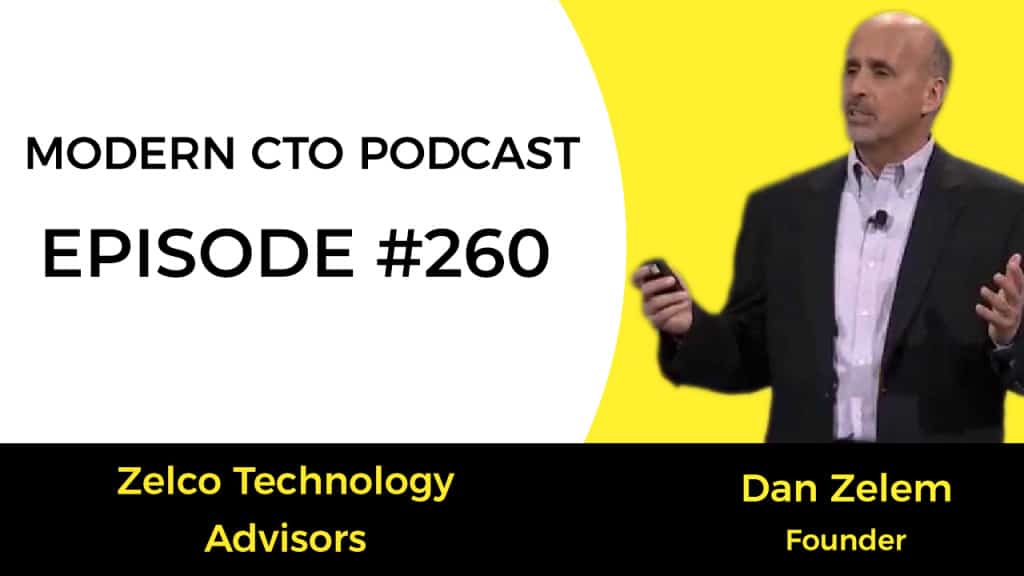
Dan Zelem - Founder at Zelco Technology Advisors
Today we are talking to Dan Zelem, the founder at Zelco Technology Advisors. And we discuss promoting the company’s vision in service of the customer, putting your people in a position to succeed, and focusing on the outcome to drive the business forward.
All of this, right here, right now, on the Modern CTO Podcast!
About Dan:
Daniel Zelem is the founder at Zelco Technology Advisors.
Prior to that, Zelem was the CIO of Mercy College. Before Mercy College, he was the CTO of Johnson & Johnson. Preceding J&J, Zelem served as SVP, Chief of Business Technology at Medco Health Solutions, Inc., where he was responsible for IT strategy and ongoing operations of the company’s vast technology assets. Zelem held a critical role in Medco’s international growth including joint ventures and acquisitions. He was a key contributor and thought-leader in delivering game-changing strategies to provide a competitive advantage to Medco and its clients.
During his nearly 20-year career with Medco, Zelem oversaw the implementation of an industry leading enterprise information warehouse platform, the launch of medco.com – the world’s largest online pharmacy, the Enterprise Image Service platform which enables Medco’s nationwide network of pharmacies to electronically process millions of mail-order prescriptions each year, and Medco’s enterprise IT Strategy and the modernization of IT assets.
Transcript
(Joel Beasley at 00:00:00) Today, we are talking to Dan Zelem and we discussed promoting your company's vision in service of the customer, putting your people in a position to succeed, and focusing on the outcome to drive the business forward. All of this right here, right now on the Modern CTO podcast.
(Dan Zelem at 00:00:20) Here we go.
(Joel Beasley at 00:00:21) This is the Modern CTO podcast. For me, dressed up is when I have—I don't think I ever wear a suit, but I'm trying—
(Dan Zelem at 00:00:39) To avoid it as much as possible.
(Joel Beasley at 00:00:43) What I consider my rebellion is I wear really high end sneaker shoes, right?
(Dan Zelem at 00:00:50) I see that's a thing now. Yeah, yeah, I see guys on TV doing that and it's like, wow, wearing sneakers now with suits. That's pretty cool.
(Joel Beasley at 00:00:59) Oh, I know. I was watching MasterChef and I saw one of the wealthy, stylish guys. He's wearing this really nice suit and then he had these bright sneakers that match.
(Dan Zelem at 00:01:11) I've seen a lot of people do that now. It's kind of—I'll have to give that a try because it's probably more comfortable than shoes.
(Joel Beasley at 00:01:18) Oh, I gave it a try. I did. The shoes are still expensive, so it's not like a price difference.
(Dan Zelem at 00:01:23) No, they're—yeah. The sneakers are comfortable. Yeah. What brand typically?
(Joel Beasley at 00:01:28) I've tried everything, but I'm interested in this new brand called On. They just came out and they look amazing.
(Dan Zelem at 00:01:41) O-N?
(Joel Beasley at 00:01:42) Yeah, but it looks like their logo almost looks like a crop circle. I was like, what is this? I was like, I want the crop circle shoes. He's like, you mean On? And I'm like, oh, that's what it is. Because they do the O and the N.
(Dan Zelem at 00:01:52) Strange. Yeah, it's cool.
(Joel Beasley at 00:01:54) This is the show, by the way. There's no intro. This is the welcome to the Modern CTO podcast. This is it.
(Dan Zelem at 00:02:01) That's great. That's great. Before I left Johnson & Johnson, we had a bunch of millennials who started a podcast internally within the company, and they did a good job. And it was all organic. And it was a great way to communicate in an informal setting and be able to share it broadly. So it was—I gave them a lot of credit, doing it on their own. They created their own channel and it started to take off. So yeah, that was pretty cool.
(Joel Beasley at 00:02:35) Was it about inside Johnson & Johnson, or what was that?
(Dan Zelem at 00:02:38) It was tech stuff that was happening. It was a way to—because in a big company, it's hard for everybody to know what the heck is going on. No matter what you do. And with a global company, it's even harder because you're dealing with thousands and thousands of miles away. And it's just a great way that they used it to—what are the cool things that people are doing? What is the CTO thinking? Sort of like this type of thing. What's on your mind? Topical, but it was really quite effective. It was good.
(Joel Beasley at 00:03:12) So how long were you at Johnson & Johnson? It was a while, right?
(Dan Zelem at 00:03:15) Five years. Yep. And then prior to that, I was with Medco for about twenty. So I've been in healthcare technology for thirty-some-odd years. And then prior to that, I was in banking for twelve.
(Joel Beasley at 00:03:29) Oh, at least you got out of there.
(Dan Zelem at 00:03:31) Yeah. Well, you know, for me, I was at Chemical Bank and the merger mania started. And I saw the writing on the wall and said, this is not gonna be good. So I started planning my exit. And I was so lucky to end up at a company like Medco, which was really a company that gave birth to an industry, the PBM industry. And to be part of that was just an amazing experience. That is really where I give credit to where I honed my craft and my skills.
(Joel Beasley at 00:04:06) What is the PBM industry?
(Dan Zelem at 00:04:07) That's the pharmacy benefit management industry. And they're a B2B company. When you work for a corporation, you have medical benefits, but you also have prescription benefits. And PBMs work on your behalf to negotiate drug pricing. But they do much more than that. They do clinical interventions. They do fulfillment of mail service prescriptions. If you have a chronic condition like diabetes or some other chronic condition where you're gonna be on medication for your entire life, you can get ninety-day prescriptions for the cost of a thirty-day retail. So they're a huge industry. They're kind of silent. They're kind of like an Intel Inside, but they deal with every major corporation, small business, Blue Cross plan, labor unions. And Medco was really a top tier one, and it was all driven by technology. And the thing about Medco that made it unique was the scale and the arrival rate and the intensity. We were connected to every retail pharmacy in the country, and we had our own network of pharmacies and call centers. So it was like the intersection of three companies—a custom service bureau, call centers, and sort of an early stage Amazon home delivery.
(Joel Beasley at 00:05:33) And this was in the nineties, early 2000s?
(Dan Zelem at 00:05:35) Yeah. I started there in the early nineties and they were a $2 billion company when I started. And when I left, they were a $70 billion company. And we were acquired by Merck and then we were divested by Merck. And so it was like working for three or four different companies. But it was a special place that brought really smart people together to do really amazing things. Most of it driven by technology and the business and the technology group were so intertwined. It was really a magical place, and I'm glad that I got that opportunity. It's really where I got to do a lot of cool things. But it was the type of place where you couldn't afford to screw up because if you did, you might kill someone.
(Joel Beasley at 00:06:22) Yeah. Or lose a billion dollars, right?
(Dan Zelem at 00:06:24) Yeah. And it was—
(Joel Beasley at 00:06:26) Oh yeah. Because if you give someone the wrong—if you dispatch the wrong—
(Dan Zelem at 00:06:29) Yeah. No, we had factories that were putting pills in bottles and putting them in bags and putting shipping labels on them and mailing them to people's homes. And then with the advent of the web, the heyday of e-commerce, we were the first ones to do prescription ordering of refills and renewals on the web. And that was just huge. That was huge. I mean, that was unheard of. And back then, there weren't a lot of tools. I mean, we had to hand craft things together to make the technology work. That was way before things like BroadVision and WebSphere and all those things. It was way before that. I mean, they came eventually, but we had to innovate to get that done and do it securely. And we had to convince—and I played a role in that too—going to clients and convincing them why they could trust us. Because we couldn't do it with their members unless they agreed to it. And I remember when we hit first 100,000 prescriptions, and by the time we left, we were doing millions and it was a $6 billion channel. People were ordering and renewing and doing customer service transactions. And the great thing about us that really differentiated us from everybody else is that our website was fully integrated with our back-end transaction system. So if you made an order on the web, you could drop that web connection, make a call and do an order status, get an answer, or call a customer service rep and get an answer in real time.
(Joel Beasley at 00:08:13) But this is in the nineties. So that's—
(Dan Zelem at 00:08:15) Yeah. This is like—yeah. This is incredible. And we were doing it with a mainframe.
(Joel Beasley at 00:08:21) Oh.
(Dan Zelem at 00:08:21) Yeah. This was a mainframe we were doing it with. And this was the day before RESTful APIs and all this other stuff. And we had—it was just phenomenal. We used IBM MQ Series to do that real-time connection with the mainframe. And it was incredible. It was incredible. That's just an example, though, of the type of stuff that we did. And to be part of that—you don't get many opportunities to do that. And so it was a special place. And then unfortunately, I thought I'd retire from there because I was there twenty years and we were killing it for years. But then a couple of things went the wrong way, and the next thing you know, we were doing a merger. And while it may have been called a merger, it wasn't a merger. We were being acquired by Express Scripts. And two very different companies, different values, different points of view.
(Joel Beasley at 00:09:24) How did they get an edge? Where did they get their white space? How did they get into that position?
(Dan Zelem at 00:09:29) Well, there were a couple of things in the marketplace that hit us. And the CEO had to make a decision like, are we gonna dig our way out of this? And there were a lot of people who wanted to do that. Or was the right time to sell high and move on and do the best thing you can for the shareholders? And that's really what happened.
(Joel Beasley at 00:09:46) Was it policy related?
(Dan Zelem at 00:09:50) There were some things in the press that hit us with clients. There were some big clients that we didn't win and others did win, and those all put pressure. When you look at your company—
(Joel Beasley at 00:10:02) When you look at a traded company.
(Dan Zelem at 00:10:04) Yeah. It's brutal. And so the winds were going down. They weren't—the wings, they're forcing down. And the fiduciary responsibility to your shareholders. And it was the right call. It was the right call because it would've taken a long time to dig our way out of that. And probably for the shareholders, including myself—I was one. But it wasn't easy. It was—and then I got to lead the fun charge of, okay, whose systems are we gonna use? And that was eleven months of really interesting conversations, especially when you're the one being acquired. But I'm proud to say that, as a result of that, all of our systems were chosen.
(Joel Beasley at 00:10:53) That's awesome. But they're not mainframes anymore, though.
(Dan Zelem at 00:10:57) Well, they still are. They still are in that industry. Yeah, they still are because it's all CICS. And underneath it all, it's all CICS COBOL. And you're not gonna replace that easily in any short amount of time, and it still works. And it's still highly performing. So it's surrounded by a bunch of distributed systems, but it's still mainframe. But things are moving off, but it's still mainframe driven. It's one of the industries that is still, I think, highly mainframe driven, but it is going to change. But that's a lot of code to move.
(Joel Beasley at 00:11:32) Oh yeah. Actually, this experience brings up—we keep questions in our documents that people ask us and say, hey, when you come across a person with this type of experience, ask these questions. And so I've got one that I think would be a good fit for you. Is that okay?
(Dan Zelem at 00:11:47) Yeah. Sure.
(Joel Beasley at 00:11:47) Alright. So this person's name is Alvin and he asked me—he said, I wanna hear from CTOs that have handled and survived critical technology inflection points, like beginning of the Internet, mobile apps, SaaS, the cloud. He says there's definitely a wave right now with the AI, ML technology, but it'd be interesting to hear about those who've gone through a major technical transition. Like, how did you evaluate it?
(Dan Zelem at 00:12:13) Yeah. So we certainly did that with cloud at J&J. And because everything's cloud and digital now and machine learning and digital is this big umbrella which covers everything. Half the people don't even know what they're talking about. What do you really mean by that? And the thing that I like to point out is that digital as a startup is a way different experience than digital in a large enterprise because you've got this base that you've gotta deal with. You've got these systems of record that really is where everything runs at the end of the day. And so when you start putting up Salesforce and you start putting up other types of digital things, ultimately, if you really want it to be end to end, you've gotta figure out a way how to harness and be able to coexist and leverage some of those legacy systems. And that's a major journey because building stuff on the edge is easy to do, but it becomes an island if you don't integrate it. And so that's one aspect of it. I think the other aspect of it—how do you survive that? For my experience, it was having a sound financial model that acts as a pull, not a push. Meaning that people see—we move to these digital technologies, we move to the cloud. There's agility and there's cost savings as well. And it acts as sort of a help, not only to help keep a scorecard of who's achieving the goals, but also that there's savings to be had there for moving away from physical assets into more of a digital space and virtual space. So leveraging financials, I think, is a key one. And I think the other side of it is whether it's digital or machine learning, any of these things, is having that relationship with the business that can really show them what good looks like and what the opportunities are to demonstrate value. And so you get that flywheel effect where you hit the inflection point and then it becomes self-sustaining. But there's a heavy lift to get from here to there. And I think a lot of that, particularly with enterprises, you've got a base of people who aren't necessarily modern day digital people. And how do you do the change management with those folks to get them moving to a higher level and to kind of retool their skills? And I think the third aspect is bringing in people who bring a different point of view. Like when I came to Johnson & Johnson, they had a long history with folks there. So I brought my perspective from Medco, which was a low margin business, operational excellence. We're gonna do it. We're not gonna try. We're gonna actually do it.
(Joel Beasley at 00:15:10) I love that mentality.
(Dan Zelem at 00:15:12) And we're not gonna fail. Right? As compared to a company like Johnson & Johnson—big margins. IT was not necessarily a differentiating factor in the company, more of a back office type of thing.
(Joel Beasley at 00:15:29) It could be, though.
(Dan Zelem at 00:15:31) It could be. And I'm proud to say that in the tenure that I was there, we turned the image internally and externally of the IT organization 360 degrees where we are thought of as thought leaders. And I had the opportunity to present at Amazon's re:Invent conference and tell a story.
(Joel Beasley at 00:15:52) Oh, you told a story?
(Dan Zelem at 00:15:54) Yeah, I told our journey. Talk—and that was at that time 15,000 people. I mean, it was just incredible.
(Dan Zelem at 00:16:04) And, you know, two years before that, we hadn't even begun. So it was just, man, it feels good. It was just an amazing, amazing story. And yeah, you know, it was one for the ages for sure.
(Dan Zelem at 00:16:20) And, you know, I told people at J&J too, man, this doesn't come along that often. Jump on board because, you know, you may not get these opportunities in your career to have that sort of impact and really be, you know, out in front of the industry. And we were. And we virtualized, you know, we went from very low rates of virtualization. We got up to like 80% virtualized our environment.
(Dan Zelem at 00:16:47) And, you know, these are old ERP platforms. You know, they're not these modern day platforms. And, you know, we had companies telling us that, no, you can't virtualize Oracle. You can't virtualize SAP. And we did it. That's amazing. We did it. You know?
(Joel Beasley at 00:17:08) Now with Amazon, I gotta ask because you presented—
(Dan Zelem at 00:17:12) No, this was on a private cloud. Right? So we had a hybrid cloud environment, you know, where we moved most of our assets to because we just weren't ready, and people are still not ready to move their systems of record necessarily to public cloud. Although I believe it will happen, but there's a lot of ground to be covered there with regulated industries.
(Joel Beasley at 00:17:37) Now I'm curious, are there 15,000 people in technology at the company, or are there 15,000 people at the company?
(Dan Zelem at 00:17:44) Oh, at Johnson & Johnson?
(Joel Beasley at 00:17:45) I don't know how big.
(Dan Zelem at 00:17:47) Oh, no. There are 130,000 people. Oh, wow.
(Joel Beasley at 00:17:49) So when you talk about 15,000, you're talking about that's just in technology.
(Dan Zelem at 00:17:53) No, no, no. That was the people at Amazon in the conference.
(Joel Beasley at 00:17:56) Oh, the crowd.
(Dan Zelem at 00:17:58) The crowd was 15,000.
(Joel Beasley at 00:18:00) Oh, okay. Alright.
(Dan Zelem at 00:18:01) And I was in the audience. They had another 10,000, you know, on the webcast.
(Joel Beasley at 00:18:05) I had a poster. It said, "Go, Dan."
(Dan Zelem at 00:18:11) And it was a great experience. So there's Jeff Bezos sitting right before me in the front row. That's amazing. Yeah. It was, and I have to tell you that, you know, working with AWS, you know, and we did a lot of things with them. We rolled out virtual desktops for them, like 25,000 of them. And they're my favorite technology company to work with because they were so passionate about the customer, and they let you in bed with their engineers to get stuff done. You know, you look at what I call now the old tech companies, you gotta go through layers and layers before you get to someone who actually knows what they're talking about. And it was just so refreshing, and the way that they operate the company, the way they think is really, really cool.
(Joel Beasley at 00:19:07) We do that over here because, you know, I've been writing code for 17 years. Right? And we have a platform and a product and all that stuff. So we have our engineers, they see the support tickets come through, they can respond to people. Everybody has like shared time when they're doing that, you know, some help desk concept. And that's because the most frustrating thing to me growing up in this industry was, you know, before payments were figured out by Stripe when you were having to build like tons of credit, like all these little things that are amazing now, is when I needed to interface with these organizations, it's like they put me to a salesperson, then a customer desk person, and then I have to get through the basic technical support, the advanced technical, and then finally someone who can just be like, uh, you need to—
(Dan Zelem at 00:19:53) Oh, yeah. That's it. You need to do this.
(Joel Beasley at 00:19:55) Over here. They didn't, somebody forgot to give you this key, so that's why you're getting rejected or like something super simple. Right.
(Dan Zelem at 00:20:01) It's a big frustration for many, many companies and individuals that have to deal with that. But, you know, we had a great relationship with them, and we did some creative things. And we influenced some of their products and actually made some of the product change because, you know, operating again as a startup, it's great. But when you're an enterprise, there's different things you gotta consider. And, you know, so it was a great working relationship, and we worked well with them.
(Joel Beasley at 00:20:33) And so today, like, now you're at a college.
(Dan Zelem at 00:20:38) Now I'm at a college.
(Joel Beasley at 00:20:39) You're at a medical college?
(Dan Zelem at 00:20:41) No, no, no, no. I was on the, I had a board seat here. So I was on the board of trustees. I was on it for about three or four years. And then when I decided to retire from J&J, you know, the chairman of the board of trustees asked me, hey, would you consider helping us out? And one thing led to another, and then here I am. And it, you know, it's the same issues, just lots smaller scale in terms of trying to get to, you know, moving off legacy platforms and being on digital. And really, you know, the challenge here is, though, you know, you have students coming in that have a very different perspective about how they wanna be served. And so, you know, moving the college to more of a self-service digital experience as, you know, like people are used to on, you know, doing everything on their phone or whatever, those are the types of things I'm working on now with the college.
(Joel Beasley at 00:21:45) That's me. You know, so I'm a big nerd. Right? So I like to study different things. And I got into this one class. Audible has these, like, long called the Great Courses. Have you heard of these?
(Dan Zelem at 00:21:59) Mm-hmm. Yeah. Yep. Yep.
(Joel Beasley at 00:22:00) So I found one on education, like the history of the education system and all of that. And it's interesting because back in the day, they would, the government would build a library and then people would come to learn, and it was to make the town smarter so they could make more money so they could have taxes. Right. And then they started teaching classes, and then we started to get this idea of school. And then when the British colony wanted to expand, they created the schools. But originally, it was like, the people who wanted to from the town could go into the library, start learning some stuff, improve themselves, create things, and they could just pick whatever they wanted, and then there were other people there they could start little groups with. But I see colleges as almost coming full circle to that, like, in the future, not maybe today, but with the way that the content and the courses and everything.
(Dan Zelem at 00:22:49) Oh, yeah. No, it's, you know, it's quite stark to see that, you know, there's certain professors today that are into new learning experiences and how people learn, but you have, you know, a lot still who wanna stand at a lecture and write on the board. But it is evolving though where, you know, active learning, things like that are making their way into the classroom. And, you know, that's one of the other things I'm focused on now is classroom tech. You know, what should be the tech inside the classroom that really facilitates the new way people learn, which a lot of it is about storytelling, right, and those types of things. And so we're, you know, we're actually, one of our major projects we're working on now, we're building out our Manhattan campus, right in Herald Square. We're gonna have a beautiful facility where we'll have students who can live there, as well as doing a big renovation of the space using the sort of modern views of what the furniture should look like, what the lighting should look like, what the classroom tech will look like. We're gonna use AV over IP to give us much more control over the environment. You know, one of the things I'm a huge advocate for, and I'm helping people here get to that, is it's gotta be simple. We struggle with people not coming to a classroom when they can't get this to work or that work, and they waste 20 minutes of classroom time trying to get the projectors to work. But my thing is, like, you know, you're not gonna train them. You've gotta make it intuitive. How do we create it where, you know, hey, we can push a button, everything starts up, and it works every time. And if they're having a problem, how do we reach out real time and reset the device for them versus calling the help desk or, you know, waiting for it. You know, everybody says, hey, why can't you have guys waiting outside the door? Well, that's not financially feasible. It will never fly. So, you know, putting that type of, you know, again, thing that I learned from Medco, a service-minded mentality. Right? I tell people all the time, if you were calling the company and you're inside your house and you got that experience, what would you do? Would you be happy with it? No. You wouldn't. You wouldn't take it. So why, you know, we as in technology, we're service provider. You know? At J&J, I was a $2 billion service provider. Right. You know? Because I ran shared services. And, you know, but that's what, you know, I learned at a company like Medco because we were a service company.
(Joel Beasley at 00:25:38) So was Medco your first job in technology?
(Dan Zelem at 00:25:41) No. I started as a programmer way back when. Oh, yeah? At Chemical Bank. Yeah. No, I was a programmer. Yep. I was on, remember mini computers? Yeah. You know, there was, you know, DEC had big mini computers, but I worked on a platform called Datapoint. I bet you don't know what that is. No. I don't. No. Yeah. Google it. Yeah. It was one of the early competitors to DEC who had that, you know, the VAX. And it was a BASIC programming language, basically. But yeah, you could do some neat things with it. But it was a mini computer that was developed by, they were out of Texas, I think. But yeah. And they were a hot thing for, you know, three or four years, and then Wang came along. And then, you know, this came along, and that came along, and they ceased to exist. But it was, you know, it's really where I first got the opportunity to program. And then I moved to the mainframe programming, and then I got into fourth generation language. You remember that? No. The database natural, that's another one. That was a fourth generation language that was, again, gonna make COBOL go away, which never happened. But then I got into analytics.
(Joel Beasley at 00:26:58) Gone. Yeah. I know.
(Dan Zelem at 00:26:59) It's still not gone. Then I got into analytics and data warehousing. I got, you know, worked in a Teradata platform with the bank.
(Joel Beasley at 00:27:05) Yeah. I know that. Yeah.
(Dan Zelem at 00:27:06) And then that's really where I came over to Medco was really to build out their information warehouse, which that was another huge success story for us. We built an integrated longitudinal database that, you know, you as a patient, we could look at your drug history across different companies that you work for, do all sorts of advanced analytics on it. And we actually got to create an information product that we offered to clients. And it helped Medco sell deals because back then, people couldn't get access directly to data. We gave them direct access to the raw detail and rolled it up on the fly.
(Joel Beasley at 00:27:49) Oh, you guys were, like, ahead of your time. I love it.
(Dan Zelem at 00:27:52) Yeah. I mean, yeah. We were in a lot of ways. And what today is a lot of that's common practice, but back then, it really wasn't. And no one else was doing it.
(Joel Beasley at 00:28:01) So when you first made the transition from programmer to, like, from being an individual contributor, right, just working on your own code in your team, to leading a team, your first team, where was that at?
(Dan Zelem at 00:28:15) That's at Chemical. You know, I very quickly advanced to be sort of a matrix lead. Okay. You know, my degree is in economics, and I kinda got into coding through mathematics. Mm-hmm. And so I did that, and I was interested in it. But for me, I've always been interested in the outcome more than, you know, being the guy who's coding in the bowels of the system. You know? And very quickly that emerged in my career where I was helping people drive the outcomes and interfacing with the business because I have the ability to kind of talk on both sides. I can go down very deep at a technical level, but I can also translate it into business. What does it really mean for business? What's the outcome? How do we know we're adding value? Right? Those types of things. Yeah. Like, because, you know, who cares if you develop something and no one uses it? Like, that doesn't mean anything. And so, you know, I very early on, I kinda migrated that way. But, you know, I also then went through stages where, you know, I became someone who managed large-scale infrastructure, and that really happened when we developed the website because we had no infrastructure. So literally had to build a team around managing a web infrastructure in DMZ. And, you know, so I'd learned how to manage that. And again, but I wasn't, you know, down to the bowels of operating system. But again, how do we create the value? How do we create, you know, something that's repeatable and scalable and is cost efficient?
(Joel Beasley at 00:29:50) So one of the things that we get a lot with the show is people, a good portion of our audience, about 30% of them, they're individual contributors wanting to move to become a team leader. Right?
(Dan Zelem at 00:30:02) Mm-hmm.
(Joel Beasley at 00:30:03) And so they're listening for tips and advice. So can you share some takeaways or story or some advice from your first opportunity as a leader running a team?
(Dan Zelem at 00:30:13) Well, I think the first thing, you know, it's about the business. Right? That's, it's about first and foremost, why are you there? You're not there just to be, you know, a coder. You're there to promote the company's mission and revenue and profitability and service of the customers. So that's, you know, and at Medco, we kinda told everyone in the group, yeah, you're a technologist, but most importantly, you're in the medical industry. And you have, you know, sort of a higher authority there. So what are you playing for is first. And I think the second thing is that, you know, demonstrate that you can deliver beyond just you. So, yeah, you can do stuff yourself. But have you got the experience and an opportunity, and seek those out where you got two or three people working with you and you drove the outcome? And then third is what I said is, you know, having that business acumen. Because if anybody wants to grow and become a technology executive, you've gotta have that business acumen. You've gotta have that presence to be able to, you know, talk in front of a group of executives who love technology and know how important it is, but they really don't understand it. And, you know, if you go in there and do a bunch of techno babble, they're gonna say, I don't know what that guy or gal is talking about, but get someone here who actually can translate it into something that's meaningful to us. And that's a real skill to be able to do that as well. And a lot of technical people grow up not having that. They don't, and they don't practice enough at it. You know, for me, I was lucky. It was kinda innate and, but, you know, I still had to practice it as well. And, you know, but—well, you can be inclined to do something.
(Joel Beasley at 00:32:14) But if you put effort at it, then persistence will be skill number one. Yeah, I mean, yeah.
(Dan Zellum at 00:32:21) Yep. And so, yeah, you know, I always tell people that you want opportunities. The best way to get that is, you know, opportunities always come up, and when someone in the room says, you know, "Who should we think about?" Is your name gonna pop up? Is your name gonna be in front of that list? Right? Because that's how it happens.
(Dan Zellum at 00:32:42) Yeah, you can apply for this and apply for that, but, you know, there's a line of people waiting outside that. You wanna be top of mind. Right? Because that's how it happens.
(Joel Beasley at 00:32:53) That's what... Look, we have a leadership company that came out of the podcast, and this is what we talk about so much. People say, "Oh, I've been here the longest. I got past stuff."
(Dan Zellum at 00:33:01) It doesn't mean anything.
(Joel Beasley at 00:33:02) I know. I'm like, "Look, in their mind, they don't think you can perform the job." Because if they were confident in your ability to perform the job, they would have considered you for the opportunity. But they don't feel confident.
(Dan Zellum at 00:33:14) Yeah.
(Joel Beasley at 00:33:15) You have to not only improve, but communicate your journey of improving to the stakeholders. You have to show them your skill.
(Dan Zellum at 00:33:22) Yep. And so, you know, that's what I tell people. And, you know, I was just talking to a young student here yesterday, and, you know, I told them that, you know, one of the mistakes that people make is they think someone else is responsible for their career. Yeah. And I told them, I said, "You know, if you hear nothing else in this conversation, you are responsible for your career, and you need to hold that in the center." Because, you know, there's gonna be a lot of stuff that comes your way, and things are gonna go wrong and things are gonna go right.
(Dan Zellum at 00:33:57) But, you know, that's what I've always fundamentally believed, that, you know, to the greatest extent that you can make things in your control, that's always gonna be a better outcome versus having stuff happen to you.
(Joel Beasley at 00:34:10) I heard that, and that's 100% correct. But I heard this myth of, like, there's these people that work at companies, and they believe the company is responsible for improving and growing them. And so I didn't believe that they existed, but then I ran into a bunch of them, and my mind was blown.
(Dan Zellum at 00:34:29) They exist. They exist. And, you know, maybe forty years ago, that may have been true, you know, in the old corporate world. It's no longer true. Yes, are they interested in your growth? Yeah, they are. But there's, you know, budgets for training and budgets for those types of things—they're thin. And what I've always found is the best way to grow is, you know, your own act of learning, which is a combination of what your company can offer, your own development, reading, research, and the biggest thing is doing, learning by doing.
(Dan Zellum at 00:35:09) And that's, you know, if you're not... it's a big mistake to think otherwise.
(Joel Beasley at 00:35:17) I love it. We are of the same tribe, my friend. I'm so glad that when I talk to you, and you're a person who's gone far and has continued to grow throughout their career and get to, you know, the top of these large industries, that you have these takeaways that are aligned with how I see the world, I guess.
(Dan Zellum at 00:35:37) Yeah. A lot of them are, you know, very practical. They're not, you know, they're not mind-blowing. They're very, you know, they're...
(Joel Beasley at 00:35:46) And they're rare nonetheless in action.
(Dan Zellum at 00:35:46) No, I guess that's true too.
(Joel Beasley at 00:35:47) I hear it in my Audible books. Every day I hear it from the successful people I listen to. That's one of the main reasons why I have this show, Dan, is because I like to be around people who think like I do. And I like to find people that not only from the books, but people I can actively engage in conversations with.
(Joel Beasley at 00:36:05) Yeah. That believe this stuff. It makes it more real.
(Dan Zellum at 00:36:09) You've found a person who believes it 100%. And, you know, I'm proud to say that, you know, over the course of my career, I got to show a lot of people who listened and took the advice, and they're now very successful in their own right. And, you know, by using some of these principles that, you know, were hard for them to accept at times. But for those who have, they've achieved, and it's helped them. So, for me, that's also been a very rewarding part of my journey is helping other people grow.
(Dan Zellum at 00:36:47) And, you know, a lot of that is, I call it pushing them to the front of the bus. Right? Who do you want in the front of your bus driving? You know? Because you have passengers all day long.
(Dan Zellum at 00:36:57) Yeah. You know? A lot of those people turn out to be like movie critics.
(Joel Beasley at 00:37:03) You know, they point out all the things that are wrong. They're not even paying attention to the road in front of them.
(Dan Zellum at 00:37:05) Yeah. And if you push people to the front of the bus and you get more drivers, everybody wins.
(Joel Beasley at 00:37:10) I like that analogy.
(Dan Zellum at 00:37:11) Right? Because as an executive, you know, you don't succeed if you don't have, you know, smart people around you.
(Joel Beasley at 00:37:18) So what... Tell me, one of the top qualities that stands out to you about someone who you would invest time into.
(Dan Zellum at 00:37:25) Well, first and foremost, they're willing to learn. Right? They're willing to, you know, really willing to learn. And they have an aptitude, so you can see that in that. But, you know, so often I believe everybody has a skill and a talent. And what I get the most joy out of is finding that hidden talent in people and growing it and putting them in situations where they have, "Well, I can't do that," and getting them in that situation and getting them to do that and giving them the support to do that. So for me, I've always just been good at being able to spot those people and putting them in the right opportunity and giving them the air cover, because that's important too.
(Joel Beasley at 00:38:11) Creating a space where they can...
(Dan Zellum at 00:38:13) Can succeed. Right. As well. And, you know, so it, again, it's aptitude. It's their ability to communicate, their willingness to learn, to have an open mind, just... And, you know, when I... So for me, it's a quick thing, though. Like, if I tell you and you choose not to do it, then, okay, then I'm gonna back away.
(Joel Beasley at 00:38:35) Yeah. I heard... I was listening to Oprah Winfrey give, like, a speech to a college, and she had this thing that stuck with me, like, really well, really strong, and she said, "Believe people the first time they show you who they are."
(Dan Zellum at 00:38:47) And I was like, "Woah."
(Joel Beasley at 00:38:48) I was like, "That's pretty good. That's pretty deep." Yeah.
(Dan Zellum at 00:38:51) Yeah. Yeah. Yeah. Absolutely. So it's, that's been a big part of what I've enjoyed in my career. And when I, you know, when I worked at Johnson & Johnson compared to Medco, I got to, you know, meet people across the globe. I mean, I've been to places I never thought I'd get to. And that was one of the things I enjoyed most about my job is experiencing different cultures and getting to know what motivates people in different cultures and really learning more about how they think. And how do you figure out how to get, you know, people across the globe to act as one?
(Joel Beasley at 00:39:29) Are you writing a book? Are you gonna write a book?
(Dan Zellum at 00:39:31) I don't know if I have the skills to do that. I could probably talk one, but I don't know if I could actually sit down and write one. But I certainly have enough material. That's for sure.
(Joel Beasley at 00:39:41) That's for sure. Alright. So tell me real quick as we wrap up, Dan, what are you most excited about today?
(Dan Zellum at 00:39:49) You know, I look at all the stuff that's happening around us with the, you know, things like autonomous systems, you know, just the pace of change, drones, you look at 5G, you know, all of the stuff that over the next years are gonna just, you know, be incredible. You know, robotics, you know, 3D printing, you know, printing, you know, body parts maybe. It's just mind-boggling. And, you know, the thing that, you know, I'm a big believer in sort of the concept of a platform. You know, the power of the cloud as a platform is just mind-blowing because it's made, you know, the engine sort of a commodity and has freed up the world to do these amazing things and have the scale and the power to do it that just weren't possible.
(Joel Beasley at 00:40:47) I love it.
(Dan Zellum at 00:40:48) It's just, it's, you know... So I'm, you know, I'm excited about it again, but it's not just the technology. It's the things that you can do. And if you look at health care, just to end there, the possibilities... I mean, that's why I love health care so much, because it's, you know, it's real. You're impacting people's lives. You're making a difference. And I look at the possibilities, you know, with, you know, body parts or, you know, sensors that could be implanted into the body. It's just incredible. So it's an exciting time, and I think it's gonna get even more exciting.
(Dan Zellum at 00:41:28) And I think the acceleration of the things that are capable and possible, you know, are just... they're just endless.
(Joel Beasley at 00:41:37) There's too many advancements in too many different areas. Like, you can pull up a video. They've got robots that are running and doing backflips. Pull up another video...
(Dan Zellum at 00:41:45) Yeah.
(Joel Beasley at 00:41:45) They have people who have hands with, like, bionic hands with, like, soft touch capabilities that feel like human hands. Yeah. The amount of stuff... Like, self... They're putting, like, learning and the gesture. It's like, everywhere you look, there's massive rapid advancements every six or twelve months. I'm like, we're in the next twenty years, we're gonna see phases. It's gonna be like fireworks. Yeah.
(Dan Zellum at 00:42:10) It's, it's pretty cool. But, you know, as, you know, the thing with these Max 8s, you also see the power of technology where it could become too sophisticated and people can't then... maybe, we don't know, they can't operate it.
(Joel Beasley at 00:42:25) It becomes so... Like, when AI starts making its own technology, humans won't be able to operate it.
(Dan Zellum at 00:42:31) Yeah. That becomes, you know, if you look at, you know, it's not far-fetched that, you know, the big issue there is that, you know, maybe in some of these evolving countries, pilots may not have been trained well enough to deal with what was happening to override the computer, if you will. Yeah. And you think about applying that to surgery, applying that to, you know, any other critical infrastructure. You know, it's sort of like the HAL thing. Right?
(Joel Beasley at 00:42:57) Yeah. Now we're into some Elon Musk territory. Yeah. Now we are. Humans... Humans are the biological bootloader to our AI overlords. Yeah.
(Dan Zellum at 00:43:10) Exactly. Right? So it's, yeah. You know, some of it's a little scary. You know? Some of it is filled with, you know, promise and amazing things that can be done, but then there's another side of it too. It's like, you know... How do we know it's right?
(Joel Beasley at 00:43:26) But when I... So when I was talking to Kevin Scott, who's the CTO of all of Microsoft, right? First CTO of the entire organization in twenty-three years. So I was having a conversation with him about this, and he brought some interesting perspective. He said, after he's analyzed it all, like, three-sixty around, right, he just has to choose an optimistic outlook. Like, there's no other way to go.
(Dan Zellum at 00:43:47) Right. That's probably true. I'd, you know... And I think I'm there as well, but I'm also, you know, I do have in the back of my mind...
(Joel Beasley at 00:43:55) It's the healthy skepticism. Right?
(Dan Zellum at 00:43:58) That's a good... Yeah. Yeah.
(Joel Beasley at 00:43:59) That's a good word for it. It's the balance. Yeah.
(Dan Zellum at 00:44:03) It is. And you need both. You need both.
(Joel Beasley at 00:44:05) Definitely need balance. Otherwise, it goes too far. Dan, this is fantastic. I am so incredibly grateful that you came on and...
(Dan Zellum at 00:44:16) Oh, no. My pleasure. Thank you for reaching out to me. I, you know, was like, "Wow. This is pretty good." Alright. Well, I appreciate the opportunity, and I'd love to keep in touch.
(Joel Beasley at 00:44:28) Yes. Awesome. Well, thank you so much, Dan. You have an excellent, excellent weekend.
(Dan Zellum at 00:44:31) You too. Take care.
(Joel Beasley at 00:44:35) Thank you so much for listening. And if you found this episode useful, please share it with a friend or colleague who you think would get value from it. And if you have topics that you'd like to hear discussed on the podcast, either add me on LinkedIn or send me an email: [email protected]. Every time I get an email or LinkedIn message, it absolutely makes my day and inspires me to keep going.