
Episode 255 ·
Gastón Milano - CTO at GeneXus
Today we are talking to Gastón Milano, the CTO at GeneXus. And we discuss how GeneXus is combining low code and AI to change the way applications are built, how Uruguay has become a thriving tech hub, and why working together is the best way to build trust over the long term.
All of this, right here, right now, on the Modern CTO Podcast!
Check them out now at Genexus.com
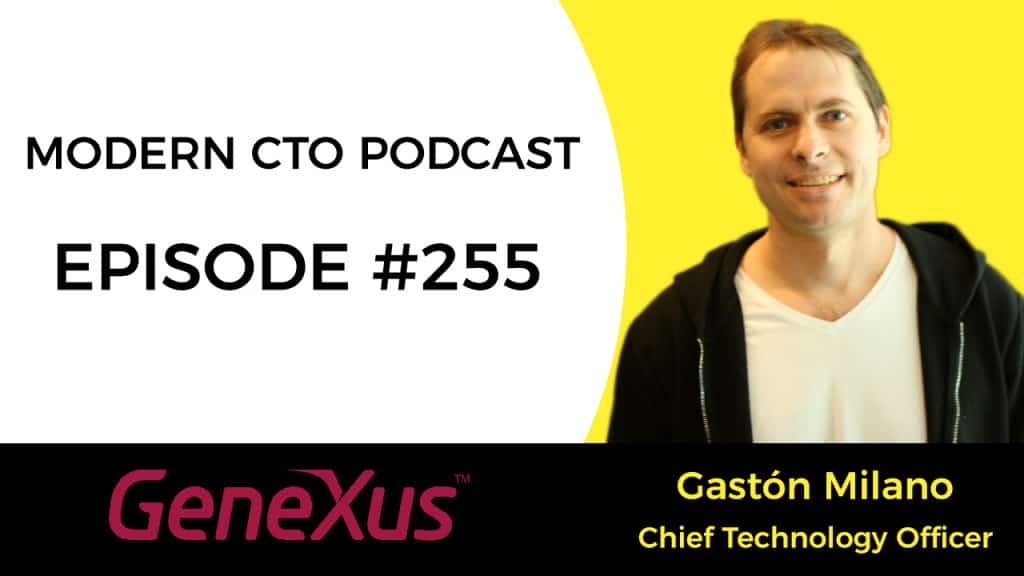
About Gastón:
Gastón Milano is a Systems Engineer formed by the Faculty of Engineering of the University of the Republic (Uruguay) specialized in Model-based Development and works since 1997 in GeneXus. It is CTO of GeneXus and conducts research in many areas of knowledge-based development as well as in the area of Human Computer Interaction and user experience. In addition Gaston is Professor of the University of the Company, Interaction Designer (Nielsen Norman Group) and local leader in Montevideo of Interaction Design Foundation.
In 2019 he was appointed as a member of the National Academy of Engineering of Uruguay.
About GeneXus:
GeneXus is a Uruguayan company that, based on in-house research, develops state-of-the-art proprietary technology in the fields of database design and maintenance, application development and maintenance, and, in particular, automatic knowledge management. Founded in 1988, the company is headquartered in Montevideo, has offices in the United States, Mexico and Brazil, and is present in more than 35 countries through its network of distributors.
GeneXus™ is the main product developed by GeneXus company. It's the first intelligent tool for automatically creating, developing and maintaining mission-critical, multi-platform applications that can be easily adapted to changes in the business and to the new possibilities opened by the evolution of technology.
Transcript
(Joel Beasley at 00:00:00) Hello, my friends. Today we are talking to Gaston, the CTO at GeneXus. We discuss how GeneXus is combining low-code and AI to change the way applications are built, how Uruguay has become a thriving tech hub, and why working together is the best way to build trust over the long term. All of this right here, right now on the Modern CTO Podcast. Here we go.
(Joel Beasley at 00:00:27) This is the Modern CTO Podcast.
(Gaston at 00:00:38) Hello. Hello. Hello, Joe. How are you?
(Joel Beasley at 00:00:41) Good, man.
(Gaston at 00:00:42) Nice to meet you.
(Joel Beasley at 00:00:43) I like your name. It reminds me of all the Disney movies we're watching lately with the kids.
(Gaston at 00:00:50) Okay, good. Yeah. Joe, here in Uruguay is not so common. So I can say to you that I like your name because it's not so common, but it's a nice name anyway.
(Joel Beasley at 00:01:06) Oh, thank you so much. I appreciate it. Look at that. We're like best friends now.
(Gaston at 00:01:11) Maybe because I was listening to you in several podcasts. I used to listen to a lot of podcasts, and I started listening to you. And there's many good cases of technology guys talking, and it was great for me.
(Joel Beasley at 00:01:29) Oh, perfect. Thank you. Yeah. That's what we try to do. Just, like, hang out and talk, not like a formal interview. Just set some context and hang out, because this is life, man. We're doing life, right?
(Gaston at 00:01:42) Yeah. Yeah. I was listening to one guy that was talking about Google Analytics, something like Google Analytics for the real world in terms of the physical one, the machine, IoT, and artificial intelligence. There were many good podcasts from you.
(Joel Beasley at 00:02:01) Thank you.
(Gaston at 00:02:01) It's a pleasure for me to be here.
(Joel Beasley at 00:02:04) Thank you. Well, it's a pleasure for me to get to talk with you. I'm curious to know, like, have you always been in love with technology, or did it happen after college? Like, when did you first get introduced to technology?
(Gaston at 00:02:16) Well, I came from a really poor family from here, from Uruguay. Luckily, here in Uruguay, there's a very strong public education with a lot of opportunities. Because of that, I stayed in contact with technology, learning Logo and Basic since I was, I don't know, 10 years old. And I was amazed by technology at those times. And I liked to play games, computer games from the beginning, from the Atari, TK-90, and all those eras. And yes, I was in touch with technology from the beginning. From my beginning, I know that there are other guys that started before. We here in Uruguay, there's a strong foundation of computer science because in 1975 when I was born, actually, the European University, public university, brought the first computer and started the first career in software engineering in Latin America. And so I think in that aspect, I was very lucky to be born here in Uruguay, this small country. We have more cows than people here in Uruguay. So, and Uruguay, even though Uruguay's main industries are livestock industry and agriculture, we started a new path from some, I don't know, believers on technology from the beginning from the 1970s. And actually, Nicolas and Breogan, the founders of GeneXus, they started the company, and it was the first company here in Uruguay that sold software outside of Uruguay in 1989. Okay? And they started with this idea of low-code that, like today is low-code, but at those times it didn't exist. They started in 1989. And I started in GeneXus more than 22 years ago, and it's my only work. It was GeneXus. And I think I was very lucky, and I did all my public education here in Uruguay, and I could travel the world with this education that we have. I think it's one of the things that in Uruguay is very strong.
(Joel Beasley at 00:05:00) Yeah. Yeah. You have a strong technology community there. I know because when I look at our podcast analytics, our downloads, Uruguay is always, it's definitely in the top 30 of, like, the cities or, I don't know which filter I was using, cities or countries, but it's always up there. And the reason why it first got on my radar is I met this guy about two or three years ago, right when we started doing the podcast, who was the developer for a point-of-sale system out in Uruguay. And he reached out and he was asking me, his name was Jer, and he asked me about like getting promoted. And so we had some conversations, we jumped on a call, and then he executed some of the tactics that we discussed, and then he actually got promoted. And so he made a video, and he did it on a rooftop in Uruguay. He made a video and he was like talking to me, like, hey, Joel. Thank you so much. And it was beautiful. Uruguay was beautiful.
(Gaston at 00:05:54) Yeah. Yeah. I think so. Yeah. Yeah. I totally agree with that. I had offers to work in many places during my career, and I really love to do things from Uruguay. Actually, we have several branches for our company in Japan and US and Brazil, Mexico, and different countries. I love to go there and see what's happening with our technology, but I love to be here. I like soccer. I really like soccer. That's one of the main reasons people know Uruguay. I like soccer. I like meats. I like all the traditions here in Uruguay. We have good beaches. We have four seasons, truly seasons here. So for people that like the summer, for people that like winter. So I would love to be here. That's it.
(Joel Beasley at 00:06:54) So why into technology? Why not pro soccer player?
(Gaston at 00:07:00) Well, no. Actually, I tried. Because I tried, and I failed with success. I truly tried. Actually, my oldest, one of my sons, I have three kids, and the oldest is trying to follow my path of soccer player. I tried. I actually was part of a startup that works around soccer ideas, but I was a bad player at all. It's just now it's a hobby at this time. But I truly like soccer in all the aspects of soccer. I think that being part of a team like a soccer team or could be a basketball team, I like basketball too. It gave me a lot of things that I'm using today. I think, I don't know if consciously or not, but I'm using, and here in Uruguay, when you are in a team, we have several expressions that are, okay, we need to go. We need to make this goal. We need to try to defend at this moment and try to have some kind of strategies. And the team, working in a team is very important. Trying to know several things around soccer, it gave me, actually, I read books from Barcelona and other teams that are amazing. The sample, Holland, other countries that did a change on the way of playing soccer, and that's amazing. The same for basketball. But in soccer, I think that there's a lot of things to learn.
(Joel Beasley at 00:08:49) What's something that you learned while playing team sports that has helped you be a good leader?
(Gaston at 00:08:56) Well, actually, the first thing is that it's difficult that you always do the goals, okay? You're just a part of a team. And even if you are a very good player, like could be Messi in a team, if you are not playing in coordination, with focus, with all aligned with the internal objective, it's quite difficult to be the world championship. Okay? Even if you are the best player, you are the best programmer. And the other thing that I learned is that every player has weaknesses and several good stuff to give to the team. So if we balance these weaknesses and the power of each player, you are going to reach the final goal. But with all people, with the internal motivation, with a focus, that basically is not just win a game. You need to win a championship. Okay? And there's the other thing that you learn is to lose. Because in soccer, you lose probably more games than you win. So it's quite complicated at the beginning when you are a kid to learn to lose several games. And you start losing games, and you start trying to know the advantages of this loss. Okay? And you always have a revenge, okay, in terms of a championship. Actually, last week, my kid lost the championship, the final. They had seen a final, and they lost. So it was a hard weekend, but at the same time, we have very lessons to learn on this weekend. Okay? And that's some of the lessons that we have from soccer.
(Joel Beasley at 00:11:16) I like that. I like what you said about it's not about necessarily winning the game. It's about having a mindset of how do you win the championship, which makes you adjust your perspective and come out and see the entire situation from the beginning to the end. And then I also really like how you discussed about how to lose well, right? Like how to understand the loss and use it as a strength to really understand it so that you don't repeat the same mistakes next time.
(Gaston at 00:11:47) Yeah, exactly right. It sounds very easy, but you can see today in the world that there's many people that don't know how to lose. That's yeah.
(Joel Beasley at 00:11:57) Yeah, I know.
(Gaston at 00:11:59) I don't want to be explicit on that, but there's many people that don't know how to lose. And another thing in Uruguay, from Uruguay, the soccer, in soccer is, like, in general, the teams have a goal that maybe is an utopia because, in general, thinking that a team like Uruguay with 3 million people can be the world championship, it sounds very complicated. But there's a chance. There's a chance to do that. Okay? And actually, Uruguay has two world championships. And in the last two championships, for example, in 2010, it was in the semifinal in the championship. It was amazing to see this happen, but just because all the people that were in this team were training and they were focusing on giving a little more than the rest of things without stars in the team.
(Joel Beasley at 00:13:07) And so did you say that there's only 3 million people in Uruguay?
(Gaston at 00:13:11) Yeah.
(Joel Beasley at 00:13:12) So why is it becoming such a big, yeah, not the exact number, we don't, it's not the clue. Why is it becoming such a tech hub?
(Gaston at 00:13:23) Well, I think that one of the third reason is that we are small. When you are small, you have several problems. At the beginning, you have several problems because we are in the middle of two countries like Brazil and Argentina. Okay? So, for example, your economy depends on them or depends on US or depends on China. So when you create systems in this challenging environment, you need to figure out some way to be flexible in the medium term because things are going to change for sure. Because you are not printing your money, for example. Okay? You depend on dollars or the currency. It's true that you have several dependencies. So first of all, people here create systems in a different way. And we can compete against, for example, China and other countries, not by showing a lot of people working together. We need to create new ways of creating software, for example. Okay? We can't compete with 100 people to create a system. We need to create, we have, for example, I don't know, three engineers. How to compete with that, with 100? Okay? So you need to imagine new ways. When you have constraints, you have new ways to do things. And probably this is a very good place to create new ideas. At the same time, as I said before, I think that having a strong education foundation in Uruguay is one of the keys to give these few people a good foundation of math and software engineering. Okay? From the beginning. Okay? For example, Uruguay is one of the first countries in the world to give one laptop per child. Okay? It's the first country, I think, to follow the ideas of Negroponte, of having one laptop per child. So this was done, I don't know, this time, I don't know exactly, about 10 years ago. So in Uruguay, each child has a laptop to do things. And many good things are happening because of that. But the same happened in 1975 when the first computer was introduced to the Republic University. So I think that this is like, everybody knows, but it's education. Education. Put all the balls in education. Obviously, there's other things after that to sync before. For example, Uruguay today is in the Digital Nine group. So we are very engaged with the open data movement. Our government is one of the most electronical governments, and we could do things like in now fighting with the coronavirus in Uruguay different from another country, for example. For example, we were the first country on releasing an application for, for example, for triage, the COVID-19 symptoms. Okay? And when you triage the symptoms and try to have some kind of category for the people here, at the end of the flow, a healthcare system is going to call you and have some conference with you. On the other side, you have, for example, in US, the Apple released an application that at the end of the flow, you need to call 911. Okay? That's the difference of a country that could be a full integration, probably because it's small. But we are a very good place to do experiments. For example, many people are calling us like Silicon Valley from South America because you, actually, in Uruguay, it's quite cheap to try things because we are 3 million. Okay? Actually, our application right now, more than 1 million people are using this application. That is almost all the active population in Uruguay. So there are many things like one laptop per child, you can do it here in Uruguay. There's many companies seeing Uruguay as a place to try many things. We are working on autonomous vehicles, et cetera. We have very good partnerships with Google, Apple, Microsoft, IBM here in Uruguay, with partnerships with different companies. That's, but what is the origin of all this? I think that is the education. And here, because we are small, we have very good trust and respect between public and private IT industry. Because of that, when somebody came here, for example, for the coronavirus strategy here, there were many companies from public and private industry working together. And at the first time, the methodology is just trust. Trust each other because we didn't have time to figure out what tool are we going to use. Are we going to use Google Apps or Microsoft Teams or Zoom? We just met together and started using Notepad as a way of synchronization and focusing. After that, we started evolving to tools, but we knew that everybody was going to use the best tool in each stage of this pandemic. But we have a very strong foundation of companies that trust each other. Okay? And we are very happy with many companies that are having very successfully working for Silicon Valley and other countries. I have several friends working in Google and Apple and other companies, very big companies around the world.
(Joel Beasley at 00:20:11) That makes sense why the technology scene is growing inside of Uruguay. If you have this country, this smaller country with, like, 3 million people, you're going to have a lot of camaraderie, like people wanting to get along and have success, especially with it being that size. And it's very smart how you prioritize education and give a laptop to every child. Right? That's brilliant.
(Joel Beasley at 00:20:35) And then I know you mentioned a lot about education being critical or important to the success and the growth. And then I see that you've done some teaching as well at the university. Do you feel like it's your responsibility to go help? And what are you teaching at university?
(Gaston at 00:20:54) We have several universities. We have a basically an education that is very generalist. Okay? It's not—you can have several specializations, but when you reach the university, that is public university—there's a public university and, obviously, there are some private ones. But you always have the possibility, like me, to reach the public university and grow in a public university. When you are there, it's very hard to reach the final of the career.
(Gaston at 00:21:37) There's a lot of math there. There's a lot of C that you are—they're trying to improve your computational thinking. Okay? They are very—there's very good teachers there that try to move forward people to work in difficult problems, and truly difficult problems around the world. Okay?
(Gaston at 00:22:09) There's, for example, now—we are, the university—I'm a teacher from one private university. I'm not from the public one. But the final projects in the university are amazing at this time. Okay? There's some—there's a partnership, for example, the public university with the MIT for some careers around artificial intelligence.
(Gaston at 00:22:36) There's products on—the third bits of the product came from some final project of university. And there's really good teachers from Uruguay and from other countries that came here to Uruguay. Well, at this time, they are remotely. But it's generally, for me, the university here in Uruguay is one of the stones where you can put all above, whatever you want, right now in this moment.
(Joel Beasley at 00:23:16) Can you give me an overview of what GeneXus does? And also, can you remind me? Did you say you've been at GeneXus for twenty-two years?
(Gaston at 00:23:26) Yeah. Wow. It's my only work.
(Joel Beasley at 00:23:28) That's amazing.
(Gaston at 00:23:30) Yeah. I actually—I'm part of several startups. Okay? Because GeneXus at some moment said, "Oh, okay. GeneXus has a vision." Okay? But there's many people working on GeneXus that in many cases, in some cases, they have other ideas. And GeneXus has a way to create a spin-off with them and try to move forward with these ideas in other orders. Because of that, GeneXus today is a great community of several companies. Some derived from GeneXus and some others collaborating with the GeneXus community. But what GeneXus does is basically try to—in some way, it's like a utopia.
(Gaston at 00:24:21) At the beginning, it was like a utopia. I think that because of that, I was in love with GeneXus because I used to like to believe things that few people believe in. That's because I think that if generally, in those areas, there's a lot of opportunities. Because if everybody's seeing some things, it's quite difficult to find something there.
(Gaston at 00:24:50) But if you look in a place that is dark, it seems like a utopia, you can find during the time, you can find your place and you can find that this idea, this crazy idea is not so crazy because you are collaborating to change. Probably, you walk two steps and the horizon moves two steps more. But this keeps you walking, okay, in some way. And so, GeneXus—to create software that makes software. Basically, software is helping any industry to move forward. Okay? Any industry except the software industry. Okay? You are—we are using software for whatever you want. Yes.
(Gaston at 00:25:42) I mean, the livestock industry, the retail industry—in every place, you are using software. But the only industry that is not using software is the software industry. This idea in 1989, it was obviously a crazy idea. And in 1989 to think about artificial intelligence when artificial intelligence was not what it is today—it was more crazy. For several years, when you say, "No, we want to use software to create software," and we didn't mention about artificial intelligence because they'd say, "Okay. These guys are crazy. I'm not going to listen to you." So the first way was the CASE tools, after rapid application development tools. And now we are not alone in this world, and we are calling this low-code tools, no-code tools with different strategies. But the idea, basically, our idea is to be a solution generator.
(Gaston at 00:26:53) We don't believe that a system creating—for example, here in Uruguay, we created three applications, native, mobile, and one for the call for the help desk system, workflow integrated with the health care system already there, in seven days. Okay? And if I tell this to any developer, they are going to say that this is impossible. But we did it. Okay?
(Gaston at 00:27:28) So we did it. And actually, Tim Cook and Sundar Pichai sent a note and said, "Okay, you did it." And how we did it? Nobody asked us that. We did it because people, obviously, first, because people first of all, because the trust and respect between all these companies. Because ideas, the ideas that we brought from South Korea, what they did, et cetera, et cetera.
(Gaston at 00:28:01) And we did it because in some part, GeneXus. Because we call—we have some kind of modeling of the reality of what we want instead of how. And GeneXus transforms that on technology. With GeneXus, in general, you can focus on the business, on what you want to create instead of how. Because the how is going to change during the time.
(Gaston at 00:28:30) Actually, we have been using the word, GeneXus is future-proofing you. Because in what we call a knowledge base of GeneXus, you specify what you want. I want a coffee, but I don't say to GeneXus how to reach this coffee. Because during the time, it's going to change. Maybe I want a coffee.
(Gaston at 00:28:57) Today is, "Mom, bring my coffee because I am 10 years old." Okay. Bring my coffee. Okay. But after 10 years, bring me a coffee—go to the kitchen and do it yourself. That's the how. So you need to focus on what. And the way of doing that is creating languages that are declarative. Declarative language that says what instead of how.
(Gaston at 00:29:31) Because what remains during the time in general. For example, we have one of the most important banking system core banking systems created with GeneXus that started generating—they specified what. And at the beginning, we were generating for an AS/400, IBM. We had a partnership with IBM. They were—we had a generator for an AS/400 generating for RPG. Generated the language. It was RPG to how. But now the same system with similar lines of code of the declarative language, they migrated to Android application, Java application for the core, and are hosted on containers or whatever they want. Okay? But the GeneXus remains the same in many modules. Because in our banking system, there's many tools, many things that remain the same during, yeah, twenty years.
(Gaston at 00:30:34) Because of this kind of things, it's because Japan is our main market for GeneXus because they believe in the future. They know they have a lot of problems. For example, in terms of that the average age for a programmer in Japan is 45 or more. Okay? So they have a problem there.
(Gaston at 00:30:59) And they already did. They already traversed the path of creating software, for example, in Java. And they told us, "We have spaghetti code here. And the knowledge of our company is in Java code." It's incredible to have the knowledge of all the companies around the world in code. Because how to evolve that? A bunch of people trying to convert to another technology. Well, our approach is like artificial intelligence at the beginning. To have a knowledge base where you declare what you want. Okay?
(Gaston at 00:31:37) And in each stage of technology, of the evolution of technology, move creation generators to bringing this knowledge to some platform. For example, okay, we have a Ruby generator or .NET generator. For example, people that are using GeneXus today, even when Microsoft changed from .NET Framework to the .NET—sync or .NET Core—they don't worry about that. Because GeneXus already has a generator that moves from the old technology to the new technology in the Microsoft world.
(Gaston at 00:32:14) The same for SAP. We have a generator for SAP. And if you are a programmer from the SAP world, you probably know that they are moving to a different world, moving from Business API to using Java and other technologies. And people would say, "Okay. But all my knowledge is in code, so I need to move my code." And this is quite difficult because the way that the code is programmed in general is a procedural way of programming. And so in procedural way, they have, for example, for the coffee, they say, "Mom, call your mom and go and call the coffee." And this is now is not more valid. So you need to change all your programming stuff behind scenes. So GeneXus, even though it seems like a utopia, is software that creates software for solving real-time applications in several industries, like health care, retail, and different industries. Here, for example, we applied for the coronavirus crisis here in Uruguay, but there's many customers from GeneXus that are using GeneXus in other industries.
(Joel Beasley at 00:33:33) That's pretty interesting because rewriting software is a huge expense, and it's a lot of time. So if you can define the goals that you need to achieve, and then as the technology changes, as the .NETs rewrite or SAPs rewrite, it's almost as if you're the team that makes sure all the plumbing is working so that the companies don't have to do massive rewrites of their applications. They can just focus on, like, the business logic part, and then you guys can be the translators.
(Gaston at 00:34:10) Exactly. Exactly. The problem with this approach—this is amazing to think and say, "Okay. This is going to work." We have several problems because during—in several universities around the world, we are not creating engineers. We are creating programmers in some aspect. Okay? That they want to use and I include the last programming language. So they say, "Why am I going to use this instead of my favorite programming language?"
(Gaston at 00:34:48) And Charles Simonyi said—Charles Simonyi, the creator of Excel said—this is because we are creating software programmers instead of software engineers. Because we need to do a jump on quality, the kind of quality of abstraction, start thinking on knowledge and how to this knowledge traverse the time. I don't know if the GeneXus knowledge base is going to remain one hundred years more. But I know that the knowledge of GeneXus was stored for more than thirty years and remains useful, and we can move many companies. I think that we are the only in this aspect in the world. Okay? People that create software thirty years ago that they can migrate without losing more than, I don't know, 90% of their code. Okay? Because always there's some aspect that you need any way to change. Okay?
(Gaston at 00:36:04) That's—we can't say 100% of conversion. But in general, when I say, for example, maybe some programmers say that this is just worse. But I say, just think—if I write in a phrase, "error if the stock is less than zero." Okay? This is different of writing a procedural code of writing an error.
(Gaston at 00:36:33) Because if you write like that, like, "error if" something—rules, declarative rules—when you are going to write to run in an Android, this rule means done after somebody asked for a number, you pop up a panel or something like that. But if you are running in a batch process, this means to write in a log a different thing. Because of that, something simple—we truly know that writing declarative code, and even in the low-code era now, everybody is saying, "Okay. Graphical stuff is amazing." We believe that there is a mix between graphical and textual code because text is the most basic communication for programmers.
(Gaston at 00:37:32) It's a tool for programming. I mean, you can—I can paste in your email and send you, "Look at this code." I can compare easily, et cetera. And sometimes, if I give you a figure, a picture, sometimes it's quite difficult to know when you start reading at the top, left top corner, at the right corner, or no—read in that way. With text, you don't have that problem. And so because of that, we are mixing when you say, "Okay. But how do you program in GeneXus?" You are programming in a mix of things. Obviously, to design a screen is a declarative language with the drag and drop, et cetera. But for rules, we have a declarative language.
(Joel Beasley at 00:38:24) I like it. That's interesting. It sounds like you guys have been working on this for over twenty-two years.
(Gaston at 00:38:32) Yeah. Yeah. More—me, I was working twenty-two years, but there's other guys that are more than me.
(Joel Beasley at 00:38:39) So do you think one of the strategies that Uruguay is doing right to get ahead as a country, if I'm taking notes, right, and I want to make America better, right, or make whatever country you're in better—note number one would be give every child a laptop. And number two would be to have those children start drinking coffee at a young age.
(Gaston at 00:39:08) It's great. Yeah. Actually, the second—let me change you the second point, the coffee one. Maybe the first one step is okay, but it's not enough. The second could be—could be start doing some kind of game-based learning for kids with those laptops. Okay? Here in Uruguay, we are traversing in public education to a program around Minecraft for education. Minecraft for education. That is truly amazing for me because in this pandemic, I was worried about my kid that was every day playing with Fortnite and Minecraft. Okay?
(Gaston at 00:40:01) That was the life. So I started trying to figure out if really it's so bad or not to have some kind of things in terms of game-based learning. And I started studying all the learning path of Minecraft. I now I'm convinced that having including game-based learning on the kids could change everything in the future of our generations. For example, for coronavirus, I was working in squads, okay, with people that I never met before. Okay? And at the same time, Facundo, that is my youngest guy, 10 years old, was playing with guys from any country with having a good communication, alignment, et cetera, in a squad for Fortnite. Okay? And Fortnite is amazing that in some ways, they are completely working remotely, and they are working with constraints because the storm is coming, so they need to move constantly, and they need to build stuff in order to have some kind of advantages. So I don't know if I'm crazy, but I say, "Okay.
(Gaston at 00:41:27) Facundo is having some aspects that are very important to work in teams because they need to—they need to align with their friends in the squad. They need to move to the safe zone. They need to know that there is going to be some storm out there that is going to come. That's it's a fact. Okay?
(Gaston at 00:41:52) They need to move because if not, it could be easy to others to shoot them. And when, you know, they have enough—final one-on-one on one—they need to build. Okay? So if you—it's the same they're trying to do when you are—some competitors, and what is the way of trying to survive. Try to build stuff.
(Gaston at 00:42:20) Don't worry about what the other guy is doing. Just build stuff and probably try to be in some aspect in this—try to move to the safe zone and try to build and try to move and create more teams, meet more guys that you don't know in order to have some kind of partnership to be bigger than you are. And in terms of Fortnite, in terms of Minecraft, he had several things that he already knows. For example, that they need to bring things in the backpack before going to mining. Put all the tools in the backpack in order to prepare to go to mining, to reach the materials they need to build other stuff.
(Gaston at 00:43:10) And I think in some way, in this analysis that I was thinking during the pandemic, in the isolation in my house, it's like, okay, here in Uruguay, we have several things in the backpack. We have several things like the education, healthcare system, IT industry. We already have in the backpack. There is no time when you are in a crisis. There is no time for improvisation. You need to say, okay, what I have in my backpack and go to fight. Okay? So if you need help or you don't have something in your backpack, ask another one, another guy to lend you something and go.
(Gaston at 00:43:56) And I think so. One laptop per child, game-based learning, and try to move the computational thinking on your kids, on your country. This is, I think, that is going to change everything, even not for IT. Computational thinking for everything. Okay?
(Gaston at 00:44:16) Try to don't be in fallacy. Don't talk fallacies. Try to remove the ways people are telling you things from the content of what they're saying to you. Okay? Try to trust people. Try to respect people. And on those, I'll trust and respect. And how to create trust and respect? The only thing that I know right now is doing things together. Okay?
(Gaston at 00:44:53) Now probably is the only thing. How to create trust? How I can trust you, Joel? Just doing, let's do something together. Because if not, probably we'll have some kind of engagement on this call. This is the first podcast. You now trust a bit more with me because we did it together. But probably if we want to trust more, we need to do more things together. Okay? And that's the only thing that always, for example, in this pandemic, I worked with many people in GeneXus that I never worked before. And I trust them more than before the pandemic, than before coronavirus.
(Gaston at 00:45:36) And in Uruguay, all the IT industry and the public industry trust each other more after the pandemic. This is a good thing after that, because we did things together. We did it together, so we trust more now.
(Joel Beasley at 00:45:53) I like how you said that so simply about creating trust and respect by doing something together. When I think about that, what goes through my mind is when I go around and do public talks, one of the biggest things I hear recurring regardless of country or anything like that is engineers talking about how their manager, they don't ever interact with them. They don't ever see them. They don't ever know where they are. Even when they were in offices, it's like this person that they just randomly check in with here and there, and they're not like a presence.
(Joel Beasley at 00:46:34) And then when I talk to leaders that I've gotten to go meet and I deem like great leaders, they are constantly doing things with their direct reports. And so I'm starting to pick up on that pattern that bad managers don't tend, like, it's not about doing the detailed work, right? It's about building the trust by doing something together. It doesn't mean you have to get in there and do the coding for them or that doesn't mean you have to be over-controlling or analytical of their work.
(Gaston at 00:47:06) Micromanagement, right.
(Joel Beasley at 00:47:07) Micromanagement. Yeah. It just means that you have to set up a routine to where it feels like you're all doing this together versus I'm going to come here on Monday, dump a bunch of instructions on you and leave. So that's what I see as a key difference between leaders who people really like and respect and admire and people who are just thinking like, I don't even know who they are.
(Gaston at 00:47:33) And in this practice, you learn a lot. You teach a lot and you learn a lot. During this pandemic, I learned a lot, and I tried to teach some stuff that we need to learn for some guys.
(Gaston at 00:47:59) But the other thing that is consequence of, I think that you can ask me, okay, in those, I don't know, three months that you were working in Coronavirus UY, I think that we could create this kind of system with GeneXus and other technologies because the humor. Okay? The humor to maintain the humor during those parts of programming. Okay?
(Gaston at 00:48:27) I say, okay, Gaston, look at what are you doing? Okay? Because many people think that because you are the CTO and you were a very good programmer, and you always are creating, in some moment I was a chief architect and I know many things. I know many things, but I'm not so intelligent like many people think. So they see your weaknesses.
(Gaston at 00:48:56) They see, okay, and this improves the communication a lot. Okay? And they know I always try to say, okay, I will hire people that can be my boss, and I'm proud of having this guy with me because I'm trying to learn a lot with them. I have an amazing team. Several times I'm in the conference and the papers. But in some aspect, I'm stealing a lot of ideas and things from other guys. And that's the only thing that I know how to move forward your company. I know that there's many companies like Netflix, et cetera, that has some culture that is in that way of having very high-performance teams where there's very without a great hierarchy, et cetera.
(Gaston at 00:50:00) We are following this path to be a small company.
(Joel Beasley at 00:50:05) What are citizen developers? I noticed that phrase coming up a couple times when I was reading about your company. Can you describe that for me?
(Gaston at 00:50:16) Yeah. Well, this is part of the main idea of that guides us to say, okay, that we would like that many people that are not available to create programs, that they can create programs. Actually, the best case, the best tool for citizen developer could be Excel. Excel is, okay, there's a lot of citizen developers there. It could be a problem during the time. But when we are calling citizen developers, we are thinking now at this time on people that know the business more than technology. Don't know more the business instead of having knowledge about C#, Node.js, or whatever technology is in the trend today. So the citizen developer wants to solve a problem.
(Gaston at 00:51:16) They want to solve one problem. So we are trying to create tools for these pragmatic programmers that probably they are very smart people in their domain. But there has some lack of knowledge in several technologies. Actually, I think that today, in general, the developers lack some skills in some aspects. Or you are an amazing developer that knows about security, scalability, the language that you are programming. That are probably, I don't know, three or four languages to learn. It's quite difficult to find this developer today, or you find it's very expensive for your company. So the citizen developers want solutions for some particular problems. We need to create tools for them because they are pragmatic and they want to solve a business problem. And we are in the path of creating a low-code tool. We have been working during all this time a low-code tool.
(Gaston at 00:52:30) That is different. There's a difference with a no-code tool, but they have some aspect in common. But we are trying to create tools for this citizen developer that not only they can create their solution, but they can, in addition to that, evolve and maintain that solution. Because today, it seems like in some moments there's a competence, there's a challenge between competitors and say, who is fast? With what tool I can create more easily and faster the solution? And that is just a piece of the problem.
(Gaston at 00:53:12) Because you need to think about what is going to happen with that in 20 years in the future. Probably the construction of software, it could be, I don't know, 30% of the time of the life cycle of a system. But the remaining time is evolution. The remaining time is maintenance. The remaining time is about more, including operational stuff for the system and not just creation time.
(Gaston at 00:53:48) So are you going to have the rock star of programming in your team in order to maintain with the last technology your system during 10 years? Probably it's quite difficult for several companies around the world. As I said before, some bank in Japan has no problem. They have very good Java developers. But Java is not trendy today. It's not, there's other tools that are more cool now. Who is going to maintain this system? And the programmers that you need to hire are quite complicated to reach. So they decide a different way. And they're inside this kind of bank, there are citizen developers that want to solve solutions around the banking system.
(Gaston at 00:54:47) That's another category that is the no-code that is more for small problems, in some aspect, like could be solved with an Excel spreadsheet or other tools. The problem with that that I am envisioning is the fragmentation of tooling that could be quite difficult in the future to move altogether to a cohesive view of your solution. That could be a problem to say, I don't know, everybody is releasing a no-code tool today. So in terms of strategy for a small company, it could be a solution in the short term, but quite difficult to evolve to a medium or long term.
(Joel Beasley at 00:55:33) That's interesting. So that's what makes you different is that your solution is a long-term solution.
(Gaston at 00:55:39) Exactly. We are in the low-code, or if you are saying we are no-code, low-code, we are low-code, and we are focusing on evolving complex systems. So in general, from small companies to big companies, but with the vision of evolving during the time and not just solving the problem today and having other problems in the future.
(Joel Beasley at 00:56:12) Amazing. That's so awesome. I want to start to wrap up here, but I've got a last question for you.
(Gaston at 00:56:18) Okay.
(Joel Beasley at 00:56:19) What are you learning right now as a leader?
(Gaston at 00:56:24) Well, difficult one, but very good question.
(Joel Beasley at 00:56:28) And you can choose. You can answer in English or your native language. It's fine.
(Gaston at 00:56:35) Okay. I prefer in Spanish, obviously, but if until here you understand me, that's good. Okay. I'm, this is very interesting for me because I'm returning to my first era. For example, previously to having all this social networks that you can imagine. Okay? I'm following a path of deep thinking. Okay? And I'm trying to, I'm trying to learn a lot from places like ResearchGate or ACM libraries. Trying to figure out what other people already review some facts. Okay?
(Gaston at 00:57:23) It's quite difficult today. Obviously, I follow the path of going to the main conferences around the world. I'm trying to avoid the vendor conference. I'm trying to see, like, conferences like QCon in San Francisco or Jakob Nielsen about UX. Okay? More than a vendor. Okay? Even I used to like to go, for example, to Microsoft TechEd or Google I/O. I just send other people to see those ideas and images of the world of those vendors and bring me those ideas and try to learn from them and mix them all together and try to see what's happened after you have a different view of the reality. And so I'm trying to learn right now from academic places that bring me other point of views.
(Gaston at 00:58:31) And I mix with the reality, and I try obviously to do, for example, different courses today in Coursera, et cetera. But in Coursera, I try to do deep thinking on what I want to be in each three months. Okay? Gaston is going to be a different person. And probably the books that I'm reading today is going to affect the Gaston that is going to be in three months.
(Gaston at 00:59:03) What kind of Gaston are you going to find? Okay? So I try to set some goals, like, I think it's very good to have goals on envisioning where you want to be, who you want to be instead of what you want to know. Because it's very, for me, it's being a trustable person, respectable person in terms of my family, my friends. It's more important than what I know. So that's what I'm learning. I'm learning from my kids. I'm learning from my family, and I try to mix with other things like just technology. I wanted, for me, I'm trying to grow, and I think that I was growing during this time because I changed my mind. I like soccer, and so I try to study soccer. I try to study things, like, internally, I feel that bring me to be a better person. So that's a quite complicated question.
(Gaston at 01:00:19) But in terms of technology, academic groups, W3C or ACM libraries, ResearchGate, et cetera. The vision of all my team that is incredible. We have learning courses internally in GeneXus, and I learn a lot there. And actually, what I want to be, I'm trying to learn from people that is near to me. My boss, Nicolás Jodal, they have amazing guys. All my friends here in GeneXus, they have several stories, wonderful stories. I learned a lot, and in my family, obviously. That's the, I think that the is the place I'm learning more. With my kids, I'm learning every day many things. And then I think that at the end of the day is what is going to remain from Gaston. It's some stuff from there.
(Joel Beasley at 01:01:23) I like that. No. You have some really good insight. I really like how you brought out you focus on goals of who you want to be versus what you want to know because that is just massively important. I hear so many talks, you know, back when we went to conferences, right? There's so many talks about like the tactics and all of these different skills. And one thing I haven't heard a talk on or someone speak about is the importance of like a solid foundation for your home life, like investing in your relationships at home to give you a foundation. And we talk so much about these other types of management skills or technical skills, but the reality is the thing that has one of the greatest impacts on your performance no matter what is your home life.
(Gaston at 01:02:13) Yeah. For sure. For sure. One of my heroes is in terms of some guys that has some many ideas that for me changed my mind as like Richard Feynman, for example. Okay? Because I'm very bad on knowing the name of the things, but I like to know how things work in my family, in the soccer, in the sport, in the country right now. I probably didn't know, I know nothing about the healthcare system before the pandemic. I know just a little. And now I realized that I grow on, because I met many people, and I like it to know how things work. And know the name of things, the acronyms or the last trendy stuff.
(Gaston at 01:03:13) Maybe because I am older than before and I start saying, okay, I want to start having a deep thinking and having a brainstorming with myself first before going and say, okay, hey guys, and try to create waves and all the stuff without knowing what is the objective of things. I changed it a lot just by having this kind of thinking. And I enjoy the process. And I hope I don't like people that meet you and say, oh, Gaston, you are the same that you are in the school. I don't like that because I'd say I changed a lot. You didn't notice? I suppose that it's because they say, I still trust you and I know that, but the expression is saying, okay, you are the same. No. I'm not the same. I am expecting to not to be other person next year, a better person, obviously. I want to be a better person for my family, first of all, and for obviously, by transition, like you said, it's you are going to be a better person for your company, for sure.
(Joel Beasley at 01:04:28) Yes. Thank you. Thank you so much. We made a podcast. How do you feel?
(Gaston at 01:04:34) Very well. Very well. You probably know that it's not my first language, the English. But anyway, I tried my best to do this.
(Joel Beasley at 01:04:46) Oh, you did great. Your English is great. Yeah.
(Gaston at 01:04:49) Thank you. Thank you very much. Thank you very much. No, I feel very good, very good.
(Gaston at 01:04:56) I talk a lot. I don't know if you understand everything, but I feel that you said that One Laptop per Child and coffee for the kids, and that's it. That's a good sum up.
(Joel Beasley at 01:05:09) Oh, I liked the coffee for the kids because—
(Gaston at 01:05:11) The guy, yeah. Yeah. Well, maybe it was maybe not the best sample, but yeah. Well, actually, I try to avoid the coffee every day, but no, I feel very well.
(Gaston at 01:05:28) So thank you for this time and for listening to me.
(Joel Beasley at 01:05:32) Thank you so much, Gaston. I really appreciate it.
(Gaston at 01:05:36) Thank you very much. See you.
(Joel Beasley at 01:05:37) See you. Have a great day. Thank you so much for listening. And if you found this episode useful, please share it with a friend or colleague that you think would get value from it. And if you have topics that you'd like to hear discussed on the podcast, either add me on LinkedIn or send me an email: [email protected]. Every time I get an email or LinkedIn message, it absolutely makes my day and inspires me to keep going.