
Episode 254 ·
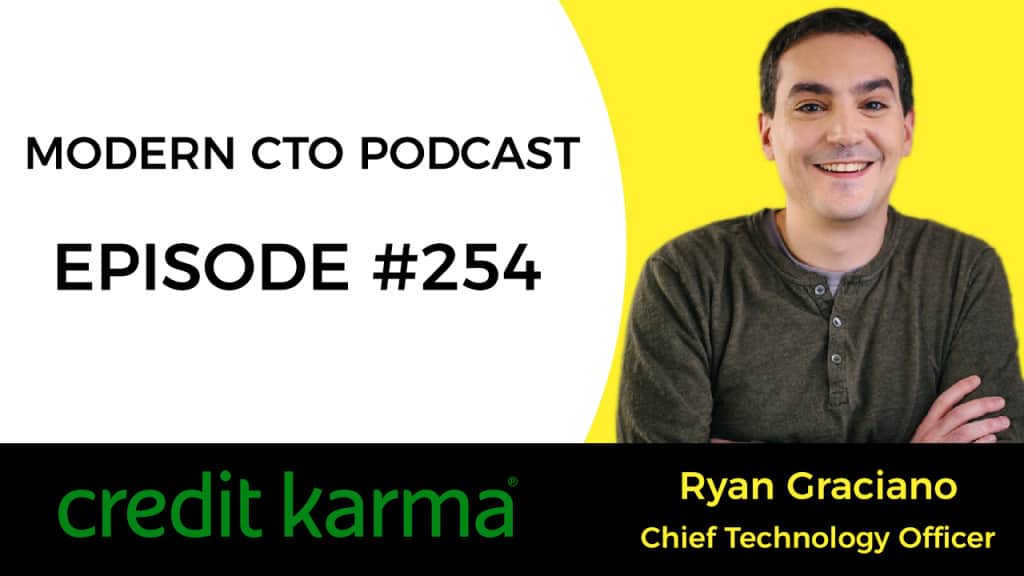
Ryan Graciano - CTO at Credit Karma
Today we are talking to Ryan, the Co-Founder and CTO at Credit Karma. And we discuss the toughest lessons learned after going through a hyper growth faze, their mission to make financial progress possible for everybody, and what to keep an eye out for as you scale values in your organization.
All of this, right here, right now, on the Modern CTO Podcast!
About Ryan:
I am a co-founder of Credit Karma, a company dedicated to re-engineering one of the largest industries in the world – consumer finance. Credit Karma’s mission is to help consumers have a better future by simplifying decision-making and management of personal credit and finances.
Credit Karma has scaled aggressively to become a major disruptor of the consumer finance industry, today valued in the billions with above 50 million members. As Chief Technology Officer, I designed the engineering framework and organization to support this growth. I manage a team that has grown from just me, to now include hundreds of engineers and counting. 1366 1024
Prior to joining Credit Karma, I worked for a small company that was acquired by IBM, where I subsequently spent a few years on search engines and enterprise software. I have a Bachelors degree in Computer Science from the Georgia Institute of Technology, a background in scalable systems and networks, and a lifelong passion for computer code and security.
About Credit Karma:
Credit Karma is focused on championing financial progress for over 100 million members in the U.S., Canada and U.K. While we're best known for pioneering free credit scores, our members turn to us for resources as they work toward their financial goals. This includes tools for credit and identity monitoring, credit card recommendations, shopping for loans (car, home and personal), growing their savings* and filing their taxes with Credit Karma Tax -- all for free. We’ve grown significantly through the years, adding more than 70 million members in the last five alone. We currently have more than 1,300 employees spread across offices in San Francisco, Charlotte, Los Angeles, Leeds, London and one coming soon to Oakland. Disrupting the financial industry is not an easy task. That’s why we know it’s one worth doing.
Transcript
(Joel Beasley at 00:00:00) Hello, my friends. Today we are talking to Ryan, the cofounder and CTO at Credit Karma, and we discuss the toughest lessons learned after going through a hypergrowth phase, their mission to make financial progress possible for everybody, and what to keep an eye out for as you scale values within your organization. All of this right here, right now on the Modern CTO Podcast. Here we go. This is the Modern CTO Podcast.
(Joel Beasley at 00:00:37) Super pumped up to be hanging out and talking with you today. And you're one of the founders of it, right?
(Ryan Graciano at 00:00:42) Yeah, I've been here for thirteen years, crazy enough. Thirteen and a half now, I guess.
(Joel Beasley at 00:00:48) What was life like leading up to Credit Karma? Before Credit Karma?
(Ryan Graciano at 00:00:52) So before Credit Karma, I graduated school in 2004 with a computer science degree, and I went to work for this really small company called Venetica. It was 60-person B2B. They made software that connected banks. It was the kind of software where you'd have one customer at a bank that actually used your product, but they paid you a ton of money. And I was really sold on the small company lifestyle, make a big impact and that kind of thing.
(Ryan Graciano at 00:01:21) And I was there for, I don't know, three weeks maybe, and they announced we're being acquired by IBM. So I joined 330,000-person IBM. I was in software there for a few years, and I decided that it just really wasn't for me. The giant company lifestyle, kind of feeling like I'm a very small part of this thing, and the type of software—not many people actually use it, sort of obscure, can't really explain what it does to anybody. And so, yeah, I decided I needed to find something else.
(Joel Beasley at 00:01:57) Now, did you do programming before college and before those first projects? When did you start writing code?
(Ryan Graciano at 00:02:04) Yeah, I was a hobbyist. I picked it up as a kid. I had the Tandy 1000, if you remember that computer. It was everything. I had a neighbor who was a little bit older, and he learned GW-BASIC. And he showed up and showed me how to draw a circle in GW-BASIC, and I was blown away that you could make the computer do something. It's just, that was sort of a revelation, because you sort of imagine these things being developed by all these smart people in a laboratory somewhere with special equipment. And I was like, it's really that easy? You could just type some stuff in and make the computer do things?
(Ryan Graciano at 00:02:48) And so then, all through junior high and high school, I spent a ton of time trying to figure out what makes the computer work. And that was right around the dawn of the modern internet, when the web started to become a thing. Because when I began, it was Gopher—Gopher and Usenet. But when the web came around right around that time, and Java came out, that's when I started to get into networking. And, you know, now it's not just making the computer do something. You can get people to connect. And that notion was so cool to me, that you could create programs to talk to other programs and actual people would use them. And so that's what really got me into it.
(Joel Beasley at 00:03:29) What type of programs were you building that were connecting and talking to others?
(Ryan Graciano at 00:03:34) So I did a lot of gaming stuff, because I played a lot of games back then. And then I was really into computer security, so I spent a lot of time trying to write exploits and figure out how to break stuff. I just thought that was a neat, a really weird and obscure aspect of programming, I guess, back then. But it was fun.
(Joel Beasley at 00:03:56) No, I totally get it. I had a downstairs computer that my sisters would use, and I was upstairs in my room, and I spent a whole summer trying to figure out how to hack that computer or gain access to it. And it was just so much fun. It was almost addictive. And then luckily when paid projects came up, they were business logic type softwares for organizations. So that's where I ended up making money, and I didn't get too lost in the security stuff for too long.
(Ryan Graciano at 00:04:28) Yeah, it can be a pretty deep rabbit hole. It can go on forever. I liked it a lot also because you would have to learn a lot about how your operating system worked or how this networking protocol worked to actually be effective. And that was sort of the fun of it. I think it was the journey to the end goal, whatever the end goal was.
(Joel Beasley at 00:04:50) So at what point were you like, I need to found Credit Karma?
(Ryan Graciano at 00:04:55) It was never quite like that. It was much more like, you know, I don't know what I want to do. My last job at IBM, I had this manager who, I was hunting teams, and he came to me and said, you know, if you just join my team, you can just do whatever you want. I won't give you any goals. There's no projects. Just be on this team and come up with stuff to do, and that could be your job.
(Ryan Graciano at 00:05:22) And I thought that was going to be the best job. My 24-year-old self thought that this was the perfect job. And I just hated it. I took that job and I hated it so much. It was boring to not have anybody really invested in what you're doing or, you know, to be this island unto yourself.
(Ryan Graciano at 00:05:43) And so I thought, hey, okay, I kind of want the opposite of this. I want something that's really high pressure, really small. The people that I'm working with really care about what I'm doing. And so I was talking to this guy, Greg Lowell, who's our now chief marketing officer at Credit Karma. And he was at a search engine marketing firm that was super small. And our CEO today, Ken Lin and founder, he was actually CEO of that search engine marketing firm. And Greg said, hey, I think you should check this out. This is a fun business. We need a technology leader. And I talked to him, and he referred me to Ken. And Ken said, no, this business is never going to scale. I have a much better idea. So he pitched me on Credit Karma. And it sounded exactly like what I wanted, you know, super high impact, lots of people, crazy pressure, not much money. And I just thought that it would be the exact opposite of what I was doing.
(Joel Beasley at 00:06:46) I get what you mean, though. I've never had somebody offer me a job exactly like that, right, where you come in and do whatever you want. But if you don't have people that need you, if you don't feel like you're valuable and useful to others, I mean, at least for me personally, that's a very strong driver for me. I need to feel that I'm very useful to others and that I'm achieving my potential as far as helping other people.
(Ryan Graciano at 00:07:11) And I was surprised to discover that, honestly, because I thought that I'd be the kind of person who wouldn't mind just kind of toiling away in research and operating to my own ends and, you know, being a one-man show. But it turned out to really not be true. I started to realize maybe it was the connecting people and the impact that I had and all those experimentations in high school that I really enjoyed, and not just the tinkering away.
(Joel Beasley at 00:07:39) Yeah, it's like when people ask, after you have so much success founding a very large company, it's like, why don't you quit or why don't you just go do something else? And it's like, well, because you love it and it's fun.
(Ryan Graciano at 00:07:53) Yeah, I get asked that a lot. What would you do or what would we do when it's all over? I don't know. I didn't really set out to do this. I was looking for a feeling and an impact, and I just kept hunting until I found it.
(Joel Beasley at 00:08:09) Well, that's good because you're learning to navigate, right? And it's clearly working for you. And so, you know, as Credit Karma goes on, I'm sure you'll just naturally gravitate towards other interesting problems. I'm sure you're doing it inside of Credit Karma every single day. And I guess the only difference would be the logo on the background. We're here—I would say building, but no one's going into buildings anymore.
(Ryan Graciano at 00:08:38) Yeah. I told a story once at an all hands about my grandfather who had started his own business years and years ago and was successful. And he would go into the office every day until he was—I think his last day was when he was 88, when he finally stopped going in. But he kept that office long after he'd transitioned the business to his sons. And I actually, as a kid, I asked my parents, like, why? He could retire. He has lots of money. He could do whatever he wants. And the answer is simple. It's just like, this is what he wants to do. This is the thing that he loves. He didn't just do it to make money and be successful. He did it because he enjoys it, and he still enjoys it. And so why would he stop? And I actually think it's one of the things that kept him—up until his nineties, he was very sharp. And I actually think it was because he never disconnected. He stayed connected to what he enjoyed his whole life.
(Joel Beasley at 00:09:40) That's important. That's what you find with aging: the people who are still doing what they love and still have a reason to get up, they tend to live a lot longer than the person who retires and has nothing to do, and they just pass away a lot faster.
(Ryan Graciano at 00:09:54) Yeah. I think we all need something. You can't—we're not built to just hang out.
(Joel Beasley at 00:10:00) So what's Credit Karma's long-term vision?
(Ryan Graciano at 00:10:04) Well, the long-term vision, if you think about just what finance is like right now, it's very fragmented. It's very manual, and it's not very consumer-oriented. So what I think finance could be like is much more oriented around: What are you trying to accomplish? What are your goals? What are you long-term trying to achieve and short-term trying to achieve? And a lot of the decisions that you need to make along the way boil down to basic math and kind of a flowchart of options that you just need a lot of information to navigate. And current products require you to know all of that. A lot of existing financial products are like, hey, read these ten articles and then look at our menu of loan options and figure that out.
(Ryan Graciano at 00:10:55) The future of Credit Karma, I believe, is one where we know you want to buy a house and we can actually automate much of that process for you, from the saving up for the down payment to the application and approval and then managing your equity. A lot of that stuff we could just do. And rather than making you read it all beforehand, we could actually just be informing along the way like an advisor would. You know, hey, this is what we're doing. This is why we're doing it. And it's possible if you can interconnect all these different back-end services that have never really been—no one's really attempted ever even to connect them in the way that we have.
(Joel Beasley at 00:11:37) So you guys are going to get into the home mortgage type business? Or are you already there?
(Ryan Graciano at 00:11:44) So we actually are already—yeah, we're in home and mortgage, and we're building those product lines out. We've recently brought out our first products in the asset space. So savings and checking accounts. And, you know, combining that with our ability to pre-approve you for so many products, now we can start to do things like, hey, we're just looking at what your situation is and what your profile is, and we think you should move money over here. And we can actually just do it for you. So you could just click confirm. And so we can move you to a much more automated financial position to where, you know, wealthy people have a financial advisor or manager that does this stuff for them. Why can't everybody have that? Because a lot of it boils down to what a machine learning system can figure out for you as long as it knows what you're trying to do.
(Joel Beasley at 00:12:32) Yeah. I listen to Ray Dalio a lot, and he talks a lot about how the algorithms are just things that humans are already doing and then they translate it into code. And then that's how they're able to scale their services, one of the largest hedge funds in the world.
(Ryan Graciano at 00:12:49) A lot of things are like that because we've all just figured out the algorithm and we're running it in our heads, but a little slower than what a computer could do.
(Joel Beasley at 00:12:59) Right. And our memory is constantly degrading, one bit per neuron per second, right? And that's the mathematical formula for memory degradation.
(Ryan Graciano at 00:13:10) I've actually never heard that. That's interesting.
(Joel Beasley at 00:13:13) And it's called the forgetting curve. So the basis of it is—I saw a TED Talk on it—and they'll show you different types of media, how you consume it. And if you watch somebody give a one-hour speech, in two weeks, how much you remember, or in one hour, how much you remember, a week, two weeks, a month. And so that's how I actually got the idea of how to design the talks. I did a bunch of talks last year before COVID, and it's basically I designed the entire talk around the one to two things they will remember in three months after hearing me speak. And then I just hammer that point in different ways from every different angle. So I'm not giving them a numerous amount of examples and things that are all connected to different points. I'm just constantly reinforcing these two points I want them to walk away with.
(Ryan Graciano at 00:13:59) That's interesting. Yeah. I wonder how much of that is retention and storage versus recall. And, you know, what's actually in there? Is it the data that's degrading or our ability to find the data? Computers have neither problem.
(Joel Beasley at 00:14:13) I know. I mean, on a long-term time scale, they—I mean, don't hard drives fail after ten, fifteen years? So, I mean—
(Ryan Graciano at 00:14:21) I kind of have it a little bit. Yeah. The actual physical media can degrade, but we figured out how to make that redundant.
(Joel Beasley at 00:14:29) Because you're in the financial world now, and before you weren't as much—in fact, the job before, you said you had unlimited creativity to do whatever you wanted. Now you're in the financial space and there's regulation. I know you've been in here for over ten years, but how do you feel—my background is software engineering—so how do you feel with all the regulation? Did that hinder you as a programmer? Did it bother you? Was it warmly accepted?
(Ryan Graciano at 00:14:59) Warmly accepted is sort of a funny few—regulated people would say warmly accepted in any industry, probably. But there are good aspects to the regulation. I mean, preventing discrimination, for example, I think is a really important thing that regulation does. And in this space in particular, there can be some really big downsides to an unregulated industry. So regulation is definitely necessary, but it does make your job harder in a lot of cases because it's imperfect by its very nature. So often you're trying to do something that's completely within the spirit of the law, but it's technically not aligned with the law. And so you're figuring out, okay, well, what does that mean? What do I actually have to do? And a story that I'll tell is, I knew a company that was working in the mortgage space, and they were working with legacy providers that wouldn't accept—what was it—it was a PDF because they thought that a PDF could be, or it was an image.
(Ryan Graciano at 00:16:03) They thought that an image could be doctored, but a PDF couldn't be doctored. And of course, that's not true. And so they tried to explain that it's not true, but the rules are the rules, and there's not even a way to appeal that. And so what they had to do is spend months on converting images to PDFs in a way that made them look like scans because they would only accept a PDF that looked like it came from a scanner. And they actually ended up putting out a patent and a white paper on how to do this.
(Ryan Graciano at 00:16:34) It's so far afield of what their company did, which was just automate the mortgage process. But, you know, it's because once these laws are written and these rules are in place, there may have been a good reason at the time. But it's very hard to change them once they're out there, and they can really stifle innovation.
(Joel Beasley at 00:16:55) That's crazy. That's so funny. I could just see us at that meeting figuring out how to make the image look like a scan and building that system and then just batch processing all of them.
(Ryan Graciano at 00:17:08) That's exactly what they did. And, you know, it worked. And all of their scans were accepted.
(Joel Beasley at 00:17:16) So where are you spending a lot of your time today? Because you started out—were you the first engineer or one of the first engineers?
(Ryan Graciano at 00:17:24) I was the first engineer, yeah, in 2007 at the height of the peak.
(Joel Beasley at 00:17:29) So the responsibilities change a lot, right? You're doing very different things today. Can you tell me about how you're spending your time today?
(Ryan Graciano at 00:17:37) Quite different today. So today I've very much gone up the management track, not the technical road. And so I'm over about, jeez, 800-something people. And I run our engineering, security, data, and actually our core products organizations as well as functions like analytics. And so I'm much more of an executive level manager than I am an engineer nowadays.
(Ryan Graciano at 00:18:04) Although, I often like to say that they can draw on the same parts of the brain. You know, in the beginning, you're thinking a lot about systems and putting stuff together. And then in the middle of your progression and middle management, you're thinking, how do I work with people and learning people and the kind of direct interaction? And then when you take another step up, it's actually kind of back to the systems side again because now you're thinking, okay, well, how does this system of people work with this system of people?
(Ryan Graciano at 00:18:33) And how do I structure incentives to make things work in the same way that I would create an objective function for an algorithm? And I don't know, you know, I can't predict what the machine learning system will do. But if I set up the right incentives and the right parameters, you know, I'll have faith that will drive towards that outcome. And so it's funny, I think, how the beginning and the end are kind of similar in a way, but the middle was very different.
(Joel Beasley at 00:19:00) I like how you gave that visualization of you can create the environment and direct the incentives to achieve the outcome. Because it's funny, as I'm thinking about it as you're speaking, you can drive yourself mad exploring these architect types or building these types of systems of people on people. But after you go through it enough, you realize that the only thing you can do is just align the incentives the best possible way and then let it run and then watch it and then watch what happens and then make corrections as necessary. Something I got hung up on previously was just trying to predict what would happen with certainty. And then you mentioned the concept of faith. You're right.
(Joel Beasley at 00:19:39) You just have to align these incentives, have some faith, and then let some time pass.
(Ryan Graciano at 00:19:43) Yeah. And I think that's exactly right. And sort of your function as an executive leader then is you kind of are the objective function. You're stewarding over the whole thing and making sure that the outcome is actually what you were intending it to be and manipulating the system such that it's going to keep driving in the way that you want. And what I think is interesting about organizations in this job is, you know, you might set up one optimization, you're moving in one direction, and then you'll necessarily move away from something else.
(Ryan Graciano at 00:20:14) And so there's sort of a grooming that has to happen where you're kind of, you know, you go this way for a while and then you have to change things to move this direction for a while so that you can take the center course overall. But there might be no easy way to actually structure the center course, you know, off the bat.
(Joel Beasley at 00:20:32) So what type of lessons are you learning today? What's going on from a leadership perspective that you're growing in today?
(Ryan Graciano at 00:20:43) So, well, things like this. What is very different about executive leadership is there's a lot more public speaking, a lot more getting out in front of a lot of people. And so that part is very different than the systems part. It's almost like politics more than it is like engineering, which is, you know, that's definitely a learning curve. So, you know, I'm always trying to improve and get better at that.
(Ryan Graciano at 00:21:12) And that's definitely something I'm learning. And then, of course, right now we're working on our acquisition with Intuit. And so we had announced that that was in process earlier this year. And so just, you know, thinking through how to lead the company through change and making sure that I'm doing a good job there is something that I've been working on.
(Joel Beasley at 00:21:35) So what do you tactically do? Is it just communication with your team about the process and reassurance, things like that?
(Ryan Graciano at 00:21:44) Yeah. I think in this kind of stage, a lot of it is communication and what type of communication and expectation setting and how are you actually going to structure the whole thing so that people can get confidence in what their future might be. Because when you announced back in February or so, and it's November and we're not quite closed yet, that's a period of uncertainty for everybody on the team. And so, you know, riding through uncertainty is tough.
(Ryan Graciano at 00:22:13) People don't like that. And so, you know, how you communicate that and yourself trying to make sure that you're kind of remaining steady and showing people what you feel inside is important.
(Joel Beasley at 00:22:29) You ever, through this process, these past thirteen years, find yourself stretched too thin?
(Ryan Graciano at 00:22:37) Oh, man. So many times.
(Joel Beasley at 00:22:40) What did you do? What was the signal? What was the indicator? And how did you learn to manage it?
(Ryan Graciano at 00:22:46) So, yeah, the toughest part is probably the hypergrowth part, I would say. You know, from start to finish, if I were to pinpoint an area that was very difficult, it would be that 2012 to 2014 range when we were just hockey stick. You know, and you're doubling the company every year and the pace of hiring and the technical challenges and just everything just hits you at once. And then all of the opportunity in the world. So at the exact same time where you're like, wow, I have all these structural things to do, you also need to be doubling down on the business.
(Ryan Graciano at 00:23:19) And so it's just sort of an insane time. And, you know, I always encourage people if you have an opportunity to join something in that stage of growth and you've never done it, it's worth it to see it. It's the messiest part, I think, of a company's history by far because it's crazy. But it's very interesting to see it go. And so, yeah, that was definitely the time I was most stretched.
(Ryan Graciano at 00:23:47) And how I managed it was just, one, just coming to terms with you just can't do everything. You know, at that time, there's way too much stuff that any human can do. And so you really have to ruthlessly prioritize. And for me, at that time, the number one priority was hiring. You know, that was what we had to do.
(Ryan Graciano at 00:24:05) Get the best people, prioritize even who I'm hiring, so which roles are the most critical to get in place and spend the most time on. And onboarding, you know, is right alongside that because you can't just get people in the building. You need to really invest time in getting them to understand what makes the company tick and how do you think and what has made the company so successful. Where does it need to go? And there's just so much institutional knowledge you need to impart.
(Ryan Graciano at 00:24:34) And so just overinvesting there and then knowing that some things aren't going to be what I want them to be and accepting that, I think, is what keeps you sane.
(Joel Beasley at 00:24:46) Is that during that hypergrowth when you decided with the executive team to create the core values?
(Ryan Graciano at 00:24:54) It's interesting, but we actually did have—I think we had values created prior to that, but they never really stuck. And I think it was because there probably wasn't the need. You know, because you would just absorb the values by being around the founders all the time. So you don't really need to write them down. But, yeah, actually, around 2014-ish, I would say, is when we decided to create and really codify the core values for that reason. Yeah.
(Ryan Graciano at 00:25:23) We're trying to impart upon people, you know, who are we? What are the things that we really believe in? And empathy is actually one of ours and I think one of the core values that we have because there's this sort of intangible that was hard to explain, but just that people here are—it's very nice. That's how I tend to describe it to folks. It's just that it's a group of people that considers each other's feelings.
(Ryan Graciano at 00:25:52) And you can feel it when you're in the building, but it was hard to actually codify that and write it down. And empathy was one of the best words that we could come up with. And when people read it, they really got it, you know, what we're trying to achieve.
(Joel Beasley at 00:26:08) And so you were able to articulate this and then how did you scale it? I mean, you say you write it down. You communicate it. Do you do training on it? How do you scale it throughout the company?
(Joel Beasley at 00:26:21) Or is it just the early culture had it so embedded that as it grew, the people just—it was behavior that was just mimicked?
(Ryan Graciano at 00:26:31) Yeah. I think some of what happened there was it was so ingrained that it just sort of happened on the empathy side, but it does correct for outliers. And when, you know, these outliers occur and you start to get these cultural pockets that mismatch, you have something written down that says, hey, this is right and this is wrong. You know, because otherwise, you can actually get these microcultures internally.
(Ryan Graciano at 00:26:55) And if those get big enough, there's nothing to say that that microculture isn't the right culture and these other cultures aren't right. Because people don't have direct exposure to me every day to know. And, you know, once that spins too far out of control, you actually have a pretty significant issue. It's very hard to change the culture of a whole group. You know, you have to change leadership and you have to do some—we've done it and it's not easy to do that.
(Ryan Graciano at 00:27:26) And so some of it was innate, and then some of it, I think, yeah, we did a lot of things. Like, we had—I think it's weekly awards, weekly culture awards, a lot of baking it into our all-hands and all of our internal communications, and marketing did a really good job weaving it into internal branding. And it was just, you know, we tried to kind of have a full-on blitz there where anywhere we could integrate it, we did.
(Joel Beasley at 00:27:53) I'm taking notes. I know we're recording this, but it's just really good because you're giving me really direct, detailed answers. And so often, I'll ask a question and I'll get, you know, a parable-type deal back or, but you talking about how you integrate it into your weekly, your all-hands, your internal branding. So it could be, you know, integrated onboarding materials, right, through your award system that you were doing. Those are all very tactical ways that, you know, people who are having trouble getting their core values out or maybe their core values have changed, to get them to distribute them.
(Joel Beasley at 00:28:35) And I've talked to a couple other people too that have mentioned that they've had to take entire chunks of their organization, whether it's 50 people or a hundred people, and get rid of that chunk because of a bad culture issue. And it just will infect the entire—an entire section of the organization—and they have to just get rid of it. And I was like, that is a fascinating thing to understand because I was trying to figure out, how do these culture issues—how do they bubble up? Right? How do they get up to you, up to the founders, up to the people who can cut them off?
(Ryan Graciano at 00:29:14) That's tricky too. Actually, the reporting upward is very hard. So, you know, I have often heard people say, like, jeez, how did you all not know? And it's like, well, it's pretty easy to not know if no one will tell you. You know, we are all just human at the end of this all. And if the information is not flowing, if the data is held to just this one spot, then there's no reason to expect that we would know.
(Ryan Graciano at 00:29:28) And so, yeah, two things I think really happened there. One is I got a lot better at kind of establishing these informational touch points to each org and making sure that I had a better flow of information to keep that stuff from happening again.
(Ryan Graciano at 00:29:55) And, you know, one thing that we did there was just centralizing our program management organization, for example. So our program management organization, I changed it to report directly to me. And they work with everybody. You know, they work across the whole organization, and it gave me a really good funnel for what's going well and what's not going well and where are people not getting along so well and which groups don't work together so well and why is that. And establishing more of that was very helpful because the quality of information is critical that you make decisions.
(Ryan Graciano at 00:30:28) And then once we figured out what the problem was, then you have to decide, like, how deep does it go and how dramatic a change is really required. And so we've had cultural issues where, you know, I've just sat down with a leader and said, this is an issue and you need to change it. And it's not a negotiable thing. You can't break a value. So, you know, it doesn't matter how good a job you're doing, but this has to change.
(Ryan Graciano at 00:31:01) And I've had, well, actually quite a few of those conversations. And most of the time, people actually will make a pretty concerted effort to change. But sometimes not. You know, sometimes they just can't change or don't want to change or don't actually align with the value, and then you just have to make that decision pretty quick to change it up. Because usually, the org will follow the leader. And then you'll have some number of loyalists that align very directly with that leader.
(Ryan Graciano at 00:31:33) Maybe people they brought from a prior company, maybe managers who the leader hired sort of in their own image. And then those people typically will fall off very quickly after, whether you change it up or they just decide, like, hey, you know, this isn't going in a way that's going to lead to career success for me. I'd be better off somewhere else.
(Joel Beasley at 00:31:56) I noticed in your culture items you list ownership, which is one of my favorite items. I love that book, Extreme Ownership. And ever since I read it, it just blew my mind. But what I've noticed, after reading that book and having the fog lifted and having this new perspective, is that most of the world in public and things, most of the world's designed to tell you it's not your fault. Right?
(Joel Beasley at 00:32:23) And that you don't have ownership over it. And people want to—even me, I noticed sometimes I want to protect, whether it's kids or whatever. I feel like I need to protect sometimes and remove that ownership from somebody. So I was just curious because for us it's always hard. It's, I would say, one of the hardest culture items, and one of the reasons why I think it's hard is because we have that inside of our organization, right? But then we go interact with the world and it's telling us an opposite thing, and then we come back to work and it's like, this is what it is. Do you experience that at all?
(Ryan Graciano at 00:33:00) I think everyone experiences that because I think that's more normal for people to be, "Well, I'm a part of this big system, and my job is to take widget in phase three of the process and turn it into phase four widget. And I'm not responsible for anything outside of that. And even my part is dependent on the machine that I use, and this other person maintains the machine. And when the machine breaks, it's their fault." That's, I think, our default position, which on the surface doesn't sound like a crazy position.
(Ryan Graciano at 00:33:31) But I think one of the things that you get a really good perspective on starting the company is just this. When you're making all these systems and creating all these rules, there's this idea of mutability. I just made all this stuff up. We can change it. And often all it takes is somebody who is like, "Hey, I'm watching this process and I think it's broken and I have a really good idea and I'm actually gonna chase it down, come up with a plan, and then pitch it or propose or just do it." And that's actually how a lot of stuff gets done.
(Ryan Graciano at 00:34:05) I think people sort of expect that somebody on high, some VP is gonna have a light bulb moment and change everything. But their information flows are as imperfect as ours or anybody's. And often what it takes is somebody who's just like, "I'm gonna own this thing. I'm gonna be the person. I'm gonna do this."
(Ryan Graciano at 00:34:24) And we're trying to convey that attitude of anyone can take anything and change anything. You can be in charge of your own destiny and be accountable for what happens there, good and bad. And we initially had, I think it was like "be entrepreneurial" or something like that in our values, but it didn't translate well to that concept, actually, is what we discovered. It wasn't a perfect description. And when we when we did ownership, it actually worked a lot better.
(Ryan Graciano at 00:34:56) People started to actually pick up things and say, "Okay, I will own this. I'll be the person." And just even being able to say that and people know what it means, I think, was helpful.
(Joel Beasley at 00:35:07) Yeah. Otherwise you get department heads with their own P&Ls charging back for their services to other teams because they're trying to be entrepreneurial.
(Ryan Graciano at 00:35:16) Yeah. Yeah. We got a lot of really goofy—the entrepreneurial one was kind of goofy. And it implies all of these things. People wanted to be entrepreneurial, but also, and sometimes they would interpret that as, "Oh, well I should just break all process to get my thing done. 'Cause entrepreneurs, I'm watching Travis at Uber and he's just kicking down doors to get this thing done." And we're like, "It's just not what we intended." So ownership worked a little better because when you wanna get something done, it's like, "I'm gonna be accountable for the whole thing." Not just this outcome, but making people around me not miserable in the process.
(Joel Beasley at 00:35:57) Yeah. I like how the ownership ties with empathy, ties with helpfulness. I really liked those. At least those are the notes that I have from the top three core values.
(Ryan Graciano at 00:36:07) Yeah. And a lot of them are centered around just this idea of, can we empower people to take things and run with them? And inherent in those values is that helpfulness part is that if you see someone else doing that, help them out. Don't just leave them out on a limb. If they're like, "Hey, I really wanna change this and I just need you to make your widgets a little bit differently." We wanted a culture where people would be like, "Oh, yeah. That sounds, let's try it. I'll help you out." Not a culture where it felt like every time you wanted to change something, you were supported top down, but everyone else is sort of like, "That's not really my problem. That's your problem." And that pairing, I think, really helped out.
(Joel Beasley at 00:36:54) When you were starting this, or it looks like right after you started it, there was the 2008 financial crisis. And then we just recently had this whole deal with COVID in 2020. Did any of the lessons you learned being at a startup, being at a company, going through the financial crisis translate or help prepare you for what happened with COVID?
(Ryan Graciano at 00:37:17) Very, very much. Yeah. We were very prepared. When you live through one earthquake, you're very prepared for the next earthquake. Because there tends to be this normalcy bias, like, "Earthquakes, they happen, but it won't happen to me." So if you're born in 2014, you're probably thinking, like, "I'm gonna be fine. Whatever. I'm not worried about the downturn." If you live through one, yeah.
(Ryan Graciano at 00:37:46) And 2008 was a bad one. And especially in our business, I mean, we make money when we can connect people with better loans, and banks are going under in 2008. I mean, it is a catastrophic moment for your business. We, back then, we tried to raise money around that time because we needed it. We started in 2007 at the peak, and then it all went down in 2008, 2009.
(Ryan Graciano at 00:38:13) And we were planning to raise our Series A around then, and we pitched 40-something investors and not a single one would give us money at that time. And so we had to learn some things. Like one, just basic discipline around the business and marketing. And we got really good about not spending money unless we knew we were gonna get a return on that investment. And we tightened our belts a lot and became really super efficient.
(Ryan Graciano at 00:38:44) And a lot of that discipline held when we were going into this financial crisis. We really—we have a lot of the same leadership, and they knew what to do. And we knew how the banks and others would react, so we were prepared. And we've always had a plan. We've always known, like, "Hey, things ebb and flow. There's gonna be another recession. There's gonna be these events, and we wanna create a company that can weather them." So we had worked on a lot of things, coming up with businesses that were countercyclical so that, like insurance that will do well even when there's a downturn, or actually even better. And we had done a lot of things to prepare, and we had saved money.
(Ryan Graciano at 00:39:24) That's the other thing. You tell individual members on our site, save money for the rainy day. Businesses should do that too. You don't wanna be the airline that needs the bailout. We thought, we wanna—we don't wanna leave our fate in the hands of others. We're gonna have the money to weather whatever comes up. And so having that freedom was great.
(Joel Beasley at 00:39:52) Yeah. Savings is incredibly important. That feeling, I've been in both positions. I've been in the position where I'm dependent upon convincing the VC firm to give us more money because we won't make payroll, and I've been in the position where we have savings for multiple months, so we can weather a bad month or two here and there. And the ability to have that cushion and be independent and own your own outcome. The state of mind you can be in, you don't have to be stressed. Right? You can think calmly and make better long-term decisions.
(Ryan Graciano at 00:40:31) It does. The long term is what I was gonna mention. It really helps you invest in the long term. If you're paycheck to paycheck, you have a very hard time saving for retirement. Right? The more you can get into a position where you have a substantial cushion, the more you can be thinking about optimizing for the long term.
(Joel Beasley at 00:40:51) Yeah. One of our company items, culture items is, we think in terms of decades. Because I want when we're making decisions, let's think how is this going to affect us in ten years.
(Ryan Graciano at 00:41:02) That's great. Yeah. And I'm constantly—I was just talking to some people about actually planning for long term yesterday. It's one of those things you have to continually push people to do because the average role in the Bay Area lasts a couple years, two to three years. And people wanna succeed in that time and then move on to their next thing or be promoted.
(Ryan Graciano at 00:41:25) And how do you do that? You do that usually by driving metrics that will reflect short term. And then whatever you did that plays out in the long term is somebody else's problem because you're gonna be gone. And so the incentive scheme for people to work on the long term isn't necessarily there by default. And so it's something that you actually have to manage for because it's hard to measure whether or not the thing that you're doing today is gonna result in a good outcome in four years.
(Ryan Graciano at 00:41:56) And I was just describing yesterday to the team that our process is actually—usually what we do is, like, first, have a vision for the long term. So if you don't have that, start there. And that's usually something I push all of my direct reports on. Like, "Hey, where are you going?" Let's forget about effort. Forget about how much time can I spend or not. Just where do you even wanna be? Let's get very clear on that and what we would do. And then from there, once we actually know what that is, then we look at the kind of, what are we doing quarter by quarter and how much effort can we spend towards that long term.
(Ryan Graciano at 00:42:30) And usually I'll require that people are spending some significant percentage, like 30%, pushing towards their long-term vision. And the better you're doing in the short term, the easier it is and the more you can dedicate to those long-term initiatives. Again, it's like the paycheck-to-paycheck thing. If you're struggling to make your numbers at all, then it's really hard. And we've normally been able to achieve that.
(Ryan Graciano at 00:42:55) And I found that most groups would say, "Well, we just don't have the resourcing. We don't have the—" I'm usually like, "Well, if I look at your roadmap, you could probably cut the bottom 30% and still have the exact same outcome." Because it's the top few initiatives that will drive most of what you're trying to do. And where you actually draw that line on your priority chart past a certain point, it may seem if you're very in the weeds like it matters a lot, but it probably doesn't matter more than what you'll be glad to have built in three years.
(Joel Beasley at 00:43:29) So with your direct reports and you're pushing them to have these long-term goals and vision, do you work with them to connect how their long-term goals connect with the company's long-term goals? So you'll make sure that matches, and then you'll hold them accountable to these on a quarterly basis? Like, how do you do it?
(Ryan Graciano at 00:43:53) Yeah. So normally our executive team will meet annually and talk about, what's our—kind of refresh our strategy and make sure that we're all aligned in terms of where the long term is. And then my individual teams will meet quarterly and talk through their quarterly stuff. And then often around the time of the annual refresh that executive team does, I'll be checking in with teams on their long-term vision. What's happened more and more recently is that as we've gotten into a good cadence of having the long-term vision in place, it's much more like we're just refining that as we go rather than having to reboot it.
(Ryan Graciano at 00:44:33) A team that came over to me in just the past, I guess it's like eighteen months or so, is our product team. And before that, I hadn't really run a lot of product directly. But our core product team, basically the app that you use every day, that's essentially what they do. And the first thing I did was say, "Okay, where is this going?" Because I don't understand. At the time, I didn't really understand, like, why did we land on this navigation scheme? What are we driving towards? And what do we want the member to be thinking every day when they interact with their site, and how does that connect to our long-term goals? And they just didn't really have that codified.
(Ryan Graciano at 00:45:15) And they were kinda just flying through each year based on what they kinda heard the priority for the year was. And so we spent about six months just going through, "Okay. Well, if we could just wipe the slate clean and think, well, we know that the company long term is moving towards automation, and we know that we have all of these product initiatives that are gonna push us in that way. How should the product that you open every day reflect that?" And after about six months of all kinds of back and forth and ideas and brainstorming and concept cars and so on, we actually landed on something that we really thought was aligned with where the company wanted to go.
(Ryan Graciano at 00:46:00) And we executed a pretty big redesign this year, actually. So the app that you would open today is very different than the app that you would have seen just a year ago. And it really reflects where we wanted to go. We brought all of our money features, assets and checking, forward and made them first-class citizens in the application and created an app that was much more around member jobs and what is the member trying to accomplish and not so much what our organizational structure was. And that was all a result of us getting to a place where we're aligned on where we wanna be.
(Joel Beasley at 00:46:34) Do you guys have sales teams?
(Ryan Graciano at 00:46:37) We, in a different way probably than maybe some other companies you talk to. Our sales teams are more like business development that work with banks and credit unions and loan providers. Because essentially what happens is, if you're, I don't know, Chase Bank, you want to sell mortgages and personal loans and credit cards and what have you. And so we're talking to them about hosting their products on our site so that, to add them to our portfolio of member choices. But it's not sales in the classic way.
(Joel Beasley at 00:47:17) Yeah. No. That makes sense. It kinda reminds me of, I worked at a company a while back and they negotiated deals with larger other entities. But it sounds like what you were talking about. Right? It's not like we're sitting there calling B2Bs. Right?
(Ryan Graciano at 00:47:38) No, no, it's not like that. This is very different, very different from that. A lot of specs are more like a two-sided marketplace and how the business model actually operates.
(Joel Beasley at 00:47:51) So the sales team's job is they're filling that side of the marketplace, and then the app gets the consumers and the credit scores get the consumers and that fills that side of the marketplace, and then you guys pair them up. I like—first of all, I'm a huge fan because I've been using the app for, I don't know, five or six years. But it's really been great because I really liked when it could figure out how much interest I was paying on a car loan and then integrate with this other company that could let me refinance the car and get 2% better interest on it. And then it shows you the savings.
(Joel Beasley at 00:48:25) Like, oh, you'd save, like, you know, $3,000 over the lifetime of this loan by just clicking here. And then I went through the process and it was, like, this is very simple. The partner that you had brought in for that, I can't remember who it was, but they had a really advanced system and interface for qualifying you. So I didn't have to do it. I filled out a form.
(Joel Beasley at 00:48:45) It took me, like, five minutes, and then they gave me an offer to refinance one of my cars. And I said this was quite honestly the coolest financing experience I've ever had.
(Ryan Graciano at 00:48:55) That's great. Yeah, I'm so glad you had that experience because that's exactly what we're driving toward. And so we have these systems, EasyApply and Lightbox. And essentially what they do is—one, we can't see the underwriting for the partner, but our system knows what you will and won't be approved for.
(Ryan Graciano at 00:49:13) So, you know, I can't actually look at it, but it exists on a system known to our system, and it's able to figure out, you know, hey, this is everything that Joel could be approved for. And then with the EasyApply system, we're actually able to just streamline that whole application process. And, you know, our end goal there is where you once had to go—that exact experience, you would have had to go provider by provider and individually apply and give all of them all of your information. On our system, no information needs to be transferred at all until you actually decide to take this loan, and then it's seamless.
(Ryan Graciano at 00:49:50) And so it's just so much better in every respect. You know, you have a full marketplace there with an actual consumer choice. The consumer experience is much better, and you don't have nearly the same kind of data sharing that you had in the old model. It's—there's an anonymous interaction with each one of these until you've actually chosen to work with somebody.
(Joel Beasley at 00:50:11) Yeah, it's very helpful. It's very cool. I'm a fan. I love it.
(Joel Beasley at 00:50:15) And I hope that it continues to grow and that you guys continue to achieve your goal of making—you know, what was it? I want to state it correctly. What's the actual company goal?
(Ryan Graciano at 00:50:28) Yeah, we want to make financial progress possible for everybody. And so the, you know, our idea there is that just it's been a very unfair system for a lot of people and very difficult and discouraging. And, you know, it doesn't have to be that way. You know, with technology and a company that wants to make things better, it's possible.
(Joel Beasley at 00:50:49) Yeah, it's crazy. I really appreciate you taking time and coming on and hanging out and sharing all your good insight and everything. I really appreciate it, Ryan.
(Ryan Graciano at 00:50:59) Yeah, thanks, Joel. I had a really good time. This was a lot of fun. I appreciate you having me on.
(Joel Beasley at 00:51:05) Thank you so much for listening. And if you found this episode useful, please share it with a friend or colleague who you think would get value from it. And if you have topics that you would like to hear discussed on the podcast, either add me on LinkedIn or send me an email, [email protected]. Every time I get an email or LinkedIn message, it absolutely makes my day and inspires me to keep going.