
Episode 136 ·
Aneesh Chopra - First CTO of the United States
Today we are talking to Aneesh Chopra, the First CTO of the United States of America. And we discuss what it was like to report directly to the president, how he helped lead the open data revolution in government, and his 3 philosophies on leadership and innovation management.
All of this, right here, right now on the Modern CTO Podcast!
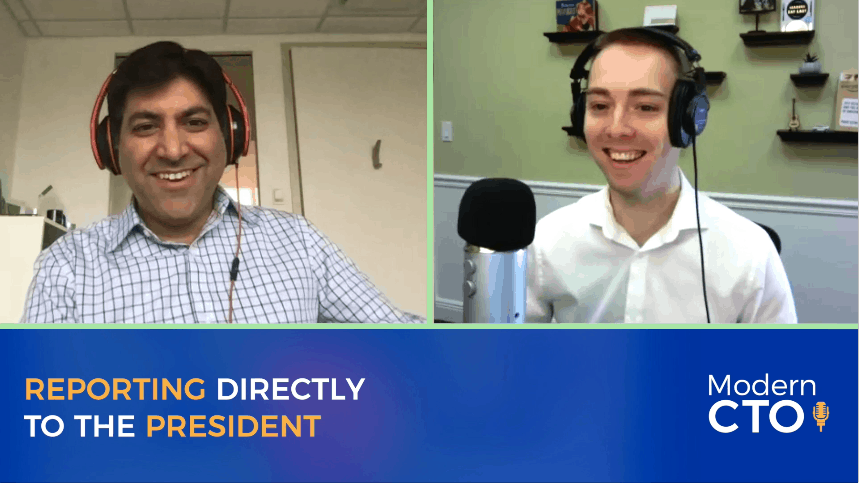
Aneesh Chopra is the President of CareJourney, a Hunch Analytics company that provides actionable, clinically-relevant analytics services to population health organizations. He served as the first U.S. Chief Technology Officer under President Obama (’09-’12) and in 2014, authored, "Innovative State: How New Technologies can Transform Government.” He joined the Board of the Health Care Cost Institute in 2017, earned his MPP from Harvard Kennedy School and BA from The Johns Hopkins University.
ABOUT CareJourney:
At CareJourney, we provide actionable analytics and patient data warehousing to improve population health. Our member-driven open health data service assembles a longitudinal view of the patient, ingests each point of contact, and measures performance continuously to inform new interventions.
Transcript
(Joel Beasley at 00:00:00) Hello, my friends. Today we are talking to Aneesh Chopra, the first CTO of the United States of America, and we discuss what it was like to report directly to the president, how he helped lead the open data revolution in government, and his three philosophies on leadership and innovation management. All of this right here, right now on the Modern CTO podcast. Here we go. This is the Modern CTO podcast.
(Joel Beasley at 00:00:38) Hey, buddy.
(Aneesh Chopra at 00:00:40) How you doing?
(Joel Beasley at 00:00:41) Fantastic. How are you?
(Aneesh Chopra at 00:00:42) I'm doing great. I'm excited to be here.
(Joel Beasley at 00:00:45) I'm excited to have you, man. Dude, you're royalty. You're the first CTO of the United States of America.
(Aneesh Chopra at 00:00:52) Hardly. But it is exciting times. It is very much exciting times.
(Joel Beasley at 00:00:57) I was scrolling through LinkedIn one day, and I saw your profile. And I was like, oh, this guy looks interesting. And I tapped on it, and I saw that you're the first CTO of the US. And I was like, come on. So I went and Googled it, and you came up on Wikipedia.
(Aneesh Chopra at 00:01:16) Yeah.
(Joel Beasley at 00:01:17) I was like, this is so crazy. And then now you're in healthcare analytics.
(Aneesh Chopra at 00:01:21) Yes. Yes. It's not fake news. It's all real. And it's bipartisan.
(Aneesh Chopra at 00:01:28) That's the important point about the role, and we'll get into this, I'm sure, as we get into the discussion. But it is a good statement about the country that we can modernize our governance, if you will, while we have very vigorous debates about the future of the country. So the good news is the modernization movement will continue even if we find different people with different policy objectives driving the bus. So that's heartening, and we've got a lot of work to do, but it's looking promising so far.
(Joel Beasley at 00:02:04) Yeah. This is perfect timing because I just finished reading the book The Third Wave.
(Aneesh Chopra at 00:02:09) Oh, yes. Yeah. You know Steve Case. Yeah. A guru. Of course.
(Joel Beasley at 00:02:13) Right? Right?
(Aneesh Chopra at 00:02:15) When I was reading your bio and everything about you, I was like, oh, this sounds a lot like Steve Case style people where it's bipartisan. Let's just move everything forward.
(Aneesh Chopra at 00:02:25) Yep. Yep. Yeah. In fact, I would argue central to the success of the third wave will be better public-private collaboration of the sort that you see from this role of a CTO. So, yeah, exciting times.
(Joel Beasley at 00:02:42) So both my brother and my stepmom are physicians, and we're always talking about data and health and all of that in general. They want to know when are we going to have the omni record? You know what I'm talking about too, don't you?
(Aneesh Chopra at 00:02:58) I do. I do. Some would call this an application to solve for hyperportillitis.
(Joel Beasley at 00:03:04) Uh, that—
(Aneesh Chopra at 00:03:05) That basically means that, well, the answer to the question is actually sooner than we may think. So we had a decade ago this experiment with Google Health and Microsoft HealthVault that was deemed a failure. And it was a failure, in my opinion, not on the idea, but in the execution. Because at the time, for a single hospital to connect to Google Health, for example, I spoke with a friend of mine who was a CIO who said, Aneesh, I estimate it took a bunch of time and maybe $100,000 of investment to connect to one system. And that's just not realistic.
(Aneesh Chopra at 00:03:42) It doesn't scale. So if the number of people that could seamlessly move their data from an individual hospital or specialist office into something that you call the omni record, if there's that much friction, then there's no business case for it even if it would be useful to your family. However, how much do you think it costs Apple in this era to connect to a standards-based API that is increasingly scaling across the industry? What's the marginal cost to connect to Apple?
(Joel Beasley at 00:04:14) Well, if it's a standard, it would be very low. Right? Because you would just do it once. Zero.
(Aneesh Chopra at 00:04:19) That's right. Yeah. That's right. And so now it's not that the Apple Health record is materially better in form or function over Google Health or HealthVault, but rather it is an idea where the implementation burden is very low. And so it just—you know, I'm reading Loonshots, this new wonderful book by Safi Bahcall where he refers to this idea of a false fail.
(Aneesh Chopra at 00:04:48) So in Silicon Valley parlance, you want to fail fast and pivot. Well, he argues that there's a lot of false failure that we need to sort of unpack. And I'd argue that Google Health, HealthVault era was a false fail, and the opportunity today is to ride the wave of these new technical standards. But by the way, we'll get into this now. But the reason it's not that Apple is a godlike figure in the healthcare universe.
(Aneesh Chopra at 00:05:18) Apple is simply performing with humility as an early adopter of government regulation. And so, really, it's a story of government regulation and industry collaboration that is allowing Apple Health to scale at a $0 marginal cost, which, by the way, also means Google and Microsoft could reenter the market or so could anybody else with the same economics.
(Joel Beasley at 00:05:43) Okay. So for my sanity, this standard, it does already exist and who created it?
(Aneesh Chopra at 00:05:50) So this is a great—so let me, this requires a little bit of history and context because it's not like, you know, the one king to rule them all, honestly. This is more about the history of American regulation and the opportunity to kind of solve a much needed public problem. So the history is that the US long has embraced the notion of standardization going back to the 1900s, early 1900s. There was a fire in the city of Baltimore, and a bunch of fire companies from around the region all came down to help. But when they all showed up, their fire trucks physically could not connect to the infrastructure.
(Aneesh Chopra at 00:06:37) So you only had really one functioning fire truck and that was nowhere near the need given the scale of this Baltimore fire. So that compelled something that is now called the National Institute of Standards and Technology, NIST, but really was in the early days the idea of a government body to say, wait a minute. For basic infrastructure like fire safety, can we all agree that the knobs and the dials and the connectors all standardize? So whether I bought a fire system from company X or Y, if I'm moving my equipment, I can plug and play. That thankfully is now kind of the default.
(Aneesh Chopra at 00:07:17) We take it for granted. So going back in the history of this, we've had the chance to collaborate. But in the 1990s, China was acting a bit shady on the standards policy. The government would start to dictate standards if you want to do business in China, and they were largely customized standards to the local Chinese market. And so you'd have this—we call it a non-tariff trade barrier where standards were used to kind of block out American or global markets and sort of gin up the local products.
(Aneesh Chopra at 00:07:51) So we had a rule that said the US government will not do that. We would, in fact, embrace private sector-led standards. And so that alternative is what has been governing us since the nineties. That's, you know, private sector figured out. Well, we get to healthcare, and, you know, President Bush in 2004 says by the end of the decade, everyone's going to have a personal health record.
(Aneesh Chopra at 00:08:15) We're going to be all connected. And so the desire, the goal, the call to action, all there. The problem was we had sort of an industry inertia. Right? That individual doctors and hospitals weren't exactly motivated or incentivized to sit down with their peers, and in many cases, competitors to agree on how a patient could easily leave doctor A to go to doctor B.
(Aneesh Chopra at 00:08:40) Why would I participate in something that would make it easier for my customers to leave? I'm being a bit sort of aggressive in that language, but you get the spirit of it. So, anyway, punchline to your question. About 2015, the federal government was ratcheting up the rules of our $35 billion economic stimulus. We basically said, we're going to give you a bunch of money because of the economic recession, but you're going to have to meet more and more stringent rules over the course of these three phases.
(Aneesh Chopra at 00:09:11) And by the time the third phase rolled around, there was sufficient evidence that we could have essentially an API standard. You know, what powers the global Internet? You know, Google Maps has a massive open API. Anyone can build on top to say we need an API for healthcare. The government didn't dictate exactly which API.
(Aneesh Chopra at 00:09:32) It just said you have to have a functioning API by, at the time, 2017. And that got delayed because it took time for the industry to get its act together. But a number of folks in the industry said, okay. We heard you. Let's sit together.
(Aneesh Chopra at 00:09:46) And maybe a dozen organizations helped launch something called the Argonaut Project as a standards acceleration effort. And within about a year and a half, maybe two, we had a common language for healthcare data, and that's called the FHIR API.
(Joel Beasley at 00:10:01) Oh, it even sounds cool.
(Aneesh Chopra at 00:10:03) Yes. Anyway, that was a long answer to your simple question, but that is the history. So now we're building on this infrastructure to make healthcare better.
(Joel Beasley at 00:10:12) I'll tell you what. The next dinner I have with my family, they're going to learn a lot.
(Aneesh Chopra at 00:10:18) Yes.
(Joel Beasley at 00:10:19) Okay. So you've got to help paint a picture for me because, right now, I imagined that your job—there were—they had some special IT closet in the Oval Office where you sat. It just made sure their printers were running. No.
(Joel Beasley at 00:10:35) I'm kidding. But tell me a little bit about—and I'm sorry. Because usually I start about how you fell in love with technology from an early age.
(Aneesh Chopra at 00:10:44) Yeah. Yeah.
(Joel Beasley at 00:10:44) Yeah. I'm so enamored with this idea. I just want you to correct my imagination—
(Aneesh Chopra at 00:10:51) Yeah.
(Joel Beasley at 00:10:52) —and kind of shed some light into what it's like being the CTO for our country.
(Aneesh Chopra at 00:10:57) Well, so thank you for the question. Let me start with what it was like being CTO for the Commonwealth of Virginia.
(Joel Beasley at 00:11:03) Perfect.
(Aneesh Chopra at 00:11:03) Because I played in the minor leagues before I went to the major leagues. And therefore, the experience wasn't as revolutionary in part because I sort of witnessed it on the ground level. Virginia in 1999-ish, 1998-ish, had a Republican governor. And the governor said, look, there's this sort of Internet phenomenon, if you remember the .com bubble.
(Joel Beasley at 00:11:30) Yes.
(Aneesh Chopra at 00:11:31) The goal was an economic development one. Virginia should be a digital capital or there was some tagline about, you know, why technology companies should start in Virginia. So to make the case that the governor decided to create the nation's first Secretary of Technology, a cabinet position dedicated to technology. And he appointed a dear friend of mine, Don Upson, who became the face of kind of a global marketing campaign to encourage tech companies to locate in Virginia. And so that was a theory of what a role like this could be, to be the evangelist and, frankly, the listener to the challenges and opportunities so that the government could be responsive to this growing important economic sector.
(Aneesh Chopra at 00:12:20) Well, then Governor Mark Warner, who's my mentor, succeeded the Republican governor and said, you know what? I want that same CTO role, but you know what I care about? I care about the massively underfunded and unproductive IT systems that represent the state infrastructure. So here I am. He's a tech entrepreneur.
(Aneesh Chopra at 00:12:42) He helped found Nextel Communications. And he said, look. I'm a business guy, and I want to run the Commonwealth like a business. And why do we have massively tech-enabled agencies on one hand and then terribly paper-laden agencies on the other? Can't we have sort of a common utility that delivers world-class IT and security to everyone equally?
(Aneesh Chopra at 00:13:07) And, gosh, we may actually save money while improving the system. So the successor to the original Secretary of Technology went entirely inward. I mean, not exclusively, but, basically, it was like, I've got to operate what became a 10-year billion-dollar-plus IT outsourcing partnership with a firm called Northrop Grumman. And so that took the next chapter. And so when I came in in the third governor, that is to say Governor Tim Kaine, the successor to Governor Warner, he had a bit of a hybrid perspective.
(Aneesh Chopra at 00:13:38) He said, you know what, Aneesh? I want to recruit someone who understands this new technology, but will collaborate with people in my cabinet who have policy expertise in the areas that matter. We want to fix education. We want to fix healthcare. We want to fix the transportation sector, and we want to ensure that we have a safe and secure environment.
(Aneesh Chopra at 00:14:00) So he said, look, I ran on these things. I've got phenomenal cabinet members in those areas, but I'm fearful that maybe we haven't got an understanding of technology or innovation or data, and that we may be missing something. So can you be sort of a collaboration cabinet secretary where you'll still operate the IT back-office system and you'll still have a role in the economic development story, but really put your time and energy where you can in healthcare IT, in educational learning systems, in transportation intelligent systems, and so forth. And that became the role. And so when President Obama was thinking about appointing Tim Kaine to be his vice president, there was a lot of research done on the, quote, Virginia model.
(Aneesh Chopra at 00:14:46) How do you get technology right? We were the best state for business, best place to raise a family, had the highest concentration of the tech sector in terms of jobs and the economy. So, really, the president had a vision for a role in his immediate office in the White House, but modeled it in some ways off of the experiences that we had, not exclusively in Virginia, but in part. So I was on the transition team helping to write the job description. I thought it was going to be for somebody from Silicon Valley.
(Aneesh Chopra at 00:15:18) I assumed it would be some luminary, some wildly successful venture capitalist or something. And lo and behold, I get the call and said, you know, actually, he wants someone that has the policy experience so that you can start on day one because we're in the middle of this economic crisis, and we've got to both find a way to modernize the country's technology infrastructure while we have to sort of strengthen the overall. So we want to rebuild the country, but modernize at the same time. Anyway, so that became the part of the role. So that was the history of it if that's too much detail.
(Joel Beasley at 00:15:49) No. It's a perfect amount. I think that's an amazing story.
(Aneesh Chopra at 00:15:54) Yeah. And to give you a perspective on bipartisanship, so we have a huge political problem. You know, presidents of both parties nominate people. They languish in Congress. The Senate has to review them, and some people can wait months and months and months to get appointed, and so you have this constant fight.
(Aneesh Chopra at 00:16:13) I had my confirmation hearing on a Tuesday. I was voted out of committee on Wednesday. I was voted on the Senate floor on a Thursday, and I was sworn in on Friday. So, basically, it was an expedited process. And it wasn't unique to me.
(Aneesh Chopra at 00:16:30) I'm just sharing it more as a metaphor. It just—I also happen to luckily fall into a calendar where that was even possible. But the point was we had, you know, kind of everybody said, oh, I may disagree with the president on X, but I really want to make sure that we modernize. And you see that today. So what it was like, I reported directly to President Obama.
(Aneesh Chopra at 00:16:53) He had given me the authority. It's called the Assistant to the President. And what that meant was that every morning at 8:30, we'd gather in the Roosevelt Room of the West Wing, and literally, I'm a nobody. And here's Rahm Emanuel sitting at the center in the middle of this economic crisis. And every morning, he would say, alright.
(Aneesh Chopra at 00:17:17) Geithner, what's the state of the economy? Summers, what do you have to say about that? Dennis McDonough, how are we doing on foreign wars? Orzag, what's the status of the budget? And all in, and on and on, to each of the most important advisors.
(Aneesh Chopra at 00:17:31) And then it would be like, Aneesh, what do you have to say? We launched a new open dataset today. So I earned the nickname, you know, Mr. Sunshine, because in those early days, every answer to the question was disastrous. The budget's out of whack. Foreign wars are not going well. The economy's in a spiral. Aneesh, hey, we launched this new service.
(Aneesh Chopra at 00:17:55) So it was humbling to be in a world where I had the opportunity to influence policy and to execute the president's vision. I had air cover because the president cared a lot about this work, but we also had some of the least controversial topics. So there were obviously areas where there was controversy, but for the most part, the bread and butter was not stuff that required a huge political compromise.
(Joel Beasley at 00:18:22) Yeah. And when I was reading your bio about the list of things that you were able to accomplish, that's what I found super impressive. Because, you know, I'm over here in the private sector, and our stuff is just streaming at light speed. And then we go interface with anything government, and it's like 1900s, right? And so when I look at your list of things, you had just project after data project after, making you just made so many things accessible. And I know there was a huge team and a lot of people involved.
(Aneesh Chopra at 00:18:58) Well, more important than a team, we had a president who wanted it. Let's be clear. I'm a nobody. I simply was the execution arm of a vision the president laid out, and I'm grateful that the president cared so much to prioritize this over other things.
(Aneesh Chopra at 00:19:12) And so we were able to get a lot done. But again, the most important thing is we really ultimately changed the default culture. So it used to be the case that the 1900s was the best you're going to get, and now it's like, wait a minute, we can modernize and we can open up our systems and allow others to modernize in collaboration with the government. So we do have, I think, a new culture where you don't like the Weather Channel? Now there's a competitive economy that can tap the source weather data, increasingly in cloud-hosted infrastructure, that you can use to compete on better interpretations of what's going to happen next. Is that the role of government? Are you asking a government agency to build that interpretive service? No. It's a private sector company building valuable products and services on top of government data.
(Aneesh Chopra at 00:19:58) And this is becoming the new model, a kind of an industry that can be born off of a more collaborative and open public sector.
(Joel Beasley at 00:20:06) Now I personally like that, and I'll tell you why. Okay. In 2011, 2012-ish, I was sitting around thinking about where I was going to live, and I really like my climate patterns of where I currently live, right? It's where I'm a native to. And so I said, I want to know where there's climate patterns similar to this so I can have a transition but not give up my lifestyle.
(Aneesh Chopra at 00:20:29) I love it.
(Joel Beasley at 00:20:30) I sat down at my Ruby, that's my programming language of choice at the time.
(Aneesh Chopra at 00:20:35) Yes.
(Joel Beasley at 00:20:35) And I started hunting for data so I could do some analysis and find similar places where it took all of our weather data, put it into seasons, and then would find where could I go to have similar seasons, similar humidity changes and all this.
(Aneesh Chopra at 00:20:50) What a great application, right?
(Joel Beasley at 00:20:52) Couldn't do it because Weather.com owned this service called WeatherUnderground.com, and they had a complete monopoly on the data. And if you wanted to do anything, you had to pay gobs of cash, and you had to tell them exactly what you were doing and why. And I got so frustrated because I built it with mock data, like fake data, and so I could write all my stuff while I was battling with them for real data. And I never got it beyond, like, they limited the scope of data I had, so I could only do it in, like, nearby. It was so frustrating.
(Aneesh Chopra at 00:21:25) Go straight to the Commerce Department. The National Weather Service has a wide-ranging set of APIs. Don't take away your opportunity. Go back now. It's widely available.
(Joel Beasley at 00:21:35) Well, I'll dig up that project for sure.
(Aneesh Chopra at 00:21:38) Yes.
(Joel Beasley at 00:21:39) Yeah. The National Weather Service has it now. That specifically I enjoy very much. So thank you for being a part of that change. Okay. So now you've done the public service part.
(Aneesh Chopra at 00:21:51) Yeah.
(Joel Beasley at 00:21:52) And you're continuing to give back in the sense that you're in this very useful sector with your CareJourney company. Tell me about how is that going? Where are you at today? When did it start?
(Aneesh Chopra at 00:22:03) Yeah. Thank you. I think we're doing well. In a way, I'm eating my own dog food. And in the area of health care, which is an area of personal passion for me, both in Virginia and at the White House, there had been a theory of change that goes something like this: if we could release the health care data held by government, because the government's pretty significant player in the administration of health care benefits, insurance, and so forth, that we should dramatically accelerate the learning about what works and what doesn't work in delivering better health care. The idea that you couldn't access the Medicare data really blinds us to a big chunk of the economy. The average specialist, maybe 40% of their patients are on Medicare. So if you want to grade which specialists are doing better than others and you can't look at that 40%, oh my goodness. Or you have to do the equivalent to your point for the Weather Underground, and you can only get it, you know, 5% of the panel at a time. You're never going to get enough signal. So you've got to release the data for feedback loops.
(Aneesh Chopra at 00:23:09) Second theory was, we spent the beginning of this conversation, we need to have a common language so that your medical records, even if you've been going to different hospitals and doctors, can all be kind of congregated, if you will, into something that you could start to run decision support against. So people like me should do this next, or, hey, you're about to do that, don't do this instead. So how do we create that GPS-like navigation decision support? Well, we've got to have that aggregation of our health records, so we've got to apply these rules against it. And that's the standards that are coming out, the FHIR API that speak that common language.
(Aneesh Chopra at 00:23:37) And the last thing is, and this is maybe the centerpiece of the startup that we're launching, is that you've got to have a payment model that rewards people in the health care system to put all this stuff to work. So right now, if your loved ones want to aggregate their health information, nobody is incentivized to help them do it. Like I said, in some cases, there's a disincentive. So how do we create a business model where there's actually an incentive to do the right thing? And the answer is to change the way we pay for care.
(Aneesh Chopra at 00:24:04) So if you reward doctors and hospitals for seeing patients a hundred times and they make more money at the hundred and first, the law of economics is that you're going to get more of the thing that you're paying for, sort of general supply-induced demand. The model of switching the outcomes payment means that you can essentially say to that same group, look, we expect that you're going to do a hundred of these things, and you should still do them. But if you could keep people healthier where they don't need a hundred, they only need 90, and, oh, by the way, you're doing the 90 at a higher quality, well, the savings that come from the 10 you didn't do, you get to share half the savings and the government gets half. So we sort of align the incentives.
(Aneesh Chopra at 00:24:41) So if you put those three things together, the opening up of data, the move to integrate open systems, and a payment model that creates a business case, then you've got a big market of opportunity. CareJourney was founded in 2014 to play a minor but important role in that journey, and that we wanted to be the insights generator for what patients and which doctors are getting the best possible care, highlighting the gaps that are missing for patients that are not getting the care they deserve, and encouraging organizations that are building clinical networks to say this group of physicians or this group tend to have a higher success rate managing the type of patients you're responsible for.
(Aneesh Chopra at 00:25:59) So we've basically built this utility-like insight service. And today, we serve over 40 customers. We've got health plans, physician networks, hospital systems, and increasingly now the pharmaceutical sector trying to figure out what role they play on the move to this value-based care journey. And that's the basis of the company. In any given patient's journey, we can identify historically, did they get the right care they were eligible for at the time it was needed? And if not, can we grade that clinical network or that health system on whether or not they were successfully routing people through the system the way research and evidence suggests they should to get the best care?
(Joel Beasley at 00:26:38) Nice. I should introduce you to Chris Bam. He's a CTO over at Change Healthcare.
(Aneesh Chopra at 00:26:45) Oh, I know Change very well. Of course.
(Joel Beasley at 00:26:47) Of course. Chris is amazing. Like, he was introduced to me through a friend of a friend in Tennessee, and he's part of, like, the Tennessee Tech Council and all this stuff. But he's a fantastic person, just, like, great human.
(Aneesh Chopra at 00:27:01) Good. Well, they're going to play an important role in making the health information flow in a more efficient and effective manner.
(Joel Beasley at 00:27:08) All right. Let's take it back. Let's take it back to when Aneesh was just a little guy. What's your first experience with technology? Like, what, how did you fall in love with it?
(Aneesh Chopra at 00:27:20) Well, I had the Commodore VIC-20. I think we all are in that, I'm a little bit older than you. But in my era, you get these machines and you have the freedom to program in BASIC. And so, you know, like every kid, I got the Compute! magazine and they had the instructions in the back and you could program little games and you could fiddle around with it. And so my fascination with computers was early.
(Aneesh Chopra at 00:27:46) At the same time, I was similarly inspired by not just sort of digital computers, but rather innovation processes more generally. My father had gone to college with a gentleman named Sam Pitroda. And Sam was the story of an immigrant who came from India to Chicago, was lucky enough to study electrical engineering at a time when the country was moving from analog to digital telecommunications infrastructure. And so he caught that wave early and was able to launch a startup and exit that startup with millions of dollars. So he had, at a very young age, been capable of doing whatever he wanted.
(Aneesh Chopra at 00:28:30) He decides to go back to India for a penny a year salary to lead an innovation movement to modernize the telecommunications infrastructure. I think the country had 300,000 phone lines for 300 million people, and it was such a luxurious item that you had to wait months and months and years, or you could bribe somebody to get it earlier. But Sam said this should be a resource in abundance. Every village in the country should have access to phone service, not just the rich villages. And so rather than just fight a political battle of subsidizing kind of traditional infrastructure deployment, which would have been very expensive for the country, he said, let me hire a bunch of engineers and give me the equivalent of a moonshot project.
(Aneesh Chopra at 00:29:16) I will build a completely indigenous telecommunications backbone that'll be free and open for the private sector to use, and we will connect every village to telephone service. And he was able to do that. And so I was fascinated on the problem-solving dimensions of innovation while I was tinkering with computers. And that kind of brought me to the point where I was in college and eventually grad school and so forth, where I started thinking about the Internet as the infrastructure of the twenty-first century and how the Internet could be used to solve big problems. And that became my particular fascination.
(Joel Beasley at 00:29:56) I love it. I love it. And it's like, all right, and everyone goes Commodore 64 or 20 or whatever.
(Aneesh Chopra at 00:30:04) VIC-20. Yeah.
(Joel Beasley at 00:30:04) But for me, and I couldn't remember it until I looked it up, but it was the IBM 5155 Portable PC. So it was like this big box, right? Do you know what I'm talking about or not?
(Aneesh Chopra at 00:30:20) I don't. I've never seen it.
(Joel Beasley at 00:30:21) Okay. So it's this, like, box, and it feels like, at the time, it was infinitely heavy, right? But it has this little screen over here and keyboard that would come out, and it just looked like a giant box, and you would take the top off of it. But, yeah, I'll send you a link after the show, but it...
(Aneesh Chopra at 00:30:39) I have seen that. Well, I've seen versions of that. There were, you know, Compaq made one of those. A bunch of companies were in that big box business that had that funky look to it.
(Joel Beasley at 00:30:50) Yeah. They came out in, like, 1984.
(Aneesh Chopra at 00:30:53) Yep. I do remember that. Yeah. Yeah.
(Joel Beasley at 00:30:55) So for me, I don't have a mental image of the Commodores, but that big thing was the thing that I would lug out. My dad would have this, you know, like, the real thing with all the, the boxes on it and everything, the dolly, you know, the engineer's dolly.
(Aneesh Chopra at 00:31:13) I do. I think it's hilarious.
(Joel Beasley at 00:31:16) With the bungee cords. Yeah. So that was the eighties and the nineties for me. But yes. So tell me a little bit about your book, Innovative State.
(Aneesh Chopra at 00:31:25) Yeah. Well, the basic principle of it is exactly as we see it today, which is we want to solve big problems in this country. And even today, like, we're chatting right on the eve of this Mueller probe, and it seems like the country's sort of splintered apart. You're on one team or the other. And you have the sense that, like, really big important problems like climate change or economic competitiveness or income inequality, they feel a little bit like we've missed the window and that we're sort of frittering away because we're yelling at each other, not collaborating to solve problems.
(Aneesh Chopra at 00:32:11) So I tried to write the book to, A, convey a sense of hopefulness that while that is the popcorn on the nightly news, under the hood, there's a lot more potential for collaboration, innovation on these big issues. And so point number one I wanted to make is there's hope. And then point number two is I wanted to provide a bit of a roadmap or a playbook, if you will, on how we can participate in that problem-solving community. So if there is a problem-solving community and I want to be a part of the solution, where do I go? What do I do?
(Aneesh Chopra at 00:32:47) And it starts with a bit of the role of government, and it describes basically four enabling tools that governments can deploy to tap into this expertise and problem-solving capacity of the country. The first is making sure that we open up our data assets, like the Weather Service, like the health care system. But imagine doing that across the board where every sector of the economy, where the government is in some form or fashion regulating or operating in the systems. Let's open it up. And that just becomes fuel for people like you to go grab that. Don't go to Weather Underground. Go to the Data.gov, and now you can find the datasets you need, and then you can go build your products and services. So that's point number one. Point number two, where we get with the Baltimore City fire, let's start participating in standards. So the government is regulating. It's not so much operating.
(Anish Chopra at 00:33:41) Like, hey, I want to launch a fintech company to make sure poor people can access capital. Well, I need access to their checking account information to be able to personalize the advice that I can give them. Now we are in a regulatory world where the consumer can access any of their data held by a regulated bank and give it to a fintech company they trust. That opens up a lot more opportunity.
(Anish Chopra at 00:34:04) So we need to have standards in the digital world, but also a framework that says we're going to promote healthy market competition and allow people the freedom of choice. So the government's playing a role on regulation. The third is—and this is interesting—we wanted to issue... We hated government. I hate government procurement. I mean, to your point about the 1990s, the 1900s experience of logging into a government website. The premise here is that instead of going to the same dozen beltway bandits, let's massively open up this $80 billion of IT spend as an example.
(Anish Chopra at 00:34:43) And Congress gave us the authority in a bipartisan way to issue challenges, prizes, and competitions. So you don't have to be a government contractor with a PhD in procurement physics. You could simply follow a challenge on challenge.gov. Say, I think I have a novel way of solving that, and you can participate. And then last but not least, we created these sort of lean startups where there are individual projects within the government that could benefit from time-constrained teams that were half government, half entrepreneurial, and together they could launch projects that could make a difference in people's lives.
(Anish Chopra at 00:35:24) So if you enable this innovative state, well, then that creates the conditions for individuals, companies, startups, big firms, all to plug in, and they can see where they can fit. You can build applications on top of the open data. You can participate in standard setting for regulations in the economy. You can respond to challenges and prizes, and you can also join the government for chunks of time. You may not want to make it a lifetime career, but you say, you know what? I just sold my company. I want to go into the government for a year or two. I want to be a contributor. How can I contribute in something meaningful and not just show up and push buttons for a little while? All of that now is possible, and Innovative State was my attempt at explaining the story and inviting people to plug in.
(Joel Beasley at 00:36:09) So that it becomes—it's like a play on words. It's like Innovative State as in, like, government, but also, like, a state we need to be in. A state of mind.
(Joel Beasley at 00:36:19) No, that's good. And when you were talking about that briefly, you said something about bringing together, like, entrepreneurial... Yeah. That reminded me, like, when Steve Case was talking about how we recruited some group of people to do something like that. Do you know what that group was called? I forget.
(Anish Chopra at 00:36:36) The U.S. Digital Service.
(Joel Beasley at 00:36:38) Yes.
(Anish Chopra at 00:36:39) Yeah. So my successor, Todd Park, unfortunately got stuck with the assignment of fixing Healthcare.gov when it crashed. And that wasn't a particularly pleasant experience. And as he dove into the problem with others, obviously one of the most fundamental issues is that government procurement is as broken as it was essentially on day one. I mean, it's one of those frustrations that you could try to fix it all the ways you want, but there's just way too much money, way too much bullcrap in it. And so you have this frustration. And so you needed a Healthcare.gov failure of that magnitude to get the president of the United States to say, you know what? We're going to fix this. And that's essentially what happened with the aftermath of Healthcare.gov.
(Anish Chopra at 00:37:26) And one of the most important things that my successor, Todd Park, advised the president to do was to stand up a unit. We brought in the best and the brightest from all over the country to come into government for stints of service and put them alongside brilliant, brilliant public servants. And you marry up the policy expertise with the technical expertise, and you can make magic happen. And that essentially is carried on in the Trump administration.
(Joel Beasley at 00:37:55) Now is that like an invite-only thing, or is there a place where you can—how do you do that?
(Anish Chopra at 00:38:01) No. So basically, anybody can apply. In fact, the U.S. Digital Service has an ongoing recruitment cycle. They're always hiring, basically. And so my presumption would be to the extent that it's possible, if you have friends or are watching this podcast interested in joining, that they might say, you know what? I've got six months to give, and I want to be a part of the team. This is it. It's not like, oh, secret society hooked me up. I need a lobbyist. It's like, hey. I've got talent, and let the best of America shine through. And if you take a look at a picture of the people at the Digital Service, it looks a lot more like America. There are African American women, Hispanic men. Anyway, it's got all flavors and colors the way our country looks, and that's the way it should be.
(Joel Beasley at 00:38:58) Yeah. Because it represents our country.
(Anish Chopra at 00:39:00) It does.
(Joel Beasley at 00:39:01) And so if I want to learn more about this, I just Google for the U.S. Digital Service?
(Anish Chopra at 00:39:06) That's right. That's right. I forget the exact URL. It's probably usds.gov, but anyway, it'll be along those lines.
(Joel Beasley at 00:39:11) Yeah. Yeah. Find it. See, look. I didn't even know that thing existed really until I heard—I actually just finished his book this morning on my walk.
(Anish Chopra at 00:39:20) Perfect.
(Joel Beasley at 00:39:22) Yeah. And I'll Audible a book, and I'll do, like, an hour here, an hour there over the course of a week or ten days or whatever. But I just finished it this morning, and I was like, oh, perfect timing. And yeah, he had mentioned this concept of the U.S. Digital Service.
(Anish Chopra at 00:39:35) I thought it was really cool.
(Joel Beasley at 00:39:36) It was really cool because had I known about this years ago, I would have definitely done it to some degree, like, gotten involved somehow.
(Anish Chopra at 00:39:44) That is awesome. Yeah. Well, great. So I love the fact that we're able to spread the word about this through the podcast.
(Anish Chopra at 00:39:50) You can think about it in the next chapter of your life, whenever you have a transition and you're ready to roll.
(Joel Beasley at 00:39:56) Absolutely. Anywhere. Yes. Alright. So, man, we've covered a lot of ground, but I've got to ask, like, what is the thing that's getting you up out of bed today? Like, what are you most excited about?
(Anish Chopra at 00:40:11) Oh, health care. I mean, health care is my—I mean, I've got a startup in health care. I care a lot about it. What happened was we had an election. So President Trump takes office, and there was a lot of turmoil because he wanted to overturn the Affordable Care Act. The industry was sort of like, which way are we going as a country? Are we going to stop everything that President Obama did? Are we going to continue? And so on the things that I talked about—the opening up of data, the encouragement of industry standards, the changing the way we pay for care—those parts of the Obama administration have continued. And about a month ago, CMS, the Medicare and Medicaid system agency, announced a set of rules that would double down on the Obama philosophy.
(Anish Chopra at 00:41:09) And I don't want to say that because it sounds partisan, but the philosophy that we introduced in the Obama administration about open data and the interoperability standards and payment reform. And it basically said, we're all in. And so the message now in the wake of these proposed rules is that there's one path. We're on that path together. So if you're in the health care sector and you're kind of waiting this thing out hoping it's going to go away, you got the message about a month ago that we're all in.
(Anish Chopra at 00:41:47) Yes. So it's motivating the industry to move. So that comment your mother and your brother-in-law or whoever you said—
(Joel Beasley at 00:41:55) Brother. Yeah.
(Anish Chopra at 00:41:56) Your brother mentioned was, hey, when is this all going to be coming together? Thanks to the rules that were announced about a month ago, the likelihood that it gets solved sooner has just gone up by a factor of 100. Nice. So if the rules went backwards, then everybody—well, I don't want to open up the API. I'd rather be the Weather Underground, Weather Channel, where I monetize it or control it as opposed to make it freely available. The rule basically says the consumer has the right to choose any app and that that app has the right to access to health data, and you can't charge the consumer or the app.
(Joel Beasley at 00:42:33) Oh, I like that last part. Yeah. Yeah.
(Anish Chopra at 00:42:36) That's a pretty powerful concept.
(Joel Beasley at 00:42:38) Well, it's pretty smart too because, like, even if I was a big player in the industry, right, who could potentially try to rally up a holdout on whatever we were trying to push forward, I wouldn't because there's so much economic benefit to—like, I could have a little spin-off company that does something innovative with the data. Like, there's so much more value to the data being tied together than it is being separate because it's like that story that we all know. Like, no matter what, it ultimately comes together. I mean, look at the banks and how long the financials, with, like, Mint. Mint blazed the way there followed by a couple other big personal finance managers to get the open bid. Right? But it always happens. Like, it just always happens. People push forward. They get it. They scrape it. They figure out how to get it. But I always push for—now here's an area of topic that we haven't really discussed, but I want to get as we wrap up because—
(Anish Chopra at 00:43:33) Yeah.
(Joel Beasley at 00:43:33) While we've talked about your abilities to do all of these great things inside of the market and that with the technology, but one thing that we haven't talked about is you've had to work with a lot of people to get these things done, right, to get the data open and to accomplish all of these goals. But I'm curious to know, like, what are some of your favorite leadership things? Right? Like, you've got—I'll be more clear if you want because that was kind of broad.
(Anish Chopra at 00:44:05) Well, I basically have three philosophies.
(Joel Beasley at 00:44:12) Oh, beautiful. You're prepared. Alright.
(Anish Chopra at 00:44:14) Well, I just—it's an important part of this. So it all comes down to... There was a research study that my colleagues—I was at a firm called the Advisory Board in the late nineties, early two thousands. And they wrote a book on why do seemingly indestructible companies hit a proverbial brick wall. And it seems like a lot of companies hit that brick wall. How do you avoid those brick walls, and how do you power through?
(Anish Chopra at 00:44:43) And that, broadly speaking, had the following key principles, and I've adopted them as central to the cause. The first and foremost issue is an air cover cultural issue, which is you've got to take the blinders off. You've got to look over your shoulder. You may think you're the greatest, but if you don't look over the shoulder, you're going to miss out. And in the public sector in particular, where it's not like you can leave the island. We live in America. So you get the America that you get. We have elections and they make changes, but by and large, the country kind of runs the country. I don't know how Singapore or China or Russia or whomever else is running the country relative to the way we run the country, but there isn't exactly a competitive market of countries. You basically have the country.
(Anish Chopra at 00:45:33) So fixing the DMV is sort of like, agitate for it, but, like, you know, maybe incremental change. So you've got to look over the shoulder. So people are building a completely new digital infrastructure. We've got to think about what does governance in the twenty-first century look like. So point number one, take off the blinders and look over the shoulder. The second point is really about kind of more structural. So if cultural is point number one—is get the culture right. Point number two is structural. And that is to say, put in place the building blocks of innovation pipeline management. So the idea there is there are a million ideas.
(Anish Chopra at 00:46:15) And on this podcast, you might have thought of two or three as we chatted. And ideas are a dime a dozen. It's an idea that scales that is the heart of innovation. So the last part about ideas that scale means that you've got to have a thoughtful way of filtering the ideas, testing the ones that you think have promise, capturing the feedback loops, adjusting accordingly, and to build in processes to allow them to scale to market. That is a management structural issue, and organizing that correctly is central.
(Anish Chopra at 00:46:51) So to me, the second philosophy is build the right structure to promote innovation, and that requires this innovation. And I have a piece if you Google it. If you Google my name in "innovation pipeline management," I commissioned a paper on this when I was in the White House, and that paper is public. And then last but not least, you know, at the end of the day, all this stuff is interesting. You could have great leadership. You could have the right structure, but none of it works without great people. And so you've got to have the right people. And no matter who you are, you know, the argument kind of—basically this is one of the cofounders of Sun Microsystems was famous in saying that no matter who you are, the best people on the subject you care about work for somebody else. And it's just a function of the reality of the world that we're in today. So you've got to find a way to tap into that expertise, either through collaboration models or really strong recruitment effort to bring the best people for the problems that need solving.
(Anish Chopra at 00:47:57) So that idea of recruiting top talent is central to being successful. And so you've got to get air cover from the top. You've got to have the right structural processes to get the most value out of your innovation loops, and you've got to have the right people that understand the world as it is to kind of move you to the world you wish to be.
(Joel Beasley at 00:48:16) And that's the philosophy. I love it. So let's get a little bit deeper into that. I just want from your—and there's no right or wrong here—but for you, what stands out to you, like, high-quality people? Like, what are they doing when you're in a room with people? Maybe you're collaborating, you're on a project. There's 10 people involved. But, like, one or two of them is going to stand out to you as exceptionally high-quality people. What are they doing? What is that?
(Anish Chopra at 00:48:43) Well, first and foremost, there's a certain amount of creativity that they bring to the problem. So what often happens is you may be brilliant in your own mind and in your own area of the world. But when you're exposed to other people and other ideas, it's the intersection of your thoughts and theirs that really creates sparks. So the person that is capable of reacting in that 10-person room to the ideas of others and building upon them—that is a certain amount of spirit of collaboration, creativity that I think is critical, number one. Number two is I care a great deal about your attitude and your demeanor.
(Anish Chopra at 00:49:26) So there are people who are, you know, there are sort of yes people and there are no people. And I'd like to start with people who are interested in the yes. Let's get to yes. And so I tend to be a person who likes to throw a lot of ideas at the wall. I want to be able to experiment with those ideas and focus on the ones that have promise.
(Anish Chopra at 00:49:47) So I want teams to come to find, you know, you gotta have a mindset that says I want to get to yes, but let me be mindful of the fact that we may have to pivot or do whatever. So kind of a can-do attitude, a little bit of a get to yes. And then obviously, you know, you gotta have someone that has a certain amount of humility. And that gets to the first point, which is you can be creative, but without humility, you may not actually absorb the feedback loops about what's happening and not. So you gotta find those folks that have that strength of individual talent, willingness to, with humility, collaborate, and with a default posture that they want to be engaged in solving as opposed to blocking.
(Anish Chopra at 00:50:29) And that's the kind of philosophy of what I'd like to see in the teams that we recruit.
(Joel Beasley at 00:50:33) I love it. You just reminded me of my entire twenties. Like, you figure out that there's confidence and you're like, oh, okay. Now that's like overdoing it, and then you back it down. Then you figure out there's humility, but then you end up so quiet that you have to realize that you have to mix in.
(Joel Beasley at 00:50:48) And then this is just insane balance of, I guess, the word would be maturing.
(Anish Chopra at 00:50:54) Right? Yeah. That's a good one. That's very good.
(Joel Beasley at 00:50:57) Okay. So I loved the how not to hit a brick wall and what you look for in people. This is great. Any other great advice that's worked well for you? Maybe time management?
(Joel Beasley at 00:51:10) How do you lay out your—
(Anish Chopra at 00:51:13) Well, I'm not particularly great at that. I would say we all have our faults. Mine is probably in time management. And so, you know, I'm trying to learn that it's important to unblock the day because I tend to squeeze every minute of the day back to back to back to expose myself to ideas, to prospects, to partners. And reserving time to think, reflect, respond—you gotta be able to do that, and you gotta find the right time to balance family. So finding the way to allocate time is like an ongoing goal, and that is something that we all have to work towards.
(Joel Beasley at 00:52:02) So one of my favorite ones: John Maxwell, have you heard of him?
(Anish Chopra at 00:52:06) I have not.
(Joel Beasley at 00:52:07) Okay. So he's a leadership author, and he's been around for quite some time. I think he's in his like seventies now. But one of his favorite things that I sort of took away is he's got a reflection chair.
(Anish Chopra at 00:52:21) Oh my goodness. That sounds pretty good.
(Joel Beasley at 00:52:23) Yeah. It's just a chair that he's labeled for reflection. And so he only sits in it when he's reflecting, and he maybe does it like ten minutes a week or whatever. It's not like an incredible amount of reflection time. But every time he walks by it, mentally, he's like, oh, that's my reflection chair.
(Joel Beasley at 00:52:40) And then he'll remember that he hasn't sat in it in a while. And so it's just in a study or in his office or wherever it is.
(Anish Chopra at 00:52:47) I'll adopt that very same—that's a great philosophy.
(Joel Beasley at 00:52:50) Yeah. Because every once in a while, you'll walk by it and you won't do it, but then you'll get that internal flag that's like, I've walked by this too many times not to reflect, and he'll sit down for ten minutes. And yeah, that's his cue, his marker for it.
(Anish Chopra at 00:53:03) I like it. Yeah. I like it.
(Joel Beasley at 00:53:05) There we go. Well, thank you so much for coming back.
(Anish Chopra at 00:53:08) My pleasure.
(Joel Beasley at 00:53:09) Yeah. You're in the Virginia area, right?
(Anish Chopra at 00:53:11) I am. We're in Arlington, right next to Washington. Happy to be here.
(Joel Beasley at 00:53:14) I'll put you on my—I have a spreadsheet with past guests and like where they are. So I travel around the world and get to speak at companies all the time. So if I'm ever in the Virginia area, I'll let you know. Come by and say hello.
(Anish Chopra at 00:53:28) I will do. Thanks. Come on over. It's a pleasure chatting with you today. Thank you for the time.
(Joel Beasley at 00:53:31) Alright. Talk soon, Anish. Take care.
(Anish Chopra at 00:53:33) See you. Bye-bye.