
Episode 71 ·
Peter Zornio - CTO of Emerson Automation Solutions
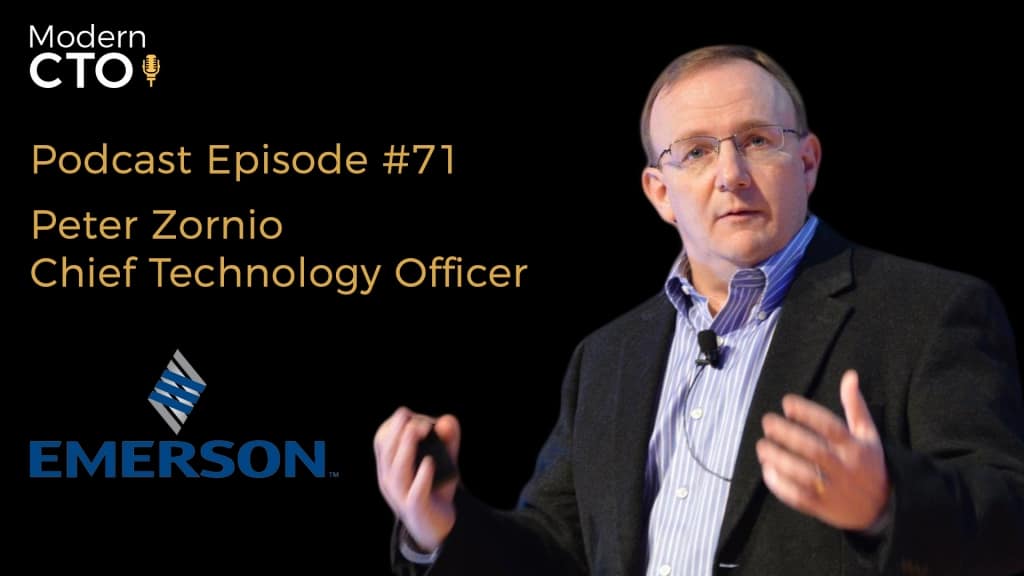
Today we are talking to Peter Zornio, the CTO of Emerson Automation Solutions. And we discuss the connection between Information technology and Operational Technology, The future of Automation, and why software developers are not ditch diggers.
All of this, right here, right now, on the Modern CTO Podcast!
Peter Zornio is Chief Technology Officer (CTO) for Emerson Automation Solutions and has been with Emerson for 12 years. As CTO, Peter has responsibility for overall coordination of technology programs, product and portfolio direction, and industry standards across the Automation Solutions group. This includes Emerson's digitization and Industrial Internet of Things (IoT) developments, such as the Plantweb™ digital ecosystem.
Past roles at Emerson have included leading development and marketing for Emerson's systems and solutions portfolio. Prior to Emerson, Peter spent over 20 years at Honeywell in a variety of positions across the entire automation portfolio. His 30 years of experience in digital manufacturing architecture covers marketing and development of all aspects of process automation and related IT technologies, including wireless, Industrial IoT strategy, field measurement, fieldbus technologies, control systems architecture, and operations management applications.
Peter is based in Austin, Texas, and holds a degree in Chemical Engineering from the University of New Hampshire.
Show Notes
Work processes are the biggest barrier
2 platforms at Emerson - Peter Zornio is CTO of Automation Solutions
Both Joel and Peter are members of the Forbes Technology Council
IT and OT (operational Technology)
Entirely different sets of people who are not integrated with IT running the Operational technology in manufacturing
OT has risen to distinguish from information technology. It's all about how do we keep the plant operating.
Has been in automation for his entire career
High availability is a great term.
The core of what keeps them going is they are purpose built embedded systems. Frequently redundant. Build to be redundant right from the beginning
More discrete manufacturing, it's not as big a deal, but for a power plant it's a huge goal to stay online 100% of the time
Building example for automations
Has been focused around production
How do you spend your day? Pie chart of day - Business Units, Customers, Product Planning. Strategy and on the right track for the future.
The life cycle is a lot longer for OT
Would like to see the engineers of these high availability talk more publicly
BP example - things went awry subsea
Autonomous vehicle is an example of the sexy side of automation
How does the QA process differ?
Do companies come to Emerson with an idea for a product and then Emerson takes on the whole development
Control challenges with the pharmaceutical and life sciences industry.
How big is the organization on the automation side? 5-8k in automation solutions
Managing structure since he came to Emerson?
Getting People excited about the space they are in. Once they find out, they are like wait a minute, what you do affects the physical world
Blackhat community has figured out that it’s cool….unfortunately
Trying to find the magic bullet from a development standpoint. Don’t have the luxury of failing fast, building systems that need to operate for 20 year
What is your leadership style? Big believer in leading by example. Exhibit the behaviors you want people emulate. Try hard to not be a jerk. Try hard to not come across as egotistical and my way is the right way. Try to drive collaboration.
Get people bought in, make them feel like they are a part of decisions.
Look you may be the smartest guy in the room, but you’re not smarter than the room.
For every engineer there's an equal and opposite engineer
What stands out as someone who is ready to lead
Always on the hunt for talent. Use the term Sparky.
Always recruiting. The most precious commodity.
61% of the CTO’s polled say lack of people is their
Software engineers are not ditch diggers. This comparison is awesome
Can’t be afraid to proudly steal as long as you give credit to where it came from
Very Promising future as long as the machines don’t take over.
On a path towards building a complete and total AI
Old Automation Joke
Interesting how the distribution is coming first for AI
Talking about the Singularity
Transcript
(Joel Beasley at 00:00:00) Hello, my friends. I'm curious to know how many of you have a leadership pipeline. We know that great leaders grow companies because we talk to them here on the show every day. But what are you doing to create great leaders within yours? If you're a CTO, it is 100% your responsibility to grow and improve your people beyond just their coding abilities.
(Joel Beasley at 00:00:20) We've built a tool that improves your people in their craft and in leadership. Visit leaderbits.io to learn more. Today, we are talking to Peter, the CTO of Emerson Automation Solutions, and we discuss the connection between information technology and operational technology, the future of automation, and why software developers are not ditch diggers. All of this right here, right now on the Modern CTO podcast. Here we go.
(Joel Beasley at 00:00:49) This is the Modern CTO podcast. I love the fact that you're, like, the CTO of automation.
(Peter at 00:01:03) Yes. Well, that's because we have a couple of different — we have two, actually — platforms in Emerson. One of them is called Commercial Residential, the other one's called Automation, and I'm the guy that works the automation platform. It's a big business. It's about — this year will be over $11 billion just focused on automation.
(Peter at 00:01:23) And, you know, we automation guys actually have been looking at all this IIoT and digital transformation, and we're like, what's the big deal? This is what we've been doing for 34 years, you know? It's like, oh, the rest of the world's actually figured out how to do this. And so, yeah, for us in automation, a lot of these conversations that are going on, I remember when they first started, I even wrote an article about, like, hey, we've been doing this for 25 years, you know? But, you know, for many industries, they just didn't have data before.
(Peter at 00:01:55) Right? I mean, you didn't have city data about your parking lots and your traffic lights and your street lamps and, you know, who was where. You didn't have data about what you were selling to who in a retail store. You didn't have data about what was going on inside of your buildings and, you know, who was in the building and who wasn't. Okay, for these guys, I understand how it's kind of a brave, new, fun world.
(Peter at 00:02:18) Okay? The world we operate in, which is the world of industrial manufacturing, and specifically industrial processes like food and beverage and pharmaceutical and refinery and oil and gas and power — we've had to have sensors and data for 30, 40 years just to run the facility.
(Joel Beasley at 00:02:38) Right.
(Peter at 00:02:39) So it's not, you know, for us, we're like, yeah, you put in sensors, the sensors feed software, you use analytics and algorithms and first principle models if you have them, and then you take action to prove things. That's what we've been doing. Okay. So we were like, oh, okay. Everybody else can now do this as well, because now they have data.
(Peter at 00:02:58) Right? A lot of these industries just didn't have any, you know, real-time or relevant-time data to work off of.
(Joel Beasley at 00:03:05) I love it. I love it, especially when I'll have a conversation. We've automated the way we schedule meetings. Right? With, like, this meeting system.
(Joel Beasley at 00:03:13) And they're like, that's unbelievable. And I'm like, no, no, no. That's unbelievable? Have you ever seen a car manufacturing facility? Yeah.
(Joel Beasley at 00:03:18) That is unbelievable.
(Peter at 00:03:21) That's automation. Right? That's real automation. Right. Exactly.
(Joel Beasley at 00:03:24) When we start talking about tolerance levels, now we're talking automation. Yeah.
(Peter at 00:03:30) Yeah. That's — so go ahead.
(Joel Beasley at 00:03:32) No. So I actually read your Forbes article. I'm a member of the Forbes Technology Council as well.
(Peter at 00:03:37) Okay. Alright. Yeah. I'm new there, so I didn't really — so you're my first actual other member to meet from that perspective, so I've not done any of the networking stuff or anything around that yet.
(Joel Beasley at 00:03:48) Me either. I think it's — I think I've been there, like, four months. I've written an article. It was pretty cool. It seems that there's a lot of people there, though.
(Joel Beasley at 00:03:57) Right?
(Peter at 00:03:58) There are. There are, and actually, there's a lot of people from a lot of startups. So I think there's a lot of people that are looking at it as a way to, you know, get their word out on what they're doing and what their startups are trying to do and all that kind of stuff.
(Joel Beasley at 00:04:10) I don't get bothered much from it, though. Like, LinkedIn, I get bothered all the time. But, like —
(Peter at 00:04:14) No, I haven't yet either. I was actually worried that I would be, but that's not really happened yet. So I think it's a good deal from that perspective. Yeah.
(Joel Beasley at 00:04:25) When you — what stood out to me about your article is you introduced a new term that I hadn't heard before, OT.
(Peter at 00:04:31) Right.
(Joel Beasley at 00:04:31) IT, OT. You want to talk a little bit about what was in your article?
(Peter at 00:04:34) Sure. So that was actually — hopefully I can remember. It was about three years ago, as I said, when the world was just — when really the, let's say, the whole discussion and marketing and big data analytics, all those good things were becoming hot topics. And as I said, I was kind of a little bemused, like, reading all this going, like, well, yeah, that's what we do. But what the term — that OT, which stood for operational technology — the reason I introduced that is a lot of the technology discussions that are going on now on IoT, digital transformation, are being led by IT technology groups and by IT companies, right, or companies that want to be viewed as IT companies.
(Peter at 00:05:21) Those of us that had been kind of doing this for a long time — if you look at the companies that already have robust systems in place like the car manufacturing that you mentioned, like a chemical plant, like a power plant, where they have a lot of sensors already, they're already using that data to automate what they're doing — there's entirely separate groups of people that are running those systems, that are putting in those sensors and collecting that data and running the software and applications on, frankly, physically separate — well, I should say not physically, but segmented from a security point of view — network and computing infrastructure that is not tied in, you know, integrated solidly with the IT stuff because it's critical infrastructure to run the plant. The analogy I always use is, you know, if you're on an airplane, right, I bet you never thought about this, but you probably hope that the systems that are controlling the jet engines and the aircraft controls are separate from the one that's feeding you the movie that, you know, happens to kick out all the time and the flight attendant goes, oh, we'll just reboot it.
(Peter at 00:06:27) No big deal. Right? Rebooting the system that's actually running the engines and the flight management system while you're in flight, that would be a little bigger, you know, bigger deal than, you know, restarting the entertainment system. Okay? So in these facilities, the systems that have been doing this critical — that have been running the operation — are typically been segmented systems run by an entirely separate group of people that we've called OT.
(Peter at 00:06:53) That term has risen as we tried to come up with a term to distinguish them from the traditional IT organizations, and that seemed to really fit because what they're doing is operations. Right? They're not about — and by operations, I mean manufacturing operations, not, you know, they're running the ERP systems or looking necessarily at inventory or orders receivable, all this kind of stuff. It's all about, you know, how do we keep the plant operating. Again, same way that you have dedicated systems on that plane that are making sure that the engines are running correctly and the flight management system is making sure you're going the right direction.
(Peter at 00:07:32) Okay? So that's what we mean by OT.
(Joel Beasley at 00:07:36) I love it. It — in my head, I totally see it, and I like the rise of the term. And so you've been — you've been at Emerson since 2007?
(Peter at 00:07:46) Correct.
(Joel Beasley at 00:07:47) So is this a — was this a term then?
(Peter at 00:07:49) No. And and before Emerson, actually, I was in another automation company for over 20 years, so I've been a career automation guy. That term really got invented from my perspective when we needed the term to describe these people that worked on these systems that were not IT systems, but were computer systems. Right? And and they shared a lot of the same technology as IT systems, meaning a lot of the same open systems technology, Wintel platform, networking was the same, but the people didn't have a name because we just thought of ourselves as the the guys that run the automation or the guys that keep the plant running.
(Peter at 00:08:32) So then all of a sudden, there was a need for a term to describe what are all these systems, these people, and that's when OT came about. I'd say three, four, five years ago, probably the first time I heard it.
(Joel Beasley at 00:08:44) Your your video dropped out in that last response.
(Peter at 00:08:47) Oh, I'm sure. I'm not sure what happened there. Start video. Okay. Here we go.
(Joel Beasley at 00:08:54) Hey. You're back.
(Peter at 00:08:57) See? Now, again, this is IT technology. It can be imperfect. Yes. If the video drops out, hey.
(Peter at 00:09:04) No big deal. Start the video again. If the, you know, if the sound drops out, oops. Okay. Let's relink.
(Peter at 00:09:10) Okay? Were we running a power plant. Oops. Oh, we just caused a blackout in New York City. That's all right.
(Peter at 00:09:16) Nobody will mind. It'll be, you know, they'll get over it. You know?
(Joel Beasley at 00:09:22) So share with me here. I'm genuinely interested. Right? I've been an engineer, software engineer, a little bit of embedded systems early on, but mostly software. And what sort of differences are there in developing technologies that need that high level of resilience, I guess, versus — like, what do you notice?
(Joel Beasley at 00:09:47) You've obviously seen some software companies come and go. I'm sure even Emerson probably acquired some or worked with some on a close level. So you've seen the practices that occur there. You've seen the practices that occur in these — I'll call them high availability environments. Right?
(Joel Beasley at 00:10:03) What's the difference? Does anything stand out to you?
(Peter at 00:10:05) Sure. And by the way, high availability is a great term. I mean, that is the term I would use for consumers.
(Joel Beasley at 00:10:10) Oh, nice.
(Peter at 00:10:11) That's what we're talking about. I mean, yes. Yes. High availability is the key. So if you've actually done embedded software development, you're probably closer to it than than most software folks because, you know, I don't think a high percentage have done that, because really what's different is at the core of what keeps us going, just like the engine management computer in your car or the flight management system in the plane I described.
(Peter at 00:10:36) These are purpose-built embedded systems. Okay? They're not using, you know, Windows or even full versions of Linux or something. They're using small microkernel operating systems, shrunk-down versions of Linux, for instance, are frequently used. They're frequently redundant.
(Peter at 00:10:54) The hardware is purpose-built and is built to be redundant right from the beginning. So the actual thing that's doing the core control is specialized and purpose-built. Now we surround that with a lot of more traditional off-the-shelf IT technology, Wintel, browser-based displays, all this stuff to convey the information that's coming from those systems. But the actual stuff that's doing the core control is typically very purpose-built. And in our space, a lot of it is built to be redundant from the beginning because the — for high availability, for that exact term that you use — because the consequence of failure is very high.
(Peter at 00:11:37) You know, as I mentioned before, power plant goes down, hey. There's a blackout. Refinery goes down. It can take them days to get that process lined out and operating correctly again. In some more discrete manufacturing, like automotive that you already mentioned, that's not as bad because a lot of times if their facilities go down, if their production goes down, they fix whatever it is and they can start right up again and they lose, you know, 10, 15 minutes of production.
(Peter at 00:12:04) But many of these other ones we deal with, it takes a long time to get them running correctly again. So not ever going down is a big goal. A lot of the IoT stuff though, a lot of the digital transformation stuff we're talking about is not in that critical space. Right? That critical space is going to continue to be a critical space like that, but there are so many other areas in the plant.
(Peter at 00:12:28) Reliability, you know, is a huge one. By that, I mean, the maintenance and dependability of the — how do you make sure that the physical machines are operating correctly, that they're not fouled? Safety, collecting information on safety and, like, looking for hazardous gases or unsafe situations. Environmental, collecting data on what are you doing for environmental impact. There's a lot of other areas that are not as critical as the core operation of the plant where there's tremendous opportunity for additional sensor data, additional software applications, additional analytics, as well as analytics and applications that run on top of the core control and optimize it, you know, and figure out, you know, okay, I'll use a building analogy because people can get that because people will get that.
(Peter at 00:13:16) I have a thermostat in every room that can keep the temperature exactly what it should be. Okay. But what should the temperature be in that room? Right? There's a higher-level application that's looking at, well, what meetings are scheduled today?
(Peter at 00:13:28) You know, is that room not going to get used for two days? You know, so it's telling the core control stuff what to do. Sorry. That was a long answer, but —
(Joel Beasley at 00:13:37) No. My mind was thinking about the differences in energy to keep the room cool versus the distance between the next use. So I'm, like, getting all nerdy over here in my head. Yeah. Like, great.
(Joel Beasley at 00:13:49) When does it — like, if if it knows that there's going to be a meeting, does it know — is it smart enough to calculate the cost to either continue to air condition it or to drop it off and then start it back up based on the distance between when it will be occupied?
(Peter at 00:14:01) You could be an advanced control and optimization engineer. That is exactly the kind of stuff we do. Right? So we, you know, if you're running a power plant, sometimes they maybe they run on multiple fuels. So is there continuous calculation about, you know, when should we switch to Fuel A instead of Fuel B based on the cost, but also based on, you know, how efficient is the plant running on one versus the other?
(Peter at 00:14:25) What's the expected load? If you look at a refinery, you got a crude oil coming in, and a big deal is, you know, no two crudes are necessarily the same if you're somebody who buys on the spot market. What's the most profitable slate of products that we could be making, you know, from this batch of crude based on what the prices are of jet fuel versus gasoline versus lube oil? You know, that's the higher-level kind of advanced production control that happens. We've been doing that stuff for a long time too. Again, that's another area where when people talk about these, we're like, well, yeah.
(Peter at 00:15:02) We've had — we write models of how these plants run, and then we run optimization algorithms to figure out what they ought to be. But it's been very focused around production. Okay? Not so much, as I said, collecting data and figuring out when's the optimum time to go, you know, clean out this heat exchanger that might be fouling. Okay?
(Peter at 00:15:25) How long is this pump going to run, you know, before it's likely to have a failure if we don't do maintenance on it? This control valve, do I need to, you know, next time I have a shutdown, take it out and replace parts in it, or is it going to fail? Those are all new areas that we're applying sensor technology, software, analytics, all the more, let's say, traditional IoT, big data analytics kind of stuff that you're talking about.
(Joel Beasley at 00:15:54) So I got to ask, from a high level from your position, how do you spend your day? Like, if it were a pie chart, what would the three biggest slices be?
(Peter at 00:16:04) Well, I spend my day, actually, or a lot of it, working across the different product lines we have because Emerson Automation Solutions has measurement. We have software applications. We have connected services where we actually offer turnkey services to customers where we look at their process and data and equipment data for them. And those are all individual business units, product lines, Emerson. So I spent a lot of time, I'll use the term cat herding, trying to coordinate, making sure that we're working together in a synchronized, coordinated manner inside of all these business units.
(Peter at 00:16:44) I spend a lot of time talking to customers. So I'm out there frequently introducing this topic and talking about what we're doing in various customer seminars and in different customer events that we have. We have a big customer event coming up in two weeks, and I'll be doing a lot of customer by the end of that week, I can't talk anymore. My voice—
(Joel Beasley at 00:17:06) No more customers. Oh, no more voice. No more voice.
(Peter at 00:17:08) No more voice, because of that. So that's another thing I spend a lot of time on. I spend a lot of time looking at our R&D planning, obviously. Right? Where should we be spending our money?
(Peter at 00:17:23) The number one thing as CTO for Automation Solutions that I'm probably expected to do is chart our product and solutions future. Where, what should Emerson Automation Solutions, what solutions that we're bringing to the market, what should they look like in a year, two years, five years? Where is the market going? What's technology trends? How do I line up our product and solution portfolio against the customer needs and the market technology trends?
(Peter at 00:17:52) And also to make sure we don't, as I call it, get whacked over the head—
(Joel Beasley at 00:17:58) The lack of a strategy. Yeah.
(Peter at 00:18:00) By a disruption. Right? By a lack. That we're not the next Blockbuster or the next bookstore, the next whatever, because there are many examples that we all know of companies that have been disrupted by the technology stuff that's going on.
(Peter at 00:18:18) And if we are, I will feel very personally responsible. So my goal is—another goal I have and another thing I do is I'm constantly trying to make sure that we're on the right track and not something's not gonna come out from left field. Now, of course, by definition, something could still come from left field, but if you do your homework and your research, you can actually see a lot of that stuff coming.
(Joel Beasley at 00:18:42) Yeah. I've learned a lot about that. It's less about fear and then more about just making sure you're in the mix.
(Peter at 00:18:51) Yeah. This industry is also very slow moving and conservative. You can imagine that the people who are putting in these—on the OT side, I should say, on the operational technology side—people put in systems, again, that they expect to stay and last for a long time. Again, the guy running that airplane is not looking for, to download a new upgrade. Hey.
(Peter at 00:19:19) We're gonna push you a new upgrade. You know, you use an app on your phone. It's like, oh, here's a new upgrade for you. Right? No. No. That's all much more controlled. The life cycle has to be a lot longer because of the criticality of what it's doing. But then these applications that we surround that data with and some of these new, those are, can be the same as what you would see in normal IT or even mobile technology in terms of constantly being upgraded. We can constantly try new stuff because they're not gonna interrupt the actual production of the facility that we're working on. Right? They're there to help optimize, not necessarily the critical safety and control.
(Joel Beasley at 00:20:00) You know what I'd like to see? It just popped into my head. I'm a big fan of thoughts just happening. I'd like to see, when we're talking about high availability, I was speaking with, whose name is Mike. He puts satellites into space. He builds satellites with NASA. They literally put them up. They grapple the satellite mid or mid-Earth orbit, refuel it, fly supplies to the space station, then come back. And I was talking to them about how they engineer that. Right? They make the models. They do the computer models. They make scaled versions because you get one shot at this. You get one—there's one shot at launching the rocket and carrying out the mission. And as you're talking about, slowly this gap is appearing in my mind of I lack the knowledge of what's happening when I'm going to deploy an update that manages thrusters or an engine on a jet, and I'm going to deploy that update versus deploying something I could just roll back in the cloud real quick if my leadership customers aren't happy. Right? Or if I get a Rollbar error. Like. And so I was curious to see or just to know or maybe just to put the thought out there is I'd like to see some of these engineers of these high availability, very life intensive manufacturing or code production or software-hardware connections talk more publicly. They just haven't come in my view, and I'm pretty out there. Like, I watch the different stuff. I don't see them talking much about it.
(Peter at 00:21:30) Yeah. You know, it's not the—to my opinion, it's not the sexiest part. Right? So the sexy part of technology tends to get the more coverage and more press. Right? So, big data analytics in the cloud and we're gonna be able to predict what's going on or, connected services in the remote monitoring part. That that's more the sexy part. But you're exactly correct. Something like satellite control is a great analogy. Right? Once that satellite's out there too, very hard to schedule a service call. Okay? It's kinda hard to, to have somebody go, go out there. We have a lot of the same things. We have customers operating in very remote areas of the world, subsea.
(Peter at 00:22:16) I mean, we all saw what happened very unfortunately with BP a few years ago. Yeah. Things went awry subsea. Right? It's not like, okay, well, we'll just send a guy out there to fix it. Okay? It was, that stuff's gotta work. Right? It's really gotta work very, very critically. One area where that is a lot of sexy but maybe isn't as some right now is what you already mentioned, autonomous vehicles.
(Peter at 00:22:43) So think about an autonomous vehicle. Do you think all the controls for that autonomous vehicle are running in the cloud? Do you want your autonomous vehicle being controlled from the cloud? I wouldn't. I can tell you as an automation guy knowing that. I mean, I want the software and the core control stuff that's actually deciding which way to steer, when to brake, when to put on the gas, all that stuff, I want that on the vehicle. Okay? Now, I want the cloud collecting all that data, I want the cloud analyzing that, I want the cloud maybe once in a while downloading a new and improved steering algorithm, okay, that runs on the vehicle. I want it doing that while the vehicle's parked, not while it's running. Okay? I don't want it doing it while I'm in the middle of my thing, right? So, that's actually an area, and we've actually seen ourselves competing a little bit with those guys because the skill sets that we bring in the OT world of controlling these industrial facilities is very similar to what these guys are having to do with the real-time control and the embedded controls that they're doing for autonomous vehicles. And that analogy holds to the next part. Like I said, all those vehicles are being analyzed every second from cloud-based software. Right? But the core operational stuff is gonna be on the vehicle.
(Joel Beasley at 00:24:02) So I'm gonna do some research because I think I could form the question better is when I see them deploying updates, like you said, to an airplane engine or, right, an onboard computer, they're gonna deploy that update. I wanna see the process the team goes through to ensure the success because I'm curious to how far that process differs from all the process I know that happens in a software company. That's what I'm really curious.
(Peter at 00:24:27) Yeah. I think, to me, it differs probably in two ways. Number one, obviously, the QA process and the metrics associated with that at a company like ours before we send something out to customers and say, yeah, it's okay, go ahead, load this on your critical control part, are extremely robust, okay, and pretty high metrics.
(Peter at 00:24:52) Number two, the customers themselves frequently—I mean, they will wait for—they don't just do it. They wait for when they're shut down. And or they really, what they do a lot of times is they'll take it onto a lab system that they have, and they'll run it for a while till they're happy. Okay? Oh, okay.
(Peter at 00:25:14) Alright. Now, actually, that's one of the new services we're offering as a software as a service, is a digital twin, a copy of this control of that critical automation software that runs in the cloud for them to test things on or for them to put in, because if that fails, it doesn't matter. It's not actually physically connected to anything, but that's something where they can actually have an environment to test things out before they actually grab it up and transfer it down into the actual on-premise operating solution. So, you know, that will be a virtualized version of the same software running in the cloud and the same software that they're actually running on-premise.
(Joel Beasley at 00:25:54) Now, do companies come to you and they have a product that they want to manufacture and you'll plan out the whole facility around it? Do you do, like, full service like that?
(Peter at 00:26:05) Oh, yeah. No. It's yes. So, typically, most of the products that they wanna manufacture are more commodity items that they know how to do before. Like, someone's already mentioned, like, gasoline or power or, whatever it may be. One of the exceptions would be pharmaceuticals and life science industry, which is a big industry that we serve because they're constantly reinventing new drugs. Right? They're constantly—that's their whole business model is to, or part of their business model is to find the next great drug, right, that cures diabetes or heart disease or whatever it may be. Many of those are now biologics. Okay?
(Peter at 00:26:50) The process control of that can be very complex, so we might get involved with them way upfront on what the control strategies need to be. And, actually, that industry is now trying to move very heavily from manufacturing drugs in what's called a batch process, which is pretty self-explanatory. Right? Yeah. Together in a reactor and you make a batch of it, and then you process it from there to more of a continuous process, which is much more efficient and much higher output, like the way a power plant runs. Okay?
(Peter at 00:27:23) That has actually presented all kinds of control challenges, and we're working very specifically with the research departments of a couple of the big pharmaceutical guys on how we actually, on a very specific control technology to control continuous processes in the life sciences industry.
(Joel Beasley at 00:27:42) Is that similar to more of, like, a just-in-time? You're making it as you need it?
(Peter at 00:27:45) It's more about how do you have the control technology that can actually control the process accurately enough to the point that you can ensure the quality of what's coming out repeatably to the point that the FDA is satisfied that what you made is really what you say it's gonna make. Because you can imagine, and as a consumer, I'm sure you should be happy that there's very strict processes and guidelines around making sure that what you say that pill is is really what that pill is. Okay? The traditional method for that has been just to make sure you do the exact same thing over and over again. Right?
(Peter at 00:28:26) We've all experienced that, sometimes, I think, in our personal lives when, like, we're trying to make cookies like grandma used to make. Right? Or spaghetti sauce, in my case, like my cousin from Italy makes where we just try to pay attention and follow the exact process, right, with the exact same ingredients. That's been the typical way that it's been done in pharmaceuticals. They move to continuous, actually, monitoring the process continuously, having the right process controls, making sure you, having that so that it's controlled tightly enough that you can say, yes. This is the product that's coming out, and it's safe for someone to take, and it really is gonna do what it's supposed to do is a challenge.
(Joel Beasley at 00:29:04) It is. I'm curious to know how many people you have, like, on your team, like, in your organization, on your side of it.
(Peter at 00:29:12) Right. So the technology organization here, it's funny you should ask because I'm in the middle right now of just doing an inventory, an org review, and I don't know. And, actually, I should know this because I haven't looked at some of the preliminary results. It's a mixture of hardware, software, firmware, embed—on the software side, it's embedded. It's human interface. It's all over the board. If I were to guess, I'm thinking it's gonna be around somewhere from 5 to 8,000 probably inside of Automation Solutions, and it's all over the globe. Right? So we do development in a lot in the United States, a lot in some more best-cost locations, India, the Philippines. We do development literally everywhere.
(Joel Beasley at 00:30:01) And what was the average size when you joined?
(Peter at 00:30:06) Size of the individual development team or the overall R&D or—
(Joel Beasley at 00:30:09) Just to give an example of growth, like, if it's about—
(Peter at 00:30:13) Yeah. We grow pretty much in lockstep with our revenue growth. I mean, as a—so I'd say our R&D in the eleven years I've been here is probably going an average rate of 4% a year or so. It's been probably what our R&D spend has been on the product side in terms of just growth.
(Joel Beasley at 00:30:32) Yeah. And the reason why I'm going there is not for financial stuff. Right. It's leadership stuff. Right? So I'm curious to, you came in and how it's changed for you as far as managing structures of teams and things of that nature from when you came in to where you are today.
(Peter at 00:30:51) Yeah. That's a great question. One of the probably the biggest things that we confront, and you kind of alluded to it already is, hey, how come I never hear from or talk to guys that are building this satellite control systems and this kind of critical infrastructure stuff. Right? And you're right. We're not, as I call it, sexy. Right? We're not necessarily out there or we're not the career necessarily that people hear about or dream about when they're a computer science major in college or an engineering major in college. So we've had to do a lot to get out there and recruit and get people excited about coming into the space that we're in, because we're not Google or Amazon or one of these guys that maybe is getting more of the sex appeal right now in terms of what they're working on.
(Joel Beasley at 00:31:47) I somewhat disagree. I think it's incredibly cool what you guys are doing.
(Peter at 00:31:51) Well, once you find out about it. Right? I was just about to say, once they find out that, like, hey, you mean you guys make stuff that actually controls the physical world? I mean, what you do actually, if it's like, yeah.
(Peter at 00:32:04) You wanna, you know, it's not just ethereal. What we do affects the physical world. Right? So we've had to do a lot, especially as obviously more and more of the people recruiting are software people. More and more of the people recruiting are skill sets that overlap with the generic IT world, you know, whether it's web skills like HTML5 or cloud technologies and, you know, somebody who's really good at developing in Azure services, right, and platform as a service kind of offerings that we're developing.
(Peter at 00:32:39) Right? Now we're having to compete more and more with the traditional IT guys than we did before when a lot of our stuff was more embedded and it was a more specialized kinda world. So we have to, we're gonna hire you as an advocate here. We have to learn, tell all these people that, like, hey, what we do is actually very cool.
(Peter at 00:32:59) Okay? One group that's figured that out, I would say unfortunately, which is a big part of what we do, is the black hat community. Right? So, you know, you can't pick up Wall Street Journal or your, you know, any kind of mainstream press thing without reading about cybersecurity attacks on critical infrastructure.
(Peter at 00:33:23) Right? The Russians were, you know, attacking the Ukrainians, the Stuxnet way back when, the virus that, you know, hit a couple of US manufacturing facilities. The Merck one was very well publicized a while ago. So that is one area, unfortunately, where we are more in the public eye right now because the systems and the technology we make controls that critical infrastructure. Okay?
(Peter at 00:33:51) And we've had to really, that's one area that's changed is we've had to tremendously increase our spend. That's probably been increasing at like 50% a year by leaps and bounds of spend that we've been doing to cyber, yeah.
(Joel Beasley at 00:34:04) Did you go to RSA? Have you been there?
(Peter at 00:34:05) No. I have guys, we have cybersecurity folks that go, and they go to some of the hacker events as well. Right? So, you know, those are the most interesting trip reports to read. I always make sure I read those as guys come back from DEF CON and some of the other hacker events.
(Joel Beasley at 00:34:23) I got to hang out with, like, the CTO of the FBI. It's pretty cool.
(Peter at 00:34:28) Yeah, right. Did he say I could tell you, but then I'd have to kill you? Did he say that a lot? Or
(Joel Beasley at 00:34:33) No. They're actually really cool. Apparently, it's like a, I think of it like a franchise. There's all these local divisions of it, and then there's just the main in Washington that connects them all. But they all operate pretty locally and independent, which is interesting.
(Peter at 00:34:49) So, I mean, we've had to up our game on how we attract people. We've had to increase our spending in cybersecurity. Like everybody, we're spending a lot on finding the magic bullet from a development organization point of view. Right? So we've done a lot of move into agile and scrum, and, you know, we're constantly looking for the magic structure to build our development organization.
(Peter at 00:35:13) Some of that's tougher because, as I said, these systems we build are pretty complex, and they are, you know, installed and maintained for a long time. So we don't have the luxury of, you know, like, popping out an app here and there and saying, oh, that one didn't work. Okay. Let's just go write another one. Right? That's not the space we're in. You know? We're building systems that, you know, have to operate for 20 years, you know, as a minimum, or customers are expecting that kind of life cycle out of them. So from a, those are some changes I've seen from development point of view.
(Joel Beasley at 00:35:47) So from you as a leader, right, of several thousand people, what is, what does it look like? Like, you've got, I understand the general concept of how people structure it, but I guess what I'm looking for is the real question for me I'm most curious about is what is your leadership style?
(Peter at 00:36:06) I would, okay. I should ask my staff that sometimes.
(Joel Beasley at 00:36:11) We'll do a poll.
(Peter at 00:36:12) No. No. No. No. Look. I am a big believer, I guess, of leading by example. Right? You know, exhibit the behaviors that you want people to emulate, whether that's, you know, dedication, you know, hard work. Try very hard to not be a jerk. Okay?
(Joel Beasley at 00:36:34) You know.
(Peter at 00:36:35) And everything.
(Joel Beasley at 00:36:35) I love the way you delivered that. Yes. Thank you.
(Peter at 00:36:38) You know, I try very hard to not come across as, you know, egotistical or, you know, my way is the only way. I'm, you know, I'm the guy that knows the right way. None of you other guys do. I really try hard to, you know, drive, and I know it sounds, you know, trite, but it's true. Collaboration from the point of view of, hey, this is what I think. This is the direction I think, you know, what do you guys think? Okay. You know, and bring that in. But when it's time to make a decision, it's like, okay, somebody's gonna make a call. That's why I have the C in the title, so here's what, you know, here's the call we're gonna make. And, in fact, you know, working across all the number of different teams that I have to work across from our different product lines, it's the only way I could work because, you know, for a lot of them, you know, I'm just not there long enough or to lead by dictate because they could nod their heads and run out their door and go like, oh, he's gone. We won't see him for another four months. Right?
(Peter at 00:37:45) You know, it's not going to work. Let's go do, let's go do what we want to do, okay, the way we want to do it. You know, that won't work. Right? So you gotta get people bought in. Um, you know, you gotta make them feel like they're a part of decisions, you gotta make sure that you're moving. At some point, yes, you do have to make more hard decisions when there's difference of opinions, but, you know, it's very, it's really true that you gotta get everybody going. One of my favorite expressions in that area is when you when you see somebody start trying to kind of dominate is, look, you may be the smartest guy in the room, but you're not smarter than the room. Okay? You're not smarter than the accumulated knowledge and experiences of all the people that are there in the room. Right?
(Joel Beasley at 00:38:30) Oh, I like that. I haven't heard, that's actually new for me. I haven't heard that one.
(Peter at 00:38:33) Yeah. Oh, I forgot. I, yeah. I heard that, like, four or five years ago, and I was like, okay. That one's going in the, that one's going in the bank. That's a good one. Right? I'll give you another one that I stole from one of the customers we work with all the time that's one of my favorites, and that is for every engineer, there's an equal and opposite engineer. Okay?
(Joel Beasley at 00:38:54) That is a universal truth, yes.
(Peter at 00:38:56) Isn't that a universal, I mean, you can take any problem, give it to three different engineers, and you're gonna get three different solutions at the end of the day, right? And, uh, that one, I have absolutely stolen as a key disciple, as a key axiom, I guess, is the right term.
(Joel Beasley at 00:39:14) Yeah. That's as true as first principles, man.
(Peter at 00:39:17) Yeah. It is. It is.
(Joel Beasley at 00:39:21) A recurring event in my phone that goes off every three weeks, and it just says review, think first principles. And I just, because we just forget naturally as people. So every three or so weeks, I just sit down and I have a note in my phone where I listed out, you know, two paragraphs of my interpretation and write up first principles, and I just review them. And I just keep reminding myself because it's so easy to get lost in the weeds.
(Peter at 00:39:47) Yep. It is. So what, what stands out to you about, like, you're working with your team. You come into contact with a lot of people. What's the flag that goes off when you start identifying someone that's a high potential or they're exhibiting signs of being a leader and you say, oh, I'm gonna pay attention to this person. It looks like they're gonna go far in life.
(Peter at 00:40:07) That, you know, that is an excellent thing to bring up, and that is another thing I do. It's another, and another expression or another thing I try to live by is you're always on the hunt for talent. I mean, it doesn't matter whether you've got an opening or, you can't be on the hunt for talent just when you've got a spot to fill. Okay? So as I go across our development teams across the world, okay, you know, when I find somebody that I can tell is, and we use the term, you know, Sparky. You know, you can just tell when you find somebody who's got that spark of, right. You can tell they've got, like, the natural curiosity about what they're working on. They're doing it because they believe in it and they care about it. You can tell they're dedicated by the way they're talking about it. They're not doing it just to, like, you know, puff themselves up and, oh, here's a guy from management. I gotta make myself, you know, look good. But when you find those guys, I always, like, make a note. Like, okay. This guy, you know, should be somebody to follow up on, and they could be, you know, anywhere in the world.
(Peter at 00:41:17) The guy that's in technology for our systems business right now was a guy I first met when I was down in Brazil. We were doing a customer event in Brazil, and I was keynote speaker. And he'd worked at a competitor, and he came in there, and I, you know, was working with him on this thing, and I just, like, okay. This is the guy to put in the book, and, you know, we reached out and grabbed him, and now he's running a large technology organization here for us. So that's another axiom I would say that, you know, people in leadership positions always be, is you're always recruiting. You're always on the outlook for, you know, for that talent, um, because at the end of the day, it really is the most precious commodity still. It really is the toughest thing to have.
(Joel Beasley at 00:42:06) Money, you can get more money.
(Peter at 00:42:08) True.
(Joel Beasley at 00:42:08) You can get more money. You can't, it's hard to get more people. It's way, I was reading just this weekend, um, and they were saying that 61%, and I don't know who they are, but the article I read, saying 61% of the CTOs believe that, like, their greatest bottleneck is not cash or capital. It's people. It's software. Yes. Software people or engineers as a whole.
(Peter at 00:42:34) And so another, I'm, okay. My staff is, I'm full of these little axioms and.
(Joel Beasley at 00:42:40) You're a great leader. That's how come. You should be. I would be scared if you weren't.
(Peter at 00:42:45) Well, and analogies. Right? So, like, my nickname sometimes is, like, the analogy king. Okay? Because I'm, so here's another one that I will give you in that exact vein, which is there's a temptation also to think about software people. They always say it is, software people are not ditch diggers. Okay? You know, you can look at another discipline or work discipline or where, you know, you go like, hey, you know, I got an average ditch digger. He digs a meter, a ditch a day. My best guy digs two meters.
(Peter at 00:43:15) I always say my worst guy does nothing. He's, you know, leaning on the shovel. Okay? With software people, if your average guy is a meter, your best guy is 10 meters, and your worst guy is throwing dirt back into the ditch. Okay?
(Joel Beasley at 00:43:32) Oh my god. That's so good.
(Peter at 00:43:34) Right? For the good guys to clean up. Right? So there's such a wide spectrum, such a wide dynamic range in talent when you start talking about software as well, that it is really critical, you know, to get a hold of those folks, right, that really can make a difference. Because, okay, we call it engineering, okay, but there's still such a, there's still a large degree of art, of natural aptitude, whatever you wanna call it. You just, you just know there are, you know, there are the code monsters, and there's the guys that are not. Right? And, you know, it's something I think that, you know, people have as an innate aptitude or they're not. Right? Just like I will never be an artist. I suck at art. Okay? Fortunately, I think I'm pretty good at engineering. So, hey, you know, that's, you know, it is really key to get those people because the dynamic range is so large. Okay?
(Peter at 00:44:34) Now, you can't have a team that's built around, you know, two guys. Right? And everybody else is standing around watching them deliver. Right? But you need to recognize those high performers and make sure you hang on to them because they can make a huge difference.
(Joel Beasley at 00:44:50) Now I would like to share with you, since you've brought in so much amazing value, do you know the company Asana?
(Peter at 00:44:57) No. I do not.
(Joel Beasley at 00:44:58) Okay. So they're fairly, um, fast growing, task management, SaaS type business out in San Francisco. They're real popular for project management for, like, marketing, business teams, things like that. And I had Prashant on the show, and he was discussing very similar to you about how they're always on the hunt for talent. And they've done something that has worked very well for them. And what they do is they have this hashtag around, you know, in their company called ABR, always be recruiting.
(Joel Beasley at 00:45:33) And they get, they've gotten talent from Uber rides, from every which way, because they're in San Francisco where you can work for, you know, a stone's throw. You can work for Google, Apple, or artificial intelligence. So to get people recruited to work on, you know, really cool task management, they've got a great culture too. But to get them for that, they have to, every person in the organization is responsible, whether you're at a meetup talking about your technology. And the way that they keep it in front of everybody is this hashtag ABR. I think you guys should have a hashtag called sparky.
(Peter at 00:46:02) Yeah. There you go. That's a good, you're right. That's a good idea. And even that term, I stole from another guy here that I work with. That's the other thing is you can't be afraid to proudly steal. Right? Other, you know, as long as you give, always give, you know, justice to whoever you stole it from. Right? You know? But there's a lot of, you know, there's a lot to be learned from other organizations, other things that are doing that technology or approaches, things that they've used that work for you. So that could be another hashtag is, you know, where did this idea came from? Hey. We saw it from our, you know, our retail monitoring guys did this, so we're gonna probably steal it. Right?
(Peter at 00:46:39) And put it in, put it in automation. But hashtag Sparky is good.
(Joel Beasley at 00:46:44) No. But you're exactly right. I mean, if anything, um, humans, we are influenced by our environment. We can't escape our environment. Everything we do is a byproduct of the collection of the information we've absorbed through some shape or fashion. Right? So everything is just sharing, and we're all doing that as a group of collective people in order to build a better, brighter future for tomorrow. So, yeah, in reality, we're all just contributing to the future, and that's pretty awesome.
(Peter at 00:47:11) Yes. It is. And very promising future as long as, you know, machines don't really take over anymore. You know.
(Joel Beasley at 00:47:21) Dun dun dun.
(Peter at 00:47:22) No. You know, hey, as somebody in the automation space, right, I think about it once in a while. I don't, you know, at my age, I'm not as worried about it, but I do think, you know, we do need to be careful, right? And because so many science fiction things have come true, right?
(Joel Beasley at 00:47:41) Oh, well, it's almost the rule.
(Peter at 00:47:43) Gene Roddenberry was so right in so many respects on many of the things that he envisioned. Now, although the transporter we're still working on, as well as warp drive, but there's a possibility there. I mean, as you look at what we're doing and as we connect everything, I have a little presentation going with customers. I'm like, tell me if you've heard this story before: we're going to put artificial intelligence in all of the machines and equipment so they know how to operate. We're going to connect them all together in a cloud network that ties them all together. I mean, we're living the script of some sci-fi movies right now.
(Joel Beasley at 00:48:24) So if you were living in the eighties, right? If you were to look at the landscape, the market, you've got the companies building semiconductors. You got the companies building entire companies built around these single pieces of these computers that are the size of a room, right?
(Joel Beasley at 00:48:42) And they're all contributing, and all of these companies are contributing to this one thing. Little would they know would they all consolidate down and just be a computer company, right?
(Peter at 00:48:51) Yes. Oh, yeah.
(Joel Beasley at 00:48:51) So that's how I see the market today for AI. Everybody's building these vision systems. Everybody's, they're just, there's no doubt in my mind either the world's going to end or we're going to reach it shortly. But that's what we are, completely 100% on a clearly defined path to building that complete and total AI.
(Joel Beasley at 00:49:13) Now, some people look at it with a positive, some people look at it with a negative. Like, for example, I was thinking this weekend when I was driving about how it'd be really cool to build some AI that could understand all the components of water desalination to help us build more efficient factories and plants, right? Because for some reason, carbon fiber, nanocarbon fiber nanotubes, and water desalination, I just have an interest in, and I keep checking up periodically on their progress.
(Joel Beasley at 00:49:39) How well they're doing, you know, waiting for them to become commercially, well, the nanotubes commercially viable. Because it's just such a better way to transmit energy, right? So, totally outside the scope of the CTO stuff, just a little nerdy. But yeah, so I keep paying attention to these things, but we are definitely on the path. And it's just, I hope that we get it working for good first.
(Peter at 00:50:04) I think more than hope. I think we better.
(Joel Beasley at 00:50:07) Thank you, Elon Musk, right?
(Peter at 00:50:09) Right, right. I think we better get it working for good first. Now, you know, can we get to where individual things are highly automated in terms of the operate? Absolutely. That's what we do here. I mean, we definitely see that. Now the interconnection of all these operations and how AI is going to work across that and see that, that's still got a long ways to go. So, yeah, okay. So again, here's another old automation joke or action, if you will, right? And ever since I started over 30 years ago, we used to always tell the old story that the production plant of the future has two living organisms at it: a man and a dog. Okay? And the dog's job was to keep the man from touching anything, and the man's job was to feed the dog. Okay? That was the old joke that you speak to around the lights-out plant, right, that everybody would say.
(Peter at 00:51:07) I think now as we are adding that whole next generation of digitization and automation, looking at other aspects, as I said before, energy usage, equipment health and reliability, all those things, I think we're also making intelligent trade-offs about, well, where are the things to invest in sensors and software versus where are the things that are still just too complicated yet for the software, where humans really are better, and looking at actually how do we digitally equip humans to do the job better, even if we can't entirely automate it. So a great analogy there would be, you know, as a driver of a car today, you are digitally equipped. You have traffic information. You have all this information from your car telling you on its health and how it is. You have analytics telling you the best route to take, you know, weather information, right? So you're still driving the car, but now you have a much more digitally equipped work process that allows you to make intelligent decisions on the best way to get from point A to B. Okay? So a lot of the work that we do isn't necessarily going to that vision today that everybody likes to jump to, the endpoint vision where everything runs itself. There's a lot of just digitally equipping and optimizing work processes with data that didn't exist before to enable people to make the right decisions that will drive the more improved outcome before we even get to automating everything.
(Peter at 00:52:42) So that's kind of the steps. Most customers I talk to, yeah, they get that vision, but they're really working on that: how do we digitize the work process that we have today and make the people that we have on-site much more productive, right? Because they still have a lot of domain knowledge about how the manufacturing runs that it's going to be tricky to get into analytics and AI systems.
(Joel Beasley at 00:53:09) Yep. And, you know, it's a couple thoughts real quick. It's interesting how the distribution's coming first, right? Like, our ability to massively produce the technology. Then the technology for when we actually have AI, it's going to be really fast to distribute AI. Like, if we are going to think about, you don't need to make an AI that knows how to do everything. You only need to make an AI that's smart enough to be a person.
(Peter at 00:53:36) No. I mean, everybody, of course, talks about the singularity, right, when you hit that point when the computer is as smart as we are. But there's, to me, and now we're going to get really tech philosophical, if you will, but to me, there's something still, because our brains are inherently still somewhat analog, because everything in there still happens at a neurochemistry level, which inherently means they're not crisply ones and zeros the way digital computers operate. It's that analog chemistry nature of them that enables us to make the inferences and the connections, I think, so much better than the core digital software system that we write today. Now, the trick, of course, everybody's working on is to write, okay, we'll write the software that makes those connections, right? We'll, you know, and that's what AI is all about, right? We're going to make the software that does that machine learning and that deep learning. It makes all that kind of connection. But that's like inherent in the way our brains work to me because of the fact that data really still, you know, data isn't stored in precise ones and zeros, right? And that can be a detriment because you can remember something maybe a little different than it actually occurred, but it also, I think, is what enables us to make the connections, the inferences that we're able to make so much more easily and better, for now at least, than digital computers can.
(Joel Beasley at 00:55:13) And that's what keeps your amazing analogies going.
(Peter at 00:55:16) Yeah. Well, that's—
(Joel Beasley at 00:55:17) That's how you, you don't, you just, Peter, what it really is is you don't want the AI becoming more of an analogy king than you.
(Peter at 00:55:24) Oh, no. I never thought of that, but you're absolutely correct there. That would really hurt.
(Joel Beasley at 00:55:30) Long loop, Peter.
(Peter at 00:55:31) That would really hurt. I would, that would make me unhappy.
(Joel Beasley at 00:55:34) Oh, man. This has been a fantastic conversation. I don't think I've gone over an hour in a long time, Peter. This is awesome.
(Peter at 00:55:41) We better not put it all on the air because nobody will want to listen that long, I guarantee you.
(Joel Beasley at 00:55:45) Oh, yeah, they will. Are you kidding me? Oh, for sure. Well, I only had to shorten them because I kept doing, I was doing so many I was losing my voice.
(Peter at 00:55:53) Oh, I understand that problem. Alright.
(Joel Beasley at 00:55:56) Thank you so much. I will—
(Peter at 00:55:57) Conversation.
(Joel Beasley at 00:55:59) Yes. Through Jake and Jackie and everybody, we'll let you know when it's going to air and the micro content clips, and I'll add you on LinkedIn so you'll see when we post them and everything.
(Peter at 00:56:07) Okay. Well, and I apologize if I don't get back to you rapidly on LinkedIn because that's like down on the task list is dealing with the social media stuff, I have to admit. So—
(Joel Beasley at 00:56:18) Apology accepted.
(Peter at 00:56:19) No, just, okay.
(Joel Beasley at 00:56:20) You have a great day, Peter.
(Peter at 00:56:21) Alright. You too. Thanks.
(Joel Beasley at 00:56:22) Alright. Bye. See you. Bye. Thank you so much for listening to the Modern CTO podcast.
(Joel Beasley at 00:56:32) Share this. Get the word out. Thank you guys so much. I couldn't do it without you. I appreciate it. You guys are the absolute best.